Travel Value Finder

Leslie Nics, TravelValueFinder.com | Updated October 2026 | Based on official US rates and rules for US citizens
Thailand vs Vietnam which is cheaper? On official US government rates, the two finish within about three percent, with Vietnam slightly lower most of the year. Thailand wins only if your Vietnam beach stop is in its winter season.
We priced ten days for two travelers sharing one room.
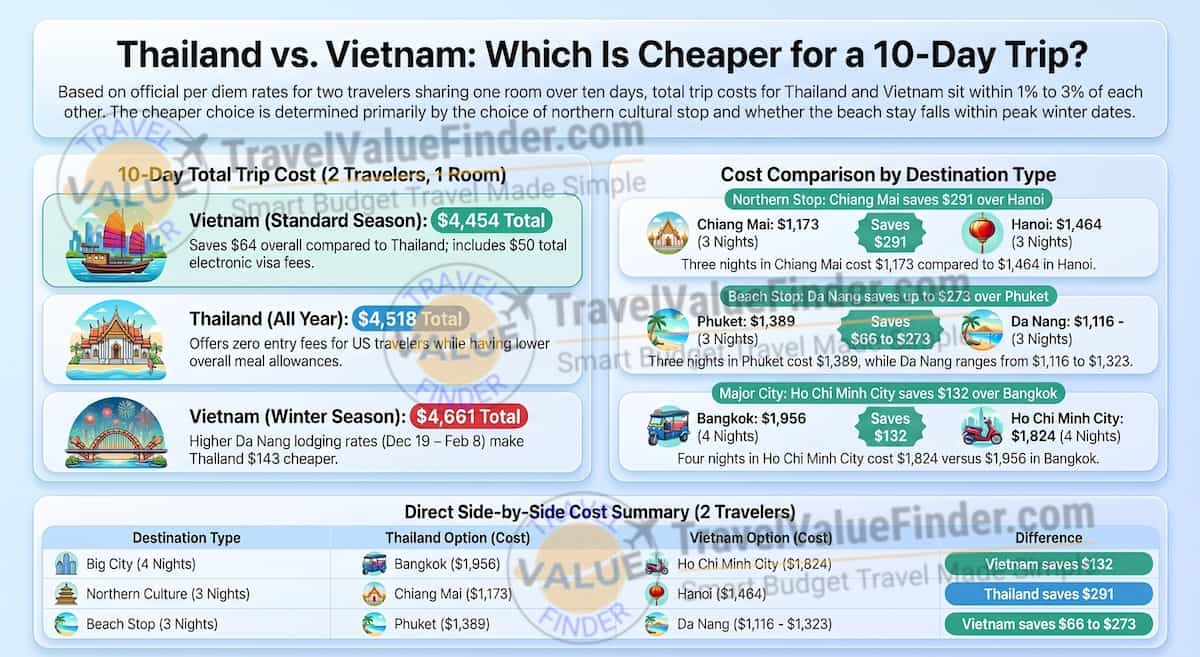
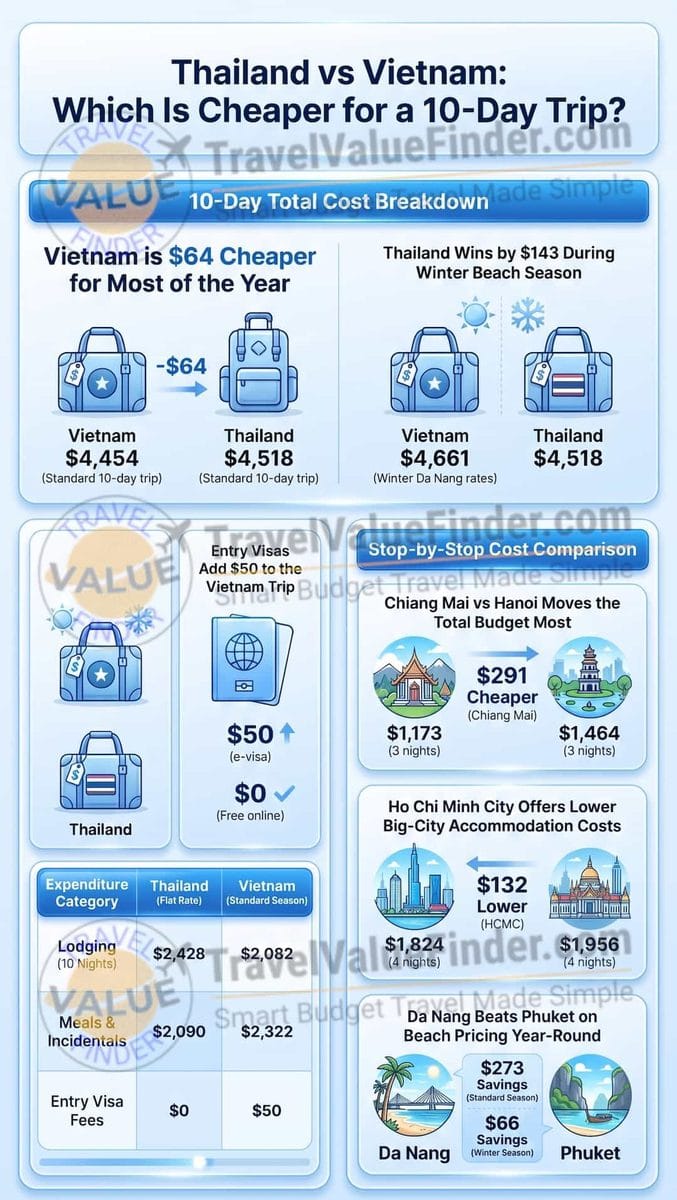
Thailand totals $4,518. Vietnam totals $4,454, or $4,661 when Da Nang is in its winter season.
The northern stop, Chiang Mai or Hanoi, moves the total more than any other choice.
Questions travelers ask first
Is Thailand cheaper than Vietnam?
Only slightly. The gap runs about one to three percent, and the cheaper country changes with the season.
Do these rates show which country has cheaper food?
Only loosely. They are government meal allowances, not menu prices. They run a little higher in Vietnam for the stops we priced.
Do I need a visa for either country?
US citizens need no visa for Thailand on stays under 60 days, but must register online. Vietnam requires an electronic visa before you fly.
Are these the numbers I will actually spend?
Probably not. They are ceilings. Budget travelers usually spend less, and luxury travelers spend more.
Thailand vs Vietnam which is cheaper on official rates
This comparison uses the US State Department foreign per diem rates. They are the maximum daily amounts the government reimburses its own employees abroad.
Every city gets a lodging cap per night and a meals and incidentals rate per person. The method is the same for both countries. That makes the gap between them fair, even though the dollar amounts run high.
A government ceiling shows how two places compare. It does not show what you will pay.” Leslie Nics, Founder and Lead Travel Writer, TravelValueFinder.com
Our trip is ten days and ten nights for two adults sharing one room. We matched three stops in each country by type: a big city, a northern culture city, and a beach. Four nights go to the big city and three each to the other two.
All prices are in US dollars. We left out flights from North America, because they depend on your departure city. You can check every rate yourself on the State Department site.
Table 1: Official daily rates by stop, in US dollars. Source: State Department foreign per diem rates, publication date October 1, 2026.
| Stop | City | Lodging cap per night | Meals and incidentals per person per day | Rate in effect since |
| Big city | Bangkok, Thailand | $259 | $115 | Aug 1, 2026 |
| Big city | Ho Chi Minh City, Vietnam | $222 | $117 | Jul 1, 2026 |
| Northern | Chiang Mai, Thailand | $219 | $86 | Jul 1, 2026 |
| Northern | Hanoi, Vietnam | $236 | $126 | May 1, 2025 |
| Beach | Phuket, Thailand | $245 | $109 | Mar 1, 2024 |
| Beach | Da Nang, Vietnam (Feb 9 to Dec 18) | $162 | $105 | Jul 1, 2025 |
| Beach | Da Nang, Vietnam (Dec 19 to Feb 8) | $219 | $111 | Jul 1, 2025 |
Here is the math for one stop. Four nights in Bangkok at $259 is $1,036 for the room. Meals at $115 for two travelers over four days is $920, so the stop totals $1,956.
Stop one: Bangkok or Ho Chi Minh City
Bangkok has the highest lodging cap in the set, at $259 a night. Ho Chi Minh City is $222. Meals are close, at $115 and $117 per person.
Four nights cost two travelers $1,956 in Bangkok and $1,824 in Ho Chi Minh City. Vietnam is cheaper here by $132, about seven percent. Both rates took effect in mid 2026, so they are current.
Stop two: Chiang Mai or Hanoi
This stop decides the comparison. Chiang Mai has a $219 lodging cap and an $86 meals rate. Hanoi has $236 and $126.
Three nights cost two travelers $1,173 in Chiang Mai and $1,464 in Hanoi. Thailand is cheaper here by $291, about 20 percent. Hanoi’s rate dates from May 2025, so it may trail current prices.
Price the most expensive stop first. It usually decides the whole trip.” Leslie Nics, Founder and Lead Travel Writer, TravelValueFinder.com
Stop three: Phuket or Da Nang
Da Nang is the only stop with two seasons. From February 9 to December 18, its lodging cap is $162 and meals are $105. From December 19 to February 8, those rise to $219 and $111.
Phuket stays flat at $245 and $109 all year. Three nights cost two travelers $1,389 in Phuket. Da Nang costs $1,116 in the long season and $1,323 in winter.
Vietnam is cheaper at the beach in both seasons, by $273 and $66. Phuket’s rate dates from March 2024, the oldest figure in the set.
Ten day totals
Table 2 combines the three stops and adds entry fees. Vietnam’s lodging caps are lower overall, but its meals rates are higher. Vietnam also needs a visa, which adds $50 for two travelers.
Table 2: Ten day totals for two travelers sharing one room, in US dollars. Entry fees are the Vietnam electronic visa at $25 each.
| Item | Thailand | Vietnam, Da Nang Feb 9 to Dec 18 | Vietnam, Da Nang Dec 19 to Feb 8 |
| Lodging, ten nights | $2,428 | $2,082 | $2,253 |
| Meals and incidentals, two travelers | $2,090 | $2,322 | $2,358 |
| Entry fees, two travelers | $0 (may change) | $50 | $50 |
| Total | $4,518 | $4,454 | $4,661 |
| Difference from Thailand | Baseline | $64 lower | $143 higher |
Thailand vs Vietnam which is cheaper in the long season? Vietnam, by $64, about one percent. In Da Nang’s winter window, Thailand wins by $143, about three percent.
Vietnam’s big city and beach stops save $405 together in the long season. Hanoi gives back $291, and visas take $50 more. Neither gap is large enough to decide a trip.
Swap a stop and the answer moves
Stops matter more than countries. The State Department table lists other bases with lower rates.
Da Lat, a Vietnamese highland city, has a $175 lodging cap and a $103 meals rate. Three nights cost two travelers $1,143, which is $30 less than Chiang Mai.
On the coast, Phu Quoc has a $180 cap and an $83 meals rate. Three nights cost $1,038, against $1,389 in Phuket. Pattaya in Thailand comes to $1,140.
What this comparison leaves out
These totals exclude flights, the transfers between stops, local transport, activities, and shopping. Exchange rate swings also move real prices. Our Thailand cost breakdown and Vietnam budget guide cover those categories for each country.
Cash matters too. The State Department warns that Vietnamese ATMs can charge high fees, and that cards will likely carry a fee. Check your bank’s foreign fees before you fly.
What the cheaper choice can still cost you
Thailand lets US citizens enter without a visa for stays under 60 days, according to the State Department’s Thailand page. You must register online first through the Thailand Digital Arrival Card portal. Entry terms can change, so confirm on the Royal Thai Embassy visa page before you book.
Vietnam requires a visa for US citizens, except for stays of 30 days or less on Phu Quoc. The Vietnam Immigration Department portal issues electronic visas for up to 90 days.
A single entry costs $25 and multiple entries cost $50. Allow three to five working days, and file the online arrival declaration within three days of your flight.
Canadian travelers should confirm entry rules with each country’s embassy. Our entry notes cover US citizens only.
The State Department rates both countries Level 1, exercise normal precautions, as shown on its Vietnam page. Thailand adds increased caution near the Cambodian border and in three far southern provinces. None of those areas appear on this route.
Tap water is not considered safe to drink in Vietnam, and in many parts of Thailand. Air quality can be poor in both.
Chiang Mai’s burning season runs roughly February through late April. The State Department calls pollution a significant problem in Hanoi. The CDC pages for Thailand and Vietnam list vaccine advice.
Da Nang sits on Vietnam’s central coast, where the State Department says storms run from June to December. They peak from September to November, and flooding can last through December. Plan the beach stop outside that window.
Both governments warn about motorbike crashes. Vietnam also bars renting a scooter without a Vietnamese driver’s license, so budget for taxis.
How I would choose
I treat a per diem comparison as a ranking tool, not a budget. It shows which stops pull a total up or down. It cannot tell you what a good dinner costs.
If your plan includes Hanoi, price that stop first. If your dates fall in Da Nang’s winter window, the two countries are close enough to pick on other grounds.
When two countries sit this close, pick the one that fits your dates.” Leslie Nics, Founder and Lead Travel Writer, TravelValueFinder.com
I would not choose a country over a gap of one to three percent. I would choose the season, pace, and flight that suit you best. Also weigh the transfers, because a cheaper stop with a long transfer can erase the savings.
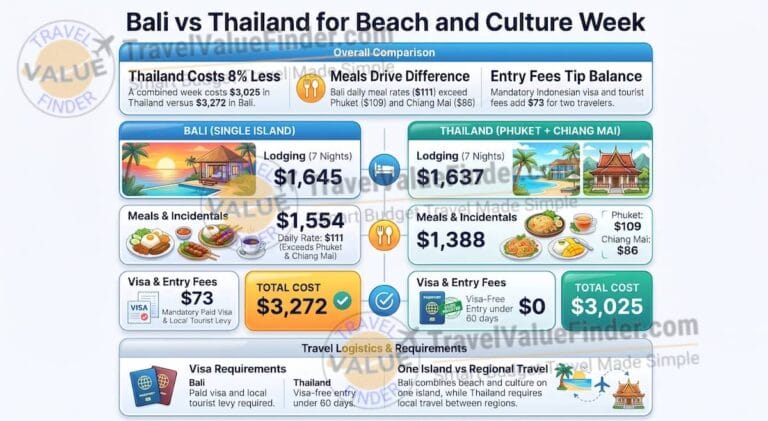
If you are interested how much it cost to visit Bali, see Bali vs Thailand: Which Costs Less for a Beach and Culture Week?
Run your own numbers
Your trip will not match our scenario. Change the nights, stops, or travelers in our travel budget calculator. For other destinations, see our travel cost guide by destination.
Planning the stops themselves? Read our Vietnam travel guide, where to stay in Bangkok, or budget hotels in Phuket. For a wider route, see budget travel in Southeast Asia.
Last questions before you book
Is the per diem rate what tourists pay?
No. It is a ceiling for government travelers. We use it because it is official and consistent across cities.
Why leave flights out?
Fares depend on your departure city and dates, and no official source publishes them. Add your own quote to our totals.
How current are these rates?
The State Department updates them monthly. We used the October 1, 2026 publication. Each city’s effective date appears in Table 1.
What changes if I travel solo?
Lodging counts once and meals count half as much. Solo totals are $3,473 for Thailand and $3,268 for Vietnam with one visa, or $3,457 in Da Nang’s winter window. Vietnam is cheaper in both seasons.
Can I visit both countries on one trip?
Yes. Choose a multiple entry Vietnam visa only if you will enter Vietnam twice. Add the flight between countries, which we did not price.
Where these numbers come from
- US Department of State, Office of Allowances, Foreign Per Diem Rates, publication date October 1, 2026
- US Department of State, Thailand International Travel Information, travel advisory dated July 7, 2026
- US Department of State, Vietnam Travel Advisory and travel guidance, advisory dated June 24, 2026
- Vietnam Immigration Department, electronic visa portal
- Thailand Immigration Bureau, Thailand Digital Arrival Card portal
- Royal Thai Embassy, Washington DC, visa information
- CDC Travelers’ Health, Thailand and Vietnam
All rates and rules were checked in October 2026. However, please verify rates and rules changes with the sources provided.