Travel Value Finder

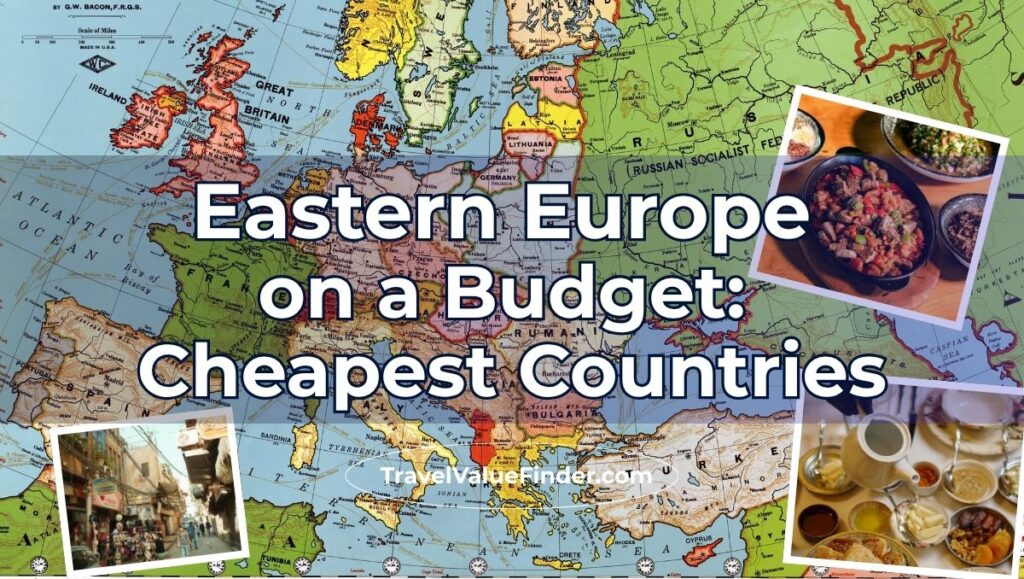
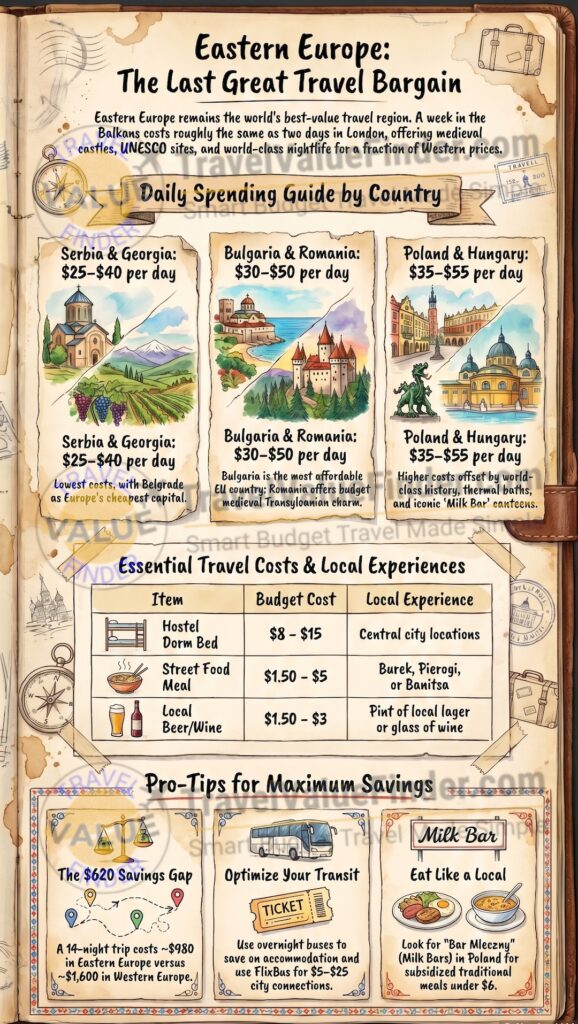
Eastern Europe on a budget is one of the last great travel bargains left in the Western world – and the gap between what it costs and what you get for that money is wider than almost anywhere else you could go. A week in Serbia, Bosnia, or Bulgaria costs roughly what two days in London costs. Not two days of luxury. Two days of hostel, supermarket sandwiches, and one museum visit.
The Eastern Europe budget trip delivers medieval castles, thermal baths, incredible food, UNESCO World Heritage old towns, and a nightlife scene that rivals anything in Western Europe – at a fraction of the price.
How much does Eastern Europe cost per day?
| Country | Budget/Day | Mid-Range/Day | Comfort/Day | Key Fact |
|---|---|---|---|---|
| Serbia | $25 – $35 | $45 – $65 | $70 – $100 | Cheapest capital in Europe: Belgrade €42/day avg. |
| Bulgaria | $30 – $45 | $55 – $80 | $90 – $130 | Cheapest EU country; real budget = $35 – 40/day |
| Romania | $30 – $50 | $60 – $90 | $100 – $140 | Median $36/day real traveler data (Nomadic Matt) |
| Poland | $35 – $50 | $65 – $95 | $110 – $160 | BudgetYourTrip: €68.72/day average; Kraków cheapest |
| Hungary (Budapest) | $35 – $55 | $70 – $100 | $120 – $170 | BudgetYourTrip: €93.03/day avg.; thermal baths $20 |
| Czech Republic | $40 – $60 | $75 – $110 | $130 – $180 | Prague inflation; Brno/Olomouc 30% cheaper |
| Bosnia & Herzegovina | $25 – $40 | $50 – $70 | $80 – $110 | Street food from $2; Sarajevo = hidden gem |
| Georgia (Caucasus) | $25 – $40 | $50 – $75 | $90 – $130 | BudgetYourTrip: €33.18/day – cheapest in region |
Source: BudgetYourTrip.com 2026 Europe Rankings; Nomadic Matt Eastern Europe cost data; FinancialAha 2026 Europe Travel Cost analysis. Budget = hostel dorm + street food + local transport. Mid-range = guesthouse/3-star + mix of restaurants. Comfort = boutique hotel + restaurants.
Leslie Nics, TravelValueFinder.com | April 2026 | First-hand research across 15+ European countries
According to BudgetYourTrip.com’s 2026 Europe Cost Rankings, the five cheapest countries in Europe for travelers are Georgia (€33.18/day average), Serbia (€42.06/day), Kosovo (€49.19/day), Poland (€68.72/day), and Bulgaria (€73.53/day). Every one of them is in Eastern Europe. And every one of them – from Serbia’s Belgrade to Poland’s Kraków to Bulgaria’s Plovdiv – is genuinely extraordinary to visit, not just cheap.
This guide gives you the Eastern Europe on a budget framework that actually works: the cheapest countries ranked with real 2026 prices, the hidden costs most budget guides miss, a realistic 2-week itinerary with total cost, and the insider tips that separate experienced Eastern Europe budget travelers from first-timers who still overspend.
The numbers are real. The destinations are tested. And the verdict is the same as it has always been: Eastern Europe is the best-value travel region on earth for Americans.
Eastern Europe gave me the trip I always imagined before I could afford it – and then gave it to me again at a fraction of the price I expected. Brașov at sunset with a €4 glass of Romanian wine. The Sarajevo old town at dawn with nobody else around. Belgrade’s ruin bars at midnight when the city is just getting started. None of it cost what you’d expect. All of it delivered more than you’d imagine. Leslie Nics, TravelValueFinder.com
Planning your Eastern Europe trip? Compare flights and hotels across all destinations in this guide through our trusted partner: Search Eastern Europe Flights and Hotels – TravelValueFinder. Real-time prices, hundreds of providers, secure booking.
Why Eastern Europe on a Budget is the World’s Best Travel Bargain in 2026
Three forces combine in 2026 to make Eastern Europe on a budget even more compelling than usual:
| Factor | Impact on Your Eastern Europe Budget |
|---|---|
| Strong US dollar | The USD remains strong against the Hungarian forint, Romanian leu, Bulgarian lev, Serbian dinar, and Polish złoty. Your $100 buys more in Eastern Europe in 2026 than it did in 2022 – 2023 in most of these currencies – partially offsetting local inflation |
| Budget airline expansion | Wizz Air now covers 200+ Eastern European routes from under €20. Ryanair added 30 new Eastern European routes in 2025. FlixBus connects every major Eastern European city for $5 – $25. Getting in, out, and between destinations has never been cheaper |
| Romania and Bulgaria in Schengen (Jan 2025) | Since January 2025, Romania and Bulgaria are full Schengen members – meaning US passport holders can visit them on the standard 90-day visa-free allowance alongside all other Schengen countries. Important: Days in Romania and Bulgaria now count toward your overall 90-day Schengen limit |
| Western vs Eastern price gap widens | According to FinancialAha’s 2026 Europe Budget Travel analysis, a realistic 2-week budget trip through Western Europe costs ~$1,600. The same trip through Eastern Europe costs ~$980 – that is $620 saved on a 14-night trip without reducing quality |
Eastern Europe Budget Guide 2026: Costs by Country, Category, and Travel Style
Here is the complete Eastern Europe on a budget reference table – the most detailed cost comparison available for 2026:
| Country | Hostel Dorm | Budget Hotel | Street Food Meal | Local Restaurant (main) | 2026 Highlight |
|---|---|---|---|---|---|
| Serbia | $8 – $15 | $30 – $55 | $2 – $4 | $5 – $10 | €42/day average – cheapest capital Belgrade in Europe |
| Bosnia & Herzegovina | $8 – $14 | $28 – $50 | $1 – $3 | $4 – $9 | Sarajevo = most affordable UNESCO capital in Europe |
| Bulgaria | $9 – $16 | $30 – $60 | $2 – $4 | $5 – $10 | €73.53/day avg; cheapest EU country; $35 – $40 budget real |
| Romania | $10 – $18 | $35 – $65 | $2 – $5 | $5 – $12 | $36/day real traveler average; Brașov cheapest Transylvania |
| North Macedonia | $9 – $15 | $28 – $50 | $1.50 – $3 | $4 – $8 | €107/day avg; Ohrid Lake = $30/day all-in possible |
| Albania | $8 – $14 | $25 – $50 | $1.50 – $3.50 | $5 – $10 | €91.75/day avg; 1-year visa-free for Americans |
| Georgia (Caucasus) | $8 – $14 | $25 – $50 | $2 – $4 | $4 – $8 | €33.18/day – joint-cheapest country in Europe; wine under $3 |
| Poland | $12 – $22 | $40 – $75 | $2.50 – $5 | $6 – $12 | €68.72/day avg; Kraków cheapest; Warsaw slightly higher |
| Hungary | $12 – $22 | $40 – $80 | $3 – $6 | $7 – $14 | €93.03/day avg; Budapest thermal baths $20 all day |
| Czech Republic | $14 – $26 | $50 – $90 | $3 – $6 | $8 – $15 | €121.61/day avg – Prague priciest; Brno/Olomouc 30% less |
Leslie’s overall verdict: The cheapest Eastern European countries on a budget in 2026 are Georgia, Serbia, and Bosnia & Herzegovina – all achievable on $25 – $35/day budget, $50 – $70 mid-range. Bulgaria and Romania offer the best EU-country value. Hungary and Czech Republic are the priciest in the region – still dramatically cheaper than Western Europe, but noticeably higher than the Balkans.
Country-by-Country Guide: Eastern Europe on a Budget
#1 Serbia – The Cheapest Capital City in Europe (and One of the Best)
Daily budget: $25 – $35 | Mid-range: $45 – $65 | Visa: None for US citizens | Currency: Serbian dinar (RSD) – ATMs widely available
Serbia is the single best argument for Eastern Europe on a budget – and it is not even close. Belgrade has the cheapest average daily cost of any capital city in Europe according to BudgetYourTrip’s 2026 rankings at €42.06/day ($45/day) – and that is the average across all traveler types. A dedicated budget traveler does this on $25 – $35. A pub beer costs $1.50 – $2.50. A full three-course meal at a local kafana (traditional tavern) with wine costs $8 – $12. A hostel dorm bed in central Belgrade costs $8 – $15/night.
But Serbia is not just cheap. It is extraordinary. Belgrade’s Skadarlija bohemian quarter – cobblestoned, lined with kafanas playing live Serbian folk music, with roses on every table – would cost five times as much to replicate in Prague or Vienna. The Belgrade Fortress at sunset is genuinely one of Europe’s great free views. The nightlife – a scene that regularly makes international lists of the world’s best – operates from floating clubs on the Sava and Danube rivers called splavs that charge no entry and where a round of drinks costs what a single beer costs in London.
| Expense | Low / Budget | Mid-Range |
|---|---|---|
| Hostel dorm (Belgrade) | $8 – $12/night | N/A |
| Guesthouse / budget hotel | N/A | $30 – $55/night |
| Kafana dinner with wine (per person) | $6 – $10 | $12 – $20 |
| Beer at local bar | $1.50 – $2.50 | $2 – $4 |
| Belgrade to Novi Sad bus | $4 – $6 (1.5 hours) | Same |
| Belgrade Fortress entry | Free | Free |
| Daily total estimate | $25 – $35 | $45 – $65 |
- Don’t miss: Skadarlija Quarter (free to walk), Kalemegdan Fortress at sunset (free), Nikola Tesla Museum ($3), Novi Sad day trip ($4 – $6 bus), Exit Music Festival (July – Europe’s best value major festival)
- Best time to visit: May – June and September – October for pleasant weather and lowest accommodation prices. Summer (July – August) is hot but the splav nightlife is at its peak
#2 Bulgaria – The Cheapest EU Country for Budget Travel
Daily budget: $30 – $45 | Mid-range: $55 – $80 | Visa: None (Schengen) | Currency: Bulgarian lev (pegged to euro)
Bulgaria is the cheapest country in the European Union for travelers – confirmed by BudgetYourTrip’s 2026 Europe rankings at €73.53/day average. Eastern Europe budget travelers consistently report that Bulgaria costs less than any equivalent EU destination and delivers experiences – the Rila Monastery, Plovdiv’s old town, the Rhodope Mountains, the Black Sea coast – that feel dramatically underpriced relative to their quality.
The case for Bulgaria on an Eastern Europe on a budget itinerary: three genuinely extraordinary cities (Sofia, Plovdiv, Veliko Tarnovo), a mountain landscape that rivals Switzerland at 5% of the price, a Black Sea coast that rivals Croatia’s at a fraction of the cost, and a food and wine culture (Bulgarian shopska salad, banitsa pastry for $0.80 from any bakery, local Mavrud red wine for $3/glass) that most tourists never encounter because they are too busy eating schnitzel in Prague.
- Sofia free walking tour: Sofia has one of Europe’s best free walking tours – meeting at the Eagle Bridge at 11am and 6pm daily. Essential first activity; runs on tips
- Black Sea vs Sunny Beach: Sunny Beach is a package holiday resort (overpriced, overcrowded). Nessebar – a UNESCO medieval city 5km away, $2 taxi – is extraordinary and largely free. Budget travelers choose Nessebar every time
- Train vs bus: Sofia – Plovdiv bus costs $4 – $6 (2 hours) – consistently faster and cheaper than the train. For the Black Sea coast, overnight bus from Sofia to Burgas saves a night’s accommodation
#3 Romania – Medieval Castles at Budget Prices
Daily budget: $30 – $50 | Mid-range: $60 – $90 | Visa: None (Schengen since Jan 2025) | Currency: Romanian leu (RON)
Romania is Eastern Europe on a budget at its most visually dramatic. The Transylvanian landscape – medieval walled cities (Brașov, Sibiu, Sighișoara), Bran Castle (the legendary ‘Dracula Castle’), and the Carpathian Mountains – is one of Europe’s most distinctive and remains, in 2026, one of its most affordable. A full day’s admission across Brașov’s Black Church, the surrounding fortifications, and a half-day hike in the Carpathians costs under $15.
The food economy is exceptional. A bowl of ciorba (sour vegetable soup) with bread at a local restaurant costs $2 – $3. A full meal with mains and local wine costs $8 – $14. The local plum brandy (țuică) costs $1 – $2 at any village market. According to Romania cost data, a realistic Romania budget runs $36/day – firmly in Eastern Europe budget territory.
- Best value cities: Brașov ($28 – $38/day all-in), Sibiu ($25 – $35/day), Sighișoara ($22 – $32/day). Bucharest is 15 – 20% more expensive but offers the Palace of Parliament (world’s largest building by volume after the Pentagon – $7 entry) and the Old Town nightlife
- Transport hack: Romania’s overnight trains are cheap ($10 – $18 Bucharest – Brașov sleeper) and save a night’s accommodation. Book through the Romanian railway website (CFR Calatori) or 12Go Asia for international bookings
#4 Poland – Best History, Culture, and Food at Eastern European Prices
Daily budget: $35 – $50 | Mid-range: $65 – $95 | Visa: None (Schengen) | Currency: Polish złoty (PLN)
Poland is the Eastern Europe on a budget destination with the most emotional and historical depth – and a food scene that is dramatically underrated. Kraków’s Main Market Square (Rynek Główny) is the largest medieval market square in Europe and is free to walk around any time of day or night. The Wawel Castle complex overlooking the Vistula River is one of Europe’s most impressive castle fortresses at €8 – €12 entry. And the Wieliczka Salt Mine – a UNESCO World Heritage site with underground chapels, sculptures, and lakes all carved from salt – costs $25 for a guided tour that takes 2 – 3 hours.
Polish food deserves a specific mention on any Eastern Europe budget trip: a plate of pierogi (dumplings stuffed with potato and cheese, or meat, or sauerkraut and mushroom) from a milk bar (bar mleczny – a surviving communist-era canteen subsidised for locals) costs $3 – $5 and constitutes one of the most satisfying and culturally authentic meals in Europe. Warsaw’s Hala Koszyki market hall has an extraordinary range of Polish street food at market prices. The beer-to-price ratio in Poland also defies Western European logic: a pint of Żywiec in a local pub costs $2 – $3.
- Bar mleczny (milk bar): The essential Poland budget experience. Look for ‘Bar Mleczny’ signs in Polish cities – these Soviet-era canteens serve filling traditional Polish food for $3 – $6 per meal. Pod Barbakanem in Warsaw and Bar Mleczny Centralny in Kraków are both excellent
- Auschwitz-Birkenau: Entry to the memorial site is free; guided tours are $35 – $45. Book weeks in advance – the guided tours sell out. Located 1.5 hours from Kraków by direct bus or train ($4 – $6 each way)
#5 Budapest, Hungary – Eastern Europe’s Most Photogenic Budget City
Daily budget: $35 – $55 | Mid-range: $70 – $100 | Visa: None (Schengen) | Currency: Hungarian forint (HUF)
Budapest is not the cheapest city in Eastern Europe on a budget – but it is the one that delivers the most concentrated ‘I cannot believe how good this is’ moments per dollar spent. The Széchenyi Thermal Baths: $20 – $22 for a full day of soaking in 138-year-old thermal pools under baroque architecture. The Fisherman’s Bastion (after 8pm, free): a neo-Gothic terrace with the most photographed view of the Hungarian Parliament building, reflected in the Danube below. The ruin bar district (Szimpla Kert is the original): a crumbling pre-war Jewish Quarter building converted into a labyrinthine bar where a craft beer costs $2.50.
The Budapest formula for Eastern Europe budget success: stay in a hostel in the Jewish Quarter ($12 – $22/night), eat langos (deep-fried dough with sour cream and cheese) from the Great Market Hall for $2, visit Széchenyi Baths midweek (off-peak pricing), walk the Chain Bridge at dawn with nobody else around, and spend the evenings in the ruin bars where the atmosphere costs nothing beyond a reasonably priced drink. This is $40 – $55/day all-in, and it is one of the best trips available anywhere in Europe at any budget level.
#6 Georgia – The Surprise Cheapest Country in the Region (Wine Included)
Daily budget: $25 – $40 | Mid-range: $50 – $75 | Visa: None for Americans (1 year visa-free) | Currency: Georgian lari (GEL)
Georgia’s position as Europe’s joint-cheapest country (€33.18/day average alongside Armenia) makes it the Eastern Europe on a budget wildcard that experienced travelers talk about in the way Bangkok used to be talked about: you do not believe how cheap it is until you are there. A full dinner at a Tbilisi restaurant – Georgian khinkali (dumplings), lobiani (bean-filled bread), and a glass of extraordinary Rkatsiteli amber wine – costs $8 – $12 per person. A Tbilisi metro journey costs $0.40. A guesthouse private room in the Old Town costs $20 – $35/night.
Georgia’s additional superpower for Americans on an Eastern Europe budget trip is its visa-free stay of up to one full year – no paperwork, no income proof, just arrive and stay. The wine culture (Georgia is considered the world’s birthplace of wine; 500+ native grape varieties; qvevri clay-vessel fermented wines that produce a unique amber colour and flavour) adds a dimension no other budget travel destination in Europe can claim. A bottle of excellent Georgian Saperavi red at a local wine bar costs $3 – $6. The same wine would cost €25 – €35 at a Western European restaurant.
- Tbilisi Fabrika: A repurposed Soviet sewing factory converted into a hostel, café, restaurant, and cultural space. The courtyard is free to enter and is the social hub of Tbilisi’s international traveler community. Show up and you are immediately part of something
- Kazbegi mountain day trip: The Gergeti Trinity Church perched on a 2,170-metre peak above the Caucasus Mountains is one of Europe’s most dramatic landscapes. Marshrutka (shared minibus) from Tbilisi: $5 – $8 each way. Entry to church: free
The Ultimate 2-Week Eastern Europe Budget Itinerary (With Real Costs)
This is the most practical thing this guide can give you: a tested, realistic 14-night Eastern Europe on a budget itinerary from Budapest to Sofia via Belgrade, with real 2026 prices for every single line item.
Route: Budapest, Hungary (3 nights) – Belgrade, Serbia (3 nights) – Sarajevo, Bosnia (2 nights) – Plovdiv, Bulgaria (2 nights) – Sofia, Bulgaria (2 nights) – Brașov, Romania (2 nights)
| Cost Category | Total for 14 Nights | Details |
|---|---|---|
| Accommodation (14 nights avg.) | $196 | $14/night average: Budapest $22 hostel dorm, Belgrade $10, Sarajevo $10, Plovdiv $12, Sofia $12, Brașov $12 |
| Food and drinks (14 days) | $196 | $14/day average: mixing street food ($3 – $5/meal), local restaurants ($6 – $12 dinner), supermarket lunches ($2 – $4) |
| Internal transport (buses + trains) | $85 | Budapest-Belgrade bus $12 (7hr), Belgrade-Sarajevo bus $15 (6hr), Sarajevo-Plovdiv bus $22 (8hr), Plovdiv-Sofia train $5 (2hr), Sofia-Brașov bus/train $30 (7hr) |
| Activities and entrance fees | $95 | Budapest thermal baths $21, Bran Castle $8, Sarajevo tunnel museum $5, Plovdiv Old Town free, Belgrade Fortress free, Széchenyi spa $21, various walking tours (tip $10 total) |
| SIM card + misc | $20 | Roaming SIM at Budapest airport ($15) covers most of the route |
| Travel insurance | $42 | $3/day comprehensive coverage – non-negotiable for Eastern Europe travel |
| TOTAL (14 nights, excl. international flights) | $634 | $45/day average – genuinely comfortable budget travel across 6 countries |
International flights: New York – Budapest round-trip typically $550 – $900. Return flight from Bucharest (or fly Brașov – Bucharest – home) adds flexibility. Total all-in 2-week trip from USA: $1,200 – $1,550 for a budget traveler. Mid-range ($70/day on the ground): total trip approximately $1,800 – $2,150.
Find out more about What Croatia Actually Costs: A Week in Dubrovnik and Split, Broken Down
10 Tips That Experienced Eastern Europe Budget Travelers Actually Use
These are the strategies that make the difference between a $45/day trip and a $75/day trip across the same Eastern Europe budget itinerary:
- Take overnight buses – they save a night’s accommodation: The Belgrade – Sarajevo overnight bus costs $15. That simultaneously transports you AND eliminates $10 – $15 in hostel costs. Three overnight buses on a 2-week Eastern Europe on a budget trip saves $30 – $45 in accommodation – enough for two extra nights of travel
- Use FlixBus and local buses, not trains: In Eastern Europe, buses are usually faster, cheaper, and more frequent than trains. FlixBus connects major cities for $5 – $25. Local bus companies (like Lux Express for the Baltics, or Arriva for the Balkans) cover smaller cities that FlixBus misses. Check Rome2Rio to compare all options
- Eat at milk bars in Poland and kafanas in Serbia: The bar mleczny (milk bar) in Poland serves subsidised traditional food for $3 – $5 per meal. The kafana in Serbia delivers 3-course meals with live music for $8 – $12. These are not ‘budget options’ – they are the authentic versions of local food culture that tourists in tourist restaurants never access
- Free walking tours in every city: Sofia, Belgrade, Bucharest, Sarajevo, Kraków, Budapest, and Tbilisi all have excellent free walking tours. They are tip-based, delivered by locals who know and love their city, and consistently the best first activity in any Eastern European budget destination. Book through GuruWalk or Free Tours by Foot
- Visit the Black Sea coast in May or September, not July: Bulgaria’s Black Sea coast in July peaks at $80+/day for beach accommodation. In May or September, the same coast costs $35 – $50/day, the water is still warm enough to swim in, and the crowds are a fraction of peak season
- Get a Wise card before you leave: The Wise multi-currency card converts your dollars to local currency at the real mid-market rate with low fees – avoiding the 3 – 5% currency conversion fees that standard bank cards charge. On a 2-week Eastern Europe on a budget trip spending $600 on-ground, that saves $18 – $30 with zero effort
- Buy beer and snacks from local supermarkets: Lidl, Biedronka (Poland), Kaufland (Romania, Bulgaria), and Mega (Serbia) are in every Eastern European city. A 500ml local beer costs $0.50 – $0.80. A loaf of bread costs $0.40 – $0.80. Stock your hostel-kitchen breakfast for $2 – $3/day and save $5 – $8 vs. any café
- Use hostel social programmes to cut activity costs: The best Eastern European hostels run group activities – city scavenger hunts, cooking classes, day trips – at cost or for free to guests. Mostel in Sofia and Bulgaria (legendary in the Eastern Europe budget community) organises free transport for guests moving between their hostel locations
- Skip Sunny Beach and Santorini-equivalents: Every Eastern European country has a ‘famous tourist trap’ that costs 2 – 3x the rest of the country. Sunny Beach in Bulgaria, Bled in Slovenia, Zakopane in Poland during peak season. These places are beautiful – but the budget alternatives (Nessebar, Lake Bohinj, Kraków itself) are equally beautiful and dramatically cheaper
- Book shoulder season for maximum Eastern Europe budget value: April – May and September – October are the sweet spots: pleasant weather, 20 – 40% lower accommodation prices than July – August peaks, and smaller crowds at every major attraction. The shoulder season price difference on a 14-night Eastern Europe on a budget trip can save $100 – $200 in accommodation alone
Getting Around Eastern Europe on a Budget: The Transport Guide
Transport is the Eastern Europe on a budget decision that most impacts your total trip cost. Here are the best options by route:
| Route | Best Option | Cost | Notes |
|---|---|---|---|
| Budapest – Belgrade | Bus | $12 – $18 (7 hrs) | FlixBus and local buses; trains exist but slower and more expensive. Overnight option available |
| Budapest – Kraków | Train or bus | $15 – $30 (6 – 7 hrs) | Trains competitive on this route; book 2+ weeks ahead for cheapest fares via Rail Europe |
| Belgrade – Sarajevo | Bus | $12 – $18 (6 hrs) | No direct train. Bus is comfortable and scenic through mountain scenery |
| Sarajevo – Dubrovnik | Bus | $15 – $25 (5 – 6 hrs) | Spectacular coastal scenery; limited schedule – book ahead |
| Bucharest – Brașov | Train | $5 – $10 (2.5 hrs) | Trains genuinely efficient on this route; run hourly. CFR Calatori booking website |
| Sofia – Plovdiv | Bus | $3 – $6 (2 hrs) | Bus is faster and cheaper than train; runs every 30 – 45 minutes |
| Tbilisi – Batumi (Georgia) | Night train | $5 – $12 (5 – 6 hrs) | Overnight sleeper train saves accommodation; spectacular Caucasus scenery |
| Any major city – any major city | FlixBus | $5 – $25 typical | The budget travel backbone of Eastern Europe – hundreds of routes, often the cheapest option by a significant margin |
| Inter-country flights | Wizz Air | €9 – €35 typical | Wizz Air dominates Eastern Europe budget aviation – Sofia, Bucharest, Budapest, Warsaw, Belgrade all on network |
Book your Eastern Europe trip at the best prices. Our trusted partner searches hundreds of providers in real-time: Search Eastern Europe Flights and Hotels – TravelValueFinder. We earn a small commission at no extra cost to you.
People Also Asked: Eastern Europe on a Budget
How much does it cost to travel Eastern Europe per day?
According to BudgetYourTrip’s 2026 Europe Cost Rankings, the cheapest Eastern European countries average €33 – €73 per day across all traveler types. For a dedicated Eastern Europe budget traveler staying in hostel dorms, eating local food, and using public transport, realistic daily costs are: Georgia and Serbia $25 – $35/day; Bosnia, Bulgaria, and Albania $28 – $40/day; Romania and North Macedonia $30 – $45/day; Poland and Hungary $35 – $55/day; Czech Republic $40 – $60/day. A comfortable mid-range traveler in private rooms and restaurants adds $25 – $40 to each of these figures.
Is Eastern Europe cheap for Americans?
Yes – Eastern Europe is one of the cheapest regions in the world for American travelers. The strong US dollar, low local cost structures, and dramatically lower prices than Western Europe combine to make Eastern Europe on a budget a genuine bargain. According to FinancialAha’s 2026 Europe Travel Cost analysis, a 2-week budget trip through Eastern Europe costs ~$980 total on the ground, compared to ~$1,600 for an equivalent Western Europe trip. That is $620 saved with no reduction in quality of experience – and in many cases a richer, more authentic trip.
What is the cheapest country to visit in Eastern Europe?
Georgia (Caucasus region) averages €33.18/day – the cheapest in Europe according to BudgetYourTrip’s 2026 rankings. Among Balkan countries accessible without a visa for Americans: Serbia averages €42.06/day (cheapest capital city in Europe), followed by Kosovo (€49.19/day), Poland (€68.72/day), Bulgaria (€73.53/day), and Albania (€91.75/day). For EU members only, Bulgaria is the cheapest at €73.53/day, followed by Poland. Romania’s $36/day real traveler average (Nomadic Matt data) makes it the best-value country for a mix of experiences including medieval castles, Transylvania, and the Carpathian Mountains.
How much does a 2-week trip to Eastern Europe cost?
A realistic 2-week Eastern Europe on a budget trip (Budapest – Belgrade – Sarajevo – Plovdiv – Sofia – Brașov) costs approximately $634 on the ground for a budget traveler – $45/day all-in across 6 countries. Adding international round-trip flights from the USA (typically $550 – $900 to Budapest or Bucharest), the total 2-week all-in trip costs $1,200 – $1,550 from the United States. A mid-range version ($70/day) runs $980 on the ground, $1,530 – $1,880 with flights. According to FinancialAha’s 2026 data, a mid-range 2-week Eastern Europe trip costs ~$980 total – significantly less than the equivalent Western Europe trip at ~$1,600.
What are the best cities to visit in Eastern Europe on a budget?
The best Eastern Europe budget cities in 2026 are: (1) Belgrade, Serbia – cheapest European capital at $25 – $35/day, extraordinary kafana culture and nightlife; (2) Kraków, Poland – medieval market square, proximity to Auschwitz, excellent milk bars from $3/meal; (3) Brașov, Romania – Transylvanian gateway, medieval old town, mountain hiking, $28 – $38/day; (4) Plovdiv, Bulgaria – UNESCO old town, vibrant arts scene, $30 – $45/day; (5) Budapest, Hungary – thermal baths, ruin bars, Danube views, $35 – $55/day; (6) Tbilisi, Georgia – ancient city, extraordinary wine culture, 1-year visa-free for Americans, $25 – $40/day; and (7) Sarajevo, Bosnia – most emotionally complex city in Europe, extraordinary food, under $30/day budget possible.
How much is food in Eastern Europe?
Food is where Eastern Europe on a budget delivers its most dramatic value. Street food and local restaurant meals in the Balkans and Eastern Europe cost $1.50 – $5 per dish. A full sit-down restaurant dinner with a main course, drink, and dessert costs $6 – $14 at a local restaurant (not a tourist-facing establishment). The cheapest food experiences: Bulgarian banitsa pastry from a bakery ($0.60 – $0.80), Polish pierogi at a milk bar ($3 – $5 for a full plate), Serbian burek (meat-filled pastry) from a pekara ($0.80 – $1.50), Georgian khachapuri (cheese bread) from a street vendor ($1.50 – $3). A daily food budget of $8 – $14 covers three excellent meals in most Eastern European countries.
How do I get around Eastern Europe cheaply?
The cheapest way to get around Eastern Europe on a budget uses a combination of: (1) FlixBus for intercity routes ($5 – $25 per journey, hundreds of Eastern European routes); (2) Wizz Air for longer distances where flights undercut buses (€9 – €35 for many routes, often cheaper than the equivalent bus ticket booked late); (3) Local national bus companies for routes FlixBus misses (always 20 – 50% cheaper than trains); (4) Overnight buses and trains that eliminate a night’s accommodation while transporting you; and (5) Walking in cities – most Eastern European old towns are compact and completely walkable. Use Rome2Rio to compare all transport options between any two points.
Final Thoughts: Eastern Europe on a Budget Is One of Travel’s Last Genuine Bargains
Eastern Europe on a budget in 2026 is not a compromise. It is a choice – the choice to spend the same $1,200 that would cover four days in Santorini on a two-week trip across six countries with medieval castles, thermal baths, extraordinary food, world-class nightlife, and some of the most historically significant landscapes in Europe. The Eastern Europe budget traveler is not cutting corners. They are making a different calculation about what travel is for.
Serbia’s kafanas, Romania’s Transylvanian roads, Bulgaria’s rose valley in bloom, Poland’s milk bar pierogi, Hungary’s ruin bars at midnight, Georgia’s amber wine by a Tbilisi fire – none of this is available to the traveler who spends their European budget on one week in Paris. All of it is available to the traveler who makes the Eastern Europe on a budget choice and goes east instead of west. The crowds are smaller. The welcome is warmer. The price is a fraction. The memories last exactly as long.
Go east. You will not regret it.
Every time I come back to Eastern Europe I’m reminded that the best travel experiences I’ve ever had weren’t the most expensive ones. They were in Skadarlija at midnight. In a brașov bakery at 7am. On a slow train through the Carpathians with a flask of homemade plum brandy that someone’s grandmother pressed into my hands at the station. Eastern Europe gives you those moments every day. And it costs less than a mediocre meal in Paris. Leslie Nics, TravelValueFinder.com
Book your Eastern Europe adventure at the best prices. Our trusted partner searches hundreds of providers simultaneously: Find Cheap Eastern Europe Flights and Hotels – TravelValueFinder. We earn a small commission at no extra cost to you – helping keep all our guides completely free.