Travel Value Finder

Leslie Nics, TravelValueFinder.com | Updated September 2026 | Based on first-hand research and current 2026 pricing for US women travelers
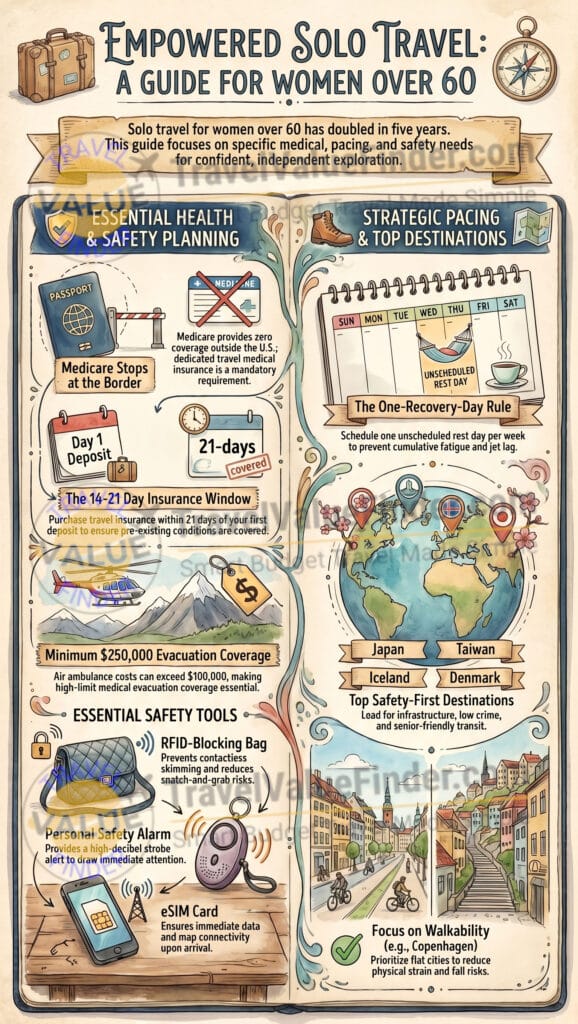
Solo female travel after 60 has roughly doubled over the past five years. The right approach is different from advice built for a 30 year old. This guide covers safety data, medical insurance basics, pacing, and the destinations that actually work for a woman traveling alone at this stage.
Table of Contents
Why This Guide Is Different
Most solo female travel advice is written with a younger traveler in mind. Insurance, pacing, and mobility rarely get more than a passing line.
This guide treats those topics as central, not an afterthought. The destinations, tables, and checklists below are built around what actually matters at this stage of travel.
Every destination was checked against the US State Department advisory level and the Global Peace Index. Only Level 1 or Level 2 destinations with strong healthcare access made the list.
Quick Answers: Solo Female Travel After 60
Is it safe for a woman over 60 to travel alone?
Yes. Women over 60 report less worry and fewer unwanted incidents than younger solo travelers in the same destinations.
Does Medicare cover care outside the US?
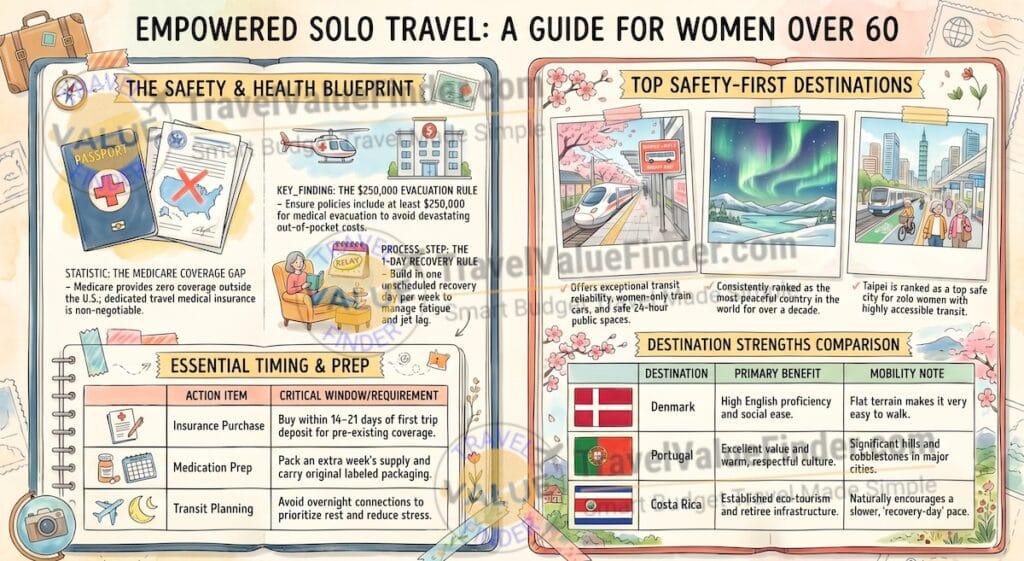
No. Medicare provides essentially no coverage outside the United States, so separate travel medical insurance is essential.
What is the best destination for a first solo trip after 60?
Japan, Portugal, and Denmark top most lists. All three combine low crime, flat or reliable transit, and strong healthcare access.
How much medical evacuation coverage do I need?
Aim for at least $250,000. Air ambulance evacuation alone can cost over $100,000.
Solo Female Travel Destinations After 60 at a Glance
These seven destinations combine safety, walkability, and healthcare access for women traveling alone.
Figures reflect on the ground spending only and exclude airfare. Costs vary by season and travel pace.
| Destination | Daily Budget | Mobility Note | Standout Strength |
| Japan | $80 to $130 | Very walkable, some older stations lack elevators | Women only train cars, precise transit |
| Denmark | $150 to $250 | Flat, highly bikeable | Easiest city navigation in Europe |
| Taiwan (Taipei) | $45 to $80 | Flat, metro accessible | 24 hour safe public spaces |
| Iceland | $150 to $250 | Reykjavik easy, rural areas limited transit | Lowest violent crime rate globally |
| Portugal | $60 to $110 | Hills and cobblestones in Lisbon, Porto | Strong value, warm culture |
| New Zealand | $100 to $160 | Long distances between towns | Slower pace, strong safety record |
| Costa Rica | $80 to $150 | Uneven terrain in eco lodges | Established expat and retiree services |
Why Age Often Works in Your Favor
Crime data alone does not capture the full safety picture for an older solo traveler.
Multiple travel surveys find women over 60 report fewer incidents of unwanted attention than younger solo travelers in the same cities. Experience and destination choice both play a role.
That does not mean any destination works equally well. Walkability, healthcare access, and transit reliability matter more at this stage than nightlife or backpacker circuits.
Confidence also plays a role. Many women over 60 have traveled before, and that experience shows in how they choose a destination and plan a trip.
Destination choice still matters more than confidence alone. A country with reliable transit and low crime removes daily stress that no amount of experience fully offsets.
The One Coverage Gap That Catches Travelers Off Guard
Medicare provides essentially no coverage outside the United States, according to Medicare.gov. A hospital visit abroad is billed entirely out of pocket without separate coverage.
Air ambulance evacuation back to the US can run over $100,000. A policy with at least $250,000 in evacuation coverage closes that gap.
Buy a policy within 14 to 21 days of your first trip deposit if you manage a pre-existing condition. Our travel insurance guide covers what else to check.
| Coverage Type | Minimum to Look For |
| Emergency medical treatment | $100,000 to $250,000 |
| Medical evacuation | $250,000 or higher |
| Pre-existing condition coverage | Buy within 14 to 21 days of deposit |
Trip cancellation coverage is worth having too, but it matters less than the medical categories above for this age group.
Two of the Easiest Cities to Start With
Copenhagen is flat, highly walkable, and bikeable end to end. English is spoken widely enough that language is rarely a barrier.
Food halls like Torvehallerne make solo dining feel completely normal, with easy people watching built in.
Taipei offers a similar ease in Asia at a lower daily cost. The metro runs past midnight, and convenience stores stay open all night on nearly every block.
Both cities work well as a confidence building first trip before attempting somewhere with more hills or longer distances.
Neither city requires a rental car. Public transit alone covers nearly every sight worth seeing.
Health Access While You Travel
Major cities in every destination on this list have English speaking private clinics. Ask your hotel for a recommendation before you need one, not after.
Pharmacies in Japan, Denmark, and Taiwan can often help with minor issues without a full clinic visit. Staff commonly speak enough English to assist tourists.
Bring enough of any regular prescription to last the full trip plus one extra week. Refilling a US prescription abroad is often difficult or impossible.
The CDC’s traveler health site lists destination specific health notices worth checking before departure.
Building a Trip That Matches Your Pace
Add one full unscheduled day to every week of travel. Treat it as a real plan, not something to fill in later.
Skip overnight transit connections where possible. A red eye flight into an immediate train ride costs more recovery time than it saves.
A two week trip with three or four scheduled destinations gives more breathing room than five destinations in the same span.
Plan the first two days in a new time zone as deliberately light. Jet lag recovery tends to take longer than it used to.
Resist the urge to fill day one with sightseeing. A slow morning and one short outing beats a packed schedule that leaves you exhausted by day three.
Choosing Accommodation for Comfort
Book somewhere within walking distance of transit, a pharmacy, and food. This one choice removes more daily friction than any other.
Ask specifically about ground floor or elevator access for multi night stays. Listings do not always state this clearly.
In hilly cities like Lisbon, Porto, or Rome, check whether your accommodation requires stairs on arrival with luggage.
For stays of a week or longer, an apartment style rental with laundry cuts down on packing weight. It also removes the need to hunt for a laundromat mid trip.
Best Time to Visit Each Destination
Season affects both comfort and crowd size more than most travelers expect.
| Destination | Best Months | Why |
| Japan | March to May, October to November | Mild temperatures, cherry blossoms or fall color |
| Denmark | May to September | Mildest weather, longest daylight hours |
| Taiwan | October to April | Cooler, drier, avoids typhoon season |
| Iceland | May to August | Midnight sun, easiest driving conditions |
| Portugal | April to June, September to October | Warm without peak summer crowds |
| New Zealand | December to February | Southern hemisphere summer, best hiking weather |
| Costa Rica | December to April | Dry season across most regions |
Match a Destination to Your Priority
Use this table if you already know what matters most for this specific trip.
| Priority | Best Fit | Why |
| Easiest possible navigation | Denmark or Taiwan | Flat terrain, reliable transit |
| Lowest overall risk | Iceland or Japan | Very low crime, strong infrastructure |
| Best value for a longer stay | Portugal or Taiwan | Lower daily costs, strong safety |
| Slower, quieter pace | New Zealand or Costa Rica | Outdoor focus, established expat services |
| First trip, want extra support | Small group tour in any destination | Logistics handled, built in community |
Common Worries, Addressed Honestly
Loneliness worries many first time solo travelers more than safety does. Booking one group activity per city, a walking tour or cooking class, solves this quickly.
Fear of getting lost is another common concern. An offline map and a charged power bank remove most of that risk before it starts.
Worry about being seen as an easy target rarely matches reality. Surveys consistently show women over 60 report fewer unwanted incidents than younger travelers report in the same places.
Solo Independent or Small Group: A Quick Decision Guide
Independent travel gives full control over pacing and plans. It works best in a destination you have researched and feel ready for.
Small group women’s travel handles logistics and adds instant community. It suits a first trip to an unfamiliar region well.
Many women use a small group trip as a bridge, then return to the same country independently later. There is no need to pick one style for every trip.
Look specifically for women only small group operators that guarantee a single room with no extra fee. This removes the solo supplement cost some hotels add.
Practical Habits That Actually Help
None of these require special gear or a big budget increase. Consistency matters more than any single product.
| Situation | What to Do |
| Carrying medication | Keep it in original packaging with a doctor’s note listing generic names |
| Packing for a long trip | Bring one extra week of medication beyond your planned length |
| Choosing footwear | Break in supportive walking shoes well before departure |
| Using public WiFi | Use a VPN for anything involving banking or personal information |
| Storing documents | Use the hotel safe, carry only what you need each day |
| Feeling unwell abroad | Use your insurer’s 24 hour assistance line before seeking care |
Medication and Document Checklist
Carry a doctor’s note listing every medication by generic name, dosage, and reason. Customs and pharmacies abroad rely on generic names, not brand names.
Split medication between carry on and a second bag. Never pack all of it in checked luggage.
Check whether your specific medication is legal at your destination before you pack it. The CDC’s traveler health site is a reliable place to start.
Bring a copy of your passport and insurance card stored separately from the originals. A photo on your phone works as a backup if paper copies are lost.
Register your trip with the State Department’s free traveler program before departure. It sends safety alerts and helps the embassy reach you in an emergency.
What Else Belongs in Your Bag
A cross body bag with a zip closure beats a backpack for daily use around a city.
A lightweight, packable rain layer earns its space in nearly any destination on this list. Weather changes fast in coastal cities like Reykjavik and Lisbon.
Bring a portable phone charger rated for at least one full charge. A dead phone removes your map, your translator, and your emergency contact in one moment.
Where to Go From Here
Pick the destination from this list that matches your comfort level, not the one that sounds the most impressive. Book your flight, buy insurance the same week, and lock in your first two nights.
Everything else about the trip can stay flexible.
Frequently Asked Questions
Is Japan a good first solo trip for a woman over 60?
Yes. Precise transit, women only train cars, and low crime make it one of the easiest first picks for an unfamiliar region.
What should I pack differently at this age?
Prioritize broken in walking shoes, a full medication supply, and a printed doctor’s note over any specialty travel gadget.
Are small group tours worth the cost?
For a first trip to an unfamiliar region, often yes. They remove the logistics burden and add instant community without giving up independence entirely.
How far in advance should I buy travel insurance?
Within 14 to 21 days of your first trip deposit, especially if you manage a pre-existing condition that needs coverage.
Which destinations are easiest for limited mobility?
Denmark and Taiwan are the flattest picks on this list. Both have reliable, accessible public transit and short walking distances.
Is 60 too old to start traveling solo for the first time?
No. Many women take their first solo trip after 60 and report it becoming a regular habit within a year.
Do I need travel insurance for a domestic-feeling trip like Canada?
Yes, if you rely on Medicare. It still provides no coverage outside the United States, Canada included.
More Solo Travel Guides for Women
New to solo travel? Start with our general solo female travel destinations guide. In your 50s rather than 60s? See solo travel over 50.
Prefer a slower trip style overall? Read slow travel. Traveling internationally for the first time? Start with countries for first-time travelers.
Browse the full Solo & Niche Travel collection for every guide in this series.
Sources
- US Department of State, Travel Advisories
- Medicare.gov, Coverage Outside the United States
- Institute for Economics and Peace, Global Peace Index 2025
- World Economic Forum, Global Gender Gap Report
- Centers for Disease Control and Prevention, Traveler’s Health