
Solo Travel Over 50: Tips, Destinations & Budget Advice

Something shifts in your 50s. The list of ‘one day’ trips starts to feel urgent in a way it did not at 35. The kids have left — or are leaving. The career is either in full stride or winding down. The life that once made spontaneous travel feel impossible is quietly becoming the life that makes it not just possible but necessary. And more and more Americans over 50 are responding to that shift by doing something their parents’ generation rarely did: traveling alone.

Leslie Nics, TravelValueFinder.com | Updated April 2026 | Written for US travelers 50 and older | Key data from AARP 2026 Travel Trends Survey, Road Scholar research, and first-hand solo travel experience across 40+ countries

According to the AARP 2026 Travel Trends Survey, 64% of adults age 50 and older plan to travel in 2026. And according to AARP’s research on solo travel benefits, 12% of all international trips by travelers 50-plus are intended as solo trips. For solo travel over 50, Road Scholar — one of the US’s leading educational travel companies — reports that 20–30% of its 80,000–100,000 annual travelers choose solo travel each year, many of them over 65.

This guide is built specifically for you — the American traveler over 50 who is considering or already doing solo travel. It goes deeper than generic solo travel advice: we address the real questions that matter most at this life stage — how to handle international health coverage, which destinations work best for 50-plus solo travelers (and why), how senior discounts can fundamentally change your budget math, what the Gen X solo travel revolution actually looks like in practice, and how to take your first solo trip if you have never done it before.

Solo travel is immensely important for me as a Gen X traveler. It’s not just about exploring new destinations but a journey of loving me and spending time with me without guilt. I have a profound sense of growth after each trip. — Tomiko Harvey, 52 — quoted in AARP Magazine on solo travel

Planning your solo trip? Find the best flights and hotels for every destination in this guide through our trusted partner: Search Solo Travel Flights and Hotels — TravelValueFinder Deals. Real-time prices, secure booking.

The Over-50 Solo Travel Revolution: Why Now Is Different

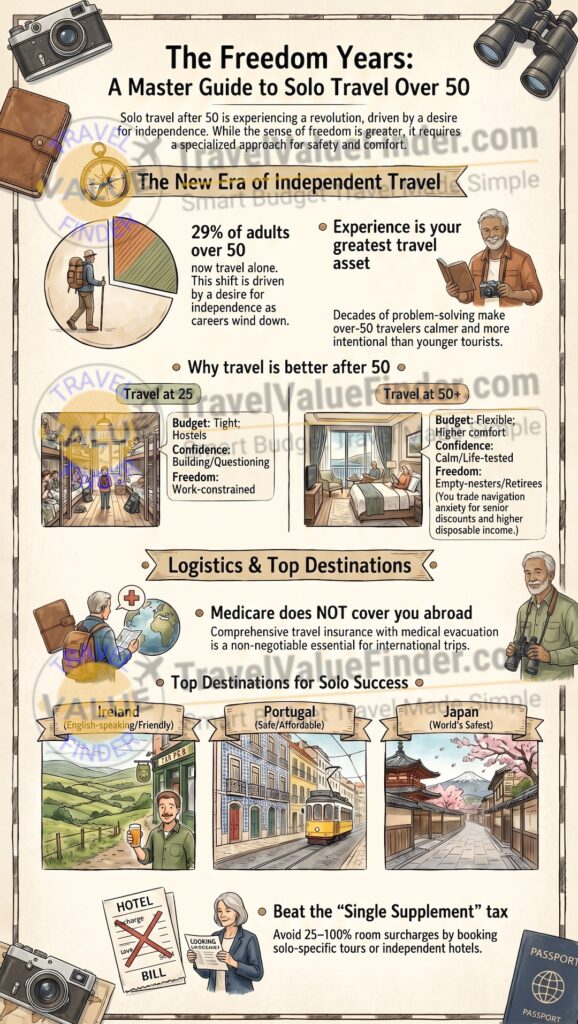
The statistics on solo travel over 50 reveal something remarkable about this moment. According to hotelagio.com’s travel statistics for the 50+ demographic, 29% of adults over 50 now travel alone — a figure that has prompted US travel companies to launch dedicated solo-only programs for older adults. And the driving force behind the shift is one specific demographic: Gen X women in their early-to-mid 50s.

AARP identifies this trend directly in its research: ‘The desire for Generation X women in their early 50s to venture out independently is driving a generational shift in solo travel. As Gen Xers approach the empty nest stage and retirement, they bring a greater sense of independence, autonomy and adventure than previous generations.’ Gen X — born 1965–1980 — has always been the independent generation. And as they cross 50 with the empty nest arriving, they are simply applying that independence to travel in a way their own parents never did.

This matters for every reader over 50 — male or female, Gen X or Baby Boomer — because the infrastructure of solo travel over 50 is better than it has ever been. Tour operators now offer ‘no single supplement’ pricing. More hotels offer genuine solo rates. Online communities of 50-plus solo travelers share destination-specific knowledge in extraordinary detail. The logistics that once made solo travel over 50 feel complicated have been systematically solved.

Solo travel over 50 is a rewarding way to explore the world with freedom, confidence, and a renewed sense of adventure. By planning ahead, choosing safe and comfortable destinations, and managing your budget wisely—such as traveling during off-peak seasons and booking early—you can enjoy a stress-free journey tailored to your pace and interests. Popular destinations like Europe, Japan, and Southeast Asia offer accessibility, safety, and rich cultural experiences perfect for mature travelers. For more detailed tips, destination ideas, and budget advice, be sure to read the full article below.

Solo Travel Over 50 - Tips, Destinations & Budget Advice-Infographic
Solo Travel Over 50 – Tips, Destinations & Budget Advice-Infographic

What Makes Solo Travel Over 50 Different — And Better

Solo travel at 50+ is not the same experience as solo travel at 25. In most important ways, it is better. Here is the honest comparison:

FactorSolo Travel at 25Solo Travel Over 50
Budget realityOften tight; hostels and budget transportMore disposable income; more accommodation choices; senior discounts add significant value
Life experienceNavigation anxiety; unfamiliar systemsDecades of problem-solving; less rattled by inconvenience; better instincts
Time flexibilityUsually constrained by work and educationEmpty nesters and retirees have weeks — even months — of travel freedom
Social dynamicsFocused on meeting other young travelersComfortable with selective socialising; richer conversations with locals and fellow travellers
Self-knowledgeStill discovering what you likeYou know exactly what experiences matter to you; less experimentation, more intention
Health considerationsRarely a factorRequires planning (insurance, medications, accessibility) but very manageable with preparation
ConfidenceStill building; easy to second-guess decisionsSubstantial life experience creates a calm that makes solo travel feel natural rather than nerve-wracking
Personal growth potentialSignificantEqually significant — different in character: not self-discovery but self-renewal

The bottom line: The things that make solo travel at 25 exciting — the novelty, the adrenaline of figuring things out — are still present at 50+. What gets added is the wisdom to appreciate them more fully.

The 5 Real Challenges of Solo Travel Over 50 (and Exactly How to Handle Each One)

Every generic article on solo travel over 50 tells you to ‘stay safe’ and ‘plan ahead.’ This guide does something more useful: it names the specific challenges that are genuinely harder after 50 and gives you the precise strategies experienced 50-plus solo travelers actually use.

Challenge 1: International Health Insurance — The Non-Negotiable You Cannot Ignore

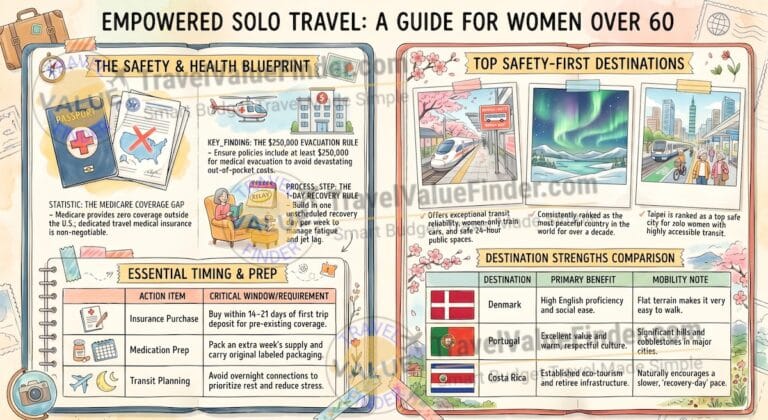
This is the challenge that no other solo travel over 50 guide addresses honestly enough. Medicare — the health coverage most Americans associate with age 65+ — does not cover medical care outside the United States, with very limited exceptions. Medicaid also generally does not cover international travel. This means that an American solo traveler over 65 going abroad is traveling without any domestic health coverage whatsoever. An American solo traveler between 50 and 65 likely has employer or Marketplace insurance that covers emergencies abroad at worst, nothing at best.

The solution — and it is simpler than most people fear — is comprehensive travel insurance that includes medical evacuation coverage.

Your SituationThe Risk Without CoverageThe Solution
Under 65, with employer insuranceMost US employer plans cover international emergencies at limited rates; a $50K medical evacuation is not coveredAdd a travel insurance policy with at least $100K medical evacuation. Cost: $80–$200/month depending on age and destination
65+, on MedicareMedicare does NOT cover most international care. No coverage at all abroad except limited circumstancesTravel insurance with Medicare supplement (Medigap plans C, D, G, M, N include foreign emergency coverage) OR dedicated travel insurance
65+, with Medicare AdvantageSome Medicare Advantage plans include international emergency coverage — read your plan carefullyConfirm international coverage in writing before departure. Get travel insurance as a backup regardless
Pre-existing conditionMost standard travel insurance excludes pre-existing conditions unless purchased within 14–21 days of trip depositBuy travel insurance IMMEDIATELY after booking — not weeks later. Look for ‘Cancel for Any Reason’ (CFAR) add-ons

Recommended providers with strong over-50 and senior coverage: Allianz Travel Insurance, Travelex, and GeoBlue (specifically designed for international travel by Americans). Full guide: Travel Insurance Guide: What It Covers and Best Options

Challenge 2: Medication Management Across Time Zones and Borders

Solo travelers over 50 are significantly more likely to travel with daily medications — blood pressure, thyroid, statins, anticoagulants, diabetes medications — and managing these across time zones, border controls, and varying pharmacy systems requires specific preparation that 25-year-old travel guides simply do not address.

  • Carry a 2x supply minimum: Pack double your required medication quantity and split it across your checked bag and carry-on. If one goes missing, you are not in a medical emergency
  • Get a doctor’s letter: A signed letter from your physician listing all medications (generic and brand names), dosages, and the medical condition they treat is standard procedure for crossing borders and for replacing prescriptions abroad if needed
  • Research import restrictions: Some medications legal in the USA are controlled or restricted in other countries. Japan, in particular, has strict rules on certain codeine-containing medications and some OTC cold medicines. Check the destination country’s customs authority before packing
  • Time zone strategy: For medications taken at specific times (thyroid, diabetes), gradually shift your dosing schedule in the days before departure, or consult your doctor about transitioning over the first two days at destination. Do not simply take medication 8 hours late because you crossed time zones
  • Know the local names: Travel with both brand name and generic name for each medication. In Europe and many Asian countries, brand names differ entirely from US names

Challenge 3: Mobility and Physical Accessibility

According to AARP’s travel challenges research, mobility challenges are the most commonly cited difficulty among 50-plus travelers who need accommodations. This matters for solo travel over 50 planning specifically because there is no travel companion to help navigate accessibility gaps — you are managing everything independently.

  • Research accommodation accessibility before booking: Filter for ‘wheelchair accessible’ or ‘accessible room’ on Booking.com — but also email the hotel directly and ask specific questions: Is there a lift to the room? Are there steps at the entrance? How far is the nearest bathroom from the room?
  • Build in recovery time: A 25-year-old can do 12 hours of walking and bounce back. Most 50+ travelers feel the difference by day three of heavy touring. Build one lighter, slower day into every 3–4 days of intensive activity
  • Consider airport accessibility: Request wheelchair assistance at airports even if you do not use a wheelchair — it significantly reduces transit stress and queuing. You can book this through your airline when purchasing tickets at no cost
  • Choose terrain-conscious destinations for your first trips: Lisbon’s hills are beautiful but demanding. Porto’s Ribeira waterfront is flat. Santorini’s iconic caldera views require steep stair access or cable car. Know what you are committing to physically before arrival

Challenge 4: The Single Supplement — The Tax on Traveling Alone

The single supplement is one of travel’s most frustrating realities for solo travelers of any age — but it hits over-50 travelers particularly hard because many prefer organised tours and cruises, which aggressively charge it. The single supplement adds 25–100% to a cabin or tour room price to compensate for the revenue the operator loses from not having a second guest.

  • Tour operators with no single supplement policies: G Adventures (many tours; varies by trip), Intrepid Travel (some departures), Road Scholar (educational travel for 50+, regularly offers solo-friendly pricing), Overseas Adventure Travel (strongly oriented toward 50+ travelers; 47% of travelers are solo)
  • Cabin share programmes on cruises: Many cruise lines (Princess, Holland America, Norwegian) offer programmes that match single travelers with same-gender cabin partners to eliminate the single supplement — worth asking about when booking
  • Book solo-specific departures: Some tour companies now offer departures guaranteed to have 8–12 solo travelers, creating an automatic social group without the single supplement. These fill fast — book early
  • The hotel alternative: For independent travel, hotels do not charge single supplements (you simply pay the room rate). This is one reason many experienced over-50 solo travelers prefer independent travel to guided tours — the economics work in your favour

Challenge 5: Loneliness — The Fear That Is Larger Before the Trip Than During

Every solo travel over 50 guide mentions loneliness. Most underestimate how quickly it dissolves in practice. The first dinner alone in a new city is the hardest. By the third, you are choosing the counter seat because you enjoy the conversation it reliably starts. Here is what actually works, specifically for the 50-plus solo traveler:

  • Day tours and group activities: For the 50+ solo traveler who is not interested in hostel common rooms, day tours are the social equivalent. A food tour, a walking tour, a cooking class — these put you alongside 8–15 other curious people for 3–4 hours, and at 50+ you typically have the social skills to make those connections last beyond the tour itself
  • Online communities before departure: Solo Travel Society (Facebook) and Solo Traveler World both have active 50+ communities that exchange destination-specific advice, accommodation recommendations, and occasionally organize meetups at destinations
  • Slow travel as an anti-loneliness strategy: A solo traveler who spends two weeks in one neighborhood of Lisbon or Chiang Mai will become a familiar face at the same café, the same bakery, the same evening bar. That regularity is the fastest route to genuine local connection — infinitely more effective than moving cities every two days

The Senior Discount Advantage: How Over-50 and 65+ Status Transforms Your Travel Budget

This is the section most generic solo travel over 50 articles completely neglect — and it is genuinely significant. Senior discounts across transport, attractions, accommodation, and travel services can reduce the effective cost of a trip by 15–30%. Most of these discounts are not advertised aggressively; you have to know to ask for them.

The Key Senior Discounts Every Over-50 Solo Traveler Should Know

CategoryDiscount AvailableHow to Access
US domestic flightsAARP member discount through Expedia: 10% off eligible bookingsLog in to AARP’s travel portal at aarp.org/travel. Annual membership is $16
European railEurail Senior Pass: 15% off standard Eurail prices for travelers 60+Book at eurail.com; select ‘Senior’ category at purchase
UK train railSenior Railcard (UK): 1/3 off most rail fares for 60+Buy at railcard.co.uk; save immediately on first journey
European museums50–100% discounts at most European national museums for 65+ (varies by country)Always carry your passport showing date of birth; ask at the ticket desk even if not prominently advertised
Japan transportTOICA and Suica IC cards work at standard prices, but Japan Rail offers senior discounts on some intercity routesAsk at JR ticket offices; some routes offer 30–50% senior fares
US National ParksAmerica the Beautiful Senior Pass: lifetime admission to all 400+ US national parks for a one-time $80 fee (age 62+)Purchase at any national park entrance or at recreation.gov
HotelsAAA and AARP hotel rates: 5–15% at major chains including Marriott, Hilton, Best Western, Choice HotelsAlways identify as AAA or AARP member when booking; many discounts require membership card at check-in
Travel insuranceWhile premiums increase with age, AARP-endorsed plans and Road Scholar’s included insurance often offer better senior valueCompare at InsureMyTrip.com which filters by age and shows all available plans

The AARP number: An annual AARP membership costs $16. The hotel, flight, and car rental discounts available through AARP’s travel portal routinely save members $200–$500+ on a single international trip. The membership pays for itself many times over on a single trip.

Best Destinations for Solo Travel Over 50 in 2026

The best destinations for solo travel over 50 are chosen by different criteria than generic solo travel lists. Infrastructure reliability matters more. Safety and walkability rank higher. Access to quality healthcare is a relevant consideration for longer stays. And the experiences on offer — cultural depth, culinary richness, historical significance — tend to matter more than nightlife or beach party scenes. Here are the destinations that consistently top the list for American solo travelers 50 and over:

DestinationDaily BudgetBest ForSafetyWhat Makes It Right for Over-50 Solo Travel
Ireland (Dublin + West)$90–$130First international soloExcellentEnglish-speaking, culturally familiar, TripAdvisor named Dublin #1 solo city 2026, extensive guided tour options, strong healthcare infrastructure
Portugal (Lisbon + Porto)$65–$90Culture, food, walkabilityExcellentHighest safety rating for solo female travelers in Europe, excellent healthcare, English widely spoken, superb food at budget prices
Italy (Florence + Amalfi)$90–$130Art, food, historyVery GoodWorld-class cultural experiences, strong guided tour infrastructure, excellent Italian healthcare system for emergencies
Japan (Tokyo + Kyoto)$80–$130Safety, culture, foodWorld’s SafestSafest country on earth for solo travel, excellent public transport, extraordinary cuisine, counter dining culture makes eating alone completely normal
Spain (Seville + San Sebastián)$75–$110Food, culture, climateExcellentHighest safety index score for female solo travelers globally (index 7.45), exceptional culinary culture, walkable historic centres, senior rail discounts
New Zealand (South Island)$100–$150Adventure + safetyExcellentEnglish-speaking, outstanding natural beauty, excellent driver-based self-tour infrastructure, high-quality healthcare system
Hawaii (inter-island)$120–$180No jet lag, domestic easeExcellentNo passport required, US healthcare system, no language barrier, America the Beautiful senior pass works on Big Island and Maui national parks
Thailand (Chiang Mai)$40–$65Budget, culture, wellnessVery GoodExtraordinary value, massive international community of 50+ digital nomads and slow travellers, excellent private healthcare at low cost, wellness infrastructure
Mexico (Yucatán Peninsula)$55–$85Short flight, culture, ruinsGoodShort US flight, no visa, Mérida is one of Mexico’s safest cities, cenotes and Mayan ruins, IMSS public hospitals accessible to tourists
Croatia (Dubrovnik + Hvar)$80–$120Scenic beauty, historyExcellentEU-standard healthcare, stunning Adriatic scenery, Game of Thrones tourism infrastructure makes day trips easy, ferry-based island hopping well-suited to solo travel

A note on Ireland: TripAdvisor’s 2026 Travellers’ Choice Best of the Best Awards named Dublin the #1 city in the world for solo travel — and for American solo travelers over 50 specifically, it is close to a perfect choice. English as the native language eliminates every language anxiety. The culture is familiar without being identical. The pub culture is one of the most naturally social environments in the world — sitting alone at a bar in Ireland is never awkward; it is an invitation to conversation. And the Cliff of Moher, the Ring of Kerry, the Wild Atlantic Way are all accessible via well-organized day tours from Dublin and Galway that suit the over-50 solo traveler perfectly.

For deeper destination guides and where-to-stay advice:

Budget Advice for Solo Travel Over 50: What Changes, What Stays the Same

The budget for solo travel over 50 has a different structure than it does at 25. You are probably willing to spend more on accommodation (a private room rather than a dorm; a 3-star rather than a 1-star). You are probably less willing to eat cheaply all the time (good food matters more). And you have several budget advantages that younger travelers do not: senior discounts, points and miles accumulated over decades, and the ability to travel in shoulder season and off-peak periods because you are no longer constrained by school calendars or a boss’s approval.

A Realistic Daily Budget Framework for Solo Travelers Over 50

Budget StyleDaily BudgetWhat This Covers
Comfortable budget$80–$120/day3-star hotel or quality guesthouse, 2 restaurant meals + 1 self-catered, 2–4 metro journeys, 1 paid attraction per day. Works well in Portugal, Spain, Eastern Europe, Thailand, Mexico
Mid-range comfort$120–$200/day4-star hotel or boutique accommodation, restaurant meals for lunch and dinner, taxi when needed, daily activities without budget anxiety. Works across Western Europe, Japan, New Zealand
Comfortable splurge$200–$350/dayHigh-end hotel, fine dining 1 night per week, private guides for specific experiences, no budget compromise. Appropriate for Italy’s Amalfi Coast, Ireland’s countryside, Japan’s ryokan experience

Budget Strategies Specifically Valuable for the Over-50 Solo Traveler

  1. Use the shoulder season advantage fully: Traveling in April–May or September–October saves 20–30% on accommodation vs. peak summer. As a traveler unconstrained by school calendars, this is one of your most powerful budget tools. Full guide: Budget Travel Tips: 30 Strategies to Travel More for Less
  2. Hotel loyalty programmes pay off most at this life stage: Baby Boomers and Gen X have, on average, accumulated more hotel and airline loyalty points than any other demographic. If you have Marriott Bonvoy, Hilton Honors, or Chase Ultimate Rewards points sitting unused, a solo trip is exactly when they deliver the highest per-dollar value
  3. Book single rooms, not doubles at a solo supplement: Independent hotel booking at the room’s single-occupancy rate is always better than a tour company’s double-plus-single-supplement rate. For solo travel over 50, this often means self-directed travel beats organised tours on pure economics
  4. Slow travel lowers daily costs dramatically: A week in one city at a weekly accommodation rate vs. five different cities at nightly rates saves 25–40% on accommodation alone — and eliminates the daily transport costs of moving between destinations
  5. Medicare supplement for travel lowers insurance costs: If you have Medigap Plan G, C, or D, you already have basic international emergency coverage baked in (up to $50K lifetime, after deductibles). A supplemental travel insurance policy to extend that coverage costs significantly less than buying standalone coverage from zero
  6. Consider a travel credit card with travel insurance: Cards like the Chase Sapphire Reserve include trip cancellation insurance, lost baggage coverage, and medical emergency referral services as card benefits — reducing the standalone travel insurance premium you need to purchase

Taking Your First Solo Trip After 50: A Step-by-Step Guide

If you have never traveled alone and you are over 50, this section is written specifically for you. The good news: starting solo travel at 50 or 60 or even 70 is not only possible — it is arguably the perfect time.

Step 1: Choose a Low-Barrier First Destination

Do not start with India. Do not start with Japan if language anxiety worries you. Start with a destination that removes as many logistical variables as possible so that your experience of solo travel is ‘this is wonderful’ rather than ‘this is overwhelming.’ The best first solo destinations for Americans over 50 are: Ireland, Portugal (particularly Lisbon), Hawaii (inter-island), Italy (Tuscany or Florence), Spain (San Sebastián or Seville), or the UK (London or Edinburgh). All five share: English widely spoken or native, excellent tourism infrastructure, US State Department Level 1 or 2 travel advisory, strong healthcare systems, and a well-established solo travel community.

Step 2: Book Your First 2 Nights Before Anything Else

The moment of arriving in a new city alone without knowing where you are going is the most disorienting part of solo travel for anyone. Solve it completely by booking your first two nights before you get on the plane. After that, you can be flexible — but the arrival is stress-free because you know exactly where the taxi is going. Book through our partner’s booking platform for real-time pricing across hundreds of providers.

Step 3: Buy Travel Insurance the Same Day as Your Flights

The ‘Cancel for Any Reason’ (CFAR) rider is available only if purchased within 14–21 days of your initial trip deposit. Health insurance riders that cover pre-existing conditions require the same timing. Buy the day you book the flight — not three weeks later when you have sorted everything else. See our complete guide: Travel Insurance Guide: What It Covers and Best Options

Step 4: Tell Someone Your Itinerary in Writing

Share your hotel name, address, and confirmation number; your flight details including the return flight; and a rough day-by-day plan with a trusted person at home. Agree a check-in schedule (a text every 2–3 days is enough; more if you want the safety net) and agree what ‘no contact for 48 hours’ means in terms of who to call. This is not paranoia — it is the same common sense you would apply to any trip, solo or otherwise.

Step 5: Book One Organised Activity for Your First Day

A free walking tour, a food tour, a museum guided visit — something with a structure and other participants built in for your first day. This gives you immediate social contact on arrival (which is when loneliness risk is highest for a new solo traveler), a built-in orientation to the city, and the confidence that comes from having successfully navigated a shared experience. By Day 2, you will not need the structure. Book through GetYourGuide or Viator.

Solo Travel Over 50 for Women: The Specific Considerations

Women over 50 are the fastest-growing segment of solo travelers globally — and the demographic driving most of the innovation in solo travel infrastructure. The solo travel over 50 for women experience has specific dimensions that deserve direct attention:

Solo travel is not just about exploring new destinations but a journey of loving me and spending time with me without guilt. As a Gen X traveler in my 50s, I have a profound sense of growth after each trip. — Tomiko Harvey, 52 — AARP Magazine

  • Safety perceptions vs. reality: The AARP research notes that 90% of solo female travelers over 50 prefer organised tours or escorted travel for some or all of their trip — driven by safety perceptions. This is often more conservative than the reality warrants, particularly for Ireland, Portugal, Spain, Italy, Japan, New Zealand, and most of Western Europe where solo female travel is genuinely very safe
  • Accommodation as a safety tool: A centrally-located, well-reviewed hotel or boutique guesthouse is the most powerful safety tool available. It gives you a safe base to return to, a concierge who knows where you are going, and proximity to restaurants and attractions that eliminates the need for late-night navigation in unfamiliar areas
  • The Road Scholar option: Road Scholar’s educational travel programmes are specifically designed for the 50+ traveler and are disproportionately used by solo women (47% of Overseas Adventure Travel’s travelers are solo; 85% of solo travelers with that company are women). They offer the safety and social structure of a group with significant free time
  • Communities for women: Gutsy Traveler and Women on the Road are both specifically oriented toward solo female travel over 40 — with destination safety reports, community forums, and trip meetups

Plan Your Solo Trip Over 50: Essential Resources on TravelValueFinder

Everything you need before and during your trip:

Ready to book your solo trip over 50? Find the best flights and hotels through our trusted partner: Search Flights and Hotels — TravelValueFinder Deals. Hundreds of providers, real-time prices, secure booking. We earn a small commission at no extra cost to you.

Frequently Asked Questions: Solo Travel Over 50

Is solo travel safe after 50?

Yes — and often safer than solo travel at 25, because experience and judgment improve with age. The key to safety in solo travel at any age is destination selection, accommodation choice, and preparation. For over-50 solo travelers specifically: choose destinations in Western Europe, Japan, New Zealand, Ireland, and the US, where safety infrastructure is excellent; stay in centrally-located, well-reviewed accommodation; tell someone at home your itinerary; and carry comprehensive travel insurance. The 50-plus demographic is actually among the least likely to experience safety problems abroad because of better risk assessment and less risk-taking behaviour.

Does Medicare cover international travel emergencies?

No — with very limited exceptions, Medicare does not cover medical care outside the United States. This is the most important financial planning consideration for solo travelers over 65. Purchase comprehensive travel insurance with a strong medical evacuation benefit (minimum $100,000 recommended) before every international trip. If you have a Medicare Advantage plan, review your plan documents carefully — some include limited international emergency coverage. If you have a Medigap supplemental plan (particularly Plan C, D, G, M, or N), you have $50,000 in foreign emergency coverage after deductibles, which provides a baseline — but travel insurance is still recommended for trips over two weeks.

What is the single supplement and how do I avoid it?

The single supplement is a surcharge of 25–100% added to cruise cabin or tour room prices when you travel alone, charged because the operator loses the revenue from a second guest. To avoid it: (1) book with tour operators that have no single supplement programmes (G Adventures, Intrepid Travel, Road Scholar, Overseas Adventure Travel); (2) join cabin share programmes on cruises that match you with a same-gender partner; (3) travel independently and book hotels directly, where single-occupancy rates are normal and supplements are rare.

What are the best destinations for solo travel over 50 for first-timers?

For American solo travelers over 50 taking their first solo trip, the five best destinations are: (1) Ireland — English-speaking, culturally familiar, TripAdvisor’s #1 city for solo travel in 2026 (Dublin), outstanding pub social culture; (2) Portugal (Lisbon or Porto) — safest country in Western Europe for solo female travelers, affordable, excellent food; (3) Italy (Tuscany or Rome) — world-class culture, strong guided tour infrastructure, excellent cuisine; (4) Hawaii — no passport, US healthcare system, no language barrier, America the Beautiful senior pass for national parks; and (5) Spain (Seville or San Sebastián) — highest safety index for female solo travelers globally, extraordinary food culture, warm climate.

How do I meet people when traveling solo over 50?

The strategies that work best for over-50 solo travelers are: (1) organized day tours and food tours, which put you alongside other curious travelers for 3–4 hours; (2) educational travel programmes like Road Scholar, which specifically attract 50+ solo travelers; (3) slower travel that creates repeat-visit familiarity at local cafés and restaurants; (4) online communities (Solo Travel Society on Facebook, Women on the Road) that sometimes organise destination meetups; and (5) hotel bars and concierge conversations, which are natural social starting points at 4-star+ properties. Counter seating at restaurants also creates natural conversation in Japan, Portugal, Spain, and Italy where it is culturally normal.

What should I pack for solo travel over 50?

Essential additions to a standard packing list for the over-50 solo traveler: a comprehensive medication supply (double quantity, split across carry-on and checked), a signed doctor’s letter listing all medications and conditions, copies of travel insurance documents and emergency contact numbers kept separately from your phone, a small first aid kit tailored to your health profile, compression socks for long flights (reducing deep vein thrombosis risk), a portable charger (your phone is your safety tool — keep it charged), and a TSA-compliant lock for hotel room security. For the full packing guide: Essential Travel Packing List: What to Bring and What to Leave

Final Thoughts: Solo Travel Over 50 Is Not a Compromise. It Is the Whole Point.

The solo travel over 50 experience is not the same as solo travel at 25 modified for an older body. It is a fundamentally different experience — richer, more intentional, more deeply felt. When you have spent decades being responsible for other people, a trip where every decision is yours alone is not loneliness. It is freedom.

The data supports this. According to AARP’s research on solo travel, the motivation for travelers over 50 going solo is to have more time for themselves — as empty nesters, as people stepping back from long careers, as individuals claiming space that decades of responsibilities left no room for. Travel is one of the most powerful ways to claim that space. And doing it alone — with no schedule to negotiate, no preferences to accommodate, no pace but your own — is one of the most meaningful gifts you can give yourself at this life stage.

Solo travel over 50 is not something you do despite your age. It is something you do because of everything your age gives you: the wisdom to appreciate it, the confidence to navigate it, and the life experience to know that some things cannot wait.

The desire to travel is incredibly resilient. Despite challenges or barriers, older adults are adapting how they travel, not whether they travel. — Lona Choi-Allum, Senior Consumer Insights Manager, AARP — from the AARP 2026 Travel Trends Survey

Book your solo trip today. Our trusted partner searches hundreds of providers for the best flight and hotel prices: Find Solo Travel Flights and Hotels — TravelValueFinder. Secure booking, transparent pricing. We earn a small commission at no extra cost to you.

Share this post