Travel Value Finder

Where to stay in Tokyo?
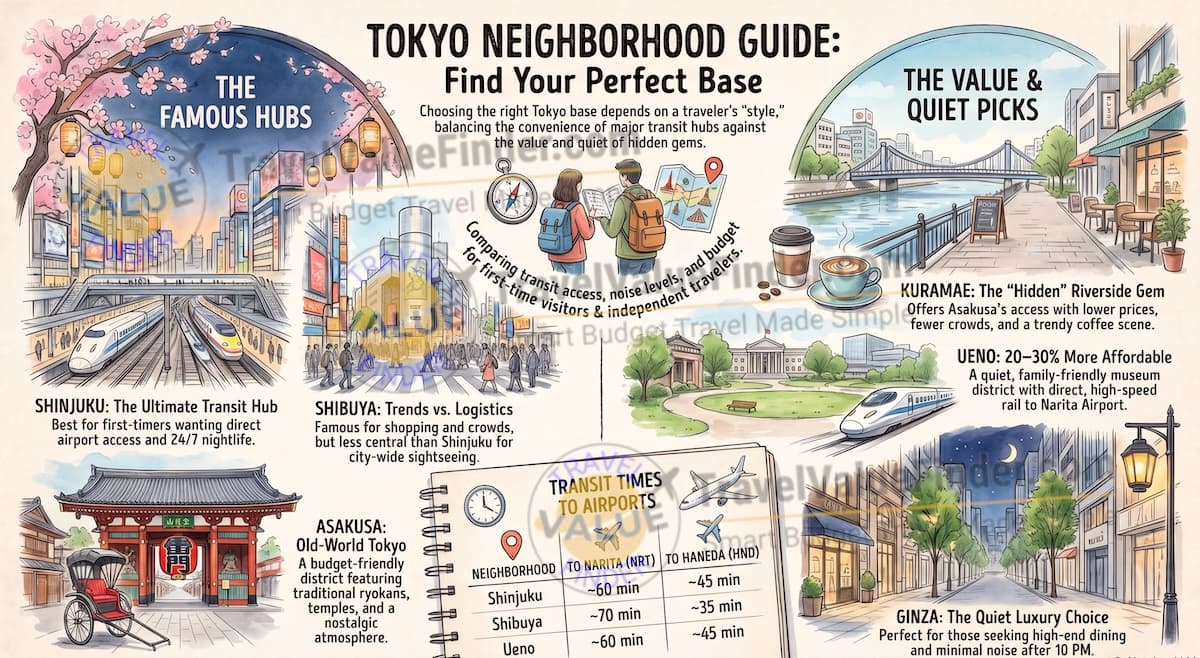
- First-time visitors do best in Shinjuku or Shibuya for transit access;
- budget travelers get more value in Ueno or Asakusa;
- Kuramae, a quiet riverside district next to Asakusa, offers the same access at a lower price and barely shows up on any “where to stay” list.
Leslie Nics | TravelValueFinder.com | Updated September, 2026
Table of Contents
Quick Compare: Where to Stay in Tokyo
| Neighborhood | Typical $/night | Noise After 10pm | Best For |
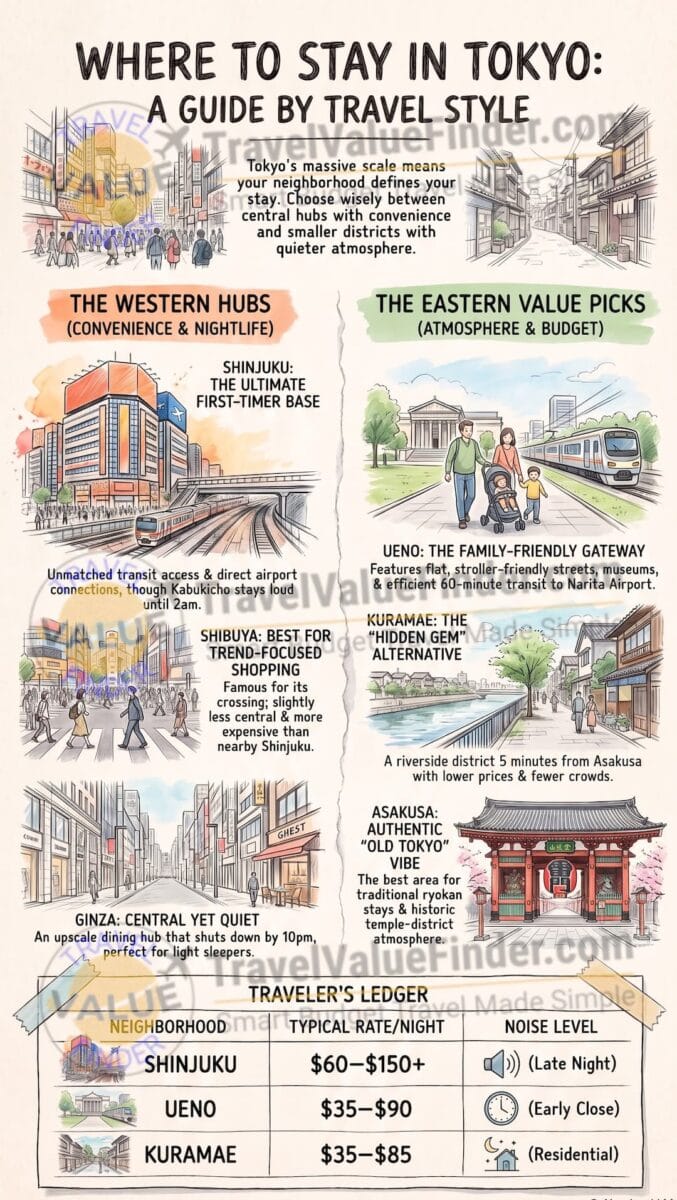
| Shinjuku | $60–$150+ | Loud (Kabukicho especially) | First-timers, transit hub, nightlife access |
| Shibuya | $70–$160+ | Loud on weekends | Trend-focused visitors, shopping |
| Asakusa | $40–$100 | Moderate | Old-Tokyo atmosphere, temples, hostels |
| Ueno | $35–$90 | Quiet | Museums, families, Narita access, value |
| Kuramae | $35–$85 | Quiet | Same access as Asakusa, lower price, fewer crowds |
Shinjuku
Best for: First-time visitors who want one base for the whole trip
Transit: Shinjuku Station; the world’s busiest, every major line
Noise: Loud, especially Kabukicho. Fine to walk through, worth avoiding for sleep
Shinjuku’s real advantage isn’t its skyline, it’s logistics. From here, nearly anywhere in Tokyo is reachable within 30–40 minutes, and the Narita Express runs directly from Shinjuku Station.
Golden Gai’s tiny bars make it a genuinely good base for solo travelers who want to meet people. The trade-off is exactly what makes it convenient. Hotels directly above or near the station can run noisy from the first trains around 5am, and Kabukicho’s nightlife district stays loud well past 2am on weekends.
The neighborhood is also large enough to have real internal variation worth knowing before booking. The area immediately around Kabukicho is a different noise profile than Shinjuku’s quieter southern side near Takashimaya Times Square, even though both count as “Shinjuku” on a map.
Checking a hotel’s specific block, not just the neighborhood name, matters more here than almost anywhere else on this list.
Shibuya
Best for: Trend-focused visitors, shopping, the famous crossing
Transit: Shibuya Station, major Yamanote Line stop, less central than Shinjuku
Noise: Loud on weekends; quieter midweek
Shibuya is arguably a better neighborhood to visit than to actually sleep in on a first trip. It sits toward the southwest of the Yamanote loop. It a less central home base for covering the rest of the city than Shinjuku. However, the two getting recommended almost interchangeably.
It has fewer accommodation options than Shinjuku at a comparable price point, and what’s there books up faster given the area’s popularity with younger travelers.
Ebisu, just one stop south, offers a quieter alternative with similar restaurant quality for travelers who want Shibuya’s dining scene without booking directly in its loudest blocks.
Asakusa
Best for: Old-Tokyo atmosphere, temples, hostel-district budget access
Transit: Asakusa Station, Ginza and Toei Asakusa lines; less central than Shinjuku
Noise: Moderate; quieter than Shinjuku or Shibuya after 10pm
Asakusa built its budget-travel reputation the honest way. Tourism arrived here decades before luxury hotel development did. Therefore there are a dense concentration of hostels and budget ryokans around Senso-ji Temple that still undercuts the west-side neighborhoods.
Nakamise-dori’s shopping street and Sumida Park’s cherry blossoms cost nothing to walk, and the area has a nostalgic, unhurried feel that Shinjuku and Shibuya don’t try to offer.
The trade-off: it sits further from many other major sights, meaning more transit time built into each day.
Traditional ryokan stays are also genuinely more available here than almost anywhere else on this list. For travelers who want at least one night of tatami mats and futon bedding as part of the Tokyo experience rather than a standard hotel room throughout.
Ueno
Best for: Museums, families, value, easy Narita Airport access
Transit: Ueno Station, major hub, Narita Express (~1hr to airport), Shinkansen access north
Noise: Quiet, most things close early
Ueno is the value pick most first-timers overlook simply because it isn’t marketed as hard as Shinjuku or Shibuya.
Hotels here typically run 20–30% cheaper than equivalent options in those two neighborhoods. That is a meaningful saving over a week-long stay. It is sits on the Yamanote Line with direct access to Akihabara, the Tokyo National Museum, Ueno Park, and the lively Ameyoko market street.
Its major limitation is exactly its virtue: things close early. It suits families and light sleepers far better than travelers chasing nightlife. It’s also one of the flattest, most stroller-friendly neighborhoods on this list. A detail parents traveling with young children consistently flag as more useful in practice than any amenity list.
Kuramae: The One Every List Skips
Best for: Same access as Asakusa, lower price, fewer crowds
Transit: Kuramae Station, Toei Asakusa and Toei Oedo lines; 5-minute walk to Asakusa
Noise: Quiet, residential riverside character
Kuramae sits directly beside Asakusa, close enough to walk to Senso-ji in minutes. It is considered a quiet cluster of independent coffee roasters, small ceramics studios, and leather workshops.
Therefore, it is the kind of neighborhood locals describe as “up-and-coming” without the price tag that phrase usually implies elsewhere in Tokyo.
It sits on the same Toei Asakusa Line as its famous neighbor, plus the Oedo Line, giving it genuinely comparable transit access.
What it doesn’t have yet is Asakusa’s tourist density. This is the neighborhood that made the case for itself simply by being a five-minute walk from everything Asakusa offers, at a lower price, with almost none of the crowds.
It also sits directly along the Sumida River. A genuinely different visual character from Asakusa’s temple-and-shopping-street density. It has quiet riverside walking paths a few minutes from some of the city’s most visited landmarks.
For a traveler who wants Asakusa’s access without Asakusa’s crowds at breakfast, Kuramae is close to the ideal compromise, and it’s still underpriced relative to what it actually offers.
What Different Hotel Tiers Actually Get You
| Tier | Typical Rate | What to Expect |
| Budget / capsule | $17–$40/night | Compact pod or shared room, clean, minimal amenities |
| Business hotel | $54–$100/night | Private room, 15–18 m², efficient design, often includes breakfast |
| Mid-range (3-star) | $126/night | Standard 18–22 m² rooms, better location flexibility |
| Luxury (4–5 star) | $217–$391+/night | Larger rooms, top-tier service, prime locations |
Build Your Tokyo Itinerary Around the Right Base
Use our Free AI Trip Planner to build a day-by-day Japan itinerary, and don’t miss our How to Find Cheap Flights guide for strategies on getting affordable flights.
Two More Worth Knowing: Ginza & Shimokitazawa
Ginza: Best for quiet nights, upscale dining, minimal nightlife noise
Ginza rarely makes a budget traveler’s shortlist, but it deserves a mention for a specific traveler. It is ideal for anyone who wants genuine quiet after dark without sacrificing central location.
Most of the neighborhood shuts down by 10pm, which makes it one of the calmest bases on this entire list despite sitting close to Tokyo Station.
Shimokitazawa: Best for authentic local Tokyo, vintage shops, live music venues
Shimokitazawa sits at the opposite end of the spectrum in character. It is genuinely a local neighborhood popular with young Tokyoites. There a plenty of vintage clothing shops, small live-music venues, and independent cafés.
It won’t suit a first-timer who wants everything within walking distance, but it’s a strong pick for a return visitor who’s already covered the obvious sights.
Airport Access by Neighborhood
For a city Tokyo’s size, airport access shifts meaningfully by base, and it’s worth checking against a specific itinerary rather than assuming “it’s all central Tokyo, it’ll be fine.”
| Neighborhood | To Narita (NRT) | To Haneda (HND) |
| Shinjuku | ~60 min (Narita Express) | ~40–45 min |
| Shibuya | ~70 min | ~30–35 min |
| Asakusa / Kuramae | ~75–85 min | ~35–40 min |
| Ueno | ~60 min (Keisei Skyliner nearby) | ~40–45 min |
| Ginza | ~65–75 min | ~30 min |
Ueno’s Narita access in particular is worth flagging: the nearby Keisei Skyliner route makes it one of the more efficient bases for travelers flying in or out of Narita specifically, on top of its already-strong value pricing.
Ready to book? Compare real-time flight and hotel prices through our trusted search partner. We earn a small commission at no extra cost to you, which helps keep guides like this one free.
The Noise Question Nobody Puts in Writing
Every neighborhood comparison mentions price and transit. Almost none of them rate noise directly, and it’s the detail that actually determines whether a trip feels rested or ragged by day four.
- Shinjuku and Shibuya run loud until 2–3am, particularly on weekends and especially around Kabukicho.
- Ginza, by contrast, largely shuts down by 10pm.
- Asakusa and Kuramae land in between. Enough evening energy to not feel dead, quiet enough to actually sleep.
Light sleepers and anyone traveling with kids should treat this as a harder filter than star rating. A well-reviewed hotel on a loud block still means a loud night, whatever the reviews say about the room itself.
Most mid-range Tokyo business hotels are small enough that opening a large suitcase fills the entire floor – know that before you pick a neighborhood based on price alone. Leslie Nics, TravelValueFinder.com
Related Travel to Japan Guide
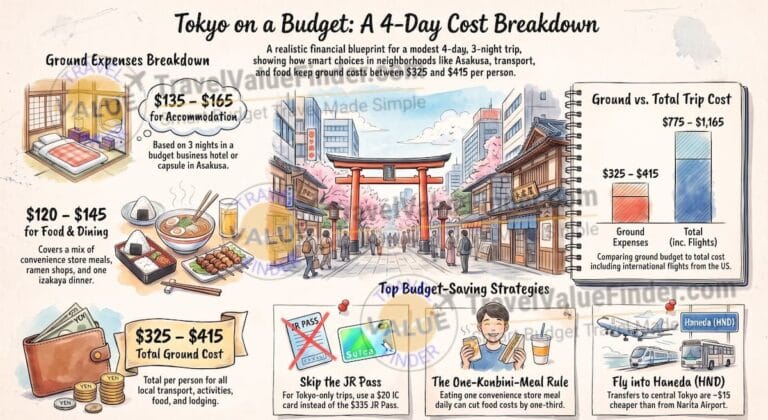
- Travel to Tokyo 4 Days Modest Budget Guide
- 25 Best Things to Do in Tokyo : The Ultimate Tokyo Bucket List for First-Timers & Return Visitors
- Best Hotels in Tokyo: Ultra-Luxury Towers, Zen Ryokan, and the City That Reinvented the Hotel Stay
- Best Hotels in Osaka: Food City, Neon Nights, and the Luxury Scene Tokyo Doesn’t Tell You About
- Cherry Blossom Season in Japan: When to Actually Go (Not What the Calendars Say)
People Also Ask
What is the best area to stay in Tokyo for first-time visitors?
Shinjuku is the most commonly recommended base for first-timers, thanks to its central transit position and direct Narita Express access – most of Tokyo is reachable within 30–40 minutes from here.
Is Shibuya or Shinjuku better to stay in?
Shinjuku generally offers better value as an actual home base – Shibuya sits less centrally within the Yamanote loop and has fewer accommodation options at a comparable price.
Where should I stay in Tokyo on a budget?
Asakusa and Kuramae offer the strongest combination of low rates and easy transit access, with Ueno close behind for travelers who also want museum and family-friendly amenities.
What’s the quietest area to stay in Tokyo?
Ginza and Kuramae are among the quietest popular options, both largely settling down well before Shinjuku or Shibuya’s nightlife districts are just getting started.
FAQ
Is Kuramae safe for tourists?
Yes, like most of central Tokyo, Kuramae is considered very safe, and its quieter, more residential character makes it feel especially calm compared to the busier tourist neighborhoods nearby.
How far is Kuramae from Asakusa’s main temples?
About a 5-minute walk or one stop on the Toei Asakusa Line, making it functionally interchangeable with Asakusa for sightseeing purposes.
Are Tokyo hotel rooms really that small?
Standard rooms in mid-range business hotels commonly run 15–22 square meters. It is genuinely compact by U.S. standards, and worth checking specifically if traveling with large luggage.
Which neighborhood is best for families with children?
Ueno is frequently recommended for families, thanks to its parks, museums, larger room options, and flat, stroller-friendly terrain, Asakusa shares that flat, walkable quality as well.
How many nights should I budget to see Tokyo properly?
At least 4–5 nights is commonly recommended, since Tokyo’s size means each major district such as Shinjuku, Shibuya, Asakusa, Ginza realistically deserves close to a full day.
Sources
- Japan National Tourism Organization (JNTO) – neighborhood and transit access guidance
- East Japan Railway Company (JR East) – Yamanote Line and Narita Express route and timing data
- Tokyo Metro and Toei Transportation – line and station access information
Affiliate Disclosure: TravelValueFinder.com participates in affiliate programs. When you book through our links, we may earn a small commission at no extra cost to you. This supports our independent editorial team. All recommendations are based on genuine editorial research.