Travel Value Finder

Leslie Nics, TravelValueFinder.com | Last updated: October 2026 |
Kyoto can be an extraordinary destination for independent senior travelers, but it requires a different kind of planning from a city such as Vienna. The issue is not simply whether Kyoto has good public transportation or whether the major sights are worth visiting.
The real question is how much walking, standing, stairs, uneven surfaces, crowding, and transportation effort is hidden inside each sightseeing day.
Kyoto rewards a slower approach. Rather than trying to visit several famous temples and neighborhoods every day, a long-stay traveler can divide the city into manageable areas, return to favorite places, use buses and trains strategically, and leave enough time for ordinary days.
This audit applies the Travel Value Finder Senior Travel framework to Kyoto: one comfortable base, geographically grouped outings, selective day trips, realistic pacing, and a practical assessment of transportation and physical friction.
Table of Contents
Why Kyoto Can Work as a Single-Hub Destination
Kyoto has enough cultural depth for several weeks. Temples, shrines, gardens, traditional neighborhoods, markets, museums, cafés, seasonal scenery, and nearby excursions provide a wide range of experiences without requiring a new hotel every few days.
The single-hub approach is particularly useful because Kyoto’s attractions are spread across different parts of the city. Staying put means you can learn one neighborhood and one set of daily routines instead of repeatedly packing, checking out, and navigating unfamiliar accommodation.
The goal is not to see everything. It is to experience Kyoto at a pace that remains enjoyable after the novelty of the first few days wears off.
The 30-Day Kyoto Slow Travel Model
A month in Kyoto should include major cultural experiences, but it should also include recovery days and ordinary neighborhood time. A temple-heavy itinerary can become physically demanding even when the distances on a map look modest.
| Focus | Approximate Time |
| Historic Kyoto and major cultural sites | 6–8 days |
| Temples, shrines and gardens at a slower pace | 5–7 days |
| Neighborhoods, markets, cafés and everyday Kyoto | 5–6 days |
| Parks, riverside walks and flexible outdoor days | 3–4 days |
| Regional day trips | 3–4 days |
| Rest and weather-flexible days | 4–5 days |
Kyoto’s Senior-Travel Challenge: The Sightseeing Day Is Longer Than It Looks
Kyoto is a good example of why destination difficulty cannot be judged only by its transit network. A traveler may take a train or bus efficiently and still face a long walk, a queue, steps, a temple path, uneven paving, or several hours of standing.
A famous attraction may also involve more physical effort than its location on a map suggests. Entrance areas, gardens, shrine approaches, elevated viewpoints, and large temple grounds can turn a short transfer into a substantial outing.
For senior travel, the useful question is therefore: what does the complete door-to-door day involve?
Divide Kyoto Into Daily Zones
The easiest way to reduce unnecessary effort is to group nearby attractions. Instead of crossing Kyoto repeatedly, choose one area and stay there for much of the day.
A day can focus on eastern Kyoto, another on central Kyoto, another around Arashiyama, and another around a market or neighborhood. The exact grouping should depend on your accommodation and the attractions you personally care about.
This approach also creates flexibility. If a particular temple or neighborhood is more tiring than expected, you have not committed yourself to another distant attraction later the same day.
Why Slow Travel Can Work Particularly Well in Kyoto
Kyoto is a destination where returning to a place can be more rewarding than adding another place to the list. A garden can look completely different in changing weather or light. A neighborhood becomes more interesting once you know where to buy breakfast or stop for coffee.
Slow travel also gives you the freedom to avoid peak periods when practical. You can choose an early outing, return to your accommodation, and then decide whether you want another activity later.
For travelers after 55, this flexibility can be more valuable than squeezing another landmark into the itinerary.
Why Staying in One Place Can Change the Economics
A month-long Kyoto stay changes the value calculation. Accommodation location affects transportation, food choices, convenience, and the amount of time spent moving between activities.
A central tourist address may be convenient for some interests but expensive. A quieter neighborhood with straightforward rail or bus access can sometimes provide a better long-stay balance.
Consider the whole routine: accommodation, transport, grocery access, restaurants, laundry, kitchen facilities, and the effort required to get home after a long sightseeing day.
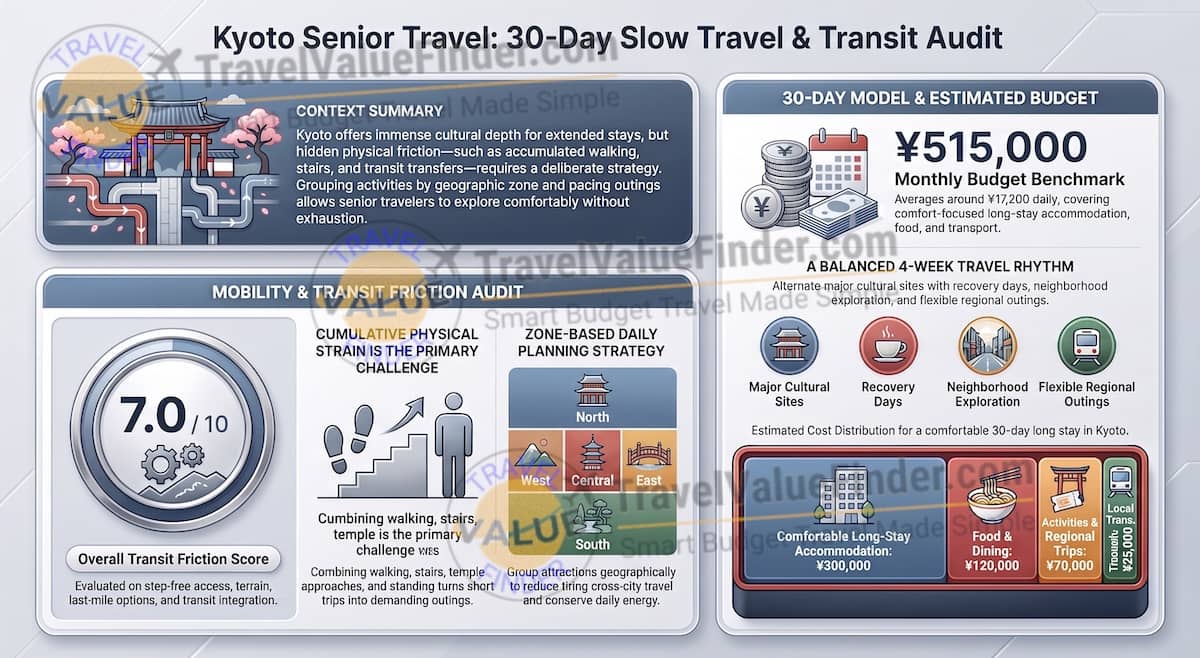
An Illustrative Kyoto Monthly Budget
This is a planning example rather than a current universal price quote. Actual costs vary significantly by season, accommodation type, neighborhood, dining style, exchange rates, and the number of paid attractions and excursions.
| Category | Illustrative Monthly Amount |
| Comfortable long-stay accommodation | ¥300,000 |
| Local transportation | ¥25,000 |
| Food and dining | ¥120,000 |
| Activities and regional trips | ¥70,000 |
| Illustrative total | ¥515,000 |
| Approximate daily equivalent | ¥17,200 |
The purpose of the model is to give a long-stay traveler a framework for planning. It should be adjusted to your own accommodation standard, travel style, and exchange-rate assumptions.
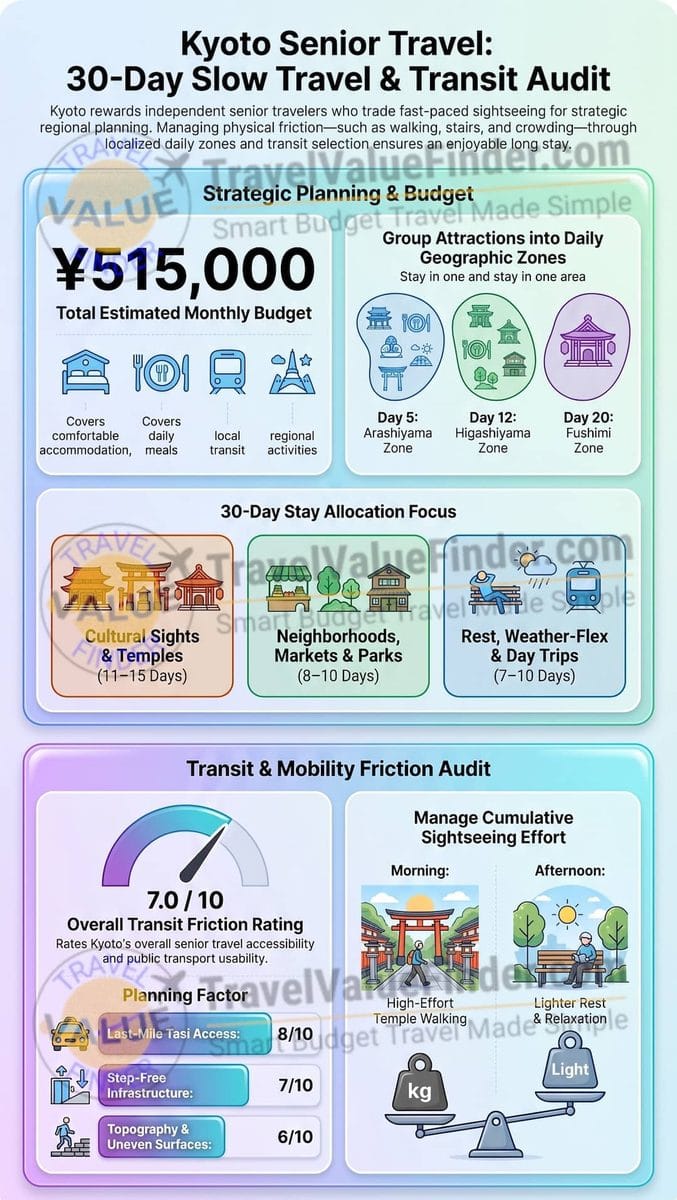
Kyoto Transit Friction Audit
Kyoto’s transportation system can make independent travel practical, but route choice matters. Buses, trains and walking often work together rather than one mode taking you directly from your accommodation to the attraction entrance.
For senior travelers, the key questions are the number of transfers, the walking required before and after transit, the amount of standing involved, crowd levels, and whether a taxi can provide a useful last-mile alternative when energy is low.
| Planning Factor | TVF Planning Score |
| Step-Free Infrastructure | 7/10 |
| Topography & Surfaces | 6/10 |
| Last-Mile Options | 8/10 |
| Senior Transit Integration | 7/10 |
| Overall Transit Friction Score | 7.0/10 |
These are Travel Value Finder editorial planning scores, not an official accessibility rating or certification. Individual stations, vehicles, routes, attractions, and personal mobility needs can differ.
Kyoto Walking: Temples, Stairs and Uneven Surfaces Matter
Walking is one of Kyoto’s greatest pleasures and one of the main issues to consider for senior travel. Historic districts can involve uneven paving, stone paths, steps, slopes, and long approaches to temples and shrines.
The problem is often cumulative rather than dramatic. One short walk is manageable. Several walks plus a temple complex plus standing in a queue plus another transfer can produce a much more demanding day.
A useful strategy is to treat walking as part of the day’s budget. If the morning involves a large temple complex, make the afternoon lighter. If a neighborhood walk is the main activity, do not automatically add several major sights afterward.
Crowds Are Part of Kyoto’s Physical Planning
Crowding deserves a place in a senior-travel audit because it can change the experience of moving through a destination. Busy approaches, queues, narrow streets and crowded transit can slow progress and reduce opportunities to sit or move at your own pace.
A slower traveler can respond by choosing timing carefully, visiting fewer attractions per day, and leaving flexibility to change plans when an area is unusually busy.
The goal is not to eliminate crowds completely. It is to avoid building a 30-day itinerary that assumes every famous attraction must be experienced at peak times.
Choosing the Right Kyoto Base
For a longer stay, the best accommodation is not necessarily the one closest to the most famous temple. Think about your everyday return journey.
- Convenient access to a train, subway, or useful bus route.
- A supermarket or everyday food options nearby.
- A pharmacy and other basic services within a comfortable distance.
- An elevator or clearly understood stair arrangement.
- A quiet sleeping area after busy sightseeing days.
- Kitchen and laundry facilities appropriate for a longer stay.
- Enough seating and living space for genuine rest days.
- An easy taxi option for the days when public transportation feels like too much effort.
Kyoto by Neighborhood: Think in Daily Life, Not Just Attractions
A month-long traveler will eventually stop thinking like a visitor every hour of the day. You will buy groceries, do laundry, eat ordinary meals, rest, and perhaps return home in the middle of the day.
That makes neighborhood convenience important. A location with reliable transportation and everyday services may be more useful than an expensive property chosen only because it is close to one famous attraction.
This is one reason the single-hub strategy works: you gradually learn which routes and neighborhoods make your own travel rhythm easier.
A Possible 30-Day Kyoto Rhythm
Week 1: Settle In and Learn the Neighborhood
Keep the first week relatively light. Find your grocery options, pharmacy, useful transit routes, cafés, and convenient places to sit. Add only a few major cultural attractions while you learn how much walking your chosen neighborhood and routes actually involve.
Week 2: Major Kyoto Cultural Experiences
Use the second week for the temples, gardens, historic areas and cultural experiences that matter most to you. Group activities geographically and avoid combining several physically demanding sites in one day.
Week 3: Neighborhoods, Nature and Regional Exploration
Mix quieter Kyoto days with one or two excursions. A riverside walk, market visit, garden, museum or café day can provide a valuable contrast to a temple-heavy sightseeing day.
Week 4: Revisit and Slow Down
Return to a neighborhood, garden, market, café or cultural site you particularly enjoyed. The final week can become less about collecting attractions and more about experiencing Kyoto as a temporary home.
Kyoto Day Trips and Regional Excursions
A single-hub trip does not mean staying inside Kyoto. It means choosing excursions selectively and considering the entire door-to-door effort.
| Possible Excursion | Senior-Travel Consideration |
| Nara | Major cultural attractions, but plan walking distance and the overall time on your feet. |
| Osaka | A different urban experience; consider whether the extra city movement adds enough value for your itinerary. |
| Uji | A potentially lower-commitment cultural excursion with tea and historic sights; plan walking according to your interests. |
| Lake Biwa area | Useful for travelers who want a change of scenery; exact route and activity should be matched to energy and season. |
The best day trip is not necessarily the most famous one. It is the one whose total transportation, walking and sightseeing effort fits comfortably into your week.
Kyoto Seasonal Considerations
Season is especially important in Kyoto because weather, scenery and visitor patterns can change the character of the city.
- Spring can bring attractive seasonal scenery but also periods of high demand and crowding.
- Autumn can be similarly popular. Summer can bring heat and humidity that make extended walking more demanding.
- Winter can offer a quieter atmosphere but requires preparation for colder weather and shorter daylight.
A 30-day stay provides an advantage: you can move outdoor activities around the weather instead of treating every day as fixed.
What to Look for in a Kyoto Long-Stay Apartment
- Elevator and building access that match your needs.
- Air conditioning and heating appropriate to the season.
- A practical bathroom layout.
- Convenient grocery and food options.
- Public transportation that works for your most frequent journeys.
- A quiet bedroom.
- Kitchen and laundry facilities.
- Comfortable seating and enough space for rest days.
Where Kyoto May Not Work as Well
Kyoto may be less comfortable for travelers who expect every major attraction to be easy to reach on foot or who prefer a completely flat, modern city environment.
Historic districts can involve uneven surfaces and stairs. Popular sites can become crowded. Some sightseeing days naturally require more standing and walking than a traveler expects.
The answer is usually not to remove Kyoto from the itinerary. It is to change the pace, reduce the number of daily attractions, use transportation and taxis strategically, and allow recovery time.
Who Is Kyoto Best Suited To?
Kyoto is particularly well suited to independent senior travelers who value Japanese culture, gardens, temples, traditional neighborhoods, food, history and the ability to spend several weeks exploring gradually.
It can suit travelers who enjoy walking in moderation and are willing to use transportation when distances or fatigue make walking inefficient.
It may require more careful planning for travelers with limited tolerance for stairs, uneven surfaces, heavy crowds, or long days on their feet. Accommodation and daily pacing become especially important in those circumstances.
Kyoto Senior Travel: The Bottom Line
Kyoto is not a destination where a simple ‘easy’ or ‘difficult’ label tells the whole story. Its senior-travel experience depends heavily on how you structure each day.
The strongest approach is to treat walking, stairs, crowds and transportation as part of the itinerary rather than as minor details. Choose a practical base, group attractions by area, use public transportation strategically, consider taxis when they reduce unnecessary effort, and build genuine rest days into the month.
Kyoto’s depth is its greatest advantage for slow travel. You do not need to keep moving to keep discovering something new.
Frequently Asked Questions
Is Kyoto good for seniors?
Kyoto can be an excellent destination for independent senior travelers who enjoy culture, gardens, temples, food and traditional neighborhoods. The main considerations are walking, stairs, uneven surfaces, crowds and the physical effort of sightseeing days.
Is Kyoto easy to get around?
Kyoto has several useful public transportation options, but many trips combine transit with walking. The complete door-to-door route matters more than the quality of any single transportation mode.
Is Kyoto good for slow travel?
Yes. Kyoto has enough cultural and neighborhood depth to support a multi-week stay. Slow travel also makes it easier to revisit places, avoid over-scheduling and adapt to weather or crowds.
How long should seniors stay in Kyoto?
A two- to four-week stay can work well for travelers who want to explore gradually. The right length depends on interests, budget, season and how many regional excursions you want to include.
What is the biggest senior-travel challenge in Kyoto?
The main issue is often cumulative physical effort: walking, standing, stairs, uneven surfaces, transfers and crowds can turn several individually manageable activities into a demanding day.
Where should seniors stay in Kyoto?
For a longer stay, prioritize a comfortable neighborhood with useful transportation, groceries, pharmacies, quiet sleeping conditions, building access that suits you, and reasonable options for taxis when needed.
Does Travel Value Finder provide an official accessibility rating for Kyoto?
No. The Transit Friction scores in this article are Travel Value Finder planning assessments. They are not official accessibility certification and do not replace checking the specific station, accommodation, attraction or route for your own needs.
Explore the Travel Value Finder Senior Travel Framework
Kyoto applies the Travel Value Finder Senior Travel framework to a historic Japanese destination where walking, stairs, crowds, seasonal conditions and the relationship between transit and sightseeing are central to the experience.
The Senior Travel pillar explains the overall strategy. This Kyoto audit shows how that strategy changes when the destination’s main friction points are historic surfaces, temple approaches, crowding and accumulated walking.
Next in the destination series: Tokyo.
Sources
- Japan National Tourism Organization, Kyoto Stations
- Kyoto Taxi Association, Kyoto Taxis
- City of Kyoto, One-Day Pass
- Kyoto City Bus & Subway Information Guide