Travel Value Finder

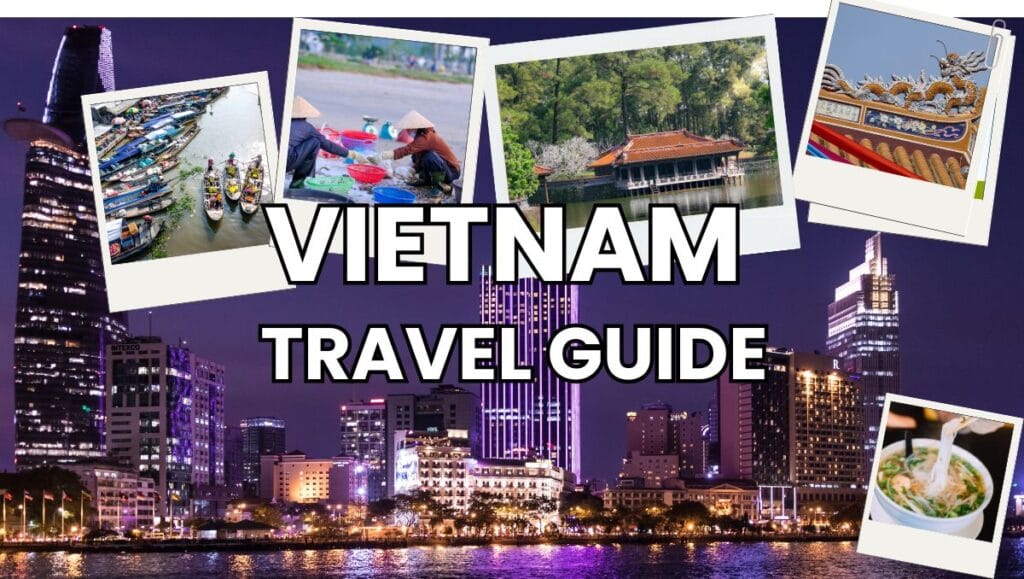
This Vietnam travel guide covers everything American travelers need to plan a trip:
- the best places to visit in Vietnam from north to south, realistic 2026 costs by city and travel style,
- the specific money-saving strategies that work here (and the traps that don’t),
- the e-visa process, transport between cities, and
- the one practical warning about Vietnamese currency that almost every first-timer gets caught by.
Disclaimer: This article is for general informational purposes only and does not constitute financial, investment, tax, legal, immigration, or other professional advice. Costs and other figures are estimates and can change. Always verify current information and consult a qualified professional before making significant financial, travel, or retirement decisions.
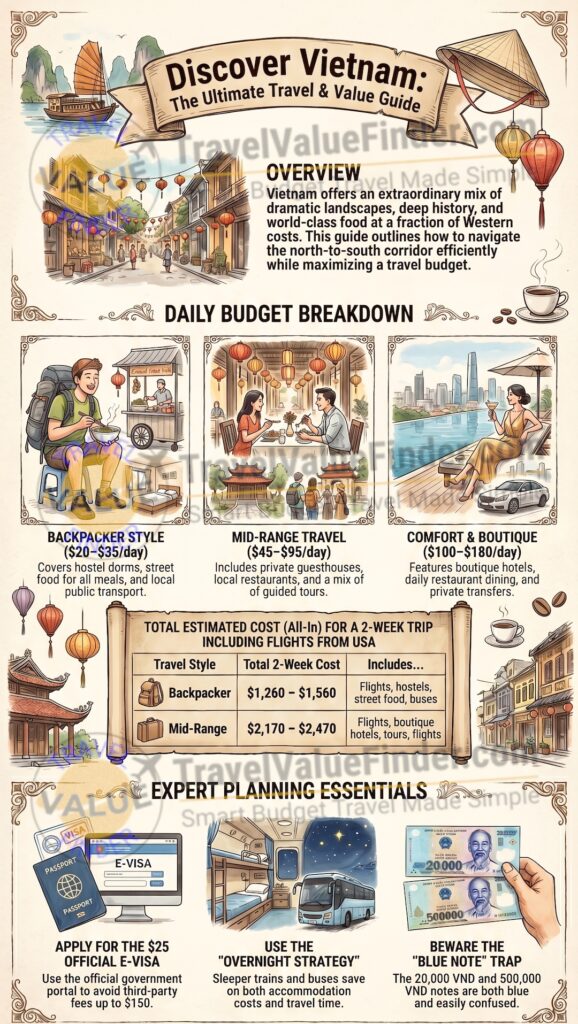
According to BudgetYourTrip.com’s 2026 Vietnam data, most travelers spend $1,200 – $2,400 for two weeks in Vietnam including flights. Less than one week in most Western European destinations.
How much does Vietnam cost per day?
| Travel Style | Daily Budget | Daily (VND) | 2-Week Total | What This Covers |
| Backpacker | $20 – $35 | 510K – 893K | $280 – $490 | Hostel dorm, street food all meals, public transport, temples |
| Mid-Range | $45 – $95 | 1.1M – 2.4M | $630 – $1,330 | Guesthouse/budget hotel, local restaurants, mix of transport, tours |
| Comfort | $100 – $180 | 2.5M – 4.6M | $1,400 – $2,520 | Boutique hotel, daily restaurant dining, private transfers, Ha Long cruise |
| Luxury | $183+ | 4.6M+ | $2,562+ | 5-star hotels, fine dining, private guides, premium Ha Long cruise |
Source: BudgetYourTrip.com 2026 (luxury avg $183/day); verified against real traveler data. Backpacker figure based on hostel dorm $6 – $10, street food $8 – $12/day, local transport $2 – $5. Excludes international flights, e-visa ($25), and inter-city transport.
Leslie Nics, TravelValueFinder.com | Updated April 2026 | Written for US travelers | Exchange rate used: 1 USD = 25,500 VND | All prices verified May 2026
Vietnam Visa for Americans: The E-Visa Process in 2026
Americans visiting Vietnam in 2026 require an e-visa.
Here is the complete, current information every traveler using this Vietnam travel guide needs to know:
| E-Visa Detail | 2026 Current Information |
| Cost | $25 USD. Paid online via the official Vietnamese government e-visa portal (evisa.xuatnhapcanh.gov.vn). Do NOT pay more. Third-party ‘visa services’ charge $50 – $150 for the same visa |
| Validity | 90 days, multiple entry. A major improvement over the old 15-day single-entry visa. You can stay up to 90 days and re-enter multiple times within the 3-month window |
| Processing time | 3 working days in most cases. Apply at least 7 – 10 days before travel to have a buffer |
| What you need | Valid passport (6+ months remaining), passport photo, entry/exit point, credit card for $25 payment, accommodation address for first night |
| ETIAS note | Vietnam is NOT in the Schengen Area. ETIAS (the new European pre-travel authorization from Q4 2026) does not apply to Vietnam entry |
| VND confusion warning | ⚠ Critical: The 20,000 VND note (blue) and 500,000 VND note (also blue) look dangerously similar in low light. Mixing them up means paying 25x more than intended. Handle cash carefully, especially at night markets and street vendors. Always check denominations in good light |
Best Places to Visit in Vietnam: The North-to-South Corridor
Vietnam runs 1,650 km from north to south – roughly the distance from New York to Miami.
The classic Vietnam travel guide route follows the country top to bottom: Hanoi in the north – Ha Long Bay – Hue – Hội An – Da Nang – Nha Trang – Ho Chi Minh City (with a Mekong Delta day trip).
Hanoi. Vietnam’s Extraordinary, Chaotic, Irresistible Capital
Daily budget: $22 – $40 | Best for: First impression of Vietnam, street food, Old Quarter, Ha Long Bay base | Recommended stay: 3 – 4 nights
Hanoi is the start of almost every Vietnam travel guide itinerary, and for good reason.
The Old Quarter, with its narrow streets each historically dedicated to a specific trade (Silk Street, Tin Street, Paper Street), is genuinely unlike any other urban environment in Southeast Asia.
The energy is extraordinary. Motorbikes weave in every direction, street vendors balance bamboo poles loaded with fruit, and the smell of pho drifts from a hundred unseen kitchens.
Somewhere behind a doorway that looks like a wall is a courtyard café where Vietnamese coffee drips slowly into condensed milk over ice.
| Hanoi Essential | Cost | Notes |
| Hostel dorm (Old Quarter) | $7 – $12/night | Best social hostels: Hanoi Rocks, Vietnam Backpacker Hostels |
| Pho from a street cart | $1.50 – $2.50 | Best at 6 – 8am when the broth is fresh. Follow the locals, not the signs |
| Egg coffee (cà phê trứng) | $1.50 – $2.50 | Hanoi’s iconic invention. Whipped egg yolk over strong coffee. Café Đinh is the original |
| Ho Chi Minh Mausoleum | FREE (Tue – Thu, Sat – Sun, 8 – 11am) | Queue early; dress respectfully; no shorts or sleeveless tops |
| Hoa Lo Prison (Hanoi Hilton) | $1.60 (40,000 VND) | Deeply affecting; essential context for understanding modern Vietnamese history |
| Temple of Literature | $1.40 (35,000 VND) | Vietnam’s first university (1076 AD); beautiful pavilions and lotus ponds |
| Bia hoi at a Hoan Kiem corner | $0.20 – $0.40/glass | The cheapest beer on earth. Fresh-brewed Vietnamese draught beer. Sit on plastic stools. This is Hanoi. |
| Daily total | $22 – $35 (backpacker) | $40 – $65 (mid-range) |
Hue. Imperial City, Royal Tombs, and the Best Bánh Mì in Vietnam
Daily budget: $20 – $35 | Best for: History, Nguyen dynasty architecture, incredible local food | Recommended stay: 2 nights
Hue is one of the most underrated stops on the Vietnam travel guide route.
A city that rewards slow travel and genuine curiosity in a way that busier Hội An and Hanoi sometimes do not.
The Imperial Citadel (modeled on Beijing’s Forbidden City, built 1804 – 1833) costs $8 to enter and is genuinely extraordinary. A walled palace complex covering 3 square kilometres with moats, gates, pavilions, and gardens.
The Royal Tombs along the Perfume River are among Vietnam’s most atmospheric historical sites.
Each emperor built his own tomb complex, and exploring them by rented bicycle ($2 – $4/day) through the surrounding pine forests is one of Vietnam’s best half-day experiences.
- Hue food: Hue cuisine is considered Vietnam’s most sophisticated – the former imperial capital developed a distinctly elaborate food culture. Bún bò Huế (spicy beef noodle soup, distinctly more complex than pho) is $1.50 – $2.50 from local shops. Bánh khoái (crispy Vietnamese pancake with shrimp and pork) is $3 – $5. Nem lụi (lemongrass-skewered pork) is $1 – $2 per stick. These are all local to Hue and unavailable at the same quality elsewhere in Vietnam
- Transport: Hue is on the main train line. Sleeper train from Hanoi: $22 – $32 (8 – 10 hours, book the 4-berth sleeper cabin). Bus from Hoi An: $3 – $5 (3 hours, cheaper than train for short distance)
Hội An. Vietnam’s Most Beautiful Town and Best-Value Boutique Destination
Daily budget: $25 – $45 | Best for: Ancient Town, beaches, tailoring, cooking classes | Recommended stay: 3 – 4 nights
Hội An is the highlight of virtually every Vietnam travel guide, and the most photographed place in Vietnam.
The UNESCO-listed Ancient Town, with its Chinese merchant houses, Japanese Covered Bridge, pagodas, and lantern-draped streets is extraordinary in daylight. It is genuinely magical after dark when the lanterns are lit and the Thu Bồn River reflects them from below.
The Ancient Town day ticket costs $5 (120,000 VND) and covers access to five specific attractions including the Japanese Covered Bridge and traditional merchant houses.
Hội An is also where the Vietnam travel guide delivers its most remarkable accommodation value:
- boutique hotels with pool,
- traditional Vietnamese architecture,
- generous breakfasts, and
- genuinely warm staff in beautiful garden settings cost $35 – $60/night.
The same quality in Bangkok or Bali would cost $80 – $120.
A cooking class (morning market visit + five dishes + recipe booklet) costs $25 – $35.
A bicycle to An Bang Beach (3km from the old town) costs $1 – $2/day to rent.
And the food, cao lầu (thick rice noodles unique to Hội An), white rose dumplings (hoa trắng bánh), bánh mì from the legendary Phượng is at its absolute best here.
| Hội An Essential | Cost | Notes |
| Ancient Town ticket (5 attractions) | $5 (120,000 VND) | Buy at one of the ticket booths on entry to the old town |
| Bánh mì from Phượng | $1.50 – $2.50 (40,000 VND) | The original famous bánh mì, cited by Anthony Bourdain. Queue at 7 – 9am and 11am – 1pm |
| Cooking class (half day) | $25 – $35 | Includes market visit, 4 – 5 dishes, recipe booklet. Morning classes always include market |
| Bicycle rental (full day) | $1.50 – $3 (40,000 – 75,000 VND) | Rent from your hostel or any shop on the main street. Use to reach An Bang Beach |
| My Son Sanctuary day trip | $6 entry + $8 – $15 transport | Cham temple ruins from 4th – 14th century AD; 45 min from Hội An. Worth visiting independently |
| Daily total | $25 – $40 (backpacker) | $50 – $80 (mid-range with pool hotel) |
Ho Chi Minh City. Vietnam’s Energy Capital and Entry Point for the South
Daily budget: $25 – $45 | Best for: War history, food, nightlife, Mekong Delta base | Recommended stay: 2 – 3 nights
Ho Chi Minh City (still called Saigon by virtually everyone who lives there) is everything Hanoi is but louder, faster, and more relentlessly ambitious.
As a destination in a Vietnam travel guide, it serves two purposes:
- essential historical context (the War Remnants Museum is one of the most affecting history museums in Southeast Asia with entry $1.60), and
- a gateway for the Mekong Delta and Phu Quoc island.
The Cu Chi Tunnels, the 250km tunnel network used by the Viet Cong during the American War, and 70km northwest of the city, are one of Vietnam’s most visited sites ($8 entry, $15 – $20 for a half-day group tour from the city).
| HCMC Essential | Cost | Notes |
| War Remnants Museum | $1.60 (40,000 VND) | Open daily 7:30am – 5:30pm. Plan 90 – 120 minutes. Emotionally difficult; historically essential |
| Cu Chi Tunnels (group tour) | $15 – $20 (tour) + $8 (entry) | Half-day from HCMC. Book through hostel for lowest price vs. street tour agencies |
| Grab motorbike (city ride) | $0.80 – $1.50 per 2 – 3km | Use Grab app always. Transparent metered pricing vs. negotiated scooter taxis |
| Ben Thanh Market | Free entry; negotiate all prices | Start at 40 – 50% of asking price. Best for lacquerware, textiles, coffee, souvenirs |
| Phu Quoc domestic flight | $20 – $50 (booked early) | Vietnam’s premier beach island; 1-hour flight; excellent snorkelling and sunset beaches |
Vietnam Food Guide: What to Eat, Where to Find It, What It Costs
Food is the single greatest reason to visit Vietnam.
This is the best argument for traveling on a Vietnam travel guide budget rather than a luxury one.
The finest Vietnamese food is not in the upscale restaurants.
It is at the street carts and market stalls where the ingredients were bought that morning and the recipes have not changed in generations.
Here is the complete guide to what to eat in Vietnam and what it costs:
Vietnam Essential Dishes and Real 2026 Prices
| Dish | Local Price | USD | Where to Find the Best Version |
| Phở (noodle soup) | 35,000 – 60,000 VND | $1.40 – $2.35 | Hanoi for phở bò (beef); HCMC for phở gà (chicken). Best at dedicated phở shops open 6 – 10am only |
| Bánh mì (baguette sandwich) | 20,000 – 40,000 VND | $0.78 – $1.57 | Hội An (Phượng’s); every city has excellent versions. Best from carts with glass cases, not indoor shops |
| Bún chả (grilled pork + noodles) | 40,000 – 60,000 VND | $1.57 – $2.35 | Hanoi specialty. The dish Barack Obama and Anthony Bourdain famously ate together in Hanoi. Every local restaurant serves it |
| Bún bò Huế (spicy beef noodles) | 35,000 – 55,000 VND | $1.37 – $2.16 | Hue city only (authentic). Spicier, more complex than pho. The best Vietnam noodle dish many travelers have never heard of |
| Bánh xèo (sizzling pancake) | 30,000 – 60,000 VND | $1.18 – $2.35 | Crispy rice flour pancake with shrimp and pork, wrapped in lettuce. Central and southern Vietnam specialty |
| Cà phê sữa đá (iced coffee) | 15,000 – 30,000 VND | $0.59 – $1.18 | Everywhere. Vietnam’s robusta coffee with condensed milk over ice. One of the world’s great coffee experiences |
| Bia hơi (fresh draft beer) | 5,000 – 10,000 VND | $0.20 – $0.39 | Hanoi’s bia hoi corners – plastic stools on the pavement, fresh-brewed beer served in small glasses. The cheapest beer on earth |
| Cơm tấm (broken rice + pork) | 35,000 – 60,000 VND | $1.37 – $2.35 | HCMC specialty. The definitive Saigon breakfast – grilled pork ribs over broken rice with fish sauce. Best from small street shops |
| Tourist restaurant mark-up | 100,000 – 250,000 VND | $3.92 – $9.80 | The same dishes above cost 3 – 5x more at tourist-facing restaurants with photo menus. Eat where locals eat. The plastic stool is always better than the tablecloth |
Getting Around Vietnam: Transport Costs and the Overnight Option
Transport is where strategic decisions in this Vietnam travel guide save the most money.
Here is the complete transport breakdown for the north-to-south route:
Vietnam Inter-City Transport Guide 2026
| Route | Option | Duration | Cost | Notes |
| Hanoi – Hue | Sleeper train | 10 – 12 hrs | $22 – $32 | Best option: 4-berth soft sleeper. Overnight saves accommodation. Spectacular coastal mountain scenery on the last section |
| Hanoi – Hue | Budget flight | 1.5 hrs | $25 – $60 | VietJet or Bamboo Airways. Faster but misses the train scenery and overnight accommodation saving |
| Hue – Da Nang | Train | 2.5 hrs | $5 – $8 | Best scenic train section in Vietnam. The Hải Vân Pass coastal section is breathtaking. Seats fine; no need for sleeper |
| Da Nang – Hội An | Public bus #1 | 45 min | $0.60 (15,000 VND) | World’s best-value transport option. Runs every 15 – 20 min. Grab car alternative: $4 – $6 |
| Hội An – Nha Trang | Sleeper bus | 12 hrs | $15 – $19 | Overnight. Save accommodation. Reputable operators: The Sinh Tourist, Camel Travel, Hoi An Express |
| Hanoi – HCMC (all the way) | Reunification Express train | 33 – 37 hrs | $45 – $75 | One of Asia’s great rail journeys. 4-berth sleeper cabin. Covers the entire country in one extraordinary ride |
| Any city pair (fast option) | Budget domestic flight | 1 – 2 hrs | $20 – $60 | VietJet Air, Bamboo Airways, Vietnam Airlines. Book 2 – 4 weeks ahead. Excellent for Hanoi – HCMC or HCMC – Phu Quoc |
| City transport (Hanoi/HCMC) | Grab motorbike | 5 – 20 min | $0.80 – $2 | Always use Grab app for transparent, metered pricing. Do not accept unsolicited motorbike rides |
The overnight transport strategy:
- The Hanoi – Hội An – HCMC corridor can be done almost entirely on overnight buses and trains. This eliminates 4 – 5 nights of accommodation costs on a 14-day trip.
- Budget travelers who use overnight transport for 4 of their long-distance moves save $40 – $80 in accommodation versus day travel + separate hotel stays.
- This is the most powerful single strategy in this Vietnam travel guide for stretching a budget.
Vietnam 2-Week Trip Cost: Real Budget Breakdown
Route: Hanoi (3 nights) – Ha Long Bay cruise (2 nights) – Hue (2 nights) – Hội An (4 nights) – Ho Chi Minh City (3 nights).
See detailed 14-Day Itinerary in our Vietnam Travel Budget article.
10 Vietnam Budget Travel Tips That Actually Work
- Eat where the queue is longest and there is no English menu: The best Vietnamese food is always where locals eat. A pho shop with a queue of Vietnamese workers at 7am is better than any restaurant with photos on the menu. The plastic stool café is the rule; the tourist restaurant is the exception. One local meal per day vs. one tourist restaurant saves $5 – $15 per day, and $70 – $210 over two weeks.
- Use overnight buses and trains as your accommodation: Every overnight sleeper bus or train simultaneously transports you and eliminates a night’s accommodation. On a 14-day Hanoi-to-HCMC trip, 4 overnight journeys save $40 – $80 in hostel costs while covering the distances that define the journey. Book through Expedia’s bundle packages.
- Never pay more than $25 for the e-visa. Apply directly: The Vietnamese e-visa costs exactly $25 via the official government portal. Third-party ‘visa services’ charge $50 – $150 for an identical result. Go directly to evisa.xuatnhapcanh.gov.vn and save $25 – $125 before you even arrive.
- Buy a Viettel SIM immediately at the airport: Viettel 30-day 20GB SIM costs $6 – $8 at every airport and convenience store. Your phone is your navigation, translation, transport-booking, and scam-avoidance tool in Vietnam. Keep it connected for under $8/month.
- Watch the VND note denominations carefully: The 20,000 VND (blue) and 500,000 VND (also blue) notes are dangerously similar in low light. Confusing them means paying 25x more than intended. Always check denominations in good light. This mistake costs travelers $15 – $50 before they notice – completely preventable with 5 seconds of attention.
- Book Ha Long Bay directly through a hostel, not a tourist-street agency: Tourist agencies on Hanoi’s main backpacker streets add $20 – $40 in commission to Ha Long Bay cruises. The same cruise booked through your hostel or directly with the operator costs $90 – $120. The quality is identical; the price is 20 – 30% lower.
- Negotiate at markets starting at 40 – 50% of the first price: At Ben Thanh Market (HCMC) and Dong Xuan Market (Hanoi), the opening price is 2 – 3x the acceptable price. Counter at 40 – 50% of the first offer. The final agreed price is typically 60 – 70% of the original. Do not feel rude. This is the expected process and vendors budget for it.
- Use Grab instead of xe ôm (motorbike taxis): Xe ôm drivers in tourist areas quote $3 – $5 for trips that Grab prices at $0.80 – $1.50. Always use Grab for city transport. It is metered, transparent, and significantly cheaper. The Grab app works in all major Vietnamese cities.
- Visit Hội An’s Ancient Town at night, not just during the day: The Ancient Town ticket ($5) admits you to specific attractions. But the streets, the lanterns, the river reflections, the silk shops, the food stalls are free to walk day and night. The best time to be in Hội An is after 7pm when the lanterns are lit. This costs nothing beyond your dinner.
- Travel during shoulder season (April – June or Sept – Oct): Peak season (December – January in the south; July – August everywhere) means higher accommodation prices and more crowded sites. Shoulder season delivers 20-30% lower accommodation costs across Vietnam and meaningfully fewer visitors at Hội An’s Ancient Town and Ha Long Bay
Frequently Asked Questions: Vietnam Travel Guide
How much does a trip to Vietnam cost?
According to BudgetYourTrip.com’s 2026 Vietnam data, most travelers spend $1,200 – $2,400 for two weeks in Vietnam including flights. This is less than one week in most Western European destinations. On the ground (excluding international flights), a backpacker spends $20 – $35/day, a mid-range traveler $45 – $95/day, and a comfort traveler $100 – $180/day. Our 14-night Hanoi-to-HCMC trip arrives at $610 on-ground for backpackers ($44/day) and $1,420 for mid-range ($101/day). International flights from the USA to Vietnam (Hanoi or HCMC) typically cost $650 – $1,050 round-trip via Seoul, Tokyo, or Singapore.
What are the best places to visit in Vietnam?
The classic Vietnam travel guide route covers: Hanoi (3 – 4 nights: Old Quarter, street food, temple of literature, bia hoi culture), Ha Long Bay (2 days/1 night: limestone karsts, cave kayaking, overnight cruise), Hue (2 nights: Imperial Citadel, Royal Tombs, Hue cuisine), Hội An (3 – 4 nights: Ancient Town lanterns, beaches, cooking classes, bánh mì Phượng), Ho Chi Minh City (2 – 3 nights: War Remnants Museum, Cu Chi Tunnels, Ben Thanh Market).
Do Americans need a visa for Vietnam?
Yes, Americans require an e-visa to enter Vietnam. The 2026 e-visa costs $25 USD, grants a 90-day stay with multiple entry, and is processed online via the official Vietnamese government portal (evisa.xuatnhapcanh.gov.vn) in approximately 3 working days. Apply at least 7 – 10 days before travel. Do not use third-party ‘visa services’ that charge $50 – $150 for the same result.
What is the best time to visit Vietnam?
Vietnam’s best time to visit depends on which region you are prioritizing. Northern Vietnam (Hanoi, Ha Long Bay): October – April for cool and dry weather. May – September is hot and occasionally typhoon-affected. Central Vietnam (Hue, Hội An, Da Nang): February – August offers the driest weather; September – January brings heavy rain and occasional flooding in Hội An’s ancient town. Southern Vietnam (HCMC, Mekong Delta, Phu Quoc): November-April (dry season) is ideal; May – October is monsoon season with afternoon downpours. For the full Hanoi-to-HCMC route, February – April and October – November are the best compromise months with reasonable weather throughout the country and lower accommodation prices than peak season (December – January).
Is Vietnam safe for solo travelers?
Yes, Vietnam is one of the safest countries in Southeast Asia for solo travelers, including solo female travelers. Violent crime against tourists is rare. The main safety considerations are: (1) traffic: Vietnamese roads are genuinely chaotic; use crosswalks at busy junctions, follow the ‘walk slowly and steadily’ rule that lets motorbikes flow around you, and avoid renting a motorbike unless you have significant riding experience; (2) scams: common in tourist areas, typically involving overcharging for transport or fake tours. Use Grab for all city transport, book Ha Long Bay through your hostel, and research taxi prices before getting in; (3) petrol station motorbike taxi drivers who approach tourists at bus stations and airports. Always use Grab or a pre-booked taxi at airports. For the full solo travel safety guide, see: Solo Travel Tips for First-Timers: How to Travel Alone Safely
What food should I eat in Vietnam?
The Vietnam travel guide food essential list: phở (beef or chicken noodle soup; the national breakfast, best in Hanoi, $1.50 – $2.50 from a street cart), bánh mì (Vietnamese baguette sandwich with pork/pâté/vegetables; world’s most satisfying $1 meal, best from Phượng in Hội An), bún chả (Hanoi’s grilled pork and noodles with dipping sauce; the dish Obama and Bourdain shared), bún bò Huế (spicy beef noodle soup, unique to Hue; more complex than pho, genuinely extraordinary), cơm tấm (broken rice with grilled pork, HCMC specialty; the definitive Saigon breakfast), cà phê sữa đá (Vietnamese iced coffee with condensed milk; one of the world’s great coffee experiences at $0.60 – $1.20), and bia hơi (fresh-brewed draught beer in Hanoi at $0.20 – $0.40/glass; the cheapest beer on earth, served on plastic stools at pavement corners).
How long should I spend in Vietnam?
The optimal Vietnam travel guide duration is 14 – 21 days for the full north-to-south route (Hanoi – Ha Long – Hue – Hội An – Ho Chi Minh City). Fourteen days is tight but achievable; 21 days allows time for Ninh Binh, Phong Nha caves, and Phu Quoc island without feeling rushed. A 7-day trip is possible but requires focusing on one region only; either the north (Hanoi + Ha Long Bay) or the central/south (Hội An + HCMC). The 90-day multiple-entry e-visa introduced in 2023 now makes longer stays significantly more practical for remote workers, retirees, and slow travelers who want to use Vietnam as an extended base.
Final Thoughts: Vietnam Rewards Travelers Who Show Up and Pay Attention
This Vietnam travel guide can give you
- the prices,
- the visa details,
- the transport routes, and
- the strategic advice.
What it cannot give you is the experience itself.
Vietnam does that for $20 – $35 a day if you travel smart. It does it generously with extraordinary food, extraordinary landscapes, and a population that has been through more than most countries in the past century.
Go. Eat the pho. Drink the bia hoi. Take the overnight train. Let the country show you what it is.
You will come back different. In the best possible way.
Book your Vietnam trip at the best prices. Our trusted partner searches hundreds of providers: Find Cheap Vietnam Flights and Hotels – TravelValueFinder. We earn a small commission at no extra cost to you.
Affiliate Disclaimer: Some links in this article are affiliate links. We may earn a referral commission on qualifying bookings at no additional cost to you.