Travel Value Finder

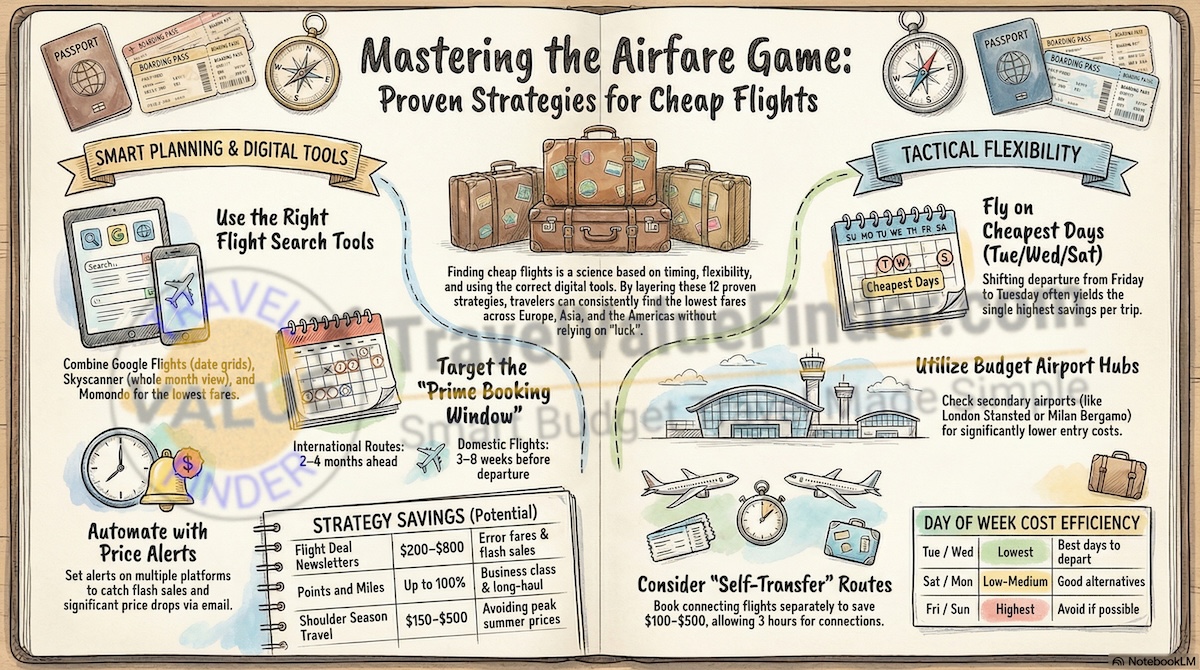
Looking for proven strategies on how to find cheap flights? Finding cheap flights is part science, part timing, and part knowing where to look. After years of booking budget travel across three continents — and helping thousands of readers do the same through TravelValueFinder — I have refined these strategies into a reliable, repeatable system that consistently saves $200 to $600 on return flights.
By Leslie, TravelValueFinder.com | Last updated: April 2026 | Based on years of booking budget travel across Europe, Asia, and the Americas
Whether you are searching for cheap flights to Europe, a last-minute domestic deal, or the best international airfare, these 12 strategies work. They are not hacks or loopholes that disappear overnight — they are grounded in how airline pricing actually works, and they are updated for 2026.
The travelers who consistently pay the least for flights are not lucky — they are prepared. They know when to search, where to search, and when to pull the trigger. — Leslie, TravelValueFinder.com
Discover how to find cheap flights with this quick infographic, featuring 12 proven strategies to help you save money and book smarter on your next trip.
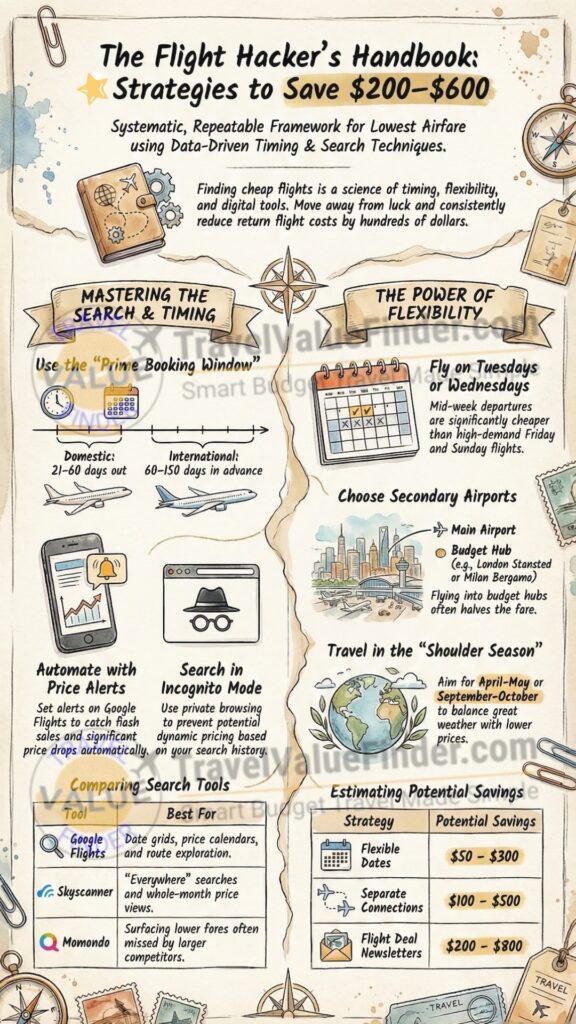
How to Find Cheap Flights: 12 Strategies at a Glance
| # | Strategy | Potential Saving |
| 1 | Use the right flight search tools | Baseline — find true lowest fares |
| 2 | Be flexible on dates | $50–$300 per round trip |
| 3 | Be flexible on airports | $50–$250 per trip |
| 4 | Book at the optimal time | $100–$400 on international routes |
| 5 | Set up flight price alerts | $80–$300 vs. booking blind |
| 6 | Use budget airlines strategically | $40–$200 on intra-regional routes |
| 7 | Book connecting flights separately | $100–$500 on select routes |
| 8 | Use points and miles | Up to 100% off flights |
| 9 | Travel in shoulder or off-peak season | $150–$500 vs. peak season |
| 10 | Use flight deal newsletters and alerts | $200–$800 on error fares & flash sales |
| 11 | Clear cookies or use incognito mode | $20–$80 (prevent dynamic pricing) |
| 12 | Consider nearby destination airports | $30–$200 per trip |
Strategy 1: Use the Right Flight Search Tools
Not all flight search engines are equal. Some surface deals others miss; some have superior date-grid views that make flexible searching effortless. Use a combination of these for every search:
| Tool | Best For | Link |
| Google Flights | Date grid, price calendar, route explorer | flights.google.com |
| Skyscanner | Whole Month view, ‘Everywhere’ search | skyscanner.com |
| Kayak | Price forecasting, multi-city trips | kayak.com |
| Momondo | Often surfaces lower fares than competitors | momondo.com |
| Kiwi.com | Multi-stop and self-transfer combinations | kiwi.com |
Pro tip: always check the airline’s own website after finding a fare on an aggregator. Budget airlines like Ryanair, EasyJet, and Wizz Air often only sell their cheapest seats directly.
Strategy 2: Be Flexible on Dates
Date flexibility is the single most powerful lever you have over flight prices. Shifting your departure or return by even one or two days can save $50–$300 on a return trip.
Cheapest Days to Fly (General Pattern)
| Day of Week | Typical Cost | Verdict |
| Tuesday | Lowest | Best day to depart |
| Wednesday | Low | Excellent alternative |
| Saturday | Low | Good for leisure travel |
| Monday | Medium | Acceptable |
| Thursday | Medium | Acceptable |
| Sunday | High | Avoid if possible |
| Friday | Highest | Most expensive day |
Use Google Flights’ date grid or Skyscanner’s Whole Month view to see the price across every date at a glance — this takes the guesswork out entirely.
In my experience booking dozens of Europe trips, shifting a Friday departure to Tuesday has consistently saved me more money than any other single change I could make. — Leslie, TravelValueFinder.com
Strategy 3: Be Flexible on Airports
Major cities are often served by multiple airports — and the price difference between them can be dramatic. Always check all nearby airports before assuming you know the cheapest entry point.
| Destination City | Main Airport | Budget Alternative |
| London, UK | Heathrow (LHR) | Stansted, Luton, Gatwick |
| Paris, France | CDG | Beauvais (BVA) — 90 min out |
| Rome, Italy | Fiumicino (FCO) | Ciampino (CIA) |
| Milan, Italy | Malpensa (MXP) | Bergamo (BGY) — Ryanair hub |
| Barcelona, Spain | El Prat (BCN) | Girona (GRO) — 90 min |
| New York, USA | JFK / Newark | Stewart (SWF) for some LCCs |
For our full destination guides — including transport from budget airports into city centres — see our Europe Travel Guides on TravelValueFinder.
Strategy 4: Book at the Optimal Time
Booking too early or too late both cost you money. Research consistently shows there is an optimal booking window for each type of route:
| Route Type | Optimal Booking Window | Notes |
| Transatlantic (US/Canada → Europe) | 2–4 months ahead | Prices spike within 3 weeks of departure |
| Intra-European | 4–8 weeks ahead | Budget airlines release cheap seats early |
| Long-haul (Asia, Australia) | 3–6 months ahead | Earlier is generally better |
| Domestic flights | 3–8 weeks ahead | Last-minute domestic deals do exist |
| Holiday / peak season | 4–6 months ahead | Christmas/summer — book very early |
According to data from CheapAir’s annual flight booking study, the “prime booking window” for US domestic flights is 21–60 days before departure. For international routes, 60–150 days is typically optimal.
Strategy 5: Set Up Flight Price Alerts
Price alerts are one of the most underused tools in budget travel. Instead of manually checking prices every day, you set an alert and the search engine emails you when the price drops.
How to Set Up Alerts on Google Flights
- Go to Google Flights and search your route
- Toggle on “Track prices” below the search bar
- Google will email you when prices rise or fall significantly
- Use the price insights panel to see whether current prices are low, typical, or high for your route
Skyscanner and Kayak also offer alert systems. Setting alerts on two or three platforms simultaneously maximises your chances of catching a genuine price drop.
I always set alerts for any trip I’m planning more than 6 weeks away. On my last Rome booking, an alert caught a flash sale that dropped the fare by $340 — I wouldn’t have spotted it manually. — Leslie, TravelValueFinder.com
Strategy 6: Use Budget Airlines Strategically
Budget carriers have transformed the economics of European travel — a flight that would cost $180 on a legacy carrier often costs $20–$60 on a low-cost airline. But they require careful handling to avoid hidden fees that erode the savings.
Major Budget Airlines by Region
| Airline | Strongest Routes | Key Watch-Out |
| Ryanair | Western & Central Europe-wide | Strict cabin bag rules; check before booking |
| EasyJet | UK, France, Spain, Italy, Switzerland | Second bag fees add up quickly |
| Wizz Air | Central & Eastern Europe | Fees for seat selection and priority boarding |
| Transavia | France, Portugal, Netherlands | More generous than Ryanair on baggage |
| Vueling | Spain & Southern Europe | Often competitive vs. Iberia on Spain routes |
| Norwegian | Scandinavia, transatlantic | Reduced long-haul network post-COVID |
Always book directly on the airline’s own website for the cheapest fares — budget carriers often do not list their lowest prices on aggregators. Before booking, check the full Ryanair baggage policy and equivalent pages for other carriers.
Strategy 7: Book Connecting Flights Separately (Self-Transfer)
Airlines charge a significant premium for seamless connections because they assume responsibility for rebooking if you miss a connection. When you book each leg separately, you take on that risk — but you can save $100–$500 on certain routes.
Example: Instead of booking London → Tokyo as one itinerary, search London → Helsinki on Finnair, then Helsinki → Tokyo on ANA separately. The combined price can be dramatically lower.
Self-Transfer Rules to Follow
- Allow at least 2.5–3 hours minimum connection time (more at large, complex airports)
- Only do this with carry-on luggage — checked bags complicate self-transfers significantly
- Understand you forfeit rebooking protection if your first flight is delayed
- Use Kiwi.com’s “Nomad” search — it is specifically designed to find self-transfer combinations
- Travel insurance that covers missed connections is strongly recommended for this approach
For more on planning complex European trips, see our How to Travel Europe on a Budget: The Complete 2026 Guide for rail and transport alternatives that sometimes beat flying altogether.
Strategy 8: Use Points and Miles
Points and miles programs are how frequent travelers — and savvy occasional travelers — fly for free or for a fraction of the cash price. The entry point is simpler than most people realize.
How to Get Started with Points and Miles
- Get a travel rewards credit card — cards like the Chase Sapphire Preferred, Capital One Venture, or American Express Gold earn points on everyday spending
- Sign up for the free frequent flyer programs of airlines you use — even occasionally. Points accumulate even without a co-branded card
- Transfer credit card points to airline partners — this is where the best value is unlocked. Amex Membership Rewards, Chase Ultimate Rewards, and Capital One miles all transfer to multiple airline programmes
- Target business class and premium cabin awards — points provide the most value when redeeming for seats that would otherwise cost $2,000–$8,000 in cash
A single welcome bonus on a travel credit card (typically 60,000–100,000 points after a minimum spend) can be worth one or two return transatlantic flights in economy — or a business class one-way.
Points and miles are not just for frequent business travelers. I earned enough points from a single credit card welcome bonus to fly return to Japan in economy — entirely free. Anyone can do this with a little planning. — Leslie, TravelValueFinder.com
Strategy 9: Travel in Shoulder or Off-Peak Season
When you travel matters almost as much as how you book. Peak season prices — particularly June through August for European destinations — can be 40–80% higher than shoulder season equivalents.
| Season | Period | Flight Price | Crowds |
| Peak | Jun–Aug, Christmas, Easter | Highest | Very busy |
| Shoulder | Apr–May, Sep–Oct | Moderate | Manageable |
| Off-peak | Nov–Mar (excl. Christmas) | Lowest | Quiet |
For our destination-specific ‘best time to visit’ guides — which include local weather, crowd levels, and seasonal price breakdowns — see:
Strategy 10: Use Flight Deal Newsletters and Alert Services
Error fares — genuine pricing mistakes by airlines — and flash sales appear briefly and disappear fast. You will never find them through casual searching. Dedicated flight deal services monitor thousands of routes 24/7 and alert subscribers the moment a deal appears.
Best Flight Deal Services (2026)
- Going (formerly Scott’s Cheap Flights) — Best for US and Canada departures; premium membership unlocks the best deals first
- Secret Flying — Strong for European and long-haul deals; free to use
- The Flight Deal — US-centric; excellent for business class and premium error fares
- Fly4Free — European focus; strong Eastern Europe and transatlantic deals
- Airfarewatchdog — Good for domestic US deals
The free tiers of these services are genuinely useful. Premium tiers (typically $25–$50 per year) give you first access to deals before they sell out — often worth the cost on a single booking.
Strategy 11: Search in Incognito Mode (and Clear Cookies)
Whether dynamic pricing based on search history genuinely exists is debated among travel experts — but the practise costs nothing and eliminates any risk. Always search for flights in incognito or private browsing mode, which prevents cookies from being stored between sessions.
Additional Price-Display Tips
- Change your VPN location to the destination country — fares are sometimes cheaper when purchased from the destination’s local market
- Switch the currency in flight search tools — occasionally prices differ by currency due to local market adjustments
- Search in the local language — some airline websites show different prices to different regional audiences
- Compare prices across devices — some users have reported minor differences between mobile and desktop pricing
These savings are typically modest ($20–$80) compared to the strategic savings from strategies 1–10, but they are free and take seconds to implement.
Strategy 12: Consider Nearby Destination Airports
Sometimes the cheapest way to reach a destination is to fly into a nearby city and travel overland. This is particularly effective in Europe, where high-speed rail and budget buses connect cities efficiently.
Smart Alternative Entry Points
- Flying into Lisbon and taking a 3-hour bus to Seville or Faro is often cheaper than flying to Seville directly
- Flying into Frankfurt and taking a 2-hour train to Paris can save $80–$150 vs. flying to Paris CDG
- Flying into Budapest and bussing to Vienna (3 hours, ~€10 bus) saves compared to flying into Vienna directly
- Flying into Athens and island-hopping by ferry to Santorini or Mykonos avoids expensive inter-island flights
For detailed where-to-stay guides in these cities — including transport options from all nearby airports — explore our guides on Where to Stay in Lisbon, Where to Stay in Barcelona, and Where to Stay in Rome.
Combining the Strategies: What This Looks Like in Practice
Actionable strategies on how to find cheap flights. Here is a real-world example of how layering these strategies works. A hypothetical New York → Rome return trip in September:
| Action Taken | Strategy Applied | Price Impact |
| Search on Google Flights + Momondo | Strategy 1: Right tools | Found $120 cheaper than Kayak alone |
| Shift departure Tue instead of Fri | Strategy 2: Date flexibility | -$180 |
| Fly into Ciampino, not Fiumicino | Strategy 3: Alt airport | -$90 |
| Booked 10 weeks ahead | Strategy 4: Optimal timing | -$150 vs. last-minute |
| Travel in September not August | Strategy 9: Shoulder season | -$220 |
| Total saving vs. unplanned booking | All strategies combined | ~$640 saved |
Plan Your Trip: Useful Resources on TravelValueFinder
Once you have booked your cheap flight, use these guides to plan the rest of your trip:
- How to Travel Europe on a Budget: The Complete 2026 Guide
- Where to Stay in Paris — Best Areas & Hotels 2026
- Where to Stay in Rome — Best Areas, Hotels & Neighborhoods
- Where to Stay in Barcelona — Best Areas & Neighborhood Guide 2026
- Where to Stay in Lisbon — Best Neighborhoods & Local Insights
- Best Budget Hotels in London, UK — 2026 Guide
- Lisbon on a Budget: Cheap Things to Do, Eat & Stay
- Paris on a Budget: How to Save Money Without Missing Out
- Free AI Trip Planner — Get a Day-by-Day Itinerary in Seconds
Frequently Asked Questions on How to Find Cheap Flights
What is the cheapest day to book flights?
Tuesday is widely cited as the cheapest day to purchase flights, as airlines often release sales and adjustments on Monday evenings that are available to buyers on Tuesday. However, the day of purchase matters less than booking in the optimal window for your route. Use a price calendar rather than relying on any single day rule.
How far in advance should I book international flights?
For transatlantic routes (US or Canada to Europe), the optimal booking window is typically 60–120 days ahead. For long-haul routes to Asia or Australia, booking 90–150 days out gives the best prices. Within Europe, budget airline fares are cheapest 4–8 weeks before departure.
Do flight prices go down closer to departure?
Occasionally — particularly for unpopular routes or flights with many unsold seats. However, as a general strategy, waiting for last-minute drops is risky and usually more expensive than booking in the optimal window. Last-minute deals are more reliably found through dedicated flight deal newsletters (Strategy 10) than through waiting on aggregators.
Is it cheaper to book flights directly with the airline or through aggregators?
For full-service airlines: aggregators like Google Flights and Skyscanner often show the lowest prices and allow easy comparison. For budget airlines (Ryanair, EasyJet, Wizz Air): always book directly on the airline’s own website — they frequently do not publish their cheapest fares on aggregators, and booking direct avoids additional fees.
What is an error fare and how do I find them?
Error fares are genuine airline pricing mistakes — a flight priced at $150 return that should cost $800, for example. They appear when airlines or booking systems make data errors. They are unpredictable and often corrected within hours. The best way to find them is through dedicated deal newsletters like Going, Secret Flying, and The Flight Deal (see Strategy 10). Airlines are not obliged to honour error fares, though many do.
Should I use a VPN to find cheaper flights?
Searching with a VPN set to the destination country can sometimes surface lower prices, as airlines occasionally price differently for local markets. Results are inconsistent — it works more reliably on Asian and Latin American routes than on European or North American routes. It is worth a quick check but should not be relied upon as a primary strategy.
Final Thoughts: How to Find Cheap Flights is a System, Not a Trick
Know how to navigate the system for how to find cheap flights. Cheap flights are not found by luck or by knowing a secret website. They are the result of a systematic approach: using the right tools, searching at the right time, being flexible on dates and airports, setting up alerts, and knowing when a price is genuinely good versus when to wait.
These 12 strategies (on how to find cheap flights) work independently — but they compound when used together. Apply three or four of them on your next booking and compare the price to what you have paid in the past. The difference will speak for itself.
Once your flight is booked, head to our Travel Guides to find the best places to stay and things to do at your destination — and check our Budget Hotel Deals to complete the picture on accommodation without overspending.
Every expensive flight you book is money that could have been spent at your destination. Master the flight booking game and you effectively give yourself a bigger travel budget — without earning a single extra dollar. — Leslie, TravelValueFinder.com