Travel Value Finder

Everyone wants to travel cheap — but most people assume it means roughing it, skipping experiences, or spending months planning. It does not. After years of travelling the world on a tight budget, I have learned that the travellers who consistently spend the least are not doing anything exotic. They follow a reliable set of strategies that compound into serious savings.
By Leslie, TravelValueFinder.com | Last updated: April 2026 | Based on years of first-hand budget travel across Europe, Asia and the Americas
This guide gives you 25 proven tips to travel cheap — covering flights, accommodation, food, transport, activities, and the mindset shifts that tie it all together. Whether you are planning your first budget trip or trying to cut costs on your next one, these strategies work across destinations and travel styles.
According to the World Tourism Organization (UNWTO), international tourist arrivals are at an all-time high in 2026 — which means more competition for cheap deals, but also more tools, more budget accommodation options, and more resources than ever before to help you travel cheap without compromising on quality.
Traveling cheap is not about spending as little as possible. It is about spending wisely — so every dollar you save goes back into more time, more destinations, and deeper experiences. — Leslie, TravelValueFinder.com.
25 Tips to Travel Cheap: Quick Reference Guide
Here is a snapshot of all 25 tips, organised by category, with estimated savings per tip:
| # | Tip | Category | Potential Saving |
| 1 | Use a flight price calendar | Flights | $100–$400 |
| 2 | Fly midweek | Flights | $50–$250 |
| 3 | Use budget airlines | Flights | $40–$200 |
| 4 | Set flight price alerts | Flights | $80–$350 |
| 5 | Travel in shoulder season | Flights + Hotels | $200–$600 |
| 6 | Stay in hostels | Accommodation | $25–$80/night |
| 7 | Use alternative accommodation | Accommodation | $40–$120/night |
| 8 | Book accommodation strategically | Accommodation | $20–$80/night |
| 9 | Cook your own meals | Food | $15–$30/day |
| 10 | Eat the set lunch menu | Food | $8–$20/day |
| 11 | Shop at local markets and supermarkets | Food | $10–$25/day |
| 12 | Use free walking tours | Activities | $20–$60/day |
| 13 | Take advantage of free museums | Activities | $15–$50/day |
| 14 | Use public transport | Transport | $15–$40/day |
| 15 | Take overnight transport | Transport | $30–$90/trip |
| 16 | Travel slowly | Mindset | $100–$400/week |
| 17 | Use points and miles | Flights + Hotels | Up to 100% off |
| 18 | Get a no-fee travel card | Money | 3% on all spending |
| 19 | Use Wise or Revolut for currency | Money | 2–4% on exchange |
| 20 | Travel with carry-on only | Flights | $30–$120/trip |
| 21 | Choose cheaper destinations | Planning | $30–$80/day |
| 22 | Book far enough in advance | Planning | $100–$400 |
| 23 | Use an eSIM instead of roaming | Tech | $30–$100/trip |
| 24 | Get the right travel insurance | Protection | Saves thousands if needed |
| 25 | Plan with a free AI trip planner | Planning | Time + money |
How to Travel Cheap on Flights: Tips 1–5
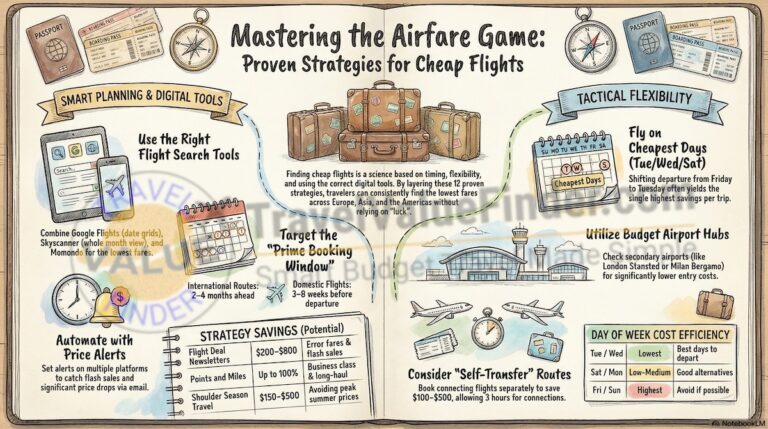
Flights are typically the single biggest expense in any trip. These five tips alone can cut your flight costs by 30–60%. For a full deep-dive into the flight-booking system we use, see our guide: How to Find Cheap Flights: 12 Proven Strategies That Actually Work.
Tip 1: Use a Flight Price Calendar
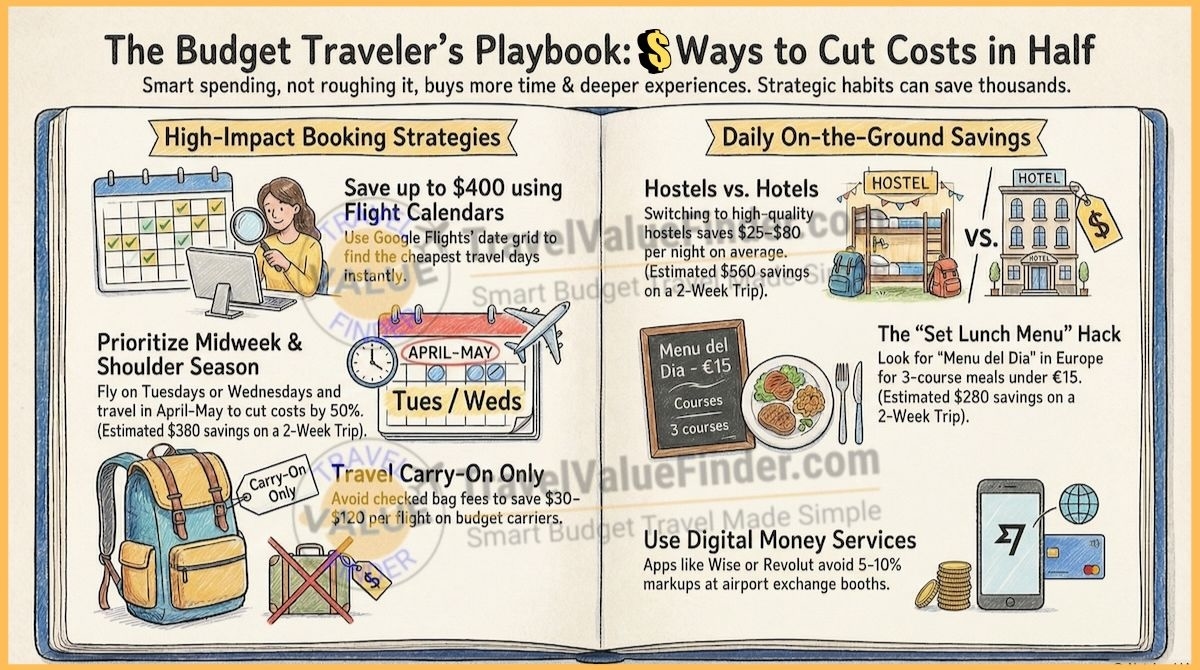
The single most powerful tool for anyone trying to travel cheap is a flight price calendar. Google Flights date grid and Skyscanner‘s Whole Month view show you the cheapest fare for every date in a calendar format — instantly revealing which days are cheap and which are expensive, without guessing.
- Action: Before you lock in dates, open Google Flights, enter your route, and click the date grid. Shift your trip by 2–3 days either side and compare prices.
- Saving: $100–$400 on a return international flight
Tip 2: Fly Midweek
Tuesday and Wednesday are consistently the cheapest days to fly on most routes. Fridays and Sundays are the most expensive — driven by business and leisure travel peaks. To travel cheap, avoid flying at the start or end of the working week whenever your schedule allows.
- Action: Use the price calendar (Tip 1) to confirm midweek prices for your specific route — patterns vary by destination
- Saving: $50–$250 on a return trip
Tip 3: Use Budget Airlines — But Know the Rules
Budget carriers have transformed the economics of travel, making it possible to travel cheap even in expensive regions like Western Europe or Southeast Asia. But hidden fees can quickly erode the savings if you do not read the small print.
| Airline | Best Routes | Key Watch-Out |
| Ryanair | Western & Central Europe | Very strict cabin bag rules |
| EasyJet | UK, France, Spain, Italy | Second bag fees add up |
| Wizz Air | Central & Eastern Europe | Seat selection fees are significant |
| AirAsia | Southeast Asia-wide | Baggage, meals and seat all extra |
| IndiGo | India domestic | Fast boarding but strict weight |
| Norwegian | Scandinavia, transatlantic | Reduced long-haul network |
- Action: Always book directly on the airline’s own website. Check Ryanair baggage policy and equivalent pages before every booking
- Saving: $40–$200 per intra-regional flight vs. full-service carriers
Tip 4: Set Up Flight Price Alerts
Price alerts are one of the most underused tools for anyone wanting to travel cheap. Rather than checking prices daily, you set an alert and get emailed when the fare on your route drops significantly.
- Set alerts on Google Flights (toggle ‘Track prices’ below the search bar)
- Set alerts on Kayak and Skyscanner simultaneously for maximum coverage
- Subscribe to Going (formerly Scott’s Cheap Flights) for error fares and flash sales — the free tier is genuinely useful
- Saving: $80–$350 vs. booking without monitoring prices
Tip 5: Travel in Shoulder Season
One of the most reliable ways to travel cheap is simply to shift your trip by 4–8 weeks. Shoulder season (April–May and September–October for most of Europe, Asia, and the Americas) offers flights and hotels at 20–50% less than peak summer or Christmas prices — with better weather than the off-season and far fewer crowds.
- Peak season: June–August, Christmas, Easter — highest prices, biggest crowds
- Shoulder season: April–May, September–October — best value overall
- Off-peak: November–March (excluding Christmas) — lowest prices, quieter, some reduced hours
- Saving: $200–$600 across flights and accommodation combined
Cheap Accommodation Tips: Tips 6–8
Accommodation is typically your second-largest travel expense. These three tips significantly reduce that cost without sacrificing comfort or safety. For city-specific recommendations, browse our Budget Hotel Deals by destination.
Tip 6: Stay in Hostels
Hostels are the cornerstone of budget travel. A quality hostel dorm bed costs $10–$35 per night depending on location — a saving of $50–$100 compared to even a modest hotel. To travel cheap while staying sociable and centrally located, hostels are hard to beat.
What makes a good hostel:
- Free breakfast included — saves $8–$12 per day
- Communal kitchen for self-catering meals
- Central location — reduces transport costs
- Strong recent reviews on Hostelworld or Booking.com
- Lockers provided (bring your own padlock)
Book through Hostelworld for the widest inventory, or Booking.com which increasingly lists hostels alongside hotels.
For our hand-picked budget accommodation guides:
- Best Budget Hotels in Paris
- Best Budget Hotels in Rome
- Best Budget Hotels in London
- Best Budget Hotels in Bangkok
- Best Budget Hotels in Bali
- Best Budget Hotels in Dubai
Tip 7: Use Alternative Accommodation
Beyond hostels and hotels, several platforms let you travel cheap on accommodation — sometimes for free:
- Couchsurfing — Free stays with locals worldwide. Requires a verified profile and genuine engagement with the community
- Workaway — Work 4–5 hours per day in exchange for free room and board. Ideal for slow travellers staying a week or more in one place
- HelpX — Similar to Workaway; strong for farm stays, rural hostels and eco-projects across Europe
- Trusted Housesitters — House-sit for homeowners while they travel; accommodation is free in exchange for pet/home care
- Airbnb — Best value for groups of 3+; splitting an apartment beats individual hotel rooms significantly
Tip 8: Book Accommodation Strategically
How and when you book matters as much as where you stay. A few principles that consistently help me travel cheap on accommodation:
- Book early for peak season (June–August and holidays) — hostels and budget hotels fill fast and prices surge as they fill
- Book late for shoulder and off-peak season — last-minute deals are common when occupancy is low
- Use Booking.com‘s Genius loyalty tier — free to join, gives 10–15% off at participating properties
- Always check the property’s own website after finding it on an aggregator — direct bookings are sometimes cheaper and always support the host more
- Use Google Hotels to compare rates across all booking platforms simultaneously
How to Eat Well and Travel Cheap: Tips 9–11
Food is one of the easiest travel costs to control — and one of the best ways to travel cheap day-to-day without feeling deprived. The key is eating like a local, not like a tourist.
Sitting down to a €12 three-course lunch menu in a local restaurant in Lisbon, surrounded by office workers on their lunch break, is one of travel’s great pleasures. It is also one of its great bargains. — Leslie, TravelValueFinder.com.
Tip 9: Cook Your Own Meals
One self-catered meal per day is one of the simplest and most effective ways to travel cheap. Buying breakfast and lunch from a local supermarket and cooking dinner in a hostel kitchen can save $15–$30 per day — that is $100–$200 per week, or the cost of an extra flight.
- Shop at Lidl, Aldi, Mercadona (Spain), Biedronka (Poland), or Carrefour (France) — all budget supermarket chains with extensive European footprints
- Stock up on staples: bread, eggs, pasta, local cheese, fruit, and tinned food
- Most hostels have a communal kitchen — this is a key thing to check when booking
For destination-specific food guides and cheap eats:
- Lisbon Food: Cheap Eats and Affordable Dining Guide
- Rome Food Guide: What to Eat and Where
- Florence Food Guide: What to Eat for First-Time Visitors
- What to Eat in Lyon, France
Tip 10: Eat the Set Lunch Menu
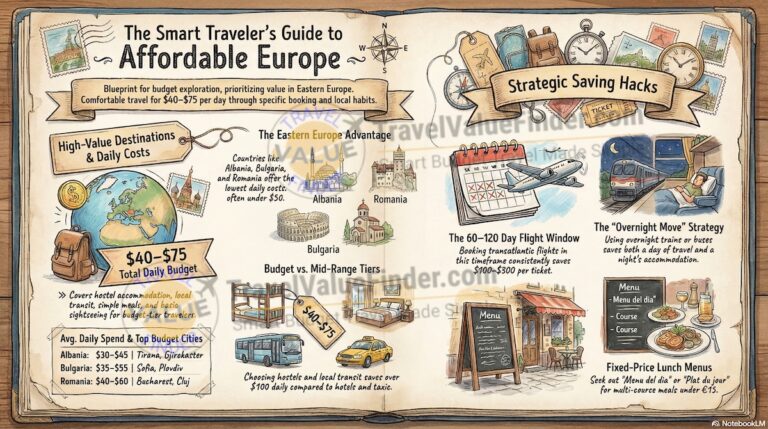
Across Spain, France, Portugal, and Italy, restaurants offer a fixed-price lunch — ‘menu del dia’, ‘plat du jour’, or ‘menu fisso’ — that includes 2–3 courses, bread, a drink, and sometimes dessert for €10–€15. This is one of the best-kept secrets of European travel and a genuinely enjoyable way to travel cheap on food without sacrificing quality or local experience.
- Always available Monday to Friday, typically 12:00–15:00
- Usually far superior value to ordering à la carte
- Walk one or two streets away from tourist centres for the best prices
Tip 11: Shop at Local Markets and Street Food Stalls
Local food markets and street food stalls consistently offer better quality and lower prices than tourist-facing restaurants. To reliably travel cheap on food, build market visits into your travel routine:
- Borough Market (London), La Boqueria (Barcelona), Mercato Centrale (Florence) — all free to browse, with affordable hot food and snacks
- Morning produce markets in smaller towns often have cooked food stalls serving locals at local prices
- Street food in Southeast Asia (Thailand, Vietnam, Malaysia) averages $1–$3 per dish — eating street food for every meal there is both authentic and extremely cheap
Cheap Activities and Sightseeing: Tips 12–13
Tip 12: Take Free Walking Tours
Free walking tours are one of the best tools to travel cheap on sightseeing. Available in virtually every major city worldwide, these tours are led by local guides who work for tips — meaning you pay what the tour was worth to you after it ends. A two-hour tour that orientates you to the city, introduces its history and points you toward the best cheap food spots is worth far more than its nominal cost.
- Find free tours at GuruWalk or Free Tours by Foot — searchable by city worldwide
- Ask your hostel — staff invariably know which tours are best
- Tip your guide fairly — $5–$15 per person is standard
Tip 13: Take Advantage of Free Museums and Attractions
Europe in particular has an extraordinary number of permanently or periodically free world-class attractions. Building these into your itinerary is one of the smartest ways to travel cheap on activities without missing the highlights:
| Attraction | City | Cost |
| British Museum | London, UK | Always free |
| Tate Modern | London, UK | Always free (special exhibitions paid) |
| National Museum of Scotland | Edinburgh, UK | Always free |
| Louvre | Paris, France | Free 1st Sunday each month |
| Museo del Prado | Madrid, Spain | Free Mon–Sat 6–8pm, Sun 5–7pm |
| Rijksmuseum | Amsterdam | Free for under-18s |
| Acropolis Museum | Athens, Greece | Free on select days |
| Vatican Museums | Rome, Italy | Free last Sunday of month |
Check Free Museum Days and each museum’s own website before visiting to confirm current free access dates.
Transport Tips to Travel Cheap: Tips 14–15
Tip 14: Use Public Transport
Taxis, Ubers, and private transfers are the enemies of the budget traveller. To travel cheap on ground transport, public transit is almost always the answer — and in most major European and Asian cities, it is also faster than driving in traffic.
- Buy multi-day or weekly passes where available — almost always cheaper than per-journey fares
- Use Citymapper for real-time public transport routing in 100+ cities worldwide
- In Europe, Bolt and Lime e-scooters offer cheap, flexible city transport for short trips
For city-specific transport guides:
- Getting Around Paris: Metro, Buses and Walking
- Transportation in Rome: Metro, Buses, Taxis and Airport Transfers
- Transportation in Florence: How to Get Around
Tip 15: Take Overnight Transport
Overnight trains and buses are one of the most effective ways to travel cheap in a single move — you travel while you sleep, saving both a night’s accommodation and a day’s transport cost simultaneously. A €35 overnight bus from Lisbon to Madrid saves you both the transport cost and a hostel bed in one booking.
- FlixBus — Overnight routes across Europe from as little as €10; book early for the cheapest fares
- Trainline — Book overnight train routes across 45+ European countries
- Omio — Compare overnight train, bus and flight options on the same screen for any European route
- 12Go Asia — The equivalent for overnight buses and trains across Southeast Asia
Money and Payments: Tips 16–19
How you manage your money while travelling has a direct impact on how much you spend. These four tips help you travel cheap by eliminating the fees and poor exchange rates that quietly drain your budget.
Tip 16: Travel Slowly
Slow travel — spending a week or more in each destination rather than hopping between cities every two days — is one of the most underrated strategies to travel cheap. Every time you move cities, you incur transport costs, often pay more for first-night accommodation, and spend time and money reorienting yourself.
- Staying in one city for a week typically unlocks weekly hostel rates (10–15% cheaper than nightly) or Airbnb discounts
- You discover free and cheap local options that take a few days to find — neighbourhood restaurants, free events, local transport shortcuts
- You spend less on activities because you stop feeling the pressure to see everything at once
- Saving: $100–$400 per week compared to city-hopping every 2 days
Tip 17: Use Points and Miles for Free Flights and Hotels
Points and miles programmes are how experienced travellers travel cheap — or even free — on flights and hotels that would otherwise cost hundreds or thousands of dollars. The entry point is easier than most people think.
- Get a travel rewards card — the Chase Sapphire Preferred and Capital One Venture both earn flexible points on everyday spending
- Redeem points via airline transfer partners for the best value — typically 1.5–2 cents per point vs. 1 cent for cash back
- Use AwardHacker to find the lowest points cost for any route across all loyalty programmes
- Saving: A single credit card welcome bonus (60,000–100,000 points) can cover one or two return economy flights to Europe or Asia
Tip 18: Get a No-Foreign-Transaction-Fee Card
Most standard bank cards charge a foreign transaction fee of 2–3% on every purchase abroad. On a $3,000 trip, that is $60–$90 in fees alone — for nothing. To travel cheap, getting a fee-free card before your trip is one of the simplest single improvements you can make.
- Chase Sapphire Preferred and Capital One Venture — both zero foreign transaction fees
- Charles Schwab debit card — Reimburses all ATM fees worldwide; excellent for cash withdrawals
Tip 19: Use Wise or Revolut for Currency Exchange
Airport currency exchange booths and hotel currency desks charge margins of 5–10% above the real exchange rate. To travel cheap on money itself, use a digital money service that gives you the real mid-market rate:
- Wise — Send and receive money internationally at the real exchange rate with a small transparent fee; borderless debit card available
- Revolut — Multi-currency account with fee-free exchange up to monthly limits; widely used across Europe
- Never exchange currency at airports or hotel desks — the margin can be 8–12% above the real rate
Planning Tips to Travel Cheap: Tips 20–25
Tip 20: Travel With Carry-On Only
Packing carry-on only is one of the most consistently effective ways to travel cheap on flights — especially with budget airlines where checked bags can cost as much as the fare itself. Ryanair’s checked bag fee can reach €35 each way; on a return trip, that is €70 added to every flight.
- Pack a maximum of 7–10kg in a 40L backpack or cabin-sized suitcase
- Use packing cubes to compress clothing and maximise space
- Wear your heaviest items on travel days (boots, jacket, jeans)
- Do laundry mid-trip — most hostels have washing machines for €3–€5
- Saving: $30–$120 per trip on budget airlines alone
Tip 21: Choose Cheaper Destinations
Not all travel costs the same. One of the most powerful ways to travel cheap is simply to choose destinations where your money goes further. Eastern Europe, Southeast Asia, Central America, and parts of South America consistently offer extraordinary experiences at a fraction of the cost of Western Europe, Japan, or North America.
| Region | Daily Budget (budget traveller) | Highlights |
| Southeast Asia | $25–$50/day | Thailand, Vietnam, Bali, Malaysia |
| Eastern Europe | $40–$65/day | Poland, Romania, Serbia, Bulgaria |
| Central America | $35–$60/day | Guatemala, Nicaragua, Honduras |
| South Asia | $20–$45/day | India, Nepal, Sri Lanka |
| Mexico | $45–$70/day | Mexico City, Oaxaca, Yucatan |
| Western Europe | $70–$120/day | France, Italy, Spain, Portugal |
For our detailed budget destination guides, explore our Europe Travel Guides and see the full How to Travel Europe on a Budget: The Complete 2026 Guide.
Tip 22: Book at the Right Time
There is an optimal booking window for every type of trip. Booking too far in advance or waiting too late both cost money. To consistently travel cheap on flights and accommodation, understand the booking curve:
- International flights: book 60–120 days ahead for best prices
- Budget airline flights within Europe or Asia: 4–8 weeks ahead
- Peak season accommodation: book 3–4 months ahead
- Shoulder/off-peak accommodation: 2–4 weeks ahead; last-minute deals are common
- Use Kayak’s Price Forecast tool which predicts whether prices will rise or fall in the next 7 days
Tip 23: Use an eSIM Instead of Roaming
Data roaming charges from your home network are among the most quietly expensive aspects of international travel. To travel cheap on connectivity, replace international roaming with a local eSIM:
- Airalo — Largest eSIM marketplace; data plans for 190+ countries from as little as $5 for 1GB
- Holafly — Unlimited data eSIMs for 150+ destinations; good for longer trips
- eSIMs are activated instantly by scanning a QR code — no SIM card swapping or local phone shops needed
- Saving: $30–$100 per trip vs. paying your home carrier’s international roaming rates
Tip 24: Get the Right Travel Insurance
Travel insurance seems counterintuitive in a guide about how to travel cheap — but an uninsured medical emergency abroad can cost tens of thousands of dollars and derail your entire travel budget permanently. The right insurance costs $30–$80 per month and protects against the worst-case scenarios that would otherwise be catastrophically expensive.
- SafetyWing — From $45/month; simple monthly subscription ideal for long-term and slow travellers
- World Nomads — Comprehensive coverage including adventure activities; well suited to active travellers
- Hey Mondo — Good value flexible policies; single-trip and annual multi-trip options
- Always check that your policy covers the activities you plan to do — adventure sports, scooter riding, and extreme activities often require add-ons
Tip 25: Plan Smarter With a Free AI Trip Planner
Good planning is one of the most overlooked ways to travel cheap. A well-planned trip avoids expensive last-minute decisions — the pricey hotel when you arrive somewhere without a booking, the overpriced restaurant when you have not researched alternatives, the day tour you paid full price for because you did not know it was available cheaper elsewhere.
TravelValueFinder’s Free AI Trip Planner generates a personalised day-by-day itinerary for any destination in seconds — including budget tips, suggested accommodation areas, free attractions, and local food recommendations. It is completely free to use.
- Action: Before your next trip, spend 10 minutes with our AI Trip Planner to map out your days before you arrive
- Not sure which destination suits your travel style? Take our Travel Personality Quiz for personalised destination suggestions
How Much Can You Save? Total Savings Summary
Here is how the savings stack up when you apply the key strategies together on a hypothetical 2-week trip to Europe:
| Strategy Applied | Individual Saving | Running Total Saved |
| Fly midweek + shoulder season | $380 | $380 |
| Budget airline + carry-on only | $240 | $620 |
| Hostel dorms vs. budget hotel (14 nights) | $560 | $1,180 |
| Self-cater 1 meal/day + set lunch menus | $280 | $1,460 |
| Free walking tours + free museums | $200 | $1,660 |
| Wise/Revolut + no-fee card | $110 | $1,770 |
| eSIM instead of roaming | $75 | $1,845 |
| Total estimated saving | ~$1,845 | vs. unplanned trip |
Estimates based on a 2-week Western Europe trip departing from North America. Individual savings will vary by destination, season, and travel style.
Most travelers leave thousands of dollars on the table — not because deals do not exist, but because they never built the habit of looking for them. Apply even half of these 25 tips and your next trip will cost dramatically less. — Leslie, TravelValueFinder.com.
Plan Your Trip: Essential Resources on TravelValueFinder
Put these tips into practice with our destination guides, budget hotel picks, and travel tools:
- How to Find Cheap Flights: 12 Proven Strategies That Actually Work
- How to Travel Europe on a Budget: The Complete 2026 Guide
- Paris on a Budget: How to Save Money Without Missing Out
- Lisbon on a Budget: Cheap Things to Do, Eat and Stay
- Cheap Things to Do in Lisbon: Top Attractions Under €10
- All Travel Guides: Tips, City Guides and Things to Do
- All Budget Hotel Deals by Destination
- Free AI Trip Planner: Get a Day-by-Day Itinerary in Seconds
- Discover Your Travel Personality Quiz
Frequently Asked Questions
What is the cheapest way to travel?
The cheapest way to travel cheap combines several strategies simultaneously: fly on budget airlines midweek in shoulder season with carry-on only, stay in hostels or use Couchsurfing, eat at local markets and self-cater one meal per day, use free walking tours and free museums for activities, and use Wise or Revolut for fee-free currency exchange. Applied together, these can reduce a typical trip cost by 40–60%.
Can I travel cheap without staying in hostels?
Yes. Hostels give the best value per night but they are not the only option. You can travel cheap on accommodation through Couchsurfing (free), Workaway (free in exchange for a few hours of work per day), Airbnb split among a group, or budget hotels in Eastern Europe and Southeast Asia where private rooms are often $25–$45 per night. The key is avoiding the reflex to book the nearest convenient hotel without comparing alternatives.
How much money do I need to travel cheap in Europe?
A realistic budget travel Europe daily budget is $40–$65 per day in Eastern Europe (Poland, Hungary, Romania, Serbia) and $65–$95 per day in Western Europe (Spain, Portugal, France, Italy) — all-in including accommodation, food, transport and activities but excluding flights. See our full How to Travel Europe on a Budget guide for a detailed country-by-country breakdown.
What is the best app for finding cheap flights?
Google Flights is the most powerful overall tool for its date grid and price tracking features. Skyscanner‘s ‘Whole Month’ view and ‘Search Everywhere’ function are excellent for flexible travellers. For error fares and flash sales, Going and Secret Flying alert you to deals you would never find through manual searching. For full guidance, read our How to Find Cheap Flights guide.
Is it possible to travel cheap in expensive countries like Switzerland or Norway?
Yes, though it requires more planning. In Switzerland, camp or stay in budget hostels ($30–$45/night), cook most meals (supermarkets like Lidl and Migros are significantly cheaper than restaurants), use the Swiss rail day pass for transport, and focus on free outdoor attractions (hiking, lakes, city walking). Even expensive countries become manageable when you apply the right strategies to travel cheap.
How do I travel cheap if I am a first-time solo traveller?
Start with a well-connected, budget-friendly destination with strong hostel infrastructure — Lisbon, Budapest, Krakow, or Bangkok are all excellent choices. Book a hostel with strong recent reviews (Hostelworld is the most reliable source), use free walking tours to get your bearings in the first day or two, and connect with other travellers through your hostel’s social spaces. Solo travel is more affordable than most people expect because you make 100% of the decisions — including all the money-saving ones.
Final Thoughts: Travel Cheap, Travel More
Learning to travel cheap is a skill that compounds over time. The first time you apply three of these tips, you might save $300. The second time, it becomes habit and you save $600. By your fifth or sixth trip, you are travelling for a fraction of what you used to spend — without any reduction in the quality of your experiences.
The goal is not to minimise spending for its own sake. The goal is to spend deliberately — to eliminate the waste, the fees, the tourist-trap markups, and the last-minute panics that drain travel budgets silently. Everything you save on flights, accommodation, and food is money that goes back into more time, more destinations, and more of the experiences that matter.
Start with one tip. Then add another. Travel cheap, and travel more.