Travel Value Finder

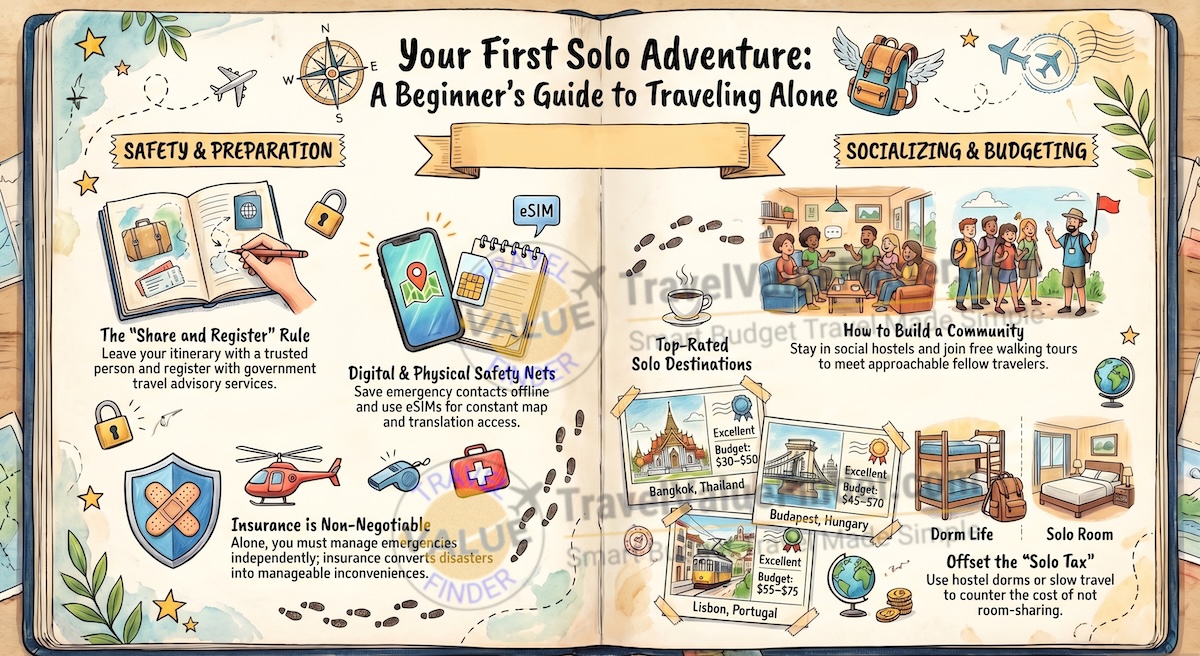
Solo travel is one of the most transformative experiences available to any traveller — and one of the most unnecessarily feared. The anxiety around travelling alone tends to evaporate within the first 48 hours of a first solo trip, replaced by a freedom and self-reliance that group travel simply cannot replicate.
By Leslie, TravelValueFinder.com | Last updated: April 2026 | Based on first-hand solo travel experience across 40+ countries spanning Europe, Southeast Asia, Latin America, and beyond.
Whether you are considering your first solo travel adventure or are already booked and want to make sure you do it right, this guide covers everything: the practical safety tips, the best destinations for first-timers, how to meet people on the road, how to manage your money and bookings alone, and the mindset shifts that separate stressful solo trips from extraordinary ones.
According to the World Tourism Organization (UNWTO), solo travel has grown to represent one of the fastest-growing travel segments globally — with surveys showing that first-time solo travellers consistently rate their trips among the best of their lives. The fear is larger than the reality. This guide closes that gap.
Every solo traveler I have spoken to over the years says the same thing: I wish I had done it sooner. The fears that hold people back — loneliness, safety, not knowing what to do — dissolve within days. What remains is something that group travel rarely delivers: complete freedom. — Leslie, TravelValueFinder.com
Planning your first solo trip? Find the best flights and hotels for your destination through our trusted partner: Search Solo Travel Flights and Hotels — TravelValueFinder Deals. Hundreds of providers, transparent pricing, secure booking.
Solo Travel at a Glance: What to Expect
Before diving into the specific tips, here is an honest overview of what solo travel actually involves across the key dimensions first-timers worry about most:
| Concern | The Reality | What Actually Helps |
| Safety | Solo travel is safer than most first-timers expect — risk is largely manageable with preparation and awareness | Research your destination, trust your instincts, share your itinerary |
| Loneliness | Loneliness is the most common fear and the quickest to disappear — solo travellers are the most sociable travellers on the road | Stay in hostels, take free walking tours, join day trips |
| Cost | Solo travel costs more per head than group travel (no room-splitting) but can be offset with hostel stays and full decision control | Hostels, slow travel, and cooking occasionally equalise the cost |
| Decision fatigue | Making every decision alone can be tiring — but it also means every decision matches exactly what you want | Plan the first day or two; leave the rest flexible |
| Emergencies | Genuine emergencies are rare, but being alone when they happen requires more preparation | Travel insurance, shared itinerary, offline emergency contacts |
| Navigation | Getting lost is part of solo travel — and almost always leads somewhere interesting | Offline maps (Google Maps or Maps.me) handle almost everything |
Solo Travel Safety Tips: How to Travel Alone Confidently
Safety is the most common concern among first-time solo travellers — and the area where good preparation makes the biggest difference. These tips are not about being fearful; they are about being informed and proactive so you can focus on enjoying your trip.
Before You Depart
- Share your itinerary — Leave a full trip plan with at least one trusted person at home: your flight details, accommodation names and addresses, and a rough daily plan. Update them when plans change significantly
- Register with your government’s travel advisory service — The US Smart Traveler Enrollment Program (STEP), UK’s FCDO Travel Aware, and equivalent services for other nationalities send emergency alerts and allow embassies to contact you in a crisis
- Research your destination’s specific risks — Check FCO Travel Advice (UK), US State Department Travel Advisories, and Numbeo Crime Index for current safety data for your destination
- Get comprehensive travel insurance — This is non-negotiable for solo travel. Alone, any medical emergency, trip disruption, or theft requires you to manage the entire situation independently. Insurance converts a potential disaster into a manageable inconvenience. See our full guide: Travel Insurance Guide: What It Covers and the Best Options
- Save emergency contacts offline — Your phone may run out of battery, get stolen, or have no signal. Write down your insurance emergency number, your embassy’s local number, and one trusted home contact on a small card kept separately from your phone
On the Ground
- Trust your instincts — If a situation, person, or area feels wrong, leave. Your gut is calibrated by millions of years of threat detection. Solo travel gives you complete freedom to act on it without having to convince anyone else
- Stay in well-reviewed, populated areas — Your first accommodation in any new city should be centrally located, well-reviewed, and ideally somewhere that other travellers stay. Being close to the action means never having to take late-night taxis in unfamiliar areas
- Keep digital and physical document copies separate — Photograph your passport, visa, and insurance documents. Store them in cloud storage (Google Drive or Dropbox). Keep a paper copy in a separate bag to your originals
- Use hotel or hostel safes for valuables — Never leave your passport, extra cash, or laptop visible in a room. Use the safe provided or a padlocked locker in a hostel
- Be discreet about your plans — Announcing to strangers in bars that you are travelling alone and your next destination is rarely wise. Share selectively with people you have spent time getting to know
- Learn basic local phrases — Even five words in the local language (help, thank you, where is, how much, no) signal respect and often unlock unexpected kindness from locals
- Stay connected — Use an Airalo eSIM or local SIM for affordable data. Having maps, translation, and the ability to call for help at all times is the single biggest safety improvement for solo travel
The most dangerous thing about solo travel is the inertia of not doing it. The actual risks, when examined honestly, are modest and almost all manageable with straightforward preparation. The cost of never going is far higher. — Leslie, TravelValueFinder.com
Best Solo Travel Destinations for First-Timers (2026)
Choosing the right destination for your first solo travel experience makes an enormous difference to how the trip goes. The best starter destinations share a few qualities: strong tourist infrastructure, low crime rates, good English language coverage, affordable hostels, and an established backpacker culture that makes meeting other travellers easy.
Best Solo Travel Destinations in Europe
| Destination | Solo Rating | Daily Budget | Why It’s Great for Solo Travel |
| Lisbon, Portugal | Excellent | $55–$75/day | Safe, walkable, English widely spoken, outstanding hostel scene, very sociable |
| Budapest, Hungary | Excellent | $45–$70/day | Affordable, legendary hostel culture, easy to meet travellers, great nightlife |
| Barcelona, Spain | Excellent | $65–$90/day | Vibrant, safe for solo travellers, walkable, huge international community |
| Prague, Czechia | Excellent | $45–$65/day | Very safe, cheap, beautiful old town, strong backpacker infrastructure |
| Amsterdam, Netherlands | Very Good | $80–$110/day | English everywhere, extremely walkable, excellent hostel options |
| Rome, Italy | Very Good | $65–$90/day | Incredible history, easy city to navigate, strong free walking tour scene |
| Athens, Greece | Very Good | $55–$80/day | Affordable, safe, growing hostel scene, great gateway to Greek islands |
Best Solo Travel Destinations Beyond Europe
| Destination | Solo Rating | Daily Budget | Why It’s Great for Solo Travel |
| Bangkok, Thailand | Excellent | $30–$50/day | Legendary solo travel hub; enormous backpacker infrastructure; sociable hostels |
| Bali, Indonesia | Excellent | $35–$60/day | Welcoming, safe for solo travellers, strong community of digital nomads and long-termers |
| Tokyo, Japan | Excellent | $60–$90/day | Safest major city in the world for solo travel; incredibly easy to navigate |
| New Zealand | Excellent | $80–$120/day | English-speaking, extremely safe, outstanding hostel and backpacker culture |
| Colombia (Medellín) | Good | $40–$65/day | Transformed city, vibrant scene, growing solo travel community — research neighbourhoods first |
| Mexico City, Mexico | Good | $45–$70/day | Incredible food and culture, improving safety, large expat and nomad community |
For where-to-stay guides in solo-friendly destinations:
- Where to Stay in Lisbon — Best Neighborhoods and Local Insights
- Where to Stay in Bangkok
- Where to Stay in Bali
- Where to Stay in Barcelona — Best Areas 2026
- Where to Stay in Athens — Best Areas 2026
- Where to Stay in Amsterdam — Neighborhood Guide 2026
- Where to Stay in Budapest
- Where to Stay in Rome — Best Areas 2026
Ready to book your solo trip? Search flights and hotels across all solo-friendly destinations: Find Your Solo Travel Flights and Hotels — TravelValueFinder. Compare hundreds of providers in one search.
How to Meet People When Travelling Alone
The fear of loneliness is the second most common concern among first-time solo travellers — and the most quickly resolved. The reality is that solo travellers are the most sociable travellers on the road. You are approachable in a way that couples and groups simply are not, and the backpacker and hostel community is extraordinarily open to new connections.
Best Ways to Meet Fellow Travellers
- Stay in social hostels — Choose hostels with communal spaces, organised events, and hostel bars. The common room of a well-run hostel is the most reliable place to meet fellow solo travellers in the world. Book through Hostelworld and filter by social atmosphere reviews
- Take free walking tours — A 2–3 hour free walking tour puts you alongside 10–30 other curious travellers exploring the same city. Post-tour conversations naturally continue into coffee, lunch, and sometimes a multi-day travel companionship. Find them at GuruWalk or Free Tours by Foot
- Join day trips and group activities — Wine tours, cooking classes, kayaking, city bike tours, and similar activities attract sociable travellers. GetYourGuide and Viator both have extensive searchable catalogues by city
- Use travel-specific social apps — Meetup.com lists free and low-cost events in cities worldwide; Couchsurfing’s Hangouts feature connects travellers and locals for meetups without needing to stay with anyone; Bumble BFF is increasingly used by solo travellers to find friends
- Talk to hostel staff — Hostel staff are locals who deal with travellers daily. They know the best cheap restaurants, the hidden bars, and the local events that do not appear on tourism websites. Ask them what they would do if they had the day off
- Eat at the bar or communal table — Many restaurants have bar seating or communal tables that invite conversation. Asking your neighbour for a menu recommendation is one of the easiest conversation starters in travel
- Accept invitations — When fellow travellers invite you to join them for dinner, a walk, or a day trip, say yes more often than feels instinctive. The solo travel experience is largely built by saying yes to things you would not have planned yourself
Solo travel does not mean traveling alone. It means traveling on your own terms — which almost always leads to far more genuine connections than travelling in a group where the social dynamic is already closed. — Leslie, TravelValueFinder.com
Solo Travel on a Budget: Managing Costs Alone
The main financial disadvantage of solo travel is the loss of room-sharing — you pay the full cost of accommodation rather than splitting it. Here is how to offset that and keep your solo travel budget under control:
Accommodation Strategies for Solo Travellers
| Option | Cost Range | Best For |
| Hostel dorm (4–8 bed) | $12–$35/night | Socialising, budget-maximising, flexible bookings |
| Hostel private room | $35–$75/night | Privacy with hostel social access; often cheaper than hotels |
| Budget hotel single | $50–$100/night | Peace and quiet; city-centre locations on a moderate budget |
| Couchsurfing | Free | Deep local experience; best for experienced solo travellers |
| Workaway / HelpX | Free (work exchange) | Long-term stays; slow travel; meaningful local connections |
| Airbnb private room | $30–$80/night | Home environment; useful for destinations with few good hostels |
Financial Management for Solo Travellers
- Use a no-fee travel card — Cards like Wise or Revolut give you the real exchange rate with no foreign transaction fees. Solo travellers cannot split these costs, so eliminating them entirely is even more important
- Set a daily budget and track it — Apps like Trail Wallet or TravelSpend make it easy to log daily spending and see where you stand against budget
- Keep emergency funds separate — Maintain a reserve in a separate account or card that you do not touch unless genuinely necessary. Aim for enough to cover 3 nights accommodation plus a flight home
- Take free walking tours instead of paid city tours — For solo travel on a budget, this is one of the highest-value activities available
- Slow down — Every city move costs money in transport, orientation time, and often a premium for short-stay accommodation. Spending a week in one city instead of two to three days costs significantly less per day
For comprehensive budget strategies across flights, accommodation, food and activities, see:
- How to Travel Cheap: 25 Tips to Cut Your Travel Budget in Half
- How to Find Cheap Flights: 12 Proven Strategies That Actually Work
- How to Travel Europe on a Budget: The Complete 2026 Guide
How to Plan Your First Solo Trip: Step by Step
Planning a first solo travel trip is simpler than most people expect. Here is the process that works:
- Choose the right first destination — Start with a country that is safe, English-friendly, well-touristed, and has a strong hostel infrastructure. Portugal, Spain, Thailand, New Zealand, and Japan are consistently recommended for first-time solo travel
- Book flights and your first two nights in advance — Arriving somewhere new without accommodation sorted is unnecessarily stressful. Book your first destination’s accommodation in advance. After that, you can be flexible. Compare flights and hotels: Search Flights and Accommodation — TravelValueFinder
- Get your travel insurance before anything else — Purchase travel insurance the same day you book your flights so you are covered for cancellation from day one. See: Travel Insurance Guide: What It Covers
- Build a loose daily outline for the first few days — Plan your first day or two — airport transfer, one meal option, one activity — and leave the rest flexible. Having a plan for arrival prevents the disorientation that can hit in the first hours alone in a new city
- Pack carry-on only if possible — Solo travel with carry-on only gives you complete mobility — no waiting at carousels, no checked luggage fees, no lost bags. See: Essential Travel Packing List: What to Bring and What to Leave
- Download essential apps before you leave — Google Maps offline, Airalo for eSIM, Wise for currency, and XE Currency for reference. Having these ready on home WiFi avoids scrambling on arrival
- Tell someone at home your plan — Share your itinerary, accommodation details, and a check-in schedule with one trusted person. Agree a “no contact” protocol — for example, if they do not hear from you for 48 hours, they should call your accommodation
Not sure where to start with your itinerary? Use our free tool:
- Free AI Trip Planner — Generate a Day-by-Day Solo Travel Itinerary in Seconds
- Discover Your Travel Personality Quiz — Find Your Perfect Solo Destination
Solo Travel Safety Tips for Women
Women represent the majority of solo travellers globally — and female solo travel is more achievable than mainstream narratives suggest. That said, additional awareness and preparation are genuinely useful in certain destinations and contexts.
Destination Research
- Check Her Own Map and Women on the Road — both dedicated female solo travel resources with destination-specific safety data and first-hand reports
- Read recent TripAdvisor forums and Solo Travel Society (Facebook Group) for current, crowd-sourced safety information from female travellers who have just returned from your destination
- Research local customs around dress and behaviour — in some destinations, dressing conservatively significantly reduces unwanted attention
On the Ground
- Trust your instincts without apology — leave any situation that feels uncomfortable, without feeling the need to explain yourself
- Choose your first accommodation carefully — a centrally located, well-reviewed hostel or hotel in a safe neighbourhood eliminates most late-night transport risk
- Avoid sharing your solo status with strangers unnecessarily — if asked, you can say your partner or friends are meeting you shortly
- Use bSafe personal safety app — includes a live location sharing function, a fake call feature, and an SOS alert that sends your location to emergency contacts
- Pre-book airport transfers rather than taking informal taxis on arrival — especially for late-night arrivals in unfamiliar cities
- Connect with other female solo travellers through the Solo Travel Society or Girls LOVE Travel — both active communities with destination-specific advice, meetup coordination, and support
Solo Travel for Over-50s and Retirees
Solo travel after 50 — whether as a retiree or simply someone finally taking the time — is one of life’s great freedoms. The assumptions that solo travel is only for young backpackers are comprehensively wrong: over-50s are among the most satisfied solo travellers in the world, with the resources, patience, and life experience to get the most from it.
Key Considerations for Solo Travel Over 50
- Senior rail discounts, museum discounts, and transport concessions are available across most European countries — bring your ID and ask at every ticket office
- Travel insurance becomes more important and more expensive — ensure your policy covers pre-existing conditions fully. See: Travel Insurance Guide
- Consider slower, longer stays in fewer destinations — the pace of slow travel suits most over-50 solo travellers and significantly reduces costs
- Group tours offer an excellent hybrid option — companies like G Adventures and Intrepid Travel run small-group tours where you travel as part of a group but have significant free time, combining the social benefits of group travel with real independence
- Destinations like Portugal, Spain, France, and Greece are particularly well-suited to solo travel over 50: safe, accessible, English-friendly, and with excellent healthcare infrastructure
If you are considering extended travel or relocation in retirement, our guides cover everything:
- Retire in Portugal: A Practical Guide for Over-55s
- Retire in Spain: A Practical Guide
- Retire in France After 55: Healthcare, Costs, Visas and Lifestyle
- Spain vs Portugal for Retirement: Full Comparison
- Affordable Retirement: Best Countries Where Your Money Goes Further
Essential Packing for Solo Travel
Solo travellers have specific packing priorities — particularly around security, communication, and self-sufficiency. Beyond the standard solo travel packing list, these items matter most when you are on your own:
| Item | Priority | Why It Matters for Solo Travellers |
| Padlock (TSA-approved) | Essential | Hostels provide lockers but not locks — without one you have no secure storage |
| Offline maps downloaded | Essential | Solo travellers cannot ask a travel companion for directions — offline maps eliminate dependence on data |
| Portable power bank | Essential | A dead phone when you are alone is a genuine problem — keep a 10,000mAh bank always charged |
| Door alarm / wedge | Recommended | A cheap door alarm or wedge provides additional security in budget accommodation |
| eSIM or local SIM | Essential | Constant connectivity is a safety tool for solo travellers, not a luxury |
| First aid kit | Recommended | Minor medical issues are yours to manage alone — a basic kit handles most situations |
| Card photocopies | Essential | If your wallet is stolen, copies stored separately allow you to cancel cards and access emergency funds |
| Whistle or personal alarm | Optional | Lightweight safety tool; particularly useful for female solo travellers in more remote areas |
For the complete packing guide: Essential Travel Packing List: What to Bring and What to Leave
Plan Your Solo Trip: Essential Resources on TravelValueFinder
Everything you need to plan and book your first or next solo travel adventure:
- How to Find Cheap Flights: 12 Proven Strategies That Actually Work
- How to Travel Europe on a Budget: The Complete 2026 Guide
- How to Travel Cheap: 25 Tips to Cut Your Travel Budget in Half
- How Much Does It Cost to Visit Italy? A 2026 Budget Breakdown
- Travel Insurance Guide: What It Covers and the Best Options
- Essential Travel Packing List: What to Bring and What to Leave
- Lisbon on a Budget: Cheap Things to Do, Eat and Stay
- Paris on a Budget: How to Save Money Without Missing Out
- Free AI Trip Planner: Get a Day-by-Day Solo Itinerary in Seconds
- Discover Your Travel Personality Quiz: Find Your Perfect Solo Destination
Frequently Asked Questions
Is solo travel safe for first-timers?
Yes — solo travel is safer than most first-timers expect. Millions of people travel alone every year without incident. The key is choosing an appropriate first destination (somewhere with low crime, strong tourist infrastructure, and English language coverage), preparing properly (travel insurance, shared itinerary, offline maps and emergency contacts), and exercising the same common sense you would at home. The actual risk of solo travel, when examined honestly, is modest and largely manageable.
What is the best country for solo travel for the first time?
For first-time solo travelers, Portugal (particularly Lisbon), Thailand (particularly Bangkok and Chiang Mai), Japan, New Zealand, and Spain consistently rank as the best starting points. All five offer excellent safety records, strong English language coverage, well-developed tourist and hostel infrastructure, and an existing culture of solo travel that makes meeting people and getting around straightforward.
How do I not feel lonely when traveling alone?
Loneliness in solo travel typically disappears within the first 48 hours. The most effective ways to stay connected: stay in social hostels with common rooms and organised events, take free walking tours in every new city (they reliably generate multi-day travel friendships), join day trips and group activities through GetYourGuide or Viator, and use Meetup.com or Couchsurfing Hangouts for local events. Solo travellers are uniquely approachable — most meaningful travel connections happen because someone was alone and therefore available.
How much does solo travel cost?
Solo travel typically costs 20–40% more per day than the same trip with a travel partner — because you pay the full cost of accommodation rather than splitting a room. The gap can be closed by staying in hostel dorms ($12–$35/night) rather than private rooms, slow travelling to reduce per-city costs, and applying standard budget travel strategies. For a detailed breakdown by destination, see our How to Travel Cheap guide and our Europe on a Budget guide.
What should I do if something goes wrong when I am travelling alone?
If something goes wrong on a solo trip: contact your travel insurer’s 24/7 emergency line first (they can coordinate medical care, legal referrals, and emergency travel arrangements); if you are a victim of crime, file a police report immediately (required for any insurance claim); contact your country’s nearest embassy or consulate if your passport is stolen; call your trusted home contact and let them know what has happened. The key preventive measure is keeping all these numbers stored offline before departure — not relying on internet access to find them when you need them.
Is solo travel lonely?
Rarely, and almost never for long. Solo travel tends to be the most socially rich form of travel because you are approachable in a way groups are not, and because the hostel and backpacker community is extraordinarily open. Most solo travelers find that they meet more people and form more genuine connections than they do traveling in a group — where the social dynamic is already closed to outsiders. The first day or evening alone in a new city is the most challenging. After that, almost universally, the experience opens up.
Do I need travel insurance for solo travel?
Travel insurance is even more important for solo travellers than for group travel — because every emergency (medical, logistical, financial) must be managed alone. There is no travel companion to hold your bag while you navigate a hospital, help you rebook a missed flight, or loan you money if your wallet is stolen. Travel insurance converts these scenarios from crises into managed inconveniences. See our full guide: Travel Insurance Guide: What It Covers and the Best Options.
Final Thoughts: Take the First Step Into Solo Travel
Solo travel changes how you see the world — and how you see yourself. The version of you that navigates a new city alone, makes spontaneous decisions, recovers from things going wrong, and builds connections with strangers from across the globe is a more capable, more confident, and more curious version than the one who stayed home.
The fear of solo travel is real but not accurate. Every experienced solo traveller will tell you the same thing: the hardest part is making the booking. After that, the trip carries you. Choose your destination, book your first two nights, get your travel insurance, and take the first step. Everything else follows.
Book the trip. The rest takes care of itself.
Time to make it real. Search flights and hotels for your first solo trip through our trusted partner: Find Solo Travel Flights and Hotels — TravelValueFinder Deals. Best prices across hundreds of providers. We earn a small commission at no extra cost to you — it helps keep all our guides completely free.