Travel Value Finder

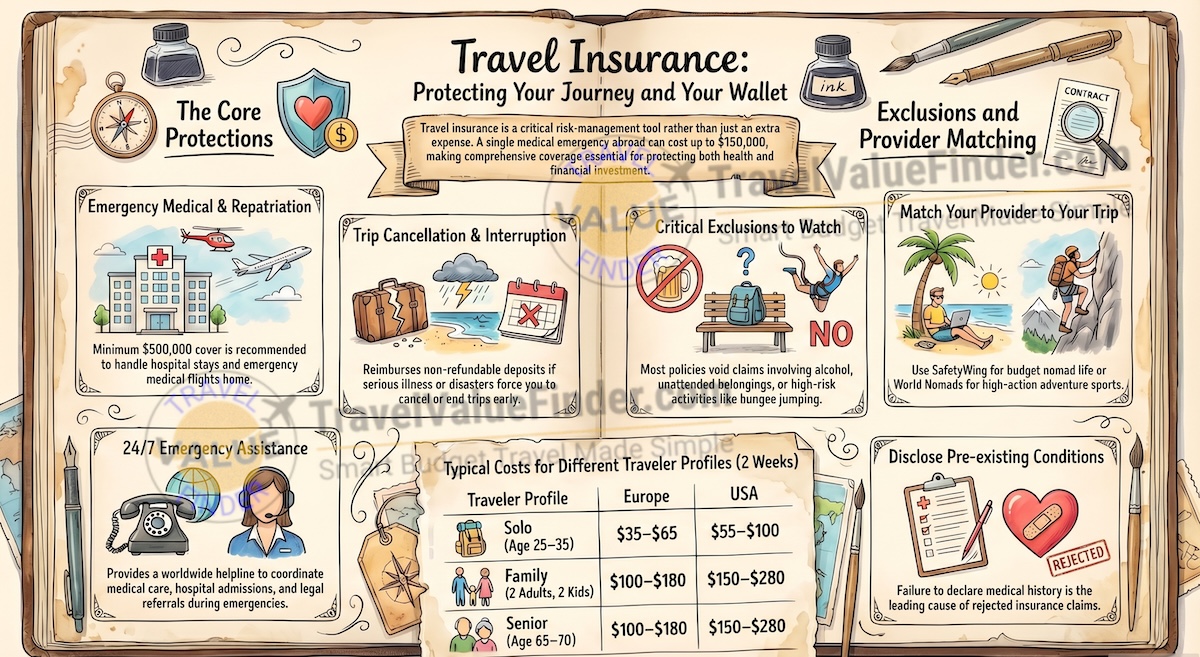
Travel insurance is one of the most important and most misunderstood purchases a traveller makes. Many people buy it without knowing what it actually covers — or skip it entirely, assuming nothing will go wrong. Both approaches are costly mistakes.
By Leslie, TravelValueFinder.com | Last updated: April 2026 | Based on years of first-hand budget travel across Europe, Asia and the Americas
A single medical emergency abroad can cost $10,000–$150,000 without travel insurance. A cancelled trip due to illness, a stolen bag, a missed connection, a natural disaster — these are not rare events for frequent travelers. They are normal risks that a quality travel insurance policy covers at a fraction of what a single claim would otherwise cost you out of pocket.
This guide breaks down exactly what travel insurance covers, what it does not, how much it costs, and which providers offer the best value for different types of travelers — from budget backpackers to retirees, families, and frequent flyers.
Travel insurance is not an expense — it is a decision about risk. The question is not whether something will go wrong on your travels. The question is whether you can afford it when it does. — Leslie, TravelValueFinder.com
Planning your trip? Find and compare flights and hotels using our trusted booking partner: Search Flights and Hotels — TravelValueFinder Deals. Best prices, fully protected bookings.
Do You Really Need Travel Insurance? The Short Answer
Yes — in almost every case. Here is when travel insurance is essential, recommended, or optional:
| Situation | Travel Insurance Need | Why |
| International travel | Essential | Medical costs abroad can be catastrophic |
| Pre-paid trip (flights, hotels, tours) | Essential | Cancellation cover protects your deposits |
| Traveling with expensive gear | Strongly recommended | Cameras, laptops, phones easily stolen |
| Budget domestic travel | Recommended | At minimum for medical; trip cancel optional |
| Traveling in EU with GHIC card (UK citizens) | Still recommended | GHIC covers state healthcare only — not repatriation or cancellation |
| Credit card includes travel insurance | Check carefully | Card policies often have coverage gaps and low limits |
What Travel Insurance Covers: The Core Protections
A comprehensive travel insurance policy typically includes six core areas of protection. Understanding each one helps you assess whether a policy is genuinely comprehensive or offers only superficial coverage.
1. Emergency Medical Cover
This is the most critical element of any travel insurance policy, and the main reason it is non-negotiable for international travel. Emergency medical cover pays for:
- Hospital stays, surgery, and emergency treatment abroad
- Emergency dental treatment
- Medical repatriation — the cost of flying you home if medically necessary (this alone can cost $50,000–$200,000 for a long-haul medical evacuation)
- 24/7 emergency assistance helpline and medical case management
Minimum cover to look for: $500,000 for medical; $1,000,000+ recommended for long-haul or adventure travel. The USA, Australia, and Canada are the most expensive destinations for emergency medical treatment — ensure your policy has adequate limits for these markets.
2. Trip Cancellation and Interruption
Trip cancellation cover reimburses your pre-paid, non-refundable costs if you cannot travel due to a covered reason. Trip interruption pays if you have to cut a trip short. This is where travel insurance saves travelers thousands — not just hundreds — when the worst happens.
- Covered reasons typically include: serious illness or injury (yours, a traveling companion, or a close family member), bereavement, jury service, redundancy, and natural disasters at the destination
- Not covered: ‘I changed my mind’, work scheduling conflicts (unless you purchased ‘cancel for any reason’ cover), or conditions you knew about before purchasing
3. Baggage and Personal Belongings
Baggage cover in a travel insurance policy pays for lost, stolen, or damaged luggage and personal items — up to specified limits. Key things to understand:
- Policies have a per-item limit (often $300–$500) and a total limit (often $1,000–$2,500) — check whether these are adequate for what you travel with
- Valuables (cameras, laptops, jewellery) often have very low sub-limits — you may need to declare these separately or purchase additional cover
- Airlines have separate compensation obligations for lost checked luggage under the Montreal Convention — always file a Property Irregularity Report (PIR) with the airline first
4. Travel Delay and Missed Connections
When flights are delayed or connections are missed, travel insurance can cover additional accommodation, meals, and alternative travel costs — up to a daily limit and a maximum number of hours’ delay. Most policies start paying after a 4–6 hour delay threshold.
5. Personal Liability
Personal liability cover protects you if you accidentally cause injury or property damage to someone else while traveling. This is particularly important for activities like skiing, cycling, or watersports where accidents involving third parties can result in large legal claims.
6. Emergency Assistance and Evacuation
Beyond medical cover, quality travel insurance includes 24/7 emergency assistance — a worldwide helpline that coordinates medical treatment, arranges hospital admissions, organizes repatriation, and provides legal referrals. In a genuine emergency abroad, this service is often more valuable than the financial coverage itself.
Most travelers never claim on their travel insurance — but the ones who do say it was the best money they ever spent. One hospitalization, one cancelled trip, one stolen laptop and the policy has paid for itself many times over. — Leslie, TravelValueFinder.com
What Travel Insurance Does NOT Cover: Critical Exclusions
Understanding the exclusions in a travel insurance policy is as important as understanding what it covers. These are the most common reasons claims are rejected:
| Exclusion | What This Means in Practice |
| Pre-existing medical conditions | Conditions you had before buying the policy are usually excluded unless you declare them and pay an additional premium. Always disclose fully. |
| Undeclared high-risk activities | Skiing, scuba diving, motorbiking, bungee jumping — most standard policies exclude these unless you purchase an adventure sports add-on. |
| Travelling against medical advice | If your doctor has advised against travel and you travel anyway, any medical claims are typically void. |
| Alcohol and drug-related incidents | Claims arising from incidents where you were intoxicated are almost always excluded. |
| Unattended belongings | Leaving a bag unattended in a public place voids most theft claims. ‘Unattended’ is interpreted strictly. |
| Known events at time of purchase | If a hurricane, strike, or travel advisory was already announced when you bought the policy, claims related to it are usually excluded. |
| Changing your mind (cancellation) | Standard trip cancellation requires a covered reason. ‘Cancel for any reason’ (CFAR) cover is available as an add-on — usually 40–60% of the trip cost refunded. |
| Travel to countries with government ‘Do Not Travel’ advisories | If your government has issued a ‘Do Not Travel’ warning for your destination, your entire policy may be void. |
| Pregnancy beyond a certain stage | Most policies restrict cover after 26–32 weeks of pregnancy. Check limits carefully if travelling while pregnant. |
Key takeaway: Always read the policy exclusions document before purchasing, not after. The exclusions section is typically where insurers recoup their exposure on cheap policies — the price difference between a bargain policy and a quality one is almost always explained by what the exclusions section contains.
How Much Does Travel Insurance Cost?
The cost of travel insurance varies significantly based on your age, destination, trip length, coverage level, and whether you have pre-existing conditions to declare. Here is a general guide to pricing:
Single Trip Travel Insurance: Approximate Costs
| Traveller Profile | 1 Week Europe | 2 Weeks Europe | 2 Weeks USA | 2 Weeks SE Asia |
| Solo, age 25–35 | $20–$40 | $35–$65 | $55–$100 | $30–$55 |
| Solo, age 45–55 | $30–$55 | $50–$90 | $80–$140 | $45–$80 |
| Solo, age 65–70 | $60–$120 | $100–$180 | $150–$280 | $90–$160 |
| Couple, age 35–45 | $40–$70 | $65–$120 | $100–$180 | $55–$100 |
| Family (2 adults + 2 children) | $60–$100 | $100–$180 | $150–$280 | $80–$150 |
Annual Multi-Trip Travel Insurance
If you travel more than 2–3 times per year, an annual travel insurance policy is almost always better value than buying single-trip policies. Annual policies typically cost:
- $150–$250/year for a single traveller (Europe cover)
- $200–$350/year for a single traveller (worldwide including USA)
- $350–$600/year for a family (worldwide including USA)
- Age has a significant impact — annual policies for over-65s typically cost $400–$800+/year
At TravelValueFinder we always recommend getting several quotes before purchasing — prices vary significantly between providers for equivalent cover. Use InsureMyTrip or Squaremouth to compare policies from multiple insurers side by side.
Best Travel Insurance Options for 2026: Provider Comparison
Not all travel insurance is equal. Here is an honest assessment of the most reliable and widely recommended providers for different traveller types — based on coverage quality, claim settlement reputation, and value for money.
Best Overall Travel Insurance Providers
| Provider | Best For | Coverage Highlights | Starting From | Link |
| SafetyWing | Long-term & budget travellers | Medical + evacuation; monthly rolling cover | $45/month | safetywing.com |
| World Nomads | Adventure travellers | Extensive adventure sports cover; 200+ activities | $70–$120/trip | worldnomads.com |
| Hey Mondo | Flexible cover for all ages | Strong medical limits; good cancellation cover | $30–$80/trip | heymondo.com |
| Allianz Global | Families and frequent travellers | Annual plans; strong trip cancellation | $100–$300/year | allianztravelinsurance.com |
| AXA Assistance | Comprehensive cover seekers | CFAR option; high medical limits; 24/7 support | $50–$150/trip | axatravelinsurance.com |
| Battleface | High-risk destinations | Covers destinations others won’t; conflict zones | $40–$120/trip | battleface.com |
Best Travel Insurance for Specific Traveller Types
| Traveller Type | Best Provider | Why |
| Budget backpackers | SafetyWing | Monthly rolling plan; no long-term commitment required |
| Senior travelers (60+) | Hey Mondo or Allianz | Good age acceptance; strong medical cover for older travellers |
| Adventure travellers | World Nomads | Covers 200+ adventure activities including skiing, diving, trekking |
| Families | Allianz or AXA | Annual plans cover multiple trips; children often included free |
| Pre-existing conditions | Battleface or specialist insurers | Most mainstream insurers exclude or limit pre-existing conditions; specialists offer genuine cover |
| Frequent travelers (4+ trips/year) | Annual policy (any major provider) | Annual policies break even after 2–3 trips and provide year-round peace of mind |
| Cruise passengers | AXA or specialist cruise insurer | Cruise-specific cover for missed ports, cabin confinement, and itinerary changes |
Important disclosure: TravelValueFinder earns no commission from travel insurance providers. All recommendations are based on independent research into coverage quality and claim settlement reputation. For flight and hotel bookings, we use our affiliate partner: Book your flights and hotels here.
Travel Insurance for Europe: What You Need to Know
Europe is the world’s most popular tourist destination, and travel insurance requirements vary depending on where you are from and where you are going within Europe.
Schengen Visa Travel Insurance Requirements
If you need a Schengen visa to visit Europe (which applies to many non-EU passport holders), you are legally required to hold travel insurance meeting these minimum standards:
- Minimum medical cover of €30,000 (approx. $33,000)
- Cover must be valid across all Schengen Area countries
- Must cover emergency medical treatment and repatriation
- The policy must be presented as part of your visa application — a printed confirmation from your insurer is required
Most standard international travel insurance policies from reputable providers meet these requirements automatically — but always confirm with your insurer before applying for the visa.
UK Citizens Traveling to Europe (Post-Brexit)
UK citizens can use the Global Health Insurance Card (GHIC) for access to state-provided healthcare in EU countries at the same cost as a local resident. However, the GHIC does not cover:
- Private healthcare (which may be necessary in some countries or situations)
- Medical repatriation back to the UK
- Trip cancellation, baggage loss, or travel delays
- Any treatment required in non-EU destinations
Recommendation: Always purchase full travel insurance in addition to carrying your GHIC card. The GHIC reduces some costs but is not a substitute for a comprehensive policy.
Heading to Europe? Compare accommodation and flights for your trip: Search Europe Hotels and Flights — TravelValueFinder. Our partner shows real-time prices across hundreds of providers.
Travel Insurance for Seniors and Over-60s
Older travelers face unique challenges with travel insurance: higher premiums, stricter medical screening, and exclusions for pre-existing conditions that are common in later life. Here is what to know if you are over 60 and looking for cover.
Key Considerations for Senior Travel Insurance
- Age limits: Many standard insurers cap coverage at 65–70 years. Specialist senior travel insurers extend this to 80, 85, or even 90+
- Medical screening: Expect to answer detailed medical history questions. Answer honestly — false declarations void claims entirely
- Pre-existing conditions: Conditions such as heart disease, diabetes, or cancer can be covered — but require specialist insurers and typically increase the premium
- Maximum trip length: Some annual policies restrict individual trips to 30–45 days — check this if you plan extended travel
- Specialist providers worth considering: Staysure (UK), InsureandGo, and Battleface all offer senior-specific products with pre-existing condition cover
For retirees considering extended stays or living abroad in Europe, our retirement guides cover healthcare access in full:
- Healthcare in France: A Complete Guide for Retirees and Expats
- Healthcare in Portugal: A Complete Guide
- Healthcare in Spain for Retirees
- Retire in France After 55: Full Guide
- Retire in Portugal: A Practical Guide
- Retire in Spain: A Practical Guide
Travel Insurance With Pre-Existing Medical Conditions
Pre-existing conditions are the single most common cause of travel insurance claim rejection. Getting this right is critically important.
What Counts as a Pre-Existing Condition?
Every insurer defines this differently, but most include any medical condition that:
- You have been diagnosed with, received treatment for, or taken medication for — usually within the past 1–5 years (the lookback period varies by insurer)
- You have sought medical advice about, even if no diagnosis was made
- Is being investigated or awaiting test results at the time of purchasing the policy
How to Handle Pre-Existing Conditions
- Disclose everything accurately when purchasing — non-disclosure voids claims
- Get quotes from specialist insurers who offer genuine cover, not just screen-and-exclude policies
- Squaremouth and InsureMyTrip both have filtering tools for pre-existing condition cover
- Ask specifically whether your condition is covered and at what limit — get it in writing
- Consider a policy with a medical screening waiver if you purchase within a certain period of booking your trip (typically 10–21 days)
Single Trip vs Annual Travel Insurance: Which Is Right for You?
| Factor | Single Trip Policy | Annual Multi-Trip Policy |
| Number of trips per year | 1–2 trips | 3+ trips |
| Cost efficiency | Better for 1–2 trips | Better value from trip 3 onwards |
| Trip length | Any length | Usually max 31–90 days per trip |
| Flexibility | Tailored to specific trip | Continuous cover for spontaneous trips |
| Best for | One annual holiday; infrequent travellers | Frequent travellers; business travel; retirees |
| Typical cost | $30–$150 per trip | $150–$400 per year |
Rule of thumb: If you travel internationally more than twice a year, an annual travel insurance policy almost always represents better value. Compare both options at Squaremouth with your travel pattern in mind.
How to Buy Travel Insurance: A Step-by-Step Guide
- Assess your needs: Identify your destination, trip length, age, planned activities, and any medical conditions to declare
- Compare policies, not just prices: Use Squaremouth or InsureMyTrip to compare cover levels side by side — the cheapest policy is rarely the best value
- Read the exclusions: Before purchasing, open the policy exclusions document and check: high-risk activities, pre-existing condition terms, baggage sub-limits, and cancellation covered reasons
- Check existing cover: Some premium credit cards include basic travel insurance — check what yours covers and identify the gaps before buying standalone cover
- Purchase as soon as you book your trip: Trip cancellation cover only applies from the date you buy the policy. The sooner you buy, the longer you are protected against cancellation events
- Keep your documents accessible: Store your policy number, insurer emergency number, and policy document somewhere accessible offline — your phone may be stolen or have no signal when you need it most
Ready to book your trip? Once you have your travel insurance sorted, search for flights and hotels: Compare Flights and Hotels — TravelValueFinder Partner Deals. Transparent prices, secure booking, best-value options across hundreds of providers.
Plan Your Trip: Essential Resources on TravelValueFinder
With your travel insurance sorted, use these guides to plan the rest of your trip:
- How to Find Cheap Flights: 12 Proven Strategies That Actually Work
- How to Travel Europe on a Budget: The Complete 2026 Guide
- How to Travel Cheap: 25 Tips to Cut Your Travel Budget in Half
- How Much Does It Cost to Visit Italy? A 2026 Budget Breakdown
- Italy Travel Guide for First-Time Visitors (2026)
- Rome Travel Guide 2026: Things to Do, Costs and Tips
- Paris on a Budget: How to Save Money Without Missing Out
- Lisbon on a Budget: Cheap Things to Do, Eat and Stay
- Retire in Portugal: A Practical Guide for Over-55s
- Free AI Trip Planner: Get a Day-by-Day Itinerary in Seconds
Frequently Asked Questions
Is travel insurance worth it?
Yes, in almost every case for international travel. A single medical emergency abroad can cost $50,000–$200,000 — many times the annual cost of travel insurance. Even for domestic travel, trip cancellation cover protects significant pre-paid costs. The only scenario where travel insurance may be genuinely optional is very short, low-cost domestic trips with no pre-paid non-refundable bookings and existing adequate health cover at home.
What is the best travel insurance for international travel?
For most travelers, SafetyWing (best for budget and long-term travelers), World Nomads (best for adventure activities), and AXA Assistance (best for comprehensive cover including CFAR options) represent the strongest options in 2026. For seniors or those with pre-existing conditions, specialist providers like Hey Mondo or Battleface are more appropriate. Always compare at least three quotes using Squaremouth or InsureMyTrip before purchasing.
Does travel insurance cover COVID-19?
Most major travel insurance providers now treat COVID-19 as a standard illness — meaning if you are hospitalized with COVID while abroad, medical cover applies. Trip cancellation due to COVID testing positive before travel is also covered by most policies. However, government-imposed travel restrictions or border closures are typically excluded. Check your specific policy wording, as cover varies significantly between providers.
Can I get travel insurance after booking?
Yes — you can purchase travel insurance at any point before departure. However, the sooner you buy, the better: trip cancellation cover only protects events that occur after your purchase date. If you book a flight today and buy insurance in two months, any cancellation reason that arises in those two months is not covered. Best practice is to purchase travel insurance the same day you book your trip.
Does travel insurance cover lost luggage?
Yes, but with important limits. Baggage cover pays for lost, stolen, or damaged luggage up to specified per-item and total limits — typically $300–$500 per item and $1,000–$2,500 total. Valuable items (laptops, cameras, jewellery) often have low sublimits and may need to be separately declared or covered under your home contents insurance. Always file a report with the airline or local police before claiming — insurers require a reference number.
What travel insurance do I need for a Schengen visa?
For a Schengen visa, you need travel insurance providing a minimum of €30,000 medical cover, valid across all Schengen countries, covering emergency medical treatment and repatriation. Most standard international travel insurance policies from reputable providers automatically meet this requirement — confirm with your insurer and request a letter or certificate confirming Schengen compliance to include with your visa application.
Is travel insurance included with credit cards?
Some premium credit cards (such as the Chase Sapphire Reserve, Amex Platinum, or similar travel-focused cards) include built-in travel insurance as a cardholder benefit. However, these card-based policies typically have lower coverage limits, more exclusions, and require you to have paid for your trip using that card to activate the cover. They are useful as supplementary cover but rarely adequate as standalone travel insurance for international trips.
Final Thoughts: Choosing the Right Travel Insurance
The right travel insurance policy is not the cheapest one — it is the one that covers the specific risks of your specific trip. A budget backpacker in Southeast Asia needs different cover to a 70-year-old retiree on a cruise, an adventure traveller skiing in the Alps, or a family on their first European holiday.
Take 20 minutes to assess what you actually need, compare at least three policies using Squaremouth or InsureMyTrip, read the exclusions before purchasing, and buy as soon as you book your trip. That 20 minutes of planning protects everything else you have invested in your journey.
Travel confidently. Travel insured.
One last step: Compare flights and hotels for your upcoming trip through our trusted booking partner — Search Flights and Hotels on TravelValueFinder. Best prices, hundreds of providers, no hidden fees. We earn a small commission at no extra cost to you, which helps keep our guides free.