Travel Value Finder

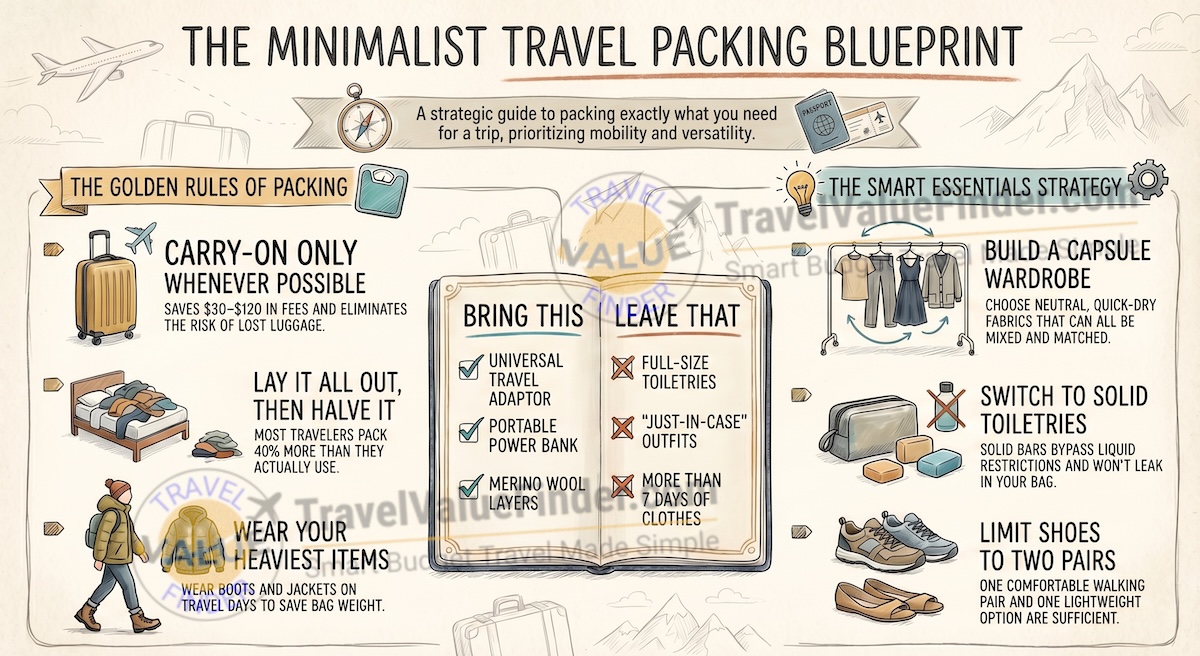
A great travel packing list is not about bringing everything you might need. It is about bringing exactly what you will need and nothing more. The travelers who pack best are not the ones with the biggest bags — they are the ones who have thought carefully about what earns its place.
By Leslie, TravelValueFinder.com | Last updated: April 2026 | Based on years of first-hand budget travel across Europe, Asia and the Americas
Whether you are building your travel packing list for a week in Europe, a month in Southeast Asia, or a long weekend city break, the fundamentals are the same: pack light, pack smart, and leave behind anything that does not have a clear job to do. Every unnecessary item costs you energy, mobility, and often money — in baggage fees, slower movement, and the mental weight of managing too much stuff.
This guide gives you a complete, category-by-category travel packing list for 2026 — including what to bring, what to leave, gear recommendations, packing strategies, and specialist lists for different trip types. It is the only packing guide you need before any trip, anywhere in the world.
Every experienced traveler eventually reaches the same conclusion: you need about half of what you think you do. Pack it all out on your bed, then put half of it back.” — Leslie, TravelValueFinder.com
Planning your trip? Book flights and hotels through our trusted partner for the best prices: Search Flights and Hotels — TravelValueFinder Deals.
The Golden Rules of Packing
Before diving into the full travel packing list, these five principles should guide every packing decision you make:
| # | Rule | Why It Matters |
| 1 | Pack carry-on only whenever possible | Saves $30–$120 per trip in baggage fees; eliminates lost luggage risk; speeds up every airport transit |
| 2 | Lay it all out, then halve it | Most travellers pack 40% more than they use. If you cannot recall needing an item on a previous trip, leave it. |
| 3 | Wear your heaviest items on travel days | Boots, jeans, and jackets worn on the plane do not count against your bag weight limit |
| 4 | Plan around laundry, not extra clothes | One laundry wash mid-trip eliminates the need for half the clothing on your list |
| 5 | Choose versatile, quick-dry fabrics | Merino wool and synthetic travel fabrics resist odour, dry overnight, and pack flat — one item does the work of three |
The Complete Travel Packing List: Category by Category
This master travel packing list is organised by category. Use it as a checklist before every trip — adapting it to your destination, trip length, and season. Items marked with (essential) should be on every list regardless of destination. Items marked (optional) depend on your specific trip.
Documents and Money
| Item | Status | Notes |
| ✓ Passport (valid 6+ months beyond travel dates) | Essential | Photograph and store digitally |
| ✓ Visa documents (if required) | Essential | Print physical copies |
| ✓ Travel insurance documents + emergency number | Essential | Store offline on your phone |
| ✓ Flight and accommodation confirmations (printed) | Essential | Backup paper copies always |
| ✓ No-fee travel credit/debit card | Essential | Wise, Revolut, or Charles Schwab debit |
| ✓ Second backup card | Essential | Different bank from primary |
| ✓ Local currency cash (small amount) | Essential | For arrival taxis, tips, markets |
| ✓ Driving licence (if renting a car) | Optional | International permit if required |
| ✓ GHIC / EHIC card (UK/EU citizens in Europe) | Optional | Not a substitute for travel insurance |
| ✓ Loyalty cards (hotel/airline frequent flyer) | Optional | Store digitally in your wallet app |
For booking flights and hotels before you travel: Compare Flights and Hotels — TravelValueFinder Partner Deals.
Clothing: The Core Wardrobe
Clothing is where most travel packing list mistakes happen — too many items, too heavy, and not versatile enough. The goal is a capsule wardrobe of items that can be mixed and matched across every occasion your trip requires.
| Item | Quantity | Packing Notes |
| T-shirts / tops | 3–4 | Quick-dry synthetic or merino wool; neutral colours for mixing |
| Shirts / blouses (smart-casual) | 1–2 | One for smarter evenings or religious sites |
| Trousers / jeans | 1–2 | Wear the heaviest pair on travel day; pack one lighter pair |
| Shorts or skirts | 1–2 | Skip in cold climates; essential for beach/SE Asia travel |
| Lightweight layer (cardigan/fleece) | 1 | Airports and AC environments are cold; doubles as pillow |
| Rain jacket / packable shell | 1 | Lightweight packable jackets weigh 200–400g and compress small |
| Underwear | 4–5 | Merino wool dries overnight; can be washed in sink |
| Socks | 3–4 pairs | Merino wool regulates temperature and resists odour |
| Pyjamas / sleepwear | 1 | A light pair of leggings and a t-shirt doubles as both |
| Swimwear | 1 | Optional for city trips; essential for beach or hot climates |
| Walking shoes / trainers | 1 pair | Wear on travel day; choose a pair that works for day and evening |
| Sandals or flip-flops | 1 pair | Essential in hot climates; doubles as hostel shower shoes |
| Warm boots / smart shoes | Optional | Only if required; shoes are the heaviest item — justify carefully |
The perfect travel wardrobe is built on three principles: everything mixes with everything else, everything dries overnight, and nothing needs ironing. If an item fails any of these tests, reconsider it.” — Leslie, TravelValueFinder.com
Toiletries and Personal Care
Toiletries are the category most travellers over-pack and every experienced traveller learns to minimise. The 100ml liquid rule applies to carry-on travel; if you are checking a bag, standard sizes apply but weight still matters.
| Item | Size / Format | Notes |
| Toothbrush + toothpaste | Travel size | Buy toothpaste on arrival to save carry-on liquid allowance |
| Shampoo / conditioner | Solid bar | Solid bars bypass 100ml rules and last longer per gram |
| Shower gel / soap | Solid bar | Same logic as shampoo — solid format is travel gold |
| Deodorant | Solid stick | Solid or crystal; no liquid restrictions |
| Sunscreen | 100ml or buy locally | Buy on arrival in sun destinations — cheaper and saves allowance |
| Moisturiser / lip balm | 50–100ml | Planes are very drying; a small tube makes a real difference |
| Razor | Safety or cartridge | Disposables work; safety razors allowed in carry-on (blade in hold) |
| Feminine hygiene products | As needed | Pack enough for the trip; availability varies significantly by destination |
| Prescription medications | Full supply + extra | Carry in original packaging; bring a doctor’s letter for controlled drugs |
| Basic first aid kit | Compact | Plasters, ibuprofen, antihistamine, antiseptic wipes, blister kit |
| Insect repellent | 100ml or solid | Essential for SE Asia, tropical regions, summer Europe outdoors |
| Hand sanitiser | 50–100ml | Useful globally; counts against 100ml liquid allowance |
Electronics and Tech
Electronics are the category where weight and value both matter most on your travel packing list. Bring only what you will actively use — every device is a battery to charge, a cable to carry, and a theft risk to manage.
| Item | Status | Notes |
| ✓ Smartphone | Essential | Your camera, map, translator, boarding pass, and guide in one |
| ✓ Charging cables for all devices | Essential | Bring only cables you will use; leave duplicates |
| ✓ Universal travel adaptor | Essential | One good universal adaptor covers all destinations |
| ✓ Portable power bank (10,000mAh+) | Essential | Carry-on only — lithium batteries cannot go in checked luggage |
| ✓ Earphones / headphones | Essential | For flights, overnight trains, and noisy hostel common rooms |
| ✓ Laptop or tablet | Optional | Only if you need to work; a phone handles most travel tasks |
| ✓ Camera | Optional | Modern smartphones replace a camera for 90% of travellers |
| ✓ E-reader (Kindle etc.) | Optional | Worth its weight for long trips; lighter than one paperback |
| ✓ eSIM or local SIM | Strongly recommended | Airalo eSIMs from $5; eliminates roaming fees entirely |
| ✓ Padlock (TSA-approved) | Essential for hostel travellers | Most hostels provide lockers but not locks |
Bags and Luggage
Your choice of bag is the single most consequential item on your travel packing list — it determines what you can carry, whether you pay baggage fees, and how mobile you are at your destination.
| Bag Type | Best For | Key Considerations |
| 40L carry-on backpack | 1–4 week trips | The gold standard for budget travel — fits Ryanair/EasyJet cabin dimensions and holds 1–2 weeks of well-chosen items |
| 20–30L day bag / personal item | Daily use at destination | Fits under the seat as second carry-on item; essential for day trips and city exploring |
| Carry-on spinner suitcase (55x40x20cm) | City trips, less walking | Good for city-to-city travel with good infrastructure; awkward on cobblestones, public transport, and hostel stairs |
| 60–75L checked backpack | Extended trips, cold climates | Only when carry-on truly is not enough; adds baggage fees and loss risk |
| Dry bag / waterproof stuff sack | Beach, water activities, rainy climates | Lightweight protection for phone, camera, documents in wet conditions |
- Recommended carry-on backpacks: Osprey Farpoint 40, Tortuga Setout 45L, Peak Design Travel Backpack 45L — all meet most airline carry-on size requirements
- Check your specific airline’s carry-on dimensions before packing — Ryanair’s cabin bag policy is particularly strict at 40x20x25cm for non-priority boarding
Comfort and Sleep Items
These items separate comfortable travel from exhausting travel — especially on long-haul flights, overnight trains, and hostel stays:
- Travel pillow — An inflatable or compressible neck pillow for long flights and train journeys. Trtl Travel Pillow or Cabeau Evolution S3 are both compact and genuinely useful
- Eye mask — Essential for daytime flights, hostel dorms, and overnight trains where light control is impossible
- Earplugs — Silicone earplugs weigh nothing and are invaluable in hostel dorms, on planes, and in noisy urban accommodation
- Sleeping bag liner — Optional but useful for hostel travel; adds warmth to thin hostel blankets and can be used alone in warm climates
- Lightweight travel towel — Quick-dry microfibre towels pack to the size of a fist. Essential for hostel travel where towels are often not included. PackTowl and Sea to Summit are reliable brands
- Reusable water bottle — A collapsible bottle packs flat and saves $3–$5 per day in bottled water. Hydaway collapses to 3.5cm; Nalgene is indestructible
What NOT to Pack: Items to Leave at Home
A great travel packing list is defined as much by what you exclude as what you include. These are the items most commonly over-packed — and consistently regretted once travellers are lugging them around:
| Leave Behind | Why You Do Not Need It |
| ✗ Multiple pairs of shoes | One comfortable walking pair + one lightweight option is sufficient for 99% of trips |
| ✗ Full-size bottles of toiletries | Buy on arrival or use solid bars; saves carry-on allowance and significant weight |
| ✗ Hair dryer / straighteners | Most hotels and many hostels provide hair dryers; straighteners are bulky and heavy |
| ✗ More than 3 books | An e-reader holds 1,000 books in the weight of one paperback |
| ✗ A ‘just in case’ outfit | The outfit you pack ‘just in case’ almost never gets worn; it is dead weight |
| ✗ Laptop (if not working) | A smartphone handles maps, translation, email, entertainment, and photos |
| ✗ More than 7 days of clothing | Any trip longer than a week requires laundry, not more clothing |
| ✗ Valuables and sentimental items | Anything irreplaceable or uninsured should stay at home; theft risk is real |
| ✗ Travel-specific gadgets you have not used before | New gear you have not tested at home often fails or disappoints on a trip |
| ✗ Thick cotton towels | Cotton takes hours to dry; a microfibre travel towel does the same job in minutes |
| ✗ Excess cash | Use a no-fee travel card for most purchases; carry only what you need for markets and tips |
I have never once returned from a trip wishing I had packed more. I have returned from dozens of trips wishing I had packed less. The bag you dread carrying is always the one you overpacked.” — Leslie, TravelValueFinder.com
Travel Packing List by Trip Type
Your travel packing list should adapt to the specific demands of your trip. Here are the key additions and subtractions for the most common trip types:
Packing List for Europe (City Travel)
- Core wardrobe applies; add one smart-casual outfit for nice restaurants and ticketed venues
- Comfortable walking shoes are non-negotiable — European city centres involve 10–20km of walking per day
- A compact day bag or tote is essential for museums, markets, and long sightseeing days
- Rain jacket is essential regardless of season — European weather is unpredictable
- Carry a physical copy of hotel confirmations — border controls occasionally ask for proof of onward accommodation in some EU countries
Heading to Europe? See our destination guides:
- How to Travel Europe on a Budget: The Complete 2026 Guide
- Italy Travel Guide for First-Time Visitors (2026)
- Paris Itinerary for First-Time Visitors
Packing List for Southeast Asia
- Replace jeans with lightweight linen or cotton trousers — temperatures range from 28°C to 38°C
- Pack a lightweight scarf or sarong — essential for temple visits (shoulders and knees must be covered)
- Flip-flops are essential; frequent shoe removal at temples means you need easily removable footwear
- Insect repellent (DEET-based) is critical — mosquito-borne illness is a genuine risk
- Stomach remedies are worth including — mild gastrointestinal issues are common in the first week
- A lightweight dry bag protects electronics during water activities and rainy season downpours
Planning a Southeast Asia trip? Find your hotels: Search Hotels Across Southeast Asia — TravelValueFinder.
Packing List for Beach and Tropical Destinations
- Reef-safe sunscreen — both for environmental protection and because many popular beach destinations now require it
- Rash guard or long-sleeve swim top — better sun protection than sunscreen for long days on the water
- Waterproof phone case or dry bag for beach and boat days
- Lightweight cover-ups and sundresses that double as beach-to-town transition pieces
- Sandals that can handle both sand and walking — Birkenstock, Teva, or Chaco all travel well
Packing List for Cold Weather and Winter Travel
- Layering is everything: thermal base layer + mid-layer fleece + outer waterproof shell
- Merino wool base layers regulate temperature, resist odour, and are far lighter than cotton alternatives
- Thermal gloves and hat in a packable format — these weigh almost nothing but matter enormously
- Waterproof boots are worth their weight for wet, snowy, or icy conditions
- Hand warmers (disposable or rechargeable) for outdoor activities in very cold climates
Packing List for Long-Term Travel (4+ Weeks)
- The same base
- Same base list applies — long-term travel does NOT require more items; it requires more laundry
- Add a portable clothesline for hostel laundry rooms
- Consider packing cubes for organisation across a long trip where you are repacking frequently
- A Universal travel adaptor with multiple USB ports is essential for multi-country trips
- Ensure your travel insurance covers the full trip duration — many standard policies cap at 30 or 45 days
How to Pack Your Travel Packing List Efficiently
Having the right items on your travel packing list is only half the challenge — packing them efficiently maximises space and keeps your bag organised throughout the trip.
The Roll-Don’t-Fold Method
Rolling clothes instead of folding them reduces volume by 20–30% and eliminates the deep creases that folding creates. Roll t-shirts, trousers, and casual items tightly into cylinders. Fold structured items like blazers flat on top.
Use Packing Cubes
Packing cubes separate clothing categories (tops, bottoms, underwear) and compress items into manageable blocks. Eagle Creek Pack-It Cubes and Compression Packing Cubes by Gonex are well-reviewed budget options. One cube per category makes finding items effortless without unpacking everything.
The Heaviest Items Nearest Your Back
When packing a backpack, place the heaviest items (shoes, laptop if carrying one, toiletries bag) closest to your back and centred. Lighter items go at the bottom and top. This distributes weight correctly and reduces strain on your shoulders and lower back.
Keep Liquids Accessible for Security
All liquids in containers of 100ml or less must go into a single clear resealable bag (1 litre maximum) for carry-on security. Pack this bag on top of everything else for fast, stress-free security clearance. Solid toiletries bypass this rule entirely.
Digital Tools to Complete Your Travel Packing List
Your phone is the most powerful item on any travel packing list. These apps eliminate the need for physical items and make every aspect of travel smoother:
| App / Tool | What It Replaces | Link |
| Google Maps (offline) | Physical maps; expensive data roaming | maps.google.com |
| Airalo | Physical SIM cards; roaming charges | airalo.com |
| Wise / Revolut | Currency exchange booths; ATM fees | wise.com |
| Google Translate | Phrasebooks; translation dictionaries | translate.google.com |
| TripIt | Paper itineraries; booking printouts | tripit.com |
| PackPoint | Manual packing list creation | packpnt.com |
| XE Currency | Currency conversion calculators | xe.com |
| Rome2Rio | Physical transport research; timetables | rome2rio.com |
| TravelValueFinder AI Trip Planner | Expensive travel agents; hours of research | travelvaluefinder.com/ai-trip-planner |
Plan Your Trip: Essential Resources on TravelValueFinder
Use your completed travel packing list alongside these guides to prepare your full trip:
- How to Find Cheap Flights: 12 Proven Strategies That Actually Work
- How to Travel Europe on a Budget: The Complete 2026 Guide
- How to Travel Cheap: 25 Tips to Cut Your Budget in Half
- How Much Does It Cost to Visit Italy? A 2026 Budget Breakdown
- Travel Insurance Guide: What It Covers and the Best Options
- Paris on a Budget: How to Save Money Without Missing Out
- Lisbon on a Budget: Cheap Things to Do, Eat and Stay
- Rome Travel Guide 2026: Things to Do, Costs and Tips
- Free AI Trip Planner: Get a Day-by-Day Itinerary in Seconds
- Discover Your Travel Personality Quiz
Frequently Asked Questions
What should be on every travel packing list?
Every travel packing list should include: a valid passport (with 6+ months validity), travel insurance documents, a no-fee travel card plus a backup card, at least 3–4 versatile clothing items in quick-dry fabric, a universal travel adaptor, a portable power bank, a travel towel, a padlock, and all prescription medications in original packaging. Documents and money are the non-negotiables — everything else is adaptable to your destination and travel style.
How do I pack for 2 weeks in a carry-on?
Packing for 2 weeks carry-on only requires: 4 tops, 2 bottoms, 4 sets of underwear and socks, 1 lightweight layer, 1 rain jacket, 2 pairs of footwear (one worn on travel day), travel-sized or solid toiletries, and your electronics. Roll everything, use packing cubes, wear your heaviest items on travel day, and plan one laundry wash mid-trip. A 40L backpack is sufficient for 2 weeks when packed this way.
What should I NOT pack in carry-on luggage?
Items not permitted in carry-on include: liquids over 100ml, sharp objects (scissors with blades over 6cm, razors with exposed blades), lithium batteries over 100Wh (in checked luggage only), and any items prohibited by your specific airline or destination country. Lithium power banks must always travel in carry-on — they cannot go in the hold. Check the latest restrictions at TSA.gov (US) or UK Civil Aviation Authority (UK) before travelling.
What is the best bag for carry-on only travel?
The best all-round bag for carry-on only travel is a 40–45L travel backpack — large enough for 1–2 weeks of clothing and essentials, compact enough to meet most airline carry-on size requirements. The Osprey Farpoint 40, Tortuga Setout 45L, and Peak Design Travel Backpack 45L are consistently recommended by experienced travellers. If you prefer a suitcase, ensure it meets the 55x40x20cm maximum dimensions required by budget airlines like Ryanair.
How do I pack light for a trip to Europe?
Pack light for Europe by: choosing a 40L carry-on backpack, building a capsule wardrobe of 3–4 tops and 2 bottoms in quick-dry fabric that all work together, packing solid toiletries to bypass liquid restrictions, wearing your heaviest items (boots, jeans, jacket) on travel day, and planning one laundry wash per week. For detailed destination-specific packing advice, see our How to Travel Europe on a Budget guide.
Do I need a travel adaptor for Europe?
Yes. Most of Europe uses Type C or Type F plugs (two round pins) at 220–240V. If you are travelling from the US, Canada, Australia, or the UK, your plugs will not fit European sockets without an adaptor. Buy a universal travel adaptor with multiple USB ports before you travel — it is cheaper at home than at airports and works across all European countries and most of the rest of the world.
What medications should I pack for travel?
A basic travel medication kit should include: ibuprofen or paracetamol (pain and fever), antihistamines (allergic reactions, hay fever, insect bites), antidiarrhoeal medication (especially for developing world travel), antacids, antiseptic cream, blister plasters, and any prescription medications you take regularly. For travel to regions with malaria risk, consult a travel health clinic 6–8 weeks before departure for prophylaxis advice. Always carry prescription medications in their original packaging with a doctor’s letter.
Final Thoughts: Build Your Travel Packing List Once, Use It Every Time
The best travel packing list is a living document — built once, refined after every trip, and improved by experience. After each journey, note what you never used and remove it. Note what you wished you had brought and add it. Within two or three trips, you will have a personalised travel packing list that works perfectly for your travel style and never needs to be rebuilt from scratch.
Start with the master list in this guide, adapt it to your destination and trip type using the specialist sections, and apply the golden rules: pack light, roll everything, and when in doubt — leave it out.
Pack less. Move faster. Travel further.
Ready to book your trip? Find the best prices on flights and hotels through our partner: Search Flights and Hotels — TravelValueFinder Deals. Hundreds of providers, transparent pricing, secure booking. We earn a small commission at no extra cost to you — it helps keep all our guides free.