Travel Value Finder


Japan departure tax July 2026 is the travel calendar deadline that every Japan traveler must act on right now. On July 1, 2026 – just 67 days from today – Japan’s departure tax triples from JPY 1,000 to JPY 3,000 per person for every traveler leaving Japan by air or sea. For a couple on a 10-day Japan trip, this single date change adds JPY 4,000 – approximately USD 27 – to the cost of the trip. That number becomes significantly larger when combined with Japan’s other 2026 tax changes that have already taken effect: a 900% increase in Kyoto’s luxury accommodation tax, a 300% increase at mid-range hotels, and two JR Pass price increases scheduled for October 2026. This Travel Alert consolidates every deadline, calculates the real cost by traveler profile, and tells you the exact actions to take before July 1.
Leslie Nics | TravelValueFinder.com | Travel Alert | April 25, 2026 | Last reviewed: April 25, 2026
Table of Contents
When does Japan’s departure tax increase in 2026? Japan’s international departure tax triples from JPY 1,000 (~USD 6.70) to JPY 3,000 (~USD 20) per person effective July 1, 2026, for all travelers aged 2 and older departing Japan by air or sea. The tax is automatically included in your airline or cruise ticket price – you do not pay it separately at the airport. Travelers with flights departing Japan before July 1, 2026 pay the current JPY 1,000 rate. Flights departing on or after July 1, 2026 are charged at the new JPY 3,000 rate.
The July 1 Deadline: What Exactly Changes and Who It Affects
Japan’s departure tax has existed since 2019, introduced at JPY 1,000 per person to fund tourism infrastructure and inbound visitor services. It has never been increased – until now. The Japanese government announced the tripling to JPY 3,000 as part of a sweeping 2026 tourist tax framework designed to raise JPY 130 billion in fiscal year 2026 to fund overtourism countermeasures, crowd management in Kyoto and Tokyo, and infrastructure investment in Japan’s lesser-known rural regions.
The departure tax is unavoidable and universal: it applies to every traveler aged 2 and older leaving Japan by air or sea, regardless of nationality, the length of their stay, or how they entered. Transit passengers who depart within 24 hours of arrival and children under 2 are exempt. The tax is embedded in your airline ticket price – there is no separate payment at the airport.
The implication for trip planning is immediate and specific: every Japan itinerary with flights departing on or after July 1, 2026 carries the higher tax. Every itinerary with flights departing before July 1, 2026 locks in the current rate. This is not a hypothetical future change – it is 67 days away as of this article’s publication date.
Japan’s tax changes in 2026 are not about deterring visitors – they are about redistributing where visitors go and when they go. The July 1 departure tax deadline is a real financial trigger. Travelers who act before it pay less. It is that simple. Leslie Nics, TravelValueFinder.com
Every Japan 2026 Tax Change: The Complete Deadline Calendar
The departure tax deadline is the most urgent item on this calendar, but it is not the only one. Here is every Japan 2026 tax change with its exact effective date, current status, and wallet impact.
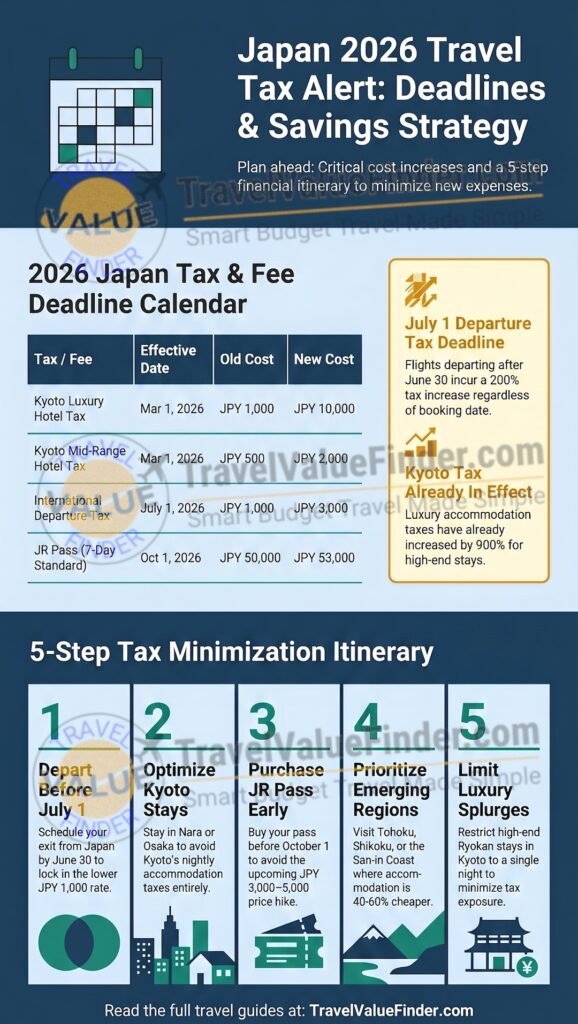
| Tax / Fee | Effective Date | Status April 2026 | Old Cost | New Cost | Net Impact – Couple, 10-Day Trip |
|---|---|---|---|---|---|
| Kyoto Accommodation Tax – Luxury (over JPY 50,000/night) | March 1, 2026 | ALREADY IN EFFECT | JPY 1,000/person/night | JPY 10,000/person/night | ↑ USD 669 for 5 Kyoto nights |
| Kyoto Accommodation Tax – Mid-Range (JPY 20,000 – 50,000/night) | March 1, 2026 | ALREADY IN EFFECT | JPY 500/person/night | JPY 2,000/person/night | ↑ USD 134 for 5 Kyoto nights |
| Kyoto Accommodation Tax – Budget (under JPY 6,000/night) | March 1, 2026 | ALREADY IN EFFECT – NO CHANGE | JPY 200/person/night | JPY 200/person/night | No change |
| Hokkaido Accommodation Tax | April 1, 2026 | ALREADY IN EFFECT | None | JPY 500/person/night (over JPY 50,000) | Minimal – applies only at luxury level |
| International Departure Tax | JULY 1, 2026 | ⚠️ 67 DAYS AWAY – BOOK NOW | JPY 1,000/person (~USD 6.70) | JPY 3,000/person (~USD 20) | ↑ USD 27 for a couple – book pre-July to avoid |
| JR Pass – 7-Day Standard Adult | October 1, 2026 | 3 months away – buy before if possible | JPY 50,000 (~USD 335) | JPY 53,000 (~USD 355) | ↑ USD 20/person – buy pass before Oct if planned |
| JR Pass – 14-Day Standard Adult | October 1, 2026 | 3 months away | JPY 80,000 (~USD 535) | JPY 84,000 (~USD 562) | ↑ USD 27/person – buy pass before Oct if planned |
| JR Pass – 21-Day Standard Adult | October 1, 2026 | 3 months away | JPY 100,000 (~USD 670) | JPY 105,000 (~USD 703) | ↑ USD 34/person – buy pass before Oct if planned |
| Proposed Visa Fee Increase (countries requiring Japan visa) | NOT YET ENACTED | Proposed only – monitor MOFA | JPY 3,000 (~USD 20) | JPY 15,000 (~USD 100) proposed | Visa-exempt nationals (U.S., UK, EU, AU, CA) unaffected |
Sources: Japan Tourism Agency; Kyoto City Government ordinances; TTR Weekly April 2026; Japan Ministry of Foreign Affairs. All USD conversions at JPY 149.5/USD, April 25, 2026.
What Does This Mean for Your Wallet and Trip Planning?
| The Japan departure tax July 2026 deadline creates three distinct cost scenarios depending on when your flights depart Japan. Here is the real calculation for each traveler profile: Departing Japan before July 1, 2026: You pay JPY 1,000 per person departure tax – the current rate. A couple saves JPY 4,000 (~USD 27) versus post-July travel. This is free money. If your Japan dates are flexible and you can schedule departure before July 1, do it today. Departing Japan on or after July 1, 2026: You pay JPY 3,000 per person – the new rate. A couple pays JPY 6,000 (~USD 40) in departure tax versus JPY 2,000 (~USD 13) previously. The additional cost is USD 27 per couple – modest in isolation, but compounding alongside the Kyoto accommodation tax and JR Pass increases means that a mid-range couple’s Japan trip in late 2026 costs approximately USD 250 – 700 more than the same trip in 2025. Combining all 2026 Japan tax changes – mid-range couple, 10 days: Kyoto accommodation tax (5 mid-range nights): +USD 134. Departure tax increase: +USD 27. JR Pass increase (2 × 14-day pass from October): +USD 54. Total additional cost above 2025: approximately USD 215. This is manageable – but it represents a genuine cost increase that value-focused travelers should factor into their Japan planning. |
The Smart Japan Itinerary That Legally Minimises Every 2026 Tax
The good news: Japan’s 2026 tax framework has been structured in ways that allow value-conscious travelers to significantly reduce their exposure through deliberate planning choices. Here is the itinerary strategy that TravelValueFinder recommends for travelers who want to see Japan in 2026 without paying the maximum new tax burden.
Step 1 – Depart Japan Before July 1, 2026
This single decision saves a couple USD 27 – not a life-changing sum, but completely free savings that require only a date adjustment. Japan’s spring travel window (late March through June) includes the tail end of cherry blossom season in northern regions and the lush green season of early summer. Departing by June 30 keeps you in the lower departure tax tier.
Step 2 – Stay Outside Kyoto or Choose Kyoto’s Budget Accommodation Tier
The Kyoto accommodation tax is the most significant new cost for most travelers. There are three ways to minimise it legally: (a) Stay in properties priced under JPY 6,000 per person per night – the budget tier where the tax remains at JPY 200, unchanged from before. (b) Stay in Nara (30 minutes by train) or Osaka (15 minutes by shinkansen from Shin-Osaka) and day-trip to Kyoto – no Kyoto accommodation tax applies as you are not staying overnight in Kyoto. (c) Stay in Kyoto for only 1 to 2 nights rather than 4 to 5 – concentrating your Kyoto visits in a shorter period while basing yourself in Osaka or Nara for the remainder.
Step 3 – Buy Your JR Pass Before October 1, 2026
JR Passes must be purchased before the trip begins and are available through authorised overseas sales agencies. If you are planning a Japan trip in late 2026 or early 2027 that will use a JR Pass, purchasing before October 1, 2026 locks in the current price. The 21-day pass rises by JPY 5,000 (~USD 34 per person) after that date. A couple buying two 21-day passes before October saves USD 68 – enough for a full dinner at a mid-range Japanese restaurant.
Step 4 – Prioritise Japan’s Emerging Regions Over Kyoto and Tokyo
Tohoku, Shikoku, the San-in Coast, Kanazawa, and Beppu all offer accommodation at 40 to 60% below Tokyo or Kyoto rates. The Kyoto luxury and mid-range accommodation taxes do not apply in these regions. The Japan Tourism Agency is directing JPY 130 billion in 2026 tax revenue specifically toward improving infrastructure in these destinations – meaning the experience quality is rising while the tax burden remains low. For value-focused travelers, this is the defining Japan travel opportunity of 2026.
Step 5 – Skip Kyoto Luxury Ryokans – Or Plan Them as a Single Splurge Night
The 900% increase in Kyoto’s luxury accommodation tax (from JPY 1,000 to JPY 10,000 per person per night at properties over JPY 50,000/night) makes a 5-night luxury ryokan stay in Kyoto approximately USD 670 more expensive for two people than the same experience in 2025. The strategic response is to plan one deliberately chosen luxury ryokan night in Kyoto – as a single special occasion rather than a multi-night stay – and spend the remaining nights in Nara, Osaka, or Kanazawa where luxury tax rates are either lower or absent entirely.
People Also Ask – Japan Departure Tax July 2026
| Quick Answer: Do I have to pay Japan’s departure tax if I am transiting through Japan? No. Transit passengers who arrive in Japan and depart within 24 hours of arrival are exempt from Japan’s departure tax. Children under age 2 are also exempt. All other travelers aged 2 and older departing Japan by air or sea pay the departure tax – JPY 1,000 per person before July 1, 2026, and JPY 3,000 per person from July 1, 2026 onwards. The tax is included in your airline or cruise ticket price automatically. |
| Q: Does the Japan departure tax apply to Japanese citizens leaving Japan? A: Yes. Japan’s departure tax applies to all travelers leaving Japan by international air or sea transport, regardless of nationality – including Japanese citizens. It was introduced in January 2019 specifically as a departure tax on all outbound international travelers. The July 1, 2026 increase from JPY 1,000 to JPY 3,000 applies universally to Japanese and foreign travelers alike. The only exemptions are transit passengers (departing within 24 hours of arrival) and children under age 2. |
| Q: Is Japan still worth visiting in 2026 despite all the new taxes? A: Yes – unequivocally, for most traveler profiles. Despite all 2026 tax changes combined, a mid-range couple visiting Japan for 10 days pays approximately USD 215 more than in 2025 – an increase of roughly 6 to 8% on a typical mid-range Japan travel budget. For context, a comparable 10-day itinerary in France, Italy, or Spain costs 40 to 60% more in base costs before any new taxes. Japan’s combination of world-class food, safety, public transport, cultural depth, and visual beauty still represents one of the highest value-per-dollar travel experiences available globally at the mid-range level. The tax changes matter most for luxury travelers staying in high-end Kyoto ryokans – that specific profile is genuinely more expensive in 2026. |
| Q: Which part of Japan is cheapest to visit in 2026 given the new taxes? A: Japan’s emerging rural regions are unambiguously the cheapest option in 2026 relative to experience quality. Tohoku (Yamagata, Akita, Iwate, Aomori), Shikoku island, the San-in Coast (Tottori, Shimane), Kanazawa, and Beppu in Kyushu all offer accommodation at 40 to 60% below Tokyo or Kyoto rates, with either no new accommodation taxes or taxes only at the luxury tier. A well-reviewed onsen ryokan in Tohoku or Shikoku with two meals included runs JPY 10,000 to JPY 18,000 per person per night – comfortable below every new tax threshold. These regions are also where Japan’s new tourist tax revenue is being directed for infrastructure improvement, meaning the experience quality is rising while costs remain low. |
| Q: If I buy a Japan airline ticket now for a July 2026 departure, do I pay the old or new departure tax? A: This depends on your departure date from Japan, not your booking date. If your flight departs Japan on or before June 30, 2026, you pay JPY 1,000 per person – the current rate – regardless of when you purchased the ticket. If your flight departs Japan on or after July 1, 2026, you pay JPY 3,000 per person – the new rate – regardless of when you purchased the ticket. The tax is calculated at the point of departure, not at the point of booking. Airlines embed this automatically in the ticket price – the tax component of your fare will reflect the rate applicable to your actual departure date. |
FAQ – Japan Departure Tax July 2026
Q: Can I get a refund on the Japan departure tax if my flight is cancelled?
A: If your flight is cancelled by the airline and you receive a full ticket refund, the departure tax component is typically included in the refund. If you voluntarily cancel a non-refundable ticket, the departure tax component may or may not be refundable depending on the airline’s policy and the terms of your ticket. Japan’s departure tax is a government charge, not an airline charge – airlines collect it on behalf of the Japanese government. For travelers concerned about cancellation scenarios, booking fully refundable fares or using a credit card with trip cancellation insurance provides the strongest protection.
Q: Does the Japan accommodation tax apply to Airbnb and short-term rentals?
A: Yes. Japan’s accommodation taxes – including the new Kyoto rates effective March 1, 2026 and Hokkaido rates from April 1, 2026 – apply to all accommodation types including hotels, traditional ryokan, guesthouses, and registered short-term rental properties. The tax is based on the nightly accommodation charge per person. Unregistered or informal accommodation (which operates outside Japan’s legal short-term rental framework) does not collect the tax, but staying in unregistered accommodation in Japan carries legal risk for both host and guest under Japan’s Minpaku Law.
Your Japan 2026 Action Plan: What to Do in the Next 67 Days
- Check your Japan flight departure date today. If your flights depart Japan on or after July 1, 2026 and your dates are flexible, search for alternative options that depart before June 30, 2026. Even a one or two day shift saves a couple USD 27 in departure tax – free savings.
- If planning Japan for late 2026 or 2027, buy your JR Pass now before the October 1, 2026 price increase. JR Passes are available through authorised overseas agencies and can be purchased months in advance. A couple buying two 21-day passes before October saves USD 68.
- Review your Kyoto accommodation booking. If you are staying in a mid-range or luxury hotel in Kyoto, calculate your new accommodation tax exposure using the table above. Consider switching nights to Nara or Osaka to reduce the tax burden while keeping Kyoto day trips.
- Add one or more of Japan’s emerging regions – Tohoku, Shikoku, San-in Coast, Kanazawa, or Beppu – to your itinerary. These destinations are 40 – 60% cheaper than Kyoto on accommodation, carry either no new taxes or minimal ones, and are about to improve significantly in infrastructure quality.
- Bookmark the Japan Tourism Agency and Japan Ministry of Foreign Affairs websites for updates on the proposed visa fee increase, which has not yet been enacted but remains under legislative consideration.
Related Guides on TravelValueFinder.com
- Full Japan tax breakdown with cost tables: Japan Tourist Tax 2026: Your Trip’s True Cost – the complete guide to every 2026 Japan tax change.
- Best alternatives if Japan costs are too high: Best Travel Destinations 2026: Skip the U.S. and Save Up to $2,600 – includes South Korea and Taiwan as strong Asia alternatives.
- Traveling to Europe on the same trip?: Europe ETIAS 2026: The Only Checklist You Actually Need
- Planning to retire in Asia?: Affordable Retirement: Best Countries Where Your Money Goes Further – covers Japan, Thailand, Malaysia, and Portugal.
- Europe budget travel after Japan: How to Travel Europe on a Budget: The 2026 Guide
- Spirit Airlines Is Gone: The Complete Traveler’s Guide to Refunds, Rescue Fares, Higher Airfares, and What Comes Next
- Your Mexico Hotel Just Got 1,000% More Expensive – Here’s the Only Way Around the FIFA World Cup 2026 Price Crisis
- Global Travel Alerts May 2026: The Complete Briefing Every International Traveler Needs Before Booking
- Travel Alerts May 2026: Ebola Crisis, Thailand-Cambodia Conflict & Summer Disruptions Every Traveler Must Act On Now
Japan is one of the few destinations in the world where the more slowly you travel and the further from the tourist trail you go, the cheaper it gets. The 2026 tax changes have made that truth more financially relevant than ever. Leslie Nics, TravelValueFinder.com
Sources and Editorial Transparency
Primary Sources: Japan Tourism Agency – Official Tax Framework • Kyoto City Government – Accommodation Tax Ordinance • TTR Weekly – Japan Departure Tax Hike • Euronews Travel – Japan Tax Changes 2026 • TravelValueFinder – Japan Tourist Tax 2026 Full Guide
Researched and written by Leslie Nics, founder of TravelValueFinder.com, with personal travel experience in Japan including Tohoku, Kyoto, Tokyo, and Shikoku. Sources: Japan Tourism Agency official announcements; Kyoto City Government accommodation tax ordinance (effective March 1, 2026); Hokkaido prefecture accommodation tax (effective April 1, 2026); TTR Weekly Japan departure tax briefing (April 2026); Euronews Travel Japan tax changes guide (April 15, 2026); Japan Ministry of Foreign Affairs visa information portal; East Japan Railway Company (JR East) JR Pass pricing announcements. All currency conversions at JPY 149.5/USD as of April 25, 2026. This article will be updated if the proposed visa fee legislation is enacted. Last reviewed: April 25, 2026.