Travel Value Finder


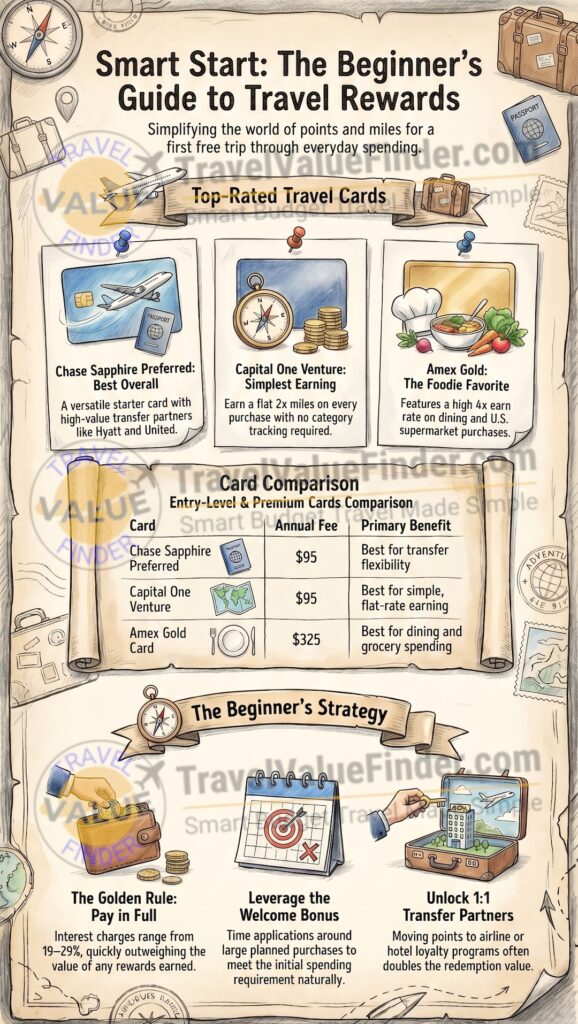
The best travel credit cards for American beginners in 2026 are: (1) Chase Sapphire Preferred® ($95/yr) – best overall, 75,000-point welcome bonus worth $750 – $1,500+ in travel, transfer to 13 partners including Hyatt and United; (2) Capital One Venture Rewards ($95/yr) – simplest 2x miles on everything, 75,000-mile bonus, transfer to 15+ airlines; (3) Capital One Venture X ($395/yr) – premium lounge access with net cost near $0 after $300 travel credit and 10,000 anniversary miles; (4) American Express Gold ($325/yr) – best for food spenders, 4x on dining and groceries, up to 100,000-point bonus; (5) Bank of America Travel Rewards ($0/yr) – best no-fee starter card.
Key rule: always pay your balance in full each month – travel rewards never outweigh credit card interest charges.
Leslie Nics, TravelValueFinder.com | Last updated: May 2026 | A practical, step-by-step guide to earning your first free flight or hotel night using points and miles – no jargon, no overwhelm.
2026 Travel Credit Cards: Quick Comparison
| Card | Ann. Fee | Welcome Bonus | Best For | Earn Rate | Best Redemption |
| Chase Sapphire Preferred® | $95 | 75,000 pts | Best overall / beginners | 5x travel via Chase; 3x dining | Transfer to Hyatt, United, Southwest |
| Capital One Venture Rewards | $95 | 75,000 miles | Simplicity & flexibility | 2x all purchases; 5x via C1 Travel | Transfer to 15+ airline partners |
| Capital One Venture X | $395 | 75,000 miles | Premium perks, lower fee | 2x all; 5x/10x via C1 Travel | Transfer to partners + lounge access |
| Amex Gold Card | $325 | Up to 100,000 pts | Big food & grocery spenders | 4x dining & groceries | Transfer to 20+ airline/hotel partners |
| Bank of America Travel Rewards | $0 | 25,000 pts ($250) | No fee / first card | 1.5x all purchases | Statement credit for travel/dining |
| Capital One VentureOne | $0 | 20,000 miles | No fee / building credit | 1.25x all; 5x via C1 Travel | Erase travel purchases at 1¢/mile |
Sources: NerdWallet Best Travel Cards 2026 | U.S. News Best Travel Cards May 2026 | CNBC Select Best Travel Cards 2026
Best Travel Credit Cards: Your Honest, Beginner-Friendly Guide for 2026
Here’s something that took me longer than I’d like to admit to figure out: the best travel credit cards don’t just reward you for flying or booking hotels. They reward you for buying groceries, eating dinner, streaming your favorite shows, and living your everyday life – and then they hand you a free flight or hotel night as a thank-you.
I’m Leslie Nics at Travel Value Finder, and I’ll be upfront with you: I came to travel credit cards late, as a retiree who assumed they were complicated and mostly for business travelers racking up miles on expensive flights. I was wrong on both counts. The points and miles world can be as simple or as deep as you want it to be – and for most everyday American travelers, the basics alone are enough to earn a free trip every year.
This guide is written specifically for beginners. No acronyms without explanation. No assuming you know what ‘transfer partners’ means. No pretending these cards don’t come with caveats. What you’ll get is a clear, honest look at the best travel credit cards available to US consumers in 2026, how they work, which one suits your life best, and the simple strategy to earn your first free flight or free hotel night without turning points-chasing into a second job.
Travel credit cards sound complicated because the industry benefits from that perception. Once you strip away the jargon, the core idea is remarkably simple: use a card for things you already buy, earn points, and redeem those points for things that used to cost you money. Leslie Nics, TravelValueFinder.com – Updated May 2026
The Golden Rule – Read This Before Anything Else
Travel credit cards only make financial sense if you pay your balance in full every month. A typical travel card charges 19 – 29% APR on carried balances. Earning 2x miles on a $500 dinner that costs you $85 in interest is a losing trade, every time. If you currently carry a balance, address that first – then revisit rewards cards when your slate is clear. This guide assumes you pay in full each month.
How Travel Credit Cards Actually Work: A Plain-English Explanation
Before we get to the specific cards, let’s make sure the fundamentals are clear. This section will take five minutes to read and will save you significant confusion later.
Points, Miles, and Points Currencies – What’s the Difference?
When you use a travel credit card, every dollar you spend earns you either points or miles. These are essentially the same thing with different branding. What matters isn’t the name – it’s who issues them and how flexible they are.
There are two main types:
- Transferable points currencies (the most valuable): Chase Ultimate Rewards, American Express Membership Rewards, and Capital One Miles are flexible currencies that you can move to dozens of airline and hotel loyalty programs. This flexibility is what unlocks the highest-value redemptions.
- Fixed-value miles (simpler but less powerful): Some cards give you miles that are worth exactly 1 cent each, redeemable as a statement credit against any travel purchase. No complexity, but also no ability to find the outsized deals that transferable currencies unlock.
What Is a Welcome Bonus and Why Does It Matter?
When you open a new travel card, almost every major issuer offers a welcome bonus – a large chunk of points you earn after meeting a minimum spend requirement within the first few months. For example: earn 75,000 points after spending $5,000 in the first 3 months.
This matters enormously because the welcome bonus alone often represents one to three years of everyday points-earning compressed into a single signup. A 75,000-point bonus from Chase Sapphire Preferred, transferred to World of Hyatt, can cover two to four nights at a hotel that would otherwise cost $200 – $400 per night in cash.
Meet the Spend Requirement Naturally
Never overspend just to hit a welcome bonus. Instead, time your card application around a planned large purchase – new appliances, a home project, insurance payments, medical bills. Put it on the new card, pay it off immediately. You earn the bonus without spending more than you already planned.
What Are Transfer Partners?
This is where travel cards separate from regular cashback cards. When your points are in a transferable currency (like Chase Ultimate Rewards or Amex Membership Rewards), you can move them – usually at a 1:1 ratio – into airline or hotel loyalty programs where the value per point is often much higher.
A concrete example: 60,000 Chase Ultimate Rewards points moved to World of Hyatt can book a hotel night worth $400+ in cash. Using those same 60,000 points as a statement credit through Chase Travel would get you only $750. The transfer partner unlocked 60 – 70% more value from the same points.
The best transfer partner relationships for most American travelers:
- Chase – World of Hyatt: Routinely delivers 2 – 3 cents per point in value. Hyatt properties often cost 5,000 – 15,000 points per night that would cost $200 – $400+ in cash.
- Chase / Amex – United, British Airways, Air Canada: Useful for booking partner flights on Star Alliance, which includes Swiss, Lufthansa, ANA, and Singapore Airlines.
- Capital One – Multiple airlines: Partners include Air Canada Aeroplan, Turkish Airlines, and Singapore Airlines – each useful for specific routes.
Annual Fees – Are They Worth It?
The short answer for most travelers: yes, if you use the benefits. A $95 annual fee card that saves you $200 in travel insurance, earns you $150 in points from everyday spending, and gives you a $50 hotel credit has a net value of +$305 even after the fee. The key is being honest about which credits and benefits you’ll actually use.
Cards with no annual fee are a perfectly valid starting point – especially while you’re learning the system. They earn fewer rewards but eliminate the fee math entirely.
The 5 Best Travel Credit Cards for 2026: Reviewed Honestly
1. Chase Sapphire Preferred® Card – Best Overall for Beginners
Annual Fee: $95 | Welcome Bonus: 75,000 points after $5,000 spend in 3 months | Best for: First-time rewards travelers; flexible redemption seekers
The Chase Sapphire Preferred has been the NerdWallet Best-Of Award winner for Best All-Purpose Travel Card from 2023 to 2026 – four consecutive years. That’s not an accident. At $95 per year, it combines a genuinely strong welcome bonus, excellent transfer partner access, useful everyday earning categories, and best-in-class travel insurance in a package that doesn’t require a spreadsheet to manage.
According to NerdWallet’s independent analysis, the welcome bonus alone is worth approximately $750 at minimum – and potentially $1,500+ if you transfer to premium partners like Hyatt or Singapore Airlines. That’s years of annual fees covered by one signup.
What You Earn
- 5x points: Travel booked through Chase Travel portal (and Lyft rides through Sept 2027)
- 3x points: Dining at restaurants, takeout, delivery services, select streaming services, and online grocery purchases
- 2x points: All other travel (flights, hotels, car rentals booked outside Chase Travel)
- 1x points: Everything else
Credits and Benefits That Matter
- $50 annual hotel credit: Statement credit for hotel stays booked through Chase Travel – covers more than half the annual fee on its own
- Complimentary DashPass: $0 delivery fees on DoorDash – worth ~$120/year if you use it
- Primary rental car coverage: Rare for a $95 card. Pays out before your personal insurance – saves $15 – $25/day on rental counter insurance
- Trip cancellation insurance: Up to $10,000 per person. A standalone policy with similar coverage typically costs $200 – $400 per trip
- Trip delay reimbursement: Up to $500 after a 12-hour delay – covers meals, accommodation, necessities
- Lost luggage insurance: Up to $3,000 per person
The Transfer Partner Advantage
The Sapphire Preferred’s 13 transfer partners at 1:1 ratio are its real superpower. Key partners include World of Hyatt, United Airlines, Southwest Rapid Rewards, JetBlue, British Airways, Air Canada Aeroplan, Marriott Bonvoy, and IHG. According to NerdWallet’s Chase Sapphire Preferred analysis, transferring points to Hyatt delivers some of the best redemption values available – up to 2 – 3 cents per point, far above the 1.25-cent baseline for Chase Travel bookings.
Important 2026 Update
Chase has confirmed the 10% anniversary points bonus ends October 1, 2026. This was a small perk (equal to 1 bonus point per $10 spent) and its removal doesn’t significantly change the card’s value proposition, according to independent analyses from Kudos and Wealthvieu. The $50 hotel credit, DashPass benefit, transfer partners, and trip insurance remain intact and continue to justify the $95 fee comfortably.
Who Should Get It
- Anyone opening their first travel rewards card and wanting maximum flexibility
- Frequent diners – the 3x on restaurants stacks up quickly
- Travelers who value strong insurance protections over airport lounge access
- Anyone interested in Hyatt hotel redemptions – Sapphire Preferred is the gateway
Who Should Skip It
- People who primarily fly one airline and want that airline’s specific perks (free bags, priority boarding)
- Those who want airport lounge access – the Preferred doesn’t include it
The Chase Sapphire Preferred is the card I recommend to anyone just starting out with travel rewards. The $95 fee feels like nothing once you’ve used the hotel credit and transferred points to Hyatt for a stay that would have cost $300. Leslie Nics, Travel Value Finder
Find out more about The Only No Foreign Transaction Fee Credit Card I’d Get Before My Next International Trip, and why it is the best credit card for travel
2. Capital One Venture Rewards Credit Card – Best for Simplicity
Annual Fee: $95 | Welcome Bonus: 75,000 miles after $4,000 spend in 3 months (~$750 in travel) | Best for: Travelers who want straightforward rewards without tracking bonus categories
The Capital One Venture is consistently ranked by WalletHub as the best overall travel credit card for its combination of simplicity and value. The pitch is clean: 2 miles on every dollar you spend, no exceptions. No rotating categories. No thinking about which card to use where. Pull out the Venture for everything and earn a consistent 2x.
The miles work in two ways. At their simplest, they’re worth 1 cent each as a statement credit against any travel purchase – buy a flight, hotel, rental car, even a rideshare, and erase it with miles. No blackout dates, no airline restrictions, no booking portals. That flexibility is genuinely unusual. But the miles can also be transferred to over 15 airline partners – including Air Canada Aeroplan, Turkish Airlines, Singapore Airlines, and Emirates – for higher-value redemptions when you want them. According to CNBC Select’s Venture card review, the transferable option is what separates the Venture from simple cashback cards.
What You Earn
- 5x miles: Hotels, vacation rentals, and rental cars booked through Capital One Travel
- 2x miles: All other purchases – flat rate, no exceptions
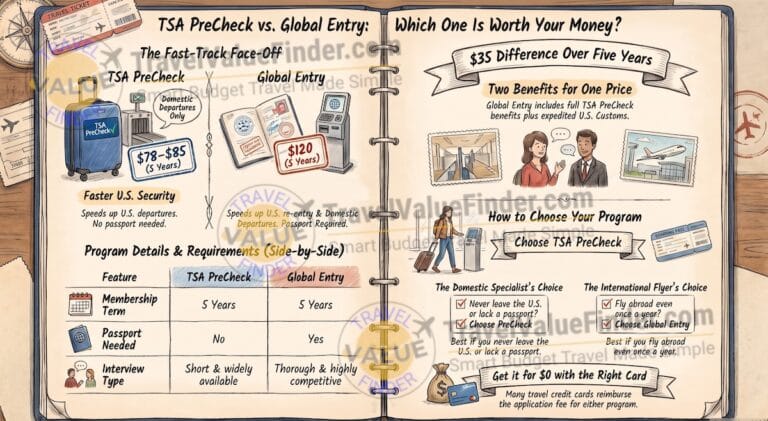
- Up to $120 credit: For Global Entry or TSA PreCheck application fee – a genuinely useful perk for any traveler
Why It Works for Beginners
The Venture’s appeal for someone new to travel rewards is its complete elimination of decision fatigue. You never have to ask ‘which card should I use here?’ It’s always the Venture. That simplicity means you’re more likely to actually use the card and earn consistently – which, over a year, adds up to a meaningful points balance.
Who Should Get It
- Travelers who prefer simple, consistent rewards over maximizing every category
- Those who book travel across multiple airlines and hotels with no brand loyalty
- Anyone who wants TSA PreCheck or Global Entry paid for as part of their annual fee
Who Should Skip It
- Hyatt loyalists – Chase Sapphire Preferred’s Hyatt transfer partner is often more valuable
- Heavy diners – Amex Gold earns 4x on restaurants vs Venture’s 2x flat
3. Capital One Venture X Rewards Credit Card – Best Premium Card for the Price
Annual Fee: $395 | Welcome Bonus: 75,000 miles after $4,000 spend in 3 months (~$750 in travel) | Best for: Travelers ready to step up to premium perks without a $695+ annual fee
The Capital One Venture X is the card that changed how Americans think about premium travel cards. Its $395 annual fee looks significant – until you do the math. A $300 annual travel credit for bookings through Capital One Travel brings the effective fee to $95. Add the 10,000 anniversary miles worth $100 in travel credited each year (starting year 2), and the net cost becomes approximately $0 for many cardholders, according to NerdWallet’s Venture X value analysis. This is why it won the NerdWallet Best Premium Travel Card Award in both 2025 and 2026.
What Makes It Premium
- Airport lounge access: Primary cardholder gets unlimited access to 1,300+ lounges worldwide via Capital One Lounges and Priority Pass. Day passes to Capital One’s own lounges cost $90 for non-members – saving even two visits annually covers a meaningful chunk of the effective fee.
- $300 Capital One Travel credit: Applies to flights, hotels, and rental cars booked through Capital One Travel. Most travelers who use the card use this credit annually.
- 10,000 anniversary miles: Deposited each year starting on your first anniversary – worth $100 in travel at minimum.
- Global Entry / TSA PreCheck credit: Up to $120 reimbursement for application fees.
- Transfer partners: 20+ airline and hotel partners, transferable at 1:1 ratio.
- 2x flat on all purchases: Plus 5x/10x on Capital One Travel bookings.
Important 2026 Update: Lounge Access Changes
Capital One significantly changed its lounge access policy effective February 1, 2026. The primary cardholder still receives unlimited complimentary lounge access to Capital One Lounges and Priority Pass locations. However, authorized users now require a $125 annual fee for lounge access, and guest access to Capital One Lounges costs $45 per adult ($25 per child). Guest access to Priority Pass lounges costs $35 per guest. According to Upgraded Points’ full lounge access history, the $75,000 annual spend threshold unlocks complimentary guest access – but that’s a significant bar for most travelers. If you typically travel solo, these changes don’t affect you. If you regularly bring family or a partner into lounges, factor the guest fees into your math.
Who Should Get It
- Travelers who already know they want lounge access and would otherwise pay for it
- Those who can realistically use the $300 Capital One Travel credit annually
- Frequent solo travelers who want premium perks at a justifiable cost
Who Should Skip It
- Families who rely on bringing guests into lounges – the 2026 policy change increases costs significantly
- Anyone who won’t use the Capital One Travel portal for at least $300 of bookings annually
4. American Express® Gold Card – Best for Foodies and Grocery Shoppers
Annual Fee: $325 | Welcome Bonus: Up to 100,000 Membership Rewards points after $8,000 spend in 6 months | Best for: Americans who spend heavily on dining and groceries and want flexible travel rewards
The Amex Gold is the card for anyone whose biggest spending categories are restaurants and supermarkets. 4x Membership Rewards points on dining worldwide and at US supermarkets (up to $50,000/year, then 1x) is among the highest earning rates available on these categories – and those categories are where most American household spending actually lives.
According to CNN Underscored’s four-year Amex Gold review, a cardholder can routinely generate 500,000+ Membership Rewards points across the card’s lifetime purely from dining and grocery spending, without ever doing anything exotic. Those points, transferred to Amex’s 20+ airline and hotel partners, deliver outsized value – Membership Rewards are one of the most valuable flexible currencies in the points world.
What You Earn
- 4x points: Dining at restaurants worldwide (up to $50,000/year, then 1x)
- 4x points: US supermarkets (up to $25,000/year, then 1x)
- 3x points: Flights booked directly with airlines or through Amex Travel
- 1x points: All other purchases
Credits That Offset the Annual Fee
The $325 annual fee sounds steep until you add up the credits. Used consistently, they reduce the effective fee dramatically:
- $120 dining credit: Up to $10/month at participating restaurants and delivery services including Grubhub, Five Guys, The Cheesecake Factory, Buffalo Wild Wings, and Wonder. Enrollment required.
- $120 Uber Cash: $10/month added to your Uber account for Uber Eats or Uber rides. Enrollment required.
- $100 Resy credit: $50 semi-annually for dining at US Resy-participating restaurants. Enrollment required.
- $84 Dunkin’ credit: $7/month at US Dunkin’ locations. New in recent refresh.
If you use all of these, the credits total $424 in annual value – more than the $325 annual fee before you count a single point earned. In practice, most cardholders capture $200 – $300 in credits. The math still works for heavy diners.
The Transfer Partner Power
Amex Membership Rewards transfer to over 20 airline and hotel partners, making them among the most flexible travel currencies available. According to NerdWallet’s Amex Gold review, transferring to airline partners like British Airways, Virgin Atlantic, or Emirates routinely delivers 1.5 – 2+ cents per point. A 100,000-point welcome bonus transferred strategically can be worth $1,500 – $2,000 or more in premium travel.
Amex also charges a small transfer fee when transferring to US airlines ($0.0006 per point, capped at $99). Transfer to non-US airline partners and hotel partners avoids this fee entirely – and those partners often offer the best redemption values anyway.
Who Should Get It
- Households spending $500+/month at restaurants or $500+/month at US supermarkets
- Travelers who want the highest possible earning rate on everyday food spending
- Anyone interested in transferring to non-US airline partners for business class awards
Who Should Skip It
- Important: The Amex Gold does NOT include airport lounge access. If that’s a priority, look at the Venture X or Amex Platinum.
- Travelers who primarily redeem for cash back – the dining credits require active use to deliver value
- Those who rarely eat at restaurants or US supermarkets – the card’s core advantage disappears
5. No-Fee Travel Cards: The Best Starting Points – Bank of America Travel Rewards & Capital One VentureOne
Not everyone is ready to pay an annual fee on their first travel card – and that’s a completely valid position. These two no-fee options let you start earning travel rewards without any cost commitment.
Bank of America® Travel Rewards Credit Card ($0 Annual Fee)
The Bank of America Travel Rewards card earns 1.5x points on all purchases with no annual fee and no foreign transaction fees. The welcome bonus is 25,000 points ($250) after spending $1,000 in the first 90 days – a relatively low bar. Points redeem as a statement credit toward any travel or dining purchase at 1 cent each – no portal required, no blackout dates, no brand restrictions. According to NerdWallet’s comparison analysis, Bank of America Preferred Rewards members who maintain $50,000+ with the bank can earn up to 2.62x on every purchase – making the card competitive with paid options for those customers.
Best for: First-time travel card users who want zero cost to start; Bank of America Preferred Rewards members.
Capital One VentureOne Rewards Credit Card ($0 Annual Fee)
The VentureOne earns 1.25x miles on all purchases (rising to 5x on Capital One Travel bookings) with no annual fee. The real advantage over the Bank of America card is transfer partner access – VentureOne miles can be transferred to Capital One’s 15+ airline partners at 1:1, the same partners available on the paid Venture card. According to Capital One’s own comparison guide, the VentureOne is designed for those new to travel rewards or who travel occasionally and don’t want to commit to a fee.
Best for: Beginners who want to learn transfer partners without paying a fee; credit building while earning travel rewards.
The Upgrade Path
Both no-fee cards work as excellent starting points before upgrading. Many cardholders start with VentureOne for 12 – 18 months, build their credit profile, then product-change or apply for the Venture Rewards ($95) or Venture X ($395). Capital One often allows upgrades without losing your miles balance.
How to Earn Your First Free Flight or Hotel Night: A Step-by-Step Guide
This is the part most guides skip – the actual process from card application to booking your first free trip. Here it is, simplified.
- Pick one card and apply. Don’t open multiple cards at once. Start with one – ideally the Chase Sapphire Preferred or Capital One Venture Rewards depending on whether you value flexibility or simplicity. Apply on the issuer’s official website.
- Plan your spending to hit the welcome bonus. Check the minimum spend requirement (typically $4,000 – $5,000 in 3 months). Map out your upcoming natural expenses: rent if you can pay by credit card, utilities, groceries, insurance. Set calendar reminders.
- Use the card for all eligible daily spending. Every grocery run, every restaurant meal, every streaming subscription, every gas station. The more you use it (while paying in full monthly), the faster your points accumulate beyond the welcome bonus.
- Pay your full statement balance every month. Set up autopay for the statement balance – not the minimum, the full amount. This is non-negotiable. One month of interest charges at 24% APR costs more than most monthly points earnings.
- Wait until you have enough points for a meaningful redemption. Don’t redeem 3,000 points for a $30 credit. Let them accumulate. A free night at a Hyatt typically requires 5,000 – 15,000 Chase points. A domestic round-trip on United might run 15,000 – 25,000 points one-way.
- For your first redemption, use the simple option. Book travel through Chase Travel or Capital One Travel at the guaranteed 1.25 – 1.5 cents per point. You don’t need to master transfer partners immediately – that comes with experience.
- When you’re ready, explore transfer partners for higher value. Once you’re comfortable, experiment with transferring points to hotel or airline partners for the deals that can make your points worth 2x or more what the portal offers.
I booked my first free hotel night using Hyatt points transferred from Chase – a $220/night room I paid zero for. That moment made me understand why people get into this. It feels like a trick that everyone else knows about and somehow forgot to mention. Leslie Nics, Travel Value Finder
Which Travel Card Is Right for You? A Simple Decision Guide
Answer these four questions to narrow it down:
1. Do you want to pay an annual fee?
- No: Start with Bank of America Travel Rewards or Capital One VentureOne.
- Yes, up to $95/year: Chase Sapphire Preferred or Capital One Venture Rewards.
- Yes, up to $400/year: Capital One Venture X (net cost near $0 with credits used).
- Yes, and you eat out/grocery shop heavily: American Express Gold Card ($325/year).
2. Do you have a preferred airline or hotel brand?
- Hyatt hotels: Chase Sapphire Preferred is your card – the best Hyatt transfer partner available.
- United Airlines: Chase Sapphire Preferred (United transfer partner) or United Explorer Card directly.
- Southwest Airlines: Chase Sapphire Preferred transfers to Southwest Rapid Rewards 1:1. The Southwest Companion Pass (a separate strategy) may also be worth exploring.
- No particular preference: Capital One Venture Rewards – simplest flat rate, widest flexibility.
3. Do you want airport lounge access?
- Yes: Capital One Venture X offers the best lounge access at the lowest effective price point after credits.
- No: Chase Sapphire Preferred, Venture Rewards, or Amex Gold – all excellent cards that skip the lounge perk and pass those savings elsewhere.
4. Where do you spend the most money?
- Restaurants and grocery stores: American Express Gold Card earns 4x – nothing else comes close.
- Everywhere equally: Capital One Venture Rewards – flat 2x on every dollar, no thinking required.
- Travel bookings: Chase Sapphire Preferred – 5x through Chase Travel and 2x on all other travel.
Check your credit card reimbursement: My Bag Didn’t Make It to Lisbon : What I Actually Got Back Under the Montreal Convention
Leslie’s Pick for Most Beginners
If you’re reading this guide and feeling overwhelmed, start here: Chase Sapphire Preferred ($95/year). It has the best combination of welcome bonus value, transfer partner flexibility, travel insurance, and everyday earning for most American travelers. Once you’ve learned the system over 12 – 18 months, you can layer in a second card to maximize other categories.
Plan Your Trip Once You’ve Got the Points
Earning points is only half the equation – knowing where to use them is the other. Here are some of Travel Value Finder’s most useful planning resources for when you’re ready to book:
Where to Stay (our neighborhood-by-neighborhood hotel guides):
- Where to Stay in New York City – Points redemptions work beautifully in NYC where hotel prices are high
- Where to Stay in Mexico City – Hyatt and Marriott both have strong Mexico City properties for points redemptions
- Where to Stay in Cancún – Compare all-inclusive pricing against points redemptions before booking
- Where to Stay in Miami – Strong Hyatt and Marriott presence; points-friendly destination
- Where to Stay in Chicago – Excellent points destination with luxury hotels at manageable point rates
- Where to Stay in Los Angeles – West Coast trips are one of the best uses of Southwest Rapid Rewards points
- Where to Stay in Orlando – Orlando has strong value options with hotel points programs
- Where to Stay in San Francisco
- Where to Stay in Seattle
- Where to Stay in Washington DC
Flight and booking tools:
- How to Find Cheap Flights: 12 Proven Strategies – Combine with your points for maximum savings
- Best Hotel Booking Sites: Where to Find the Cheapest Deals – Know when to use points vs. cash booking platforms
- Free AI Trip Planner: Build a Day-by-Day Itinerary – Plan the trip you’re saving for
Budget planning:
- Mexico Travel Budget: How Much Does It Cost Per Day? – Combine your credit card points with these budget strategies
- How to Travel Europe on a Budget – European trips are ideal for premium cabin awards using transferred points
- Best Flight Booking Apps and Sites to Find Cheap Airfare in 2026
People Also Ask: Travel Credit Card Questions Answered
What is the best travel credit card for beginners?
The Chase Sapphire Preferred® Card ($95/year) is widely considered the best first travel credit card for American beginners. It offers a strong welcome bonus (currently 75,000 points), a straightforward earning structure, best-in-class travel insurance, and access to 13 transfer partners – without requiring you to master complex redemption strategies immediately. NerdWallet has awarded it Best All-Purpose Travel Card four consecutive years (2023 – 2026).
What credit score do I need for a travel credit card?
Most premium travel cards (Chase Sapphire Preferred, Capital One Venture, Amex Gold) require good to excellent credit – typically a FICO score of 670 or higher, with better approval odds above 720. No-annual-fee options like the Capital One VentureOne are more accessible for those building credit. Always check pre-qualification tools (Chase, Capital One, and Amex all offer these) before applying, as hard inquiries affect your credit score.
Are travel credit card points worth it?
Yes – for anyone who pays their balance in full each month. The combination of a welcome bonus (often worth $750 – $1,500 in travel) plus ongoing earning of 1.5 – 5x on everyday spending consistently delivers value above the annual fee for most cardholders. The key is strategic redemption – points transferred to hotel or airline partners can deliver 2 – 3x the value of simple cash-back redemptions.
What is the difference between miles and points?
In practical terms, miles and points are the same thing with different branding. Airlines traditionally called their rewards ‘miles’ while hotels and banks called theirs ‘points.’ The important distinction is between flexible/transferable currencies (Chase Ultimate Rewards, Amex Membership Rewards, Capital One Miles) and fixed-value currencies (Southwest Rapid Rewards) or co-branded miles tied to one airline or hotel.
Should I get a travel card with or without an annual fee?
If you travel at least once or twice per year and can use the credits included with annual-fee cards, a $95/year card like Chase Sapphire Preferred or Capital One Venture consistently delivers $200 – $400 in net value above the fee. If you’re just starting out or travel infrequently, a no-fee card (Bank of America Travel Rewards, Capital One VentureOne) lets you start earning without any cost commitment. Start with no-fee if you’re uncertain, and upgrade when the math becomes clear.
What is the 5/24 rule and should I know about it?
Chase’s 5/24 rule means Chase will generally not approve you for a new Chase card if you’ve opened 5 or more credit cards (from any bank) in the last 24 months. This matters because Chase cards – especially the Sapphire Preferred – are often beginners’ top picks. If you’re new to credit cards, start with Chase first before opening cards from other issuers.
Can I have more than one travel credit card?
Yes, and many experienced travelers use two or three strategically. A common pairing: Chase Sapphire Preferred (for 3x dining and transfer partner access) + Capital One Venture Rewards (for 2x flat on everything else). Another popular pairing: Amex Gold (4x dining and groceries) + Chase Sapphire Preferred (for Hyatt and other Chase partner transfers). Start with one card, learn the system, and add a second only when you have clear reason to.
How long does it take to earn a free flight with a travel card?
Faster than most people expect. A 75,000-point welcome bonus (achievable in 3 months) is often enough for a round-trip domestic flight or 2 – 3 hotel nights outright. Without a welcome bonus, spending $2,000/month on a 2x miles card earns 48,000 miles per year – enough for a domestic round-trip or a solid hotel award.
Frequently Asked Questions (FAQs)
Q: Do I need to book travel through a portal to use my travel points?
No, though portal bookings sometimes offer bonus value. Chase Sapphire Preferred points can be redeemed through Chase Travel at 1.25 cents each, or transferred to partner programs for potentially higher value. Capital One Venture miles can be used to erase any travel purchase as a statement credit at 1 cent each – no portal required. Amex Gold points require booking through Amex Travel for full point value on flights, but transfer to partners for better deals.
Q: Will applying for a travel card hurt my credit score?
A new card application creates a ‘hard inquiry’ on your credit report, which typically reduces your credit score by 5 – 10 points temporarily. This effect is minor and usually recovers within 6 – 12 months. Opening a new account also lowers your average account age, which can have a small negative impact short-term. For most people with established credit (3+ years), the impact is minimal and outweighed by the card’s benefits.
Q: Are there travel credit cards for people with fair credit?
The major premium travel cards generally require good to excellent credit (670+ FICO). If your score is below that range, consider: (1) a secured card to build credit for 12 – 18 months, (2) the Capital One VentureOne for Good Credit (designed for those building credit, earns 1.25x miles), or (3) a basic cashback card to establish history before applying for travel cards. Responsible use for 12 – 18 months typically builds enough history to qualify.
Q: What is the best travel credit card for families?
For families, the Chase Sapphire Preferred offers the most value: strong trip cancellation insurance, primary rental car coverage (which matters more when traveling with family), Southwest Rapid Rewards as a transfer partner (excellent for domestic family trips), and access to Hyatt (family suites often available on points). The Amex Gold is the best choice for families with high grocery and restaurant spending – 4x on those two categories is hard to beat.
Q: Should I get a co-branded airline card or a general travel card?
For most Americans: start with a general travel card (Chase Sapphire Preferred or Capital One Venture). General travel cards give you flexibility across all airlines and hotels – essential when you’re still learning which brands you prefer. Co-branded airline cards (United Explorer, Delta Gold, Southwest Plus) make sense once you’ve identified a home airline and want specific perks like free checked bags, priority boarding, or status qualification – benefits that general cards don’t offer.
Q: Do travel points expire?
It depends on the program. Chase Ultimate Rewards points don’t expire as long as you have an active Chase credit card. Capital One miles don’t expire for the life of your account. Amex Membership Rewards don’t expire as long as your account is open and in good standing. Airline and hotel miles transferred from these programs have their own expiration rules – typically staying active as long as you have account activity every 18 – 24 months.
Q: Is the American Express Platinum Card worth considering for beginners?
The Amex Platinum ($695/year) is not a recommended first travel card. Its many credits ($200 airline fee credit, $200 hotel credit, $200 Uber Cash, $240 digital entertainment credit, etc.) require significant tracking and management to fully capture – an experienced rewards traveler’s card, not a beginner’s. After 12 – 18 months of experience with the Amex Gold or Chase Sapphire Preferred, you’ll be in a much better position to evaluate whether the Platinum’s premium fee structure fits your travel style.
The Bottom Line: Your First Travel Card, Simplified
The best travel credit card for you isn’t the one with the longest list of benefits or the most impressive annual fee – it’s the one that fits how you actually live and spend.
For most American beginners in 2026, that’s one of these two:
- Chase Sapphire Preferred ($95/year): Best if you value flexibility, transfer partners, trip insurance, and want access to World of Hyatt
- Capital One Venture Rewards ($95/year): Best if you value simplicity, want flat 2x on everything, and don’t want to think about bonus categories
Either card, used responsibly, can earn you a free flight or free hotel night within your first year. That’s the whole promise – and it’s one that consistently delivers for travelers who play by the one fundamental rule: pay your balance in full, every month.
Travel credit cards aren’t magic. They’re a straightforward exchange: you spend where you already spend, the bank earns merchant fees, and you earn points. When you redeem those points well, everybody wins – especially you. Leslie Nics, TravelValueFinder.com – Updated May 2026
Ready to start planning the trip you’re saving for? Our Free AI Trip Planner can build a personalized day-by-day itinerary for any destination. And when you’re ready to book, our Best Hotel Booking Sites guide will help you decide when to use points and when cash rates are actually better.
Sources & References
- NerdWallet – Best Travel Credit Cards of May 2026
- NerdWallet – Chase Sapphire Preferred: Is It Worth the Annual Fee?
- NerdWallet – Capital One Venture X: Is It Worth the Annual Fee?
- NerdWallet – American Express Gold Card Review
- U.S. News & World Report – Best Travel Credit Cards of May 2026
- CNBC Select – Chase Sapphire Preferred Card Review
- CNBC Select – American Express Gold Card Review 2026
- CNN Underscored – American Express Gold Card Review (4 years of use)
- American Express – Official Gold Card Benefits Page
- American Express – Gold Card Annual Fee Explained
- Capital One – Official Venture X Benefits Page
- Capital One – Official Venture vs. VentureOne Comparison
- Chase – Official Sapphire Card Comparison Page
- Kudos – Chase Sapphire Preferred 10% Anniversary Bonus Ending Oct 2026
- Upgraded Points – Capital One Venture X Lounge Access History 2021 – 2026
- WalletHub – Best Travel Credit Cards of May 2026
- Wealthvieu – Chase Sapphire Preferred Review 2026
About the Author
Leslie Nics is the founder of Travel Value Finder and a travel researcher specializing in value-focused travel for everyday Americans. Writing from the perspective of a retiree who came to points and miles later in life, Leslie helps beginners understand travel rewards without the jargon or overwhelm that dominates most of the industry. All content at Travel Value Finder is independently researched and written to strict editorial standards. Financial products discussed are based on publicly available data from card issuers and accredited financial publications – not affiliate recommendations.
Editorial Disclaimer
Travel Value Finder is not a financial advisor and this article does not constitute financial advice. Credit card terms, welcome offers, annual fees, and benefits are subject to change by issuers at any time. Always verify current terms directly with the card issuer before applying. This content is accurate as of May 2026 to the best of our knowledge and is updated regularly. Welcome offers may vary based on your credit history and issuer discretion.