Travel Value Finder

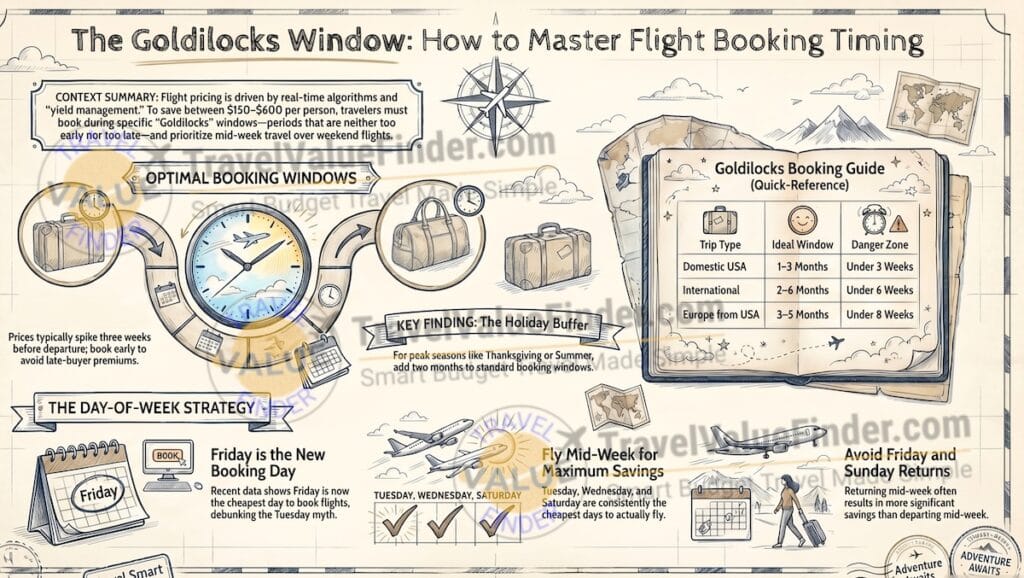
The honest answer backed by actual 2026 data from Expedia, KAYAK, Google Flights, and Going.com is that the best time to book flights cheap depends on three variables:
- your route type (domestic vs. international),
- your travel season (peak vs. shoulder vs. off-peak), and
- your flexibility.
Get these three right and you routinely save $150 – $600 per person on the same flights that other travelers pay full price for. Get them wrong and you pay the airline’s maximum price for your level of demand.
When to book flights for maximum savings has changed significantly as airlines adopted real-time algorithmic pricing. What worked in 2015 may cost you more in 2026.
Best time to book flights by trip type
| Trip Type | Ideal Booking Window | Earliest Worth Booking | Danger Zone | Key Data Source |
|---|---|---|---|---|
| Domestic USA | 1 – 3 months ahead | 3 – 6 months | Under 3 weeks | Prices spike 3 weeks before departure per Going.com 2026. |
| International (general) | 2 – 6 months ahead | 6 – 11 months | Under 6 weeks | KAYAK 2026; Skyscanner 2026 |
| Europe from USA | 3 – 5 months ahead | 6 – 9 months | Under 8 weeks | The Points Guy 2026; book by April for July travel |
| Asia from USA | 4 – 6 months ahead | 9 – 11 months | Under 10 weeks | FareCompare 2026. Complex routing benefits from early booking |
| Peak season (summer, holidays) | Add 2 months to above | As early as 11 months | Under 8 weeks is very risky | Google Flights data. Thanksgiving cheapest 52 days before Christmas cheapest by Halloween |
| Last-minute (under 3 weeks) | Avoid for planned trips | N/A | NOW – prices spike fast | Going.com. Last-minute deals now rare. Airlines use algorithms to maximize late-booking revenue |
Leslie Nics, TravelValueFinder.com | Updated April 2026 | Written for US travelers | Based on Expedia 2026 Air Hacks Report, KAYAK 2026 flight data, Google Flights analysis, and Going.com airfare research
Ready to search for the best flight prices right now?
Our trusted partner searches hundreds of providers simultaneously: Search Cheap Flights. Real-time prices, no booking fees, secure.
Why Flight Prices Change Constantly: The Algorithm Explained
Before the best flight booking timing strategies, understanding why prices change is the foundation that makes all the advice make sense.
Airlines do not set prices once and leave them. They use yield management algorithms – sophisticated software that adjusts fares in real time, sometimes multiple times per hour, based on:
| Pricing Factor | How It Affects Your Flight Price |
|---|---|
| Seat inventory | As seats sell, remaining seats become more expensive. The last 10 seats on a popular flight cost significantly more than the first 10 seats sold. Airlines know late buyers have fewer options and greater urgency. |
| Booking lead time | Prices generally increase as departure approaches and inventory decreases. But pricing also drops at certain advance booking points (typically 3 – 6 months out) when airlines want to stimulate early demand. The cheapest booking windows are these early-stimulation periods. |
| Competitor pricing | Airlines match each other in real time on competitive routes. If three airlines fly the same route and one drops prices, the others often follow within hours. Highly competitive routes (NYC-London, LA-Tokyo) stay cheaper longer than monopoly routes. |
| Day-of-week demand | Business travelers drive Monday and Friday demand for domestic US routes. Prices are higher on those days because business travelers pay whatever it costs. Tuesday, Wednesday, and Saturday have lower demand from leisure travelers, keeping prices lower. |
| Seasonal demand | Summer, Thanksgiving, Christmas, spring break, and school holidays create demand spikes that push all prices higher. The best time to book flights for peak season is earlier than you think. 4 – 8 weeks earlier than the equivalent off-peak booking window is often better. |
| Route-specific factors | Some routes are inherently more expensive (thin routes, monopoly markets, island connections). On these routes, early booking matters more. There are fewer fare classes and prices rise faster. |
| Real-time algorithmic adjustment | Per Expedia’s 2026 Air Hacks Report, airlines now use software that adjusts fares continuously based on all the above factors simultaneously. The ‘Tuesday price drop’ of the early 2000s was real then. Airlines used to release sales on Tuesdays. That stopped years ago. Prices change any time, any day |
Best Time to Book Flights: The Goldilocks Window by Route Type

The concept of the ‘Goldilocks Window’. The booking zone that is not too early and not too late is the most useful framework for flight booking timing.
Booking too early (more than 6 – 9 months for domestic, more than 11 months for international) means you pay prices that have not yet been discounted by competition and demand stimulation.
Booking too late means you pay peak prices as seats diminish. The windows below represent where savings are statistically most likely:
Domestic US Flights: The 1 – 3 Month Window
| Timing | What the Data Shows |
|---|---|
| 6+ months ahead | Prices are set but not yet discounted. You can book and monitor for drops, but this is not typically the cheapest window for domestic routes. |
| 3 – 6 months ahead | Ideal window starts here for domestic travel. Competition is active. Airlines have stimulated fares to build load. You have enough advance time to qualify for the lowest fare buckets. Good flexibility still available on seat selection and date changes. |
| 1 – 3 months ahead | The sweet spot for domestic booking. Per Going.com’s 2026 research, domestic flights are typically cheapest when booked 1 – 3 months before departure. Fares are competitive. Inventory is still healthy. Prices have been pushed down by algorithm competition. |
| 3 weeks ahead | Prices start rising rapidly. Airlines know that travelers within 3 weeks of departure have committed to travel and will pay more. Business traveler demand pushes prices up further. |
| Under 1 week | Avoid unless flexible or using points/miles. KAYAK 2026 data confirms domestic prices peak in this window. The ‘last-minute deal’ era is largely over. Airlines have sophisticated yield management that fills planes without cutting prices. |
International Flights from the USA: The 2 – 6 Month Window
| Destination | Ideal Booking Window |
|---|---|
| Europe (UK, France, Spain, Italy, Germany) | 3 – 5 months ahead for shoulder/off-season travel. 4 – 6 months ahead for summer (June – August) travel. If you want July Europe flights, have them booked by February to March. |
| Asia (Japan, Thailand, Vietnam, Korea) | 4 – 6 months ahead for standard travel. 6 – 9 months ahead for peak season (Cherry blossom season in Japan, Chinese New Year, Songkran). Long-haul routes with fewer competing airlines benefit most from early booking – inventory is smaller and price drops less frequent. |
| Latin America (Mexico, Colombia, Peru, Brazil) | 2 – 4 months ahead for most routes. Strong competition keeps prices reasonable longer. 3 – 5 months for peak holiday season. Mexico (beach destinations like Cancún and Puerto Vallarta) should be booked 4 – 5 months ahead for Christmas and New Year travel. |
| Australia / New Zealand | 5 – 9 months ahead due to long-haul routes with limited competition. Auckland and Sydney have fewer competing airlines than European routes. Prices rise earlier and inventory is more limited. The furthest advance booking of any major English-speaking destination. |
| Africa / Middle East | 4 – 7 months ahead for most African and Middle Eastern destinations. Dubai (strong Emirates/Etihad competition) can be booked closer to 3 – 4 months. Sub-Saharan Africa routes (Cape Town, Nairobi, Accra) with limited routing options should be booked 5 – 7 months ahead. |
The Seasonal Flight Booking Calendar: When to Book for Every Travel Period
This is the most actionable section with a month-by-month booking calendar for every major US travel period, based on 2026 data from Google Flights, Expedia, and Going.com:
| Travel Period | When to Book | Ideal Window | Danger Zone | Key Data |
|---|---|---|---|---|
| Spring Break (March – April) | January – February | 8 – 10 weeks out | Under 4 weeks | High student/family demand. Book by early February for late March departure |
| Memorial Day Weekend | February – March | 8 – 12 weeks out | Under 5 weeks | First peak of summer demand. Competing with spring break travelers adjusting plans |
| Summer (June – August) | February – April for domestic; January – March for international | 3 – 5 months | Under 8 weeks is very expensive | Peak demand. Book Europe by April for July travel. Book Asia by February to March |
| Labor Day Weekend | June – July | 6 – 10 weeks out | Under 4 weeks | Last big summer surge. Overlaps with end-of-summer travel. More competitive than Thanksgiving |
| Thanksgiving (US) | Mid-August to mid-October | 5 – 10 weeks out | Under 3 weeks | Google Flights data: cheapest ~52 days before departure. Book by Oct for Nov travel. Waiting costs $100 – $300 per ticket |
| Christmas / New Year | September – October (by Halloween) | 8 – 14 weeks out | Under 6 weeks = premium prices | Book before Halloween. October bookings save $150 – $500 vs December bookings |
| New Year’s travel (International) | August – October | 3 – 5 months | Under 8 weeks | International New Year travel (Tokyo, Sydney, London) needs earlier booking than domestic. Inventory limited |
| Valentine’s Day | November – December | 6 – 10 weeks out | Under 3 weeks | Couples travel spikes. Caribbean and Mexico destinations fill fast. Book before Christmas for Feb travel |
| Off-season / shoulder season | 2 – 4 weeks to 2 months ahead | 1 – 3 months | No real danger zone | Off-peak travel has the most flexible booking windows. Prices are low and inventory is plentiful. More last-minute options here than in any peak period |
The Tuesday Myth: Debunked by Expedia’s 2026 Data
The most persistent myth in flight booking timing is that Tuesday is the best day to book flights cheaply.
This advice circulated for years because airlines historically released sales on Monday evenings, causing competitors to match prices on Tuesday mornings. This created a brief Tuesday pricing dip.
That era is over, and the 2026 data confirms it clearly.
| Myth vs. Reality | 2026 Data |
|---|---|
| MYTH: Tuesday is the best day to book flights | According to Expedia’s 2026 Air Hacks Report, Friday is now the cheapest day to book flights not Tuesday. Expedia VP Melanie Fish confirmed: ‘Flight prices change constantly, and this year Expedia found that Friday is the cheapest day to book flights.’ The shift is driven by changing corporate travel patterns. Business travelers now complete trips earlier in the week, reducing Friday demand and opening cheaper inventory for leisure travelers |
| MYTH: Book at midnight for lower prices | False. Airlines update prices based on demand algorithms that run continuously, not at set times. There is no reliable ‘midnight drop’ in airfares. Per KAYAK’s 2026 data: ‘Flight prices change as often as airlines see fit, sometimes multiple times daily.’ Checking at midnight is as likely to show higher prices as lower ones |
| MYTH: Last-minute deals are always available | Largely false in 2026. Going.com’s research confirms ‘the era of amazing last-minute flight deals is largely over.’ Airlines use yield management to fill seats at high prices from business travelers and urgent travelers. Genuine last-minute deals exist for midweek departures on less popular routes, but relying on last-minute pricing for a planned trip is a high-risk strategy |
| MYTH: All airlines price the same way | False. Budget carriers (Frontier, Ryanair, EasyJet) use aggressive dynamic pricing that can change significantly multiple times daily. Legacy carriers (Delta, United, American) use more structured fare class systems. Per AirHint’s 2026 AI research: ‘Price patterns vary significantly across airlines and routes; low-cost carriers use particularly aggressive algorithmic pricing that adjusts fares multiple times daily’ |
| MYTH: More expensive cabin = harder to get good price | Partially false. For points and miles redemptions, business and first class often release award availability earlier (when booking opens, up to 11 months out) or very last-minute. For cash bookings, business class follows similar demand patterns to economy but with higher baseline prices throughout. Early booking is equally important for business class cash fares |
The 2026 reality: The best day to book flights cheaply is Friday for the best odds of a good fare, but flexibility on travel dates matters far more than booking day.
Flying on Tuesday, Wednesday, or Saturday is consistently 5 – 15% cheaper than flying on Monday, Friday, or Sunday. Shifting your departure by one day can save more than any booking-day advantage.
Cheapest Days to Fly: What the 2026 Data Actually Shows
The day you fly (not the day you book) has a more consistent impact on airfare than booking day. Here is what the 2026 data shows:
| Day of Travel | Relative Cost | 2026 Ranking | Explanation |
|---|---|---|---|
| Tuesday | Cheapest | #1 (tied) | Fewest business travelers, and lowest leisure demand mid-week. Consistently among cheapest days across almost all routes |
| Wednesday | Cheapest | #1 (tied) | Same mid-week demand trough as Tuesday. Per Going.com and FareCompare 2026. Tue/Wed consistently cheapest days to fly |
| Saturday | Cheap | #3 | Business travelers are home for the weekend. Leisure travelers prefer to maximize weekend time by not traveling on it. |
| Thursday | Moderate | #4 | Transitional day. Some business travel ahead of Friday returns. Leisure travel building toward weekend. Mid-range pricing |
| Sunday | Moderate – expensive | #5 | Return travel for weekend leisure travelers and business travelers heading to Monday meetings pushes prices higher |
| Monday | Expensive | #6 | Business travel peak. Early Monday departures command premium prices. Leisure travelers extending weekends pay the premium. KAYAK 2026: ‘Sundays and Mondays are usually more expensive since many people plan trips over the weekend’ |
| Friday | Most expensive | #7 (most expensive) | Friday is the most expensive day to FLY. Even though (per Expedia 2026) it is now often the cheapest day to BOOK. This apparent contradiction: fewer business travelers fly on Fridays in 2026, so leisure deals appear but for the booking calendar, Friday fares for future travel can be better. Fly Tuesday or Wednesday. Book on Friday |
The actionable takeaway:
For domestic US travel, shift your departure from Friday to Tuesday or Wednesday. For a $350 round-trip, this saves an average of $50 – $80.
For international travel, flying mid-week on both departure and return can save $100 – $200 per person.
The return date matters more than departure. Per KAYAK 2026: ‘the real win is returning midweek, where savings are more considerable. Avoid Friday or Sunday returns.’
The Best Tools for Finding Cheapest Flight Booking Times
The right tools eliminate the guesswork in booking flights at the cheapest time. Here are the most effective free tools available in 2026:
| Tool | What It Does for Flight Booking Timing |
|---|---|
| Google Flights | The most powerful free flight research tool available. Key features: (1) Price calendar: shows cheapest dates across an entire month so you can shift travel by 1 – 3 days for big savings; (2) Flexible dates exploration: shows cheapest travel periods for a whole season; (3) Price tracking alerts: set an alert for a specific route and receive email notifications when prices drop; (4) Explore mode: enter your departure city and see cheapest destinations worldwide sorted by price. Use Google Flights before any flight booking |
| KAYAK | Price Predictor feature uses historical data to advise ‘Buy now’ or ‘Wait.’ KAYAK’s 2026 data is among the most comprehensive on US airfare patterns. The Hacker Fares feature finds combinations of one-way tickets on different carriers that are cheaper than round-trip fares on one airline. Strong for identifying cheapest booking windows on specific routes |
| Skyscanner | ‘Whole Month’ view shows cheapest days across an entire month at a glance. The ‘Everywhere’ destination feature shows cheapest destinations from your departure airport for maximum flexibility. Skyscanner’s 2026 research confirmed flight prices often follow weekly cycles with lowest fares earlier in the week. Good for discovering flexible date savings |
| Going.com (formerly Scott’s Cheap Flights) | Deal alert service. Going monitors thousands of routes 24/7 and sends alerts specifically for deals priced significantly below normal (including rare mistake fares for premium members). You do not search for flights; Going finds deals and notifies you. This is the most passive and effective method for catching price drops and limited-time sales on your target routes. Free tier covers basic routes, while premium gives more options |
| Airfarewatchdog | Specialises in identifying and alerting on airline sale prices and error fares. Good for monitoring specific departure airports. Free alerts. Does not require specifying a destination if you are flexible about where you travel |
| Google Flights Price Alerts | Set and forget. The most practical tool for non-obsessive flight bookers. Set an alert for your specific route and travel dates. Google emails you whenever the price changes significantly. Once you see your target price, book immediately. No ongoing monitoring required on your part. The single best passive tool for catching the right time to book flights |
Route-Specific Flight Booking Strategies: Where the General Rules Break Down
The general booking windows work for most routes, but several specific route types have different pricing dynamics that override the standard advice:
- Thin routes (small cities, limited competition): Flying from a small regional airport to an international destination often means fewer carriers and less fare competition. Book earlier for these routes 4 – 6 months instead of 2 – 4. Prices rise faster when only 1 – 2 airlines serve the route. Consider driving to a nearby major hub where more competition keeps fares lower. A 2-hour drive to a large hub followed by a $300 cheaper international flight is frequently worth it.
- Monopoly domestic routes: Some US domestic routes have only one airline (or one dominant carrier). On these, prices barely move with booking window. You will not find the standard Goldilocks savings here. Consider alternative routing (connecting through a nearby hub on a competitive carrier). If you must book a monopoly route, early booking is the only reliable cost strategy.
- International routes with strong US carrier competition: Trans-Atlantic routes (especially NYC, Chicago, and LA to major European hubs) are served by 8 – 15 competing carriers. This competition keeps prices volatile and creates more opportunities for deals at multiple booking windows. Set Google Flights alerts and wait for a competitive price drop. These routes reward patience more than thin routes.
- Budget airline routes (Frontier, Ryanair, EasyJet): Budget carriers use aggressive dynamic pricing that can make fares $9 in advance and $300 at the gate. Per AirHint’s 2026 AI research, budget airline prices are highly algorithm-driven and change multiple times daily. For these carriers, buy when you see a price you’re comfortable with, and waiting frequently backfires. Flash sales on these carriers happen without notice and sell out within hours.
- Award availability (points and miles): If you are booking with points and miles, the timing calculus is completely different. Airlines release award inventory at booking open (typically 11 months out for many carriers) and sometimes in large drops very close to departure. For points bookings: search as early as possible and book the moment award space appears. It does not return once sold. See our guide: How to Find Cheap Flights: 12 Proven Strategies That Actually Work
7 Booking Timing Mistakes That Cost Travelers the Most Money
These are the seven most expensive flight booking timing errors, and the fix for each:
| Mistake | Typical Cost | Fix |
|---|---|---|
| #1: Waiting for last-minute deals | $100 – $400 extra | Do not wait. Last-minute deals are rare in 2026. Airlines fill planes by raising prices for desperate late-bookers. Book within the Goldilocks Window for your route type and stop waiting for a deal that probably will not appear |
| #2: Booking too far in advance | $50 – $200 extra | Prices 9 – 11 months out are not yet discounted for most routes. Set a Google Flights alert instead of buying at the first available price. You will often see a cheaper window 3 – 5 months before departure |
| #3: Booking for peak travel on a normal window | $150 – $500 extra | Add 2 months to the standard window for peak travel. Thanksgiving needs October booking; summer Europe needs February – April booking. Christmas needs October booking. Standard windows do not apply to peak periods |
| #4: Flying Friday or Sunday instead of Tuesday or Wednesday | $50 – $200 extra | Shift departure or return by 1 – 2 days. Tuesday and Wednesday are the cheapest days to fly on almost all routes. The return date matters even more. A Sunday return costs significantly more than a Wednesday or Thursday return on the same trip |
| #5: Not setting Google Flights price alerts | $50 – $300 missed saving | Set alerts for every route you are considering. Free, automatic, and delivers the right time to buy directly to your inbox. No monitoring required. Google does it for you and emails when the price changes |
| #6: Not considering alternative airports | $100 – $400 extra | For NYC: compare JFK, LGA, EWR, and BDL (Hartford). For LA: LAX, BUR, LGB, ONT, SNA. For SF Bay: SFO, OAK, SJC. Flying into a secondary airport frequently saves $100 – $400 with only marginal time or convenience cost. Always check the alternative airport in your destination city too |
| #7: Booking inflexible tickets when prices are volatile | Avoidable loss | Book refundable or changeable fares when booking early on volatile routes. Major US carriers allow 24-hour cancellation on any ticket for free (per DOT regulations). Use this window: book the good price, then continue monitoring. If prices drop further, rebook on the cheaper fare within 24 hours of the original booking |
Holiday Flight Booking Guide: When to Buy for Every Major US Holiday
Holiday flight booking timing is where most American travelers consistently overpay. Here is the specific data for every major holiday:
| Holiday | Book By | Cheapest Window | What Happens If You Wait |
|---|---|---|---|
| Thanksgiving | Mid-October | 52 days before (Google Flights data) | Prices rise 20 – 40% in the 3 weeks before Thanksgiving as late-bookers compete for remaining seats |
| Christmas (Dec 23 – 26) | By Halloween (Oct 31) | 8 – 12 weeks before | This is the most expensive booking mistake in travel. Waiting until November for Christmas flights can add $200 – $600 per ticket. October bookings are dramatically cheaper |
| New Year’s Eve / Jan 2 return | September – October | 10 – 14 weeks before | One of the most demand-constrained periods of the year. Limited flexibility in dates creates pricing power for airlines |
| Spring Break (late March – April) | January – early February | 7 – 10 weeks before | College spring break dates are set in advance. Demand is highly concentrated and predictable. Airlines price accordingly early |
| July 4th Weekend | April – May | 6 – 10 weeks before | Short domestic trips create concentrated demand over 4 days. Prices spike early and remain high |
| Memorial Day Weekend | March – April | 6 – 10 weeks before | First major summer travel push. Many travelers book late and pay premium prices for the 3-day weekend |
| Labor Day Weekend | June – July | 5 – 8 weeks before | Summer wind-down. Still high demand for final summer trips. Book in June to beat peak pricing |
Plan Your Budget Trip: Essential Resources on TravelValueFinder
- How to Find Cheap Flights: 12 Proven Strategies That Actually Work
- Best Flight Booking Apps and Sites to Find Cheap Airfare in 2026
- Best Travel Credit Cards for 2026: Earn Points and Travel Free
- Best Hotel Booking Sites: Where to Find the Cheapest Deals
Frequently Asked Questions: Best Time to Book Flights
When is the best time to book flights for cheap prices?
The best time to book flights for the cheapest prices depends on your route type: domestic US flights are cheapest when booked 1 – 3 months ahead; international flights generally 2 – 6 months ahead, varying by destination.
How far in advance should I book international flights?
For most international routes, book flights 2 – 6 months in advance for off-season or shoulder season travel.
What is the cheapest day to book flights?
According to Expedia’s 2026 Air Hacks Report, Friday has emerged as the cheapest day to book flights. Replacing the longstanding ‘Tuesday is best’ myth.
What is the cheapest day to fly?
The cheapest days to fly are consistently Tuesday, Wednesday, and Saturday across most US domestic and international routes in 2026, per Going.com, FareCompare, and Thrifty Traveler data.
Do flight prices go down closer to departure?
Generally no. This is the most dangerous myth in flight booking. Per Going.com’s 2026 research, prices ‘typically rise significantly three weeks before departure’ and ‘airlines frequently raise fares closer to takeoff.’ The exception: occasionally, airlines discount last-minute seats on underperforming routes with midweek departures but this is rare and unpredictable.
Is it better to book flights early or wait?
For most trips, booking early is better than waiting, but ‘early’ has a specific meaning. ‘Early’ means within the Goldilocks Window: 1 – 3 months for domestic, 2 – 6 months for international.
When should I book Christmas flights?
Book Christmas flights by Halloween (October 31) for the lowest prices. October bookings for late December travel save $150 – $600 per ticket compared to November or December bookings for the same flights.