Travel Value Finder

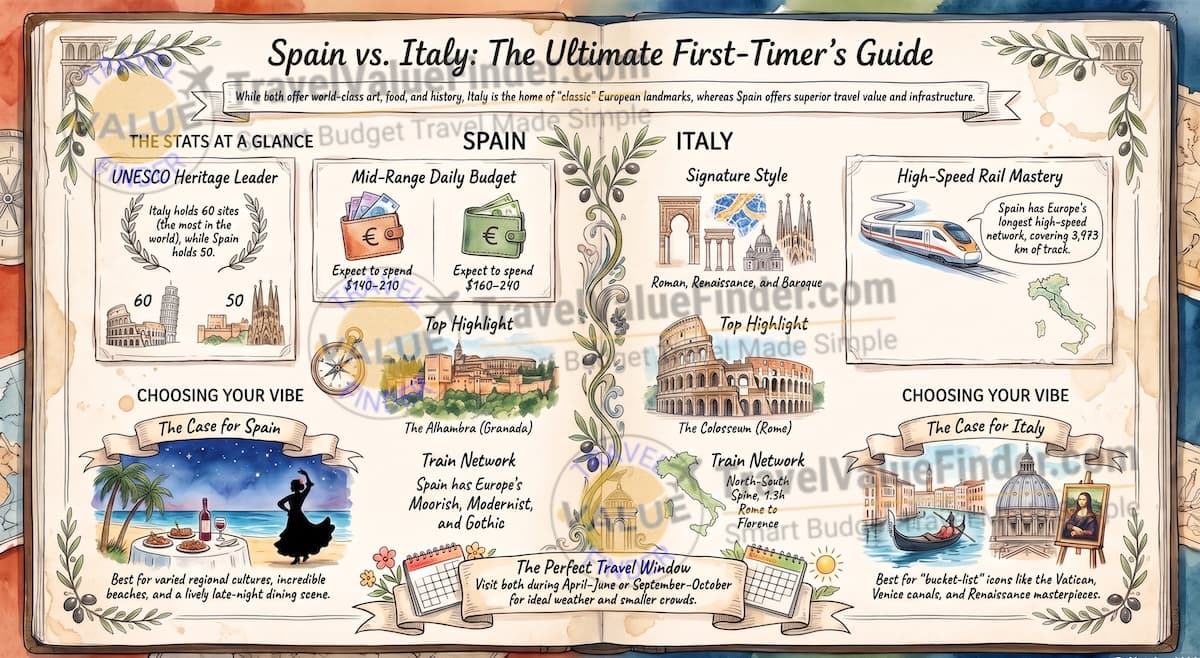
Here’s the short version if you’re pressed for time: choose Italy if you want the classic bucket-list landmarks like the Colosseum, the Vatican, Venice’s canals, Florence’s Renaissance art, and don’t mind a bit more spending on hotels and paid attractions.
Choose Spain if you want a slightly more affordable trip, an easier time getting around by train, incredible beaches alongside the history, and a livelier late-night culture.
The table below breaks down the core differences at a glance.
Below, we break down real 2026 costs, official UNESCO heritage rankings, high-speed rail systems, and US government safety data for both countries, side by side, so first-time visitors to Europe can decide which one deserves their first trip – using facts, not just travel-forum opinions.
Leslie Nics | TravelValueFinder.com | July, 2026
Table of Contents
Spain vs Italy: The Quick Answer for First-Time Visitors
If you’re planning your first trip to Europe, the Spain vs Italy debate is one of the biggest decisions you’ll face, and unlike a single-city comparison, it shapes an entire two-week itinerary.
Both countries are Mediterranean, Catholic, food-obsessed, and packed with world-class art and architecture which is exactly why the choice is so hard.
| Category | Spain | Italy |
| Best known for | Moorish architecture, beaches, tapas & nightlife | Roman history, Renaissance art, iconic landmarks |
| UNESCO World Heritage Sites | 50 | 60 (most of any country in the world) |
| Typical daily cost (mid-range) | $140–210 | $160–240 |
| High-speed rail | Renfe AVE, from €17, Madrid–Barcelona in 2.5 hrs | Frecciarossa/Italo, from ~€15, Rome–Florence in 1h22m |
| US State Dept advisory | Level 2 (Exercise Increased Caution) | Level 2 (Exercise Increased Caution) |
| Choose this country if… | You want value, beaches, and easy trains | You want the classic “Europe highlights” trip |
Table 1: Spain vs Italy at a glance for first-time visitors, based on 2026 pricing and official UNESCO/government data.
Bottom line: If this is your only trip to Europe and you want the landmarks people picture when they imagine the continent, Italy edges ahead. If you’d rather stretch your budget further, add a beach day to your city-hopping, and rely on one of the world’s best rail networks, Spain is the stronger pick.
And if you have two weeks or more, both countries are genuinely easy to combine – more on that below.
Why Spain vs Italy Is Such a Hard Call for First-Timers
Both countries rank among the world’s most-visited, both are overflowing with UNESCO World Heritage Sites, and both deliver on food, art, and history in ways few other destinations can match.
The real difference comes down to texture rather than quality.
Italy’s identity is built around a single dominant thread; the Roman Empire and the Renaissance concentrated into a handful of unmissable cities.
Spain’s identity is more regional and varied: Moorish Andalucía, Catalan Barcelona, and the Basque Country each feel like a different country, tied together by a shared language and an even better train system.
People ask me to pick a winner between Spain and Italy like it’s a sports match, but it’s really a question of what you want more of; concentrated, iconic history, or variety and value spread across a bigger, more diverse country. Both answers are right. They’re just right for different travelers. Leslie Nics, TravelValueFinder.com
Cities & Highlights: What Each Country’s Top Stops Look Like
Italy’s first-timer circuit typically runs Rome, Florence, and Venice, sometimes with Milan added for shopping or as a flight hub.
Spain’s equivalent circuit usually covers Madrid, Barcelona, and one stop in Andalucía, Seville or Granada for Moorish architecture like the Alhambra. Both circuits can be done by train without renting a car.
For Italy, start with our Italy Travel Guide for First-Time Visitors, then dig into Rome Travel Guide, Florence Travel Guide, Best Places to Visit in Venice, and Where to Stay in Milan.
For Spain, see our Spain Travel Guide, plus Where to Stay in Madrid and Barcelona Travel Guide.
Culture & Art: Moorish Spain vs Renaissance Italy
Both countries are cultural heavyweights by the numbers.
Italy holds 60 UNESCO World Heritage Sites, more than any other country on Earth, according to the UNESCO World Heritage Centre, reflecting layers of Etruscan, Roman, and Renaissance history packed into a relatively small area.
Spain holds 50 sites, the fifth-highest count of any country, per the UNESCO World Heritage Centre, spanning everything from the Alhambra’s Moorish palaces to Gaudí’s modernist Barcelona.
The character is genuinely different:
Italy’s heritage skews toward ancient ruins and Renaissance masterpieces, while Spain’s blends Roman, Islamic, and Christian influences in a way that’s unique in Western Europe.
| Category | Spain | Italy |
| UNESCO World Heritage Sites | 50 | 60 |
| Signature architectural style | Moorish / Mudéjar, Gaudí modernism | Roman classical, Renaissance, Baroque |
| Must-see cultural icons | Alhambra, Sagrada Família, Prado Museum | Colosseum, Sistine Chapel, Uffizi Gallery |
Table 2: Official UNESCO World Heritage Site counts, verified directly from whc.unesco.org.
Cost of Travel: Spain vs Italy for First-Time Visitors
Spain generally runs a bit cheaper than Italy. This is especially for day-to-day travel, mainly because hotel rates outside Barcelona’s most touristy zones and Madrid’s center tend to be lower than equivalents in Rome, Florence, or Venice.
Italy’s cost is pulled up by Venice specifically, which carries a significant premium on hotels and dining that Spain has no real equivalent to.
| Travel Style | Spain (per day, USD) | Italy (per day, USD) |
| Budget traveler | $75–105 | $85–120 |
| Mid-range traveler | $140–210 | $160–240 |
| Luxury traveler | $320+ | $350+ |
Table 3: Estimated daily costs per person, based on 2026 hotel, food, and local transit pricing observed in each country’s major first-timer cities.
For hotel-specific comparisons, see Cheap Hotels in Barcelona Under €150 and Cheap Hotels in Madrid Under €150 for Spain, or Where to Stay in Rome, Italy and Luxury Hotels in Rome for Italy.
Getting Around: High-Speed Rail Compared
This is one of Spain’s clearest advantages for a first-time visitor.
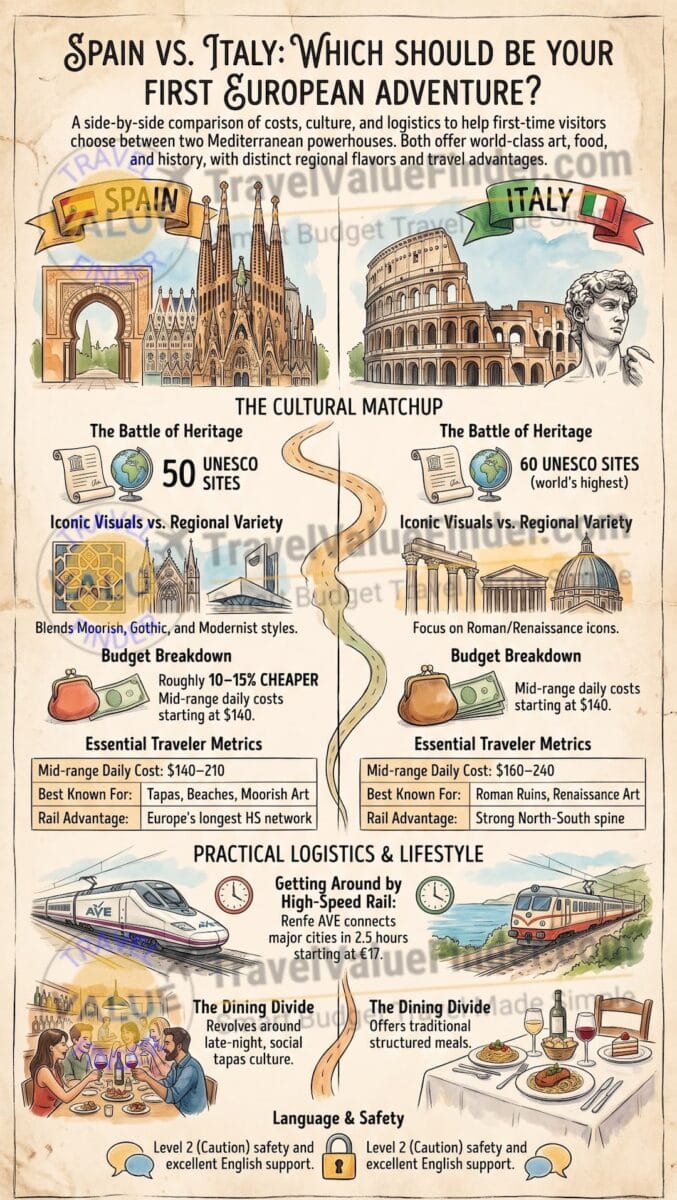
The Renfe AVE network is Europe’s second-longest high-speed rail system, connecting Madrid and Barcelona in as little as 2.5 hours with fares starting around €17 when booked early, according to Renfe, Spain’s state rail operator.
Italy’s high-speed network, run by Trenitalia (Frecciarossa) and the private operator Italo, is excellent on its core north-south spine.
Rome to Florence takes as little as 1 hour 22 minutes, per Trenitalia but covers less of the country at high speed than Spain’s network does.
This means some regional connections (particularly in the south) rely on slower conventional trains.
| Category | Spain (Renfe AVE) | Italy (Trenitalia / Italo) |
| Flagship route | Madrid–Barcelona: 2.5 hrs, from €17 | Rome–Florence: 1h22m, from ~€15–20 |
| Network reach | 3,973 km of high-speed track – Europe’s longest | Strong on the north-south spine; less extensive in the south |
| Operator | Renfe (state-owned) + Iryo, Ouigo (competitors) | Trenitalia (state-owned) + Italo (competitor) |
Table 4: Official 2026 high-speed rail comparison. Sources: Renfe (renfe.com) and Trenitalia (trenitalia.com).
Food & Dining Culture
Both countries are considered among the best food destinations in the world, but the daily rhythm is different.
Spain’s tapas culture means smaller, shared plates spread across a longer evening with dinner often starting after 9 p.m.
Italy’s meal structure is more traditional. A starter, a pasta or rice course, then a main typically eaten earlier than in Spain.
Vegetarian travelers often find Italy slightly easier to navigate thanks to widespread pasta and pizza options. Spain rewards travelers willing to try regional specialties like paella (Valencia), pintxos (the Basque Country), and jamón ibérico.
For Italy specifically, see our Rome Food Guide and Florence Food Guide.
Language & Ease of Travel for Americans
Neither country requires you to speak the local language to get by in major tourist areas, but the experience differs slightly.
Spain’s tourism industry, especially in Madrid and Barcelona, tends to have broad English support in hotels and restaurants, and Renfe’s booking system and station signage are consistently bilingual.
Italy’s main tourist circuit (Rome, Florence, Venice, Milan) is equally manageable for English speakers.
However, smaller towns and some regional train stations can require more patience or a translation app.
Neither factor should be a deciding one on its own. Both countries are very manageable for first-time visitors who don’t speak the local language.
Safety for First-Time Visitors
Both countries carry a Travel Advisory Level 2 (Exercise Increased Caution) from the US State Department, a rating shared with most of Western Europe.
For Spain, the advisory cites general terrorism and unrest risk factors common across the region.
For Italy, the primary practical concern is pickpocketing in crowded tourist areas.
In both countries, violent crime targeting tourists is rare. Standard precautions in crowded stations, tourist landmarks, and public transit cover the large majority of practical risk.
Best Time to Visit Each Country
Both countries share similar seasonal patterns; shoulder season (April–June and September–October) offers the best balance of good weather, manageable crowds, and reasonable prices.
July and August bring peak heat and peak crowds to both.
Southern Spain (Andalucía) and southern Italy can both see extreme summer heat. Travelers visiting Seville, Granada, Rome, or Naples in July and August should plan around midday sightseeing.
See our Best Time to Visit Rome and Best Time to Visit Florence guides for Italy-specific seasonal detail.
Which Country Should You Visit First?
Here’s a simple way to think about the decision:
- Choose Italy first if this is likely your only trip to Europe, you want the classic bucket-list landmarks, and you’re comfortable with a slightly higher daily budget.
- Choose Spain first if you want to stretch your budget further, you’re drawn to beaches alongside your history and museums, or you want the easiest, fastest intercity trains in Western Europe.
- Do both if you have 12 or more days. Madrid/Barcelona and Rome/Florence are both well connected by direct flights, making a two-country itinerary genuinely practical rather than a rushed add-on.
If someone’s planning their very first Europe trip and asks me to just pick one, I usually lean Italy for the emotional impact of seeing the Colosseum and the Sistine Chapel in person. But if they tell me budget is tight or they want a beach day built in, Spain wins every time. Leslie Nics, TravelValueFinder.com
Ready to dig into the details? For Italy, browse Top 10 Things to Do in Rome and Top Things to Do in Florence. For Spain, our full Spain Travel Guide and Barcelona Travel Guide are a good starting point.
Can You Visit Both Spain and Italy in One Trip?
Yes, and it’s a genuinely popular itinerary for travelers with two weeks or more.
Direct flights connect Madrid and Barcelona to Rome and Milan in roughly 2 hours. Therefore, making a split trip, say, 5 days in Spain and 6 days in Italy very manageable without excessive travel time.
For flight-booking strategy that applies to either leg, see our How to Find Cheap Flights and How to Travel Europe on a Budget guides.
Want a day-by-day plan with costs built in for either country? Get a PDF download with our Free AI Trip Planner – build a full day-by-day Spain and Portugal itinerary in seconds.
People Also Asked
Is Spain or Italy better for first-time visitors to Europe?
Italy is generally the stronger pick for a single first trip if you want the classic bucket-list landmarks (Colosseum, Vatican, Venice). Spain is better if budget, beaches, and easy train travel are top priorities.
Is Spain cheaper than Italy?
Yes, generally. Spain runs roughly 10–15% cheaper than Italy on average daily costs, mainly due to lower hotel rates outside peak tourist zones. Italy’s cost is pulled up notably by Venice.
How many UNESCO World Heritage Sites does Italy have compared to Spain?
Italy has 60 UNESCO World Heritage Sites, the most of any country in the world. Spain has 50, the fifth-highest count globally, according to the UNESCO World Heritage Centre.
Which has better trains, Spain or Italy?
Spain’s Renfe AVE network is more extensive, covering the country more thoroughly at high speed. Italy’s Frecciarossa network is excellent on its core north-south routes but covers less of the country overall.
Is it safe to travel to Spain and Italy right now?
Yes. Both countries carry a Level 2 (Exercise Increased Caution) advisory from the US State Department, the same rating held by most of Western Europe. The primary practical risk in both is pickpocketing in crowded tourist areas.
Can you visit both Spain and Italy in one trip?
Yes. With 12 or more days, direct flights of roughly 2 hours between Madrid/Barcelona and Rome/Milan make a combined itinerary practical and popular.
Frequently Asked Questions
What’s the biggest difference between Spain and Italy for tourists?
Italy’s appeal is concentrated around a single dominant historical thread with Roman and Renaissance history in a handful of iconic cities. Spain’s appeal is more regional and varied; spanning Moorish architecture, Catalan modernism, and beach culture tied together by an extensive high-speed rail network.
Do I need to speak Spanish or Italian to travel comfortably?
No. Major tourist areas in both countries have strong English support in hotels and restaurants. Spain’s train system and signage tend to be a bit more consistently bilingual than Italy’s regional stations, but neither poses a serious barrier on the standard first-timer circuit.
Which country has better food, Spain or Italy?
Both rank among the world’s best. Italy’s cuisine is generally easier for picky eaters and vegetarians thanks to widespread pasta and pizza options. Spain rewards travelers willing to explore regional specialties like tapas, pintxos, and paella.
Is it cheaper to fly into Spain or Italy from the US?
Airfare is generally comparable between the two, with both Madrid and Rome served by frequent nonstop flights from major US cities. Neither country has a consistent price advantage over the other for transatlantic flights.
How many days do you need for a first trip to Spain or Italy?
Most first-time visitors spend 7–10 days in either country to comfortably cover 2–3 major cities without rushing. A combined Spain-and-Italy trip typically needs 12 or more days.
Which country is better for beaches, Spain or Italy?
Spain generally offers more accessible, beach-focused itineraries alongside its historic cities, particularly along the Costa del Sol and in the Balearic Islands. Italy has excellent coastline too (the Amalfi Coast, Sicily), but it’s less central to a first-timer’s core city-hopping itinerary.
Sources
- UNESCO World Heritage Centre: Italy (official state party page)
- UNESCO World Heritage Centre: Spain (official state party page)
- Renfe: official Spain high-speed rail (AVE) information
- Trenitalia: official Italy high-speed rail (Frecciarossa) information
- US Department of State: Spain Travel Advisory
- US Department of State: Italy Travel Advisory