Travel Value Finder

What are the best national parks to visit for value?
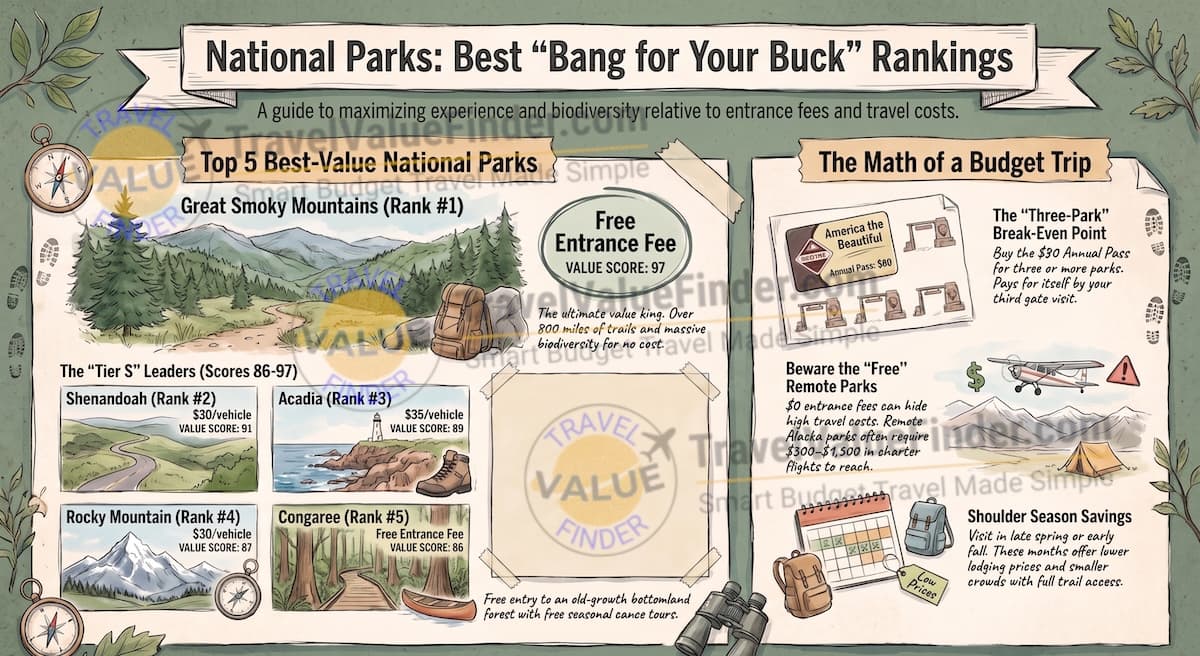
- Great Smoky Mountains,
- Shenandoah,
- Acadia,
- Rocky Mountain, and
- Congaree.
These rank highest when scored on cost versus experience. All charge $0–$35 to enter yet deliver some of the largest trail networks and highest biodiversity in the National Park System.
Leslie Nics | TravelValueFinder.com | July, 2026
I spent months cross-referencing
- entrance fees,
- camping costs, and
- the new 2026 America the Beautiful pass pricing against what each park actually delivers, and
- ranked America’s national parks by value for the money, not just wow-factor.
Great Smoky Mountains comes out on top for one simple reason:
- it’s completely free to enter, and
- arguably the most biodiverse park in the system.
Here’s the full ranking, the math behind it, and exactly how to get the most out of every dollar.
Table of Contents
The Best National Parks to Visit for Value: My Top 10 (Quick Answer)
If you only read one table on this page, make it this one.
These are the ten best national parks to visit when value for the money not just beauty is the deciding factor.
Here is the scored on my 100-point rubric explained below.
| Rank | Park | Entrance Fee | Value Score /100 |
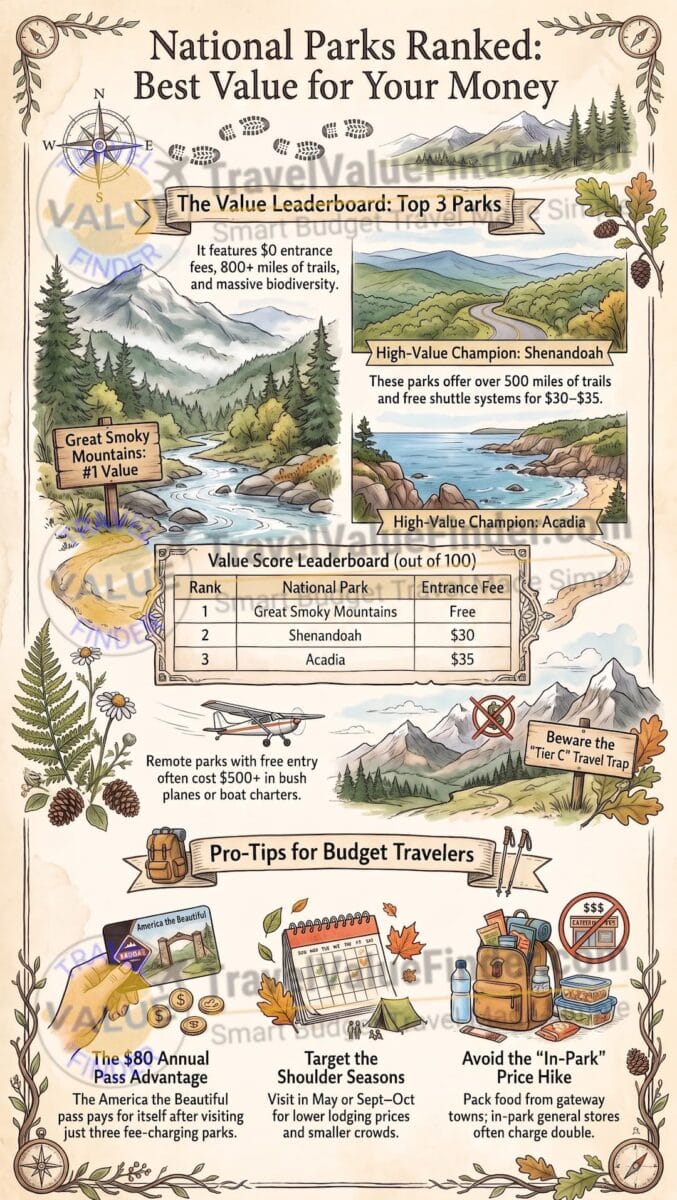
| 1 | Great Smoky Mountains (TN/NC) | Free | 97 |
| 2 | Shenandoah (VA) | $30/vehicle, 7 days | 91 |
| 3 | Acadia (ME) | $35/vehicle, 7 days | 89 |
| 4 | Rocky Mountain (CO) | $30/vehicle, 7 days | 87 |
| 5 | Congaree (SC) | Free | 86 |
| 6 | Zion (UT) | $35/vehicle, 7 days | 84 |
| 7 | Redwood (CA) | Free | 83 |
| 8 | Grand Canyon (AZ) | $35/vehicle, 7 days | 82 |
| 9 | Voyageurs (MN) | Free | 80 |
| 10 | Yellowstone (WY/MT/ID) | $35/vehicle, 7 days | 79 |
Every ‘best national parks’ list I read before building this one told me where to point my camera. None of them told me where my money actually goes furthest. Leslie Nics, TravelValueFinder.com
How I Scored Every Park: My Value Rubric
Most national park rankings score on beauty, wildlife, or Google reviews.
That tells you what to expect, not what it costs you to get it.
I built a 100-point rubric across four categories, applied consistently across every park I ranked:
| Category | Points | What It Measures |
| Entrance fee efficiency | 25 | Lower fee (or free entry) relative to park size and what’s inside it |
| Free activity depth | 25 | How much of the park’s best experience is reachable without paying for tours, shuttles, or permits |
| Lodging & camping affordability | 25 | Availability of budget camping (often $15–$30/night) vs. being forced into expensive gateway-town hotels |
| True cost of access | 25 | Realistic travel cost to reach the park. This is where remote Alaska parks lose the most points, even though their entrance is technically free |
That last category is the one every other ranking ignores, and it matters more than any other line item.
A park with a $0 entrance fee that costs $600 in float-plane charters just to set foot in it is not, in any meaningful sense, a good value. I’ll get to those parks specifically further down.
The 2026 National Park Fee Changes You Need to Know First
The value math changed for everyone in 2026.
As of January 1, 2026, the America the Beautiful Annual Pass costs $80 for U.S. residents. It covers entrance fees at every fee-charging national park plus roughly 2,000 other federal recreation sites for a full year.
At the same time, 11 of the most-visited parks;
- Acadia,
- Bryce Canyon,
- Everglades,
- Glacier,
- Grand Canyon,
- Grand Teton,
- Rocky Mountain,
- Sequoia & Kings Canyon,
- Yellowstone,
- Yosemite, and
- Zion,
now charge non-U.S. residents a $100-per-person surcharge on top of the standard entrance fee.
If you’re a U.S. resident, that surcharge doesn’t apply to you at all. That quietly makes 2026 one of the best years on record for domestic park value.
| Question | 2026 Answer |
| Annual pass cost (US resident) | $80, covers your vehicle for 12 months at nearly every fee-charging park |
| Annual pass cost (non-resident) | $250 |
| Standard single-park vehicle fee | Typically $30–$35 for 7 consecutive days |
| Parks with a non-resident surcharge | 11 parks, $100/person, does not apply to US residents |
| Fee-free days in 2026 | 8 days, U.S. residents only |
| Break-even point on the $80 pass | Roughly 3 parks at the $30–$35 fee level |
That break-even number is the single most useful piece of math in this article.
If you’re a U.S. resident planning to visit three or more fee-charging parks in the same 12 months, the $80 annual pass pays for itself before your third gate.
Visiting only one or two parks a year, then the pay-as-you-go 7-day fee is cheaper.
The Best-Kept Secret: National Parks With No Entrance Fee At All
Here’s something most ‘best national parks’ lists bury or skip entirely.
Most sites managed by the National Park Service are free to visit. That includes several full national parks, not just monuments and historic sites.
These are the free-entry national parks I’d point a budget-conscious traveler toward first:
- Great Smoky Mountains (TN/NC); free by a 1934 land-transfer agreement, and still the most-visited park in the country
- Congaree (SC); free entry, elevated boardwalk trail through the largest intact old-growth bottomland forest in the US
- Redwood (CA); free entry, drive-through and walk-through groves of the tallest trees on Earth
- Voyageurs (MN); free entry, a genuinely underrated water-based park bordering Canada
- Great Basin (NV); free entry, ancient bristlecone pines and some of the darkest night skies in the lower 48
- Capitol Reef (UT); free entry, the quietest of Utah’s five national parks and arguably the best value in the state
- Wind Cave & Mammoth Cave; free surface entry; only the guided cave tours carry a separate ticket price ($8–$45 depending on tour length)
- Gateway Arch, Cuyahoga Valley, New River Gorge, Indiana Dunes, Hot Springs, North Cascades; all fully free to enter
Full Value Tier List: Where Every National Park Falls
This is the part that separates a value ranking from a beauty ranking.
I grouped all 63 national parks into four value tiers based on the rubric above.
Exact per-park fees shift occasionally, so treat this as directional and confirm the current fee on the NPS site for your specific park before you go.
| Tier | What It Means | Example Parks |
| S = Exceptional Value | Free or low-cost entry, massive free-activity depth, easy access | Great Smoky Mountains, Congaree, Redwood, Shenandoah, Voyageurs, Acadia, Rocky Mountain, Great Basin, Capitol Reef |
| A = Strong Value | Standard $30–$35 fee, but the experience clearly justifies it | Zion, Grand Canyon, Yellowstone, Grand Teton, Olympic, Arches, Canyonlands, Joshua Tree, Death Valley, Mount Rainier |
| B = Fair Value, Plan Ahead | Standard fee plus extra costs (timed-entry reservations, ferries, cave tours, or long drives from any major airport) | Glacier, Bryce Canyon, Yosemite, Sequoia & Kings Canyon, Channel Islands, Isle Royale, Carlsbad Caverns, Dry Tortugas |
| C = Technically Free, Genuinely Expensive to Reach | No entrance fee, but access requires costly charter flights, boats, or multi-day logistics | Gates of the Arctic, Kobuk Valley, Lake Clark, Katmai, Wrangell-St. Elias, Glacier Bay, Kenai Fjords, American Samoa |
Tier C is the most important tier in this whole article. The one no other ‘best national parks’ list will tell you about honestly.
These Alaska and Pacific parks charge nothing at the gate, but reaching them can cost $500–$1,500 in float planes, water taxis, or multi-day travel. That makes them poor value for anyone budgeting a trip, however spectacular they are once you arrive.
If cost matters to your decision, these are bucket-list parks to save for later, not first-timer picks.
Top 10 Best-Value Parks, Broken Down
1. Great Smoky Mountains National Park : Value Score: 97. Zero entrance fee, over 800 miles of trails, and more tree species than all of Europe combined. Camping runs $17–$27/night at developed campgrounds. This is the single best value in the entire National Park System, full stop.
2. Shenandoah National Park : Value Score: 91. A $30 vehicle fee covers 7 days along 105 miles of Skyline Drive, with over 500 miles of trails including a stretch of the Appalachian Trail. Close enough to Washington, D.C. that it doesn’t require a flight for most East Coast travelers.
3. Acadia National Park : Value Score: 89. $35 for 7 days buys granite peaks, Atlantic coastline, and freshwater lakes packed into one of the smallest major parks. Plus a free propane-powered shuttle (the Island Explorer) that removes the need for a rental car once you’re there.
4. Rocky Mountain National Park : Value Score: 87. $30 for 7 days, alpine tundra above 12,000 feet reachable by paved road, and camping from around $28/night. One of the best fee-to-elevation-gain ratios in the system.
5. Congaree National Park : Value Score: 86. Free entry, a 2.6-mile elevated boardwalk loop through old-growth forest that costs nothing and requires no permit, plus free ranger-led canoe tours seasonally.
6. Zion National Park : Value Score: 84. $35 for 7 days includes a mandatory but well-run shuttle system, meaning your entrance fee also functions as your in-park transportation cost.
7. Redwood National and State Parks : Value Score: 83. Free entry to walk or drive among the tallest trees on Earth. Camping is inexpensive, and several of the best groves are a few steps from a parking pullout.
8. Grand Canyon National Park : Value Score: 82. $35 for 7 days for one of the most recognizable natural wonders on the planet. Free rim-trail access, free shuttle buses on the South Rim, and no additional fee to simply stand at the edge and take it in.
9. Voyageurs National Park : Value Score: 80. Free entry to a genuinely underrated water-based park most travelers have never heard of. This means far smaller crowds for the same natural payoff.
10. Yellowstone National Park : Value Score: 79. $35 for 7 days covers the largest concentration of geysers on Earth. It loses a few points versus the parks above it only because of its size. Seeing more than a fraction of it requires multiple days and a longer drive between areas.
Lessons Learned
Honest lessons from building this ranking and visiting a meaningful chunk of this list myself is that;
- I underestimated how much camping reservations matter to real-world value.
A park can score well on paper and still cost you $200+ in last-minute gateway. This is largely for town lodging if you didn’t book a campsite through Recreation.gov months in advance.
Zion, Yosemite, and Rocky Mountain sell out fastest.
I’d also budget separately for timed-entry reservation fees, which are small individually (often $2) but easy to forget when comparing parks side by side.
And I initially ranked a couple of Utah parks higher before accounting for how much a rental car costs to actually connect them.
Value isn’t just the entrance fee, it’s the full logistics chain.
A $0 entrance fee means nothing if getting there costs $500. A $35 fee means nothing if the park gives you a week’s worth of hiking. Value only shows up when you do the full math, not just the headline number. Leslie Nics, TravelValueFinder.com
5 Ways to Stretch a National Park Budget Further
- Buy the $80 pass if you’re visiting 3+ parks. It pays for itself before your third standard-fee park and works for a full 12 months from purchase.
- Book camping the moment the reservation window opens. Sites at popular parks release on Recreation.gov exactly 6 months out and can sell out within minutes for peak dates.
- Target the shoulder season. Late spring and early fall bring lower gateway-town lodging prices and dramatically thinner crowds at the same entrance fee.
- Check for a free entry day if you qualify. The NPS runs 8 fee-free days in 2026 for U.S. residents – a free way to test a park before committing to an annual pass.
- Pack food in. In-park general stores and lodges routinely charge double what a grocery run in the gateway town costs – a cost lever nearly identical to what I found true for city travel too. See our broader budget travel tips for more ways this adds up.
Plan the Rest of Your Trip
- How to Find Cheap Flights: 12 Proven Strategies for getting to your gateway airport for less
- Essential Travel Packing List what to actually pack for a multi-day outdoor trip
- Travel Insurance Guide worth considering for remote parks far from hospitals
- Solo Travel Tips for First-Timers; many of these parks are excellent, safe solo destinations
- How to Travel Cheap; general budget strategies that apply just as well to a road trip as a flight
- Free AI Trip Planner; turn any of these parks into a personalized day-by-day itinerary
People Also Ask
What are the best national parks to visit on a budget?
Great Smoky Mountains, Congaree, Redwood, Voyageurs, and Great Basin charge no entrance fee at all. This makes them the strongest budget picks. Shenandoah, Rocky Mountain, and Acadia are the best value among fee-charging parks.
Is the America the Beautiful pass worth it?
Yes, for U.S. residents visiting three or more fee-charging parks in a 12-month period. At $80, it breaks even after roughly three standard-fee parks. This covers your vehicle at nearly every other fee-charging federal recreation site for a full year.
Which national park has no entrance fee?
Great Smoky Mountains, Congaree, Redwood, Voyageurs, Great Basin, Capitol Reef, New River Gorge, Cuyahoga Valley, Indiana Dunes, Hot Springs, North Cascades, and most Alaska parks charge no entrance fee. However, though, several of the Alaska parks are expensive to physically reach.
What is the cheapest national park to visit overall?
Great Smoky Mountains ranks as the cheapest relative to what it offers; free entry, extensive free trails, and inexpensive camping, combined with easy driving access from several major East Coast and Southeast cities.
Frequently Asked Questions
How much does it cost to visit a national park in 2026?
Most fee-charging parks cost $30–$35 per vehicle for a 7-day pass. Add camping ($15–$35/night) or gateway-town lodging, food, and gas, and a modest 3-day visit typically runs $150–$400 depending on the park and season.
Do I need a reservation to enter a national park?
Some high-traffic parks, including Rocky Mountain, Zion, Arches, Glacier, and Yosemite use timed-entry reservation systems during peak season. Booked through Recreation.gov, in addition to the standard entrance fee.
Does the non-resident $100 surcharge apply to US citizens?
No. The $100 per-person surcharge introduced in 2026 applies only to non-U.S. residents at 11 specific parks. U.S. citizens and permanent residents pay only the standard entrance fee or use their America the Beautiful pass.
Are national parks free for kids?
Children typically aren’t charged separately at vehicle-fee parks. The fee covers the entire vehicle. At per-person fee sites, children under 15 are generally admitted free.
What’s the best time of year to visit for the best value?
Late spring (May) and early fall (September–October) generally offer the best combination of lower gateway-town lodging prices. There are thinner crowds, and full trail access before winter closures at high-elevation parks.
Sources
- National Park Service; Entrance Passes: official pass pricing and eligibility
- National Park Service; Nonresident Fees: official 2026 surcharge policy and affected parks
- U.S. Department of the Interior; Press Release: official announcement of the 2026 fee and pass changes
- Recreation.gov; Digital America the Beautiful Passes: official pass purchase platform
- National Park Service; Find a Park: official directory of all 63 national parks and individual fee pages
Disclaimer: Entrance fees, pass prices, and policies are set by the National Park Service and can change. Figures in this article reflect research at time of publication (2026) and are cross-checked against nps.gov; always confirm current fees for your specific park before traveling.