Travel Value Finder

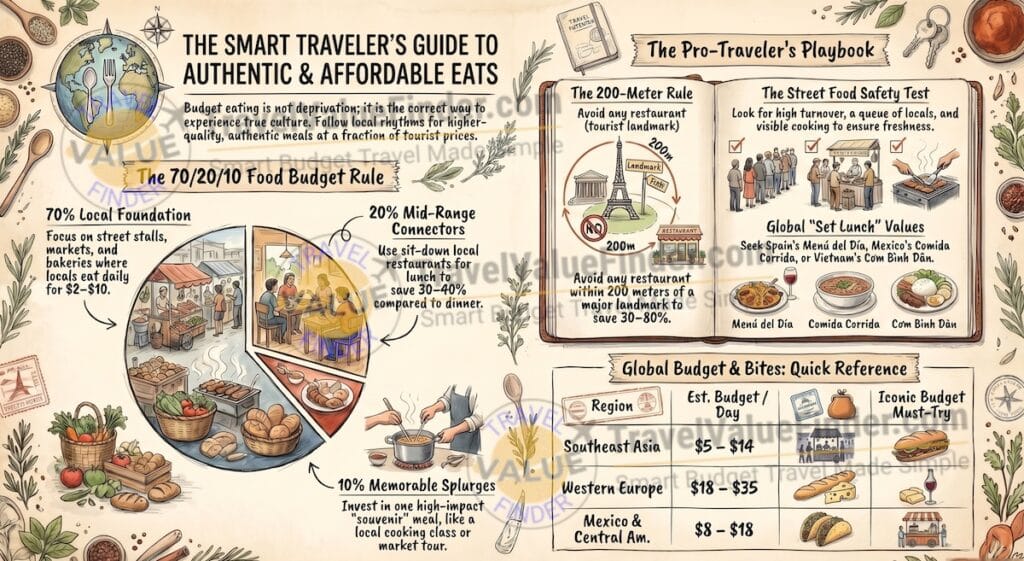
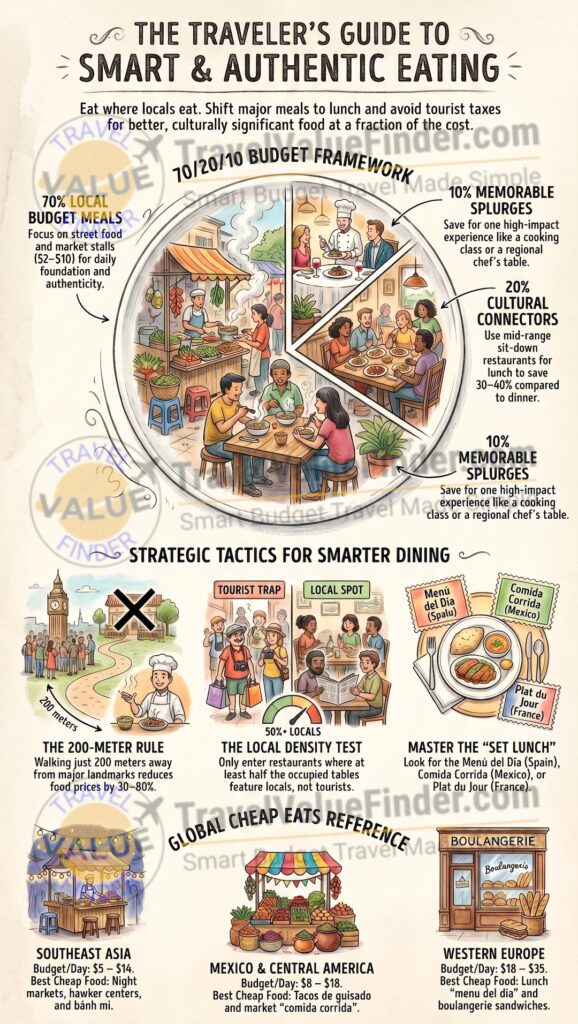
To eat cheaply while traveling without missing out on food culture: (1) Follow locals – eat where they eat, not where signs are in English. (2) Make lunch your main meal – restaurant lunch prices are 30 – 40% lower than dinner for identical food. (3) Prioritize street food and markets over tourist-area restaurants – these are almost always both cheaper and more authentic. (4) Apply the 70/20/10 rule: 70% local budget meals, 20% mid-range sit-down, 10% one memorable splurge. (5) Use supermarkets strategically – for breakfast and snacks, not as a substitute for experiencing local cuisine. (6) Avoid the 200-meter tourist tax – any restaurant within 200 meters of a major landmark charges 30 – 80% more. (7) Eat the ‘set lunch’ wherever it exists (menú del día in Spain, comida corrida in Mexico, plat du jour in France) – it is the best food value in those countries.
Leslie Nics, TravelValueFinder.com | Last updated: May 2026 | A practical destination-by-destination guide to spending less on food without missing a single meal that matters – no calorie-counting, no hostel kitchen purgatory, just smarter eating in every country you visit.
Where and What to Eat Cheaply: Global Quick Reference : Region-by-Region Cheap Eats Cheat Sheet
| Region | Budget/Day | Best Cheap Food | Cultural Must-Try | Avoid (Tourist Trap) |
| Mexico & Central America | $8 – $18 | Tacos de guisado, street tlayudas, market comida corrida | Mercado 20 de Noviembre (Oaxaca), Mexico City fondas | Anything on the Cancún Hotel Zone strip |
| Southeast Asia | $5 – $14 | Night-market stalls, hawker centers (Singapore/Malaysia), bánh mì | Bangkok night markets, Hội An market lane, Penang hawkers | Khao San Road, major temple-area ‘tourist menus’ |
| Western Europe | $18 – $35 | Lunch ‘menu del día’ (Spain), boulangerie lunch (France), mercato sandwiches (Italy) | Spanish tapas bars, Paris covered markets, Rome campo de fiori | Restaurant within 200m of any major landmark |
| Eastern Europe | $10 – $20 | Milk bars (Poland), lángos (Hungary), Georgian khachapuri | Bar Mleczny Warsaw, Budapest market hall, Tbilisi old town | ‘English menu’ restaurants near big squares |
| Japan | $15 – $28 | Convenience store onigiri & bento, ramen, gyudon chains, depachika basements | Tsukiji outer market, depachika food floors, standing sushi bars | ‘English OK’ tourist-facing izakaya near Shinjuku station |
| India | $4 – $12 | Thali sets, dosa at filter coffee shops, railway platform snacks | Local dhabas (roadside restaurants), Old Delhi lanes, Mysore meals | Hotel restaurants marketing to foreign tourists |
| USA (domestic travel) | $25 – $55 | Food trucks, international neighborhood spots, farmers markets | Chinatowns, Flushing Queens NY, food halls, taco trucks | Airport restaurants, hotel dining, chain spots near attractions |
Sources: TravelBoom 2026 Leisure Travel Study – Culinary Tourism Data | Grand View Research – Culinary Tourism Market 2026 | Navy Federal Credit Union – Vacation Food Budget Tips
How to Eat Cheaply While Traveling: The Smarter Way to Think About It
Let me be honest with you about something most travel guides get wrong. They treat eating cheaply while traveling as an act of deprivation – a list of things to avoid, skip, or replace with granola bars from your carry-on. That framing completely misses what’s actually happening in the world’s best budget dining.
The taco stand in Oaxaca serving $1 tacos to a queue of Mexican construction workers at noon? That is authentic food culture. The bánh mì cart in Hội An charging 30,000 dong ($1.20) for a perfectly assembled sandwich? That is the real Vietnam on a plate. The milk bar in Warsaw where elderly Polish customers have been eating the same bigos stew for thirty years at $3 a bowl? That is irreplaceable cultural experience.
Budget eating in most of the world isn’t a compromise. It’s the correct way to eat – the way locals eat, the places that have survived for decades on repeat business from people who actually live there. The expensive tourist restaurants are usually the ones where you miss out.
I’m Leslie Nics from Travel Value Finder, and this guide is the one I wish existed when I started traveling later in life. It’s built around a simple truth: the cheapest meal in most countries is also the most culturally rich one, as long as you know where to look. By the end of this guide, you’ll have a clear, practical framework for every destination – plus destination-specific strategies so you never walk into a tourist trap restaurant again.
The single best meal I’ve ever had cost $3. It was a bowl of pho at a sidewalk restaurant in Hanoi where the plastic stools were six inches off the ground and the broth had been simmering since before I woke up. No tourist restaurant in the world could replicate it – and no tourist restaurant would serve it at that price. Leslie Nics, TravelValueFinder.com – Updated May 2026
Why Budget Eating Is the Future of Travel (The Data Backs This Up)
This isn’t just a frugality argument – the data makes it compelling. According to the TravelBoom 2026 Leisure Travel Study, nearly 80% of travelers now say food is either important or very important when choosing a destination – placing cuisine on the same level as price, location, and reviews. And here’s the important detail within that finding:
- 66% of travelers say street food is what excites them most about eating abroad
- 64% prefer unique local experiences over fine dining or Michelin-starred restaurants (Hilton 2025 Trends Report)
- 73% say tasting authentic local dishes enhances their travel experience (WifiTalents Food Tourism Statistics, 2025)
- 62% believe food helps them connect more deeply with a destination’s culture
The global culinary tourism market – valued at over $1.2 trillion in 2025 by IMARC Group – is being driven not by luxury dining but by exactly the kind of eating this guide covers: neighborhood spots, market stalls, street food, and cooking classes. According to Grand View Research’s 2026 Culinary Tourism Report, the ‘existential tourist’ segment – those who seek local, rustic dining over prestige – is the largest and fastest-growing traveler type.
In other words: eating cheap and eating authentically are the same thing in most of the world. The data just confirms what savvy travelers have always known.
The 70/20/10 Food Budget Rule for Travelers
Most budget food guides give you a list of tips. What they don’t give you is a framework – a mental model you can apply in any country, any meal, without having to think too hard. Here’s the one I use on every trip.
70%: Local Budget Meals – Your Daily Foundation
Seventy percent of your meals should be where locals at your economic level actually eat. Street food stalls with plastic stools. Market lunch counters. Bakeries. Canteens near offices or universities. These meals cost $2 – $10 almost everywhere in the world outside of Scandinavia and Switzerland, and they are almost always the best food available.
This isn’t hardship. This is the best food you’ll eat on the trip – freshest ingredients, fastest turnover, recipes refined over decades. A plate of pad kra pao from a Bangkok street stall at $1.50 beats most Thai restaurants in America at $18.
20%: Mid-Range Sit-Down – Your Cultural Connectors
Twenty percent of your food budget goes toward proper sit-down meals at local restaurants – not tourist restaurants, but places where the menu might not be in English and the waiter might not speak it either. These meals typically cost $8 – $25 in most countries and give you the full experience: atmosphere, service, a table where you can slow down and actually be somewhere.
The trick: always go for lunch instead of dinner at these places. The same kitchen, the same food, but lunch prices are typically 30 – 40% lower because locals eat their big meal midday in most of the world. Spain’s menú del día, Mexico’s comida corrida, France’s plat du jour – these are the greatest hidden values in international travel.
10%: One Memorable Splurge – Your Souvenir
Ten percent of your food budget is for the one meal per destination that becomes a story. A cooking class with a local grandmother in Tuscany. The omakase counter at a sushi restaurant in Osaka where 12 courses cost the same as one appetizer in New York. The wine pairing dinner at a family vineyard in Mendoza.
Don’t skip this. The best food memories are almost never the day-to-day meals – they’re the intentional experiences. Budget for one per destination, enjoy it without guilt, and let the 70% carry the rest of your food costs.
I tell every traveler the same thing: don’t try to save money on every meal. That’s exhausting and you miss everything. Save money on 80% of meals so you can spend properly on the 20% that become memories. Leslie Nics, TravelValueFinder.com
The 200-Meter Rule: The Fastest Way to Stop Overpaying
This is the single most effective food-budget rule I’ve ever found, and I’ve never seen it in another travel guide. It goes like this: any restaurant within 200 meters of a major tourist attraction charges 30 – 80% more for the same food you can find two blocks away.
The Colosseum in Rome. The Eiffel Tower in Paris. The Sagrada Família in Barcelona. The Grand Palace in Bangkok. The space immediately surrounding every major attraction in the world is a tourist pricing zone – and walking two minutes away collapses the price dramatically.
How to apply it:
- Walk away from the landmark before you even think about food.
- Find a street where you see more locals than tourists.
- Look for restaurants without an English sign or English menu out front.
- Look for full tables at midday – high turnover means fresh food and local approval.
- Sit down, point at what the table next to you ordered, and enjoy.
The Local Density Test
Before sitting down at any restaurant abroad, do a 10-second scan. If more than half the occupied tables have tourists at them, keep walking. This isn’t snobbery – it’s quality control. Restaurants that survive on tourist traffic optimize for turnover and margin, not flavor. Restaurants that survive on local repeat business optimize for food quality and value.
Meal-by-Meal Strategy: A Practical Day on a Food Budget
Here’s how to structure a day of eating abroad that saves money, honors food culture, and leaves you completely satisfied. The table below lays it out simply:
Daily Meal Strategy Table
| Meal | Budget Strategy | Cultural Win |
| Breakfast | Free hotel breakfast, corner bakery, or hostel kitchen | Pastry culture: croissants in France, churros in Spain, simit in Turkey |
| Lunch | Main meal of the day – local ‘lunch deal’, set menu, market stalls | Comida corrida (Mexico), menú del día (Spain), plats du jour (France) |
| Dinner | Light: market groceries, bakery leftovers, street food second round | Evening street food culture: tacos, satay, kebabs, night-market stalls |
| Snacks | Supermarket / corner shop: seasonal fruit, bread, local cheese | Learn what locals snack on – Turkish simit, Vietnamese bánh mì, Mexican elote |
| Special meal | Lunch at a ‘nice’ restaurant (30 – 40% cheaper than the same dinner) | One memorable experience: cooking class, market tour, chef’s table |
Breakfast: Win It for Free or Almost Free
Breakfast is the meal that’s easiest to solve cheaply – and the one with the richest cultural dimension if you do it right. Always check if your hotel includes breakfast before booking – this alone can save $15 – $25 per person per day. When choosing between two similar-priced hotels, the one with breakfast included is almost always the better value.
When breakfast isn’t included, the best cultural play is the corner bakery or morning stall. In France: a croissant and coffee at a stand-up zinc bar is $3 – $5 and the most Parisian experience available before 9am. In Turkey: a simit (sesame ring bread) from a street cart for 10 lira ($0.30) and a glass of çay from a tea house. In Mexico: tamales and atole from a market stall for $2. In Japan: an onigiri and canned coffee from a convenience store – yes, this is genuinely what millions of Japanese people eat for breakfast, and it’s not settling.
Lunch: Make It Your Main Event
In most of the world, lunch is the main meal of the day – and restaurant prices reflect that cultural reality. The identical kitchen that charges $30 for a dinner plate will serve the same food for $12 – $18 at lunch under a set menu. This is one of the most consistently underused strategies in budget travel.
Set lunches by country worth knowing about:
- Spain – Menú del día: A 2 – 3 course lunch with bread, drink, and dessert for €10 – €14. Includes a starter, main, dessert, and often wine or beer. The single greatest food value in Europe. Available almost everywhere weekdays from 1 – 4pm.
- Mexico – Comida corrida: Multi-course set lunch at local fondas (family canteens), typically 80 – 150 pesos ($4.50 – $8.50). Soup, rice, beans, main dish, agua fresca. Served noon – 4pm.
- France – Plat du jour / formule: Blackboard specials at local brasseries, typically €12 – €18 for two courses. Often the best cooking on the menu, made fresh that morning.
- Portugal – Prato do dia: Daily special at tascas (local taverns), €8 – €12 with bread, soup, main, dessert, and sometimes wine. Extraordinary value.
- India – Thali: An unlimited set meal of rotating regional dishes: $2 – $6 at local restaurants. Often all-you-can-eat with refills. The definitive Indian budget lunch.
- Vietnam – Cơm bình dân: Translated as ‘popular-priced rice’ – canteen-style rice plates with rotating protein and vegetable options, 30,000 – 60,000 VND ($1.20 – $2.50).
Dinner: Go Light, Go Local, Go Street
In places where lunch is the main meal, dinner is lighter and cheaper by design. This is not deprivation – it’s the native rhythm of eating. Spaniards eat tapas standing at a bar at 9pm. Thais eat pad thai from a cart at 8pm. Mexicans eat tacos at a street stand after dark. These are cultural experiences, not workarounds.
The practical approach: make dinner your street food meal. The night markets in Asia, the taco stands in Mexico, the kebab stalls in Turkey, the spätzle trucks in Germany – these are where food culture lives after dark, and they cost a fraction of a sit-down restaurant.
Street Food: The Cultural Shortcut That Happens to Be Cheap
Street food is the most misunderstood category in travel eating. Some American travelers are nervous about it – food safety worries, unfamiliar ingredients, the uncertainty of ordering without a menu. All understandable, and all overblown. Let me give you the actual framework for eating street food confidently anywhere in the world.
The Three Signs of a Safe, Quality Street Food Stall
- High turnover, long queue: A street food stall with a line of locals means the food sells fast, which means it’s made fresh, which means it doesn’t sit around. A queue is not an inconvenience – it’s a quality signal.
- Visible cooking: You can see the food being prepared in front of you. This is the gold standard of food safety transparency – you watch the process from raw ingredient to plate. A stall where food appears from a back room behind a curtain? Walk past.
- Dedicated regulars: Watch for stalls where the same people come back every day – office workers, construction crews, market vendors. These are the places that have earned loyalty through quality and consistency, not novelty.
According to the World Health Organization’s food safety guidelines, the risk of food-borne illness from street food is substantially reduced when food is served hot and freshly prepared. The practical rule: hot, fresh, and cooked in front of you. Avoid pre-cooked food that’s been sitting in the sun. Stick to items you’ve seen go from raw to cooked. Carry hand sanitizer and use it before eating.
Best Street Food Experiences by Region
- Southeast Asia: Thailand’s pad kra pao and som tam; Vietnam’s bánh mì, phở, and bún bò Huế; Malaysia’s hawker center nasi lemak; Singapore’s char kway teow. Expect to spend $1 – $4 per dish.
- Mexico and Latin America: Tacos de guisado (stewed meat tacos), tlayudas, elote (street corn), empanadas, arepas. $0.75 – $3 per item. Night markets in Oaxaca are among the world’s great street food destinations.
- Middle East and Turkey: Simit, döner, falafel, shawarma, börek. $1 – $4 per serving. Istanbul’s street food scene is one of the world’s best and most underappreciated by American travelers.
- India: Pani puri, samosas, chaat, vada pav, dosa. $0.30 – $2 per item. India’s street food tradition is ancient, regional, and extraordinarily diverse – a single city can take weeks to explore properly.
- East Asia: Japanese convenience store onigiri and bento (a genuinely significant food culture), Taiwanese night market gua bao and beef noodle soup, Korean tteokbokki and hotteok. $1 – $5.
- Europe: French boulangerie sandwiches ($4 – $7), German bratwurst from market stalls ($3 – $5), Spanish pintxos in the Basque Country ($1.50 – $3 per piece). Less common but all worth seeking.
The Invisible Street Food Map
Google Maps is your most powerful tool for finding quality street food. Search ‘[city] street food’ or ‘[dish name] near me’ and filter by rating (4.0+) with over 100 reviews. The highest-rated stalls with large review counts are almost always the ones locals have been recommending for years. A cart with a 4.7-star rating and 2,000 reviews is trusted evidence, not luck.
Markets: The Single Most Underrated Food Experience in Travel
If I could give every American traveler one piece of food advice, it would be this: spend one morning in the main food market of every city you visit. Not to buy things necessarily. To walk around, look, smell, taste samples, and understand what people in this place actually eat.
Markets are the physical expression of food culture. They show you which vegetables are in season, which proteins are central to the local diet, which spices fill the air, which vendors have been there for decades. A thirty-minute wander through a market teaches you more about a place than almost anything else you can do.
Markets for Eating vs. Markets for Buying
Most major food markets serve double duty – they’re both for buying ingredients and for eating lunch. The best eating in European markets is usually at the perimeter counters and food stalls, where market workers and local shoppers eat. In Asian markets, the eating is the point – hawker stalls, food halls, and canteen counters are integrated directly into the market structure.
Five Markets Worth Rearranging Your Itinerary For
- Mercado 20 de Noviembre, Oaxaca, Mexico: Open-fire grills serving chapulines (grasshoppers), tasajo, and tlayudas for $3 – $6. One of the great market lunch experiences on earth.
- Tsukiji Outer Market, Tokyo, Japan: Fresh sushi and seafood at breakfast prices. A tuna handroll at 7am from a market vendor who’s been making them since 5am costs $4 – $8 and cannot be replicated in a restaurant setting.
- Mercado de La Boqueria, Barcelona – with a caveat: The tourist sections are expensive and mediocre. Walk to the back third of the market where locals shop, and the prices halve. The fruit smoothie stalls at the entrance are a tourist trap. The bar at the back where market workers eat is extraordinary.
- Ben Thanh Market and surrounding streets, Ho Chi Minh City, Vietnam: The market itself has tourist pricing. The streets immediately surrounding it at breakfast and lunch hours are among the best-value eating in Vietnam.
- Grand Bazaar area food stalls, Istanbul, Turkey: Not inside the Bazaar – the streets immediately surrounding it. Simit, börek, and kestane (roasted chestnuts in winter) for $0.50 – $2. The çiğ köfte stalls are worth finding.
Supermarkets: Use Them Strategically, Not as a Crutch
Many budget travel guides suggest cooking all your own meals in hostel kitchens to save money. I’ll push back on this as a strategy. If you traveled to Japan to eat pasta you cooked yourself in a hostel kitchen, you made a planning error. Cooking your own food in a foreign country makes sense in some specific situations, but as a default budget strategy, it risks replacing food culture with food-as-fuel.
Here’s where supermarkets genuinely earn their place in a smart travel food strategy:
- Breakfast: Buy local bread, cheese, fruit, and yogurt from a supermarket for a self-catered hotel room breakfast. $3 – $5 per person, no restaurant markup. This is often even more culturally interesting than a hotel buffet – you see what locals actually stock their fridges with.
- Snacks: Supermarket snack sections reveal a country’s junk food culture – regional chips, local chocolates, unusual crisps, seasonal sweets. These are genuinely interesting to explore and cost $0.50 – $2.
- Beach or picnic days: A supermarket-sourced picnic in a park or on a beach is both cheap ($5 – $10 per person) and often the most relaxed, enjoyable meal of a trip. Buy local cheese, cured meats, fresh bread, seasonal fruit.
- Extended stays (5+ days): If you’re somewhere for a week, cooking 2 – 3 dinners yourself is completely reasonable and actually an interesting cultural experiment – shop at the local market, cook local ingredients, eat like a resident.
- The cultural supermarket walk: Even if you buy nothing, walking through a local supermarket for 20 minutes is genuinely fascinating. The cereal aisle in Spain looks nothing like the one in Japan. The meat section tells you everything about a culture’s protein preferences. The instant noodle wall in any Korean grocery is an education.
The Japan Exception: Convenience Stores Are a Food Culture
In Japan, convenience stores (7-Eleven, Lawson, FamilyMart) are not a food fallback – they are a significant component of Japanese food culture. Fresh-made onigiri, hot karaage chicken, steamed nikuman buns, matcha desserts, excellent canned coffee: all under $3 each. Eating from a Japanese convenience store is not cheating. It is participation. At least once on any Japan trip, make a full meal from convenience store selections and appreciate the extraordinary quality for the price.
Paid Food Experiences Worth Every Penny (And Most Are Cheaper Than You Think)
The 10% of your food budget I suggested putting toward a memorable experience? Here’s what actually delivers on that promise – and these are not as expensive as the travel industry would have you believe.
Cooking Classes: The Best $30 – $80 You’ll Spend on Any Trip
A local cooking class – not a branded tourist experience but a session with a home cook or market vendor – is one of travel’s great value investments. According to WifiTalents’ Food Tourism Statistics, 35% of travelers globally now take a cooking class on their trips, and 80% of food tourists specifically seek cooking classes as a primary experience. What you get: 3 – 4 hours of instruction, a meal you helped cook, a recipe you can take home, and direct access to a local’s kitchen and life. In Oaxaca: $35 – $60. In Hội An: $20 – $40. In Florence: $80 – $120. In Bangkok: $25 – $50.
Market Tours with a Local: $15 – $50
A guided market tour with a local food guide (separate from the generic group tours) gives you exactly the context that independent exploration can’t provide – which vendor has been there for forty years, which dish only appears on Tuesday, which fruit is in season for exactly the next three weeks. Apps like Airbnb Experiences, EatWith, and local tourism boards often have these for $15 – $50 per person. Worth every dollar.
Food Halls and Depachika (Japan’s Department Store Basements)
Japan’s depachika – the basement food floors of department stores – are one of the world’s great underrated food experiences. Hundreds of vendors selling regional specialties, artisan sweets, prepared meals, and premium produce in an elegant setting. Prices vary from modest (a rice ball for $1) to splurge-worthy (a beautifully packaged wagyu bento for $30), but the browsing is free and the quality of even the inexpensive items is exceptional.
Food Festivals: Free or Near-Free Cultural Immersion
According to Grand View Research, food festivals account for the largest segment of culinary tourism activity – over 30% of the entire market. Most local food festivals have free or very low-cost entry ($3 – $10) and offer sampling of dozens of regional dishes for a dollar or two each. Research your destination’s food festival calendar before you go – many of the best ones are in spring and autumn.
Apps and Tools That Actually Help You Eat Cheaply and Authentically
A few tools that consistently deliver:
- Google Maps: The most reliable food research tool available. Filter by ‘4.0+ stars’ and ‘200+ reviews’ in any neighborhood. The algorithm broadly correlates with actual quality. Search in the local language for better, less tourist-facing results (‘tacos roma norte’ returns different results than ‘tacos near me’ in the same location).
- Too Good To Go: Available in 17 countries (US, most of Europe, Canada, Australia). Restaurants, bakeries, and cafes list surplus food at day’s end for $3 – $6 per ‘magic bag’ worth $12 – $20 of food. Not suitable for every night, but excellent for spontaneous lunch finds and reducing waste.
- Yelp (for US domestic travel): Still the most reliable domestic restaurant tool. Filter by ‘Good for Lunch’ and ‘$’ price level. Read the 3-star reviews for the most realistic quality assessments.
- EatWith / Airbnb Experiences: For home-cooked meals with local hosts. $20 – $60 per person for a meal cooked by someone who actually lives in the city. The definition of authentic food culture access.
- Instagram / TikTok local food hashtags: Search #[city]food or #[city]eats in the local language. What local food creators post reflects where residents actually eat – more useful than most guidebooks for street food discovery.
- Local tourism board apps: Many cities and countries now have official apps that include curated local dining guides – not paid placements, but editorial selections. Spain’s tourism board, Japan’s JNTO, and Mexico’s tourism pages are all genuinely useful.
Eating Cheaply Within the USA: The Overlooked Budget Opportunity
Most budget eating guides focus on international travel. But the same principles apply within the United States – and for American travelers, domestic food budget management is just as relevant. According to Navy Federal Credit Union’s Vacation Food Budget Guide, the average American traveler spends approximately $58 per person per day on food during domestic vacations – a number that can be cut roughly in half with the right approach.
The same rules apply domestically as internationally:
- Ethnic neighborhoods over tourist districts: Flushing, Queens in New York has some of the world’s best Chinese and Korean food at prices 50 – 70% below comparable Midtown restaurants. The Pilsen neighborhood in Chicago has extraordinary Mexican food at local prices. Richmond and the Sunset in San Francisco are as authentic as any neighborhood in Asia for Vietnamese and Chinese food.
- Food trucks over restaurants: The American food truck scene is one of the world’s best – chefs with real culinary training serving restaurant-quality food at $8 – $14 per plate instead of $25 – $40 at the same quality sit-down.
- Farmers markets for lunch: Most US farmers markets have prepared food vendors offering locally-sourced meals for $8 – $14 – often better quality than any restaurant nearby and a genuine expression of regional American food culture.
- Lunch at dinner restaurants: The same 30 – 40% discount that applies in Spain applies across America. Many fine dining restaurants serve the identical (or near-identical) menu at lunch for dramatically less.
- University neighborhoods: Every US college town has a cluster of affordable, high-quality restaurants catering to students who want good food without restaurant-district prices. These neighborhoods are often where the best-value eating in any city lives.
Plan the Trip That Goes With Your Food Budget
Understanding how to eat cheaply is only part of the equation – knowing which destinations offer the best food value changes the whole trip calculation. Here are some of Travel Value Finder’s most useful guides for food-value travelers:
Destinations with extraordinary food value:
- Mexico Travel Budget: How Much Does It Cost Per Day? – Mexico is one of the world’s elite budget food destinations; see our full city-by-city breakdown
- How to Travel Europe on a Budget – includes which countries have the best food value (Portugal, Poland, Hungary, Spain’s menú del día)
- Italy Travel Guide for First-Time Visitors – where to eat in Italy without tourist-trap pricing
- Spain Travel Guide – home of the menú del día; the best-value lunch in Europe
- France Travel Guide – how to eat like a Parisian on a budget
City-specific hotel + neighborhood guides (which neighborhoods have the best local food access):
- Where to Stay in Mexico City – Roma Norte and Condesa have the best taco and market access at non-tourist prices
- Where to Stay in Cancún – downtown Cancún is where local food lives; Hotel Zone has tourist-menu pricing
- Where to Stay in New York City – neighborhood guide that shows which areas have the best food value
- Where to Stay in Miami
- Where to Stay in Chicago
- Where to Stay in Los Angeles
Travel planning tools:
- Best Hotel Booking Sites: Where to Find the Cheapest Deals – find accommodation with free breakfast included
- Best Travel Credit Cards for 2026: Earn Points and Travel Free – dining rewards cards that earn 3 – 4x points on restaurant spending abroad
- Free AI Trip Planner: Build a Day-by-Day Itinerary – plan your food itinerary by destination
People Also Ask: Budget Travel Food Questions Answered
What is the cheapest way to eat while traveling?
The cheapest way to eat while traveling is to follow the local rhythm: eat breakfast at a corner bakery or market stall ($1 – $4), make lunch your main meal using a local set menu deal where available ($4 – $14), and eat street food or light provisions for dinner ($2 – $8). Avoid tourist-area restaurants, apply the 200-meter rule (walk away from any major landmark before eating), and use Google Maps with rating and review filters to find where residents eat.
Is street food safe to eat while traveling?
Yes, with some straightforward guidelines. Choose stalls with high turnover and a line of locals, visible cooking where food goes from raw to cooked in front of you, and food served hot. Avoid pre-cooked food sitting at room temperature. Carry hand sanitizer. According to the World Health Organization, the main risks in street food come from improper temperature control and cross-contamination – both of which are minimized at high-turnover stalls with visible cooking.
How can I experience food culture on a budget?
Food culture is almost universally more accessible at budget price points than at expensive restaurants. The market stall, the street food vendor, the family canteen, and the neighborhood lunch counter are where a culture’s food identity actually lives – refined over generations to serve the people who live there, not visitors. The 70/20/10 rule (70% local budget meals, 20% mid-range, 10% one memorable splurge) gives you full access to food culture at a fraction of what tourist restaurants charge.
What is the cheapest food in Europe while traveling?
Eastern Europe offers the best food value in Europe – Polish milk bars (bar mleczny) serve traditional soups and pierogi for $3 – $6, Georgian khachapuri runs $2 – $4, and Hungarian lángos (fried dough) costs $1 – $2. In Western Europe, Spain’s menú del día is the standout value – a 2 – 3 course lunch with bread and wine for €10 – €14. Portugal’s tasca lunch specials and France’s boulangerie sandwiches are also genuine value. Italy’s bar lunches (a panino and coffee for €5 – €7 standing up) beat any sit-down tourist restaurant.
How much should I budget for food per day while traveling?
Food budgets vary enormously by destination. Southeast Asia: $8 – $18/day eating well at local spots. Mexico and Central America: $10 – $20/day. Eastern Europe: $15 – $25/day. Western Europe: $25 – $45/day. Japan: $20 – $35/day (convenience stores and ramen offset the cost). USA domestic travel: $30 – $55/day depending on city. According to Navy Federal Credit Union’s travel food guide, the average American traveler spends $58 per day on food domestically – well above what’s necessary with the right approach.
Should I cook my own food while traveling to save money?
It depends on where you are. In Southeast Asia, street food is often cheaper than cooking your own – a $1.50 bowl of noodles beats the cost of the ingredients. In Scandinavia, Japan’s mid-range dining, or for extended stays of 7+ days anywhere, cooking 2 – 3 meals yourself per week is a smart strategy. As a default approach, it risks replacing food culture with food-as-fuel. Use it strategically for breakfast and one dinner per week rather than as your primary eating strategy.
What are the best apps for finding cheap food while traveling?
Google Maps (filter by 4.0+ stars and 200+ reviews, search in the local language), Too Good To Go (surplus food from restaurants and bakeries at $3 – $6 in 17 countries), EatWith and Airbnb Experiences (home-cooked meals with locals at $20 – $60), and Yelp for US domestic travel. Local food Instagram and TikTok hashtags in the local language are increasingly the most current and relevant discovery tool, especially for street food.
Frequently Asked Questions (FAQs)
Q: How do I find where locals actually eat in a foreign city?
Walk away from tourist attractions before looking for food. Search Google Maps in the local language rather than English – ‘tacos’ in Rome returns tourist spots; ‘tacos’ in Spanish returns where Mexicans living in Rome actually eat. Ask your hotel or guesthouse staff – not the concierge desk, but the actual front desk person – where they eat on their lunch break. Follow foot traffic at midday: high pedestrian density around a restaurant at noon is self-correcting quality control.
Q: Is it rude to eat street food in some cultures?
In most street food cultures, eating while walking is normal and expected. Japan is a notable partial exception – eating while walking (as opposed to standing still at a stall) is considered somewhat impolite in some traditional areas, though it’s widely practiced at festivals and tourist areas. In the Middle East, eating while walking in conservative areas can attract attention. Generally: observe what locals do and follow their lead. Eating at a stall while standing is universally accepted everywhere street food exists.
Q: How do I handle dietary restrictions while eating cheaply abroad?
Vegetarian and vegan travelers have it easiest in India, Southeast Asia, and the Mediterranean – these regions have centuries of meatless cooking traditions and abundant affordable options. For celiac or gluten-free needs, research destination-specific apps (like Find Me Gluten Free) and learn the local phrase for ‘no wheat, no flour.’ Halal travelers will find excellent budget options across Southeast Asia, the Middle East, and increasingly in major European cities. The key in every case: identify your restriction in the local language before you travel – a card or screenshot on your phone works in any restaurant.
Q: What is the menú del día and where can I find it?
The menú del día (literally ‘menu of the day’) is a set lunch offered at most Spanish restaurants on weekdays, typically between 1 – 4pm. It includes a starter, main course, dessert or coffee, bread, and often a glass of wine or beer – all for €10 – €14. It’s the same kitchen, the same chefs, and largely the same food as the dinner service at a fraction of the price. Look for a chalkboard sign outside restaurants in Spain reading ‘menú’ or ‘menú del día.’ The equivalent exists across the French-speaking world (plat du jour, formule déjeuner), Portugal (prato do dia), and Mexico (comida corrida).
Q: How do I avoid tourist-trap restaurants when I don’t know a city?
Four reliable signals of tourist-trap restaurants: (1) laminated menus with photos, (2) a host standing outside aggressively inviting passersby, (3) menus in 8+ languages displayed in the window, (4) location within 200 meters of a major landmark. Four reliable signals of a good local restaurant: (1) handwritten or chalkboard daily specials, (2) tables occupied by locals at midday, (3) a short, focused menu rather than a ten-page document, (4) the restaurant is down a side street rather than on a main tourist thoroughfare.
Q: Can I eat well on $15 a day while traveling internationally?
Yes – in Southeast Asia, India, Mexico, Central America, and Eastern Europe, $15 per day is a very comfortable food budget that includes three satisfying meals with cultural authenticity. In Western Europe, $15 is tight but workable with a free hotel breakfast, a menú del día or market lunch at $10, and supermarket provisions for dinner. In Japan, $15 is achievable using convenience stores, ramen chains, and lunch specials. In Scandinavia, Switzerland, or Iceland, $15 per day for food would require significant sacrifice.
The Bottom Line: The Best Food on Any Trip Is Usually the Cheapest
I want to leave you with the thought that underlies everything in this guide, because it’s the one that actually changes how you eat when you travel.
The prestige dining in most of the world is not where the food culture lives. It’s a curated, expensive performance of what food tourists expect to want. The real food – the food that’s been refined over centuries by people feeding other people who live there – is on the street corner, at the market stall, in the family-run lunch canteen, and at the counter of the bakery that opens at 5am.
When you eat cheaply while traveling with intention – following locals, making lunch your main meal, trusting the 200-meter rule, and saving one meal per destination for a genuine experience – you’re not compromising on food culture. You’re participating in it more fully than the traveler dropping $80 on a tourist restaurant three blocks from the Louvre.
Budget eating and authentic eating are the same thing in most of the world. The sooner you believe that, the better your trips will taste. Leslie Nics, TravelValueFinder.com – Updated May 2026
Ready to plan the trip? Use our Free AI Trip Planner to build a day-by-day food-focused itinerary for any destination, and browse our destination guides to find exactly where to stay for the best local food access.
Sources & References
- TravelBoom Marketing – 2026 Leisure Travel Study: The Rise of Culinary Tourism
- Grand View Research – Culinary Tourism Market Size & Outlook 2026 – 2033
- IMARC Group – Culinary Tourism Market Size, Statistics & Forecast 2034
- WifiTalents – Food Tourism Statistics: Reports 2025
- TIS Global Summit – Why Food Is the New Travel Currency: The Power of Gastronomy
- Hospitality Marketing Insight / Dawn Gribble – The 2026 Report on Culinary Tourism
- Hilton Hotels – 2025 Trends Report (cited in multiple culinary tourism analyses)
- Navy Federal Credit Union – Travel Tips to Stretch Your Vacation Food Budget
- World Health Organization – Food Safety Fact Sheet
- Culinary Travels Magazine – Research Shows Food Is a Top Reason to Travel in 2026
- USDA Food Plans – Monthly Cost of Food Reports (food-at-home baseline data)
- Future Data Stats – Food Tourism Market Research Report 2025 – 2032
About the Author
Leslie Nics is the founder of Travel Value Finder and a travel researcher specializing in budget-smart, culturally rich travel for everyday Americans. Writing from the perspective of someone who came to international travel later in life, Leslie helps travelers and retirees find destinations, strategies, and experiences that deliver genuine value – not just the cheapest option, but the best ratio of experience to cost. All content at Travel Value Finder is independently researched and written to strict editorial standards, sourced exclusively from accredited research institutions, government bodies, and major financial and travel publications.