Travel Value Finder

Here’s the short version if you’re pressed for time:
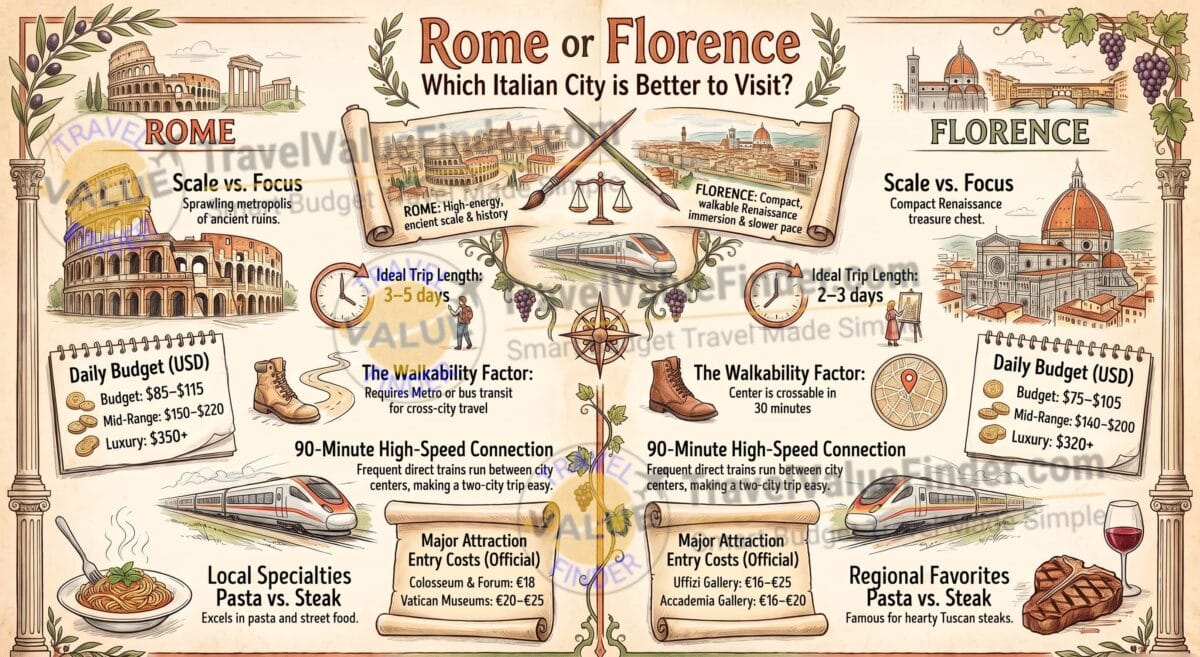
- Choose Rome if this is your only trip to Italy and you want the classic, iconic landmarks – the Colosseum, the Vatican, the Trevi Fountain.
- Choose Florence if you’d rather ease into Italy at a slower pace, in a city small enough to cover almost entirely on foot. The table below breaks down the core differences at a glance.
If you’re planning your first trip to Italy, the Rome or Florence question is one of the biggest calls you’ll make. It shapes almost everything else about your itinerary.
Leslie Nics | TravelValueFinder.com | July, 2026
Table of Contents
People Also Asked
Is Rome or Florence better for first-time visitors to Italy?
Rome is generally the stronger pick for a single first trip to Italy, thanks to its variety of iconic landmarks and broader food scene. Florence is better for travelers who prefer a smaller, more walkable, less overwhelming city, especially if Renaissance art is a top priority.
How many days do you need in Rome or Florence?
Rome typically needs 3–5 days to cover its major sites without rushing. Florence is more compact and can be covered comfortably in 2–3 days.
Is it better to visit Rome or Florence first?
If you’re doing both, either order works well since they’re connected by a roughly 90-minute high-speed train. Many first-time visitors start in Rome for the bigger landmarks, then wind down in Florence’s slower pace.
How much does it cost to visit the Colosseum and the Uffizi?
A standard Colosseum ticket (including the Roman Forum and Palatine Hill) costs €18 in 2026. A standard Uffizi Gallery ticket costs €25 (or €16 for afternoon entry after 4 p.m.), both per official 2026 pricing.
Can you day-trip from Rome to Florence?
Yes. The fastest Frecciarossa trains cover the roughly 140-mile route in about 1 hour 22 minutes, making a day trip technically possible, though most visitors prefer at least one overnight in Florence to avoid rushing.
Is Florence cheaper than Rome?
Florence is modestly cheaper than Rome for day-to-day costs like hotels and casual dining, but the core museum-ticket costs (Colosseum + Vatican vs Uffizi + Accademia) are nearly identical between the two cities.
Rome or Florence: The Quick Answer for First-Time Visitors
- Rome is the larger, more overwhelming choice. Home to the Colosseum, the Vatican, and nearly three thousand years of layered history.
- Florence is compact, walkable, and built almost entirely around the Renaissance.
| Category | Rome | Florence |
| Best for | Ancient history, iconic landmarks, food variety | Renaissance art, walkability, romantic pace |
| Ideal first-trip length | 3–5 days | 2–3 days |
| City layout | Large, spread out; needs metro/bus/taxi | Small, compact, historic center is walkable |
| Typical daily cost (mid-range) | $150–220 | $140–200 |
| Choose this city if… | You want the classic “Italy highlights” trip | You prefer a slower, less overwhelming pace |
Table 1: Rome or Florence at a glance for first-time visitors to Italy, based on 2026 pricing and typical itinerary length.
Bottom line:
- If this is your only trip to Italy and you want the landmarks people picture when they imagine the country, choose Rome.
- If you’d rather ease into Italy with a smaller, walkable city that rewards slow mornings and long lunches, choose Florence.
- And if you have five or more days, you can comfortably do both – they’re connected by a roughly 90-minute high-speed train, covered in detail below.
Why Rome or Florence Is Such a Hard Call for First-Timers
Both cities are UNESCO World Heritage Sites, both are packed with once-in-a-lifetime art and architecture. Both are genuinely excellent introductions to Italy which is exactly why the decision is so difficult.
The honest answer is that they reward different kinds of travelers.
Rome is a scale experience. There are massive ruins, and a sovereign city-state inside its borders. Food scene spans everything from street-food pizza al taglio to elaborate Roman-Jewish cuisine.
Florence is a focus experience. A small historic center where the Renaissance is concentrated into a handful of walkable blocks. This is where slowing down is part of the appeal rather than a compromise.
Rome asks you to keep moving and see a lot. Florence asks you to slow down and look closely. Neither is ‘better’. They reward completely different kinds of travelers.” Leslie Nics, TravelValueFinder.com
City Size, Walkability & Layout
This is the single biggest practical difference between the two. Rome’s historic core is large enough that you’ll rely on the Metro, and buses. Perhaps the occasional taxi to move between neighborhoods like Trastevere, the Vatican, and the Colosseum area.
Walking is pleasant but not always realistic for a packed day.
Florence’s entire historic center by contrast, is compact enough to cross on foot in under 30 minutes. The Uffizi, the Duomo, the Accademia, and the Ponte Vecchio are all within easy walking distance of each other.
Full neighborhood and transit breakdowns are in our Transportation in Rome and Transportation in Florence guides.
For picking a home base, see Where to Stay in Rome and Where to Stay in Florence.
Top Attractions & Official 2026 Ticket Prices
As of 2026, a standard Colosseum ticket which includes the Roman Forum and Palatine Hill on the same 24-hour ticket costs €18, according to the Parco Archeologico del Colosseo, the official Italian Ministry of Culture body that manages the site.
The Vatican Museums including the Sistine Chapel, cost €20 at the ticket window or €25 booked online, per the official Vatican Museums website.
In Florence, the Uffizi Gallery’s standard walk-up ticket is €25 (dropping to €16 for entry after 4 p.m.).
The Accademia Gallery, Home to Michelangelo’s David is €16 at the door or €20 booked in advance, according to the official Uffizi Galleries site and the Galleria dell’Accademia’s official site.
| Attraction | City | 2026 Price | Official Source |
| Colosseum + Roman Forum + Palatine Hill | Rome | €18 standard (24-hour ticket) | colosseo.it |
| Vatican Museums + Sistine Chapel | Rome / Vatican City | €20 on-site / €25 online | museivaticani.va |
| Uffizi Gallery | Florence | €25 standard (€16 after 4 p.m.) | uffizi.it |
| Accademia Gallery (Michelangelo’s David) | Florence | €16 walk-up / €20 booked online | galleriaaccademiafirenze.it |
Table 2: Official 2026 attraction pricing verified directly from each institution’s ticketing website. Check prices before visiting.
The takeaway most guides miss:
- pairing Rome’s two headline sites (Colosseum + Vatican) runs about €38–45 per person, while pairing Florence’s two headline museums (Uffizi + Accademia) runs about €41–45.
- Contrary to the common assumption that one city is dramatically cheaper for museum-going, the core “must-see” ticket cost is nearly identical.
- The real cost difference between the cities shows up elsewhere, in hotels and day-to-day dining.
- For a full sightseeing rundown, see Top 10 Things to Do in Rome and Top Things to Do in Florence.
Getting Between Rome and Florence
One reason this doesn’t have to be an either/or decision. Rome and Florence are connected by frequent high-speed rail, with journeys as short as 1 hour 22 minutes on Frecciarossa trains, run by Trenitalia, Italy’s state rail operator.
One-way fares on Trenitalia and its competitor Italo start as low as roughly €15–20 when booked in advance. Trains run directly between Roma Termini and Firenze Santa Maria Novella.
Both stations sit in the historic center of each city, so there’s no airport transfer to plan around.
That short, easy connection is a big part of why so many first-time visitors end up doing both cities on one trip rather than picking just one.
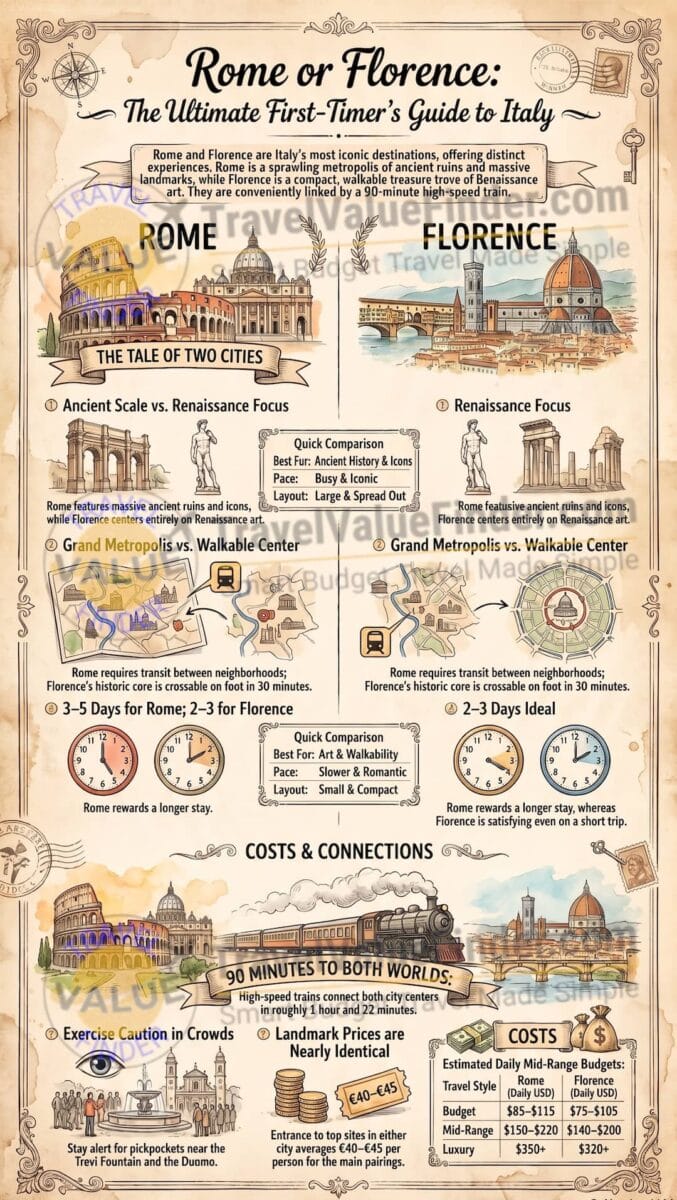
Cost Comparison for First-Time Visitors
Beyond the headline attractions, day-to-day costs run slightly lower in Florence than in Rome. This is mainly due to lower hotel rates outside peak season and a smaller, less premium-priced dining scene.
Rome’s cost is pulled up by higher-demand accommodation near major sites and a wider range of tourist-trap pricing you’ll want to research around.
| Travel Style | Rome (per day, USD) | Florence (per day, USD) |
| Budget traveler | $85–115 | $75–105 |
| Mid-range traveler | $150–220 | $140–200 |
| Luxury traveler | $350+ | $320+ |
Table 3: Estimated daily costs per person, based on 2026 hotel, food, and local transit pricing observed in each city.
For accommodation specifically, compare Where to Stay in Rome, Italy and Where to Stay in Florence, Italy.
If you’re planning something more upscale, see Luxury Hotels in Rome and Luxury Hotels in Florence.
Food & Dining: Roman vs Tuscan Cuisine
This is less a cost comparison than a style comparison, and it’s genuinely one of the best reasons to visit both.
Rome’s food scene is built around pasta classics:
- carbonara,
- cacio e pepe, and
- amatriciana,
- plus cheap, excellent street food like pizza al taglio and supplì.
Florence’s Tuscan cuisine leans heartier and more rustic:
- ribollita (bread and vegetable soup),
- bistecca alla Fiorentina (a thick-cut, bone-in steak typically shared between two), and
- schiacciata sandwiches from casual alimentari shops,
- all best paired with a glass of local Chianti.
Neither city is meaningfully cheaper at the everyday level. Rome has more ultra-cheap street food options, while Florence’s mid-range trattorias tend to offer strong value for the quality.
Full breakdowns, including where to eat and what to skip are in our Rome Food Guide and Florence Food Guide.
Safety & Practical Considerations for First-Time Visitors
Italy currently sits at Travel Advisory Level 2 (Exercise Increased Caution) from the US State Department. This is a rating shared with most of Western Europe, according to the official travel.state.gov Italy Travel Advisory.
This isn’t a reason to avoid either city. It mainly reflects general pickpocketing and petty-crime risk in crowded tourist areas, not a specific threat to visitors who stay alert.
In Rome, the main hotspots are Termini station, the area around the Trevi Fountain, and crowded Metro lines.
In Florence, it’s the zones around the Duomo and the Ponte Vecchio. Standard precautions. A front pocket or zipped bag, awareness in dense crowds cover the large majority of the practical risk in both cities.
How Many Days Do You Need in Each City?
Rome typically needs a minimum of 3 to 5 days to cover the Colosseum and Forum, the Vatican, the historic center, and at least one neighborhood without feeling rushed.
Florence is more compact. 2 to 3 days comfortably covers the Uffizi, the Accademia, the Duomo complex, and a walk through the Oltrarno neighborhood across the river. If your total Italy trip is a week or shorter, this is often the deciding factor.
Rome rewards more time, while Florence is genuinely satisfying even on a short visit.
See our Best Time to Visit Rome and Best Time to Visit Florence guides for seasonal crowd and price patterns in each city.
Which City Should You Visit First?
Here’s a simple way to think about the decision:
- Choose Rome first if: this is likely your only trip to Italy, you want the classic bucket-list landmarks, and you don’t mind a bigger, busier, more chaotic city in exchange for more variety.
- Choose Florence first if: you get overwhelmed easily by big cities, you’re specifically drawn to Renaissance art, or you want a gentler, more walkable introduction to Italy.
- Do both if: you have 5 or more days – the roughly 90-minute train connection makes a two-city itinerary genuinely practical, not just an ambitious add-on.
Can You Visit Both Rome and Florence in One Trip?
Yes, and for trips of a week or longer, it’s genuinely the best option rather than a compromise.
With direct high-speed trains under 90 minutes apart, a common first-timer itinerary is 4 days in Rome, then 2–3 days in Florence (or the reverse), with no wasted travel days in between.
If you have 10+ days, many first-time visitors extend the loop to include Venice. See Best Places to Visit in Venice for that add-on.
For a full country overview before you travel into individual cities, start with our Italy Travel Guide for First-Time Visitors.
Once you’re ready to map out the day-by-day details, our free Day-to-Day Trip Planner builds a personalized, downloadable itinerary across multiple cities in seconds.
Money-Saving Tips for Both Cities
Rome
- The Colosseum, Roman Forum, and Palatine are free on the first Sunday of every month. This is part of Italy’s national free-museum-Sunday program. Expect much bigger crowds in exchange.
- Walk between nearby sites (Colosseum to Roman Forum, Pantheon to Trevi Fountain) instead of taking taxis for short hops in the historic center.
- Eat a few blocks away from Termini station and the Trevi Fountain, where tourist-trap pricing and lower food quality are both more common.
Florence
- Book the Uffizi’s discounted afternoon ticket (€16, entry after 4 p.m.) instead of the €25 standard daytime ticket if your schedule allows.
- Reserve Accademia Gallery tickets several weeks ahead in peak season. Walk-up entry becomes unreliable from April through October.
- Skip taxis entirely where possible; the historic center is compact enough that walking is almost always faster than a car in Florence’s limited-traffic zone (ZTL).
Frequently Asked Questions
What’s the biggest difference between Rome and Florence?
Scale and pace. Rome is a large, sprawling city built around ancient history and requires public transit to get around efficiently. Florence is a small, walkable city almost entirely focused on Renaissance art and architecture.
Do I need to book Colosseum and Uffizi tickets in advance?
Yes, strongly recommended for both. The Colosseum requires a timed-entry ticket with no walk-up option, released 30 days ahead on the official site. The Uffizi and Accademia allow walk-up tickets in theory, but queues regularly exceed 1–2 hours from April through October.
Is it safe to travel to Rome and Florence right now?
Yes. Italy carries a Level 2 (Exercise Increased Caution) advisory from the US State Department, the same rating held by most of Western Europe. The main practical risk in both cities is pickpocketing in crowded tourist areas, not a specific safety threat.
What’s the best way to travel between Rome and Florence?
High-speed train. Trenitalia’s Frecciarossa and the competing Italo service both run frequent, direct trains between Roma Termini and Firenze Santa Maria Novella in as little as 1 hour 22 minutes, with one-way fares starting around €15–20 when booked ahead.
Which city has better food, Rome or Florence?
Different cuisines entirely rather than a clear winner. Rome offers more variety and cheaper street food (pasta classics, pizza al taglio, supplì). Florence offers heartier Tuscan specialties (bistecca alla Fiorentina, ribollita, schiacciata) with strong mid-range trattoria value.
Can first-time visitors skip Rome and just do Florence?
Yes, especially for travelers who prioritize art, architecture, and a slower pace over checking off bucket-list ruins. It’s an increasingly common choice for repeat Italy visitors or anyone who finds very large cities exhausting.
Sources
- Parco Archeologico del Colosseo, official Colosseum, Roman Forum & Palatine Hill ticket prices
- Vatican Museums, official ticket prices and booking
- Uffizi Galleries, official ticket prices
- Galleria dell’Accademia di Firenze, official ticket prices
- Trenitalia, official Frecciarossa high-speed rail information
- US Department of State, Italy Travel Advisory
Affiliate Disclaimer: Some links in this article are affiliate links. We may earn a referral commission on qualifying bookings at no additional cost to you