
Free Walking Tours Around the World: A City-by-City Guide

Free walking tours are the best travel hack that most guidebooks do not fully explain. In virtually every major city in the world – from Prague to Buenos Aires, from Istanbul to Hanoi – a local guide will spend 2–3 hours walking you through their city’s history, architecture, food culture, and hidden stories, introduce you to 10–20 fellow travelers who become your social group for the evening, and charge you precisely nothing upfront. The only payment is a tip at the end, and the size of that tip is entirely your decision.

How do free walking tours work, and what should you tip?

QuestionAnswerRegional Variation
How do they work?No upfront charge. A guide leads a 2–3 hour tour of the city’s highlights. At the end, you tip whatever you think the experience was worth – cash, in local currencySame model worldwide. Some cities now offer card payment via app; most still prefer cash
Are they really free?Technically yes – you can walk away tipping nothing. In practice: the guide’s entire income is tips. A good tour deserves a fair tip. Walking away without tipping is legal but not ethicalSome government-funded tours in Scandinavia and a few Asian cities are genuinely salary-paid. Research the specific operator before you go
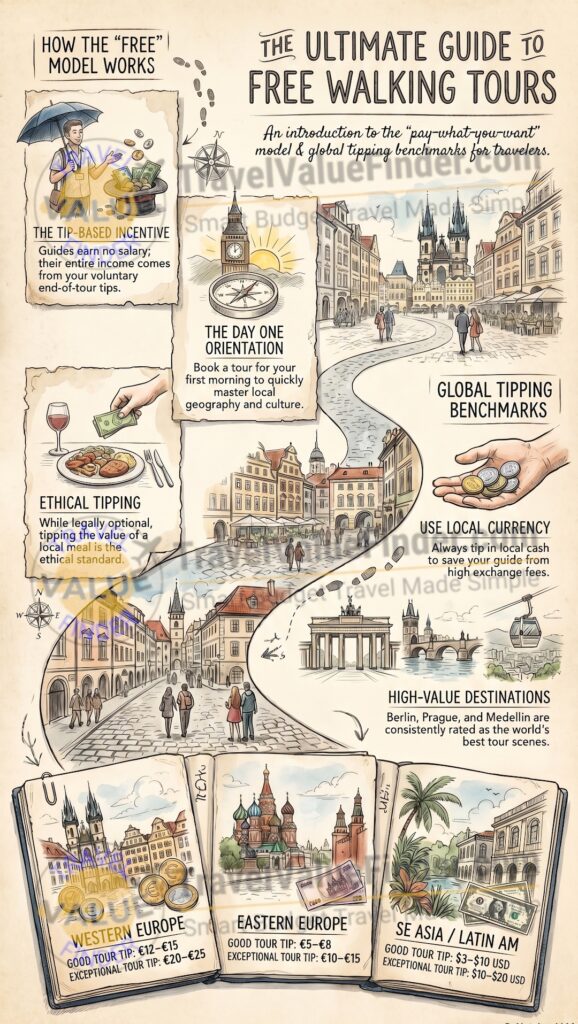
Standard tip: Western Europe€10–€15 per person for a good tour. €15–€25 in expensive cities (London, Paris, Zurich). €5–€10 in cheaper cities (Kraków, Budapest, Bucharest)Base on local cost of living, not just tour quality. A €5 tip in Kraków is generous; a €5 tip in London is insulting to the same quality tour
Standard tip: Americas, Asia, Africa$5–$15 USD equivalent per person. South America: $5–$10. Southeast Asia: $3–$8. The equivalent in local purchasing power is what mattersAlways tip in local currency where possible – guides pay exchange fees on foreign currency. Some operators in Colombia, Mexico, and Vietnam specify USD is acceptable

Leslie Nics, TravelValueFinder.com | Updated April 2026 | Written for global travelers | Covers 30+ cities across Europe, the Americas, Asia, Africa, and the Middle East | Tipping guidance by region and city with honest answers to the questions most guides avoid

The free walking tour model began in Berlin in the late 1990s – a startup called Sandemans launched the concept of tip-based tours as an alternative to expensive paid options, and the model spread globally within a decade. By 2026, free walking tours are available in over 200 cities worldwide, offered through platforms like GuruWalk and Freetour.com, and are consistently among the highest-rated activities in every city where they operate. The reason: a guide whose entire income is your tip is a guide with maximum incentive to make your experience extraordinary.

This guide is the free walking tours reference that answers every question honestly – not just ‘how much to tip’ but the complete city-by-city breakdown, the regional tipping ranges, the booking platforms ranked by reliability, the 10 etiquette rules that make you a better tour participant, and the honest answer to ‘can I skip the tip if the tour was bad?’ (Yes, legally. Read the full context below.) It covers 30+ cities across every inhabited continent. Every piece of advice comes from the perspective of a traveler who has taken free walking tours in dozens of cities and has seen – from both sides of the experience – what makes them work and what fails them.

The free walking tour is not free. It is deferred. You pay at the end, in an amount chosen by you, based on what the experience was worth. The guide knows this. You know this. The ‘free’ part simply means the admission price is set by your judgment rather than a ticketing system. Treat it like any other professional service: tip what you would pay for the equivalent in a paid tour, adjusted for the city’s cost of living. That is the only tipping formula you need. Leslie Nics, TravelValueFinder.com

Planning your next trip? Find the best flights and accommodation through our trusted partner: Search Flights and Hotels – TravelValueFinder. Real-time prices, hundreds of providers, secure booking.

How Free Walking Tours Work: The Complete Model Explained

Before the city-by-city guide, here is the complete operating model for free walking tours – including the parts most travel blogs omit:

The Business Model

Free walking tours operate on a tip-based, pay-what-you-want system. No upfront payment is required. The guide provides the full service – typically 2–3 hours of walking, commentary, historical context, local recommendations, and Q&A – and at the end, participants tip whatever they believe the experience was worth. The guide’s entire income from that tour is the tip pool. No base salary from the operator; no ticket revenue. Most operators take 0–20% of tips (for platform and marketing costs) and the remainder goes directly to the guide.

The model creates a natural performance incentive that paid tours rarely replicate: the guide has maximum motivation to make your tour outstanding, because an outstanding tour generates significantly larger tips than a mediocre one. Research from Free Tour Community and the European Travel Commission data confirms approximately 70% of travelers tip on guided tours if they found the experience valuable – and guides consistently cite this voluntary model as motivation to exceed expectations.

What to Expect on a Free Walking Tour

StageWhat Happens
BookingMost free walking tours require pre-booking through a platform (GuruWalk, Freetour.com, the operator’s website). This is free and takes 2 minutes. Pre-booking reserves your place and sends the exact meeting point – often not where you’d expect (tour operators frequently meet at landmarks adjacent to, not at, the obvious tourist site)
Meeting pointArrive 5–10 minutes early. The guide typically holds a coloured umbrella, a sign, or wears a branded t-shirt. Meeting points are usually in open public squares. In popular cities (Prague, Lisbon, Berlin), multiple companies may operate from the same square simultaneously – confirm you are joining the right guide
The tour2–3 hours on average. The guide walks the group through 6–12 stops, covering history, architecture, local culture, food, and stories. Group sizes range from 5 to 35+ people. Guides are typically young, passionate locals or long-term expats with deep city knowledge
The tipAt the end, the guide thanks the group and briefly explains the tip-based model (this varies – some are direct, some are subtle). Participants tip in cash individually, usually discreetly. The guide then often offers additional paid tours, bar recommendations, or local insider tips for those who want to continue
After the tourLeave a Google or TripAdvisor review – this is more valuable than the tip in some ways, as reviews drive future bookings and are the most useful contribution a genuinely excellent guide receives. Mention the guide’s name specifically

How Much to Tip on a Free Walking Tour: The Regional Guide

Tipping on free walking tours is the question with the most variation and the least honest guidance online. Most guides say ‘tip what you think it’s worth’ without context. Here is the context: the right tip is relative to local cost of living, not absolute. A €10 tip in Kraków (where a full restaurant meal costs €8–€12) is exceptional. A €10 tip in London (where a sandwich costs €7) is underwhelming for the same quality two-hour tour. The tables below reflect this reality:

Tipping by Region: The Reference Table

RegionGood TourExceptional TourAverage Group SizeGuide Earns (Approx.)
Western Europe (London, Paris, Amsterdam)€12–€15€20–€2520–35 people240–€525 per tour if most participants tip well. A good result for high-cost cities
Southern Europe (Spain, Italy, Portugal, Greece)€8–€12€15–€2015–30 people€120–€360 per tour at median tip
Eastern Europe (Poland, Hungary, Czech Republic, Romania, Balkans)€5–€8€10–€1510–25 people€50–€200 per tour. Lower absolute amounts but comparable in local purchasing power
North America (USA, Canada, Mexico City)$10–$15$20–$2515–30 people$150–$450 per tour for well-attended groups
Latin America (Colombia, Argentina, Peru, Brazil)$5–$10 USD$10–$20 USD10–25 peopleVaries significantly; guides appreciate USD in some cities. Tip in local currency where possible
Southeast Asia (Thailand, Vietnam, Indonesia, Cambodia)$3–$5 USD equivalent$5–$10 USD equivalent8–20 peopleLower absolute amounts but significant in local economy. $5 in Vietnam is 3–4 street meals for the guide
Middle East (Istanbul, Marrakech, Jerusalem)$5–$10 USD equivalent$10–$15 USD equivalent10–20 peopleResearch whether the guide is tip-dependent or salaried before the tour – government-sponsored tours operate differently
Sub-Saharan Africa (Cape Town, Nairobi, Accra)$5–$10 USD equivalent$10–$20 USD equivalent8–20 peopleVery tip-dependent; often the guide’s primary income. Generous tipping has genuine transformative impact

The honest answer to ‘can I not tip?’: Technically yes – the pay-what-you-want model means nothing is obligatory. In practice: walking away from a free walking tour without tipping after a good experience is the rough equivalent of eating a full meal at a restaurant and leaving no payment. The guide spent 2–3 hours of their workday on your experience. The minimum respectful tip for a decent tour is the equivalent of one local café meal – usually €3–€5 in Eastern Europe, €8–€10 in Western Europe, $5–$8 in Southeast Asia.

Free Walking Tours: City-by-City Guide (30+ Cities)

Here is the free walking tours reference table for all major cities where the model operates. Meeting points, platforms, and typical tips verified April 2026:

Europe

CityTypical TipBest PlatformMeeting PointInsider Note
Berlin€10–€15GuruWalkBrandenburg Gate (multiple operators)Birthplace of the modern free tour model. Sandemans still operates here but numerous independent guides offer superior depth. Cold War history tours are outstanding
Prague€5–€10Freetour.comOld Town Square, near Astronomical ClockOne of Europe’s best free tour scenes. 10+ operators compete, which keeps quality high. Also: communist-era walking tour is exceptional
Lisbon€8–€12GuruWalkPraça do Comércio (Commerce Square)Alfama neighbourhood tour is the most recommended. Hilly – wear walking shoes. Fado music and Moorish history coverage is exceptional
Barcelona€8–€12GuruWalk / Freetour.comPlaça de Catalunya, near Font de CanaletesGothic Quarter tours are the highlight. Gaudí architecture covered well but check guide credentials – quality varies significantly here
Madrid€8–€12Freetour.comPuerta del SolCivil War history tour is exceptional. Standard historic tour covers Prado, Retiro, Royal Palace area well in 2.5–3 hours
Rome€10–€15GuruWalkPiazza Venezia, near Altare della PatriaRome’s history density makes guides exceptional here. Key caveat: free tours cannot legally enter Vatican Museums – that requires a paid ticket
Athens€8–€12GuruWalkSyntagma Square, near ParliamentAthens Walks and This Is My Athens (city-run free guide programme) both excellent. Acropolis requires separate entry ticket (€20)
Budapest€5–€10GuruWalk / Freetour.comDeák Ferenc tér (central metro station)Communist history and World War II tours are Budapest’s standout offerings. Jewish quarter and ruin bar tours also very popular
Kraków€5–€8GuruWalkMain Market Square (Rynek Główny)Auschwitz tours operate as separate day trips ($35–$45). City tour: WWII and Jewish Quarter history is deeply moving and exceptionally covered
Amsterdam€10–€15Freetour.comDam SquareWaterways and canal architecture covered well. Jewish WWII history tour is among the most affecting in Europe
Vienna€10–€15GuruWalkStephansdom (St. Stephen’s Cathedral)Habsburg history and Ring Road architecture. Note: Vienna has licensed guide regulations that limit where free tours can go near certain sites
Edinburgh£10–£15GuruWalkRoyal Mile, near St. Giles’ CathedralScottish history and whisky culture covered brilliantly. Underground city tour (free walking tour of the buried vaults) is one of Europe’s most unique offerings
Istanbul$8–$12 USDFreetour.comSultanahmet Square (Blue Mosque area)Exceptional guide quality due to tourism school infrastructure. Hagia Sophia, Grand Bazaar, Bosphorus history all covered. Tip in Turkish lira or USD

Americas

CityTypical TipBest PlatformMeeting PointInsider Note
New York City$15–$20GuruWalkCity Hall Park (multiple operators)NYC guides must navigate strict regulations. Lower East Side food and immigration tours are particularly strong. Brooklyn walking tours offer great value
Mexico City$5–$10 USDGuruWalkZócalo (main square)One of the world’s great free tour cities – extraordinarily rich Aztec and colonial history, knowledgeable guides, and low tipping expectations. Tepito neighbourhood tour for the adventurous
Buenos Aires$5–$10 USD or ARS equivalentGuruWalkPlaza de MayoArgentina’s economic situation means tipping dynamics are complex – USD tips are often preferred by guides. Recoleta cemetery tour (Evita’s grave) is iconic
Medellín$5–$10 USDGuruWalkParque de las Luces (Metro station El Centro)Medellín’s transformation story – from world’s most dangerous city to thriving cultural hub – is one of the most extraordinary urban narratives available on any free tour anywhere
Bogotá$5–$10 USDGuruWalkParque de los Periodistas (La Candelaria)La Candelaria colonial district; street art in the upscale Chapinero area; Botero Museum (free entry). Very highly rated guides
Lima$5–$10 USDFreetour.comPlaza Mayor de LimaMiraflores coastal walk and Historic Centre both well-covered. Peruvian food history is a distinct specialty – Lima is considered South America’s culinary capital

Asia and the Middle East

CityTypical TipBest PlatformMeeting PointInsider Note
Bangkok$3–$7 USDGuruWalkSanam Luang (Grand Palace area)Free tours cover Rattanakosin Island (Grand Palace, Wat Pho, Wat Arun area). Local temple etiquette covered by guides before entry. Excellent value in a city where commercial tours are expensive
Hanoi$3–$6 USDGuruWalkHoan Kiem Lake, Turtle Tower sideOld Quarter history and French colonial architecture. Guides bring genuine expertise on Vietnam War history. Food-focused tours covering pho, bún chả, and bia hơi corners are exceptional
Chiang Mai$3–$6 USDGuruWalkTha Phae Gate (Old City east entrance)Temple and Old City history; Night Bazaar context; Lanna Kingdom history. Very well-reviewed guides who also provide excellent restaurant and activity recommendations
Siem Reap$3–$6 USDGuruWalkPub Street / Night Market areaFree city tour typically covers the town; Angkor Wat itself requires a separate $37 entry ticket. Khmer Rouge history contextualisation is excellent
Tokyo¥1,000–¥2,000 ($7–$14)Freetour.comHachiko Statue, Shibuya (or Shinjuku depending on tour)Japan’s non-tipping culture makes free tours unusual – some operators suggest a donation box model. Quality is exceptional; cover-ups for temple visits required
Marrakech$5–$10 USDGuruWalkJemaa el-Fna square, fountain near Café de FranceMedina navigation, souk history, and hammam culture. Warning: unofficial ‘guides’ in Marrakech will approach you and demand payment – always book in advance through a reputable platform
Cape Town$5–$10 USDGuruWalkGrand Parade / City HallBo-Kaap neighbourhood tour (Cape Malay history) and District Six history are Cape Town’s most powerful offerings. Apartheid history is handled with exceptional sensitivity by local guides

How to Find the Best Free Walking Tour in Any City

The quality of free walking tours varies enormously within the same city. Here is how to find the right one:

The Free Tour Selection Framework

StepWhat to Do
Step 1: Use a reputable platformGuruWalk and Freetour.com are the two most trusted global platforms for free walking tours. Both show verified reviews, guide photos, and individual guide ratings. Filter by highest rating and read the most recent reviews (within 30 days) – these reflect the current guide rather than a guide who left 18 months ago
Step 2: Book the specific guide, not just the companyMost platforms show individual guide ratings. A company may have 4.8 stars on average while one specific guide has 4.4 and another has 4.9. Book the 4.9 guide. Read reviews that mention the guide by name – consistent name-specific praise is the strongest quality signal
Step 3: Check the meeting point carefullyFree tour meeting points are often adjacent to (not at) the most obvious landmark. ‘Near Syntagma Square’ means a specific corner; ‘at Brandenburg Gate’ means a specific side. Screenshot the exact meeting instructions. Arriving at the wrong side of a major landmark adds 10 minutes of stress on Day 1 of your trip
Step 4: Book your first tour as Day 1 orientationThis is the single best use of free walking tours: on the first morning in a new city, a 2-hour tour with a knowledgeable local orients you completely – you understand the geography, know the neighbourhoods, have 5–10 restaurant recommendations, and understand the history that gives context to everything you will see for the rest of your visit. It is the most efficient €0 investment in a trip
Step 5: Ask the guide for off-menu recommendationsAt the end of the tour, guides are your best resource for current, local-knowledge recommendations: the best restaurant for the local specialty (not the TripAdvisor top 10), the market that locals actually shop at, the viewpoint that does not appear in any app. This exchange of information – guide gets a fair tip; traveler gets a year’s worth of local knowledge – is the truest value of free walking tours
Free Walking Tours Around the World - A City-by-City Travel Budget Guide - Infographic
Free Walking Tours Around the World – A City-by-City Travel Budget Guide – Infographic

10 Free Walking Tour Etiquette Rules That Make You a Better Participant

Most guides will not tell you these rules directly. They shape your experience and your fellow participants’ experience more than anything except the guide’s quality:

  1. Arrive 5–10 minutes early: The guide cannot hold the group for late arrivals. Most groups leave at the stated time. Arriving at the meeting point finding an empty square because the group left 3 minutes ago is entirely avoidable with a 5-minute buffer. Screenshot the meeting point instructions before you leave your accommodation
  2. Pre-register, even if walk-ins are allowed: Registration tells the guide how many people to expect and helps the company allocate guides appropriately for large groups. Walk-ins are usually accepted but pre-registration is the considerate choice and takes 60 seconds
  3. Stay with the group and keep the guide in hearing range: Free walking tours move through city streets with traffic, noise, and distractions. If you fall 15 metres behind, you miss context. Move with the group; stand close when the guide speaks. A guide who has to shout or repeat every point for latecomers to the circle is a guide delivering a worse experience to everyone
  4. Do not leave without warning: If you need to leave early, tell the guide before the tour starts – not halfway through. Watching half the group disappear mid-tour is demoralising and disruptive. If you must leave during the tour, quietly tell the guide at a stop – and still tip for the time you spent
  5. Put your phone away during commentary: The guide notices. More importantly, you miss the context that makes the photographs meaningful. Take photos at stops when the guide finishes speaking; put the phone away when they are talking. You have 2 hours with a knowledgeable local – use it
  6. Do not negotiate the tip: The tip is voluntary. It is not negotiable. Asking the guide ‘what’s the minimum?’ or ‘is €5 okay?’ puts them in an impossible position and is not the spirit of the model. Assess what you would pay for an equivalent paid tour; tip that amount or slightly less
  7. Tip in local currency: Guides pay fees to exchange foreign currency. Your €10 tip in USD arrives as $8.50 after exchange fees. Ask at your accommodation or hotel ATM for local currency specifically for free walking tour tipping before the tour starts – $20 in local bills is sufficient for any tour in any city
  8. Ask good questions: The best free walking tours are conversations, not lectures. A thoughtful question – ‘why did the city develop in this direction rather than that one?’ or ‘what does a local think of the tourist version of this neighbourhood?’ – elevates the experience for everyone. Guides are genuinely experts; use their expertise
  9. Leave a specific review mentioning the guide’s name: A Google review that says ‘The guide Marco was exceptional – his knowledge of Cold War history and his personal family story of living under the regime made the Berlin Wall section genuinely affecting’ is worth more to that guide than any amount of tip in terms of future bookings. Takes 3 minutes; has lasting value
  10. Do not treat it as genuinely free: The free walking tour model works because enough participants tip fairly that guides earn a decent income. If the proportion of non-tippers rises above a threshold, guides leave the model, companies fold, and the free walking tour ecosystem collapses. Tip fairly. The entire model’s survival depends on collective participant behaviour.

What to Bring on a Free Walking Tour

Most free walking tours last 2–3 hours on foot. Here is what every participant should bring:

ItemWhy It Matters
Comfortable walking shoesNon-negotiable. Free walking tours cover 3–6 km of city streets, often on cobblestones. Fashion shoes, new shoes, or heels will cause blisters that ruin the rest of your day. Wear your most comfortable, broken-in pair
Water bottle2–3 hours of walking and standing in summer heat or cold wind requires hydration. A refillable water bottle saves $2–$3 vs. buying during the tour and is more convenient than stopping to purchase
Cash for tipping (local currency)Prepare this before the tour, not during. Withdraw local currency specifically for tipping. The most common free tour participant mistake is having no cash at the end and tipping nothing – not from unwillingness but from poor preparation. Most operators do not have card readers
Weather-appropriate layers2–3 hours outdoors means you experience temperature changes, shade, wind, and possibly rain. A light layer and a packable rain jacket cover most scenarios. Your hotel has no significance at 11am in an exposed square in October
Sunscreen (southern Europe in summer)Standing for 10–15 minutes at each stop under direct southern European sun adds up. A small bottle of SPF50 in your day bag prevents a ruined afternoon from sunburn. Often forgotten on first trip days
A small daypack or crossbody bagFree walking tours move through crowded city streets where pickpockets operate. A bag with a zip closure, worn in front, keeps your phone, camera, and wallet secure. A backpack worn on your back is more vulnerable to zip-picking in crowds
An open mind about paceFree walking tours accommodate all fitness levels and nationalities. The pace is conversational, with frequent stops. Do not expect a walking workout; do expect occasional short waiting periods while the group gathers

Beyond the Standard Tour: Specialty Free Walking Tours Worth Knowing

The standard city-centre free walking tour is just the beginning. The specialty tour scene has expanded significantly – these are the other formats worth searching for:

Tour TypeWhat It Covers and Where to Find It
Street art tourAvailable in Berlin, Bristol, Lisbon, Buenos Aires, Medellín, and Melbourne. Covers murals, stencil art, political art, and the social history of graffiti culture. Often run by artists themselves – the insider knowledge about technique, permission, and commission is genuinely fascinating
Food walking tour (budget version)Some free tours include small food samples; most food tours charge $30–$60 for samples. The alternative: ask your free tour guide for a 15-minute post-tour walkthrough of the food market. Most guides do this happily for groups who showed genuine interest
Dark/ghost tourAvailable in Edinburgh, Prague, Vienna, and most historic European cities. Evening tours covering local legends, executions, plague history, and ghost stories. These are almost always pay-what-you-want. Edinburgh’s underground vault tours are the most celebrated globally
Communist/Cold War history tourSpecialist tours in Berlin, Prague, Budapest, Warsaw, Bucharest, and Sofia. These are among the most distinctive free walking tours available – covering living memory history (many guides’ own families lived through the era) with primary source personal accounts. Deeply affecting and unavailable from any guidebook
Jewish heritage tourOperating in Kraków, Amsterdam, Prague, Budapest, Seville, and Thessaloniki. These require sensitive, knowledgeable handling – the best operators specifically train guides on Holocaust history, Jewish cultural context, and the living communities that survived and rebuilt
Local neighbourhood tourAway from the tourist centre, these tours cover where residents actually live, eat, and spend time. Available in Istanbul (Beyoğlu), Buenos Aires (Palermo), Medellín (Laureles), and Lisbon (Mouraria). Often run by neighbourhood residents. Lower ratings on platforms (fewer reviews) but frequently the most authentic experience
City-run official free toursSome city governments fund genuinely free (salary-paid, no tip required/expected) walking tours as a tourism promotion. Athens (‘This Is My Athens’), Singapore (NHB Heritage Tours), Canberra (government-funded walks), and several Scandinavian cities operate these. Research before you arrive – they are different from the tip-based model

Plan Your Trip: Related Resources on TravelValueFinder

Continue planning with our complete budget travel library (all URLs verified April 2026):

Find the best flights and hotels for your next trip. Our trusted partner searches hundreds of providers in real-time: Search Flights and Hotels – TravelValueFinder. We earn a small commission at no extra cost to you – helping keep all our guides completely free.

Frequently Asked Questions: Free Walking Tours

How do free walking tours work?

Free walking tours operate on a tip-based pay-what-you-want model. No upfront payment is charged. A local guide leads a group of travelers through city highlights – typically covering 6–12 stops over 2–3 hours with historical commentary, local stories, and insider recommendations. At the end of the tour, participants tip whatever they believe the experience was worth. The guide’s income is entirely derived from those tips, which means their motivation to deliver an outstanding experience is directly aligned with your satisfaction. Book in advance through platforms like GuruWalk or Freetour.com. Arrive at the meeting point 5–10 minutes early with cash in local currency for tipping.

Are free walking tours really free?

Technically yes – you can participate in a free walking tour and tip nothing. In practice: the guide’s entire income is the tip pool, and walking away without tipping after a good experience is ethically equivalent to dining at a restaurant and leaving without paying. The ‘free’ element means the price is set by your judgment rather than a ticketing system – it makes guided tours accessible to travelers of all budgets while maintaining quality through the tip incentive. Some genuinely free tours do exist: government-funded tours in Athens (‘This Is My Athens’), Singapore (NHB Heritage Tours), and several Scandinavian cities pay guides salaries. Research the specific operator before assuming the model applies.

How much should you tip on a free walking tour?

The right tip for a free walking tour is relative to local cost of living, not absolute. General guidelines: Western Europe expensive cities (London, Paris, Zurich) – €15–€25 for an excellent tour; Southern/Central Europe – €8–€15; Eastern Europe (Kraków, Budapest, Bucharest) – €5–€10; North America – $10–$20; Latin America – $5–$10 USD; Southeast Asia – $3–$8 USD equivalent. A practical rule: tip what you would pay for one local restaurant meal as the baseline for a decent tour; double that for an exceptional one. Always tip in local currency – guides pay exchange fees on foreign currency, which reduces the effective value of USD or other foreign tips.

What is the best platform for finding free walking tours?

The two most reliable global platforms for free walking tours are GuruWalk and Freetour.com. Both show verified reviews, individual guide ratings, clear meeting point instructions, and tour length information. For city-specific operators: some of the best free tours are independent and searchable only through Google (‘free walking tour [city name]’) or through hostel recommendations. For maximum quality assurance, filter by highest-rated guides with 50+ recent reviews and read comments that mention the guide by name – consistent name-specific praise is the strongest reliability signal.

Is it rude not to tip on a free walking tour?

Not tipping on a free walking tour after a good experience is considered ethically problematic in the travel community – the guide spent 2–3 hours of professional time on your experience with no guaranteed income. The minimum respectful tip for a decent tour is roughly the cost of one local café meal. Not tipping at all is legally permitted by the model’s structure but damages the sustainability of the free tour ecosystem: when non-tipping rates rise, guides leave the model and quality drops. For travelers on genuine budget constraints, a small tip (even €2–€3) combined with a specific positive Google review mentioning the guide by name is a meaningful contribution that most guides value highly.

What are the best cities in the world for free walking tours?

The cities consistently rated highest for free walking tour quality worldwide are: Berlin (birthplace of the model; extraordinary Cold War history guides), Prague (10+ operators creating quality competition; WWII and communist history outstanding), Medellín, Colombia (transformation story from world’s most dangerous city to thriving hub is uniquely powerful), Athens (exceptional Acropolis context; also has city-run free guide programme), Lisbon (Alfama neighbourhood tour quality is extraordinary), Budapest (ruin bar and communist history tours both excellent), and Cape Town (Apartheid history tours handled with exceptional sensitivity by local guides). In Asia: Bangkok and Hanoi both have strong free walking tour scenes with knowledgeable local guides who also serve as excellent restaurant recommendation sources.

What should I bring on a free walking tour?

For any free walking tour, bring: (1) comfortable, broken-in walking shoes – 3–6 km of cobblestone streets is standard; (2) a water bottle – 2–3 hours outdoors requires hydration; (3) local currency cash for tipping – prepare this before the tour, not during; (4) weather-appropriate layers including a packable rain jacket; (5) a crossbody bag with a zip closure worn in front for security in crowded city streets; (6) sunscreen for summer tours in southern Europe, Middle East, or Southeast Asia. Leave home: heavy cameras (phone cameras are sufficient), large backpacks (a day bag under 10L is ideal), and valuables that do not need to be on your person.

Final Thoughts: Free Walking Tours Are the Best Investment in Any Trip

Free walking tours are the highest-return-per-dollar activity available in virtually any major city in the world. A 2–3 hour tour with a knowledgeable local guide – who has maximum incentive to make your experience exceptional – delivers more useful knowledge about a city than any guidebook, any app, or any amount of independent wandering in the same time frame. The context makes everything else on your trip better: the food tastes different when you understand the history behind it; the street makes sense when you know why it bends at that angle; the building is extraordinary when you know what happened inside it 80 years ago.

The model is also, in a meaningful sense, one of travel’s most equitable exchanges. A good guide in Kraków or Medellín earns a living wage from travelers who freely choose to reward excellent service. A bad guide earns little, adjusts, or exits. Quality is enforced not by a star rating system but by the most direct possible feedback mechanism: cash in hand at the end of a performance. It is a genuinely beautiful system when it works – and it works most of the time, in most cities, with most guides.

Take the tour on Day 1. Tip fairly. Leave a review. Do it in every city you visit. This is one of travel’s genuine pleasures – and it is as close to free as anything genuinely valuable ever is.

I’ve taken free walking tours in 30+ cities. The worst cost me nothing. The best were some of the most valuable 3 hours of any trip I’ve taken – more useful information, better restaurant recommendations, and more genuine human connection than any paid tour I’ve ever booked. Tip the guide €10–€15. It is the best-value transaction available to a traveler. Anywhere. Leslie Nics, TravelValueFinder.com

Find the best flights and hotels for your next trip. Our trusted partner searches hundreds of providers: Search Cheap Flights and Hotels – TravelValueFinder. We earn a small commission at no extra cost to you.

Share this post
Leslie Nics
Leslie Nics

Leslie Nics is a travel content writer at Travel Value Finder, specializing in budget travel strategies, destination guides, and itinerary planning. With hands-on travel experience across multiple regions, Leslie focuses on helping readers travel smarter, spend less, and discover meaningful destinations.

Newsletter Updates

Enter your email address below and subscribe to our newsletter