Travel Value Finder

The best travel experiences I have ever had cost nothing. The sunrise over Angkor Wat. Standing in the Pantheon in Rome at exactly the moment a shaft of light came through the oculus in the dome ceiling. Getting genuinely, usefully lost in the medina of Fez. A free lunchtime concert in a Budapest park that turned into a three-hour afternoon. Free – not as in cheap, not as in budget-compromised. Free as in the experience itself is what you paid nothing for.
Leslie Nics, TravelValueFinder.com | Updated April 2026 | Written for US travelers | Covering free activities across 6 continents, city-specific free museum schedules, and original frameworks for finding free experiences anywhere you go.
The best free things to do when traveling are not consolation prizes for travelers who cannot afford the paid options. They are often the richest, most memorable, most distinctly travel experiences available in any destination. Research by CashNetUSA analysing over 1,000 vacation destinations found that San Antonio, Texas – where almost 90% of free attractions are rated 4.5 stars and above – beats many expensive destinations purely on the quality of its zero-cost experiences. The data confirms what experienced travelers already know: free and extraordinary are not opposites.
This guide gives you the free things to do when traveling framework that experienced budget travelers use – not just a list of activities, but the systems, the strategies, and the original approaches that make free experiences consistently available in every city you visit, no matter where in the world you land.
Free doesn’t mean lesser. Some of the world’s most extraordinary travel experiences – the Smithsonian, the British Museum, Tokyo’s temples, Rome’s Pantheon, the beaches of Southeast Asia – cost nothing to enter. The most profound moments of travel often happen when your wallet is closed and your eyes are open.” Leslie Nics, TravelValueFinder.com
Before the free activities start, book your trip. Find the best flights and hotels through our trusted partner: Search Flights and Hotels – TravelValueFinder Deals. Real-time prices, secure booking.
Table of Contents
The Real Value of Free: What Free Travel Activities Actually Save You
Before the activities themselves, let’s make the financial case for prioritising free things to do when traveling – because it is more significant than most travelers realise.
| Paid Activity Equivalent | Typical Cost | Free Alternative |
| Guided city tour | $40 – $80 per person | Free walking tour (tip $10 – $15) – GuruWalk.com, 800+ cities |
| Museum entrance (world-class) | $15 – $25 per person | Free museum days – Smithsonian (always), British Museum (always), Louvre (first Sunday, Nov – Mar) |
| City sightseeing bus tour | $30 – $60 per person | Free public transit self-guided tour – most cities $2 – $5 transit card covers the same route |
| National Park entry | $15 – $35 per vehicle | America the Beautiful Senior Pass ($80 lifetime for 62+) or free parks (Great Smoky Mountains is always free) |
| Guided coastal/nature walk | $25 – $60 per person | Self-guided hikes on free public trails – often with superior views |
| Cultural performance/concert | $30 – $120 per person | Free lunchtime concerts, street performance, local festivals – year-round in most cities |
| Total saved on 14-day trip (2 people) | $500 – $1,400 | By applying the strategies in this guide |
Estimates based on a 2-person, 14-day trip using free alternatives for 60% of paid activities. Real savings vary by destination and travel style.
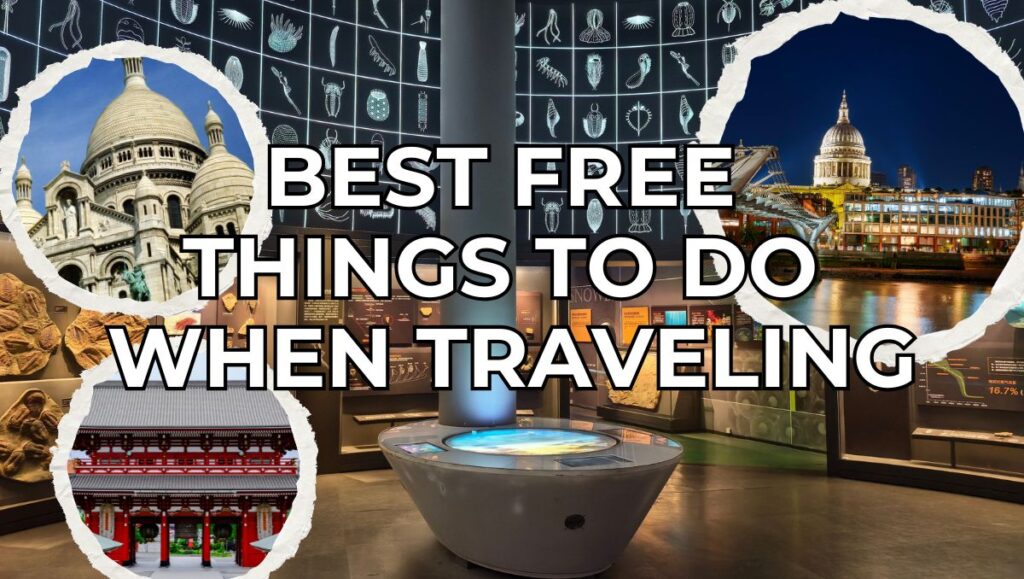
Travel doesn’t have to be expensive to be meaningful. This infographic highlights simple, budget-friendly ways to explore any destination-like wandering through local neighborhoods, visiting public parks, enjoying free cultural sites, or soaking in the atmosphere of street markets and community events. It’s a quick snapshot of how you can experience the heart of a place without spending much. For more ideas, tips, and deeper insights on making the most of your trip for free, be sure to read the full article.
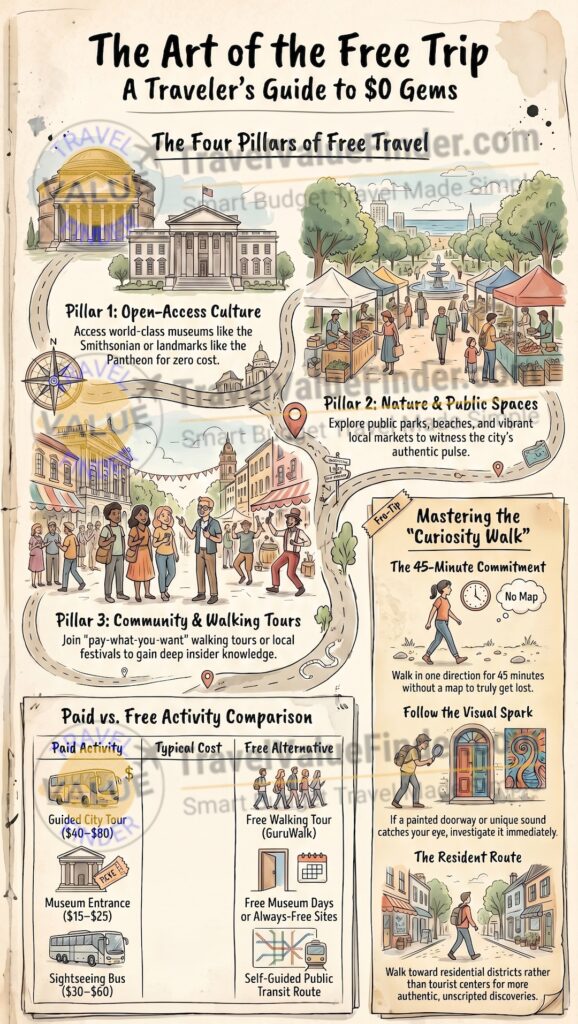
The Four Pillars of Free Travel: Leslie’s Original Framework
Most articles on free things to do when traveling give you a list. This guide gives you a framework. In my experience across 40+ countries, free travel experiences fall into four pillars – four categories that, once you understand them, allow you to build a free-activity itinerary for literally any city on earth, whether you have researched it for months or arrived with 48 hours’ notice.
| Pillar | Category | What This Covers |
| Pillar 1 | Open-Access Culture | Museums with free permanent collections or free days, historic religious buildings, cultural districts, public art, historic landmarks |
| Pillar 2 | Nature and Public Space | Public parks, hiking trails, beaches, markets, waterfronts, plazas, viewpoints, botanical gardens, riverwalks |
| Pillar 3 | Community Experience | Free walking tours, local festivals, street performances, farmers markets, public events, neighbourhood exploration |
| Pillar 4 | Observation and Presence | Sunrise and sunset watching, people-watching at key locations, sitting in the living city without agenda – the Curiosity Walk (see below) |
Every destination on earth offers all four pillars. The secret is knowing how to access each one in a new city within hours of arrival – which is what the rest of this guide teaches.
Pillar 1: Open-Access Culture – The World’s Best Free Museums and Landmarks
The Free Museum System: How to Access World-Class Art and History for Nothing
The free museum strategy is one of the highest-value free things to do when traveling – and the most systematically underused by American travelers who assume that world-class museums cost money. Many do not. Here is the definitive breakdown of which museums are always free and which have free days:
Complete Free Museum Reference Guide: Always Free vs. Free Days
| Museum / Attraction | Free Status | Details |
| ALWAYS FREE – US | ||
| All 19 Smithsonian Museums (DC + NYC + Chantilly) | Always free | National Air and Space Museum, National Museum of Natural History, American History, American Art and Portrait Gallery, African American History, and more – all permanently free |
| National Gallery of Art, Washington DC | Always free | One of the world’s great art collections – West and East Buildings, open 7 days a week |
| National Museum of the US Air Force (Dayton, OH) | Always free | Casago research: 92.85% five-star reviews – the highest-rated free attraction in the USA |
| Cleveland Museum of Art (Cleveland, OH) | Always free | World-class permanent collection including medieval and Asian art – never charges admission |
| National Zoo (Washington, DC) | Always free | Part of the Smithsonian Institution; lions, elephants, giant pandas – zero admission fee |
| ALWAYS FREE – INTERNATIONAL | ||
| British Museum (London) | Always free | Rosetta Stone, Elgin Marbles, Egyptian mummies – one of the world’s greatest museums, permanently free |
| Victoria and Albert Museum (London) | Always free | World’s greatest museum of art and design – fashion, textiles, ceramics, sculpture – permanently free |
| National History Museum (London) | Always free | Blue whale skeleton, dinosaur exhibits, Darwin Centre – free permanent collection |
| Tate Modern (London) | Always free | World’s most visited modern art museum – free permanent collection, turbine hall installations |
| Rijksmuseum (Amsterdam) – Verzetsmuseum | Note: Rijksmuseum has paid entry | Amsterdam’s Resistance Museum and Jewish History Museum both have free or low-cost options periodically |
| Musée Carnavalet (Paris) | Always free | Paris’s complete history museum across 100+ rooms – free permanently. Not the Louvre, but extraordinary |
| Musée d’Art Moderne de Paris | Always free | Permanent collection of modern art (Matisse, Picasso, Derain) – free. Right on the Seine |
| National Museum of Anthropology (Mexico City) | Free every Sunday | The world’s greatest pre-Columbian collection – Aztec Sun Stone, Mayan artefacts. Worth a trip to CDMX alone |
| FREE DAYS – KEY INTERNATIONAL | ||
| Louvre (Paris) | Free first Sunday of month (Nov – Mar: all year; Apr – Oct: monthly) | Arrive 30 min before opening on free Sundays. Book your time slot online in advance even for free days – now mandatory |
| Musée d’Orsay (Paris) | Free first Sunday of each month | The world’s best Impressionist collection – Monet, Renoir, Van Gogh. Free day is worth planning your Paris visit around |
| Centre Pompidou (Paris) | Free first Sunday of each month | Modern and contemporary art – Picasso, Kandinsky, Warhol. Spectacular city views from the roof |
| Musée Rodin (Paris) | Free first Sunday of each month (winter) | Garden with The Thinker and The Gates of Hell – the garden alone ($5) is worth it on paid days |
| Museo del Prado (Madrid) | Free Mon – Sat 6 – 8pm, Sun 5 – 7pm | One of the world’s great art museums – Velázquez, Goya, Rubens. Plan for the last 2 hours of any day |
| Museo Nacional Centro de Arte Reina Sofía (Madrid) | Free Mon, Wed – Sat 7 – 9pm; Sun 1:30 – 7pm | Picasso’s Guernica – arguably the most powerful painting of the 20th century. Free on Sunday afternoons |
| Vatican Museums (Rome) | Free last Sunday of each month | Sistine Chapel, Raphael Rooms, massive art collection. FREE once a month – arrive at 7am to manage queues |
| Uffizi Gallery (Florence) | Free first Sunday of each month | Botticelli, Leonardo, Michelangelo – the world’s best Renaissance collection. Free Sunday means massive queues; arrive before 8am |
Leslie Nics’s pro tip: The free Sunday museum strategy can save $30 – $80 per person in a single day. If you are flexible with your itinerary, plan your entire Paris, Rome, or Madrid trip around these free museum days as anchor points – then build the rest of your schedule around them.
Free Religious and Historic Landmarks: The World’s Greatest Attractions That Cost Nothing
Many of the world’s most awe-inspiring landmarks are completely free to enter. The key is knowing which ones – because tourist infrastructure often makes paid-entry sites more obvious than free ones.
| Landmark | Location | What Makes It Free and Extraordinary |
| Pantheon | Rome, Italy | Built in 27 BC, perfectly preserved, free to enter at most times (check for worship hours). The oculus – the hole in the dome – is one of architecture’s greatest achievements |
| Sacré-Cœur Basilica | Paris, France | Stunning views over Paris from the steps and the dome interior (dome access is paid). Interior is free |
| Notre-Dame Cathedral | Paris, France | Ground floor is free after 2019 restoration reopening. Towers require advance-booked tickets |
| St. Paul’s Cathedral | London, UK | The cathedral interior charges for tourism; however, the exterior and surroundings are free and extraordinary |
| Sagrada Família exterior | Barcelona, Spain | Gaudí’s unfinished masterpiece costs €33 to enter, but the exterior facades are viewable for free and equal in spectacle |
| Fushimi Inari Shrine | Kyoto, Japan | 10,000 vermillion torii gates through a mountain forest – entirely free. Go before 7am for deserted, magical atmosphere |
| Senso-ji Temple | Tokyo, Japan | Tokyo’s oldest and most beautiful temple complex – the Nakamise shopping street and main hall are free |
| Meiji Shrine | Tokyo, Japan | Forested Shinto shrine in central Tokyo – free, peaceful, extraordinary counterweight to the city’s energy |
| Nara Deer Park | Nara, Japan | Free access to the park where 1,200 wild deer roam freely. Buy deer crackers from vendors ($2) and you are in another world |
| Hagia Sophia | Istanbul, Turkey | 1,500-year-old masterpiece, now a mosque – free to enter during non-prayer hours |
| The Alamo | San Antonio, TX | Completely free – the site of the famous 1836 battle for Texan independence. San Antonio has 89.66% of free attractions rated 4.5+ stars – the highest of any city studied by CashNetUSA |
| Great Smoky Mountains | Tennessee/North Carolina | The most-visited national park in the US – and one of 16 that charge zero entry fee. 10 million visitors per year |
Pillar 2: Nature and Public Space – Free Parks, Trails, Beaches, and Markets
Nature and public space represent the most universally available free things to do when traveling – because every destination has them, they are accessible to everyone, and they consistently produce the most photographed and remembered moments of any trip.
Parks and Green Spaces: The Underrated Heart of Every City
Every great city has at least one great park, and every great park is free. They are where locals actually go – not the tourist version of local life, but the actual thing. Here is what you can do in virtually any city park for absolutely nothing:
- People-watch: Central Park, New York. The Retiro in Madrid. Gorky Park in Moscow. Villa Borghese in Rome. Lumphini Park in Bangkok. Hyde Park in London. Every park tells you something about the city that no museum can – watch who uses it, how, and when
- Picnic: Buy food from a local market or supermarket – not a tourist-facing café – and eat in the park. In London, a full picnic from M&S costs £8 – £12 and eaten in Hyde Park beats any £25 restaurant lunch for the experience
- Catch free entertainment: Shakespeare in the Park (New York, summer), Millennium Park’s Pritzker Pavilion free concerts (Chicago, summer), outdoor cinema, local band performances – parks host free programming constantly. Check the city’s official events calendar before arrival
- Exercise: Most city parks have outdoor gym equipment (London, Paris, Singapore, Mexico City all have free open-air fitness stations), running tracks, and yoga groups that welcome strangers
Markets: The Free Experience That No Other Traveler Category Gets Right
A market is a free museum of local life. The food markets, flea markets, flower markets, fish markets, and night markets that exist in virtually every destination worldwide are free to enter, extraordinary to experience, and consistently produce the most sensory-rich travel moments of any trip. You are smelling, tasting, photographing, and conversing in a way that a paid cultural tour cannot manufacture. Here is a quick global market guide:
| Market Type | Example Destinations | What You Experience for Free |
| Food/produce market | La Boqueria (Barcelona), Pike Place (Seattle), Borough Market (London), Tsukiji outer market (Tokyo), Grand Bazaar (Istanbul) | Sensory overload of local food culture; free samples in many; best street food adjacent |
| Night market | Chiang Mai Walking Street, Bangkok Chatuchak, Taipei Shilin, Marrakech Djemaa el-Fna | The most social, most photogenic, most alive city experience available after dark |
| Flea/antique market | Portobello Road (London), Marché aux Puces (Paris), Rastro (Madrid), IJ-Hallen (Amsterdam) | History, craft, unexpected beauty – and the pleasure of looking without buying |
| Flower market | Columbia Road (London), Bloemenmarkt (Amsterdam), Pak Khlong Talat (Bangkok) | Pure colour, scent, and photography – one of travel’s most underrated free mornings |
| Fish market | Tsukiji outer market (Tokyo), Bergen Fish Market (Norway), Mercado Central (Santiago) | The theatre of the catch – one of the most culturally specific experiences any destination offers |
Pillar 3: Community Experience – Free Walking Tours and Local Events
The Free Walking Tour: The Single Best Free Thing to Do in Any City
If there is one free thing to do when traveling that delivers more value per hour than any other, it is the free walking tour. GuruWalk offers over 2,300 free tours in more than 800 cities worldwide – and the model is genuinely extraordinary: a local guide who knows and loves their city takes you through 2 – 3 hours of history, hidden gems, local knowledge, and personal stories, for zero upfront cost. You pay what the experience was worth to you at the end.
What makes the free walking tour specifically better than a paid city tour for most travelers? According to Free Walking Tour Wikipedia research, because guides work entirely for gratuities, the quality tends to be significantly and consistently better than traditional paid tours – the guide’s income depends entirely on delivering an extraordinary experience. The pay-what-you-want model creates a direct quality incentive that standard pay-upfront tours simply do not have.
| Platform | Coverage | Best For |
| GuruWalk | 800+ cities worldwide, 2,300+ tours in English and other languages | The most comprehensive global platform – start here for any destination |
| Free Tours by Foot | 120+ cities primarily in USA, UK, Canada, Europe, Latin America | Strong US city coverage – great for American cities |
| FreeTour.com | 60+ countries, major tourist cities worldwide | Good for international destinations; multiple theme options per city |
| City tourist offices | Any city with a tourism infrastructure | Many organise their own free or very cheap tours not listed on third-party platforms |
| Hostel bulletin boards | Cities with active backpacker scenes | Often the best insider tours – smaller groups, deeply local guides |
Tip protocol: The pay-what-you-want system works because travelers treat it honestly. A 2 – 3 hour tour from a knowledgeable, passionate local guide is worth $10 – $20 per person as a tip – the equivalent of a museum entry fee. Guides who receive fair tips stay in the industry and improve; guides who do not eventually leave. Tip generously for genuinely great guides, less for average ones.
Free Local Events: The Calendar That Every City Has and Every Tourist Ignores
Every city has a free events calendar that most tourists never look at. Free concerts, outdoor film screenings, cultural festivals, markets, art walks, farmer’s markets, and street performance series run throughout the year in virtually every major city – and they are almost universally attended by locals rather than tourists, making them both authentic and free.
- Where to find free events: Eventbrite.com (filter for ‘free’), city official tourism websites (e.g., nycgo.com for New York, visitlondon.com), local newspaper ‘This Weekend’ sections, and Instagram with the hashtag #[CityName]Free
- Seasonal patterns: Summer brings outdoor concert series in almost every city (Central Park SummerStage in NYC, BBC Proms in London, Bastille Day celebrations in Paris). December brings Christmas markets in Europe (free to walk; you buy what you want). Spring brings cherry blossom festivals in Washington DC, Tokyo, Seoul, and Kyoto – all free to attend. Research what is happening during your travel dates, not just what the tourist infrastructure offers
- The ‘check Eventbrite on arrival’ habit: One habit that costs nothing and takes 5 minutes: when you arrive in a new city, open Eventbrite, filter for your dates and ‘free events,’ and see what is happening. This single step has led me to a free jazz concert in New Orleans, a free gallery opening in Amsterdam, and a free outdoor Flamenco performance in Seville – none of which I would have found through standard tourist research
Pillar 4: The Curiosity Walk Leslie’s Original Free Travel Method
This is the section that no other article on free travel activities has.
The Curiosity Walk is a method I developed over years of solo travel that has consistently produced the best moments of every trip – and costs absolutely nothing. Here is the concept: you pick a direction (never back the way you came), you walk for at least 45 minutes with no map and no destination, and you follow exactly one rule: if something catches your eye, go toward it.
That is the entire method. A painted doorway down an alley. A cluster of people outside a building. A sound coming from a courtyard. A smell from a kitchen. The rule is simply: if it catches your attention, investigate. Do not stay on the tourist route. Do not follow Google Maps. Do not have a destination.
In 15 years of applying this method across 40+ countries, the Curiosity Walk has led me to: a rooftop bar in Hanoi that had zero online presence and served the best banh mi I have ever eaten; a free outdoor cinema in an Athens neighbourhood park on a Tuesday evening that showed a Coen Brothers film; a completely unmarked museum of local craft and weaving in a small Moroccan medina town; a free lunchtime classical concert in a Copenhagen church that was so good it made the person next to me cry. None of these were in any guidebook. All were free. All were unrepeatable. All were more memorable than anything I paid to see that trip.
The Curiosity Walk requires only that you put your phone in your pocket, pick a direction, and trust that the city has something to show you. It always does.” – Leslie Nics, TravelValueFinder.com
How to Execute a Curiosity Walk in Any City
- Start after breakfast, before the tourist infrastructure wakes up: 7 – 9am gives you a city that is genuinely alive – delivery trucks, bread shops opening, schoolchildren, dog walkers – rather than a city performing tourism
- Pick the direction that faces away from the main tourist area: Walk toward the residential districts, the local market, the street with no English-language signs. This is always the more interesting direction
- Follow the 45-minute no-return rule: Commit to walking for at least 45 minutes before you are allowed to turn around. Most interesting discoveries happen in the first 20 minutes of disorientation
- Carry only what you can carry comfortably: Water, phone (navigation-free for the walk), one layer for weather. Nothing that makes you a target or a tourist
- If you get genuinely lost, ask for directions: This is not a failure – it is the best conversation starter in travel. In Japan they will walk you to your destination. In Morocco they will offer you tea. In Italy they will argue among themselves about the best route
- Note what you found when you return: Where did you end up? What did you see? Write it down – even one sentence per walk. After a week of Curiosity Walks, you will have a travel document that is entirely your own
City-by-City Free Experience Quick Reference: What Is Free Where
Here is a destination-specific guide to free things to do when traveling in the most popular American travel destinations:
Best Free Experiences in US Cities
| US City | Best Free Experiences |
| New York City | All 19 Smithsonian sites (National Museum of the American Indian is in lower Manhattan), Staten Island Ferry (Statue of Liberty views), Brooklyn Bridge walk, The High Line, Brooklyn Bridge Park, Central Park, The Bronx Zoo (free Wednesday mornings for NY residents), MOMA’s Free Friday evenings |
| Washington DC | All Smithsonian museums (National Mall), National Gallery of Art, US Capitol building (exterior and visitor centre free), Lincoln and Vietnam Memorials, Library of Congress reading room, free Kennedy Center performances (Millennium Stage, every day at 6pm) |
| Chicago | Millennium Park (Cloud Gate ‘The Bean’), Art Institute of Chicago (free Thursday evenings for Illinois residents; free for children under 14 always), Chicago Cultural Center, 606 Trail, free lunchtime concerts in parks, Riverwalk |
| San Antonio, TX | The Alamo, San Antonio Missions National Historic Park, Japanese Tea Garden, The San Antonio Riverwalk (free to walk), Brackenridge Park, San Fernando Cathedral – CashNetUSA named San Antonio the best city in the world for free attractions |
| Los Angeles | The Getty Center (always free, book ahead), Getty Villa (free with reservation), The Broad (free on some evenings), Natural History Museum of LA County (free first Tuesdays), Santa Monica Pier and beach, Griffith Park and Observatory (free exterior + planetarium), Venice Beach Boardwalk |
| Boston | Freedom Trail (2.5 mile walking tour, free – connect 16 historical sites), Boston Common and Public Garden, Harvard campus (free to walk), USS Constitution (free), Boston Public Library (beautiful Bates Hall Reading Room, free entry) |
Best Free Experiences in International Destinations
| City | Best Free Experiences |
| London | British Museum, Natural History Museum, Victoria & Albert Museum, Tate Modern, National Gallery, National Portrait Gallery, Science Museum, Tower Bridge view (free from south bank), Changing of the Guard (free, check times), Shakespeare’s Globe interior view (free without tour) |
| Paris | First Sunday free museums (Louvre, d’Orsay, Pompidou, Rodin), Musée Carnavalet (always free), Sacré-Cœur interior, Notre-Dame exterior, Luxembourg and Tuileries Gardens, Père Lachaise cemetery walk, Montmartre neighbourhood walk, Promenade Plantée park |
| Rome | Pantheon (free at non-peak times), St. Peter’s Basilica and Square (free – dome access charged separately), Trevi Fountain (free), Roman Forum exterior views from Capitoline Hill (free), Trastevere neighbourhood evening walk, Campo de’ Fiori market |
| Tokyo | Senso-ji Temple and Nakamise, Meiji Shrine, Shinjuku Gyoen east garden (free section), Shibuya Crossing people-watching (free), Akihabara electric town street walk, free observatory from Tokyo City Hall in Shinjuku (extraordinary view, completely free) |
| Barcelona | Sagrada Família exterior (full exterior walk free, including Nativity and Passion facades), Parc Güell lower area (free section – the colonnaded paths and dragon staircase), La Boqueria market walk (free entry), Gothic Quarter labyrinth walk, Barceloneta beach |
| Lisbon | Alfama neighbourhood walk, Belém Tower exterior, Pastéis de Belém and Antiga Confeitaria area, Feira da Ladra flea market (Tues and Sat), all national museums on first Sunday of month, Miradouro da Graça viewpoint at sunset, Tram 28 route (€3 but unlimited views) |
| Bangkok | Chatuchak Weekend Market (world’s largest market, free entry), public canal boats on Chao Phraya (free with travel card), Wat Pho grounds (temple fee applies; surroundings free), Khao San Road day walk (free to walk), Lumpini Park morning tai chi (free spectating) |
A Complete Free Day Itinerary: How to Structure $0 in Any City
Here is a template for a complete free day when traveling that works across most destinations. Swap specific attractions for your destination’s equivalents:
| Time | Free Activity |
| 7:00 AM | Curiosity Walk: 30 – 45 minutes in the neighbourhood before the tourist crowd arrives. Follow whatever catches your eye |
| 8:30 AM | Local breakfast: Buy from a boulangerie, bakery, or market stall – not a tourist café. Average cost: $2 – $5 in most cities |
| 9:30 AM | Free museum or landmark: An always-free museum or a religious/historic landmark – Smithsonian, British Museum, a major church or shrine. Allow 2 hours |
| 12:00 PM | Local market for lunch: Food market, public market, or a park picnic from a local supermarket. This is the most culturally rich possible lunch at the lowest possible price |
| 1:30 PM | Free walking tour: Book on GuruWalk.com for your destination. Allow 2.5 – 3 hours. Tip the guide genuinely at the end |
| 4:30 PM | Park, waterfront, or viewpoint: The city’s best free outdoor space. Bring a book, people-watch, or simply sit. This is what locals do with their late afternoons |
| 6:30 PM | Sunset from the best free viewpoint: Montmartre steps (Paris), Arthur’s Seat (Edinburgh), Palatine Hill (Rome), Haight-Ashbury hilltop (San Francisco). Every city has one |
| 8:00 PM | Evening neighbourhood walk: The Curiosity Walk’s evening version – streets look and feel completely different after dark. Follow the sound of music |
| Total cost | $2 – $20 – primarily for the walking tour tip and any food. Activities: $0 |
How to Find Free Things to Do in Any City: The Research System
The best free things to do when traveling are not always the most visible. Here is the research system I use before every trip to ensure I never run out of free options:
- Check the official city tourism website ‘Free’ section: Every major city has one. NYC’s nycgo.com, London’s visitlondon.com, Paris’s en.parisinfo.com. These aggregate free events, free museum days, and free admission promotions not listed elsewhere
- Search ‘free [cityname]’ on Eventbrite: Filter by your travel dates and ‘free’ under price. This surfaces local free events (concerts, openings, markets, classes) that standard tourist research completely misses
- Check the city’s subreddit on Reddit: r/[cityname] always has a ‘free things to do’ thread or regular posts about free events. Real locals, real recommendations, updated continuously
- Book a free walking tour on GuruWalk first: This is the best research tool available – your guide will tell you about free events, free attractions, and local experiences that no website or guidebook covers. Do the free tour on Day 1 and you will have a free-activity agenda for the rest of your stay
- Search the local newspaper’s events calendar: Every city’s major newspaper has a weekly events section. Many free events (festivals, concerts, art walks, neighbourhood celebrations) only appear in local press, not in tourist databases
- Follow the destination’s official Instagram account: Destinations increasingly announce free events, free museum days, and special free programming on Instagram before they appear on any other platform
Plan Your Entire Budget Trip: Essential Resources on TravelValueFinder
Pair this guide with our complete budget travel library:
- Budget Travel Tips: 30 Strategies to Travel More for Less
- How to Travel on $50 a Day (and Actually Enjoy It)
- Free Walking Tours Around the World: A City-by-City Guide
- How to Travel Cheap: 25 Tips to Cut Your Travel Budget in Half
- How to Save Money on Hotels: The Budget Traveler’s Complete Guide
- How to Find Cheap Flights: 12 Proven Strategies That Actually Work
- Cheap Countries to Visit in 2026: Best Value Destinations Ranked
- Best Solo Travel Destinations for Budget Travelers in 2026
- Paris on a Budget: How to Save Money Without Missing Out
- Lisbon on a Budget: Cheap Things to Do, Eat and Stay
- How Much Does It Cost to Visit Italy? A 2026 Budget Breakdown
- How Much Does It Cost to Visit Japan? What to Budget Per Day
- Travel Insurance Guide: What It Covers and Best Options
- Essential Travel Packing List: What to Bring and What to Leave
- Free AI Trip Planner: Get a Day-by-Day Itinerary in Seconds
Book the trip. The free activities are already waiting. Find the best prices on flights and hotels through our trusted partner: Search Flights and Hotels – TravelValueFinder. Transparent pricing, secure booking. We earn a small commission at no extra cost to you.
Frequently Asked Questions: Free Things to Do When Traveling
What are the best free things to do when traveling internationally?
The universal free activities available in virtually every international destination are: (1) free walking tours booked through GuruWalk or Free Tours by Foot – available in 800+ cities, pay what you want; (2) free museum days – the Louvre (first Sunday Nov – Mar), British Museum (always), Smithsonian (always), Musée d’Orsay (first Sunday); (3) free religious landmarks including Notre-Dame, the Pantheon, Japan’s temples and shrines, and most major churches worldwide; (4) public markets – food, flea, flower, and night markets are free to enter everywhere; and (5) public parks and waterfronts, which in every city provide the richest view of local daily life available to any visitor.
Are the Smithsonian museums really free?
Yes – all 19 Smithsonian museums and galleries are permanently free to enter, including the National Air and Space Museum, the National Museum of Natural History, the National Museum of American History, the National Museum of African American History and Culture (timed entry passes required but free), the American Art Museum and Portrait Gallery, and the National Zoo. The Smithsonian Institution is funded by the US government and operates on the principle that its collections should be accessible to everyone – no admission, no timed-entry charge, no upsell. Book free timed-entry passes in advance for the most popular sites, especially the African American History Museum.
Is the Vatican Museums free on the last Sunday of the month?
Yes – the Vatican Museums (including the Sistine Chapel) are free on the last Sunday of every month. The free day runs from 9am to 12:30pm. The trade-off: the queues are enormous. To manage this, arrive by 7 – 7:30am and join the queue before it reaches unmanageable lengths. The reward is access to the Sistine Chapel, the Raphael Rooms, and the world’s greatest art collection – for free. Note that modest dress is required (shoulders and knees covered) regardless of entry type.
What is a free walking tour and how do I book one?
A free walking tour is a 2 – 3 hour guided city tour led by a local guide who works on the pay-what-you-want model. You book for free (no upfront cost), attend the tour, and pay the guide whatever you felt the experience was worth at the end – typically $10 – $20 per person for an excellent tour. Because guides are paid on satisfaction, the quality incentive is higher than in paid tours. Book through GuruWalk.com (800+ cities worldwide), Free Tours by Foot (120+ cities, strong US coverage), or FreeTour.com (60+ countries). Search for your destination, pick a tour that matches your language and interest, and book a spot online for free.
How do I find free local events when traveling?
The most reliable methods: (1) Check the official city tourism website – every major city has a free events calendar; (2) Search Eventbrite.com for your destination and dates, filter by ‘free’; (3) Check the local subreddit on Reddit for real-time local knowledge; (4) Ask your free walking tour guide – they know every free event happening that week; (5) Follow the official Instagram account of the destination you are visiting – free events are frequently announced there before appearing anywhere else. The key is not to rely exclusively on tourist-facing sources, which rarely feature free local events that are not specifically designed for visitors.
What free things can I do in expensive cities like London, Paris, and Tokyo?
All three cities have extraordinary free offerings that rival – and often exceed – their paid equivalents. In London: the British Museum, Natural History Museum, V&A, Tate Modern, National Gallery, and Science Museum are all permanently free – giving London more world-class free museum access than almost any city on earth. In Paris: the Louvre is free on the first Sunday of every month (November – March, all major national museums are free on first Sundays); Musée Carnavalet and Musée d’Art Moderne are always free. In Tokyo: Meiji Shrine, Senso-ji, Shinjuku Gyoen’s east garden, the view from Tokyo Metropolitan Government Building (free observation deck), and Shibuya Crossing people-watching are all free. The lesson: free does not mean avoiding expensive cities – it means knowing which extraordinary experiences those cities offer for nothing.
Final Thoughts: The Free Is Not the Consolation Prize. It Is Often the Point.
The best free things to do when traveling have something in common that goes beyond cost. They tend to be the unmanufactured ones: the spontaneous, the locally-attended, the architecturally ordinary, the historically profound. The Smithsonian was not built to be a budget option – it was built to be the greatest public science and culture collection in the world, and it just happens to be free. The British Museum is not free because it is not worth paying for – it holds the Rosetta Stone, and admission is free because the UK’s founding belief about that collection is that knowledge should be accessible to everyone.
Plan your trips with free things to do when traveling not as the budget-conscious fallback but as the intentional foundation. Build your itinerary around what is free. Add paid experiences selectively, when they are genuinely worth the premium. What you will find is that the free itinerary is richer, more authentic, and more connected to the real life of the places you visit than any paid-attraction schedule could be.
The city is free. You just have to walk toward it.
The best travel experiences I have ever had cost nothing. Not because I could not afford better – but because they were better. The free walking tour that ended with dinner with strangers. The free museum that had me in tears in front of a painting. The park bench at sunset in a city I had just arrived in and was already in love with. Free is not a compromise. Free is often the whole point.” – Leslie Nics, TravelValueFinder.com
Now book the trip that makes all these free things possible. Find the best prices on flights and accommodation: Search Cheap Flights and Hotels – TravelValueFinder. We earn a small commission at no extra cost to you – which helps keep every guide on this site completely free.