Travel Value Finder

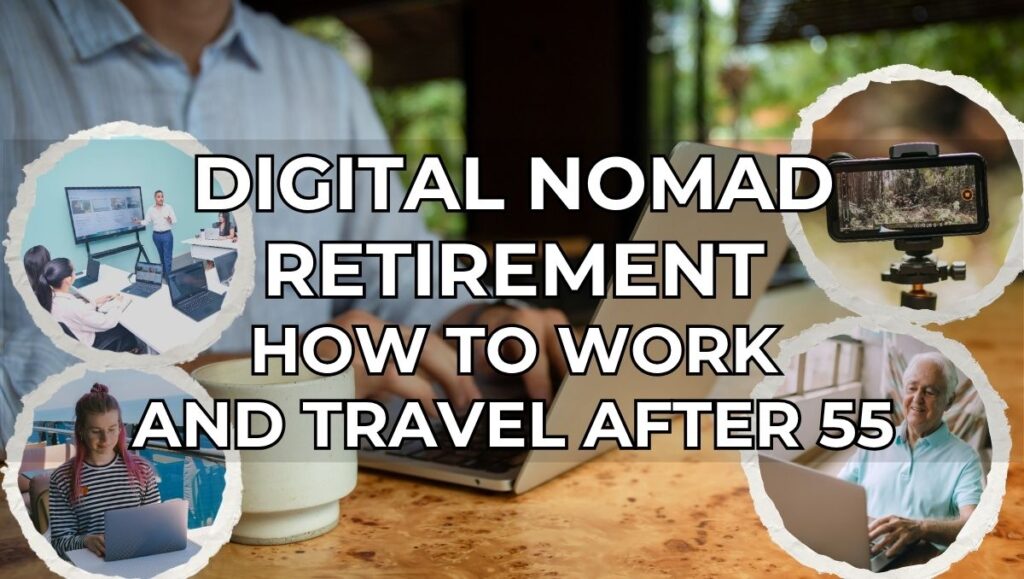
What is digital nomad retirement? Digital nomad retirement is the practice of combining partial or full retirement with location-independent income – working remotely as a consultant, freelancer, online educator, or content creator while traveling or living abroad. It differs from full retirement in that income continues (reducing the portfolio required), and it differs from traditional work in that location is completely flexible.
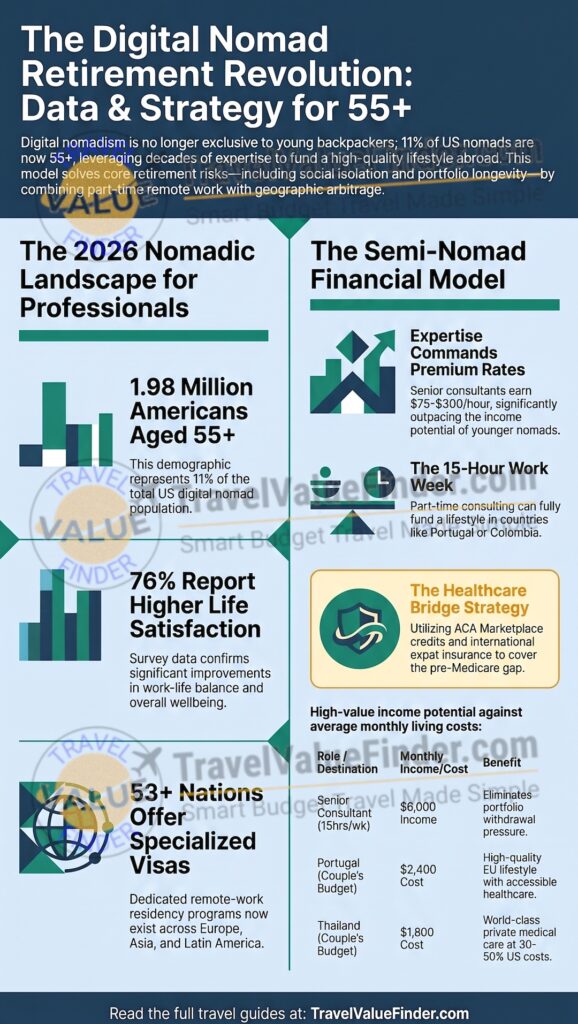
According to the MBO Partners 2025 State of Digital Nomads Report, 11% of all US digital nomads – nearly 2 million people – are 55 or older. The digital nomad retirement lifestyle is mainstream, growing, and specifically well-suited to the over-55 professional with decades of expertise to monetize.
Similarly, find the Cheapest Places to Live in the World for Retirees: Top 10 Ranked by Cost, Safety & Healthcare.
Leslie Nics, TravelValueFinder.com | Updated April 2026 | Written for US travelers | First-hand research across 15+ European countries | All prices verified April 2026 using BudgetYourTrip, Numbeo 2026, and first-hand research
Something has shifted in what retirement means for Americans over 55. The old model – stop working, collect Social Security, live off savings – is being replaced by something more interesting.
According to XtendedView’s 2025 Digital Nomad Statistics, 76% of people who adopt a nomadic lifestyle report higher overall life satisfaction, and 57% say their work-life balance improved after the switch. Baby Boomers (those born before 1965) now account for 6 – 9% of the global digital nomad population – a segment that is growing specifically because of one trend: semi-retirement working travel.
The digital nomad retirement model solves the three biggest problems that traditional retirement planning does not: the healthcare gap between ages 55 and 65 when Medicare kicks in, the portfolio longevity risk from a 30 – 40 year retirement, and the social isolation that affects an estimated 40% of retirees in their first five years.
When you are a digital nomad retiree, you are earning income (reducing portfolio pressure), your cost of living drops dramatically if you base in an affordable country (extending your runway further), and you are in constant social contact with a global community of curious, active, like-minded people.
This guide is the practical playbook for digital nomad retirement after 55 – not the aspirational overview, but the specific skills, income models, visa strategies, healthcare solutions, budgets, and destinations that experienced 55-plus nomads actually use.
Digital nomad retirement isn’t about working forever. It’s about working a little longer, on your own terms, from places that make the work feel like an afterthought. Three hours of consulting from a café in Lisbon pays for your entire day. The rest is yours. That’s the math that traditional retirement planning never makes. Leslie Nics, TravelValueFinder.com
Planning your first digital nomad destination? Compare flights and accommodation across all destinations in this guide: Search Digital Nomad Retirement Flights and Hotels – TravelValueFinder. Real-time prices, hundreds of providers. Find out more about Countries With No Income Tax: The Real Cost-of-Living Reality Check for Retirees & Digital Nomads
The Digital Nomad Retirement Revolution: What the Data Shows
The digital nomad retirement trend is not anecdotal. Here is what the most authoritative research says about the over-55 digital nomad in 2026:
| Statistic | Source and Significance |
|---|---|
| 11% of US digital nomads are 55+ | That is approximately 1.98 million Americans over 55 who are living and working as digital nomads. Source: MBO Partners 2025. This is the most robust survey of the US digital nomad population |
| 38% of digital nomads are 40+ | The majority are no longer young backpackers. The median age of digital nomads is rising fast. Localyze 2025 Digital Nomad Boom confirms 38% of the global digital nomad workforce is 40 or older – with the 55+ segment growing fastest in proportional terms |
| 76% report higher life satisfaction | This is not lifestyle marketing – it is survey data. XtendedView’s 2025 Digital Nomad Statistics documents 76% reporting higher overall life satisfaction after adopting location-independent work, with 57% noting improved work-life balance |
| 40M+ digital nomads globally; 18.1M from USA | According to DemandSage 2026, there are now 40 million digital nomads worldwide – a 147% increase since 2019. Of those, 18.1 million are from the United States. The 55+ segment accounts for a meaningful and growing share |
| Nomads spend $1,950 – $3,500/month | According to Global Wealth Protection’s 2026 nomad statistics, digital nomads spend an average of $1,950 – $3,500 per month globally, with housing at 45 – 55% of total spending. For the 55+ nomad living in affordable countries, $1,500 – $2,500/month is realistic |
| 53+ countries offer digital nomad visas | As of 2025, 53 countries have launched dedicated digital nomad visa or remote work residency programs (OECD 2025 Mobility Report). For over-55 digital nomad retirees, these visas often overlap with retirement visa programmes, creating options that did not exist five years ago |
What Makes Digital Nomad Retirement After 55 Different – and Better
The digital nomad retirement experience at 55+ is fundamentally different from what 25-year-old digital nomads describe – and in most meaningful ways, it is better. Here is the honest comparison:
| Factor | Digital Nomad at 25 | Digital Nomad Retirement at 55+ |
|---|---|---|
| Income source | Often new freelancer – building client base, lower rates | Decades of expertise command premium rates. Senior consultants earn $75 – $300+/hour. Clients come to you |
| Financial cushion | Typically limited savings; income volatility is stressful | 401(k), IRA, investment accounts provide a safety net that removes income anxiety |
| Work hours | Often full-time while trying to establish reputation | 10 – 25 hours per week is realistic for experienced consultants. The rest is genuinely free |
| Social confidence | Building confidence in new countries and cultures | Decades of professional and personal social experience. Easier to connect genuinely with locals and fellow travelers |
| Pace of travel | Often rushing – 1 – 2 weeks per destination | Slow travel preferred – 4 – 8 weeks per location. Deeper connections, lower costs, more satisfaction |
| Health considerations | Rarely a factor | Requires planning (international insurance, Medicare bridge), but very manageable with preparation |
| The main challenge | Money and clients | Healthcare and visa strategy – both solvable with the right approach (covered in this guide) |
The over-55 advantage: The skills, network, and professional credibility that take 30 years to build are the foundation of digital nomad retirement income. You are not starting from zero. You are monetizing what you already have – on your terms, from anywhere.
The Semi-Nomad Model: The Most Practical Digital Nomad Retirement Framework
Most digital nomad retirement guides describe the full-nomad lifestyle – constant movement, no fixed base, life in a carry-on bag. That model works for 25-year-olds and a small subset of over-55 adventurers. For most people over 55 who want to work and travel in retirement, the semi-nomad model is both more realistic and more satisfying. Here is how it works:
| Semi-Nomad Element | How It Works | Why It’s Better Than Full Nomad for 55+ |
|---|---|---|
| Fixed home base (3 – 6 months/year) | Keep a US address (family home, or rent a furnished apartment in a low-cost US city as base). Maintain Medicare eligibility, banking, and Social Security address | Solves the Medicare problem – you are never permanently abroad. US coverage is available when you are home |
| 2 – 3 slow-travel destinations per year | Spend 4 – 8 weeks in each destination. Rent furnished apartments monthly. Same budget as a hotel but with a kitchen, routine, and community | Weekly and monthly rates cost 40 – 60% less than nightly. You find your café, your market, your neighbour. Travel becomes living |
| 10 – 20 hours remote work per week | Consult, coach, advise, or create content in the mornings. Afternoons and evenings are yours. Strategic income that supplements Social Security or portfolio withdrawals | 10 – 20 hours of senior-level consulting at $75 – $200/hour generates $3,000 – $8,000/month – enough to fund travel and reduce portfolio withdrawals by 50 – 100% |
| Base in affordable countries | Portugal, Mexico, Colombia, Thailand, Georgia, Romania – monthly living costs of $1,500 – $2,800 for a comfortable lifestyle. Healthcare is affordable and accessible | The geographic arbitrage effect: lower costs + ongoing income = portfolio nearly untouched. Some semi-nomad retirees actually grow their portfolio in retirement |
The semi-nomad model gives you what full retirement doesn’t – purpose. A morning of useful work makes the afternoon feel earned. And when that morning happens from a terrace in Lisbon or a café in Medellín, the work itself feels different. Lighter. More like expression than obligation.”Leslie Nics, TravelValueFinder.com
What Can You Actually Do? The Over-55 Digital Nomad Skills Audit
The most common question from people considering digital nomad retirement after 55 is: “What would I actually do for income?” The answer, almost universally, is something you already know how to do – just delivered remotely. Here is the complete skills audit for the 55+ professional:
High-Income Remote Work for Over-55 Professionals
| Work Type | Hourly Rate | Hours/Week | Best For |
|---|---|---|---|
| Senior consulting / advisory | $100 – $300+ | 10 – 15 hrs | Former executives, senior managers, specialists in any field. Clients pay for experience, not availability |
| Executive coaching | $150 – $400 | 8 – 15 hrs | Leadership experience translates directly. Coaching certifications (ICF) available online; existing network is key |
| Online teaching / tutoring | $30 – $120 | 10 – 20 hrs | Former teachers, professors, or subject-matter experts. Platforms: Teachable, Podia (your own courses), Wyzant, Varsity Tutors |
| Freelance writing / content creation | $50 – $200 | 15 – 25 hrs | Former journalists, marketers, communicators. B2B writing pays significantly more than B2C. LinkedIn articles, industry newsletters |
| Healthcare telemedicine | $75 – $200 | 10 – 20 hrs | Retired or semi-retired physicians, nurses, therapists, and pharmacists. Telemedicine platforms (Teladoc, MDLive, independent) allow licensed US practice from abroad |
| Legal / accounting / financial advisory | $100 – $350+ | 10 – 20 hrs | Retired attorneys, CPAs, and financial advisors can maintain limited practice through retainer clients. Particularly valuable for expat tax and estate planning |
| Interim / fractional executive | $150 – $400 | 10 – 20 hrs | Former CFOs, CMOs, COOs, and other C-suite executives available for fractional engagements. Growing market – companies want senior-level expertise without full-time cost |
| Online course creation | Passive: $500 – $5,000+/month | Initial build, then minimal | Industry experts who can teach what they know. Initial build takes 40 – 80 hours; income becomes largely passive thereafter. Platforms: Udemy, Teachable, Skillshare |
| Travel blogging / content creation | $0 – $5,000+/month | Varies widely | Takes 12 – 24 months to monetize. Best as supplement, not primary income. Combine with consulting for income stability while audience builds |
The Monthly Income Math: What Semi-Retirement Actually Generates
| Income Scenario | Monthly Income | Annual Total |
|---|---|---|
| Consulting 15 hrs/week at $100/hr | $6,000/month | $72,000/year |
| Executive coaching 10 clients/month at $300/session x 2 sessions | $6,000/month | $72,000/year |
| Online teaching 20 hrs/week at $45/hr | $3,600/month | $43,200/year |
| Freelance writing 4 articles/month at $1,500/article | $6,000/month | $72,000/year |
| Social Security (average, age 67) | $1,907/month | $22,884/year |
| Portfolio withdrawal (4% on $500K) | $1,667/month | $20,000/year |
| Example total: Consultant + Social Security (age 67) + Portfolio | $9,574/month | $114,884/year – living in Portugal at $2,400/month, growth virtually assured |
These are illustrative examples based on market rates. Actual income varies significantly with experience, client relationships, and hours worked. The key insight: even part-time senior consulting at $75 – $100/hour dramatically reduces – or eliminates – portfolio withdrawals.
Healthcare: The Critical Issue for Digital Nomad Retirement Before 65
Healthcare is the challenge that stops most Americans over 55 from pursuing digital nomad retirement – and it is a real concern that deserves a direct, honest answer. The issue: Medicare does not cover medical care outside the United States. If you move abroad before age 65, you have no domestic health coverage at all unless you maintain a US health plan or purchase international insurance. This is not a reason to abandon digital nomad retirement – but it requires a specific strategy.
The Healthcare Bridge Strategy for Digital Nomad Retirees
| Your Situation | Healthcare Solution | Estimated Monthly Cost |
|---|---|---|
| 55 – 64, no employer coverage | ACA Marketplace plan (maintain US address). At lower income levels from semi-retirement, ACA premium tax credits may cover most or all of the premium. Key: your income must be reported on a US tax return | $0 – $400/month with ACA credits at income $30,000 – $50,000 |
| 55 – 64, the Semi-Nomad model (US base part of year) | Keep ACA Marketplace plan while in US; purchase supplemental international travel insurance for time abroad. This is the cleanest solution for the semi-nomad who spends 3 – 6 months/year in the US | $200 – $600/month (ACA) + $50 – $150/month (travel insurance abroad) |
| 55 – 64, full-time abroad | International expat health insurance – covers medical care globally. Cigna Global, Allianz Care, and AXA PPP all offer comprehensive plans. Required for most digital nomad and retirement visas | $200 – $700/month depending on age and coverage level |
| 65+, eligible for Medicare | Medicare does not cover abroad. Two options: (1) Medigap plans C, D, G, M, or N include $50K in foreign emergency coverage (after deductible); (2) Medicare Advantage plans – some have international emergency coverage. Always supplement with travel insurance abroad | $100 – $400/month (Medicare) + $50 – $200/month (travel insurance) |
| Any age, living in EU country (Portugal, Spain, Greece) with residency | Access to public healthcare systems after residency + waiting period. Portugal’s SNS, Spain’s sistema nacional de salud, Greece’s EOPYY – all accessible to legal residents at zero or minimal cost after registration | $0 – $1,500/year after qualifying period |
| Any age, living in Thailand | World-class private hospitals (JCI-accredited) at 30 – 50% of US costs. Most digital nomad retirees in Thailand pay out-of-pocket for routine care ($15 – $50/consultation) and maintain international insurance for major events and evacuation | $100 – $300/month (international insurance) + out of pocket for routine |
The bottom line: The healthcare bridge strategy for digital nomad retirement before 65 is manageable – not cheap, but manageable. An ACA Marketplace plan with credits for a semi-retiree earning $35,000 – $45,000/year can cost $0 – $300/month with subsidies. International expat insurance at 60 costs $250 – $500/month. Compare that to average US employer-sponsored health insurance of $700 – $1,200/month for an individual, and the digital nomad retirement option is often cheaper even at full international insurance rates.
Digital Nomad Visas for Retirees: Your 2026 Options
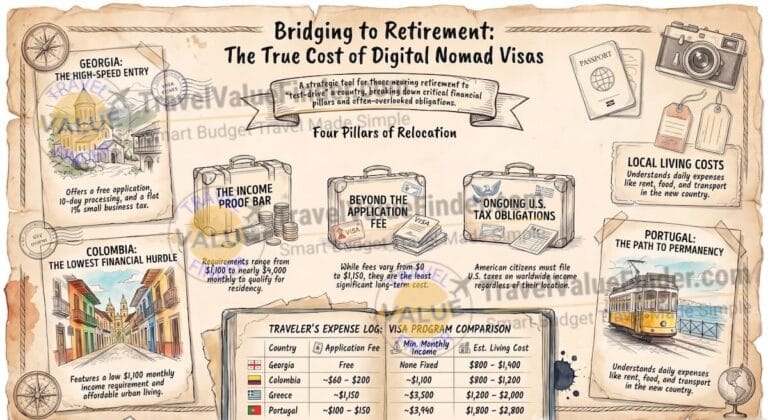
Over 53 countries now offer dedicated digital nomad visas or remote work residency programmes – and for Americans pursuing digital nomad retirement, these visas are a genuine game-changer. They allow you to live legally in a country for 6 months to 2 years (or longer), with the right to work remotely for non-local clients. Here are the best options for the 55+ digital nomad retiree:
| Country | Visa Name | Income Req. | Duration | Why It Works for 55+ Nomads |
|---|---|---|---|---|
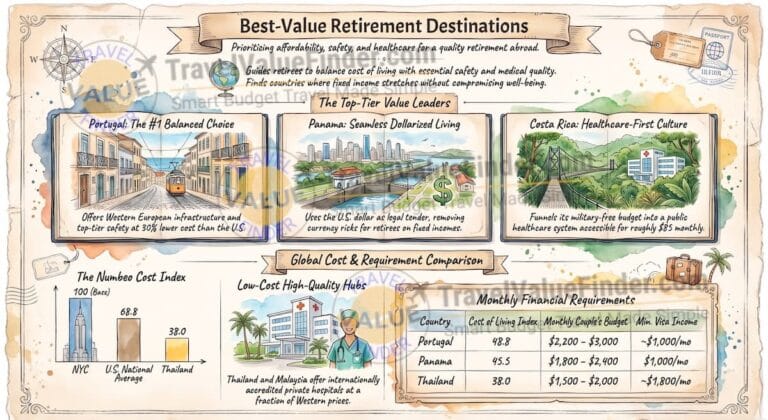
| Portugal | D8 Digital Nomad Visa | ~$3,480/month | 2 years, renewable | EU access, path to citizenship in 5 years, excellent healthcare, English widely spoken, US tax treaty |
| Portugal | D7 Passive Income Visa | ~$760/month | Renewable, path to permanent | Lower income threshold – works for retirees with Social Security + part-time income. Most accessible EU option |
| Mexico | Temporary Resident Visa | ~$1,742/month | Up to 4 years | Short US flights, familiar culture, massive expat community, affordable healthcare, 3-5 hour time zone overlap with US clients |
| Spain | Digital Nomad Visa | ~$2,334/month | 1 year, renewable to 5 | World’s best healthcare, food culture, warm climate, EU access. Income threshold higher but liveable with part-time consulting |
| Georgia | Remotely from Georgia | $2,000/month | 1 year | Americans can stay 1 full year visa-free anyway – the Remotely from Georgia program formalizes longer stays with simplified residency |
| Thailand | LTR Visa (Long-Term Resident) | $80,000/year income or $250K in assets | 10 years | World-class private healthcare at 30-50% US prices, warm climate year-round, massive digital nomad community, extraordinary food |
| Albania | Visa-free 1 year (US citizens) | None (first year) | 1 year, extendable | No visa process – arrive and stay. Europe’s lowest cost of living. Adriatic coast. Perfect test year for digital nomad retirement |
| Colombia | Digital Nomad Visa / Pension Visa | ~$730/month (pension visa) | 1 – 3 years | Year-round spring climate in Medellín, excellent private healthcare, growing US expat community, close US flights |
| Croatia | Digital Nomad Residence Permit | ~$2,539/month | 1 year | Adriatic islands, Mediterranean lifestyle, EU travel access, English widely spoken in coastal areas |
| Costa Rica | Rentista / Pensionado Visa | $1,000/month (pension) | Permanent | Foreign pension income not taxed locally, US proximity, exceptional biodiversity, growing remote worker community |
Important note: Digital nomad visa income requirements assume your income comes from outside the host country – consulting for US clients while living in Portugal qualifies perfectly. Social Security income, IRA withdrawals, and investment income typically count toward these income thresholds. Always verify current requirements with official embassy sources before applying, as requirements change frequently.
Best Destinations for Digital Nomad Retirement After 55
The best destination for your digital nomad retirement depends on your work hours, time zone needs, healthcare requirements, and lifestyle preferences. Here is the complete guide by profile:
For US Client Alignment: Time Zone Matters
| If Your Clients Are in… | Best Time Zone Base | Recommended Destinations |
|---|---|---|
| East Coast USA (ET) | UTC-5 to UTC-3 | Colombia (Bogotá – ET year-round), Mexico (CDMX, Mérida, Oaxaca – CT), Costa Rica (no DST), Panama City |
| West Coast USA (PT) | UTC-8 to UTC-5 | Mexico (Baja, Puerto Vallarta), Colombia (afternoon overlap), Panama |
| Any US time zone (flexible calls) | UTC+0 to UTC+3 | Portugal (morning calls at 8 – 11am EST = 1 – 4pm Lisbon), Spain (similar), Morocco (same as UK), Albania, Romania, Georgia |
| Independent / async work (no calls) | Any time zone | Thailand, Bali, Vietnam, Japan – any timezone works when work is asynchronous. Best for content creators, course creators, writers |
Top 6 Destinations for Digital Nomad Retirement 2026
1. Lisbon / Porto, Portugal – Best EU Base for 55+ Digital Nomad Retirees
Monthly budget: $2,200 – $2,800 (couple) | Work time zone: UTC+1 (good US morning overlap) | Visa: D7 or D8 | Healthcare: Excellent public system after residency
Portugal tops the digital nomad retirement destination list for Americans over 55 for the same reasons it tops every European retirement list – but with the added benefit of a specific digital nomad visa (D8) tailored to remote workers. The D7 Passive Income Visa works for retirees with modest income ($760+/month), while the D8 Digital Nomad Visa requires $3,480/month – achievable for part-time senior consultants.
- Lisbon vs Porto: Lisbon is more international, warmer, and increasingly expensive. Porto is 20 – 30% cheaper, equally beautiful, and has a more authentic Portuguese character. For digital nomad retirement on a budget, Porto wins
- Coworking: Both cities have excellent coworking infrastructure – Second Home Lisboa, Haka House Porto, Factory Lisbon. Daily passes $15 – $25; monthly memberships $150 – $250
- Retire in Portugal: A Practical Guide for Over-55s
2. Medellín, Colombia – Closest Option with Best Urban Amenities
Monthly budget: $1,800 – $2,400 (couple) | Work time zone: ET year-round | Visa: Digital Nomad or Pensionado | Healthcare: Excellent private hospitals
Medellín operates on US Eastern Time year-round with no daylight saving time change – making it uniquely suited to Americans doing client calls. The city’s 72°F year-round climate (‘city of eternal spring’), excellent private hospital network, strong expat infrastructure, and growing digital nomad community make it the leading Latin American choice for digital nomad retirement
- Work setup: El Poblado neighbourhood has dozens of cafés with reliable WiFi and a strong coworking scene. Selina, Selina Poblado, Tinkko Coworking – all offer day passes ($8 – $15) and monthly memberships ($100 – $200)
- Safety: Stay in El Poblado and Laureles; use Uber or InDriver; research neighbourhoods carefully. Significantly safer than most international media suggests, but still requires normal urban precautions
3. Chiang Mai, Thailand – Best for Async Workers and Wellness-Focused Nomads
Monthly budget: $1,500 – $2,200 (couple) | Work time zone: UTC+7 (best for async, some West Coast overlap) | Visa: Retirement Visa O-A or LTR | Healthcare: World-class private at low cost
Chiang Mai is the digital nomad retirement destination that the lifestyle was effectively invented around – the combination of extreme affordability, extraordinary food, Buddhist-influenced cultural richness, and an enormous established international community of remote workers makes it both the most cost-effective and most community-rich option. Private hospital consultations at Chiang Mai Ram or Rajavej Hospital cost $20 – $40. A one-bedroom furnished apartment in Nimman neighbourhood costs $350 – $600/month.
- Work consideration: UTC+7 is 12 – 15 hours ahead of US time zones. Best for async workers, content creators, and online course creators. Real-time client calls in the US morning require working evenings in Chiang Mai
- Monthly budget breakdown: Apartment $400 – $600, food $300 – $500 (mix of street food and restaurants), coworking $80 – $150, transport $40 – $80, health insurance $200 – $350, activities $100 – $200. Total: $1,120 – $1,880
4. Tbilisi, Georgia – Cheapest European City with 1-Year Visa-Free for Americans
Monthly budget: $1,400 – $2,000 (couple) | Work time zone: UTC+4 | Visa: 1-year visa-free for US citizens | Healthcare: Improving; Turkish hospitals 3 hours away
Georgia offers something no other European country can: Americans can stay for a full year with zero visa process. Tbilisi is genuinely beautiful (ancient cave monasteries, Caucasus Mountain day trips, extraordinary wine culture), genuinely affordable ($40 metro ride on a $0.40 card, dinner for two with wine for $15 – $20), and genuinely digital nomad-ready (Fabrika co-working hub, dozens of cafés with fast WiFi). For digital nomad retirement test runs, Georgia is the obvious first destination – no paperwork, no income requirements, just arrive.
- Wine culture: Georgia has 500+ native grape varieties and wine-making traditions 8,000 years old. A glass of Rkatsiteli amber wine at a local wine bar costs $2 – $4. This alone justifies a stay
- Cheap Countries to Visit in 2026 – Georgia featured
The Practical Setup: 8 Things to Do Before Your First Digital Nomad Retirement Trip
- Test your remote income before you leave: Do not leave the US without at least 2 – 3 established remote clients or a functioning online income stream. Spend 3 – 6 months building the client base or course platform before your departure. Income uncertainty is the leading cause of premature return from digital nomad retirement attempts
- Upgrade your internet toolkit: Reliable internet is non-negotiable. Essentials: a travel router (TP-Link TL-WR902AC, $30), a secondary LTE hotspot device, and the habit of verifying WiFi speed (with Speedtest.net) before booking any accommodation longer than 2 nights. A reliable 25+ Mbps upload is the floor for video calls; 50+ Mbps is comfortable
- Open a Wise and Charles Schwab account: Wise gives you mid-market exchange rates for transfers and payments. Charles Schwab’s High Yield Investor Checking reimburses all international ATM fees globally – eliminating the $5 – $8 per-withdrawal ATM fee in most countries. Both take a week to set up; do it before you leave
- Sort your healthcare before departure: International expat insurance takes 2 – 4 weeks to approve. Purchase before departure, not on arrival. If using the semi-nomad model with an ACA plan, verify your plan’s international coverage or purchase supplemental travel insurance for the months abroad. See our full guide: Travel Insurance Guide: What It Covers and Best Options
- Establish your US financial infrastructure: Keep a US address (family member’s home, or a mail-forwarding service). Maintain your US bank accounts and investment accounts at US-based brokerages. Set up electronic bill pay for any US obligations. Do not close US accounts – they are essential for banking, Social Security, and tax filing
- Consult an expat tax specialist before year one: You still file US taxes abroad. If you are earning income from remote consulting, understand your self-employment tax obligations. If you are taking IRA distributions or Roth conversions while living abroad, the timing matters. One session with an enrolled agent familiar with expat returns saves significant money
- Start with a 6 – 8 week test trip, not a permanent move: The first digital nomad retirement trip should be an extended test, not a permanent relocation. Bring enough for 8 weeks, plan to extend or return based on honest self-assessment. Do you work well without an office structure? Does the time zone work for your clients? Does the lifestyle make you happy or anxious? Answer these questions before committing
- Build your community before you arrive: Join Facebook groups for expats in your target destination (Expats in Lisbon, Americans in Medellín, Digital Nomads in Chiang Mai). Introduce yourself before arrival. Many digital nomad retirement communities have monthly meetups, Slack groups, and informal networks. Arriving already connected is significantly less isolating than arriving alone
Ready to compare cities now?
- Use our Free Retirement Cost of Living Calculator — get your personalized report in 30 seconds – Free PDF download.
- How to Use a Retirement Cost of Living Calculator – to Compare Cities Worldwide
Plan Your Digital Nomad Retirement: Essential Resources on TravelValueFinder
Our complete library of guides for the 55+ traveler and digital nomad retiree:
- How to Retire Early and Travel the World: A Practical Guide
- Best Countries to Retire Abroad on a Budget in 2026
- Best Countries for First-Time Travelers: Easy, Affordable & Rewarding
- Cheapest Countries to Retire In: Top Picks for 2026
- Best Places to Retire in Europe on a Small Budget
- Retire in Portugal: A Practical Guide for Over-55s
- Solo Travel Over 50: Tips, Destinations and Budget Advice
- Travel Insurance Guide: What It Covers and Best Options
- Cheap Countries to Visit in 2026: Best Value Destinations Ranked
- Budget Travel Tips: 30 Strategies to Travel More for Less
- How to Find Cheap Flights: 12 Proven Strategies That Actually Work
- Free AI Trip Planner: Get a Day-by-Day Itinerary in Seconds
Book your first digital nomad retirement destination. Our trusted partner compares hundreds of providers for flights and long-stay accommodation: Search Digital Nomad Retirement Stays – TravelValueFinder. We earn a small commission at no extra cost to you.
People Also Asked: Digital Nomad Retirement
What is digital nomad retirement?
Digital nomad retirement is a lifestyle model that combines partial or complete retirement with location-independent income and travel. Rather than stopping work entirely, the digital nomad retiree reduces work to 10 – 20 hours per week, works remotely for US or international clients, and lives in affordable countries where their income (combined with Social Security or portfolio distributions) funds a high quality of life at dramatically lower cost than remaining in the United States. According to the MBO Partners 2025 Report, 11% of all US digital nomads – approximately 1.98 million people – are 55 or older, confirming that this is a mainstream lifestyle choice, not a fringe experiment.
Can retirees become digital nomads?
Yes – and the over-55 professional is often better positioned than younger digital nomads to succeed. The key assets of the 55+ digital nomad retiree are: decades of professional expertise that commands premium consulting and coaching rates ($75 – $300+/hour); an established professional network that generates client referrals without cold outreach; financial cushion from existing savings and Social Security that removes the income pressure younger nomads face; and the time and freedom that come from fewer dependents and obligations. The main practical challenges – healthcare coverage and visa strategy – are both solvable with the right planning approach.
What jobs can you do as a digital nomad retiree?
The highest-earning remote work options for digital nomad retirees over 55 are: senior consulting and advisory work ($100 – $300/hour); executive coaching ($150 – $400/hour); fractional executive roles (CFO, CMO, COO engagements at $150 – $400/hour); telemedicine for licensed healthcare professionals ($75 – $200/hour); legal and accounting advisory ($100 – $350/hour); freelance writing and content creation ($50 – $200/hour); online course creation (passive income of $500 – $5,000+/month after initial build); and online teaching and tutoring ($30 – $120/hour). The most successful digital nomad retirement income streams leverage existing credentials and networks rather than starting from zero.
What are the best countries for digital nomad retirement?
The best countries for digital nomad retirement in 2026 depend on your work time zone needs, budget, and lifestyle preferences. For US time zone alignment: Mexico (ET/CT), Colombia (ET year-round), and Costa Rica (CT/ET). For maximum affordability: Georgia ($1,400 – $2,000/month couple), Albania ($1,200 – $1,800), Thailand’s Chiang Mai ($1,500 – $2,200). For EU quality of life and residency path: Portugal ($2,200 – $2,800 couple via D7 or D8 visa), Spain, or Greece (7% flat tax on foreign income for 15 years). For lowest visa barriers: Georgia and Albania (1-year visa-free for Americans), Mexico (6-month tourist entry freely available).
How much do you need for digital nomad retirement?
The digital nomad retirement budget depends on your destination and income. In an affordable country like Thailand or Colombia, a couple spending $1,800 – $2,400/month all-in needs $21,600 – $28,800 per year. At the 4% portfolio withdrawal rule, that requires a $540,000 – $720,000 portfolio – but only if there is zero other income. The semi-nomad model changes this math significantly: a consultant earning $4,000 – $6,000/month part-time needs very little portfolio withdrawal. According to Global Wealth Protection’s 2026 nomad statistics, digital nomads globally spend an average of $1,950 – $3,500 per month – and the 55+ semi-nomad on a reduced schedule is typically at the lower end of that range.
Do you need a digital nomad visa to retire and work abroad?
Not always – and for many Americans starting their digital nomad retirement journey, the best first step is a country that does not require a visa at all. Georgia allows Americans to stay 1 full year visa-free. Mexico offers 180-day tourist entries that are renewable. Albania allows 1-year stays. These visa-free periods are ideal for testing the digital nomad retirement lifestyle before committing to a formal visa process. For longer-term stays (2+ years) or for EU countries requiring legal residency, the digital nomad visa or passive income visa (Portugal’s D7, Spain’s Digital Nomad Visa, etc.) is the appropriate route.
Is digital nomad retirement safe after 55?
Yes – and in many respects, the digital nomad retirement lifestyle is specifically well-suited to over-55 travelers who have the judgment, resources, and risk management experience to navigate it confidently. The primary safety considerations are: (1) destination choice – Portugal, Spain, Mexico’s Yucatán, Thailand, and Georgia all have strong safety records for foreign retirees; (2) healthcare planning – international expat insurance covering medical evacuation is non-negotiable; (3) financial security – maintaining US accounts, Social Security, and an investment portfolio provides the safety net that removes income desperation; and (4) the semi-nomad model, which keeps you connected to US systems and support networks for part of the year. According to XtendedView’s 2025 statistics, 76% of people who adopt a nomadic lifestyle report higher overall life satisfaction – a strong vote of confidence from those who have made the leap.
Final Thoughts: Digital Nomad Retirement Is Not Retirement Lite – It’s Retirement Better
The old retirement model asked you to stop. Stop working, stop traveling, stop expanding. Digital nomad retirement asks something different: stop doing it on someone else’s terms. Work less, but work on what you are genuinely good at. Travel more, but travel slowly enough to actually live somewhere rather than just photograph it. Earn enough to fund the lifestyle without the portfolio anxiety that haunts traditional early retirees.
The data supports this. 11% of US digital nomads are already over 55 – approaching 2 million people. 76% report higher life satisfaction after the switch. The tools have never been better: 53 countries with digital nomad visas, global coworking infrastructure, telemedicine, AI productivity tools that multiply what an experienced professional can produce in 15 hours per week. The digital nomad retirement lifestyle is not a fantasy for the young and restless. It is an increasingly mainstream choice for experienced professionals who have earned the right to design their own third act.
The question is not whether you can do this. The question is: what are you waiting for?
Every digital nomad retiree I’ve spoken to says the same thing: the hardest part was the decision. Once they were on the plane, once they’d set up in their first Portuguese apartment or Colombian neighbourhood or Thai guesthouse – once they’d had their first morning of work from a café that cost them $3 – they wondered what had taken so long. The life was always available. It just required choosing it. Leslie Nics, TravelValueFinder.com
Take the first step toward digital nomad retirement. Book your exploratory trip and find long-stay accommodation through our trusted partner: Find Digital Nomad Retirement Destinations – TravelValueFinder. We earn a small commission at no extra cost to you – helping keep all our guides completely free.