Travel Value Finder


There is a version of retirement that most Americans do not know they can afford. It involves morning coffee on a terrace with a sea view, afternoon walks through cobblestone streets that are centuries older than the United States, dinners that cost $8 and last three hours, and a monthly budget that is lower – sometimes dramatically lower – than what life costs in the American cities most of us are leaving behind. Ready for a change of scenery? Discover how to retire abroad on a budget, the smart way.
Leslie Nics, TravelValueFinder.com | Updated April 2026 | Written for US retirees and pre-retirees | Data from International Living’s 2026 Global Retirement Index, SSA Payments Abroad guidance, and first-hand retirement destination research
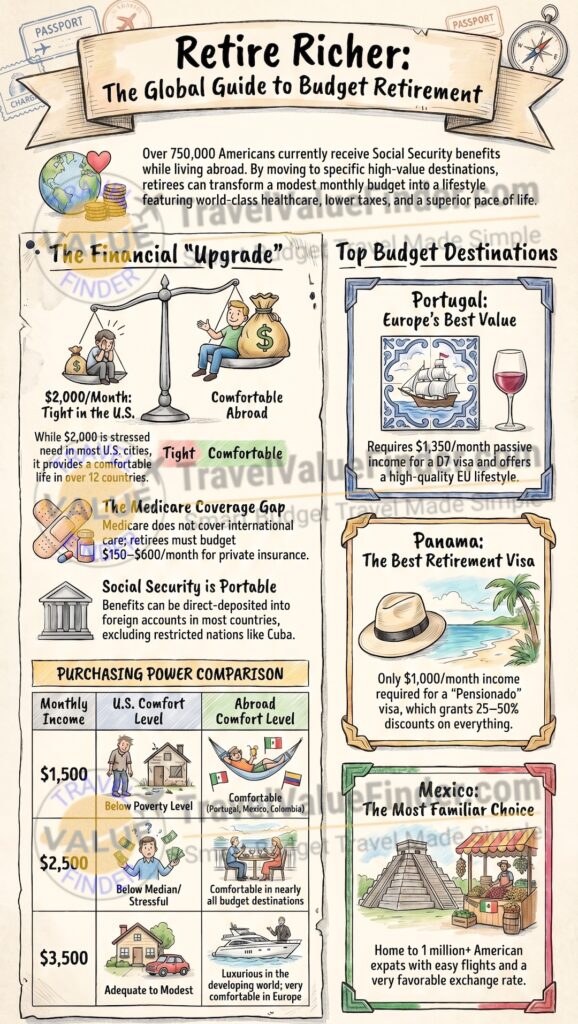
According to the Social Security Administration’s own data, approximately 750,000 Americans are already receiving Social Security benefits outside the United States. That number has grown steadily for a decade, driven by the same fundamental realization: your retirement income goes significantly further in the right foreign country than it does in the United States, and the quality of life you access in exchange is not a compromise – it is often genuinely superior.
This guide is built for American retirees and pre-retirees who are seriously considering retiring abroad on a budget. It gives you the country-by-country data (monthly costs, visa requirements, healthcare access, Social Security considerations, tax implications) that competing articles provide only superficially – plus the honest, first-hand perspective on what life actually looks, feels, and costs in each destination from someone who has spent extended time in all of them.
Retiring abroad is not an escape from life. It is a deliberate upgrade of it. When your fixed income buys three times as much – and buys it in a place with better weather, better food, and a slower pace – retirement stops being something you endure on a shrinking budget and becomes something you actively enjoy. – Leslie Nics, TravelValueFinder.com
Already exploring retirement destinations? Research flights, accommodations, and early exploratory trips through our trusted partner: Search Flights and Hotels – TravelValueFinder Deals. Real-time prices, secure booking. Find the Best Airlines for Senior Travelers 2026: Comfort, Assistance & Real Value Compared
Table of Contents
Why Retiring Abroad on a Budget Is More Achievable Than You Think
The average monthly Social Security benefit in the United States is approximately $1,907 per month as of 2026 (source: Social Security Administration). In most American cities, that is not enough to retire comfortably. In most of the countries in this guide, it is more than enough – often with money to spare. The math is the starting point for every serious conversation about retiring abroad on a budget:
| Income Level | Comfortable in the USA? | Comfortable Abroad? |
| $1,500/month Social Security | Difficult. Below poverty level for single person in most US cities | Yes – in Portugal, Mexico, Thailand, Colombia, Vietnam |
| $2,000/month Social Security | Tight – possible only in low-cost US states | Comfortably in 12+ countries; well in 6+ countries |
| $2,500/month (SS + pension) | Below median US household income – stressful in most cities | Comfortably in virtually every country in this guide |
| $3,500/month combined income | Adequate to modest in lower-cost US areas | Luxuriously in developing world; very comfortably in Europe |
According to data from Taxes for Expats, basic monthly living costs (excluding rent) for a single person run at $776 in Portugal, $818 in Spain, $901 in Greece, $1,009 in Italy, and $682 in Romania. Add a comfortable one-bedroom apartment ($400 – $800/month in most of these countries) and your total monthly all-in budget sits at $1,200 – $1,800 – firmly within reach of a single Social Security income.
Before You Move: What Every American Retiree Must Know
Social Security Abroad: The Confirmed Truth
The most common question American retirees ask about retiring abroad is: “Can I still collect Social Security?” The answer is yes – for most countries. According to USAGov’s official guidance on Social Security abroad, US citizens who qualify for Social Security can visit or live in most foreign countries and continue receiving payments without interruption.
- Direct deposit is available: The SSA can deposit directly into a US or foreign bank account in most countries. Paper checks are also available in countries with large US expat populations
- Restricted countries: Social Security cannot currently be sent to Cuba or North Korea. Specific rules apply to Cambodia, Vietnam, and some former Soviet states – use the SSA Payments Abroad Screening Tool to check your specific destination before planning a move
- You still file US taxes: American citizens are taxed on worldwide income regardless of where they live. However, most retirees abroad owe little or no additional federal tax after applying the Foreign Tax Credit and standard deductions. The 2026 standard deduction is $15,750 for single filers, with an additional $1,550 senior bonus for those 65+. Most retirees can offset their tax bill significantly through treaty benefits and foreign tax credits
- SSI does not continue abroad: Supplemental Security Income (SSI) stops after 30 days outside the United States. Standard Social Security retirement benefits are not affected by this rule
Medicare Abroad: The Gap You Must Plan For
This is the most critical financial planning point for American retirees moving abroad: Medicare – Parts A and B – does not cover medical care outside the United States, with very limited exceptions. This means that an American retiree receiving Medicare who relocates abroad is effectively uninsured for all non-emergency medical care until they arrange alternative coverage.
The solution is comprehensive international health insurance. Costs vary by age and destination – typically $150 – $600/month for retirees in their 60s and 70s. This should be factored into every budget calculation in this guide. Many retirement visa programmes (including Portugal, Spain, Greece, Costa Rica, and Thailand) require proof of international health insurance as a condition of application. Always purchase insurance before relocating.
The Tax Question: Does Retiring Abroad Reduce Your Tax Bill?
It can – significantly. Several of the countries in this guide offer specific tax incentives for foreign retirees: Portugal’s Non-Habitual Resident (NHR) programme (now modified but still beneficial in some forms), Panama’s exemption of all foreign-source income from local tax, Costa Rica’s exemption of foreign pensions, and Greece’s flat 7% rate on all foreign income for up to 15 years. The combination of a lower cost of living AND a lower effective tax rate is the double benefit that makes retiring abroad on a budget so powerful for Americans with modest but fixed incomes.
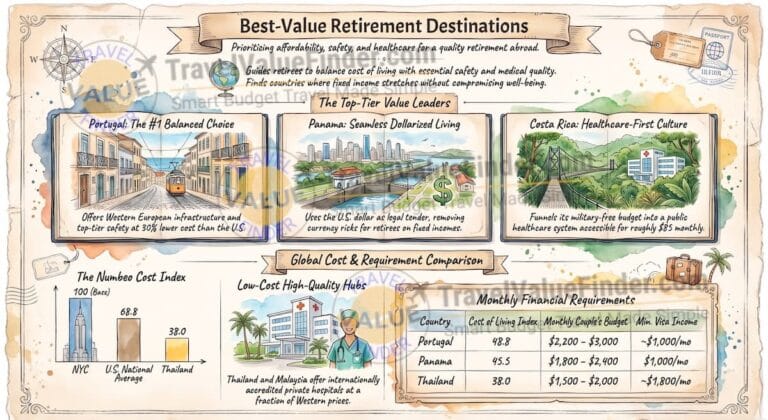
This infographic offers a quick look at some of the best countries to retire in 2026 where your money goes further, highlighting destinations known for affordable living, quality healthcare, and a relaxed lifestyle. From vibrant cities to peaceful coastal towns, it gives you a snapshot of where you can enjoy your next chapter on a budget. For a deeper breakdown of costs, visa options, and lifestyle insights, be sure to read the full article.
Best Countries to Retire Abroad on a Budget in 2026: Complete Ranking
Here is the comprehensive ranking of the best countries to retire abroad on a budget in 2026 for American retirees, assessed across five categories:
| Country | Monthly Budget (Couple) | Retirement Visa | Healthcare | Social Security | Key Advantage |
| Portugal | $1,800 – $2,400 | D7 Passive Income | Excellent | Paid in full | NHR tax programme; EU lifestyle; English widely spoken |
| Mexico | $1,500 – $2,500 | Residente Permanente | Good (private) | Paid in full | Short US flights; 1M+ American expats; Lake Chapala community |
| Panama | $2,000 – $2,800 | Pensionado Visa | Very Good | Paid in full | $1,000/month income qualifies; USD economy; 50% discounts |
| Colombia | $1,500 – $2,200 | Retirement Visa | Very Good | Paid in full | Medellín’s year-round spring climate; growing US expat scene |
| Portugal (Alentejo) | $1,400 – $2,000 | D7 Passive Income | Excellent | Paid in full | Cheapest region; wine country; quieter than Lisbon/Algarve |
| Spain | $2,000 – $2,800 | Non-Lucrative Visa | Excellent | Paid in full | Best quality of life; food; culture; access to EU |
| Costa Rica | $2,000 – $2,800 | Pensionado Visa | Good | Paid in full | Foreign pension tax-free; natural beauty; US proximity |
| Greece | $2,000 – $2,700 | Retirement/Golden Visa | Very Good | Paid in full | 7% flat tax on foreign income; 300+ sunny days; IL’s #1 for 2026 |
| Thailand | $1,500 – $2,500 | Retirement Visa (Type O-A) | Excellent (private) | Check restrictions | Extraordinary value; world-class private healthcare; warm climate |
| Malaysia | $1,800 – $2,800 | MM2H Programme | Excellent | Paid in full | English widely spoken; modern infrastructure; world’s best healthcare value |
| Italy (South) | $1,800 – $2,500 | Elective Residency Visa | Excellent | Paid in full | 7% flat tax in specific southern regions; extraordinary culture |
| France | $2,200 – $3,200 | Long-Stay Visa | World-class | Paid in full | Best healthcare system in the world; culture; food |
Monthly budgets are all-inclusive estimates for a couple: accommodation, food, utilities, transport, healthcare insurance, and leisure. Data cross-referenced with International Living 2026 Global Retirement Index, Taxes for Expats 2026, GOBankingRates 2026 retirement destinations research, and first-hand research.
Not sure which city to compare? Compare up to 3 retirement destinations side by side →
Country-by-Country Guide: Retiring Abroad on a Budget in 2026
#1 Portugal – Europe’s Best Budget Retirement Destination
Monthly budget (couple): $1,800 – $2,400 | Retirement visa: D7 Passive Income Visa | Income requirement: $1,350+/month (single) | US-Portugal tax treaty: Yes
Portugal has topped retirement destination rankings for a decade – and in 2026, it remains the single most compelling budget retirement destination in Europe for American retirees. The combination of a mild Atlantic climate, world-class cuisine (Porto’s wine cellars, Lisbon’s fish dishes, Alentejo’s olive oil and bread), extraordinary history and architecture, and a genuinely warm and welcoming culture makes Portugal a destination where retiring abroad on a budget does not feel like a financial compromise. It feels like an upgrade.
The country’s D7 Passive Income Visa requires proof of passive income of approximately $1,350/month for a single applicant or $1,800/month for a couple – making it accessible to American retirees on a combined Social Security income. After five years of legal residency, you become eligible for Portuguese citizenship – which means an EU passport and visa-free access to 188 countries.
| Category | Cost in Portugal (2026) | Notes |
| 1-bedroom apartment (Lisbon) | €800 – €1,400/month | Significantly cheaper in Porto, Coimbra, and inland regions |
| 1-bedroom apartment (outside Lisbon) | €400 – €700/month | Alentejo, Algarve (off-season), and Silver Coast offer best value |
| Grocery shopping for 2 | €250 – €400/month | Local markets and Continente supermarkets are significantly cheaper than Lisbon tourist areas |
| Restaurant dinner (2 people) | €25 – €45 | Three-course meal with wine at a local tasca; half of this in smaller cities |
| Private health insurance (couple, 60s) | $300 – $600/month | Required for D7 visa application; covers gap left by Medicare |
| Total monthly (couple) | $1,800 – $2,400 | Varies significantly by region and lifestyle |
- Tax consideration: Portugal’s NHR (Non-Habitual Resident) programme has been modified, but US retirees can still benefit from reduced tax rates on foreign income in many circumstances. The US-Portugal tax treaty reduces risk of double taxation
- Healthcare: Portugal has an excellent national health system. After obtaining residency, retirees can access public healthcare – though many expats use affordable private clinics at $30 – $60 per consultation
For our complete Portugal retirement guide:
#2 Mexico – The Closest and Most Familiar Foreign Retirement
Monthly budget (couple): $1,500 – $2,500 | Retirement visa: Residente Permanente | Income requirement: Varies by state; typically $2,600+/month | US-Mexico tax treaty: Yes
Mexico has over one million American expats – including approximately 20,000 in the Lake Chapala/Guadalajara area alone, making it the world’s largest American expat community outside the United States. The appeal is straightforward: flights from most US cities take 2 – 4 hours, Spanish is the only new language to learn, the food is extraordinary and inexpensive, and the range of climates and communities available within a single country is extraordinary. You can choose beach heat in Puerto Vallarta, eternal spring in San Miguel de Allende, highland cosmopolitanism in Mexico City, or the colonial calm of Mérida.
Mexico’s specific advantage for retiring abroad on a budget is the peso-to-dollar exchange rate, which currently runs at approximately 17 – 18 pesos per dollar. At that rate, a $2,000/month US income buys the equivalent purchasing power of $4,000 – $5,000 in US retail prices.
- Lake Chapala/Ajijic: The world’s largest American expat community – Wednesday markets, English-language library, American-style medical care, English TV, familiar food brands. If you want to leave the United States without fully leaving it, this is the destination
- San Miguel de Allende: UNESCO heritage town, extraordinary arts community, exceptional restaurants, large creative expat community – a touch more expensive than Lake Chapala but worth the premium for the lifestyle
- Mérida (Yucatán): Increasingly popular for safety, culture, Mayan heritage proximity, and genuine affordability. Ranked as one of Mexico’s safest cities. One-bedroom apartments from $400 – $700/month
- Cheap Countries to Visit in 2026: Best Value Destinations Ranked
#3 Panama – The World’s Best Retirement Visa and a USD Economy
Monthly budget (couple): $2,000 – $2,800 | Retirement visa: Pensionado Visa | Income requirement: $1,000/month pension (remarkably low) | US-Panama: No formal tax treaty, but Panama taxes only local income
Panama’s Pensionado Visa is widely considered the world’s most generous retirement programme – and it is the primary reason Panama appears in every serious discussion of retiring abroad on a budget. The programme requires just $1,000/month in pension income to qualify (Social Security alone is sufficient for most retirees), grants permanent residency immediately, and comes with an extraordinary package of permanent discounts: 50% off entertainment, 30% off bus, boat, and train fares, 25% off airline tickets, 15% off hospital bills and healthcare, and 25% off restaurant meals.
Panama’s dollarised economy – the official currency is the US dollar – eliminates all currency conversion complexity and protects retirement savings from exchange rate fluctuation. Panama City has first-world infrastructure, world-class private hospitals, a modern metro system, and more US chains and familiar products than most American cities of equivalent size. Boquete, in the highlands, is one of Latin America’s most beloved expat towns – 70°F year-round, excellent coffee (Panama’s Geisha coffee is among the world’s most awarded), and a friendly community of retirees from across North America.
- Tax advantage: Panama taxes only income earned inside Panama. US Social Security, IRA distributions, 401(k) withdrawals, and foreign pensions are not taxed locally. Combined with the Foreign Tax Credit on US returns, most American retirees in Panama owe very little additional tax
- Healthcare: Panama City has some of the best private hospitals in Latin America, accredited by Joint Commission International. Costs are typically 30 – 50% of comparable US prices
#4 Colombia – Year-Round Spring and Extraordinary Value
Monthly budget (couple): $1,500 – $2,200 | Retirement visa: Pension or Rentista Visa | Income requirement: Approx. $730+/month | US-Colombia tax treaty: Yes (signed 2024)
Medellín, Colombia – the city that spent decades as a cautionary tale – has become one of the world’s most exciting retirement destinations. The transformation is genuine and remarkable: the city of 2026 has world-class metro infrastructure, a thriving arts and restaurant scene, an active and sociable international expat community, and the climate that gave it its nickname: ‘la ciudad de la eterna primavera’ – the city of eternal spring. At 5,000 feet above sea level, it hovers around 72°F year-round. Flowers bloom constantly. The cost of living for a couple is $1,500 – $2,200 per month all-in – exceptional value for the quality of city life on offer.
- Cartagena alternative: Colombia’s Caribbean coast city offers beach retirement at similar prices – warmer, more beachside, less cosmopolitan than Medellín but deeply attractive to beach-oriented retirees
- Safety note (2026): Exercise increased caution; research specific neighbourhoods. El Poblado and Laureles in Medellín are well-established expat areas with strong safety records. Avoid peripheral areas after dark. Check the US State Department advisory before planning any long-term stay
- Healthcare: Colombia has excellent and affordable private healthcare. International clinics in Medellín charge $25 – $60 for consultations; specialist visits $40 – $100. Many expats report paying out-of-pocket for routine care at prices that undercut US copays
#5 Spain – The Best Quality of Life in the Affordable Retirement World
Monthly budget (couple): $2,000 – $2,800 | Retirement visa: Non-Lucrative Visa | Income requirement: $2,600+/month (couple) | US-Spain tax treaty: Yes
Spain is the retire abroad on a budget choice that most Americans do not initially consider because it sounds expensive. It is not – outside of Madrid and Barcelona, it is genuinely affordable, and what you get in exchange is arguably the world’s best quality of life for the money: extraordinary food and wine culture, a climate that ranges from Mediterranean perfection to Atlantic freshness, unmatched diversity of landscape and city character, and a social culture built around leisure, community, and the long unhurried meal. Spain’s healthcare system is routinely rated among the world’s best, and access to European travel via budget airlines makes weekend trips to France, Italy, Portugal, and beyond genuinely affordable.
The best value regions of Spain: Seville (warm, beautiful, lively, cheaper than Barcelona), Valencia (Mediterranean coast, excellent food market, €500 – €700 apartment outside the centre), the Canary Islands (year-round warmth, lower cost of living than mainland), and the interior regions of Castilla-La Mancha and Extremadura (rural Spain at rural Spanish prices – $1,500 – $2,000/month all-in).
- Retire in Spain: A Practical Guide for Over-55s
- Spain vs Portugal for Retirement: Full Comparison
- Where to Stay in Barcelona – Best Areas 2026
#6 Costa Rica – Pura Vida Retirement With US-Friendly Infrastructure
Monthly budget (couple): $2,000 – $2,800 | Retirement visa: Pensionado Visa | Income requirement: $1,000/month pension | Foreign pension taxation: None locally
Costa Rica’s ‘Pura Vida’ philosophy – the national expression of joy, simplicity, and gratitude – is not marketing. It is genuinely the culture. A country that abolished its military in 1948 and channelled the savings into education and healthcare, Costa Rica now has one of the world’s highest life expectancy rates and a quality of natural environment – cloud forests, active volcanoes, Pacific and Caribbean coastlines – that genuinely exceeds what most Americans have seen in their own country. For retirees who want nature, community, and value, it is hard to beat.
- Tax advantage: Costa Rica taxes only income earned inside the country. US Social Security and foreign pension income are generally not taxed locally
- The Pensionado programme: Requires just $1,000/month in pension income – the same low bar as Panama. Permanent residency within 60 days of approval. No requirement to purchase property
- Best regions: Central Valley (around San José and Escazú) for infrastructure and services; Guanacaste for Pacific beaches and dry season climate; Quepos/Manuel Antonio for rainforest-meets-beach
#7 Greece – International Living’s #1 Retirement Destination for 2026
Monthly budget (couple): $2,000 – $2,700 | Retirement visa: Non-Lucrative Residency Visa | Income requirement: Varies | Key tax benefit: 7% flat rate on foreign income for 15 years
Greece made history in 2026 by claiming the top position in International Living’s Annual Global Retirement Index – the first time it has reached #1 in 35 years of the index. The reasons are compelling: 300+ sunny days per year, Mediterranean lifestyle, living costs approximately one-third of what many Americans pay at home, and a newly attractive tax deal that has made Greece one of the most financially efficient retirement destinations in Europe.
Greece’s flat 7% tax rate on all foreign-source income – for up to 15 years from registration – is unique in Europe and particularly powerful for American retirees with diverse income sources (Social Security, pension, IRA distributions). Instead of navigating progressive tax brackets, you pay a flat 7% to Greece and use the Foreign Tax Credit to reduce your US liability. The net effect is that most American retirees in Greece face a lower combined tax burden than they would in the United States.
- Athens: World-class museums and archaeological sites at local prices; good English coverage; first-world private healthcare
- Greek islands: Crete, Corfu, Rhodes, and Lefkada all have year-round expat communities and dramatically lower costs than during tourist peak season. Off-season, a one-bedroom apartment on Crete rents for €400 – €600/month
- Where to Stay in Athens – Best Areas 2026
#8 Thailand – World’s Best Private Healthcare at Lowest Cost
Monthly budget (couple): $1,500 – $2,500 | Retirement visa: Non-Immigrant O-A (Retirement Visa) | Income requirement: $2,000+/month or $25,000 in Thai bank | Note: Verify Social Security direct deposit eligibility to Thailand
Thailand’s retirement visa programme is one of Asia’s most established, and the country offers something that no European or Latin American destination can match: world-class private hospital care at dramatically lower prices than the United States. JCI-accredited hospitals in Bangkok and Chiang Mai charge 30 – 50% of equivalent US prices for most procedures. Hip replacement in Bangkok: $12,000 – $18,000 vs $32,000 – $44,000 in the USA. Heart bypass surgery: $15,000 – $25,000 vs $70,000 – $120,000. For retirees with planned medical needs, Thailand’s healthcare cost advantage can fund the entire cost of relocating.
Chiang Mai is Thailand’s premier retirement destination: year-round cool temperatures (by Southeast Asian standards), a massive and sociable community of international retirees and digital nomads, extraordinary street food at $1 – $3 per meal, yoga centres, co-working spaces, Buddhist temples, and a digital nomad infrastructure that rivals any city in the world. A couple can live very comfortably in Chiang Mai for $1,500 – $2,000/month all-in.
- Bangkok alternative: More urban, more expensive ($2,000 – $2,500/month), world-class hospitals, extraordinary food, cultural energy – suited to retirees who want a city rather than a slower lifestyle
- Important note: Verify with the SSA whether direct deposit is available to your Thai bank account and that your specific benefits qualify under current rules. Vietnam and Cambodia have restrictions on SSA payments – Thailand does not, but always confirm using the SSA Payments Abroad Screening Tool
#9 France – The World’s Best Healthcare and an Extraordinary Quality of Life
Monthly budget (couple): $2,200 – $3,200 | Retirement visa: Long-Stay Visa | Income requirement: ~$2,200+/month | US-France tax treaty: Yes
France is not the cheapest country to retire abroad on a budget – but it is on this list because it offers the world’s most extraordinary value-to-quality ratio for retirees who prioritise healthcare above all else. The World Health Organization has consistently rated France’s healthcare system among the world’s best – and after establishing residency, retirees can access it at a fraction of the US cost (approximately €3,000 – €4,000/year in system contributions). This makes France genuinely compelling for retirees with complex health needs who would otherwise pay $12,000 – $18,000/year in US healthcare costs.
Beyond healthcare, France offers what no other country on this list fully replicates: a food and wine culture of extraordinary depth (Bordeaux wines for $5 – $15 at local cave à vins, three-course lunches for €15 – €20), a pace of life built entirely around pleasure and leisure (the French constitution effectively guarantees 5 weeks of vacation per year as a cultural right), and expat communities in Provence, the Dordogne, Brittany, and the Loire Valley that are deeply established and deeply welcoming to Americans.
- Retire in France After 55: Healthcare, Costs, Visas and Lifestyle
- Paris on a Budget: How to Save Money Without Missing Out
#10 Southern Italy – 7% Flat Tax, Extraordinary Culture, Under-the-Radar Value
Monthly budget (couple, southern regions): $1,800 – $2,500 | Retirement visa: Elective Residency Visa | Income requirement: ~$31,000/year passive income | Key tax: 7% flat tax on foreign income in qualifying southern municipalities
Southern Italy’s 7% flat tax regime for foreign retirees has made it one of the world’s most financially efficient retirement destinations – and one of the most underappreciated. Available in small municipalities (under 20,000 population) in southern regions including Sicily, Calabria, Campania, and Molise, the programme applies a flat 7% rate to all foreign-source income for 10 years. Combined with the extraordinary cost of living in rural southern Italy (apartments in small towns from €200 – €500/month; restaurant meals from €10 – €15 per person), this creates a genuinely remarkable financial situation for American retirees.
The dolce vita of southern Italy – morning coffee at the bar for €1.20, afternoon walks through medieval alleyways, evening aperitivo hour with €3 prosecco and free snacks, dinner that starts at 8pm and involves three courses and conversation – is not a lifestyle that costs money to maintain. It is simply how people live.
The Budget Retirement Abroad Checklist: 10 Things to Do Before You Move
Deciding to retire abroad on a budget is one decision. Actually doing it safely and legally is a series of practical steps. Here is the essential pre-move checklist:
- Verify Social Security payments to your destination: Use the official SSA Payments Abroad Screening Tool to confirm your benefits will continue without interruption
- Set up international direct deposit: Contact the SSA to arrange direct deposit to your foreign bank account. This eliminates check-cashing fees and delivery risks
- Purchase international health insurance before you leave: Medicare does not cover international care. Purchase a plan that satisfies both your visa requirements and your personal health needs before departure. Compare options at InsureMyTrip.com for senior-specific plans
- Consult an expat tax specialist: Your US tax filing obligations do not end when you leave the country. An enrolled agent or CPA who specialises in expat taxes (search AICPA’s expat tax directory) can structure your income timing to minimise your combined US + foreign tax liability
- Apply for your retirement visa 3 – 6 months in advance: Most retirement visa programmes process in 60 – 90 days. Start the paperwork earlier than you think you need to
- Open a local bank account: Many retirement visa applications require evidence of a local bank account. Research the banking requirements for your destination – some require significant minimum balances. International banks like HSBC, Santander, and Citibank have branches in most retirement destinations and can facilitate the process
- Research the rental market before committing to a purchase: Rent for at least 6 – 12 months before purchasing property abroad. Markets change, neighbourhoods surprise you, and your preferences about location, size, and lifestyle will evolve after you arrive
- Budget for healthcare realistically: International health insurance typically costs $150 – $600/month for retirees in their 60s. Include this in every budget calculation – it is not optional
- Explore the destination thoroughly first: Stay for at least a month before making any long-term commitment. A month reveals things about a place – the heat, the quiet, the bureaucracy, the neighbours – that two-week tourist visits completely hide
- Inform the SSA of your new address: The SSA conducts regular eligibility reviews. Keeping your address current ensures payments continue and you receive important communications. Contact the SSA or your nearest US Embassy’s Federal Benefits Unit
Ready to compare cities now?
- Use our Free Retirement Cost of Living Calculator — get your personalized report in 30 seconds – Free PDF download.
- How to Use a Retirement Cost of Living Calculator – to Compare Cities Worldwide
Plan Your Retirement Abroad: Essential Resources on TravelValueFinder
Our full retirement guide library:
- Retire in Portugal: A Practical Guide for Over-55s
- Retire in Spain: A Practical Guide
- Retire in France After 55: Healthcare, Costs, Visas and Lifestyle
- How to Retire Early and Travel the World: A Practical Guide
- Digital Nomad Retirement: How to Work and Travel After 55
- Spain vs Portugal for Retirement: Full Comparison
- Affordable Retirement: Best Countries Where Your Money Goes Further
- Best Places to Retire in Europe on a Small Budget
- Solo Travel Over 50: Tips, Destinations & Budget Advice
- Cheap Countries to Visit in 2026: Best Value Destinations Ranked
- Best Solo Travel Destinations for Budget Travelers in 2026
- How Much Does It Cost to Visit Paris? What to Budget Per Day
- How Much Does It Cost to Visit Japan? What to Budget Per Day
- Travel Insurance Guide: What It Covers and Best Options
- Free AI Trip Planner: Get a Day-by-Day Itinerary in Seconds
Research your retirement destination before you commit. Find flights and accommodation for exploratory visits through our trusted partner: Search Flights and Hotels – TravelValueFinder Deals. Hundreds of providers, real-time pricing, secure booking. We earn a small commission at no extra cost to you.
Frequently Asked Questions: Retiring Abroad on a Budget
Can I collect Social Security if I retire abroad?
Yes – for most countries. According to the Social Security Administration, US citizens who qualify for Social Security can live in most foreign countries and continue receiving payments without interruption. Social Security cannot be sent to Cuba or North Korea; specific restrictions apply to Cambodia and some former Soviet states. Use the SSA Payments Abroad Screening Tool to confirm your specific destination. Benefits can be direct-deposited into a US or foreign bank account.
How much money do I need to retire abroad on a budget?
The minimum comfortable budget for a couple depends entirely on destination. Budget estimates for a couple, all-in, include: Mexico ($1,500 – $2,500/month), Thailand ($1,500 – $2,500/month), Colombia ($1,500 – $2,200/month), Portugal ($1,800 – $2,400/month), Panama ($2,000 – $2,800/month), Spain ($2,000 – $2,800/month), and France ($2,200 – $3,200/month). These figures include accommodation, food, utilities, local transport, healthcare insurance, and leisure. A couple receiving the average combined Social Security benefit of approximately $3,000 – $3,500/month lives very comfortably in most destinations on this list.
Does Medicare cover me if I retire abroad?
No. Medicare (Parts A and B) does not cover medical care outside the United States, with very limited exceptions for emergency care near the Canadian and Mexican borders. This is the most important financial planning consideration for American retirees who move abroad. Purchase comprehensive international health insurance before relocating – typically $150 – $600/month for retirees in their 60s, depending on age, health status, and destination. Many retirement visa programmes require proof of international health insurance as a condition of application.
What is the easiest country to retire in as an American?
Panama and Mexico offer the most straightforward retirement processes for Americans. Panama’s Pensionado Visa requires just $1,000/month in pension income, grants permanent residency quickly, and offers the additional benefit of a dollarised economy that eliminates currency conversion. Mexico’s proximity, familiar culture, large American expat community, and the ability to visit freely for 180 days on a tourist visa before applying for residency makes it the lowest-friction option for most Americans. Portugal’s D7 Visa is the easiest European option, with clear requirements and a strong legal framework for foreign retirees.
Do I still pay US taxes if I retire abroad?
Yes – the United States taxes its citizens on worldwide income regardless of where they live. However, most retirees abroad owe little or no additional federal tax after applying the Foreign Tax Credit, the standard deduction ($15,750 for single filers in 2026, with a senior bonus of $1,550 for those 65+), and any applicable treaty benefits. Countries with US tax treaties (Portugal, Spain, France, Italy, and others on this list) help reduce the risk of double taxation. An expat tax specialist can structure your income timing to minimize your combined US + foreign tax liability. Most retirees who consult a specialist discover they owe significantly less than they feared.
Which countries have the best retirement visas for Americans?
The best retirement visa programs for Americans in 2026 are: (1) Panama’s Pensionado Visa – lowest income requirement ($1,000/month), permanent residency immediately, extraordinary discount package; (2) Portugal’s D7 Passive Income Visa – EU access, path to citizenship, US tax treaty; (3) Malaysia’s Malaysia My Second Home (MM2H) program – excellent infrastructure, English-speaking, world-class healthcare value; (4) Costa Rica’s Pensionado Visa – $1,000/month qualification, foreign pensions tax-free locally; and (5) Spain’s Non-Lucrative Visa – EU quality of life and healthcare, access to the entire Schengen Area.
Is it safe to retire abroad as an American?
Safety varies significantly by destination and neighborhood – exactly as it does within the United States. Portugal, France, Greece, Italy, Spain, and New Zealand are consistently ranked among the world’s safest countries and present minimal safety concerns for American retirees. Mexico, Colombia, and Thailand require more research and neighborhood-specific awareness but have well-established safe expat areas. Always check the US State Department travel advisory (travel.state.gov) before making any long-term commitment to a destination, and factor safety into your neighbourhood and accommodation decisions within any country.
Final Thoughts: Retiring Abroad on a Budget Is Not a Second-Choice Plan. It Is a First-Choice Life.
The numbers in this guide are not aspirational. They are real – sourced from real retirees living real lives in real countries, cross-referenced with government data and cost-of-living indices. When approximately 750,000 Americans are already receiving Social Security abroad, this is not a niche lifestyle choice. It is a mainstream retirement strategy that has been quietly growing for 40 years and is now entering its most accessible period ever.
The countries in this guide are not compromises. They are not places where Americans go to make do on less. They are places where the things that matter most in retirement – community, health, beauty, food, weather, pace – are genuinely better than what most US cities offer at twice the cost. Retiring abroad on a budget is the strategy that lets you retire earlier, retire more comfortably, and retire with an adventure rather than a retreat.
Your Social Security check is worth more than you think. The question is where to spend it.
The best retirement plan I’ve ever seen is the one that gets you to a place where $2,000 a month feels like abundance. Not because you’ve cut back – but because you’ve chosen a country where $2,000 a month buys a life that $6,000 a month can’t buy back home.” – Leslie Nics, TravelValueFinder.com
Start researching your retirement destination today. Book exploratory trips through our trusted partner: Find Retirement Destination Flights and Hotels – TravelValueFinder. We earn a small commission at no extra cost to you – helping keep all our guides free.