Travel Value Finder

How to use points and miles to travel for free – the 5-step overview:
| Step | What to Do | What It Gets You |
|---|---|---|
| Step 1 | Choose ONE flexible rewards credit card with a strong welcome bonus | 50,000 – 100,000 points from the sign-up bonus alone – worth $500 – $2,000 in flights or hotels depending on how you redeem |
| Step 2 | Put all spending on that card; pay the balance in full every month | Earn 1 – 5 points per dollar on everyday spending. $2,000/month in spending = 24,000 – 60,000 additional points per year |
| Step 3 | Meet the welcome bonus spending requirement (usually $3,000 – $4,000 in 3 months) | Unlock the welcome bonus – the single fastest points-earning event available. This one action typically funds a round-trip international flight |
| Step 4 | Identify your target trip and the program that covers it best | Transfer your flexible points to the airline or hotel partner that gives the best value for your specific route or destination |
| Step 5 | Search for award availability and book | Use your points to book a flight or hotel that would have cost $500 – $3,000+ in cash. Pay only the taxes and fees (often $5 – $100 on domestic; $100 – $300 on international) |
Points and miles to travel for free is genuinely one of the best personal finance skills available to Americans – and it is far more accessible to beginners than the travel rewards industry makes it seem. Millions of US travelers redeem credit card points and airline miles every year for flights and hotel nights that would cost $500 – $3,000+ in cash, paying only the taxes and fees. One family flies to Japan on points for $150 in total fees. Another books a week in a luxury European hotel on Hyatt points for $0. A solo traveler gets a round-trip transatlantic flight for 30,000 Chase Ultimate Rewards points transferred to Air France. None of these are exceptional outcomes. They are routine, repeatable results of understanding how the points and miles system works.
Leslie Nics, TravelValueFinder.com | Updated April 2026 | Written for American beginners | No jargon, no overwhelm – a practical, step-by-step guide to earning your first free flight or hotel night using points and miles
This beginner’s guide to points and miles travel for free cuts through the jargon that makes the topic seem overwhelming. You do not need to understand every airline alliance or memorize every transfer partner to get started. You need three things: the right first credit card, a clear target trip, and the patience to earn the welcome bonus before you apply for anything else. This guide gives you all three – plus the vocabulary to understand what you are doing, the mistakes to avoid from Day 1, and a step-by-step roadmap from your first card to your first free flight.
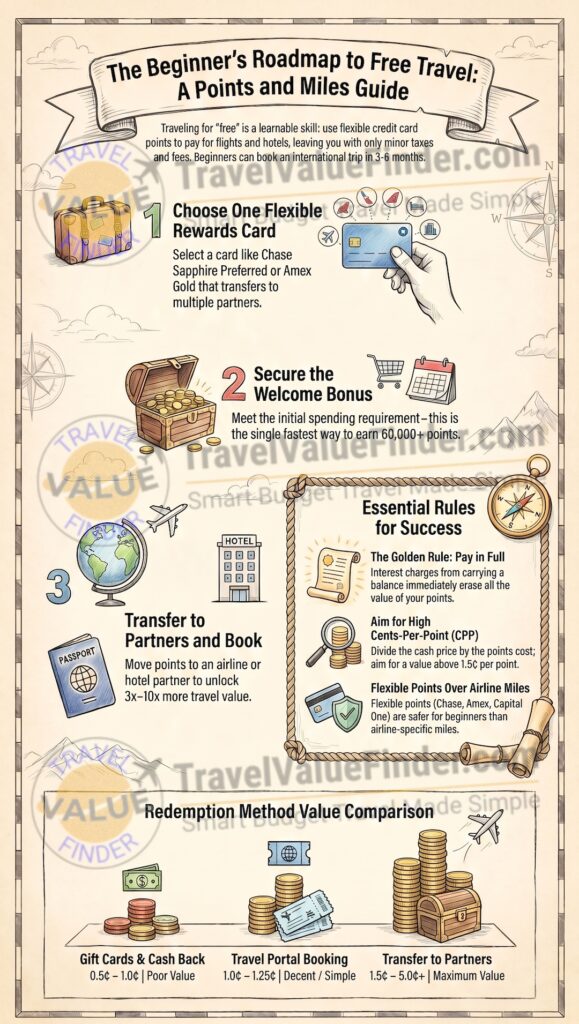
One important caveat before everything else: the points and miles system only works if you pay your credit card balance in full every month. Points are earned on spending. Interest charges on unpaid balances immediately erase all points value and then some. If you carry a credit card balance, address that first – the interest savings dwarf any points value. This guide assumes responsible credit card use as its foundation.
The points and miles game is not complicated. It feels complicated because the travel rewards industry has a financial incentive to make it feel like expertise. Here’s the actual model: put your everyday spending on a card that earns points. Earn a welcome bonus. Transfer those points to an airline or hotel program that covers your trip. Book at the cash price in points. The whole system fits in those four sentences. Everything else is detail. Leslie Nics, TravelValueFinder.com
Already have your points and ready to book? Compare flights and hotels through our trusted partner: Search Flights and Hotels – TravelValueFinder. Real-time prices, secure booking – use alongside your points strategy for the best overall deal.
Points and Miles Vocabulary: The Only Terms You Actually Need
Before the strategy, the vocabulary. Understanding these eight terms is sufficient to start your points and miles journey – everything else builds on them:
| Term | Plain-English Definition |
|---|---|
| Points | The rewards currency earned by credit cards (Chase Ultimate Rewards, Amex Membership Rewards, Capital One Miles, Citi ThankYou Points). Flexible – can be used directly or transferred to airline and hotel partners for higher value |
| Miles | The rewards currency of airline loyalty programmes (Delta SkyMiles, United MileagePlus, American AAdvantage, Alaska Mileage Plan, etc.). Typically earned by flying or by co-branded airline credit cards |
| Welcome bonus / Sign-up bonus | The single most important concept for beginners. Most premium travel cards offer 50,000 – 100,000 points when you spend a specific amount (typically $3,000 – $4,000) within 3 months of opening the card. This bonus – earned in one 3-month window – is worth $500 – $2,000 in travel and is the fastest single points-earning event available |
| Redemption | Using your points or miles to pay for travel. Poor redemptions (gift cards, merchandise, cash back at 0.5¢ – 1¢ per point) waste the value. Good redemptions (transferring to airline/hotel partners) can deliver 1.5¢ – 5¢+ per point – 3 – 10x more value for the same points |
| Transfer partners | Airlines and hotels that accept point transfers from credit card programmes. Example: Chase Ultimate Rewards transfers to United, British Airways, Air France-KLM, Singapore Airlines, Hyatt, and others. This transfer option is what makes flexible credit card points so valuable – you convert them to whichever programme offers the best value for your specific trip |
| Award availability | The specific seats or hotel rooms that airlines and hotels make available for points redemption. Award availability is limited – it is the main variable that determines whether you can book a desired route with points. Some routes have plentiful availability; others require flexibility on dates or routing |
| Cents per point (CPP) | Your measurement tool for whether a redemption is good value. Calculate by dividing the cash price of the booking by the points cost: a $500 flight for 30,000 points = 500 ÷ 30,000 x 100 = 1.67¢ per point. The general threshold: below 1¢/point is a bad redemption; 1.5 – 2¢ is decent; 2¢+ is good; 3¢+ is excellent |
| Annual fee | The yearly charge for holding a premium travel card. Most premium cards charge $95 – $695/year. The fee is justified when the card’s benefits (travel credits, lounge access, insurance, bonus categories) exceed the annual cost. For beginners: start with a $95 card, not a $695 card |
The Best First Card for Beginners: Where to Start Your Points and Miles Journey
The biggest mistake beginners make is applying for multiple cards at once or choosing a co-branded airline card before understanding the broader system. The right first card for points and miles travel for free is a flexible rewards card – one whose points transfer to multiple airlines and hotels rather than locking you into a single programme. Here are the three best options for beginners in 2026, with no recommendation to apply for any specific card (consult the card issuer’s current terms directly):
The Three Best Beginner Flexible Points Cards (2026)
| Card | Annual Fee | Welcome Bonus | Best Earning | Why It’s Good for Beginners |
|---|---|---|---|---|
| Chase Sapphire Preferred® | $95 | 60,000+ UR points | 3x dining; 2x travel; 1x all else | The most recommended beginner card. Chase Ultimate Rewards transfers to 14 airlines and hotels. Strong welcome bonus. $95 annual fee is offset by $50 hotel credit and strong travel insurance. Start here |
| American Express Gold Card | $250 | 60,000 – 100,000 MR points | 4x dining; 4x US supermarkets; 3x flights | Best card for high restaurant and grocery spenders. Amex Membership Rewards transfer to 21 airline partners including some not on Chase. Higher fee but $240 in annual dining credits offset most of it |
| Capital One Venture Rewards | $95 | 75,000 miles | 2x on all purchases | Simplest earning structure – 2x on everything. No bonus category tracking required. Capital One miles transfer to 15+ airline partners including Turkish Airlines (access to Star Alliance) and Air France (SkyTeam). Best for simplicity-first beginners |
Critical warning: Do not apply for a co-branded airline card (Delta Amex, United Explorer, American Citi card) as your first card. Airline-specific points are locked to one programme and are far less flexible for beginners who do not yet know which airline’s program offers the best value for their specific travel goals. Start with flexible points; add airline cards later once you understand the system.
What a Welcome Bonus Actually Gets You: Real Examples
| Welcome Bonus | Point Value (conservative 1.5¢/pt) | What You Can Book |
|---|---|---|
| 60,000 Chase UR points | $900 in travel | Round-trip economy to Europe (30,000 – 35,000 points via Air France or British Airways partner redemption), with points left over for a hotel night |
| 75,000 Capital One miles | $1,125 in travel | Round-trip to Japan or Southeast Asia (55,000 – 75,000 miles via Turkish Airlines partner redemption) – one of the most celebrated beginner redemptions for international travel |
| 100,000 Amex MR points | $1,500+ in travel | Business class to Europe (50,000 – 75,000 points transferred to Air France or British Airways) – a $1,500 – $3,000 cash ticket redeemed for a fraction of the cost |
| 60,000 UR + ongoing spending (Year 1 total ~100K) | $1,500 in travel | Return family trip (2 people) to a Caribbean or Mexican destination in economy – two flights that would cost $800 – $1,200 in cash covered by points |
How to Earn Points and Miles Fast: The Complete Strategy Guide
Earning points and miles happens through five main channels. For beginners, the first two account for 80%+ of all points earned:
Channel 1: Welcome Bonuses – The Fastest Points You Will Ever Earn
A welcome bonus of 60,000 – 100,000 points, earned by spending $3,000 – $4,000 in 3 months, is the highest points-per-dollar event in the entire system. At $4,000 in spending over 3 months ($1,333/month), the welcome bonus alone earns 60,000+ points – far more than a year of regular spending would produce at 1 – 3 points per dollar on the same amounts. The strategy implication: choose your card timing deliberately, and plan your large purchases (insurance premiums, travel bookings, home improvement) to coincide with the 3-month earning window.
Channel 2: Everyday Spending – Put Everything on Your Card
Every dollar of spending that does not go through a rewards card is a dollar that earns nothing. The discipline of using your points card for all spending – groceries, gas, utilities, subscriptions, dining, shopping – while paying the balance in full monthly, is the ongoing engine of your points and miles accumulation. At $2,000/month ($24,000/year) in spending on a card that earns 2x on everything (like the Capital One Venture), you earn 48,000 points per year from spending alone. Combined with the welcome bonus, your first year could easily produce 100,000 – 130,000+ points.
Channel 3: Bonus Category Spending
| Card | Bonus Categories | Points Per Dollar |
|---|---|---|
| Chase Sapphire Preferred | Dining, online groceries, streaming, travel | 3x dining; 3x streaming; 3x online grocery; 2x all travel |
| Amex Gold | US restaurants, US supermarkets, flights booked direct | 4x dining; 4x US supermarkets ($25K cap/yr); 3x direct airline purchases |
| Chase Freedom Unlimited | All purchases (no categories to track) | 1.5x on everything (can pool with Sapphire Preferred into UR account) |
| Capital One Venture | All purchases | 2x on all spending – simplest bonus structure available |
Channel 4: Shopping Portals
Major airlines and card issuers operate online shopping portals where you earn additional points on purchases you would make anyway by clicking through the portal first. United’s MileagePlus Shopping portal, Chase’s Ultimate Rewards Shopping portal, and similar platforms offer 2x – 15x points at hundreds of retailers including Amazon, Target, and major clothing brands. This doubles-dips points: you earn from your credit card and from the portal for the same purchase. Free money – as long as you remember to click through before shopping online.
Channel 5: Dining Programmes
Most major US airlines and some hotel chains operate dining programmes – link your credit card and loyalty number, eat at participating restaurants, and earn bonus points on top of your credit card earning. American Airlines AAdvantage Dining, United MileagePlus Dining, and Delta SkyMiles Dining all operate on this model. Worth the 5-minute enrollment for anyone who regularly eats at restaurants – the additional points accrue automatically with no behaviour change.
How to Redeem Points and Miles for Maximum Value
Earning points and miles is the easy half. Redeeming them for maximum value – the actual ‘travel for free’ part – requires understanding a few principles that most beginners miss:
The Points Value Hierarchy: From Worst to Best
| Redemption Type | Typical Value | Verdict |
|---|---|---|
| Gift cards / merchandise | 0.5¢ – 1¢/pt | Never do this – you are exchanging points for cash value at a 50 – 75% discount versus their travel value. Points are a travel currency; treat them as one |
| Statement credit / cash back | 1¢/pt | Acceptable as a last resort but still wasteful. Points transferred to travel partners are typically worth 1.5 – 4¢ each – 50 – 300% more value |
| Travel portal booking (Chase, Amex, etc.) | 1¢ – 1.25¢/pt | Decent and simple for beginners – book through your card’s travel portal like a travel agency. No transfer needed. Value capped at 1 – 1.25¢ per point. Good starting point while learning |
| Transfer to airline partner – economy | 1.5¢ – 2.5¢/pt | The sweet spot for most travelers. Transferring 30,000 Chase UR points to Air France/KLM for a transatlantic economy flight worth $600+ is the classic beginner redemption – 2¢/point value, 2 – 4x better than statement credit |
| Transfer to airline partner – business class | 3¢ – 6¢/pt | The highest-value redemptions: using 60,000 – 80,000 Amex MR points to fly business class to Europe (cash price $2,000 – $4,000) delivers 3 – 5¢ per point. Requires knowing partner programmes and award availability |
| Transfer to Hyatt for luxury hotels | 2¢ – 6¢/pt | World of Hyatt consistently offers the best value of any hotel programme. A Category 1 Hyatt property (20,000 points/night) in a city where the cash rate is $400/night = 2¢/point. Top-tier properties can deliver 4 – 6¢/point |
The Transfer Partner Cheat Sheet: Key Airline Connections
| If You Want to Fly… | Best Points Program | Transfer From |
|---|---|---|
| Europe (economy or business) | Air France/KLM Flying Blue OR British Airways Avios | Chase UR – Flying Blue; Amex MR – Flying Blue or Avios; Capital One – Flying Blue |
| Japan / Southeast Asia | Turkish Airlines Miles&Smiles (Star Alliance) OR ANA Mileage Club | Capital One – Turkish (best value for US-Asia); Chase UR – United (Star Alliance partner); Amex – ANA |
| Australia / New Zealand | Qantas Frequent Flyer OR Air New Zealand Airpoints | Amex – Qantas; Chase UR limited Aus options (use partner airlines) |
| Latin America | Avianca LifeMiles (Star Alliance) OR Alaska Airlines Mileage Plan | Amex – LifeMiles; Capital One – LifeMiles; Chase UR – United for LATAM routes |
| Caribbean / Mexico | Southwest Rapid Rewards (direct) OR American AAdvantage | Chase UR – Southwest for domestic/Caribbean; Citi ThankYou – American AA |
| Domestic US flights | Southwest Rapid Rewards, Alaska Mileage Plan, or United MileagePlus | Chase UR – Southwest or United; Capital One – Alaska; straightforward routes |
| Hotels (all destinations) | World of Hyatt (best value) – Marriott Bonvoy, IHG Rewards also viable | Chase UR – Hyatt (the best hotel transfer in the system); Amex – Marriott |
The Beginner’s Points and Miles Roadmap: Steps 1 – 7
Here is the step-by-step points and miles beginner roadmap – in the order that actually makes sense:
- Check your credit score before applying for any card: Premium travel cards require excellent credit – typically 720+ FICO score. Check your score for free on Credit Karma, your bank’s app, or Discover’s free credit score tool. If your score is below 700, spend 6 – 12 months improving it before applying. A rejected application temporarily lowers your score and wastes the inquiry
- Choose your first flexible points card and apply: One card only. Do not apply for multiple cards simultaneously – each application creates a hard credit inquiry, and multiple inquiries in a short period raise flags. Choose either Chase Sapphire Preferred, Amex Gold, or Capital One Venture based on your spending patterns. Apply directly through the issuer’s website
- Meet the welcome bonus spending requirement deliberately: You need $3,000 – $4,000 in spending in 3 months. Do not manufacture spending by buying things you do not need. Instead: shift all existing spending to the new card (groceries, gas, utilities, subscriptions, dining); pay your insurance premiums or any large recurring bills on the card; prepay any upcoming travel on the card. Do not carry a balance – pay in full each month
- Set up a loyalty account for the airline or hotel you want to transfer to: Create a free account with the programmes that cover your target trip (Air France Flying Blue, United MileagePlus, World of Hyatt, etc.) before you have points to transfer. Points can only transfer to existing accounts, and transfers are typically instant or take 1 – 3 days
- Identify your target redemption: Know before you earn. Ask: where do I want to go in the next 12 – 18 months? How many points does that route typically cost? Which programmes offer the best value? Use the transfer partner cheat sheet above. A clear target prevents the most common mistake: accumulating points without a plan and letting them devalue as programmes change rates
- Search for award availability before transferring: Award availability is the constraint. Before transferring points to an airline programme (transfers are generally one-way and irreversible), search the airline’s award calendar for your target dates. Use Seatspy for award seat alerts on major programmes, or search directly on the airline’s website using the award booking tool. Confirm space is available before you transfer
- Transfer points and book: Transfer the exact number of points needed from your credit card programme to the airline or hotel account. Wait for the transfer to complete (typically instant to 3 days). Book the award through the airline’s website or app. Pay the taxes and fees (typically $5 – $100 domestic; $100 – $400 international, depending on route and airline). You have just used points and miles to travel for free
The 8 Biggest Beginner Mistakes in Points and Miles
These are the mistakes that cost beginners the most value – and the specific fix for each:
| Mistake | Cost | Fix |
|---|---|---|
| #1: Carrying a credit card balance | All value and more | Non-negotiable rule: pay in full every month. A 20% APR on a $1,000 balance costs $200/year in interest – far more than any points value generated. Do not play this game if you carry balances |
| #2: Redeeming for gift cards or cash back | 50 – 80% of value lost | Only redeem for travel. Points are a travel currency. Using them for anything else destroys their value. One rule: if it’s not travel, don’t redeem |
| #3: Applying for too many cards at once | Credit score damage; potential denials | One new card every 3 – 6 months maximum. Chase’s ‘5/24 rule’ denies applicants who’ve opened 5+ cards in 24 months. Build slowly; this is a long game |
| #4: Starting with an airline-specific card | Locked into one programme | Start with flexible points (Chase UR, Amex MR, Capital One) – they transfer to multiple partners, giving you the best redemption options. Add airline cards after you understand the system |
| #5: Letting points expire | Complete loss of value | Know the expiry rules for every programme. Most credit card points don’t expire while the card is open. Airline miles often expire after 18 – 24 months of inactivity. Keep programmes active with a small earning transaction (shopping portal purchase, dining programme meal) if you’re not redeeming soon |
| #6: Transferring points before confirming availability | Irreversible wrong transfer | Transfer is one-way and permanent. Search for award space, confirm your specific dates and routing are available, THEN transfer. Never transfer speculatively hoping space will appear |
| #7: Ignoring annual fee value | Overpaying for cards that aren’t delivering | Annual fee is justified when card benefits (travel credits, lounge access, insurance, bonus categories) exceed the fee. Calculate this every year. Cancel cards that no longer earn their fee |
| #8: Redeeming at poor CPP because they’re excited | 50 – 70% of potential value lost | Never redeem below 1.5¢/point on an international redemption. The benchmark: calculate CPP before every redemption. $600 cash flight for 30,000 points = 2.0¢/pt ✓. $300 flight for 30,000 points = 1.0¢/pt – wait for a better option |
Points and Miles for Budget Travelers: How This Changes the Equation
Most points and miles content is written for high-spending premium travellers who are optimising business class flights to Asia. This section is written for the reader of this website – a budget traveller who wants to use points and miles to travel for free or near-free, making affordable destinations even more affordable and opening up destinations that would otherwise be out of reach.
| Budget Travel Scenario | How Points and Miles Change It |
|---|---|
| Southeast Asia trip: $700 flights | 55,000 – 75,000 Capital One miles transferred to Turkish Airlines covers a round-trip from the US to Thailand, Vietnam, or Japan. Cash price: $700 – $1,100. Points cost: $0 + $100 – $300 in taxes/fees. Saving: $400 – $800 – which funds 2 – 4 extra weeks of travel at $30 – $50/day in Southeast Asia |
| Europe budget trip: $600 flights | 30,000 – 35,000 Chase Ultimate Rewards transferred to Air France Flying Blue covers a round-trip economy from the US to Europe. Cash price: $600 – $900. Points cost: $0 + $50 – $150 in taxes. Combined with our Portugal or Eastern Europe budget guides, this is a 2-week Europe trip for under $1,000 total |
| Hotel night on a budget trip | A Category 1 or 2 Hyatt property (5,000 – 8,000 Chase UR points transferred to Hyatt) in a city like Prague, Lisbon, or Bangkok costs 5,000 – 8,000 points per night. Cash equivalent: $80 – $150. Use points for hotel nights at your most expensive destinations and cash for the cheapest ones (Vietnam hostels at $8/night don’t need to be points-optimised) |
| Domestic positioning flight | Flying from a secondary US city to a major hub for an international award is often cheapest with Southwest Rapid Rewards (transfer from Chase UR). A domestic hop that would cost $150 – $300 in cash uses 8,000 – 12,000 points. Combine this with an international award for a multi-leg trip fully covered by points |
The budget traveler’s priority order: Use points primarily to eliminate the largest fixed cost – international flights. Your hotel, food, and activity costs are manageable with cash in affordable destinations (€10/night hostel in Kraków; $8/night dorm in Hanoi). The $600 – $1,100 international flight is where points and miles deliver the most transformative impact on total trip cost. See our country-specific budget guides for on-ground costs:
- How to Travel Europe on a Budget
- Best Countries for First-Time Travelers: Easy, Affordable & Rewarding
- Cheap Countries to Visit: Best Value Destinations Ranked
- How to Travel on $50 a Day (and Actually Enjoy It)
Free Tools That Make Points and Miles Management Easier
These tools are genuinely free and genuinely useful for managing your points and miles journey:
| Tool | What It Does and Why Beginners Need It |
|---|---|
| AwardWallet | Points tracker – connects to all your loyalty accounts and credit card points in one dashboard. Shows balances, expiry dates, and when points are at risk. The most important tool for anyone with multiple programmes. Free tier is sufficient for most beginners |
| Seatspy | Award seat alert tool – set alerts for specific routes and cabin classes; get notified when award space opens. Essential for popular routes where availability is scarce (US to Japan in business class, transatlantic peak summer economy). Paid service but a 14-day trial is sufficient for a first booking |
| Google Flights | Cash price research – always check the cash price of your target flight before redeeming points. Google Flights shows the lowest available fares across dates and routes. Use it to calculate your CPP (cents per point) before any transfer |
| Your card issuer’s transfer portal | The transfer interface – Chase at chase.com, Amex at americanexpress.com, Capital One at capitalone.com all allow point transfers directly to partner loyalty programmes. The transfer page shows all available partners and ratios. Most transfers are 1:1 (1 credit card point = 1 airline mile). Some programmes offer transfer bonuses – watch for these (Amex occasionally offers 30% transfer bonuses to specific partners) |
Continue Planning Your Budget Trip: Essential Resources on TravelValueFinder
- How to Find Cheap Flights: 12 Proven Strategies That Actually Work
- Best Flight Booking Apps and Sites to Find Cheap Airfare in 2026
- How to Eat Cheaply While Traveling (Without Sacrificing the Food Experience)
- Best Travel Credit Cards for 2026: Earn Points and Travel Free
- How to Travel Europe on a Budget: The Complete Guide
- How to Use Points and Miles to Travel for Free: A Beginner’s Guide
- Free Walking Tours Around the World: A City-by-City Guide
- Best Time to Book Flights to Get the Cheapest Prices
- Budget Travel Tips: 30 Strategies to Travel More for Less
- Travel Insurance Guide: What It Covers and Best Options
- Best Countries for First-Time Travelers: Easy, Affordable & Rewarding
- How to Travel on $50 a Day (and Actually Enjoy It)
- Best Hotel Booking Sites: Where to Find the Cheapest Deals
- Cheap Countries to Visit: Best Value Destinations Ranked
- Free AI Trip Planner: Get a Day-by-Day Itinerary in Seconds
Ready to book your trip? Compare flights and hotels through our trusted partner while your points strategy comes together: Search Flights and Hotels – TravelValueFinder. We earn a small commission at no extra cost to you – helping keep all our guides completely free.
Frequently Asked Questions: Points and Miles Travel for Free
How do I start using points and miles to travel for free?
To start using points and miles to travel for free: (1) Check your credit score – most premium travel cards require 720+; (2) Choose ONE flexible rewards card (Chase Sapphire Preferred, Amex Gold, or Capital One Venture are the best beginner options); (3) Put all everyday spending on the card and pay the balance in full monthly; (4) Meet the welcome bonus spending requirement (typically $3,000 – $4,000 in 3 months) to unlock 60,000 – 100,000 points; (5) Identify your target trip and which airline or hotel programme covers it best; (6) Confirm award availability before transferring points; (7) Transfer and book. Your first free or near-free flight is typically achievable within 3 – 6 months of opening your first travel card, primarily driven by the welcome bonus.
What is the best credit card for beginners who want free travel?
The Chase Sapphire Preferred® is the most universally recommended first card for beginners pursuing points and miles for free travel. Its $95 annual fee is low, its welcome bonus is strong (60,000+ Chase Ultimate Rewards points), and its transfer partners (14 airlines and hotels including United, Air France, British Airways, Hyatt, and Singapore Airlines) give beginners the most flexibility for different destinations. The Amex Gold is better for high restaurant and grocery spenders (4x on both). The Capital One Venture Rewards is best for simplicity – 2x on all purchases, no category tracking, and 15+ transfer partners. Start with one card and master it before adding more.
How many points do you need for a free flight?
The points required for a free flight using miles depends on the route and cabin class: US domestic round-trip – 8,000 – 25,000 miles (Southwest, Alaska, United); US to Europe round-trip economy – 30,000 – 60,000 miles (Air France Flying Blue, British Airways Avios) or up to 80,000 on some programmes; US to Japan/Southeast Asia round-trip economy – 55,000 – 80,000 miles (Turkish Airlines, United, ANA); business class transatlantic – 50,000 – 80,000 miles (Air France, British Airways); business class to Asia – 70,000 – 110,000 miles. A single credit card welcome bonus of 60,000 – 100,000 points typically covers one of the first three options in full for one person – which is why the welcome bonus is the most important first event in every beginner’s journey.
What is the difference between points and miles?
‘Points’ and ‘miles’ are often used interchangeably but have a technical distinction. Points are the rewards currency of credit card programmes (Chase Ultimate Rewards points, Amex Membership Rewards points, Capital One miles). Miles are the rewards currency of airline loyalty programmes (Delta SkyMiles, United MileagePlus miles, American AAdvantage miles). The practical distinction: credit card points are flexible – they can be transferred to multiple airline and hotel programmes. Airline miles are program-specific – Delta SkyMiles work only within Delta’s award system. For beginners: start with flexible credit card points, which give you the most options for redemption before you know exactly where you want to travel.
What are transfer partners and why do they matter?
Transfer partners are the airlines and hotels that accept point transfers from your credit card programme. When you ‘transfer’ Chase Ultimate Rewards points to Air France Flying Blue (at a 1:1 ratio), those points become Flying Blue miles that you can use to book Air France and SkyTeam partner flights. Transfer partners matter because they unlock significantly higher value per point than redeeming directly through the card’s travel portal. A Chase UR point is worth 1¢ when redeemed for cash back but 1.5 – 3¢+ when transferred to the right airline partner for a specific route. The best Chase UR transfer partners for beginners: Air France Flying Blue (Europe), United MileagePlus (US domestic and international), and World of Hyatt (hotels worldwide).
Is travel hacking worth it for budget travelers?
Yes – points and miles strategies are arguably most valuable for budget travelers, not wealthy ones. Here is why: a business class traveller who buys their own tickets loses $3,000 per seat. A budget traveler who pays $600 for economy also loses $600. But both can earn the same welcome bonus (60,000 points) by meeting the spending requirement – and that welcome bonus covers their flight for roughly the same points cost. For a budget traveler spending $600 on a flight, points that cover that cost represent 100% savings on the trip’s largest expense. The additional weeks of travel those saved flight dollars can fund ($600 ÷ $35/day in Southeast Asia = 17 extra days of travel) is transformative. The main requirement: responsible credit card use, which is simply not spending more than you planned to spend.
What are the biggest mistakes beginners make with points and miles?
The eight most costly beginner mistakes with points and miles: (1) carrying a credit card balance – interest immediately eliminates all points value; (2) redeeming for gift cards or merchandise instead of travel (50 – 80% value destruction); (3) applying for multiple cards simultaneously (credit score damage, programme denials); (4) starting with airline-specific cards instead of flexible points programmes; (5) letting points expire through inactivity; (6) transferring points before confirming award availability (transfers are one-way and irreversible); (7) keeping annual fee cards whose benefits no longer exceed the fee; and (8) redeeming at below 1.5¢ per point when better options exist with patience. The most important single rule: pay your balance in full every month. Everything else is optimization.
Final Thoughts: Points and Miles Travel for Free Is a Learnable Skill
Points and miles travel for free is not a secret available only to financial insiders or frequent business travellers. It is a learnable system, available to any American with a good credit score and the discipline to pay their card in full monthly. The welcome bonus on one premium card – earned in a 3-month window by shifting existing spending to the new card – typically funds one round-trip international flight. The ongoing spending on that card funds domestic flights and hotel nights annually. The knowledge of how to transfer to the right partner for the right redemption is the skill that multiplies all of it.
Start simple. One card. One target trip. One welcome bonus. One transfer. One booking. The first free flight using points and miles is the one that makes everything click – the moment you understand what the system actually delivers, you think back over years of full-price tickets and feel the particular frustration of realising what was always available. Do not let that frustration compound. Start now. The system rewards whoever starts soonest.
Your first free flight is probably 3 – 6 months away. The decision to start is the only thing standing between you and it.
I booked my first points flight – a round-trip to Lisbon – with 30,000 Chase Ultimate Rewards points transferred to Air France Flying Blue. The cash price would have been $680. I paid $58 in taxes. I sat in the same seat as everyone who paid full price. The only difference between us was that I’d read the equivalent of this guide 18 months earlier and started one credit card. That’s the entire story. Leslie Nics, TravelValueFinder.com
Ready to book your first trip? Compare flights and hotels through our trusted partner: Search Flights and Hotels – TravelValueFinder. We earn a small commission at no extra cost to you.