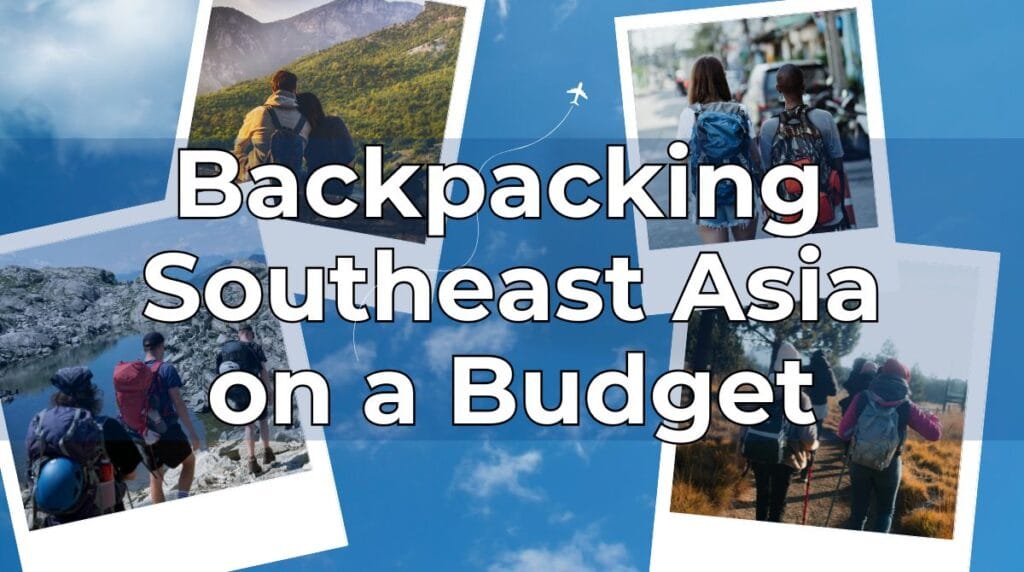
Backpacking Southeast Asia on a Budget: The Complete 2026 Guide

Backpacking Southeast Asia on a budget is still – in 2026, after inflation, after the post-COVID pricing reset, after the Instagram-driven premium hostel surge in Bali – one of the world’s great travel propositions. A month in Thailand, Laos, Vietnam, and Cambodia costs approximately what a week in Western Europe costs. The food is better. The landscapes are more dramatic. The people are warmer. And the backpacker infrastructure – built over 50 years of the trail that began in the 1970s – is so well-developed that first-timers consistently call Southeast Asia the easiest region in the world to travel independently.

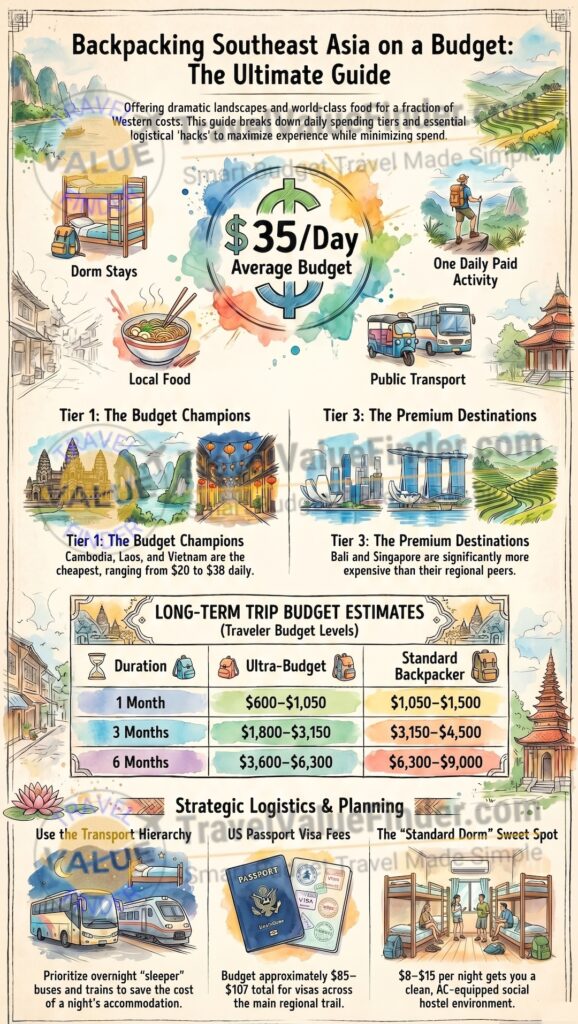
How much does it cost to backpack Southeast Asia on a budget?

DurationUltra-BudgetBackpackerMid-RangeRoute Example
1 week$140–$245$245–$350$385–$665Thailand only (Bangkok + Chiang Mai)
2 weeks$280–$490$490–$700$770–$1,330Thailand + Cambodia or Thailand + Vietnam
1 month$600–$1,050$1,050–$1,500$1,650–$2,850Thailand + Laos + Vietnam + Cambodia
3 months$1,800–$3,150$3,150–$4,500$4,950–$8,550Full Banana Pancake Trail + Malaysia + Indonesia
6 months$3,600–$6,300$6,300–$9,000$9,900–$17,100Full trail + Philippines + Borneo + slow travel

Ultra-budget: $20–$35/day. Backpacker: $35–$50/day. Mid-range: $55–$95/day. All figures per person on-ground, excluding international flights ($600–$1,200 USA – Bangkok/KL). Consistent with real traveler data of ~$35/day average across multiple countries. Add 15% buffer for unexpected costs.

Leslie Nics, TravelValueFinder.com | Updated May 2026 | Written for US backpackers, first-timers, and experienced budget travelers | Research cross-referenced with BudgetYourTrip 2026, real traveler data, and first-hand experience across the full backpacker trail

This guide is structured to answer every question a backpacker planning Southeast Asia on a budget actually needs answered – not the generic ‘eat street food and stay in hostels’ advice that fills most guides, but the specific country-by-country cost data, the complete visa table, the route decisions that save $500 on a 4-week trip, the vaccine requirements, the packing list that does not waste money, and the honest explanation of why Bali costs twice what every other Indonesian island costs and what to do about it. It also identifies the eight most common mistakes that blow a backpacker’s Southeast Asia budget in the first two weeks – and how to avoid all of them.

The best thing about backpacking Southeast Asia on a budget is that the budget version and the premium version often visit the same places. The difference is where you sleep and what plastic chair you eat at. The sunrise at Angkor Wat costs $37 regardless of your budget. The Mekong river looks the same from a $6 dorm in Luang Prabang as it does from a $120 boutique hotel. The experience is not proportional to the spend. That’s what makes this region genuinely special. Leslie Nics, TravelValueFinder.com

Planning your backpacking Southeast Asia trip? Compare flights and accommodation in one search through our trusted partner: Search Southeast Asia Flights and Hostels – TravelValueFinder. Real-time prices, hundreds of providers, secure booking.

How Much Does It Cost to Backpack Southeast Asia? Country-by-Country Budget

The cost of backpacking Southeast Asia on a budget varies significantly by country – and knowing those differences before you route-plan is the single most impactful thing you can do for your budget. Here is the complete 2026 per-country breakdown:

CountryBudget/DayMid-Range/DayHostel DormStreet MealBudget Verdict 2026
Cambodia$20–$30$40–$65$6–$10$1.50–$3Cheapest country; USD economy; no currency conversion needed
Laos$20–$35$45–$70$6–$12$1.50–$3Joint cheapest; Thailand with none of the tourism; spectacular rivers and mountains
Vietnam$22–$38$45–$80$5–$10$1.50–$2.50World’s best food-to-dollar ratio; most diverse country on the trail; 90-day e-visa $25
Thailand (North)$28–$45$55–$90$8–$15$1.50–$3Most beginner-friendly; best infrastructure; Chiang Mai cheapest major city
Thailand (Islands)$40–$65$80–$140$12–$22$2–$440–60% more expensive than north Thailand; worth it but budget accordingly
Malaysia (Peninsular)$30–$50$60–$100$9–$18$1.10–$2.50English-speaking; outstanding food; Penang hawker culture unmissable
Indonesia (non-Bali)$25–$40$45–$80$6–$14$1.50–$3Lombok, Flores, Yogyakarta all excellent budget value; $1.50 warung meals
Bali$40–$65$70–$130$12–$22$2–$5Overpriced vs. SEA peers; Instagram-driven premiums – see Bali Problem section below
Philippines$30–$50$55–$90$8–$16$1.50–$3English-speaking; extraordinary islands; island-hopping transport adds to budget
Singapore$70–$120$150–$250+$25–$45$4–$6First-world prices; 1–2 days maximum for backpackers; hawker centres save food budget

The tier structure: Budget-conscious backpackers on a Southeast Asia budget should maximise time in Tier 1 countries (Cambodia, Laos, Vietnam at $20–$35/day) and minimize time in Tier 3 (Bali and Singapore). Thailand is the ideal starting and ending base – most backpackers begin in Bangkok and the infrastructure supports seamless onward travel in every direction.

The Banana Pancake Trail: What It Is and Whether You Should Follow It

Every guide to backpacking Southeast Asia on a budget mentions the Banana Pancake Trail – the well-worn backpacker circuit that has connected Southeast Asia’s most popular traveler destinations since the 1970s. Named for the Western-friendly breakfast menus (banana pancakes, fruit shakes, toast with jam) that appeared in every traveler-facing café along the route, the Trail describes the loop that the majority of Southeast Asia backpackers follow:

Trail SegmentRoute and Key Stops
The Northern LoopBangkok – Chiang Mai – Chiang Rai (and Golden Triangle) – Pai – Back to Bangkok. Purely Thai; best for first-timers who want to test the backpacker lifestyle before crossing borders
The Classic Northern TrailBangkok – Chiang Mai – Luang Prabang (Laos) – Vang Vieng – Vientiane – Crossing to Vietnam (Hanoi) – Ha Long Bay – Hué – Hội An – Ho Chi Minh City – Cambodia (Phnom Penh) – Siem Reap (Angkor) – Bangkok
The Southern ExtensionAfter the classic trail, from Bangkok: south through Malaysia (KL – Penang – Cameron Highlands) – Singapore – Bali – Lombok – Gili Islands
The Island Loop (Thailand)From Bangkok south: Koh Samui – Koh Phangan (Full Moon Party) – Koh Tao (diving) – Koh Lanta or Koh Lipe – Up to Krabi/Railay – Phuket – Out
Off the TrailPhong Nha (Vietnam caves) – Northeast Cambodia (Ratanakiri elephants) – Northern Laos (Nong Khiaw, Muang Ngoi) – Northern Thailand beyond Chiang Rai – Philippines (Palawan, Siargao) – Indonesian islands (Flores, Toraja, Sulawesi)

Trail vs. Off-Trail: The Budget and Experience Comparison

FactorBanana Pancake TrailOff the Beaten Track
Daily cost$30–$50/day average (well-developed infrastructure but tourist pricing in places)$20–$35/day – less tourist premium; more local pricing; better value
Ease of travelVery easy – well-marked routes, English everywhere, bus/train/ferry connections establishedMore planning required; local transport; fewer English speakers; greater reward
Social sceneInstant community – hostels are full of other backpackers following the same route; you will not be aloneFewer travelers; deeper connections with locals; some loneliness possible between stops
Food qualityGood – but many restaurants have adapted to Western tastes; banana pancakes are everywhere for a reasonOften better – less adaptation to tourist palates; more authentic local dishes; lower prices
Scam exposureHigher – tourist areas have established scam industries (tuk-tuks, gem scams, ‘temple closed’ redirects)Lower – off-trail areas have less tourist-scam infrastructure; more genuine interactions
Best forFirst-time backpackers; those who want a built-in social scene; travelers with limited time (2–4 weeks)Experienced backpackers; those with 6+ weeks; anyone seeking authenticity over convenience

The Complete 8-Week Backpacking Southeast Asia Budget Itinerary

This is the most practical thing this guide can provide: a week-by-week Southeast Asia backpacking itinerary with real 2026 costs for each segment. Follow it exactly or use it as a framework to build your own route.

WeekDestinationsBudget/WeekMid/WeekKey Experiences
Week 1Bangkok (3 nights) – Chiang Mai (4 nights)$210–$280$385–$490Grand Palace; Chatuchak market; Doi Suthep temple; Chiang Mai old city; cooking class; night bazaar
Week 2Chiang Mai – Luang Prabang, Laos (slow boat 2 days) – Luang Prabang (4 nights)$175–$245$315–$455Mekong slow boat ($35–$45 incl. meals); alms-giving ceremony; Kuang Si waterfall; temple walk; Pak Ou caves
Week 3Vang Vieng, Laos (3 nights) – Vientiane (2 nights) – Cross to Hanoi, Vietnam (overnight bus)$175–$245$315–$420Tubing and karst scenery; Patuxai monument; Buddha Park; overnight bus saves accommodation
Week 4Hanoi (3 nights) + Ha Long Bay cruise (2 days/1 night) – Hanoi (1 night) – Overnight train to Hue$280–$350$455–$560Old Quarter; Temple of Literature; Ha Long Bay overnight cruise ($110–$130); Imperial Citadel Hue
Week 5Hội An (4 nights) – Da Nang (1 night) – Overnight bus to Ho Chi Minh City (2 nights)$245–$315$420–$560Ancient Town lanterns; cooking class; My Son ruins; War Remnants Museum; Cu Chi tunnels
Week 6Phnom Penh, Cambodia (2 nights) – Siem Reap (3 nights) – Bangkok flight$175–$245$315–$420Killing Fields; Tuol Sleng; Angkor Wat sunrise (3-day pass $37); Bayon temple; Ta Prohm
Week 7Bangkok (1 night) – Koh Phangan (4 nights) – Koh Tao (2 nights)$280–$385$455–$665Thai islands; Full Moon Party (if timing); snorkelling; world’s cheapest PADI diving ($300–$350)
Week 8Koh Tao – Kuala Lumpur, Malaysia (budget flight) – Penang (2 nights) – KL – Home$280–$350$455–$560George Town hawker food; street art; Petronas Towers; Batu Caves; departure
TOTAL8 weeks on the ground$1,820–$2,415$3,115–$4,130Add $600–$1,200 international flights. Budget total: $2,420–$3,615 all-in from USA

Southeast Asia Visa Guide for Americans: Complete 2026 Table

Visa costs and requirements are a backpacking Southeast Asia budget item that is consistently underestimated. Here is the complete 2026 visa reference for US passport holders – all information verified April 2026, but check travel.state.gov within 2 weeks of departure as requirements change:

CountryVisa TypeCost (USD)DurationPractical Notes
ThailandVisa exemptionFREE60 daysExtendable to 90 days at any immigration office for 1,900 THB ($54). New in 2025: 60 days (up from 30). No action required on arrival
VietnamE-visa$2590 days multiple entryApply online at evisa.xuatnhapcanh.gov.vn. Process takes 3 working days. Do NOT use third-party services charging $50–$150
Cambodiae-Visa OR Visa on Arrival$3030 dayse-Visa online recommended. Extension available ($45, 30 more days) at Ministry of Foreign Affairs in Phnom Penh. USD accepted everywhere
LaosVisa on Arrival$30–$4230 daysFee varies by nationality and entry point. Most land borders: $35. Carry exact change (USD or THB). Extension 30 days for $2/day at Immigration
MalaysiaVisa exemptionFREE90 daysNo action required. Malaysia is one of backpacker SEA’s most visa-friendly countries. No stamping needed
IndonesiaVisa Free (most entries) / Visa on ArrivalFREE (30 days) / $35 (30 days VOA)30 daysVisa-free entry at select airports including Bali. Extendable 30 days via VOA. Bali-specific tourism levy of IDR 150,000 ($9.22) effective 2024
PhilippinesVisa exemptionFREE30 daysExtendable at Bureau of Immigration offices (Manila, Cebu, Davao) – $50 for 29-day extension. Onward ticket required on entry
SingaporeVisa exemptionFREE90 daysMost straightforward entry in SEA. MRT from airport to city: SGD $2.09 ($1.55). Singapore is transport hub for budget flights throughout SEA
MyanmarCheck advisoryN/AN/ACheck US State Dept advisory before any plans. Myanmar has had ongoing civil conflict since the 2021 military coup. Many countries including the US advise against all travel

Budget reality: A full backpacking Southeast Asia trip covering Thailand, Laos, Vietnam, Cambodia, and Malaysia costs approximately $85–$107 in total visa fees for an American passport holder. Cambodia and Laos are the only significant visa costs; Thailand, Malaysia, Singapore, and the Philippines are all free entry. Build this into your total backpacking Southeast Asia budget from Day 1.

Backpacking Southeast Asia Accommodation: What Each Budget Gets You

Accommodation is the single largest variable in your backpacking Southeast Asia budget. Here is an honest guide to what you actually get at each price point:

TierNightly CostWhat You Get – The Honest Version
Ultra-budget dorm$4–$88–12 bed mixed dorm; AC or strong fan; locker (bring your own padlock); shared bathroom; often free WiFi; common room. Quality varies enormously – read reviews from the past 30 days specifically mentioning ‘cleanliness’ and ‘noise’. A 9.0+ Hostelworld rating is the minimum threshold
Standard backpacker dorm$8–$154–6 bed dorm; guaranteed AC; en-suite or very clean shared bathroom; good WiFi; sometimes free breakfast; common room with social programming. The sweet spot for most backpackers – clean, social, and cheap enough to meaningfully stretch a budget
Party hostel$10–$20Be careful with this tier: Party hostels often charge the same or more than regular hostels for a significantly worse sleep experience. Good if nightlife is your priority; terrible if sleep and early mornings matter to you. Koh Phangan and Vang Vieng have the densest concentration
Boutique hostel / private room$15–$28Private room in a hostel setting – good for couples, older backpackers, or anyone who has had enough dorms. Usually 20–30% cheaper than a budget hotel for equivalent privacy. Hội An is the standout destination for this tier – pool, breakfast, and bicycles for $25–$35
Budget guesthouse / cheap hotel$18–$40Private room; private bathroom; AC; daily housekeeping; sometimes breakfast. The step up to this tier on a backpacking trip is most justified in cities (Bangkok, HCMC) where the price difference from a dorm is small and the privacy benefit is high
  • Bring a padlock: The single most important and least remembered piece of hostel gear. Most hostel lockers require your own padlock. Without one, your valuables are in an unlocked box in a room with 8 strangers. A TSA-approved combination lock costs $5–$8 and eliminates this entirely
  • Book 1–2 nights ahead, not your whole trip: The experienced Southeast Asia backpacker books the first night in each new city and stays flexible. This allows you to stay longer when a hostel is great (and negotiate a weekly rate), leave early when it is not, and move when you meet people going somewhere interesting. Over-booking kills spontaneity and costs you cancellation fees
  • Best Hostels vs Budget Hotels: Which Is Worth It for Southeast Asia?

The Bali Problem: Why Bali Costs Twice What the Rest of Indonesia Does

No honest backpacking Southeast Asia budget guide can skip this. Bali is the most searched, most Instagrammed, and most anticipated destination on the Southeast Asia backpacking trail – and in 2026, it is also the most overpriced relative to what it delivers at a backpacker budget. The specific issues:

  • Instagram-driven pricing: Seminyak, Canggu, and Kuta have developed a tourist premium driven by social media demand that has no connection to local cost structures. A private room in a Canggu Instagram-aesthetic villa costs $40–$80/night. The identical private room in Yogyakarta (equally beautiful, also on Java) costs $12–$22
  • The Bali tourism levy: Since 2024, Bali charges IDR 150,000 ($9.22) per international visitor. This is on top of the Indonesia visa cost and is not included in most travel budget calculations
  • Western food pricing: Bali has developed the most extensive Western food scene in Southeast Asia – and it costs accordingly. An avocado toast at a Canggu café costs $8–$12. The same calories from a warung (local Indonesian eatery) cost $1.50–$2.50. The temptation to eat Western in Bali is significant; the budget impact is $15–$25/day
  • The better alternatives: Lombok (immediately adjacent, 30 min by fast boat – $12–$15 – from Bali) has comparable beaches, better surf, and costs 30–40% less. Flores and Komodo have world-class diving and Komodo dragons for $25–$35/day. Yogyakarta (Java) has Borobudur, Prambanan, and genuine Javanese culture for $22–$35/day
  • The right approach to Bali: 3–5 days in Ubud (Bali’s cultural centre – cheaper and more authentic than the coastal areas) is genuinely worthwhile. Ubud costs $30–$45/day for a backpacking Southeast Asia budget traveler, which is high but justifiable. Ubud’s rice terraces, temple culture, and arts scene are unlike anything on the trail. Seminyak and Kuta are not worth the premium for budget travelers

Getting Around Southeast Asia on a Budget: The Complete Transport Guide

Transport decisions have a significant impact on your backpacking Southeast Asia budget. Here is the strategic guide to moving through the region cheaply:

The Budget Transport Hierarchy

Transport TypeTypical CostWhen to Use It
Overnight bus or train (sleeper)$8–$25Always prioritise this when the journey is 8+ hours – you simultaneously travel AND save a night’s accommodation. The Hanoi – Hội An sleeper ($15–$19), Bangkok – Chiang Mai overnight train ($15–$28), and Siem Reap – Phnom Penh overnight bus ($8–$12) are the classic SEA backpacking budget moves
Local bus (non-tourist route)$0.50–$5For city transport and short inter-city routes where tourist buses add 3–5x premium for identical journey time. Da Nang – Hội An public bus: $0.59 (15 min wait). Same journey by tourist minivan: $5–$8
Budget domestic flight$20–$80AirAsia, VietJet, Cebu Pacific, Scoot – for any leg over 8 hours by ground where you cannot afford the time cost. Book 3–6 weeks ahead for fares under $40. Bangkok to KL: $20–$35. Hanoi to HCMC: $25–$50. Never buy domestic flights at the airport or within 5 days of departure
Grab app (city transport)$0.80–$4Thailand, Vietnam, Malaysia, Philippines, Cambodia. Metered, transparent, always cheaper than negotiated tuk-tuks or xe ôm. Non-negotiable in HCMC and Bangkok where unsolicited motorbike taxis and tuk-tuks use inflated pricing
Tuk-tuk (tourist areas)$3–$15Never for transport value – only for the experience. A Bangkok tuk-tuk that a Grab costs $1.50 quotes $5–$10 to tourists. Enjoyable for one ride; not a budget transport strategy
Motorbike rental$5–$12/dayFor island exploration (Koh Lanta, Lombok, Flores) where public transport is limited. Only rent if you have genuine riding experience – traffic in SEA is unlike anything in the US and motorbike accidents are the leading cause of traveler injury and death in the region
Slow boat (Mekong)$35–$45The Chiang Rai – Luang Prabang 2-day slow boat is one of Southeast Asia backpacking’s definitive experiences. Includes accommodation on board, meals, and the most scenic river journey in Asia. Do it even if the speedboat is cheaper – the speedboat is dangerous and misses everything

Health and Vaccines for Backpacking Southeast Asia: What Americans Actually Need

Health preparation is the backpacking Southeast Asia topic that most budget guides handle worst – either skipping it entirely or listing every possible vaccine without distinguishing what is medically recommended vs. optional. Here is the practical guide for American travelers, based on CDC travel health recommendations for Southeast Asia:

Vaccine / PrecautionRecommendationPractical Notes
Hepatitis AStrongly recommendedTransmitted via food and water. If you will eat street food (you will), this is essential. Two-shot series; first shot 2 weeks before travel ideally; second shot 6 months later
TyphoidRecommendedEspecially important for travelers eating street food in rural or less-touristed areas. Oral vaccine (4 pills) or single-dose injection. Oral available at most US pharmacies
Tetanus-diphtheria (Td/Tdap)Required if not currentShould be current for all travelers. If your last booster was over 10 years ago, get one before departure – Southeast Asia’s motorbike culture and outdoor activities create genuine tetanus risk
Hepatitis BRecommendedIf your US childhood vaccination series is complete, you are covered. If not (or unsure), the 3-dose series takes 6 months – start early
RabiesOptional; consider for 3+ month tripsDogs and monkeys in SEA carry rabies. A pre-exposure vaccine reduces the urgency of post-bite treatment but does not eliminate the need for it. The pre-travel series costs $700–$1,200 in the US – much cheaper in Bangkok’s hospitals ($50–$100/dose). Most backpackers skip pre-exposure; buy travel insurance that covers evacuation and emergency treatment instead
Malaria pillsSelective – rural onlyMalaria risk in tourist areas of Thailand, Vietnam, Cambodia, Malaysia, and Bali is very low. Pills are recommended for travel to: rural Myanmar, parts of rural Laos, Borneo (interior), Papua. Most Banana Pancake Trail travelers do not take malaria pills. Ask your doctor about your specific itinerary
Travel health insuranceNon-negotiableThe most important health preparation: comprehensive travel insurance covering medical emergencies, evacuation, and trip cancellation. A motorbike accident or rabies protocol without insurance costs $15,000–$100,000. With insurance: covered. Budget $3–$5/day. See: Travel Insurance Guide: What It Covers and Best Options

Budget note: Get vaccines in the US before departure if your insurance covers them. If not, Bangkok’s private hospitals (Bumrungrad, Bangkok Hospital) offer the same vaccines at 30–50% of US prices – many long-term Southeast Asia backpackers schedule a vaccine day in Bangkok on arrival if they have not completed their series before leaving home.

Backpacking Southeast Asia Packing List: What to Bring (and What Wastes Your Money)

Packing for backpacking Southeast Asia on a budget requires two instincts working simultaneously: bring what is genuinely necessary, and resist the urge to bring everything you might possibly need. Southeast Asia’s markets sell almost everything a traveler could want, usually at lower prices than you paid at home. Here is the complete packing guide:

The Non-Negotiable Essentials

ItemBudget PickWhy It Matters for SEA
Backpack (40–50L)$60–$15040L is the sweet spot for Southeast Asia – small enough to be carry-on, large enough for 3–6 months. Osprey Farpoint 40 and Nomatic Travel Pack are reliable. Do NOT buy the cheapest possible bag – frame failure on a border crossing is a nightmare
Travel padlock (combination)$6–$12Most important forgotten item. Required for hostel lockers. Combination padlocks avoid key loss. TSA-approved versions are lighter. Every hostel requires your own lock and few provide them
Packing cubes$12–$25 (set)Transform a chaotic backpack into an organised system. Particularly valuable when living out of a 40L bag for months
Microfibre towel$12–$20Hotels always provide towels; hostels usually do (sometimes for a fee). A compact microfibre towel covers beach days, swimming, and unexpected stays without towel service
Unlocked smartphone + offline mapsN/A (your existing phone)Your most important tool. Grab app for transport; Google Maps offline for navigation; Google Translate offline for menus; booking platforms for accommodation. Buy a local SIM on arrival ($5–$10) – do NOT use US carrier roaming rates
Sunscreen SPF50+ (from USA)$10–$20The one item do not buy in Southeast Asia – Thai and Vietnamese sunscreen is low-SPF, sometimes contains skin-whitening agents, and costs more than it should. Bring 2 large bottles from the US. You will use all of it
Lightweight rain jacket$30–$60Southeast Asia has monsoonal rain that arrives with 5 minutes warning and lasts 20 minutes. A waterproof shell that packs to fist-size covers all rain situations without the bulk of a full rain jacket
Silicone earplugs (not foam)$3–$6The difference between sleeping in a hostel dorm and not sleeping. Foam earplugs compress and lose effectiveness. Silicone moldable earplugs (Mack’s brand) stay effective all night
Insect repellent (DEET 30%+)$8–$15For rural areas, jungle treks, and evening outdoor dining. Low-DEET alternatives are insufficient in high-mosquito areas. Dengue fever (no vaccine available) is the primary risk – repellent is the primary prevention

What to Leave at Home (Save the Weight and the Money)

  • Full-sized shampoo and conditioner: Available everywhere in Southeast Asia for $1–$2. Buy on arrival. Applies equally to body wash, deodorant, toothpaste, and most toiletries
  • A hairdryer: Hostels and guesthouses throughout Southeast Asia universally provide hairdryers, or the climate is hot enough that hair dries in 20 minutes without one
  • Travel pillow for the plane: Buy a $5 inflatable one in any Asian airport if you want one. Not worth 500 grams in your bag for months
  • Multiple guidebooks: One guidebook maximum – or just use your phone. Fellow backpackers and hostel noticeboards provide more current and specific information than any printed guide published more than 6 months ago
  • A laptop (unless you genuinely need it for work): A tablet or iPad is lighter and covers 95% of what a laptop does for a backpacker. If you are a digital nomad, a lightweight laptop is justified – but most Southeast Asia backpackers do not need the weight or the theft risk
  • Essential Travel Packing List: What to Bring and What to Leave

The Backpacker Mistake Matrix: 8 Budget-Killing Errors and How to Avoid Them

These are the eight most common mistakes that blow a backpacking Southeast Asia budget in the first two weeks – and the specific fix for each:

MistakeBudget ImpactThe Fix
#1: Eating Western food daily$15–$25/day extraWestern food in Southeast Asia is expensive AND worse than the local food. A pizza in Bangkok costs $8–$12; pad thai from the cart outside costs $1.50. Over 30 days: $450–$750 in avoidable overspending
#2: Using tuk-tuks for transport$3–$10 extra per rideUse Grab for every city journey. Tuk-tuks are for the experience of one ride; not a transport strategy
#3: Booking Ha Long Bay through a tourist-street agency$20–$40 one-timeBook directly through your hostel or with the operator. The same cruise is $90–$120 direct; $130–$160 through an agency. This principle applies to every tour booking in SEA
#4: Moving too fast between cities$30–$80/week extraEvery city move costs: transport + the day lost to logistics + higher accommodation (no weekly rates). Moving every 2 days is the most expensive way to backpack. Stay 4–7 nights minimum per stop
#5: Not using overnight transport$10–$20/night avoidableEvery overnight bus or train is a free night’s accommodation. On an 8-week trip with 6 overnight journeys: $60–$120 saved with zero sacrifice to the experience
#6: ATM withdrawals of small amounts$15–$40 over 1 monthEvery ATM withdrawal in SEA costs $2–$6 in combined local and US bank fees. Withdraw larger amounts less frequently. Best solution: Charles Schwab account (reimburses all global ATM fees)
#7: Not buying travel insurancePotentially $10,000–$100,000The most expensive mistake of all – and the most common among first-time backpackers. A motorbike accident, a dog bite requiring rabies treatment, or an emergency evacuation without insurance can end your financial life. $3–$5/day. Non-negotiable. See: Travel Insurance Guide
#8: Buying things in the first tourist shop2–4x overpaymentThe first price quoted at any market is 2–4x the acceptable price. Counter at 40–50% of the asking price. Walk away if they do not come down – they will follow, or you will find the same item for the right price at the next stall
Backpacking Southeast Asia on a Budget - The Complete Backpacker Travel Guide - Infographic
Backpacking Southeast Asia on a Budget – The Complete Backpacker Travel Guide – Infographic

Is Backpacking Southeast Asia Safe? The Honest Guide

Southeast Asia is one of the safest regions in the world for budget travelers. Violent crime against tourists is rare across the entire region. The specific risks that backpackers on the Southeast Asia trail face are:

  • Traffic – the real danger: Motorbikes and traffic accidents are the leading cause of traveler injury and death in Southeast Asia. This is not an exaggeration. If you ride a motorbike, wear a helmet – every time, regardless of how locals ride. Do not rent a motorbike in Thailand, Vietnam, or Cambodia without genuine previous riding experience. A Grab motorbike (GrabBike in Vietnam) ridden by an experienced local driver is significantly safer than renting and riding yourself
  • Petty theft – the most common crime: Bag snatching from moving motorbikes happens at night in tourist areas of Bangkok, Hanoi, HCMC, and Phnom Penh. Walk with bags on the building side, not the road side. Never leave valuables unattended on beaches. Use hostel lockers with your own padlock for anything valuable
  • The classic scams: Bangkok’s ‘temple is closed today, come with me to a gem shop’ scam has been running since the 1980s and still catches new arrivals. The rule: if someone approaches you unsolicited with a helpful suggestion – be suspicious. Legitimate locals do not spend their day guiding tourists to shops. Decline politely and walk on
  • Water safety: Tap water is not safe to drink in any Southeast Asian country for most travelers. Buy bottled water ($0.20–$0.50 for a large bottle at any convenience store or 7-Eleven) or bring a filtered water bottle (LifeStraw, Grayl) to reduce plastic waste and costs
  • For solo female travelers: Southeast Asia is one of the world’s most popular solo female travel destinations. The hostel community, established traveler support networks, and generally low violent crime risk make it genuinely safe. The usual urban precautions apply – avoid walking alone late at night in poorly lit areas, trust your instincts, and be clear about boundaries in social situations. For the complete guide: Solo Travel Tips for First-Timers: How to Travel Alone Safely
  • For LGBTQ+ travelers: Thailand and the Philippines are the most LGBTQ+ welcoming destinations on the trail; Malaysia and Indonesia (particularly Aceh) the most conservative. Public displays of affection should be avoided in all countries except Thailand and parts of the Philippines. Research specific destinations before arrival

Continue Planning Your Backpacking Southeast Asia Trip: Essential Resources

Our complete guide library for backpacking Southeast Asia (all URLs verified April 2026):

Book your backpacking Southeast Asia flights and hostels at the best prices. Our trusted partner searches hundreds of providers in real-time: Find Cheap Southeast Asia Flights and Hostels – TravelValueFinder. We earn a small commission at no extra cost to you – helping keep all our guides completely free.

Frequently Asked Questions: Backpacking Southeast Asia on a Budget

How much money do I need to backpack Southeast Asia?

Budget for $35/day on average across multiple countries for a genuine backpacker – this is the real-traveler consensus figure that emerges from aggregated spending data. On this budget you stay in hostel dorms ($6–$15), eat mostly local food ($8–$14/day), use public and overnight transport, and do one paid activity per day. For one month this is approximately $1,050–$1,500 on the ground, excluding flights. Ultra-budget travelers who are strict about dorms and street food can manage $20–$25/day in Cambodia, Laos, and Vietnam specifically. Mid-range backpackers who want private rooms and can afford a daily restaurant meal need $55–$90/day. Add $600–$1,200 for international return flights from the United States (Bangkok or Kuala Lumpur are the main hubs).

What is the Banana Pancake Trail?

The Banana Pancake Trail is the well-worn backpacker circuit through Southeast Asia that has existed since the 1970s – named for the Western-adapted banana pancake breakfast that appeared on menus wherever backpackers traveled. The classic trail runs: Bangkok – Chiang Mai – Luang Prabang (Laos) – Vang Vieng – Hanoi – Hội An – Ho Chi Minh City – Phnom Penh – Siem Reap (Angkor) – back to Bangkok. A southern extension continues: Bangkok south through Malaysia to Singapore and on to Bali. The trail has well-established transport connections, English everywhere, a dense hostel infrastructure, and an instant backpacker social scene. It is ideal for first-time Southeast Asia backpackers; experienced travelers often deviate off-trail for lower costs, more authenticity, and fewer crowds.

What is the cheapest country to backpack in Southeast Asia?

Cambodia and Laos are consistently the cheapest countries for backpacking Southeast Asia on a budget – both achievable at $20–$30/day for a genuine backpacker. Cambodia has the specific advantage of a USD economy that eliminates currency conversion costs, and Angkor Wat (the $37 3-day pass that covers the world’s largest religious complex) represents extraordinary value for what it delivers. Laos costs similarly ($20–$35/day) and offers genuinely spectacular river and mountain landscapes with almost none of the tourist infrastructure that makes Thailand’s popular areas more expensive. Vietnam is slightly higher ($22–$38/day) but delivers more diversity per dollar spent than any other country on the trail.

What vaccines do I need for backpacking Southeast Asia?

According to the CDC travel health recommendations for Southeast Asia, the vaccines recommended for American travelers backpacking Southeast Asia are: Hepatitis A (strongly recommended – transmitted via food/water; essential if you eat street food), Typhoid (recommended – especially important for market and street food eating), and Tetanus-diphtheria (required if not current within 10 years). Hepatitis B is recommended if your childhood series was not completed. Rabies pre-exposure vaccine is optional but worth considering for trips of 3+ months where contact with dogs and monkeys is likely. Malaria pills are only recommended for rural Myanmar and interior Borneo – not for the main Banana Pancake Trail. Most importantly: purchase comprehensive travel insurance that covers medical emergencies and evacuation before departure.

Is Southeast Asia safe for solo backpackers?

Yes – Southeast Asia is one of the world’s safest regions for solo budget backpackers. Violent crime against tourists is rare across Thailand, Vietnam, Cambodia, Laos, Malaysia, and the Philippines. The specific risks are: traffic accidents (the leading cause of traveler injury – wear a helmet always), petty theft (use hostel lockers; keep bags on the building side of footpaths), and tourist scams (the most common being inflated transport fares and tours-to-gem-shops redirections). Solo female travelers have been backpacking Southeast Asia safely for decades – the hostel community provides an immediate social infrastructure that makes arriving alone feel natural within 48 hours. Standard urban precautions apply at night in all cities.

How long does it take to backpack Southeast Asia?

The Southeast Asia backpacking trip length ranges from 2 weeks (Thailand + one neighbouring country) to 6 months or longer (full trail + Philippines + Indonesia). Most first-time backpackers plan 4–8 weeks, which covers the classic Banana Pancake Trail (Thailand – Laos – Vietnam – Cambodia) with time to breathe in each place. The ideal stay per destination is 4–7 nights – enough to go beyond surface-level tourism, find the good local restaurants, meet people, and genuinely experience a place. Budget travelers who move too fast (2 nights per city) spend more on transport, get less from each place, and exhaust themselves. Slow down: you will spend less and experience more.

What is the best time of year to backpack Southeast Asia?

The best time to backpack Southeast Asia on a budget is November–February (the dry season across most of the region), with the caveat that this is also peak tourist season – accommodation prices are 20–40% higher and popular sites are busier. For budget-first travelers, May–June and September–October are the sweet spots: shoulder season pricing with 20–30% lower accommodation rates and manageable weather across most of the trail. Avoid Tet (Vietnamese New Year, late January or February) which causes prices to triple and accommodation to vanish throughout Vietnam; and avoid Songkran (Thai New Year, April 13–15) in Thailand unless you specifically want the famous water festival (and can handle the crowds and premium pricing it brings).

Can I backpack Southeast Asia without a full itinerary?

Yes – and most experienced Southeast Asia backpackers recommend against a fully pre-booked itinerary for trips longer than 2 weeks. The most common advice from the trail is: book your international flights in and out, book your first 1–2 nights of accommodation in the first city, and keep everything else flexible. Over-planning kills spontaneity and costs money through cancellation fees when you inevitably meet a group going somewhere different or find a place you want to stay longer than planned. A flexible itinerary adapts to recommendations from other travellers, weather changes, and the personal rhythm you discover once you are actually moving through the region. The practical exceptions: book Ha Long Bay cruises 2–3 days ahead in peak season; book any island accommodation during December–January peak season; and book international or domestic flights at least 2–3 weeks ahead for meaningful cost savings.

Final Thoughts: Backpacking Southeast Asia on a Budget in 2026

Backpacking Southeast Asia on a budget in 2026 is not the same as doing it in 2015. Prices are higher. Bali has become genuinely overpriced. Bangkok’s cheapest guesthouses have repriced. The word ‘Instagram’ has created a tourist premium in places that used to be unremarkable. And yet: Angkor Wat at sunrise still costs $37. A bowl of bun cha in Hanoi still costs $2. The slow boat down the Mekong to Luang Prabang still costs $35–$45 and is still one of the most extraordinary journeys available in any country at any budget. These things are unchanged.

The Southeast Asia budget backpacker in 2026 is not looking for the cheapest possible version of travel. They are looking for the version of travel where every dollar delivers the maximum in experience, beauty, food, human connection, and memories. Southeast Asia still delivers that more reliably than almost anywhere else on earth – at $30–$50/day, which is genuinely what a working American saves in a good month if they try.

Book the flight. Bring a padlock. Download Grab. Trust the plastic stool with the longest queue. Southeast Asia will do the rest.

I have met people at plastic tables in Hanoi who had $400 left in their account and were extending their trip. I have met people at boutique rooftop bars in Bangkok who had run out of ways to spend money and were bored. The correlation between budget and experience in Southeast Asia runs the wrong direction. The less you spend, the more you get. That is not a travel cliché. It is a mathematical property of this specific region. Leslie Nics, TravelValueFinder.com

Find the best deals on your Southeast Asia backpacking trip. Our trusted partner searches hundreds of providers: Search Cheap Southeast Asia Flights and Accommodation – TravelValueFinder. We earn a small commission at no extra cost to you.

Share this post
Leslie Nics
Leslie Nics

Leslie Nics is a travel content writer at Travel Value Finder, specializing in budget travel strategies, destination guides, and itinerary planning. With hands-on travel experience across multiple regions, Leslie focuses on helping readers travel smarter, spend less, and discover meaningful destinations.

Newsletter Updates

Enter your email address below and subscribe to our newsletter