Travel Value Finder

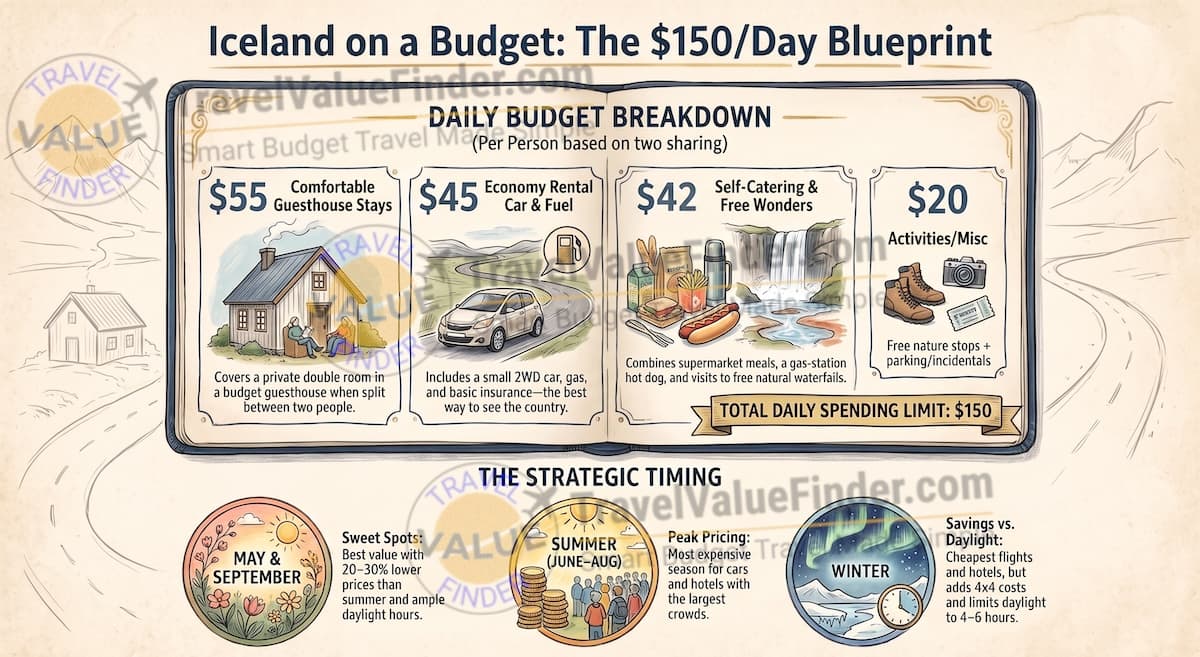
What does $150 a day buy in Iceland? A realistic Iceland travel budget of $150 per person (based on two people sharing) covers a guesthouse room, a rental car with gas and insurance, self-catered meals plus one restaurant stop, and one paid activity averaged across the trip – solidly above shoestring camping and well below the $300+/day ‘average traveler’ figure most sites quote.
Leslie Nics | TravelValueFinder.com | July, 2026 | Last reviewed: July 14, 2026
A $150-a-day Iceland travel budget is the sweet spot most guides skip entirely – too comfortable to be shoestring camping, too lean to be the $300+/day “average traveler” number every big Iceland site quotes. At $150 a day, split between two people sharing a rental car and a guesthouse room, you get a real bed, a proper meal every day, a car to actually see the country, and still walk away from Iceland’s most expensive attractions without flinching.
Here’s exactly how I’d spend it, and – just as important – the best time to visit Iceland to make that $150 stretch as far as it possibly can.
My Real Iceland Travel Budget: What $150 a Day Actually Covers
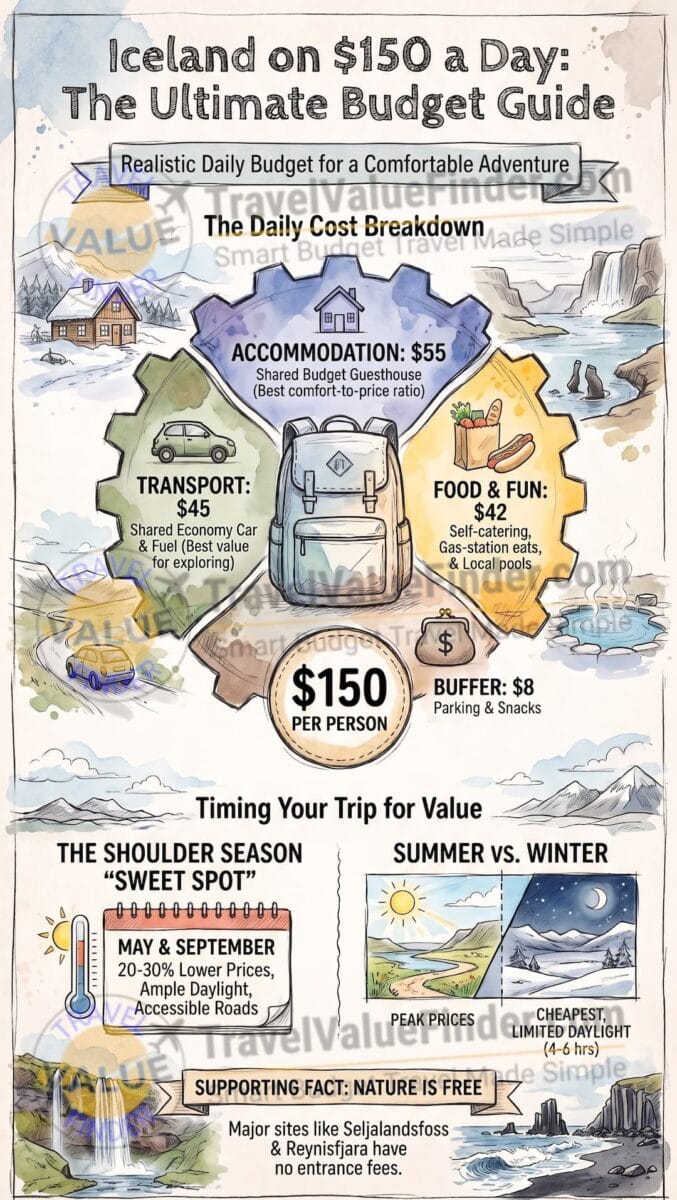
Here’s the full day, per person, assuming two people splitting a rental car and a guesthouse room – the way almost every serious Iceland budget breakdown (including my own) actually gets built.
| Category | Cost (Per Person) | What It Buys |
| Accommodation (guesthouse, shared) | $55 | A private double room in a budget guesthouse, split two ways |
| Rental car + gas + basic insurance (shared) | $45 | A small economy car, the only realistic way to see Iceland beyond Reykjavík |
| Food | $30 | Self-catered breakfast and lunch, one modest restaurant or gas-station meal |
| Activities (daily average) | $12 | Free waterfalls and hikes most days, one geothermal pool or paid stop averaged in |
| Buffer / incidentals | $8 | Parking fees, snacks, small extras |
| Total | $150 | A full, comfortable day in Iceland |
Every Iceland budget I read gave me two extremes: a camping trip that sounded miserable in the rain, or a number so high it didn’t feel like budget travel at all. $150 a day is the real middle nobody writes about. – Leslie Nics, TravelValueFinder.com
Why $150 a Day Is the Right Number, Not Just a Round One
Iceland’s own budget-travel data backs this up more precisely than you’d expect: independent travelers who’ve tracked their actual Iceland spending have landed on $100–150 a day as the realistic range for watching costs carefully while still eating real food and sleeping in a real bed, with true shoestring camping trips coming in closer to $75 and mid-range comfort trips running $300–350 a day or more.
$150 sits at the top of that tight-but-comfortable bracket – the version of budget travel that doesn’t feel like deprivation.
Where the Money Actually Goes
The room ($55). A guesthouse double outside central Reykjavík, or in a Ring Road town like Vík or Höfn, consistently beats hotel pricing for the same comfort level. Skip Reykjavík hotels beyond your first and last night – you’re paying for location you won’t use once you’re driving the Ring Road.
The car ($45). Every serious Iceland budget guide agrees on this one thing: a rental car isn’t optional if you want to see past the Golden Circle. An economy 2WD car, shared two ways with gas and basic collision coverage included, is the single best value decision in this entire budget – it unlocks nearly everything else on this list for free.
The food ($30). Breakfast and lunch from supermarkets like Bónus or Krónan (the two cheapest chains), plus one real meal – either a self-cooked dinner at a guesthouse with a kitchen, or Iceland’s famous gas-station hot dog, genuinely good and around $6–8. One sit-down restaurant meal every 2–3 days fits inside this average without breaking it.
The activities ($12, averaged). This is the line that surprises people: most of Iceland’s best experiences – Seljalandsfoss, Skógafoss, Reynisfjara black sand beach, the Golden Circle’s Þingvellir and Geysir – cost nothing to visit. Averaged across a week, $12 a day covers one modest paid stop (a public geothermal pool instead of the $95–124 Blue Lagoon) every couple of days, not a daily expense.
The Best Time to Visit Iceland If You’re Working With $150 a Day
Every generic “best time to visit Iceland” article treats the season question as being purely about weather and daylight. On a $150-a-day budget, the season you pick is just as much a financial decision as a scenic one, since Iceland’s prices swing 40–100% between summer peak and winter low.
| Season | Cost Impact | The Trade-Off |
| Summer (Jun–Aug) | Most expensive: hotels and cars near peak pricing, hardest to hit $150/day | 24-hour daylight, every road open, warmest weather – and the biggest crowds |
| Shoulder (May, Sept) | Best value: 20–30% cheaper than summer, still good weather and long days | Fewer crowds, most roads open, genuinely the sweet spot for this budget |
| Winter (Nov–Mar) | Cheapest: hotels and flights drop sharply, but car costs can rise for 4×4 needs | Northern Lights season, but only 4–6 hours of daylight and highland roads closed |
For a $150-a-day budget specifically, May or September is the honest answer to “when should I go” – not because the weather is dramatically better than summer, but because it’s the only window where the daily cost math and the daylight hours both work in your favor at the same time.
Winter gets you there even cheaper on flights and hotels, but you’ll spend more of your $150 on gas-and-insurance upgrades for winter tires and 4×4 capability, and you’ll lose several hours of usable daylight to actually go see anything.
I used to think ‘best time to visit’ was purely a weather question. On this budget, it’s really asking: which month lets my $150 buy the most day?. – Leslie Nics, TravelValueFinder.com
What a Real $150 Day Actually Looks Like
You wake up in a guesthouse outside Vík, make instant coffee and skyr with granola from the kitchen, and you’re on the road by nine. Reynisfjara’s black sand beach and basalt columns are free, and you’ll spend an hour there without noticing the time pass.
Lunch is a sandwich made from the morning’s supermarket run, eaten in the car with a waterfall visible through the windshield. Skógafoss and Seljalandsfoss – both free, both genuinely among the best waterfalls in the country – fill the afternoon; at Seljalandsfoss you can walk behind the falls if you don’t mind getting a little wet.
Dinner is a gas-station hot dog with all the toppings, which sounds like a punchline until you’ve actually had one. You end the day at a public swimming pool in whatever town you’re staying near – geothermally heated, a few dollars to enter, and the closest thing to the Blue Lagoon experience most locals actually use.
That’s a full, genuinely memorable day in Iceland, and it lands right at $150.
What This Budget Doesn’t Cover
- International flights – budgeted separately; shoulder-season round-trip fares from North America typically run $500–800
- The Blue Lagoon or other premium spas – $95–124 per visit; genuinely worth it once, but not a daily-budget line item
- Guided glacier, ice cave, or Northern Lights tours – $100–250 each; pick one splurge activity rather than several
- The 2026 kilometer tax on rental cars – a small per-kilometer road fee, typically $80–110 total for a full Ring Road trip, worth budgeting as a one-time add-on rather than a daily cost
5 Ways to Protect This Budget
- Book the rental car and accommodation 4–6 months out. Iceland’s limited supply means prices climb steadily as dates approach, especially for summer travel.
- Shop at Bónus and Krónan only. Convenience stores and gas-station shops mark up groceries significantly – the pink-pig-logo Bónus stores are consistently the cheapest.
- Buy alcohol at the airport duty-free on arrival. Bar and restaurant alcohol runs 3–4x the price; the Keflavík duty-free shop is the only meaningfully cheap option.
- Fill your water bottle from the tap. Iceland’s tap water is some of the cleanest on Earth – bottled water is an unnecessary daily cost.
- Use a no-foreign-transaction-fee card. Cards are accepted nearly everywhere in Iceland, making this an easy, no-effort saving – see our guide to the no foreign transaction fee credit card worth getting before any international trip.
What I’d Do Differently
On my first Iceland trip, I underestimated how much a single Blue Lagoon visit and one guided glacier tour would eat into an otherwise disciplined budget – two splurges in the same week pushed several days well past $150, and I felt it by the end of the trip.
I’d tell my past self to pick one splurge for the entire trip, not one per attraction that looked good on Instagram, and let the free waterfalls and hot pools carry the rest of the experience – which, honestly, they’re more than capable of doing.
Plan the Rest of Your Trip
- Solo Female Travel 2026: Safety, Stats & Best Destinations – Iceland ranks among the safest solo destinations in the world
- Northern Lights in Greenland: Best Time, Places & Tips – how Iceland compares if you’re weighing an aurora-focused trip
- The Only No Foreign Transaction Fee Credit Card I’d Get – avoid the invisible 3% tax on every purchase abroad
- Travel Insurance Guide – worth extra consideration given Iceland’s remote roads and unpredictable weather
- How to Find Cheap Flights: 12 Proven Strategies – for the flight portion of this budget
- Essential Travel Packing List – layers matter more in Iceland than almost anywhere else
People Also Ask
Is $150 a day enough for Iceland?
Yes, $150 a day, based on two people sharing a rental car and guesthouse room, is a realistic Iceland travel budget covering accommodation, a car, real food, and one modest paid activity averaged across the trip. It sits comfortably above true shoestring camping and well below the $300+/day mid-range figure most sites quote.
What is the best time to visit Iceland on a budget?
May or September offers the best combination of lower prices (20–30% below summer peak) and still-good weather and daylight, making it the strongest choice specifically for a $150-a-day budget. Winter is cheaper still but costs more daylight hours and adds winter-driving considerations.
Do I really need a rental car in Iceland?
For anything beyond Reykjavík and the closest Golden Circle stops, yes. Public transportation outside the capital is limited, and a shared rental car is consistently rated as the best value decision in an Iceland budget by nearly every independent traveler who’s tracked their spending.
How much does food cost per day in Iceland?
Around $22–36 a day for self-catered meals plus one restaurant or gas-station meal, based on shopping at budget supermarket chains like Bónus and Krónan rather than convenience stores or tourist-area restaurants.
Frequently Asked Questions
Is Iceland too expensive for budget travelers?
No, while Iceland is genuinely one of the more expensive countries to visit, most of its best experiences (waterfalls, black sand beaches, hiking trails, the Golden Circle’s natural sites) are free, which makes a disciplined $150-a-day budget realistic without feeling restrictive.
What’s the cheapest month to visit Iceland?
January through March typically offers the lowest flight and accommodation prices, with hotel rooms starting significantly below summer rates, though at the cost of only 4–6 hours of daylight and limited access to highland roads.
Can I see the Northern Lights on a $150-a-day trip?
Yes, Northern Lights viewing itself is free; you just need dark skies away from Reykjavík’s light pollution and some luck with clear weather. Guided aurora tours exist but aren’t necessary for a budget trip if you have a rental car.
Is camping a good way to cut this budget further?
Yes, swapping the guesthouse for a tent or basic campervan can bring the daily budget down to roughly $75–100, though it trades away weather protection and comfort, which matters more in Iceland than in most destinations given how quickly conditions change.
How many days should I plan for an Iceland trip on this budget?
7–10 days is the sweet spot for comfortably driving a meaningful portion of the Ring Road without rushing, at roughly $1,050–1,500 per person on the ground, excluding international flights.
Sources
- CDC – Travelers’ Health: Iceland – official health and vaccination guidance
Disclaimer: Prices in this article are estimates based on research at time of publication (2026) and can vary by season, exchange rate, and booking window. Confirm current pricing before finalizing a trip budget.
About the Author
Leslie Nics is the founder and primary travel researcher at Travel Value Finder. He specializes in budget travel, destination research, and itinerary planning, drawing on firsthand travel experience to help readers find affordable and practical travel options. Read more on the About page or see the site’s Trust & Transparency Policy.