Travel Value Finder

What’s the best time to see cherry blossoms in Japan? There’s no single fixed date – full bloom (mankai) typically falls in late March to early April in Tokyo, Kyoto, and Osaka, but shifts 1–3 weeks earlier or later depending on the year’s temperatures. The only reliable way to time a trip is to check the live Japan Meteorological Corporation or Weathernews forecast roughly 4–6 weeks before travel, not a fixed calendar date.
Hi, I’m Leslie Nics, founder of TravelValueFinder.com – a travel resource built on real trips, honest research, and a serious passion for getting the most out of every destination without overpaying. Every recommendation in this guide comes from boots-on-ground experience, cross-checked with top sources including the Japan National Tourism Organization and japan-guide.com. My goal: give you the insider knowledge that turns a good Tokyo trip into an unforgettable one. Updated July 2026
The best time to see cherry blossoms in Japan is not a fixed date, and almost every travel calendar telling you “late March to early April” is quietly setting you up to miss them. Bloom dates shift by one to three weeks from year to year depending on winter temperatures, the full bloom window lasts as little as five to seven days, and it varies by hundreds of miles as the cherry blossom season sweeps north across the country over nearly three months.
A static blog calendar can’t account for any of that – a live forecast can. Here’s how the season actually moves, when to genuinely lock in your trip, and what to do if the blossoms and your flight dates don’t line up.
The Best Time to See Cherry Blossoms in Japan (And Why the Generic Answer Is Wrong)
“Late March to early April” is the average across many years and many cities blended together – genuinely useful for a first pass at planning, genuinely misleading if you treat it as a promise. In practice, the best time to see cherry blossoms in Japan depends on three things a static date range can’t capture: which region you’re visiting, how warm that particular winter was, and how close to your travel dates the official forecast has actually been updated.
I’ve watched three different ‘best time to see cherry blossoms’ articles give three different fixed dates for the same city. None of them were wrong exactly – they just can’t know this year’s answer, because nobody can, until the forecast catches up. – Leslie Nics, TravelValueFinder.com
Why the Dates Move So Much Every Year
Cherry blossoms bloom in response to accumulated warmth after winter dormancy, not a calendar date. A colder-than-average winter followed by a sudden warm spell can trigger bloom a full week earlier than the historical average; a slow, cool spring can delay it by just as much. Japan’s meteorological data over the past several decades shows a gradual trend toward earlier blooming overall, tied to warming average temperatures – which is exactly why a “best time” answer written even five years ago can already be running a few days late.
On top of year-to-year shift, full bloom (mankai) typically lasts only five to seven days before petals begin falling, and a strong spring rainstorm can end it early. That combination – a moving target with a short window – is the entire reason “just go in early April” is such shaky advice.
How the Season Actually Moves: The Sakura Front
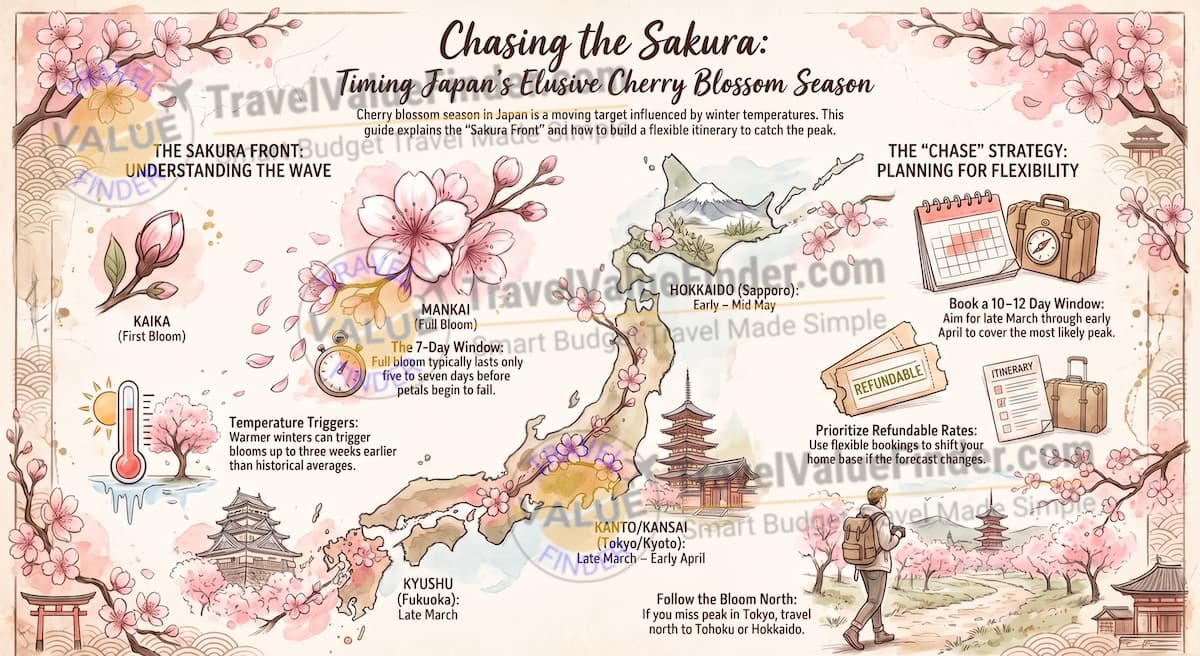
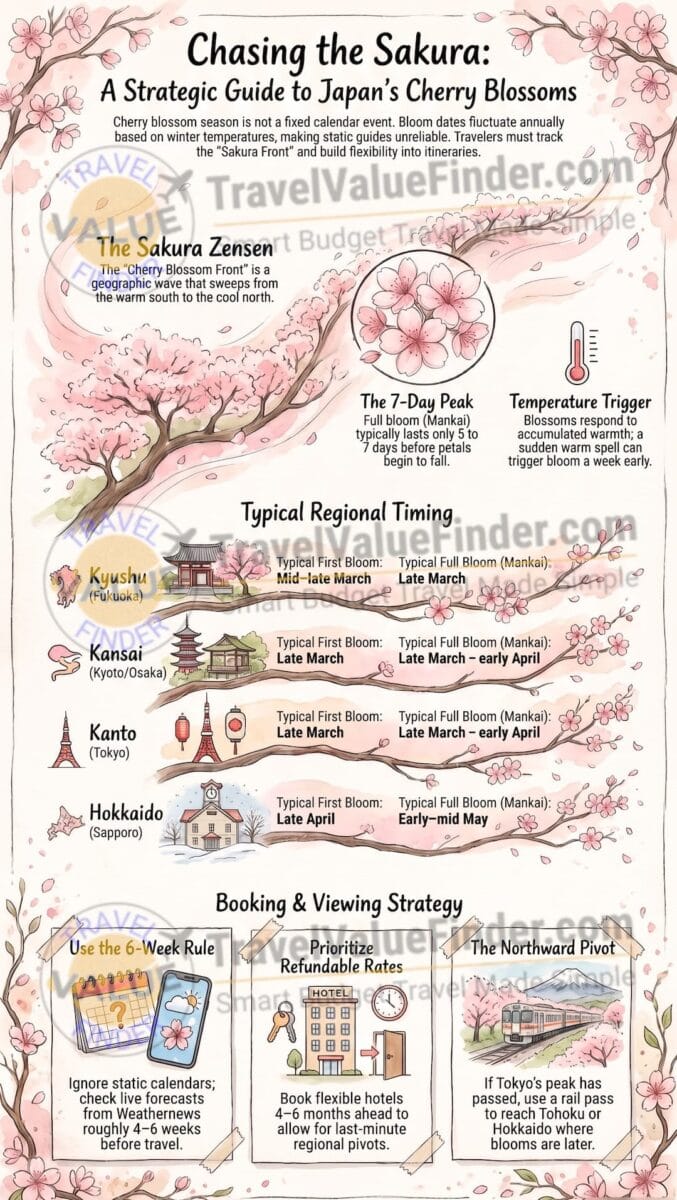
Japanese forecasters track cherry blossom progress as a moving line called the sakura zensen, or cherry blossom front – starting in the warmer south and sweeping north over roughly two and a half months. Understanding this wave is more useful than memorizing a single date, because it tells you where to look if your fixed travel dates don’t line up with any one city’s peak.
| Region | Typical First Bloom | Typical Full Bloom (Mankai) |
| Okinawa | Mid-January | Late January – early February |
| Kyushu (Fukuoka, Kumamoto) | Mid–late March | Late March |
| Kansai (Kyoto, Osaka, Nara) | Late March | Late March – early April |
| Kanto (Tokyo, Yokohama) | Late March | Late March – early April |
| Chubu (Nagoya, Kanazawa, Mt. Fuji area) | Late March – early April | Early–mid April |
| Tohoku (Sendai) | Early–mid April | Mid–late April |
| Hokkaido (Sapporo) | Late April | Early–mid May |
Treat this table as a typical range across recent years, not a promise for any specific year – that’s the entire point of this article. The real value here is the shape of the wave: if Tokyo’s blossoms have already peaked by the time you land, Tohoku or Hokkaido are very likely still ahead of you, not behind.
How to Actually Track the Real Forecast
The only genuinely reliable timing information comes from live seasonal forecasts, not fixed-date articles. Japan’s private weather forecasting companies release a tentative cherry blossom forecast in January, then update it weekly through February and March as real temperature data comes in – the closer to bloom time, the more accurate it gets.
The Japan Meteorological Agency also publishes official phenological observation data for reference. My practical rule: don’t fully trust a forecast more than about six weeks out, and check again roughly ten days before departure, since that’s when the prediction window tightens meaningfully.
The Booking Strategy That Actually Works
Because you can’t book a nonrefundable trip around a forecast that doesn’t exist yet ten months in advance, the realistic strategy is booking flexibility, not precision:
- Book flights and refundable-rate hotels for a target window, not a single date. A 10–12 day window covering late March through early April covers most years’ full bloom in Kansai and Kanto, even with typical year-to-year shift.
- Choose a home base with more than one nearby viewing region. Basing in Tokyo or Osaka gives you access to both an early-blooming region and a later one within a short train ride, which is real insurance against a bad-timing year.
- Build in at least one buffer day with no fixed plans. If the forecast shifts a few days right before you land, you want the flexibility to chase the bloom rather than watch it from a scheduled museum visit.
- Have a non-sakura backup plan for each day, not just the trip. Every major viewing spot has a genuinely worthwhile non-blossom version of itself – this removes the pressure of a single make-or-break week.
If You Miss Peak Bloom: The Backup Plan Nobody Talks About
This is the part most cherry blossom guides skip entirely: missing peak bloom in one city is not the end of the trip. If Kyoto and Tokyo have already peaked, Tohoku (Sendai) and Hokkaido (Sapporo) are typically two to five weeks behind and still building toward their own full bloom – meaning a well-planned north-moving itinerary can chase the sakura front for the better part of a month rather than gambling everything on one week in one city.
Mount Yoshino, with roughly 30,000 cherry trees planted at different elevations, also blooms in a staggered wave across its own slopes, extending the viewing window at a single location by up to two weeks.
The best cherry blossom trip I ever took wasn’t the one where I nailed peak bloom in Kyoto. It was the one where I gave up chasing a single perfect week and instead followed the bloom north for ten days. – Leslie Nics, TravelValueFinder.com
The Trade-Off Nobody Mentions: Cost and Crowds
It’s worth being honest about the other side of this: cherry blossom season is also the single most expensive and crowded stretch of the Japanese travel calendar, with accommodation prices commonly spiking 20–50% above normal and hotels in Kyoto booking out months in advance.
If the blossoms themselves aren’t the specific reason for your trip, our full Japan budget guide walks through why May or September often deliver a better cost-to-experience ratio. This guide is for the reader who has already decided the blossoms are worth the premium – if that’s you, the strategy above is how to actually get your money’s worth out of that decision.
Where to See Them Without Fighting the Biggest Crowds
- Shinjuku Gyoen, Tokyo – a large paid-entry garden (small fee) that thins crowds compared to the fully free, packed Ueno Park nearby
- Philosopher’s Path, Kyoto – a quieter canal-side walk versus the more famous, more crowded Maruyama Park
- Kema Sakuranomiya Park, Osaka – a riverside stretch with real local hanami energy and noticeably fewer tourists than central Osaka Castle Park
- Hirosaki Castle, Aomori – a genuinely spectacular, far less crowded alternative for travelers willing to go north and later in the season
- Early morning at any spot. Arriving by 7:30–8:00 a.m. at even the famous locations routinely means a near-empty view before tour groups arrive.
What I’d Do Differently
On my first cherry blossom trip, I booked based on a single blog post’s fixed date and landed four days after peak bloom in Tokyo, with petals already falling. I didn’t have a backup region built into the itinerary, so I spent the rest of the trip chasing blossoms reactively instead of by plan – which meant long, unplanned train rides that ate into time I’d wanted for other things.
Next time, I’d build the north-to-south flexibility into the itinerary from day one, rather than treating it as a fallback.
Plan the Rest of Your Trip
- How Much Does It Cost to Visit Japan? 2026 Budget Guide – full cost breakdown, including cherry blossom season price spikes
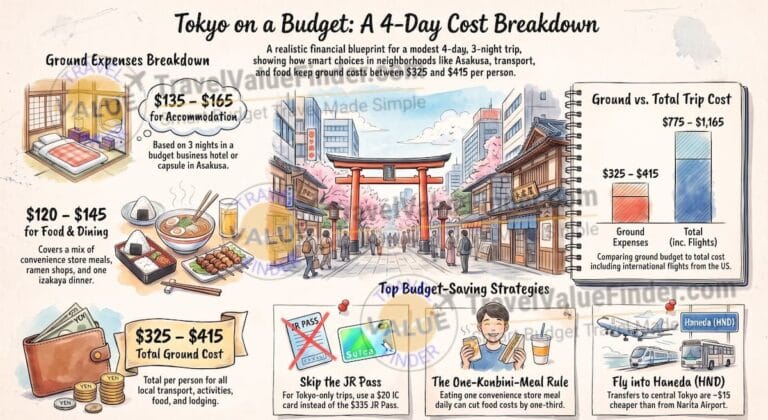
- What 4 Days in Tokyo on a Modest Budget Actually Costs – a full Tokyo itinerary you can adapt around bloom timing
- 25 Best Things to Do in Tokyo – non-blossom backup plans for any day of the trip
- Japan Travel Guide – the hub page for everything else on TravelValueFinder about Japan
- How to Find Cheap Flights: 12 Proven Strategies – booking flexibility strategies that pair well with a shifting bloom forecast
- Travel Insurance Guide – worth extra consideration given how much of this trip depends on shifting plans
People Also Ask
When exactly do cherry blossoms bloom in Japan?
Typically late March to early April in Tokyo, Kyoto, and Osaka, but the exact date shifts by 1–3 weeks year to year and is only reliably known once the live seasonal forecast updates in February and March.
What is the difference between kaika and mankai?
Kaika refers to first bloom, when roughly 5–6 flowers have opened on a reference tree. Mankai (full bloom) is when 80% or more of the tree’s buds have opened, typically 7–10 days after kaika.
Is it better to visit Tokyo or Kyoto for cherry blossoms?
Both typically bloom around the same time, so the choice usually comes down to atmosphere rather than timing: Tokyo offers larger parks and a more modern backdrop, while Kyoto pairs blossoms with traditional temples and gardens, at a higher accommodation cost and larger crowds.
How far in advance should I book a cherry blossom trip to Japan?
Book flights and refundable accommodation 4–6 months ahead for a target window, then monitor the live forecast starting in January and finalize exact regional plans 4–6 weeks before departure.
Frequently Asked Questions
How long does cherry blossom season actually last in one city?
Full bloom itself lasts only about 5–7 days in a single location, though the broader blossoming period (first bloom through petals falling) can stretch to two to three weeks.
Can I see cherry blossoms outside of Tokyo and Kyoto?
Yes, nearly every region of Japan has cherry blossoms, and less-touristed viewing spots in Kyushu, Tohoku, and Hokkaido often offer a comparable experience with far smaller crowds.
Do cherry blossoms bloom the same time every year?
No. Bloom dates shift based on that winter and spring’s specific temperatures, with a general long-term trend toward slightly earlier blooming linked to rising average temperatures.
What happens if it rains during cherry blossom season?
A strong rainstorm during full bloom can knock petals off the trees within a day or two, which is one more reason the “exact peak week” is genuinely unpredictable even with a good forecast.
Is Mount Fuji a good place to see cherry blossoms?
Yes, the Chureito Pagoda and Lake Kawaguchi areas near Mount Fuji offer a well-known combination of blossoms and mountain views, typically blooming slightly later than central Tokyo.
Sources
- Japan Meteorological Agency – official government weather and phenological observation data
- Japan National Tourism Organization (JNTO) – official tourism board, seasonal travel guidance
Disclaimer: Bloom date ranges in this article reflect typical historical patterns and can vary meaningfully year to year. Always confirm timing against a current-year live forecast before finalizing travel plans.
About the Author
Leslie Nics is the founder and primary travel researcher at Travel Value Finder. He specializes in budget travel, destination research, and itinerary planning, drawing on firsthand travel experience – including multiple Japan trips – to help readers find affordable and practical travel options. Read more on the About page or see the site’s Trust & Transparency Policy.