Travel Value Finder

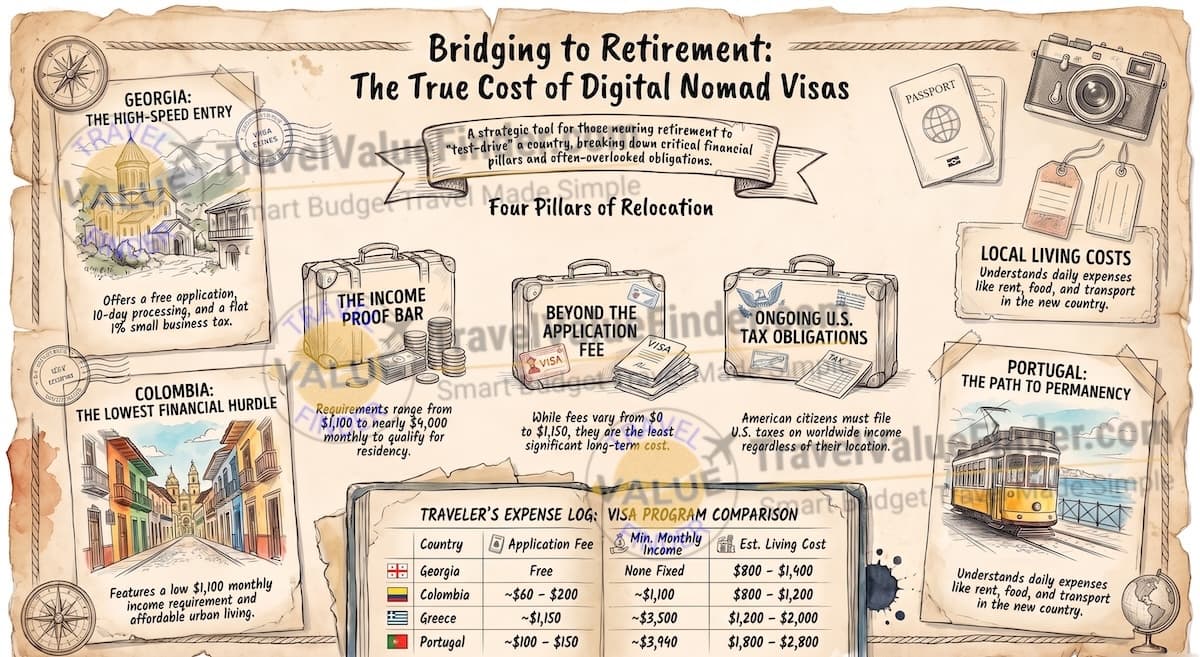
What does a digital nomad visa actually cost? Application fees typically range from $0 (Georgia) to over $1,000 (Greece), separate from the minimum monthly income you must prove, which ranges from about $1,100 (Colombia) to nearly $4,000 (Portugal). The true cost also includes local living expenses and, for Americans, continued U.S. tax filing regardless of where you live.
Leslie Nics, TravelValueFinder.com | Last updated: July 2026 | Last Reviewed: July 15 2026
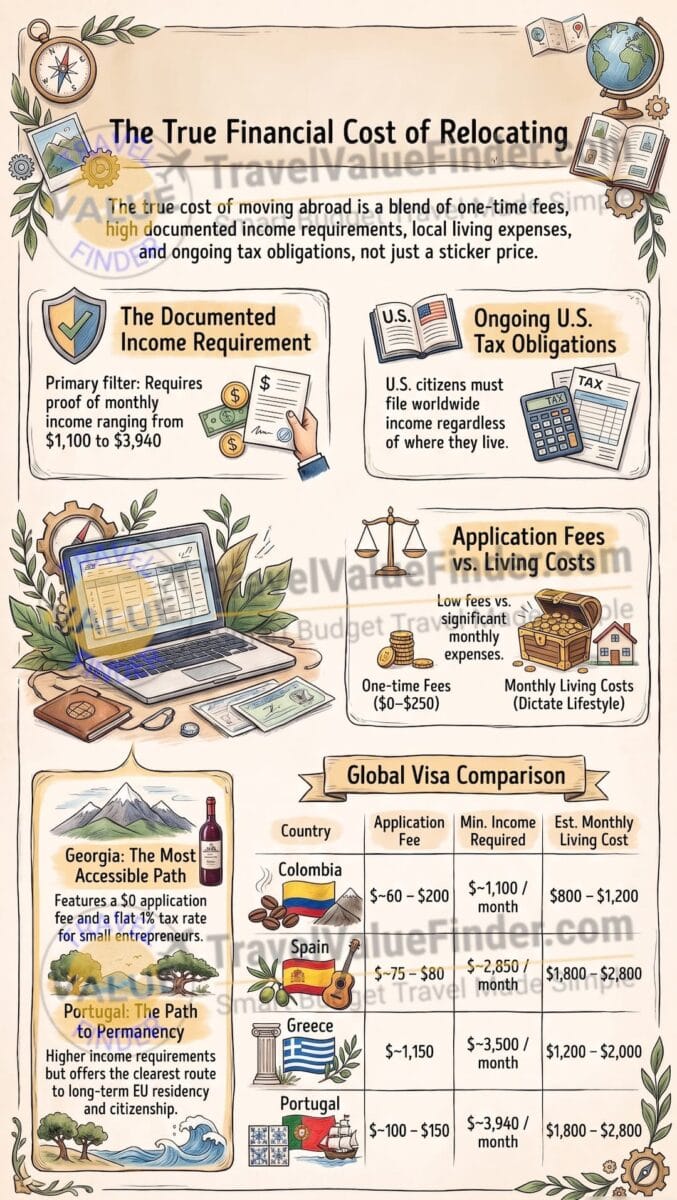
If you’re 55 and not ready to fully retire but genuinely ready for a change of scenery, the real digital nomad visa cost question isn’t just “how much is the application fee.” It’s application fees ($0–$1,000+ depending on the country), a minimum monthly income requirement you have to prove ($1,100–$3,940 depending on the country), the actual cost of living once you’re there, and – for Americans specifically – what it does to your U.S. tax return.
Most digital nomad visa guides are written for 27-year-old freelancers testing out van life.
This one is written for the person weighing a digital nomad visa as a genuine bridge between working full-time and full retirement abroad – someone closer to the audience of our retirement destination guides than a backpacker blog. Here’s what it actually costs, country by country.
What Digital Nomad Visa Costs Actually Look Like (Country by Country)
Before the country-by-country breakdown, the short version: digital nomad visa costs break into four separate line items that most guides blur together – a one-time application fee, an income you must prove (not a fee, but a hard requirement), the actual monthly cost of living once you’re there, and your ongoing U.S. tax obligation. Here’s how six popular options compare on all four.
| Country | Application Fee | Min. Monthly Income Required | Est. Monthly Living Cost |
| Georgia | Free | None (income proof, no fixed minimum) | $800 – $1,400 |
| Colombia | ~$60 – $200 | ~$1,100/month | $800 – $1,200 |
| Costa Rica | ~$100 – $250 | ~$3,000/month (single applicant) | $1,500 – $2,500 |
| Greece | ~$1,150 (incl. €150/dependent) | ~$3,500/month | $1,200 – $2,000 |
| Spain | ~$75 – $80 | ~$2,850/month | $1,800 – $2,800 |
| Portugal (D8) | ~$100 – $150 | ~$3,940/month | $1,800 – $2,800 |
Every digital nomad visa comparison I found was written like the reader is 28 and deciding between Bali and Lisbon on a whim. I wanted the version for someone weighing this as a real bridge between working and retiring, not a gap year. Leslie Nics, Founder & Lead Travel Writer, TravelValueFinder.com
The Four Real Costs Nobody Separates Clearly
1. The application fee. A one-time, often modest cost – Georgia’s is free, most others fall between $60 and $250. Greece is a notable outlier at roughly $1,150 including dependent fees.
2. The income requirement. Not a cost you pay, but a bar you must clear and document – bank statements, employment contracts, or freelance income proof. This is the single biggest filter on which countries are realistic for a given income level, and it varies by more than 3x across popular options.
3. The actual cost of living. The number that determines your quality of life once you’re approved, and the one most comparison charts bury below the visa mechanics. A country with an easy visa and a low income threshold isn’t automatically a good deal if living costs eat the difference.
4. Your ongoing U.S. tax obligation. The cost every non-American guide skips entirely and every American reader needs. This is significant enough that it gets its own section below.
Four Countries Worth a Closer Look
Georgia – the free, fast option. Georgia’s “Remotely from Georgia” program is free to apply for, processes in about 10 business days, and citizens of the U.S. and dozens of other countries can already enter visa-free for up to a year, which the program simply formalizes into a legal work status. Georgia also offers a flat 1% tax rate for individuals registered as small business entrepreneurs – genuinely one of the most tax-efficient options in this comparison, on top of being the cheapest to enter.
Colombia – the lowest income bar. At roughly $1,100 a month in required income, Colombia has one of the most accessible thresholds of any digital nomad visa globally, paired with a genuinely low cost of living in cities like Medellín, where $800–1,200 a month covers a comfortable one-bedroom, dining out regularly, and healthcare.
Costa Rica – the territorial tax advantage. Costa Rica taxes on a territorial basis, meaning foreign-sourced remote income generally isn’t taxed locally at all – a real advantage over countries like Spain or Portugal, which begin taxing worldwide income once you become a local tax resident. This pairs well with the country’s existing appeal to the site’s retiree-adjacent audience – see our full Costa Rica travel budget breakdown for what daily life costs there beyond the visa question.
Portugal – the path to something more permanent. Portugal’s D8 visa has the highest income requirement in this comparison at roughly $3,940/month, but it’s also the clearest path to long-term EU residency and eventual citizenship of any option here – a meaningfully different proposition than a visa that expires with no further pathway. If Portugal is on your radar for its retirement appeal as much as its remote-work visa, our Portugal cost guide and Spain vs. Portugal retirement comparison cover the bigger picture.
The U.S. Tax Question Almost Every Guide Skips
Here’s the detail that matters most for American readers and gets the least attention: the United States taxes citizens on worldwide income regardless of where they live. A digital nomad visa changes where you’re legally allowed to live and work – it does not change your obligation to file a U.S. tax return.
The primary tool that reduces the actual tax bill is the Foreign Earned Income Exclusion, which allows qualifying Americans living abroad to exclude a set amount of foreign-earned income (adjusted annually) from U.S. federal tax. Whether a specific country also taxes that same income locally depends entirely on that country’s residency rules – some, like Georgia and Costa Rica, are genuinely favorable; others begin taxing worldwide income after roughly 183 days of residency.
This is genuinely a case where a qualified tax professional, not a blog post, should confirm your specific situation before you commit to a country.
The visa fee is the smallest number in this entire decision. The tax treatment and the income requirement are the two that actually determine whether a country works for you. Leslie Nics, Founder & Lead Travel Writer, TravelValueFinder.com
Who This Actually Makes Sense For
A digital nomad visa is a genuinely different tool than a retirement visa, and worth being clear-eyed about which one fits your actual situation.
It makes the most sense if you have steady remote income you can document, you’re not ready to fully stop working, and you want to legally test a country for a year or two before committing to something more permanent – which is exactly the audience this guide is written for, distinct from either a 20-something backpacker or a fully retired reader with no income requirement to prove.
If full retirement, rather than continued remote work, is closer to your actual plan, our guide to affordable retirement countries and common mistakes when moving to France cover that path specifically, since the visa category, income requirements, and healthcare considerations are meaningfully different from a digital nomad visa.
What I’d Do Differently
I initially treated the application fee as the main cost comparison point across countries, the way most guides frame it – and it’s genuinely the least important number in the whole decision.
The income requirement determines which countries are even realistic, and the tax treatment determines what you actually keep. I’d tell my past self to build the comparison in that order – tax treatment and income fit first, application fee last – rather than starting with the cheapest sticker price and working backward.
Plan the Rest of Your Move
- Affordable Retirement: Best Countries to Retire – if full retirement, not remote work, is the actual goal
- Costa Rica Travel Budget – real daily costs for one of this guide’s top territorial-tax picks
- How Expensive Is Portugal? A Real Cost Guide – the fuller cost picture behind Portugal’s D8 visa
- Spain vs. Portugal Retirement – for readers weighing these two beyond just the visa
- Common Mistakes When Moving to France – visa, healthcare, and bureaucracy lessons that apply well beyond France
- Travel Insurance Guide – worth reviewing before any extended stay abroad
- The Only No Foreign Transaction Fee Credit Card I’d Get – relevant for ongoing spending once you’ve relocated
People Also Ask
How much does a digital nomad visa cost?
Application fees typically range from free (Georgia) to around $1,150 (Greece, including dependent fees), separate from the minimum monthly income requirement you must document, which ranges from roughly $1,100 to nearly $4,000 depending on the country.
What is the cheapest digital nomad visa to get?
Georgia’s “Remotely from Georgia” program is free to apply for and has no fixed minimum income threshold, making it one of the most accessible options currently available, alongside Colombia’s roughly $1,100/month income requirement.
Do digital nomad visa holders still pay U.S. taxes?
Yes. U.S. citizens must file federal tax returns on worldwide income regardless of where they live. The Foreign Earned Income Exclusion can reduce the actual tax owed on foreign-earned income, but it does not eliminate the filing requirement.
Can I use a digital nomad visa as a step toward retirement abroad?
Yes, for many readers this is exactly the appeal – some digital nomad visas (like Portugal’s D8) offer a path toward longer-term residency, letting you test a country while still working before deciding whether to pursue full retirement relocation there.
Frequently Asked Questions
Do I need to quit my job to get a digital nomad visa?
No, most digital nomad visas are specifically designed for people who keep their existing remote job or freelance income, as long as that income comes from outside the host country.
How long does a digital nomad visa typically last?
Most programs run 6 months to 2 years initially, with many offering renewal options; a smaller number, like Portugal’s D8, offer a clearer path toward longer-term residency.
Can my spouse or children come with me on a digital nomad visa?
Most programs allow dependents to apply alongside the primary applicant, typically with an additional per-dependent fee and sometimes a higher combined income requirement.
Is health insurance required for a digital nomad visa?
Yes, in nearly all programs – proof of health insurance valid in the host country is a standard requirement alongside income documentation.
Is this article legal or immigration advice?
No. This article reflects independent research and general information, not personalized legal, immigration, or tax advice. Visa rules, income thresholds, and tax treaties change frequently – always confirm current requirements with the country’s official immigration source and a qualified tax professional before applying.
Sources
- IRS – Foreign Earned Income Exclusion – official U.S. government guidance on tax treatment for Americans working abroad
- U.S. Department of State – International Travel – official travel and entry guidance by country
Disclaimer: This article is for general informational purposes and reflects independent research, not personalized legal, immigration, or tax advice. Visa fees, income thresholds, and tax rules change frequently and vary by individual circumstances; always confirm current requirements directly with the relevant country’s official immigration authority and a qualified immigration attorney or tax professional before making relocation decisions. TravelValueFinder is not a law firm or tax advisory service.
About the Author
Leslie Nics is the founder and primary travel researcher at Travel Value Finder. He specializes in budget travel, destination research, and itinerary planning, drawing on firsthand travel experience to help readers find affordable and practical travel options. Read more on the About page or see the site’s Trust & Transparency Policy.