How I’d Spend a Week in Costa Rica Without Blowing the Budget (My Real Costa Rica Travel Budget)

What does a week in Costa Rica cost on a budget? A realistic Costa Rica travel budget runs about $105–110 per person, per day (roughly $735–770 for a full week), covering mid-range accommodation, meals at local restaurants, shared shuttle transport, and one guided tour every couple of days – well above shoestring hostel travel, well below the $200+/day luxury tier.

A realistic Costa Rica travel budget for a full week, on the ground, is around $105 a day per person – enough to see the volcanoes, the cloud forest, and the beach without staying in a hostel dorm or nickel-and-diming every meal.

Costa Rica has a reputation as the expensive outlier of Central America, and that reputation is fair – but most budget guides respond to it with either a shoestring backpacker number that means skipping half the country, or a luxury number that isn’t really “budget” at all. Here’s the week I’d actually book, region by region, with the real math behind it.

Leslie Nics, TravelValueFinder.com | Last updated: July 2026 | Last Reviewed: July 16 2026

My Real Costa Rica Travel Budget: What a Week Actually Costs

Here’s the full week at a glance before the day-by-day breakdown. This covers the classic first-timer route – Arenal, Monteverde, and the Pacific coast – without cutting the corners that make a trip feel like deprivation.

CategoryCost (Per Person, Per Day)What It Buys
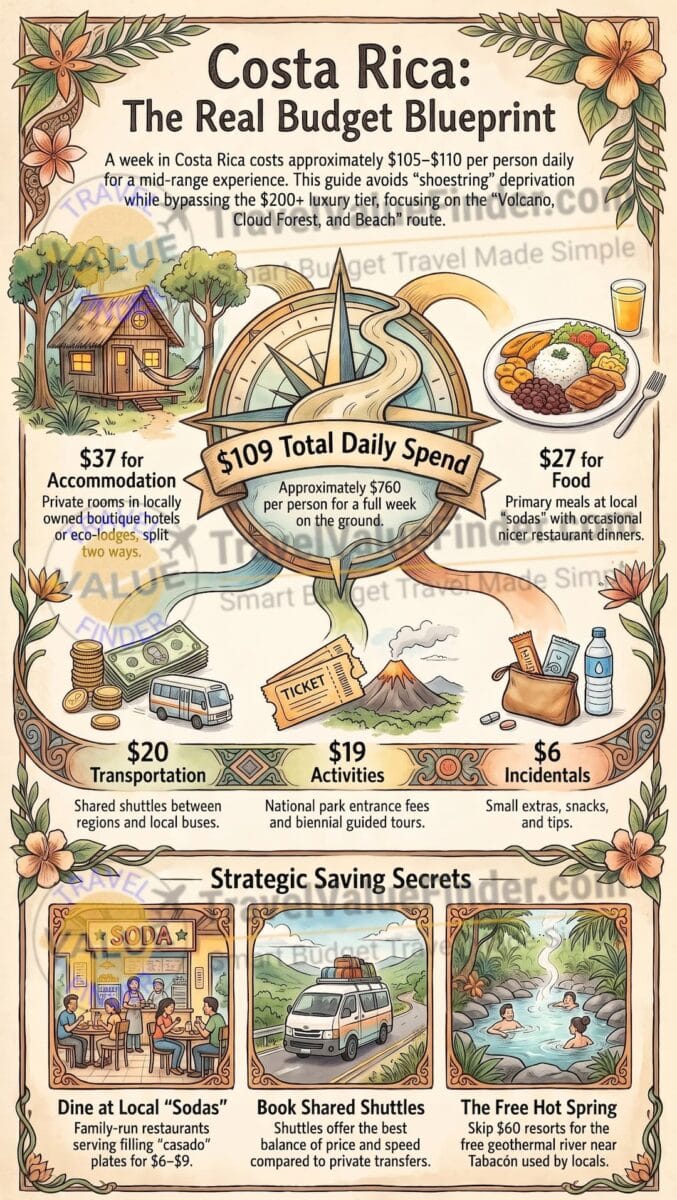
Accommodation (shared, mid-range)$37A clean private room at a boutique hotel or eco-lodge, split two ways
Food$27Meals at local sodas plus a couple of nicer restaurant dinners
Transportation$20Shared shuttles between regions, local buses, occasional taxis
Activities & tours (daily average)$19National park entrance fees plus one guided tour every 2–3 days
Buffer / incidentals$6Snacks, tips, small extras
Daily total$109Roughly $760 per person for the full week, on the ground

Every Costa Rica budget I read gave me either a hostel-dorm number that meant skipping Monteverde entirely, or a number so high it stopped being a budget trip. $105 a day is the real number for the trip most people actually want to take. Leslie Nics, Founder & Lead Travel Writer, TravelValueFinder.com

Why $105 a Day Is the Right Number for Costa Rica

Costa Rica genuinely costs 40–60% more than its Central American neighbors, and every serious cost breakdown of the country agrees on the same rough shape: true shoestring backpacking runs $45–90 a day, and a comfortable mid-range trip – good lodges, real meals, a reasonable number of tours – lands consistently in the $90–200 a day range depending on the source.

$105 sits right at the accessible end of that mid-range band: enough to avoid the dorm-room-and-rice-and-beans version of Costa Rica, without stepping into the $200+ eco-luxury tier that most budget travelers don’t need.

The Week I’d Actually Book: Arenal, Monteverde, and the Pacific Coast

This is the route nearly every first-time Costa Rica itinerary converges on for good reason – it’s the only combination that fits a single week without spending half of it in transit, and it covers the three landscapes that make the country worth visiting: volcano, cloud forest, and beach.

Day 1 – Arrive in San José, transfer to La Fortuna. A shared shuttle from San José to the Arenal/La Fortuna area takes about 3–3.5 hours and costs roughly $15–20 per person – noticeably cheaper than a private transfer and only slightly slower.

Day 2 – Arenal Volcano and La Fortuna Waterfall. A guided hike around the volcano’s old lava fields runs about $45–55 per person; La Fortuna Waterfall’s entrance fee is around $18. Both are genuinely worth the cost and anchor the day’s activity budget.

Day 3 – Hot springs, then travel to Monteverde. The famous resort hot springs (Tabacón, Baldi) run $60–90 per person – skip them. There’s a free public hot spring river spot near the road to Tabacón that locals actually use, with the same geothermal water for $0. The afternoon shuttle to Monteverde (about 3 hours on a rough road) runs $12–18.

Day 4 – Monteverde Cloud Forest Reserve and hanging bridges. Reserve entrance is about $22–26; the hanging bridges walk (a separate attraction) is another $25–30. Doing both in one day is a full, memorable day and the single best justification for the higher end of the activities budget.

Day 5 – Travel to the Pacific coast (Manuel Antonio or Uvita). The shuttle south runs 3.5–4.5 hours and costs $25–35 – the priciest transfer of the week, but there’s no efficient budget alternative for this particular leg.

Day 6 – Manuel Antonio National Park. Entrance is $18, and sloths, monkeys, and pristine beach inside the park make it worth every dollar of the week’s activities budget. A local guide (optional, shared among a small group) adds about $15–20 per person and dramatically increases the wildlife you’ll actually spot.

Day 7 – Beach day, then return to San José for departure. A free day by design – the beach costs nothing, and it’s the natural place in the itinerary for the week’s activities budget to rest before the final shuttle back to the airport.

The best days of that week cost the least – a free hot spring, a free beach, a park entrance fee that’s a fraction of what people assume Costa Rica costs. The expensive days were expensive on purpose, not by accident. Leslie Nics, Founder & Lead Travel Writer, TravelValueFinder.com

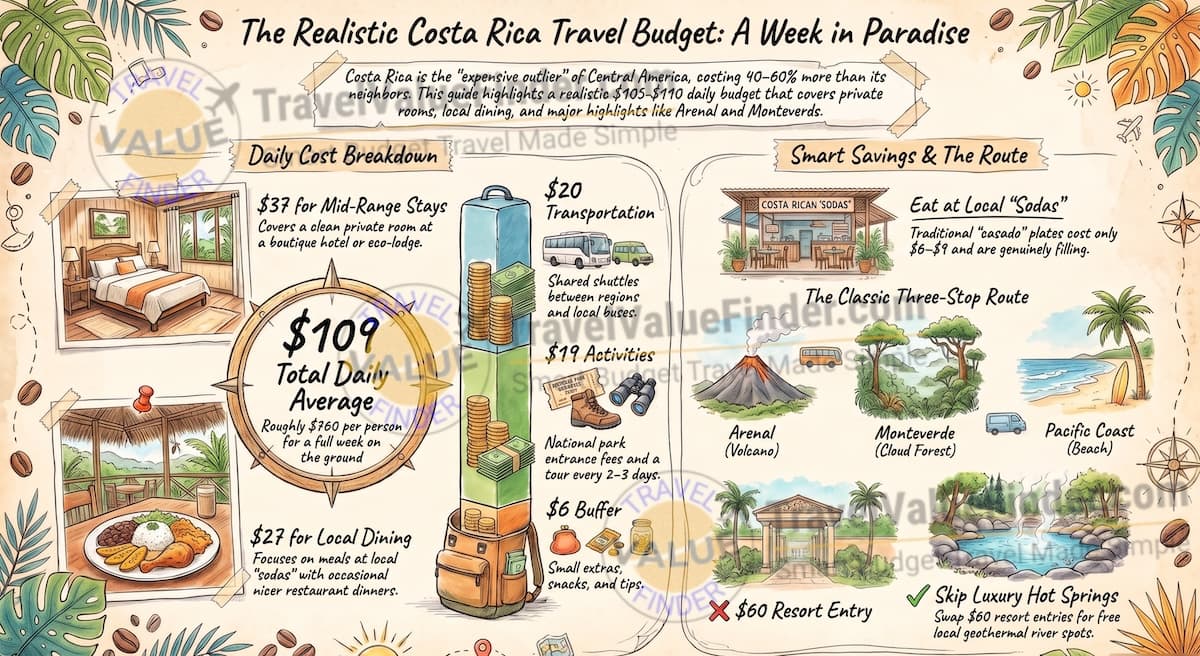
Costa Rica Travel Budget Cost Guide Infographic - Travel Value Finder
Costa Rica Travel Budget Cost Guide Infographic – Travel Value Finder

Where the Money Actually Goes

Accommodation ($37/day). A private room at a locally owned boutique hotel or eco-lodge, split two ways, consistently beats an international chain hotel on both price and character. Booking directly with the lodge, rather than through a major OTA, often saves an additional 10–15%.

Food ($27/day). A soda – Costa Rica’s everyday local restaurant – serves a casado (rice, beans, protein, salad) for $6–9, genuinely filling and good. Save restaurant dining for one or two nights; the rest of the week’s meals at sodas keep this line item well under control.

Transportation ($20/day, averaged). Shared shuttles are the sweet spot between the cheapest-but-slowest public bus and the fastest-but-priciest private transfer or rental car – and they remove the stress of navigating unmarked rural roads yourself.

Activities ($19/day, averaged). This line swings hard by day – some days are free, others run $50+ – but it averages out cleanly across the week if you follow the pattern above: one paid highlight activity most days, with free wildlife-watching and beach time filling the rest.

What This Budget Doesn’t Cover

  • International flights – budgeted separately; date-flexible round-trip fares from the U.S. typically run $300–550
  • A rental car – shared shuttles cover this itinerary well, but a 4×4 rental (often needed for rural roads) runs $40–75/day including mandatory insurance if you’d rather self-drive
  • Alcohol beyond a casual drink or two – imported beer and spirits carry a real markup in tourist areas
  • Travel insurance – genuinely worth budgeting separately given the adventure-activity-heavy nature of a typical Costa Rica trip

5 Ways to Protect This Budget

  • Withdraw colones, not dollars, from ATMs. Paying in USD at restaurants and shops routinely applies a worse exchange rate than paying in the local currency.
  • Book shared shuttles in advance, not private transfers on arrival. The price gap between the two is often 2–3x for the same route.
  • Skip the resort hot springs. The free public spot near Tabacón delivers the same geothermal water experience for $0 instead of $60–90.
  • Eat where the menu is only in Spanish. A soda with a Spanish-only menu is a reliable signal of local pricing rather than tourist markup.
  • Use a no-foreign-transaction-fee card for anything not paid in cash. See our guide to the no foreign transaction fee credit card worth getting before any international trip.

What I’d Do Differently

I booked the Manuel Antonio shuttle as a private transfer on my first trip, purely because it was the last piece I arranged and I didn’t want to deal with shared-shuttle scheduling. It cost roughly triple the shared-shuttle rate for a ride that took only about 20 minutes less.

I’d tell my past self to book every transfer at least a few days ahead – the shared shuttles fill up, but they’re rarely actually full, and the savings are too large to leave on the table for the sake of convenience.

Plan the Rest of Your Trip

People Also Ask

Is $100 a day enough for Costa Rica?

Yes, around $100–110 a day is a realistic, comfortable Costa Rica travel budget covering mid-range accommodation, real meals, shared transport, and regular activities, well above shoestring hostel travel and below the $200+/day luxury tier.

How much does a week in Costa Rica cost?

A week on the ground typically costs $735–770 per person at a smart mid-range budget of roughly $105–110/day, not including international flights, which usually add another $300–550 round trip from the U.S.

Why is Costa Rica more expensive than other Central American countries?

Costa Rica’s stronger infrastructure, extensive environmental protections, well-developed tourism industry, and 13% VAT combine to make it 40–60% more expensive than neighbors like Nicaragua, Guatemala, or Honduras for similar services.

What’s the best itinerary for one week in Costa Rica?

Arenal (volcano and hot springs), Monteverde (cloud forest), and a Pacific coast stop like Manuel Antonio is the most common and efficient first-timer route, balancing travel time against seeing the country’s three signature landscapes.

Frequently Asked Questions

Do I need a rental car in Costa Rica?

Not necessarily, shared shuttles cover the classic Arenal–Monteverde–Pacific coast route well and remove the stress of navigating rural roads yourself. A 4×4 rental makes sense mainly for more remote or flexible itineraries.

Is it cheaper to book Costa Rica tours in advance or on arrival?

Booking directly with local tour operators a few days ahead is usually cheaper than last-minute booking through a hotel concierge, which often adds a markup.

What is a soda in Costa Rica?

A soda is a small, family-run local restaurant serving affordable traditional meals, typically $6–9 for a filling casado plate – the single best way to keep a Costa Rica food budget under control.

Is it safe to drink tap water in Costa Rica?

Yes, in most of the country, including San José and major tourist areas, tap water is safe to drink. Some remote rural areas may warrant bottled water as a precaution.

What’s the cheapest time of year to visit Costa Rica?

The green season (May–November) offers noticeably lower prices on accommodation and tours compared to the December–April dry season, in exchange for more frequent afternoon rain showers, which rarely last all day.

Sources

Disclaimer: Prices in this article are estimates based on research at time of publication (2026) and can vary by season, region, and exchange rate. Confirm current pricing before finalizing a trip budget.

About the Author

Leslie Nics is the founder and primary travel researcher at Travel Value Finder. He specializes in budget travel, destination research, and itinerary planning, drawing on firsthand travel experience to help readers find affordable and practical travel options. Read more on the About page or see the site’s Trust & Transparency Policy.

Share this post
Leslie Nics
Leslie Nics

Leslie Nics is the founder and primary travel researcher at Travel Value Finder. He specializes in budget travel, destination research, and itinerary planning, drawing on firsthand travel experience across multiple regions to help readers find affordable and practical travel options.

Newsletter Updates

Enter your email address below and subscribe to our newsletter