Travel Value Finder

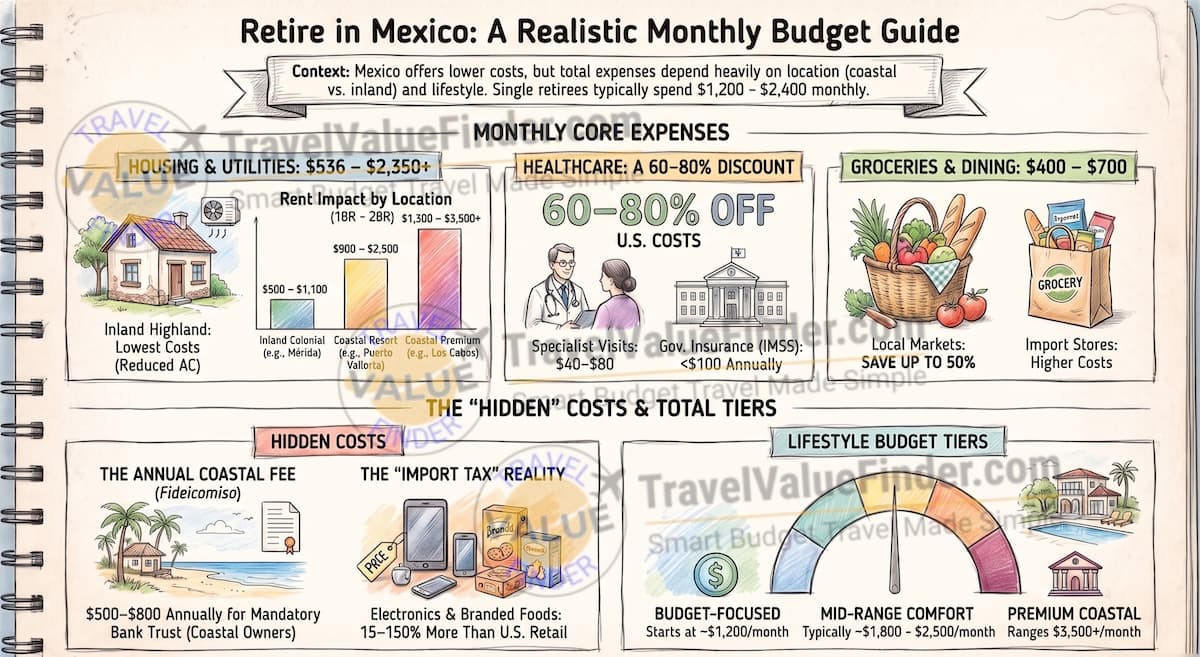
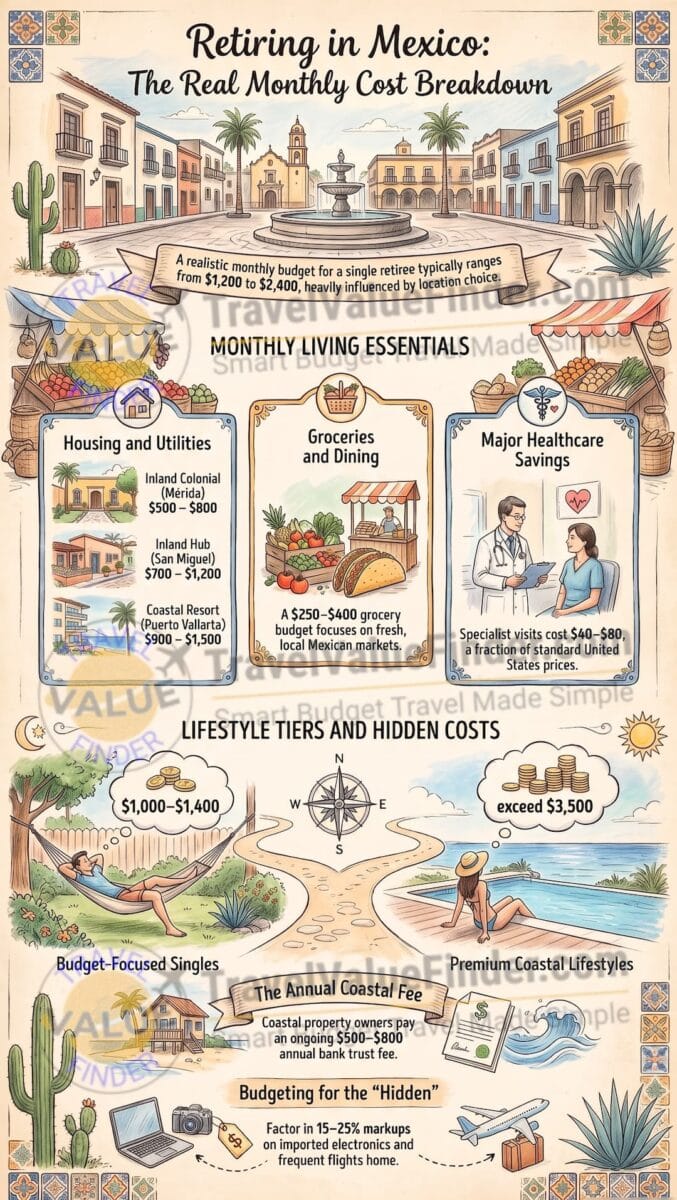
The cost of living in Mexico for retirees breaks down to roughly $700–$1,200/month rent, $60–$150 utilities and internet, $250–$400 groceries, $150–$300 dining out, $40–$170 transportation, and $60–$500+ healthcare depending on whether you use IMSS or private insurance – landing most single retirees between $1,200 and $2,400/month before location-driven swings.
Leslie Nics, TravelValueFinder.com | Last updated: July 2026 | Last Reviewed: July 31, 2026
Most cost of living in Mexico for retirees guides hand you a single blended number and call it a budget. That number is close to useless on its own, because housing alone can swing your total by a factor of two depending on which city and neighborhood you pick – the same pattern this site’s pillar guide covers at the city level.
This page goes one layer deeper: category by category, with the real ranges behind each line item, plus the costs most retirement content quietly leaves out entirely.
Housing: The Line Item That Decides Everything Else
| City Type | 1BR Rent | 2BR Rent |
| Inland colonial (Mérida, Lake Chapala) | $500–$800 | $700–$1,100 |
| Established inland hub (San Miguel de Allende) | $700–$1,200 | $1,200–$2,000 |
| Coastal resort (Puerto Vallarta) | $900–$1,500 | $1,200–$2,500 |
| Coastal premium (Los Cabos, Riviera Maya) | $1,300–$2,200 | $1,800–$3,500+ |
Furnished rentals in expat-friendly buildings run 15–30% above these figures; unfurnished long-term leases in local neighborhoods run at or below the low end. Utility deposits and a first-and-last-month rent requirement are standard, similar to US leasing practice.
Utilities and Internet
- Electricity, water, gas, garbage combined: $36–$150/month, driven almost entirely by air conditioning use – inland highland cities like San Miguel de Allende or Lake Chapala rarely need AC and sit at the low end
- Home Wi-Fi: $23–$47/month depending on speed and provider
- Mobile plan: typically $10–$25/month for a generous data plan, well below comparable US carrier pricing
Groceries and Dining Out
- Groceries (single person, local-market-heavy): $250–$400/month
- Groceries with regular imported/specialty items: $400–$600/month
- Inexpensive lunch out: $4–$15
- Mid-range dinner for one: $15–$25
- Three-course dinner for two in an expat-hotspot restaurant: $44–$105
Alcohol is a real budget lever for retirees who drink regularly: local beer runs $1–$3, wine starts around $7/bottle, and imported spirits run noticeably higher than domestic tequila, mezcal, or rum.
Transportation
| Mode | Typical Cost |
| Local bus | $0.50–$0.60/ride |
| Uber/DiDi ride | $2–$7 depending on distance |
| Public transport, full month (no car) | Under $40/month |
| Owning a car (fuel, maintenance, insurance) | ≈ $170/month |
Many retirees in walkable colonial centers – Mérida, San Miguel de Allende, central Oaxaca – go without a car entirely. Coastal and spread-out cities like Puerto Vallarta or Mexico City’s outer neighborhoods make a car or regular rideshare use more of a practical necessity than a lifestyle choice.
Healthcare
| Option | Typical Annual Cost |
| IMSS voluntary enrollment (age 50s–60s) | $63–$93/year per person |
| Private local insurance | $2,000–$3,500/year |
| International private insurance | $3,500–$6,000+/year |
| Specialist consultation, out of pocket | $40–$80/visit |
Healthcare is the category where the discount actually holds up under scrutiny. Everything else in Mexico can vary by neighborhood – a specialist visit costing a fifth of the US price is close to universal. – Leslie Nics, Founder & Lead Travel Writer, TravelValueFinder.com
The Hidden Costs Most Guides Leave Out Entirely
This is the section I think deserves far more attention than it gets. The headline cost-of-living numbers rarely include the following, and they add up fast for retirees who don’t budget for them from day one:
- Imported electronics: 15–25% above US retail pricing
- Vehicles: 20–40% above US pricing if bought in Mexico
- Branded US/European specialty groceries: 1.5–2.5× US pricing at import-focused stores
- US travel: 2–4 trips/year for a couple to visit family typically totals $1,200–$5,600/year
- Property closing costs: 5–8% inland, 7–12% coastal
- Fideicomiso (bank trust) fees for coastal property ownership: $500–$800/year, ongoing, not one-time
Reality Check: The fideicomiso fee alone catches a lot of coastal-property buyers off guard because it doesn’t stop after closing – it’s an annual cost for as long as you own property inside the Restricted Zone (within 50 km of the coast or 100 km of a border), and it’s rarely mentioned in the same breath as the property price itself.
Sample Monthly Budgets by Lifestyle
| Lifestyle Tier | Single | Couple | What’s Included |
| Budget-focused | $1,000–$1,400 | $1,400–$2,000 | Local groceries, public transport, IMSS, modest apartment |
| Comfortable expat | $1,500–$2,200 | $2,200–$3,200 | Mix of local/imported food, occasional car, private insurance, dining out weekly |
| Premium / coastal | $2,500–$3,500+ | $3,500–$5,000+ | Beachfront or premium rental, imports, full private healthcare, frequent dining out |
Two Real Budgets, Line by Line
Averages hide more than they reveal. Here’s what two different retirement realities actually look like on paper, built from the category ranges above rather than a single blended number.
A Single Retiree in Mérida: Budget-Focused
| Category | Monthly Cost |
| Rent (1BR, centro-adjacent) | $650 |
| Utilities + internet | $70 |
| Groceries (mostly local market) | $300 |
| Dining out (2–3x/week) | $120 |
| Transportation (no car, bus + occasional Uber) | $35 |
| Healthcare (IMSS voluntary) | $7 (annual fee spread monthly) |
| Entertainment/miscellaneous | $100 |
| Total | $1,282 |
This is close to the realistic floor for a comfortable – not austere – single-retiree life in one of Mexico’s safest, most affordable cities. It assumes no car, no imported groceries, and IMSS rather than private insurance. Add a private insurance policy instead of IMSS and this budget moves to roughly $1,450–$1,650/month.
A Couple in Puerto Vallarta: Comfortable Coastal
| Category | Monthly Cost |
| Rent (2BR, Zona Romántica or Marina Vallarta) | $1,600 |
| Utilities + internet (AC-heavy) | $140 |
| Groceries (mix of local + imported) | $500 |
| Dining out (several times weekly, tourist-area pricing) | $350 |
| Transportation (one car, fuel + insurance) | $170 |
| Private health insurance (2 people) | $500 |
| Entertainment/miscellaneous | $250 |
| Total | $3,510 |
This sits toward the upper end of this page’s “Comfortable expat” tier for a couple, driven almost entirely by coastal rent and AC costs that simply don’t exist in Mérida’s or San Miguel’s inland climate. Trading Zona Romántica for a less central Puerto Vallarta neighborhood, or dropping to public transport, brings this down to roughly $2,700–$3,000/month without meaningfully changing the lifestyle.
Line these two budgets up side by side and the real lesson isn’t that Puerto Vallarta is ‘expensive’ – it’s that AC, imported groceries, and beachfront rent are each individually optional, and most coastal budgets are paying for two or three of them at once without noticing. – Leslie Nics, Founder & Lead Travel Writer, TravelValueFinder.com
Run Your Own Numbers
- Use our Free Retirement Cost of Living Calculator – get your personalized report in 30 seconds – Free PDF download.
- How to Use a Retirement Cost of Living Calculator – to Compare Cities Worldwide
Common Budgeting Mistakes
- Pricing groceries at the local-market rate, then shopping mostly at Costco/Sam’s Club or specialty import stores – the real bill ends up 30–50% higher than planned.
- Forgetting the fideicomiso is annual, not a one-time closing cost, for anyone buying coastal property.
- Budgeting US healthcare habits (regular specialist visits, elective procedures) against IMSS wait times without a private-care buffer.
- Underestimating US travel costs – two or three trips home a year for a couple is a real four-figure annual line item, not a footnote.
The number that broke my own early estimate wasn’t rent – it was how often I’d actually fly home. Budget that like a bill, not like a maybe. – Leslie Nics, Founder & Lead Travel Writer, TravelValueFinder.com
Find Out More About Retiring in Mexico
- Retire in Mexico – What Nobody Tells You About Retiring in Mexico: 5 Things I’d Do Differently
- Mexico’s Retirement Visa, Explained: What I’d Actually Prepare Before Applying
- What Retiring in Mexico Really Costs, Category by Category
- Best Places to Retire in Mexico: Which City Actually Fits You
- Where to Stay in Mexico City
You May Be Interested In
- Cost of Living in Portugal for Retirees: Real Numbers & Tips
- Cost of Living in Spain for Retirees
- What Retiring in Greece Really Costs, Category by Category
- Affordable Retirement: Best Countries Where Your Money Goes Further
- Retirement Cost of Living Calculator
People Also Ask
How much does it cost to live comfortably in Mexico as a retiree?
A comfortable single-retiree lifestyle typically runs $1,500–$2,200/month; couples typically need $2,200–$3,200/month, before location-driven swings toward the coast.
What is the biggest cost of living surprise for retirees in Mexico?
Import markups on specialty groceries and electronics, and the fact that the fideicomiso coastal-property trust fee is an annual cost, not a one-time closing fee.
Is healthcare really cheaper in Mexico?
Yes, consistently – specialist consultations typically run $40–$80 out of pocket, and IMSS voluntary enrollment costs $63–$93/year, both a fraction of comparable US costs.
Do retirees need a car in Mexico?
Not in walkable colonial centers like Mérida or San Miguel de Allende, where many retirees go without one entirely. Coastal and sprawling cities make a car or regular rideshare use more practical.
FAQ
What is the cheapest category of expense in Mexico compared to the US?
Healthcare and domestic transportation typically show the largest percentage savings versus the US, often 60–80% lower for comparable services.
How much should I budget for groceries in Mexico?
$250–$400/month for a single person shopping mostly at local markets; $400–$600/month with regular imported or specialty items.
Are utilities expensive in Mexico?
Generally not, $36–$150/month combined, with air conditioning use in hot coastal climates being the main driver of the higher end of that range.
What’s a realistic minimum monthly budget in Mexico?
Around $1,000–$1,400/month for a single retiree in a lower-cost inland city, covering modest housing, local groceries, public transportation, and IMSS healthcare.
Does Mexico’s cost of living vary a lot by season?
Coastal tourist towns see meaningful seasonal swings in rental and dining prices during high season (roughly December–April); inland cities are comparatively stable year-round.
Sources
- U.S. Department of State – Mexico Travel Advisory
- Instituto Nacional de Migración (INM) – property and Restricted Zone (fideicomiso) requirements (gob.mx)
- IMSS – Instituto Mexicano del Seguro Social, Modalidad 33 fee schedule (imss.gob.mx)
About the Author
Leslie Nics is the founder and primary travel researcher at Travel Value Finder. He specializes in budget travel, destination research, and itinerary planning, drawing on firsthand travel experience to help readers find affordable and practical travel options. Read more on the About page or see the site’s Trust & Transparency Policy.