Travel Value Finder

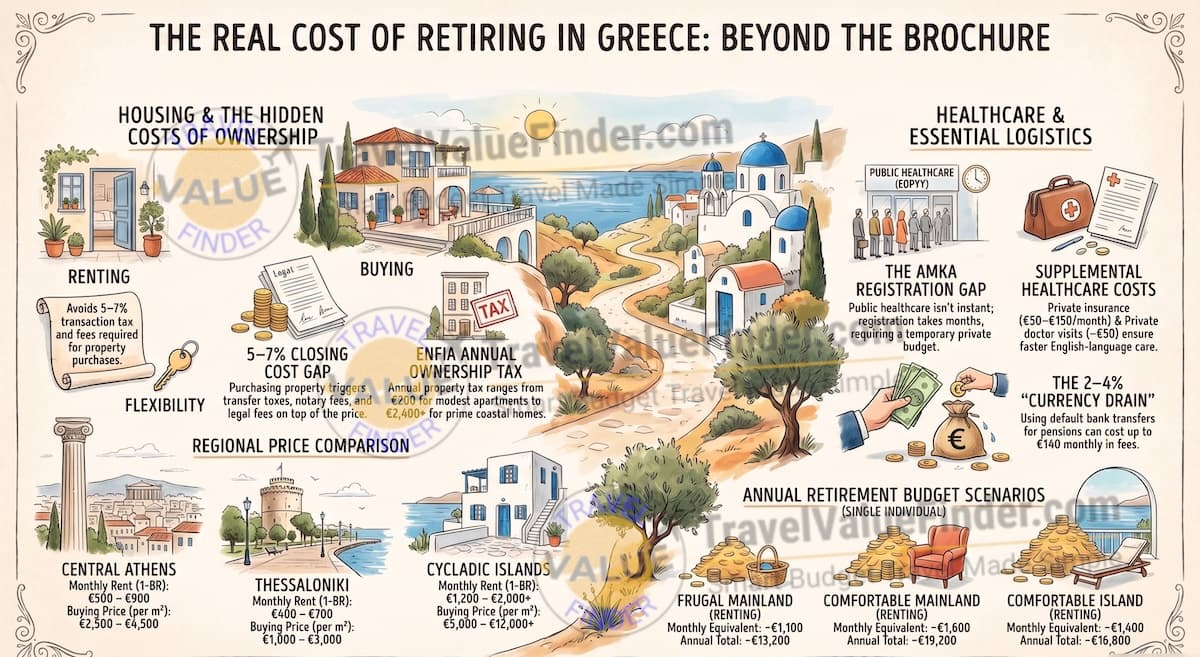
A single retiree can live comfortably on €1,100–€1,700/month on the Greek mainland, but the number that surprises most people isn’t rent – it’s how much property taxes, health insurance gaps, and ferry travel add up to once you look past the headline rent figure.
Leslie Nics, TravelValueFinder.com | Last updated: July 2026 | Last Reviewed: July 26 2026
Most cost of living in Greece for retirees guides stop at rent, groceries, and a vague healthcare line.
That leaves out three categories that quietly reshape a retirement budget: what it actually costs to own property once ENFIA and transfer taxes are added, what “free healthcare” costs before it’s actually free, and what a retirement budget looks like on paper across a full year rather than a single average month.
Cost of Living in Greece for Retirees
This breaks the real number down by category instead of by region, since region was already covered in our companion guide to retiring in Greece – this one is about what each line item actually contains.
Housing: Rent vs. Buy, With the Real Numbers Either Way
Renting remains the more common choice for new arrivals, and for good reason – it avoids a five-figure transaction cost while a retiree confirms which region actually fits.
A one-bedroom in central Athens runs €500–€900/month; Thessaloniki comes in at €400–€700; the popular Cycladic islands can run €1,200–€2,000+ even for modest units, driven by tourism-linked demand that shows no sign of easing.
The rental market itself has shifted noticeably since 2020, and it’s worth naming why: short-term tourist rentals have pulled a meaningful share of long-term housing stock out of circulation in Athens and the more visited islands, tightening supply and pushing long-term rents up in exactly the neighborhoods retirees tend to prefer.
Athens has responded with tighter short-term rental registration rules in central postcodes, which may ease pressure over time, but current listings still reflect several years of that supply squeeze.
| Region | Price per m² (buying) |
| Central Athens (Koukaki, Kolonaki, Mets) | €2,500–€4,500 |
| Athens Riviera (Glyfada, Voula, Vouliagmeni) | €4,500–€9,000 |
| Thessaloniki | €1,800–€3,000 |
| Crete (Chania, Heraklion, coastal) | €2,000–€4,000 |
| Cyclades (Mykonos, Paros, Santorini) | €5,000–€12,000+ |
| Peloponnese (Nafplio, Kalamata, Porto Heli) | €1,500–€3,000 |
Buying Property: The Costs Beyond the Price Tag
This is the category most cost-of-living content skips entirely, and it’s a meaningful gap for any retiree planning to buy rather than rent long-term. Purchasing a resale property triggers a 3.09% transfer tax, plus notary fees (roughly 1–1.5%) and legal fees (roughly 1–1.5%) – together adding 5–7% on top of the purchase price before move-in. New-build properties fall under 24% VAT instead of the transfer tax, though that VAT is suspended on most new construction through the end of 2026.
Ownership then carries an annual property tax called ENFIA, calculated per square meter and adjusted by zone, building age, and other factors rather than a flat percentage. In practice, a modest 80m² apartment in a lower-value Athens neighborhood runs roughly €200–€400/year in ENFIA, while a larger coastal or prime-zone property can run €1,800–€2,400/year or more.
A supplementary tax layer kicks in once an individual’s total Greek property holdings exceed €400,000 in assessed value, which mainly affects higher-end buyers rather than typical retiree purchases.
Foreign buyers are also frequently caught off guard by the gap between a property’s contractual sale price and its separately calculated “objective value”, the figure Greek tax authorities actually use to compute ENFIA.
The two numbers can diverge meaningfully, especially in gentrifying neighborhoods where market prices have moved faster than the government’s official valuation zones, which means a retiree can’t reliably estimate their future ENFIA bill just by knowing what they paid.
Nobody budgets for the 5–7% closing-cost tax that lands before you’ve even moved in. It’s not hidden, exactly – it’s just never in the headline number. – Leslie Nics, Founder & Lead Travel Writer, TravelValueFinder.com
Rental Income & Capital Gains: What Property Owners Should Know
Retirees who buy and later rent out a Greek property – a common move for those splitting time between countries – face a progressive tax schedule on that rental income: 15% on the first €12,000, 35% from €12,001 to €35,000, and 45% above that. It’s worth noting this applies independently of the 7% flat-tax regime, which covers foreign pension income specifically, not Greek-sourced rental income.
Capital gains tax on property sales was reactivated in 2025 after a long suspension, applying to gains realized on sales after January 2025 – a meaningful shift for anyone who bought under the old suspended-tax assumption and is now planning to sell. Retirees buying primarily as a long-term residence rather than an investment are less exposed to either of these, but both are worth knowing before treating Greek property purely as the tax-friendly asset it was a few years ago.
This matters most for retirees weighing a two-property strategy – keeping a home base elsewhere while renting out a Greek property part of the year.
The rental-income brackets apply on top of, not instead of, whatever tax treatment applies to the retiree’s pension income, so the two need to be modeled together rather than assumed to simply add up to the advertised 7% rate across all income sources.
Healthcare: What “Free” Actually Requires First
Once a retiree has a Greek Social Security Number (AMKA), EOPYY provides low- or no-cost access to GPs, specialists, and hospital care – genuinely strong value by international standards.
What the word “free” glosses over: AMKA registration itself takes real paperwork and lead time, private doctor visits (common for faster appointments or English-language care) run about €50, prescriptions run €5–€15, and many retirees layer private insurance on top of EOPYY anyway, at €50–€150/month depending on age and coverage.
None of these numbers are large individually. Added up across a year, they’re a genuine budget line, not a rounding error.
The AMKA process itself deserves more attention than it usually gets. It requires an in-person application, proof of legal residency status, and – for retirees who arrived on the FIP permit specifically – often takes longer to process than the residence permit application itself did.
Retirees who assume EOPYY coverage begins the moment they land in Greece are routinely surprised to find themselves paying full private rates for the first several months while AMKA registration works its way through the system.
| Healthcare Item | Typical Cost |
| EOPYY registration (via AMKA) | Low/no direct cost once registered |
| Private doctor visit | ~€50 |
| Prescription medication | €5–€15 per prescription |
| Supplemental private insurance | €50–€150/month |
Food, Utilities & Everyday Spending
Groceries for a single retiree cooking mostly at home run roughly €180–€300/month, with mainland cities typically undercutting the islands.
Utilities for a standard apartment run €120–€250/month, with heating adding a real seasonal bump in northern mainland cities during winter – a cost that barely registers on the more temperate islands.
Dining out remains genuinely affordable relative to Western Europe: a taverna meal runs €8–€20 depending on city and season, and a monthly public transport pass in Athens or Thessaloniki runs around €30.
Car ownership is the other variable most budgets underestimate, particularly outside Athens and Thessaloniki’s well-served metro and bus networks. Fuel, insurance, and road tax together typically add €150–€300/month for retirees who need a car for daily life – common on islands and in smaller mainland towns where public transit thins out considerably.
Retirees settling in a walkable central neighborhood in Athens or Thessaloniki can often skip car ownership entirely, which is a meaningful budget lever many cost-of-living comparisons don’t isolate as its own line item.
Compare Greek Regions Against Your Own Numbers
- Use our Free Retirement Cost of Living Calculator – get your personalized report in 30 seconds – Free PDF download.
- How to Use a Retirement Cost of Living Calculator – to Compare Cities Worldwide
Banking & Moving Money: The Recurring Cost Nobody Line-Items
Opening a Greek bank account is generally straightforward with a valid residence permit and AMKA, but the recurring cost retirees consistently underestimate is the cost of moving pension income from abroad into that account every month.
Standard international wire fees and unfavorable exchange rates can quietly cost 2–4% per transfer if a retiree simply uses their home bank’s default international transfer service rather than a lower-cost currency provider – on a €3,500 monthly pension transfer, that’s a real €70–€140 a month lost to fees and spread, purely from not shopping the transfer method itself.
It’s a solvable cost, but only if it’s budgeted and addressed deliberately rather than defaulted into.
| Transfer Method | Typical Cost on €3,500 |
| Home bank’s default international wire | €70–€140 (2–4%, fees + exchange spread) |
| Dedicated currency transfer service | €10–€35 (0.3–1%) |
Over a full year, the gap between these two options is worth several hundred euros – a genuinely avoidable cost, and one of the easiest wins in this entire budget once a retiree knows to look for it.
The Annual Snapshot
Cost-of-living content almost always frames everything as a monthly number, which quietly hides the lumpy, once-a-year costs – ENFIA, insurance renewals, ferry-heavy travel months – that don’t spread evenly across twelve months.
Here’s the same budget viewed as a full year instead, since a retiree working from a monthly average alone can end up genuinely surprised by how uneven the actual cash flow feels once property taxes and annual renewals land in the same quarter.
| Scenario | Monthly Equivalent | Annual Total |
| Frugal mainland (Thessaloniki, renting) | ~€1,100 | ~€13,200 |
| Comfortable mainland (Athens, renting) | ~€1,600 | ~€19,200 |
| Comfortable island (Crete, renting) | ~€1,400 | ~€16,800 |
| Property owner add-on (mid-range Athens apartment) | +~€100–€200 | +ENFIA €400–€1,200/yr + insurance/maintenance |
The property-owner row is deliberately separated out, since it’s the category most likely to blow past a renter’s budget baseline if it isn’t priced as its own line item from the start.
What I’d Budget For That I Didn’t Expect
The AMKA registration timeline, for one – it’s not instant, and treating EOPYY as available “as soon as I land” is optimistic. I’d also budget the first year of healthcare as private-insurance-only rather than assuming EOPYY access kicks in immediately, since the gap between arriving and being fully registered is longer than most retirees expect.
And I’d price ENFIA into the decision to buy versus rent far earlier in the process – it’s a small annual number in isolation, but it’s a permanent one, unlike a lease that can simply not be renewed if a town doesn’t work out.
I’d also separate “what I pay every month” from “what actually lands once a year” much earlier than most retirees do. ENFIA bills, insurance renewals, and the heavier travel months around holidays all cluster unevenly across the calendar – a budget that only tracks a flat monthly number will feel comfortable eleven months a year and genuinely tight in the twelfth, for reasons that have nothing to do with overspending.
Renting for the first year isn’t just cheaper upfront – it’s the difference between an ENFIA bill you chose and one you’re stuck with because a neighborhood didn’t turn out the way it looked in July. – Leslie Nics, Founder & Lead Travel Writer, TravelValueFinder.com
Find out more about retiring in Greece
- Retire in Greece – What Nobody Tells You About Retiring in Greece: 5 Things I’d Do Differently
- Greece’s FIP Visa, Explained: What I’d Actually Prepare Before Applying
- Cost of Living in Greece: What Retiring in Greece Really Costs, Category by Category
- Best Places to Retire in Greece: Which Island or Mainland City Actually Fits You
- What to Do in Athens Greece
- Where to Stay in Santorini Greece
You May Be Interested in
- Italy Travel Guide For First-Time Visitors (2026)
- Where to Stay in Rome (2026 Guide): Best Areas, Hotels & Neighborhoods for Every Budget
- Retire in Portugal: A Warm, Practical Guide for People Over 55
- Best Places to Live in Portugal After 55: My Personal Guide
- Retire in Spain: A 55+ Guide to Planning Your Dream Life
- Best Places to Live in Spain After 55: A Practical Comparison
- Retire in France After 55: Healthcare, Cost, Visas & Lifestyle Explained
- Best Places to Live in France After 55: Regions Retirees Truly Enjoy
People Also Ask
How much does it cost to live comfortably in Greece as a retiree?
A single retiree can live comfortably on roughly €1,100–€1,700/month depending on whether they’re in a mainland city like Thessaloniki or Athens, with islands running meaningfully higher.
Is healthcare really free for retirees in Greece?
Access through EOPYY is low- or no-cost once a retiree is registered with a Greek Social Security Number (AMKA), but registration takes time, and many retirees still budget for private doctor visits or supplemental insurance for faster access.
How much is property tax in Greece?
Annual ENFIA tax typically runs €200–€400/year for a modest apartment and can reach €1,800–€2,400/year or more for larger or prime-zone properties, calculated per square meter rather than as a flat percentage.
Is it cheaper to rent or buy when retiring in Greece?
Renting avoids the 5–7% in transfer tax, notary, and legal fees that come with buying, making it the lower-risk choice while a retiree confirms a region actually fits their needs long-term.
FAQ
What’s included in the 5–7% Greek property purchase cost?
A 3.09% transfer tax on resale properties, plus notary fees (roughly 1–1.5%) and legal fees (roughly 1–1.5%), on top of the purchase price itself.
Do islands really cost that much more than the mainland?
Yes, popular islands can run rent 60–70% above mainland levels, driven largely by tourism demand and limited housing supply, though larger islands like Crete track closer to mainland pricing.
How much do prescriptions cost in Greece?
Typically €5–€15 per prescription for retirees registered with EOPYY, though costs vary by medication and coverage specifics.
Does ENFIA apply to renters?
No, ENFIA is an ownership tax paid by the property owner, not the tenant, which is one of the practical advantages of renting while evaluating a long-term move.
Are utility costs higher in winter?
Yes, particularly in Athens, Thessaloniki, and other mainland cities, where heating adds a real seasonal cost that’s largely absent on the more temperate islands.
Sources
- Independent Authority for Public Revenue (AADE) – ENFIA calculation methodology and current rates
- EOPYY (National Organization for the Provision of Health Services) – public healthcare access and cost guidance
- Hellenic Statistical Authority (ELSTAT) – household expenditure and cost-of-living data
About the Author
Leslie Nics is the founder and lead researcher at TravelValueFinder.com, where the focus is always on what things actually cost – not what the brochure says they cost. Read more on the About page or see the site’s Trust & Transparency Policy.