Travel Value Finder

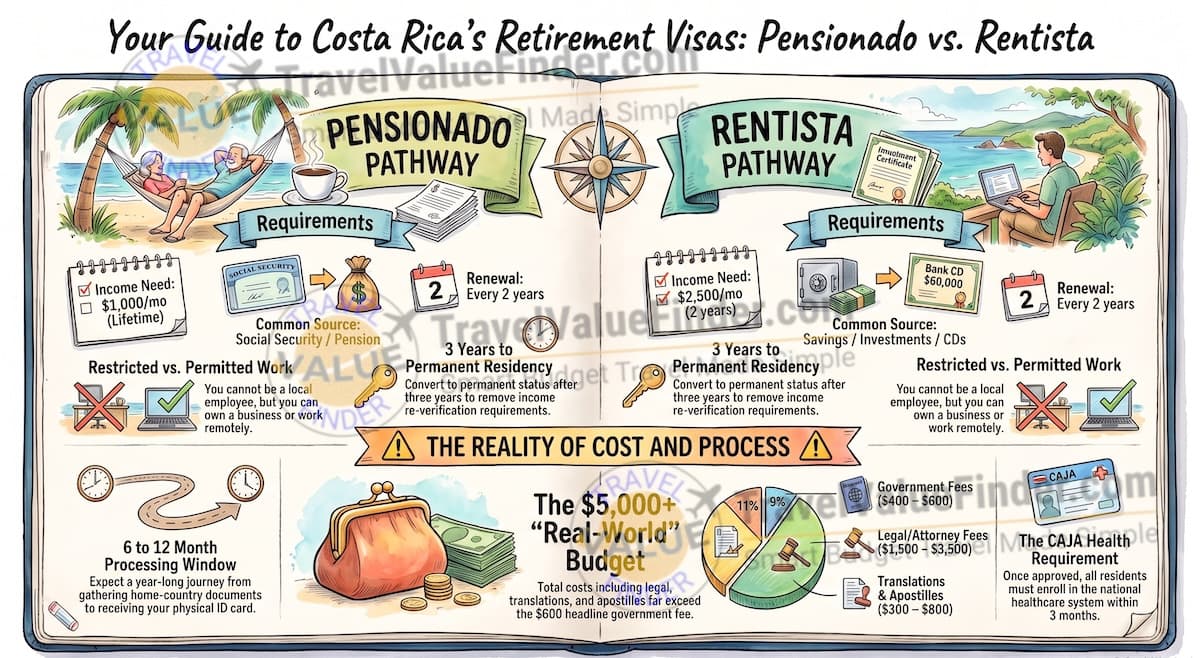
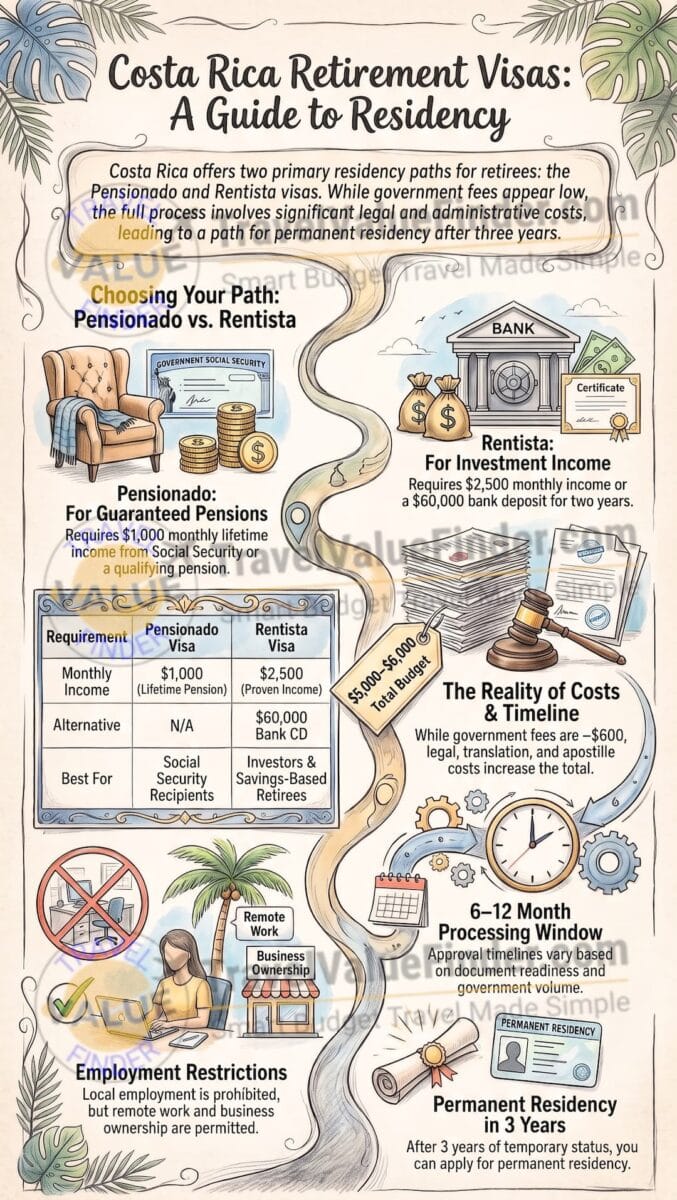
Costa Rica’s retirement visa is really two separate categories: Pensionado, requiring $1,000/month in guaranteed lifetime pension income, and Rentista, requiring $2,500/month in proven income for two years (commonly satisfied with a $60,000 bank CD). Government fees run $400–$600, but a realistic full-process budget including translations, apostilles, and legal support runs $5,000–$6,000. Temporary residency converts to permanent after 3 years.
Leslie Nics, TravelValueFinder.com | Last updated: Aug 2026 | Last Reviewed: Aug 07, 2026
Search for a Costa Rica retirement visa and the income numbers are easy to find. What’s harder to find is a clear-eyed account of what the full process actually costs once translations, apostilles, and (often necessary) legal support are added to the government’s own fee schedule – a number that runs meaningfully higher than the $400–$600 headline figure most guides lead with.
Costa Rica doesn’t have one visa labeled “retirement visa” – it has two parallel categories built for slightly different financial situations: Pensionado for retirees with a qualifying lifetime pension, and Rentista for retirees living off investments or savings rather than a traditional pension.
Pensionado vs. Rentista: Which Costa Rica Retirement Visa Fits
| Pensionado | Rentista | |
| Requirement | $1,000/month lifetime pension | $2,500/month proven income for 2 years, or $60,000 bank CD |
| Minimum age | None | None |
| Income source | Government pension, workplace pension, Social Security, CPP, etc. | Investments, rental income, annuities, other non-employment sources |
| Best for | Retirees with Social Security or a traditional pension | Retirees living primarily off savings or investment income |
Both categories prohibit working as an employee in Costa Rica for the principal applicant and dependents – though owning a business, making investments, and remote work for a foreign employer with no locally sourced income all remain permitted, a distinction worth understanding clearly before assuming either visa restricts income entirely.
The Application Process, Step by Step
- Gather documentation: proof of qualifying income (pension certification letter, or bank/financial institution letter for Rentista), a valid passport, and a clean criminal record certificate from your home country and anywhere you’ve lived for 2+ years in the past 5.
- Many applicants enter Costa Rica on a standard tourist stay, submit the application to DGME (Dirección General de Migración y Extranjería) while present in-country, then travel as needed while the application processes.
- Attend biometrics and any required interview appointments.
- Await approval – total processing commonly runs 6–12 months, though timelines vary.
- Once approved, enroll in CAJA within 3 months and obtain your DIMEX residency ID card.
Red Flag: Both Pensionado and Rentista status require proving your qualifying income continues at every renewal, not just at initial application – this isn’t a one-time hurdle. Rentista applicants in particular should plan for how they’ll re-document a continuing $2,500/month income stream every two years, not just the first time.
What This Actually Costs, Fee by Fee
| Fee | Amount |
| DGME application fee | ≈ $250–$500 |
| Residency card (DIMEX) issuance | ≈ $100+ at each 2-year renewal |
| Document translation & apostille (multiple documents) | $300–$800, varies by home country |
| Immigration attorney (common, not strictly required) | $1,500–$3,500 |
| Total government fees alone | $400–$600 |
| Realistic full-process budget | $5,000–$6,000 |
That realistic total runs meaningfully higher than the $2,700 all-in figure this cluster’s Mexico visa guide cites for a comparable process – a genuine cost difference worth factoring into a side-by-side comparison, not just the headline income thresholds.
Documents You’ll Actually Need
| Document | Notes |
| Valid passport | Standard requirement |
| Pension certification letter (Pensionado) or income/bank letter (Rentista) | Must confirm the income is guaranteed for life (Pensionado) or 2+ years (Rentista) |
| Clean criminal record certificate | From home country and any country of 2+ years’ residence in the past 5 years |
| Birth certificate, marriage certificate (if applicable) | Apostilled, with certified Spanish translation |
| Passport photographs | Standard biometric specifications |
| Proof of CAJA enrollment (post-approval) | Required within 3 months of residency approval |
The Path to Permanent Residency and Citizenship
After 3 years of continuous temporary residency – one year sooner than Mexico’s 4-year path – Pensionado and Rentista holders become eligible for Permanent Residency, which removes the income re-verification requirement entirely and lifts most work restrictions.
Costa Rican citizenship becomes available after 7 years of residency, requiring a Spanish proficiency test and civics exam; the U.S. permits dual citizenship, so citizens don’t need to give up their American passport.
Three years to permanent residency instead of four sounds like a small difference on paper. In practice, it’s a full extra year of not having to re-prove your income to a government office. – Leslie Nics, Founder & Lead Travel Writer, TravelValueFinder.com
A Real Timeline: One Couple’s Path to Residency
Numbers on a checklist are one thing; watching them unfold over a year is another. Here’s a realistic month-by-month timeline for a Pensionado couple, built from the process steps above:
| Timeframe | What’s Happening |
| Months 1–2 | Gather pension certification letters, apostille and translate birth/marriage certificates, request criminal record checks from home country. |
| Month 3 | Enter Costa Rica on a standard tourist stay; submit the DGME application in person. |
| Months 4–9 | Application under review at DGME. Many applicants travel home and back during this window rather than staying put the entire time. |
| Month 10 | Biometrics appointment; approval notice received. |
| Months 10–11 | CAJA enrollment (required within 3 months of approval) and DIMEX residency card issued. |
| Month 24 | First renewal – income re-verified, DIMEX card renewed. |
| Year 3 | Eligible to apply for Permanent Residency – no more income re-verification required. |
Ten to eleven months from first document to physical residency card is a realistic middle-of-the-road estimate- some applicants move faster with strong legal support and clean documentation, others run longer if DGME requests additional paperwork mid-process.
Building in a buffer, rather than planning around the fastest case anyone’s told you about, is the single most useful thing to do with this timeline.
Every timeline I read before starting my own research assumed the fastest possible version of every step. Build your plans around the middle of the range, not the best case someone posted in a Facebook group. – Leslie Nics, Founder & Lead Travel Writer, TravelValueFinder.com
Map Out Your Costa Rica Retirement Numbers
- Use our Free Retirement Cost of Living Calculator – to see how Costa Rica’s visa thresholds compare against your actual monthly budget – free, instant, no account needed.
- How to Use a Retirement Cost of Living Calculator – to Compare Cities Worldwide
What I’d Prepare Differently
I’d start the apostille and certified-translation process for every document months before the DGME application, not after – it’s consistently the slowest, most bureaucratic-feeling part of the process, and it doesn’t compress well under time pressure.
I’d also budget the realistic $5,000–$6,000 figure from day one instead of anchoring on the $400–$600 government-fee headline number, so the attorney and translation costs don’t arrive as a mid-process surprise.
The number that would have thrown off my own planning wasn’t the pension threshold – it was assuming the government fee was the whole bill. It’s maybe a tenth of it. – Leslie Nics, Founder & Lead Travel Writer, TravelValueFinder.com
Find Out More About Retiring in Costa Rica
- Retire in Costa Rica – What Nobody Tells You About Retiring in Costa Rica: 5 Things I’d Do Differently
- Costa Rica’s Retirement Visa, Explained: What I’d Actually Prepare Before Applying
- Cost of Living in Costa Rica: What Retiring in Costa Rica Really Costs, Category by Category
- Best Places to Retire in Costa Rica: Which Town Actually Fits You
- Costa Rica Travel Budget
You May Be Interested In
- Mexico’s Retirement Visa, Explained: What I’d Actually Prepare Before Applying
- France Retirement Visa Explained: How I’d Plan It After 55
- Portugal D7 Visa
- Greece’s FIP Visa, Explained: What I’d Actually Prepare Before Applying
- Retirement Cost of Living Calculator
People Also Ask
How much income do I need for Costa Rica’s retirement visa?
$1,000/month in guaranteed lifetime pension income for Pensionado, or $2,500/month in proven income for two years (or a $60,000 bank CD) for Rentista.
How long does the Costa Rica Pensionado visa take to process?
Commonly 6–12 months from application to approval, though timelines vary by case complexity and DGME processing volume.
Do I need a lawyer for Costa Rica residency?
Not strictly required, but most applicants use one – attorney fees of $1,500–$3,500 are a major reason the realistic total cost runs well above the $400–$600 government-fee figure.
Can I work in Costa Rica on a Pensionado visa?
Not as an employee – that’s prohibited for both the principal applicant and dependents. Business ownership, investment income, and remote work for foreign employers with no local income source remain permitted.
FAQ
What’s the difference between Pensionado and Rentista?
Pensionado requires a guaranteed lifetime pension of $1,000/month; Rentista requires $2,500/month in proven income for two years, typically via a $60,000 bank CD, for retirees without a traditional pension.
Do I have to re-prove my income every year?
Income is re-verified at each 2-year renewal, not annually, but it is an ongoing requirement – not a one-time hurdle at initial application.
How much does Costa Rica residency really cost all-in?
Government fees alone run $400–$600, but a realistic full budget including translations, apostilles, and legal support runs $5,000–$6,000.
When can I apply for Costa Rican permanent residency?
After 3 years of continuous temporary residency as a Pensionado or Rentista, one year sooner than Mexico’s comparable 4-year path.
Is Costa Rican citizenship available to retirees?
Yes, after 7 years of residency, requiring a Spanish proficiency test and civics exam. The U.S. allows dual citizenship, so American retirees don’t need to renounce their US passport.
Sources
- Dirección General de Migración y Extranjería (DGME) – official Costa Rican residency requirements (migracion.go.cr)
- Caja Costarricense de Seguro Social (CCSS/CAJA) – official enrollment requirements (ccss.sa.cr)
- U.S. Department of State – Costa Rica Travel Advisory
About the Author
Leslie Nics is the founder and primary travel researcher at Travel Value Finder. He specializes in budget travel, destination research, and itinerary planning, drawing on firsthand travel experience to help readers find affordable and practical travel options. Read more on the About page or see the site’s Trust & Transparency Policy.