Travel Value Finder

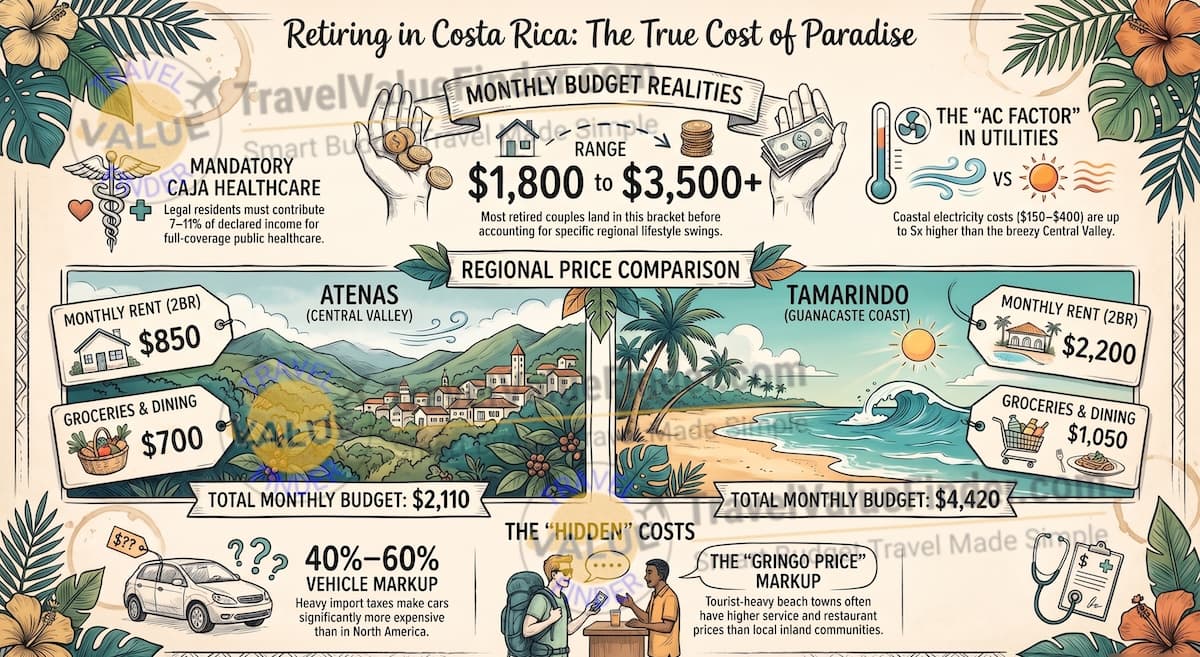
The cost of living in Costa Rica for retirees breaks down to roughly $700–$1,500/month rent, $50–$150 utilities (more with AC), $300–$500 groceries, $150–$350 dining out, $40–$180 transportation, and $70–$470 healthcare depending on CAJA versus added private insurance – landing most retired couples between $1,800 and $3,500/month before the Central-Valley-versus-coast swing.
Leslie Nics, TravelValueFinder.com | Last updated: Aug 2026 | Last Reviewed: Aug 07, 2026
Most cost of living in Costa Rica for retirees guides land on a single blended number somewhere between $1,600 and $3,500 a month and leave it there. That range is so wide it’s barely a budget – the real driver, as this cluster’s pillar guide covers at the town level, is whether you’re in an inland Central Valley community or a Guanacaste beach town, a gap that can nearly double your monthly total.
This page goes one layer deeper: category by category, with the hidden costs most retirement content leaves out entirely.
Housing: The Line Item That Decides Everything Else
| Region | 1BR Rent | 2BR Rent |
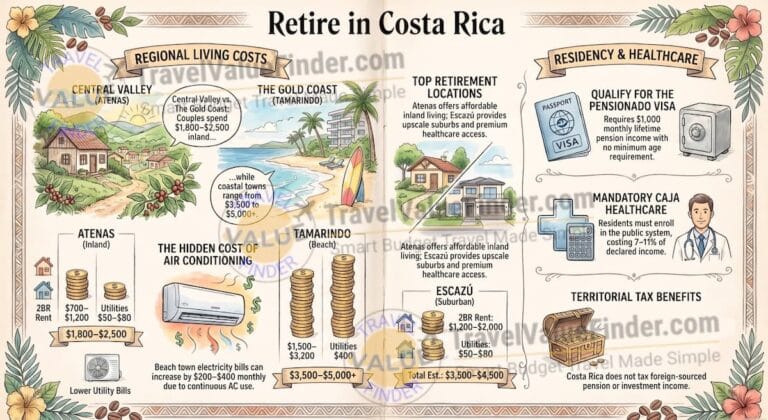
| Affordable Central Valley (Atenas, Grecia) | $400–$700 | $700–$1,200 |
| Upscale Central Valley (Escazú, Santa Ana) | $700–$1,200 | $1,200–$2,000 |
| Southern Zone (Uvita, Ojochal) | $600–$1,000 | $1,000–$1,800 |
| Guanacaste beach (Tamarindo, Nosara) | $900–$1,800 | $1,500–$3,200 |
Furnished, gated-community rentals in expat-favored buildings run 15–30% above these figures; unfurnished long-term leases in local neighborhoods run at or below the low end – the same pattern seen across this cluster’s Mexico cost-of-living page.
Utilities and Internet
- Electricity, water, garbage combined, inland/no-AC: $50–$80/month
- Electricity with regular AC use, coastal: $150–$400/month – the single biggest swing factor in this whole category
- Home internet: $30–$60/month depending on speed and provider
- Mobile plan: $15–$30/month for a generous data plan
Groceries and Dining Out
- Groceries, local-market-heavy: $300–$400/month per person
- Groceries with regular imported items: $450–$650/month per person
- Casual lunch (soda/local restaurant): $6–$10
- Mid-range dinner for two: $30–$60
- Dinner for two, tourist-area restaurant (Tamarindo, Nosara): $60–$140
“Gringo pricing” in tourist-heavy coastal towns is a real, well-documented pattern – the same grocery basket or restaurant meal commonly runs noticeably higher in Tamarindo than in an inland Central Valley town, independent of the general cost-of-living gap between the two regions.
Transportation
| Mode | Typical Cost |
| Local bus | $0.50–$2 depending on distance |
| Uber/local taxi | $3–$10 depending on distance |
| Public transport, full month (no car) | Under $50/month |
| Owning a car – fuel, maintenance, insurance | $150–$250/month, before purchase price |
| The Vehicle Tax Reality Import taxes make cars significantly more expensive in Costa Rica than in the US – a $25,000 US vehicle commonly costs $40,000 or more once landed and registered in Costa Rica. Many retirees buy used, locally, specifically to avoid this markup, or plan to go without a car entirely in walkable Central Valley towns. | |
Healthcare
| Option | Typical Cost | Notes | |
| CAJA (mandatory) | 7–11% of declared income, ≈$70–$220/month | Zero co-pays, covers pre-existing conditions | |
| Private insurance (INS) | $60–$250/month | Supplements CAJA, doesn’t replace it | |
| International private insurance | $100–$1,000+/month | Broadest coverage, highest cost | |
| Private specialist visit, out of pocket | $80–$150 | ||
CAJA isn’t a discount version of real healthcare – it’s the real system, and the private layer most expats add is about speed, not quality. – Leslie Nics, Founder & Lead Travel Writer, TravelValueFinder.com
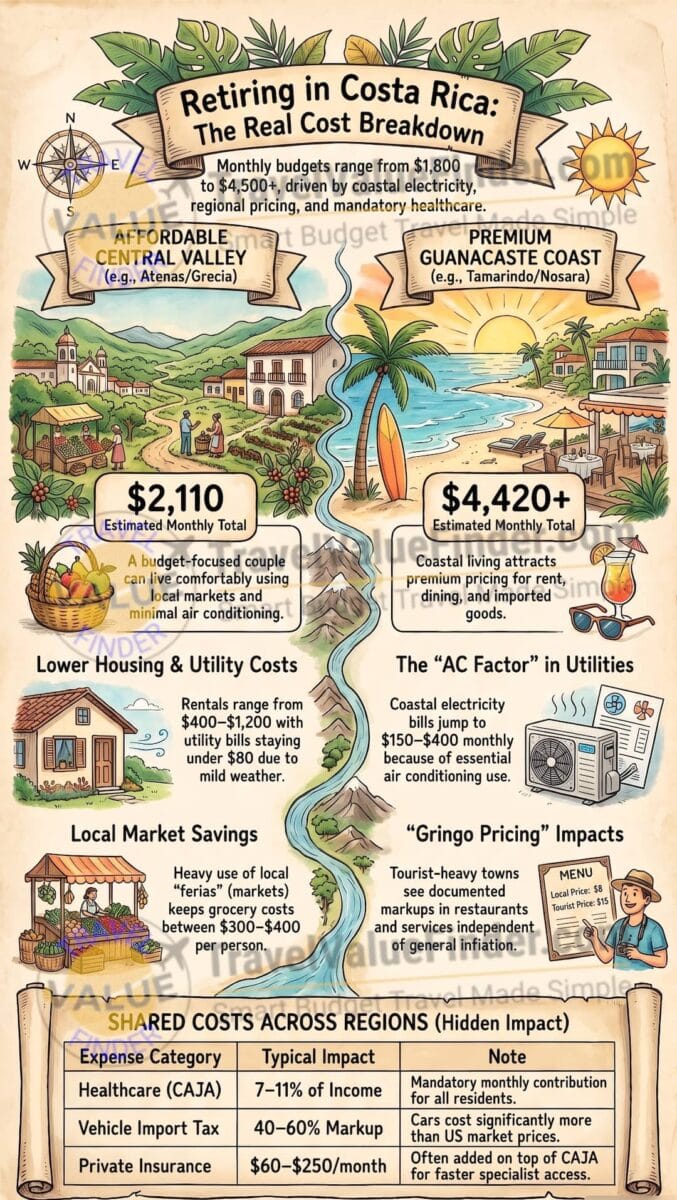
The Hidden Costs of Living in Costa Rica Most Guides Leave Out Entirely
This is the section I think deserves far more attention than it gets. The headline cost-of-living numbers rarely include the following, and they add up fast for retirees who don’t budget for them from day one:
- Vehicles: 40–60%+ markup over US pricing once import taxes are factored in
- Mandatory CAJA contribution: 7–11% of declared income, an ongoing percentage cost most guides mention only in passing
- Imported specialty groceries: 1.5–2.5× local pricing at import-focused stores
- US travel: 2–4 trips/year for a couple to visit family typically totals $1,200–$5,600/year
- “Gringo pricing” in tourist-heavy coastal restaurants and services – a real, documented markup independent of the general regional cost gap
- Property transfer taxes and closing costs: typically 3.5–4% of purchase price, plus legal fees
Two Real Budgets, Line by Line
Averages hide more than they reveal. Here’s what two different retirement realities actually look like on paper.
A Retired Couple in Atenas: Budget-Focused
| Category | Monthly Cost |
| Rent (2BR house) | $850 |
| Utilities + internet (minimal AC) | $90 |
| Groceries (mostly local market) | $550 |
| Dining out (2–3x/week, local sodas) | $150 |
| Transportation (older used car) | $180 |
| CAJA (mandatory, based on declared income) | $140 |
| Entertainment/miscellaneous | $150 |
| Total | $2,110 |
This sits comfortably inside this page’s Central Valley affordable range for a couple, and it’s close to the number this site’s pillar guide cites for a modest life in Atenas or Grecia – $2,000–$2,500/month.
A Retired Couple in Tamarindo: Comfortable Coastal
| Category | Monthly Cost |
| Rent (2BR, near-beach) | $2,200 |
| Utilities + internet (AC-heavy) | $300 |
| Groceries (mix of local + imported) | $600 |
| Dining out (tourist-area pricing, several times weekly) | $450 |
| Transportation (one car, fuel + insurance) | $220 |
| Private insurance layered on CAJA (2 people) | $350 |
| Entertainment/miscellaneous | $300 |
| Total | $4,420 |
This lands squarely in this page’s Guanacaste beach range. Choosing a rental a short drive from the beach instead of directly on it, or cutting AC use, typically brings this down to roughly $3,500–$3,800/month without a major lifestyle change.
Line these two up side by side and the AC bill alone explains a third of the gap. The beach isn’t expensive because it’s the beach – it’s expensive because of what living next to it requires you to run and buy. – Leslie Nics, Founder & Lead Travel Writer, TravelValueFinder.com
Compare These Towns Against Your Own Budget
- Use our Free Retirement Cost of Living Calculator – to get a personalized budget report comparing Costa Rica against any of the other countries covered on this site – free, instant, no account needed.
- How to Use a Retirement Cost of Living Calculator – to Compare Cities Worldwide
Common Budgeting Mistakes
- Treating CAJA as a nice-to-have rather than the mandatory percentage-of-income cost it actually is.
- Pricing a used car at US rates instead of budgeting for Costa Rica’s significant import-tax markup.
- Underestimating AC’s effect on the electric bill in Guanacaste specifically, where December–April is genuinely hot and dry.
- Forgetting “gringo pricing” in tourist towns is real and specific, separate from the general Central-Valley-vs-coast cost gap.
Find Out More About Retiring in Costa Rica
- Retire in Costa Rica – What Nobody Tells You About Retiring in Costa Rica: 5 Things I’d Do Differently
- Costa Rica’s Retirement Visa, Explained: What I’d Actually Prepare Before Applying
- Cost of Living in Costa Rica: What Retiring in Costa Rica Really Costs, Category by Category
- Best Places to Retire in Costa Rica: Which Town Actually Fits You
- Costa Rica Travel Budget
You May Be Interested In
- What Retiring in Mexico Really Costs, Category by Category
- Cost of Living in Portugal for Retirees: Real Numbers & Tips
- Cost of Living in Spain for Retirees
- What Retiring in Greece Really Costs, Category by Category
- Retirement Cost of Living Calculator
People Also Ask
How much does it cost to live comfortably in Costa Rica as a retiree?
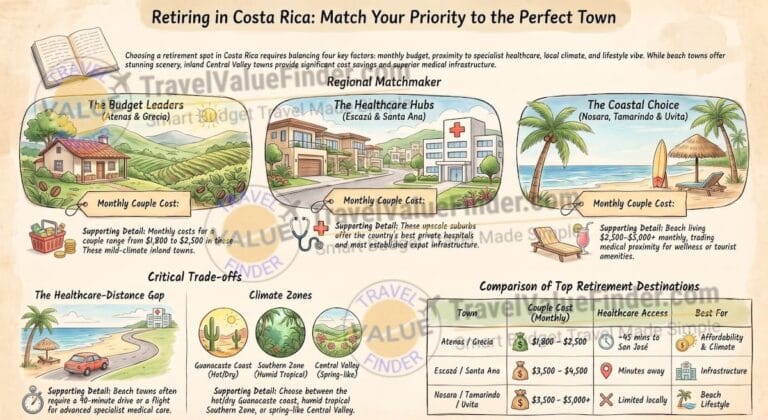
A comfortable retired couple typically spends $1,800–$2,500/month in the affordable Central Valley, or $3,500–$5,000+/month on the Guanacaste coast.
What is the biggest cost of living surprise for retirees in Costa Rica?
Vehicle costs: import taxes routinely push a $25,000 US car’s Costa Rican price above $40,000 – and the mandatory CAJA percentage-of-income healthcare contribution most guides understate.
Is healthcare really affordable in Costa Rica?
Yes, CAJA runs 7–11% of declared income with zero co-pays and full pre-existing condition coverage, and private specialist visits typically cost $80–$150 out of pocket.
Do retirees need a car in Costa Rica?
Not always in walkable Central Valley towns, but coastal and rural areas make a car considerably more practical, and buyers should budget for Costa Rica’s steep vehicle import-tax markup.
FAQ
What is the cheapest category of expense in Costa Rica compared to the US?
Healthcare shows the largest percentage savings versus the US – private specialist visits often cost a fraction of comparable US out-of-pocket rates.
How much should I budget for groceries in Costa Rica?
$300–$400/month per person shopping mostly at local markets (ferias); $450–$650/month with regular imported or specialty items.
Are utilities expensive in Costa Rica?
Inland, no: $50–$80/month combined. On the Guanacaste coast with regular AC use, utilities can run $150–$400/month, the single biggest swing factor in the whole budget.
What’s a realistic minimum monthly budget in Costa Rica?
Around $1,600–$2,000/month for a single retiree in an affordable Central Valley town, covering modest housing, local groceries, limited transportation, and mandatory CAJA.
Does Costa Rica’s cost of living vary by season?
Coastal tourist towns see real seasonal price swings in rentals and dining during high season (roughly December–April); Central Valley towns are comparatively stable year-round.
Sources
- U.S. Department of State – Costa Rica Travel Advisory
- Caja Costarricense de Seguro Social (CCSS/CAJA) – official contribution rate schedule (ccss.sa.cr)
- Dirección General de Migración y Extranjería (DGME) – property and residency requirements (migracion.go.cr)
About the Author
Leslie Nics is the founder and primary travel researcher at Travel Value Finder. He specializes in budget travel, destination research, and itinerary planning, drawing on firsthand travel experience to help readers find affordable and practical travel options. Read more on the About page or see the site’s Trust & Transparency Policy.