Travel Value Finder


Travel alerts 2026 have reached a level of complexity not seen since the immediate post-COVID reopening period. In the past 60 days alone: more than 11,000 flights in and out of the Middle East have been cancelled according to aviation data firm Cirium; the U.S. State Department has updated advisories for more than a dozen popular destinations; a nationwide State of Emergency in Trinidad and Tobago has pushed that country to Level 3; and the United Arab Emirates – home to Dubai International Airport, the world’s busiest international gateway – has been elevated to Level 3 while continuing to manage severe aviation disruption. This is TravelValueFinder’s consolidated global travel alert briefing for May 2026: every major current advisory, the full Middle East aviation disruption picture, which destinations are safest right now, and the exact actions to take if your travel is affected.
Leslie Nics | TravelValueFinder.com | Travel Alerts | May 1, 2026 | Last reviewed: May 1, 2026
Table of Contents
| What are the most important travel alerts for May 2026? The three most urgent travel alerts for May 2026 are: (1) Middle East aviation disruption – more than 11,000 flights cancelled since the conflict began in February 2026, with Dubai, Doha, and Riyadh routes partially resuming but still operating on reduced schedules. Multiple airlines including KLM, Air France, and Air Canada have suspensions extending to June or September 2026. (2) UAE elevated to Level 3 by the U.S. State Department – the first time the UAE has held this advisory level, affecting Dubai and Abu Dhabi. (3) Trinidad and Tobago at Level 3 after a nationwide State of Emergency declared in March 2026 due to violent crime. Full details, airline-by-airline status, and all updated advisories are covered in this briefing. |
Why April and May 2026 Are the Most Complex Travel Alert Period in Years
The convergence of events affecting global travel in the first half of 2026 is unusual in both its scale and its geographic spread. A partial U.S. government shutdown has created staffing pressures at State Department consular services. Ongoing conflict in the Middle East following U.S. and Israeli military action against Iran in late February 2026 has fundamentally disrupted what is arguably the world’s most important aviation corridor – the east-west routes connecting Europe, Africa, and South Asia through Dubai, Doha, and Abu Dhabi. Heightened fuel prices resulting from regional instability are increasing airfares globally. And a wave of updated U.S. State Department advisories has changed the safety picture for several destinations that travelers had planned for summer 2026.
For travelers with bookings in or through the Middle East, with Caribbean plans involving Trinidad or nearby islands, or with summer itineraries that depend on fuel-price-sensitive airfares, this briefing contains time-sensitive, actionable information that can save both money and significant inconvenience.
The most expensive travel mistake is not the trip that goes wrong. It is the trip that could have been rerouted, rescheduled, or refunded – and was not, because the traveler did not know the alerts existed before departure day. Leslie Nics, TravelValueFinder.com
ALERT 1: The Middle East Aviation Crisis – The Full Picture
The most consequential global travel disruption of 2026 began on February 28, when U.S. and Israeli military action against Iran triggered the closure of airspace across multiple countries in the region. Iraq, Jordan, Qatar, and Bahrain closed their airspace simultaneously. Dubai International Airport – the world’s single busiest airport for international passenger traffic, which handled 55.6 million passengers via Emirates alone in 2025 – went from near-normal operations to a highly managed, disruption-heavy model within 72 hours.
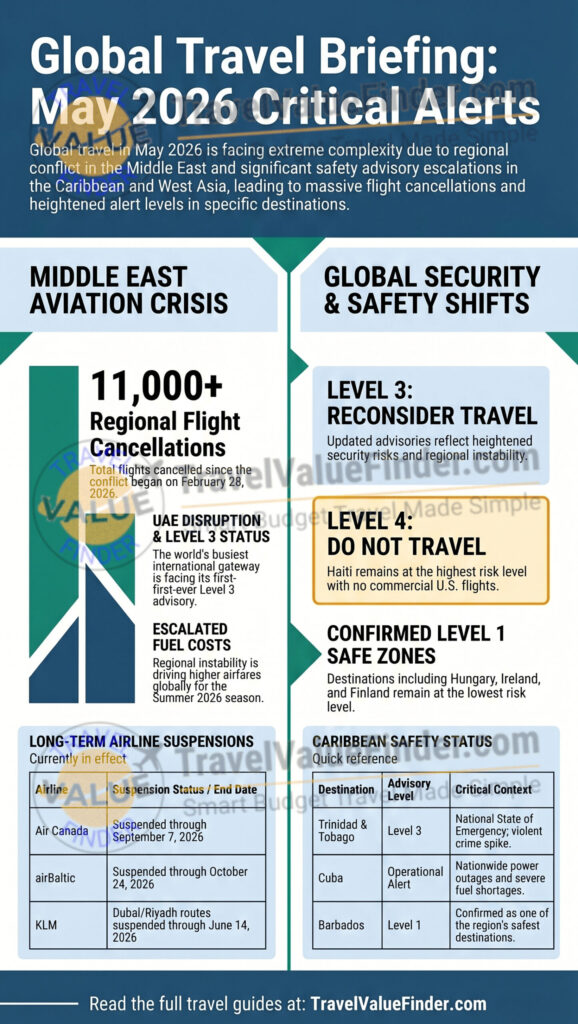
According to aviation data firm Cirium, cited by Al Jazeera, more than 11,000 flights in and out of the region were cancelled in the days immediately following the conflict’s start. Airlines that had built their entire long-haul network architectures around Dubai, Doha, and Abu Dhabi hub connections faced the most severe operational consequences – with passengers connecting from Australia, the UK, Europe, and East Africa suddenly stranded or rerouted through alternate Asian hubs.
As of May 1, 2026, the situation has partially stabilized but remains materially disrupted. Key facts from the most current data available:
Current Middle East Aviation Status – May 1, 2026
| Airline / Hub | Current Status (as of May 1, 2026) | Suspension Dates | Passenger Options |
|---|---|---|---|
| Emirates (Dubai) | Reduced schedule – operating to 100+ destinations. Dubai DXB partial resumption. | Feb 28 – ongoing (partial recovery) | One complimentary date change within ticket validity. New bookings: one free date change offered. |
| Etihad (Abu Dhabi) | Limited commercial schedule – gradually expanding. No change fees until March 31, 2027. | Feb 28 – April 15 (now partially resumed) | Tickets issued on/before Feb 28 for travel Feb 28 – Apr 15: rebook free to May 15, 2026, or request refund. |
| Qatar Airways (Doha) | Gradually increasing – targeting 120+ destinations by mid-May 2026. | Ongoing limited operations | Rebook/refund for Feb 28 – May 31 travel. Rebookings permitted to June 15, 2026. |
| KLM (Amsterdam-Dubai / Riyadh) | Dubai and Riyadh suspended until June 14, 2026. | Feb 28 – June 14, 2026 | Rebook to same class by June 14. Full credit voucher valid 1 year (KLM/Air France/Delta/Virgin Atlantic). |
| Air France (Paris-Dubai/Beirut/Riyadh) | Suspended until May 3, 2026 (Dubai). Beirut/Riyadh ongoing. | Feb 28 – May 3+ 2026 | Rebook/refund for Feb 28 – May 31 travel on or before June 15, 2026. |
| Air Canada (-Tel Aviv/Dubai) | Suspended until September 7, 2026. | Feb 28 – Sept 7, 2026 | Full rebook or refund. Contact Air Canada or travel agent directly. |
| airBaltic (-Dubai) | Suspended until October 24, 2026. | Through October 24, 2026 | Rebook or refund. One of longest suspension periods in the industry. |
| Qantas / Jetstar (Australia-Dubai) | Rerouting Perth – London via Singapore fuel stop. No other route impacts. | N/A – rerouted only | Perth – London passengers: longer journey, no cancellation. Refund/rebook available Feb 28 – May 31. |
| Oman Air (Muscat) | Operating normally. Dubai/Bahrain resumed April 18. Doha/Kuwait/Baghdad cancelled until April 30. | Select routes until April 30 | Change/refund available via Oman Air website for affected routes. |
| Flydubai (Dubai) | Gradual resumption with reduced schedule. Longer flight durations due to rerouting. | Ongoing reduced ops | Passengers on cancelled flights: one free date change, full refund, or full credit voucher within 30 days. |
| SAS (-Middle East) | Beirut/Tel Aviv: rebook/refund for Feb 28 – Aug 14 travel. | Feb 28 – Aug 14, 2026 (Beirut/TLV) | Rebook once free of charge to same destination, same service class, to Oct 31, 2026. |
Sources: The National (April 2026); Gulf News UAE Aviation Report (April 2026); KLM Travel Alerts (April 29, 2026); Point Hacks Middle East Airspace Closures (April 22, 2026); Al Jazeera (March 2026). Status subject to change – verify directly with your airline before travel.
What Does the Middle East Aviation Crisis Mean for Your Wallet and Trip Planning?
The Middle East disruption has created three distinct financial impacts for international travelers, regardless of whether they had any plans in the region:
| If you have a booking through a Middle East hub (Dubai, Doha, Abu Dhabi): You are entitled to a free date change, travel credit, or full refund depending on your airline and booking date. Do not cancel before checking your eligibility – most major airlines are offering fee-free rebooking to mid-2026 or beyond. Contact your airline directly rather than through a third-party booking platform for the clearest option If you are planning future travel and use Middle East hubs for connections: Build a 3-to-4-month buffer into any booking through Dubai, Doha, or Abu Dhabi for summer 2026. Consider rerouting through Asian hubs – Singapore, Hong Kong, Kuala Lumpur, Seoul, or Tokyo – as Point Hacks specifically recommends for travelers with cash fares seeking alternative connections. If you are not traveling through the Middle East but are affected by rising fuel prices: The knock-on effect of heightened regional fuel costs has increased airfare on routes globally. TravelPulse specifically notes that heightened fuel prices from the Middle East conflict are creating uncertainty heading into the peak summer 2026 travel season. Book summer flights as soon as practical – fuel-price-driven fare increases typically accelerate as demand peaks in June. |
ALERT 2: U.S. State Department Advisory Changes – April 2026 Complete Update
The U.S. State Department updated advisories for multiple destinations throughout April 2026. Below is the complete picture – every destination with a material change or reconfirmation – organized by advisory level so travelers can assess quickly.
Understanding the Advisory Level System
| Level | Color | Meaning | What It Means for Your Trip |
|---|---|---|---|
| Level 1 | Green | Exercise Normal Precautions | Lowest risk. Standard urban safety awareness applies. Travel freely. |
| Level 2 | Yellow | Exercise Increased Caution | Specific risks documented. Research your area and apply heightened situational awareness. |
| Level 3 | Orange | Reconsider Travel | Serious risks. Do not travel without a compelling reason, robust safety plan, and travel insurance. |
| Level 4 | Red | Do Not Travel | Life-threatening risks. U.S. government may have limited ability to assist in emergencies. |
Source: U.S. Department of State – travel.state.gov. Advisory levels are reviewed: Levels 1 and 2 every 12 months; Levels 3 and 4 at minimum every 6 months or when conditions change substantially.
April 2026 Advisory Updates: The Complete Destination-by-Destination Picture
| Destination | Current Level | Last Updated | Key Risk Factors | TravelValueFinder Practical Assessment |
|---|---|---|---|---|
| Hungary | Level 1 – Exercise Normal Precautions | April 15, 2026 | Petty crime at tourist sites and Budapest transit hubs. Passport theft on Budapest – Vienna – Bratislava trains. | Safe to travel. Budapest remains one of Europe’s most rewarding and affordable short-break destinations. Guard belongings on international trains. |
| Bermuda | Level 1 – Exercise Normal Precautions | April 10, 2026 | Petty crime in tourist areas. Health: mosquito-borne Dengue fever risk in warmer months. | Safe to travel. Main precaution is health, not crime. Use insect repellent May through October. |
| Barbados | Level 1 – Exercise Normal Precautions | April 10, 2026 | Petty crime (purse snatching, pickpocketing) in high-traffic tourist areas. | Safe to travel. Standard urban awareness applies. Keep valuables in hotel safe. One of the Caribbean’s safest islands. |
| Ireland | Level 1 – Exercise Normal Precautions | April 2026 | Dublin pickpockets. Adjustment required for left-side driving. | Safe to travel. Tripadvisor’s top global solo travel city for 2026. Arguably Europe’s most welcoming destination. |
| Finland | Level 1 – Exercise Normal Precautions | April 2026 | Heightened vigilance in crowded Helsinki venues during peak summer tourist season. | Safe to travel. Consistently ranked world’s happiest and one of its safest countries. Summer crowds require standard awareness. |
| Colombia | Level 3 – Reconsider Travel | March 31, 2026 | Street crime. Specific new warning: sedative drugs used to incapacitate tourists in bars and via dating apps. Coca-growing region risks. | Reconsider travel. Note: major tourist cities (Cartagena, Medellín, Bogotá tourist zones) operate at materially lower risk than the national Level 3 suggests. Research city-specific current conditions. Avoid nightlife district solo encounters. |
| Trinidad and Tobago | Level 3 – Reconsider Travel | April 13, 2026 | Nationwide State of Emergency declared March 2026. Spike in violent crime. Specific no-go areas in Port of Spain: Laventille and Beetham districts. | Reconsider travel. Tobago carries lower crime rates than Trinidad and may be suitable with strong safety planning. Do not visit Trinidad without checking current local conditions. |
| UAE (United Arab Emirates) | Level 3 – Reconsider Travel | 2026 (conflict-related) | Regional conflict impact. Aviation disruption. Ground safety in Dubai tourist zones remains functional but the government advisory reflects regional instability. | Reconsider travel. Ground-level Dubai tourism infrastructure remains largely intact, but the Level 3 designation reflects genuine regional instability. Travel insurance with war/conflict exclusion review is essential for any UAE booking. |
| Nigeria | Level 3 – Reconsider Travel | April 2026 (reconfirmed) | Crime, terrorism, unrest, kidnapping. Specific avoid: Borno, Jigawa, Kogi, Kwara, Niger, Plateau, Taraba, Yobe, northern Adamawa states. | Reconsider travel. Level 3 is a serious designation. Significant parts of Nigeria – particularly Lagos and Abuja for business travelers – are visited without incident, but require thorough local research. |
| Haiti | Level 4 – Do Not Travel | April 16, 2026 (reconfirmed) | Crime, terrorism, kidnapping, unrest, limited healthcare. National state of emergency since March 2024. U.S. commercial flights not currently operating to/from Port-au-Prince. | Do not travel. No commercial U.S. flights operating. This is the highest advisory level – heed it. |
| Jordan and Saudi Arabia | Trips cancelled by Intrepid Travel through April 30, 2026 | March – April 2026 | Regional security situation. Intrepid and other operators cancelling all departures. | Await further guidance. Monitor official government advisories from your home country before booking any regional travel. |
Sources: U.S. Department of State travel.state.gov; TravelPulse April 26, 2026; Travel Off Path April 2026; Travel and Tour World April 2026; Intrepid Travel EU Travel Alerts.
ALERT 3: Caribbean Safety Update – What Has Changed and What Has Not
The Caribbean presents a divided safety picture heading into the peak summer 2026 season. Most of the region’s major tourist destinations remain at Level 1 and are genuinely safe for planned travel. However, two specific situations require traveler attention: Trinidad and Tobago’s escalation to Level 3 and the ongoing monitoring of Haiti’s Level 4 status.
Caribbean Advisory Quick Reference – May 2026
| Destination | Advisory Level | Key Notes | Summer 2026 Booking Decision |
|---|---|---|---|
| Barbados | Level 1 | Petty crime awareness in tourist areas | Proceed – one of the Caribbean’s safest and most consistently welcoming islands |
| Bermuda | Level 1 | Dengue fever risk in warm months – use insect repellent | Proceed – luxury cruise and resort destination with near-zero violent crime |
| Jamaica | Level 2 | Specific high-risk zones outside tourist areas. Resort areas are lower risk. | Proceed with research – stay in resort zones, research specific area before booking |
| Dominican Republic | Level 2 | Crime and health advisories. Specific resort zone risk variation. | Proceed with research – choose well-reviewed all-inclusive resorts and verify location |
| Bahamas | Level 2 | Nassau petty crime and some violent crime. Family islands notably safer. | Proceed with research – family island destinations (Exumas, Eleuthera) carry lower risk |
| Cuba | Operational disruption | Nationwide power outages since March 16 island-wide blackout. Fuel shortage worsening. | Reconsider or postpone – service disruptions ongoing. Intrepid cancelled trips through April 30. |
| Trinidad and Tobago | Level 3 | State of Emergency declared March 2026. Violent crime spike. Port of Spain no-go areas. | Reconsider travel – Tobago may be appropriate with strong safety planning; Trinidad requires exceptional caution |
| Haiti | Level 4 | No U.S. commercial flights. Active violence, terrorism, kidnapping. National emergency since 2024. | Do not travel – the most serious possible designation. Government assistance extremely limited. |
Sources: U.S. State Department travel.state.gov; TravelPulse April 26, 2026; Travel and Tour World April 2026.
Cuba Traveler Alert: Power Outages and Service Disruptions Cuba is experiencing repeated nationwide power outages following a March 16, 2026 island-wide blackout that left approximately 10 million people – the entire island population – without electricity. According to Intrepid Travel’s advisory, the current global fuel shortage is expected to further intensify Cuba’s limited fuel supply in coming weeks, increasing the likelihood of disruptions to essential services including accommodation, transport, and food supply chains. Intrepid cancelled all future Cuba departures through April 30, 2026. Travelers currently in Cuba can safely continue and complete their itineraries as planned, but new bookings carry significant disruption risk until further notice. Monitor your operator’s alerts and the Cuban government’s official communications for updates.
What the Current Travel Alert Landscape Means for Summer 2026 Planning
The convergence of the Middle East aviation disruption, updated Caribbean advisories, and rising fuel-driven airfare costs creates a specific set of planning implications for travelers building summer 2026 itineraries. Here is TravelValueFinder’s assessment of where the current alerts create both risks and – importantly – opportunities.
Destinations Confirmed Safe and Well-Priced for Summer 2026
| Destination | Advisory Level | Summer 2026 Pricing Outlook | Why This Destination Benefits from Current Alerts |
|---|---|---|---|
| Portugal (Lisbon / Porto / Algarve) | Level 2 (standard for most of Western Europe) | Stable – direct transatlantic routes not affected by Middle East disruption | Unaffected by Middle East aviation crisis. Direct U.S./UK routes operating normally. Remains Western Europe’s strongest value destination. |
| Japan (Tokyo / Kyoto / Emerging Regions) | Level 1 | Depart before July 1 to avoid departure tax tripling | Unaffected by current alerts. See our Japan Tourist Tax 2026 guide for the key deadline. |
| Ireland | Level 1 (reconfirmed April 2026) | Transatlantic direct routes unaffected and competitive | Confirmed safest European destination. Tripadvisor’s top solo travel city 2026. No aviation disruption exposure. |
| Hungary | Level 1 (reconfirmed April 15, 2026) | Central European routes unaffected | One of Europe’s most affordable Level 1 capitals. No impact from Middle East disruption on direct routes from U.S. or UK. |
| Taiwan (Taipei) | Level 1 | Asia routes via Pacific hubs unaffected by Middle East crisis | #1 ranked safest city for solo female travel in 2026. Routes via Asian Pacific hubs (Tokyo, Seoul, Hong Kong) fully operational. |
| South Korea (Seoul) | Level 2 | Routes via Pacific hubs unaffected | Strong K-culture tourism demand. Incheon routes fully operational via Pacific. Excellent value. |
| Finland | Level 1 (reconfirmed April 2026) | Scandinavian routes unaffected | One of world’s safest countries. Direct or one-stop from most U.S. hubs. Summer midnight sun season. |
| Colombia (Cartagena / Medellín tourist zones) | Level 3 nationally – but major tourist zones operate differently | Cartagena direct routes from U.S. unaffected | National Level 3 designation obscures a more nuanced city-level picture. Research specific destinations carefully. |
TravelValueFinder assessment based on U.S. State Department advisory levels, Middle East aviation disruption data, and live flight availability as of May 1, 2026. Advisory levels can change – always verify at travel.state.gov before booking.
People Also Ask – Global Travel Alerts May 2026
| Is it safe to travel to Dubai in 2026? The U.S. State Department has elevated the UAE to Level 3 (Reconsider Travel) in 2026 due to the regional conflict. Ground-level safety in Dubai’s main tourist zones – Downtown Dubai, Dubai Marina, Palm Jumeirah – remains largely functional according to current reports. However, Dubai International Airport has experienced significant aviation disruption, with more than 11,000 regional flights cancelled since February 2026 and multiple airlines suspending or reducing Dubai routes through June to October 2026. Travelers with Dubai bookings should: verify their airline’s current flight status; check refund and rebooking eligibility; review their travel insurance for war/conflict exclusions; and monitor the U.S. State Department advisory at travel.state.gov. |
| Q: My flight connects through Dubai or Doha. What should I do? A: First, check your airline’s current travel alert page directly. Most major airlines with Middle East hub connections – including Emirates, Etihad, Qatar Airways, KLM, and Air France – are offering fee-free rebooking or full refunds for affected routes. Do not cancel before verifying whether you qualify for a free change, as many airlines’s waivers only apply if the change is made through official channels before specific cut-off dates. Second, if you need to travel soon and your connection is disrupted, Point Hacks specifically recommends rerouting through Asian hubs – Singapore (SIN), Hong Kong (HKG), Kuala Lumpur (KUL), Seoul (ICN), or Tokyo (NRT/HND) – for cash fare passengers seeking alternate connections to Europe, Africa, or South Asia. Third, check whether your travel insurance covers disruption from regional conflict – many standard policies explicitly exclude war and conflict zones. |
| Q: What is the difference between a Level 2 and Level 3 U.S. State Department advisory? A: Level 2 (Exercise Increased Caution) means specific risks are documented – typically crime in certain areas, health concerns, or situational risks – but travel is not discouraged. The State Department recommends you research the specific risks described and apply heightened awareness. Most popular tourist destinations in Western Europe, Southeast Asia, the Caribbean, and Latin America sit at Level 2. Level 3 (Reconsider Travel) is a materially different designation – it means serious risks to safety and security that the State Department believes should genuinely cause travelers to reconsider their plans. It is not a travel ban, but it indicates that conditions are severe enough that the U.S. government recommends travelers have a compelling reason to go and a robust safety and emergency plan in place. Levels 3 and 4 are reviewed at minimum every 6 months, or when conditions change substantially. |
| Q: Should I buy travel insurance given the current global travel alert situation? A: Yes – and the current alert environment makes specific types of coverage more important than usual. Given the Middle East aviation disruption and ongoing regional instability, check your policy for: (1) Trip cancellation for government advisory changes – does your policy pay out if the State Department raises a destination’s advisory level after you book? (2) Travel interruption for flight cancellations beyond your control – including those caused by airspace closures. (3) War and conflict exclusions – many standard travel insurance policies explicitly exclude losses arising from war or armed conflict. If your itinerary includes or connects through the Middle East, verify this exclusion carefully before purchasing. World Nomads and Battleface are among the few insurers offering optional war risk coverage for travel insurance in 2026. (4) Medical evacuation – especially for Level 3 destinations where local healthcare quality may be limited. |
| Q: How often does the U.S. State Department update travel advisories? A: Level 1 and Level 2 advisories are reviewed at minimum every 12 months. Level 3 and Level 4 advisories are reviewed at minimum every 6 months. However, advisories are also updated any time conditions change substantially – which can happen within 24 to 48 hours during a fast-moving security event. The most reliable way to stay current is to enroll in the Smart Traveler Enrollment Program (STEP) at step.state.gov – a free service that sends email updates from the U.S. embassy or consulate at your destination. STEP also helps the State Department locate and assist you in an emergency. Enrollment is strongly recommended for any international travel, regardless of the destination’s advisory level. |
Your 8-Step Action Plan for Any Traveler Affected by Current Alerts
- Check your destination’s current advisory level at travel.state.gov. Do this before booking anything and again 48 hours before departure. Conditions can change.
- If your flight connects through a Middle East hub, visit your airline’s official travel alert page immediately. Look for fee-free rebooking or refund waivers applicable to your travel dates.
- Enroll in STEP (Smart Traveler Enrollment Program) at step.state.gov for every international destination you plan to visit. This is free and takes 10 minutes. It gives U.S. embassy access to your location if an emergency occurs.
- Review your travel insurance policy for war/conflict exclusions, trip cancellation terms, and medical evacuation coverage. If your policy does not cover government advisory changes, consider supplemental coverage.
- For Middle East bookings: do not cancel before checking eligibility for fee-free changes. Airlines including Emirates, Etihad, Qatar Airways, KLM, and Air France all have active waiver policies with specific eligibility windows that are more valuable than a self-initiated cancellation.
- For Caribbean travel: if Trinidad and Tobago is your destination, consult your tour operator, airline, and the State Department advisory before proceeding. If Tobago specifically is your plan, research current local conditions – it carries materially lower risk than Trinidad and may be appropriate with strong safety planning.
- For fuel-price-sensitive summer bookings: book as soon as your plans are confirmed. TravelPulse specifically notes that heightened fuel prices from the Middle East conflict are creating fare uncertainty heading into peak summer season. Early booking locks in the best available rates.
- Download your airline’s app and enable push notifications for your flights. During periods of aviation disruption, rebooking options and waivers are often communicated via app first – before email or website updates.
FAQ – Global Travel Alerts May 2026
Q: Is it still safe to travel internationally in summer 2026?
A: Yes – for the majority of popular international destinations, summer 2026 travel is proceeding normally with no material safety concerns beyond the standard precautions that apply to any international travel. The destinations under the most significant alerts – UAE (Level 3 due to regional conflict), Trinidad (Level 3 due to crime emergency), and Haiti (Level 4) – represent a small fraction of global travel volume. The Americas, Europe, most of Asia-Pacific, and the Caribbean’s major island destinations remain at Level 1 or Level 2 with well-documented and manageable risks. The primary practical concern for summer 2026 travelers is the aviation disruption from Middle East conflicts affecting connection routes and fuel-driven airfare increases – both of which can be managed through the strategies in this article.
Q: What has happened to flights through the Middle East and when will they fully resume?
A: More than 11,000 flights in and out of the Middle East region were cancelled following the airspace closures that began on February 28, 2026, according to aviation data firm Cirium. As of May 1, 2026, major hubs including Dubai International, Abu Dhabi International, and Hamad International in Doha have partially resumed operations, but multiple airlines are maintaining suspension of specific routes well into summer: Air Canada until September 7, airBaltic until October 24, and SAS until August 14 for specific routes. Full normalization of the Middle East aviation corridor is not expected before mid-2026 at the earliest, with some airlines already planning reduced frequencies rather than full restoration of pre-conflict schedules. Travelers should check airline-specific pages weekly for updates as the situation remains fluid.
Related Guides on TravelValueFinder.com
Japan travel tax deadline alert – Japan Tourist Tax 2026: Your Trip’s True Cost – the July 1 departure tax deadline that affects every Japan traveler this year.
ETIAS Europe entry system – Europe ETIAS 2026: The Only Checklist You Actually Need – the new pre-clearance system launching in late 2026 for 30 European countries.
Best safe destinations for 2026 – Best Travel Destinations 2026: Skip the U.S. and Save Up to 2,600 – 7 destinations confirmed safe and cost-effective for summer and autumn 2026.
Solo female travel safety rankings – Solo Female Travel 2026: The Definitive Safety, Destination, and Budget Guide – the full CEOWORLD safety tier framework with verified 2026 data.
Budget Europe travel unaffected by current alerts – How to Travel Europe on a Budget: The 2026 Guide
Portugal – confirmed safe and exceptional value – Cheap Hotels in Porto – Best Budget Stays Under €120
- Spirit Airlines Is Gone: The Complete Traveler’s Guide to Refunds, Rescue Fares, Higher Airfares, and What Comes Next
- Europe ETIAS 2026: The Only Checklist Every Traveler Needs Before Flying
- Your Mexico Hotel Just Got 1,000% More Expensive – Here’s the Only Way Around the FIFA World Cup 2026 Price Crisis
- Travel Alerts May 2026: Ebola Crisis, Thailand-Cambodia Conflict & Summer Disruptions Every Traveler Must Act On Now
- Travel Alerts May 2026: 3 Urgent Disruptions Every Traveler Must Know This Week
- ETIAS Europe Travel Permit 2026: The Coming Deadline That Will Blindside 1.4 Billion Travelers
Travel alerts are not designed to stop you from traveling. They are designed to make sure you travel informed. An informed traveler is a safer traveler – and almost always a smarter one. Leslie Nics, TravelValueFinder.com
Sources and Editorial Transparency
Primary Sources: U.S. State Department – Travel Advisories • TravelPulse – Key Advisories April 2026 •
Al Jazeera – UAE Resumes Limited Flights • The National – Middle East Flight Updates • Gulf Business – Airlines Cancelling Middle East Flights • Travel and Tour World – UAE Flight Disruptions • Gulf News – UAE Aviation 32 Days Into Conflict • Travel Off Path – 12 Destinations Advisory Update
This article was researched and written by Leslie Nics, founder of TravelValueFinder.com. All data is sourced from official government and primary industry sources only. Sources: U.S. Department of State Travel Advisories (travel.state.gov – accessed May 1, 2026); TravelPulse – Key Travel Advisories Announced in April 2026 (Patrick Clarke, April 26, 2026); Al Jazeera – UAE Resumes Limited Flights Amid Middle East Travel Chaos (March 3, 2026); The National – Middle East Flight Updates: Airlines Resume Routes But Disruptions Remain (April 9, 2026); Gulf Business – Full List of Airlines Cancelling/Delaying Middle East Flights (updated April 18, 2026); Gulf News – UAE and Regional Aviation 32 Days Into War (April 2026); Travel and Tour World – UAE Flight Disruptions: 45 Cancellations and 136 Delays (April 27, 2026); Point Hacks – What to Do If Your Flight Is Affected by Middle East Airspace Closures (updated April 22, 2026); Travel Off Path – U.S. State Department Updated Travel Advisories for 12 Popular Destinations (April 2026); Travel and Tour World – U.S. State Department Issues New Travel Advisories for April (April 27, 2026); Intrepid Travel EU – Travel Alerts (Jordan/Saudi Arabia/Cuba cancellations, April 2026); USAGov – Travel Advisory Levels (updated March 26, 2026); Cirium aviation data (cited by Al Jazeera, March 2026). This article will be updated weekly as the situation evolves. Last reviewed: May 1, 2026.