Travel Value Finder


The math to retire early and travel the world has never been more in your favour – if you know where to apply it. The standard FIRE movement tells you to save 25 times your annual expenses, invest in index funds, and withdraw 4% per year. At $60,000 annual US expenses, that means you need $1.5 million. At that savings rate of 10 – 15% (the US average, according to the Bureau of Economic Analysis), most Americans would need 30+ years to reach it.
Leslie Nics, TravelValueFinder.com | Updated April 2026 | Research cross-referenced with FinancialAha 2026 FIRE Number by Country analysis, International Living 2026 Global Retirement Index, and first-hand research in 40+ countries.
But the version of FIRE that lets you retire early and travel the world – ExpatFIRE, or geographic arbitrage FIRE – rewrites the math entirely. If your annual expenses are $24,000 living in Portugal or $18,000 in Thailand, your FIRE number drops to $600,000 or $450,000. According to FinancialAha’s 2026 FIRE Number by Country analysis, the global median FIRE number is just $640,000 – substantially below what most Americans calculate when they run the domestic numbers. And in the lowest-cost retirement destinations, the number drops below $400,000.
This is not a fantasy. According to Nomadic FIRE’s geographic arbitrage research, a couple that moves to Portugal instead of staying in the US cuts their retirement target from $1,000,000 to approximately $630,000 – and could retire early and travel the world 17 years sooner than if they had stayed home. With Colombia’s cost of living, that same couple needs only $300,000 – achievable in 6 years of disciplined saving. The guide you are reading covers everything you need to know to make this a practical reality.
The traditional FIRE number is calculated for a life lived in one of the most expensive countries in the world, on one of the most expensive healthcare systems in the world, with one of the highest costs of living in the world. The moment you take the dollar you earned in America and spend it somewhere else, the number changes completely. That is the entire point of ExpatFIRE. The world is your leverage. Leslie Nics, TravelValueFinder.com
Planning your early retirement and world travel? Research your first destinations and book exploratory trips through our trusted partner: Search Flights and Hotels – TravelValueFinder Deals. Real-time prices, secure booking.
Table of Contents
Understanding FIRE: The Financial Foundation of Early Retirement Travel
FIRE stands for Financial Independence, Retire Early – a movement built on three principles: save aggressively (50 – 70% of income), invest in low-cost index funds, and structure your withdrawal so the portfolio lasts indefinitely. According to U.S. News Money’s FIRE guide, the standard calculation is: multiply your annual expenses by 25 to get your FIRE number, then withdraw 4% per year (the 4% rule from the Trinity Study). Achieve that number, and your portfolio – invested in a diversified mix of US and international index funds – has a high probability of lasting 30+ years without depletion.
For American workers, Finance Monthly 2025 notes that the average US savings rate sits between 5 – 10%, while FIRE adherents target 50 – 70%. The 2026 contribution limits are: 401(k) at $23,500/year (plus catch-up contributions), Roth/Traditional IRA at $7,000/year. Maximising all tax-advantaged accounts is the first step for anyone who wants to retire early and travel the world.
The 4 FIRE Types and Which One is Best for World Travel
| FIRE Type | Annual Spending | Portfolio Needed (4% rule) | Best For Travel? |
| Lean FIRE | Under $25,000 | Under $625,000 | Best for ExpatFIRE travelers |
| Regular FIRE | $40,000 – $60,000 | $1,000,000 – $1,500,000 | Good – allows more comfort travel |
| Fat FIRE | $100,000+ | $2,500,000+ | Luxury travel, no compromises |
| ExpatFIRE / Geo-Arbitrage FIRE | $18,000 – $36,000 abroad | $450,000 – $900,000 | The ideal model for retire early and travel the world |
| Barista FIRE / Coast FIRE | Part-time income + portfolio | $300,000 – $600,000 invested | Great for slow travel + occasional income |
Leslie Nics’s pick for travelers: ExpatFIRE – using geographic arbitrage to dramatically reduce your FIRE number while maintaining or improving your quality of life – is by far the most powerful strategy for Americans who want to retire early and travel the world. The rest of this guide is built around that framework.
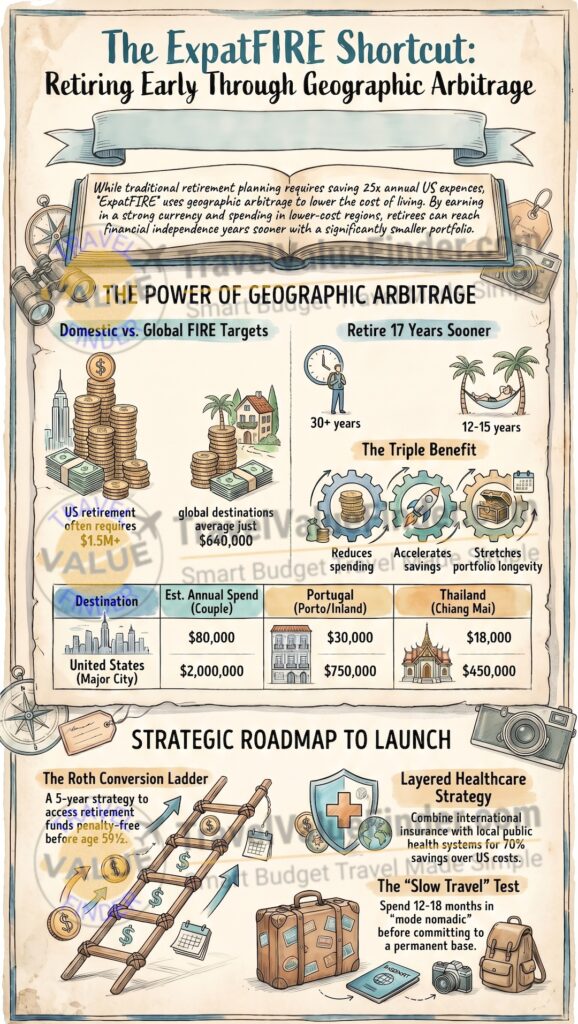
This infographic offers a quick look at how smart financial planning, intentional saving, and flexible lifestyle choices can turn that goal into reality. From building passive income to managing travel costs, these highlights give you a taste of what it takes to make it happen-then head to the full article for a step-by-step guide and practical tips to start your journey.
The Geographic Arbitrage Math: How Moving Abroad Rewrites Your Retirement Timeline
Geographic arbitrage is the financial superpower that makes early world travel retirement possible – and its effect on the retire early and travel the world timeline is more dramatic than most people understand. According to FinancialAha’s 2026 FIRE Number by Country data, FIRE targets vary by over 9x between the cheapest and most expensive countries. The global median is $640,000 – substantially below the $1.25 – $1.5 million most Americans calculate for a domestic FIRE lifestyle. In the lowest-cost viable retirement destinations, the number drops below $400,000.
The Geographic Arbitrage Savings Calculator: Real Examples
| Couple’s Retirement Scenario | Annual Spend | FIRE Number (25x) | Years to Save ($100K/yr income, 50% savings rate) | Retire At (starting at 30) |
| Stay in USA (major city) | $80,000 | $2,000,000 | ~40 years | Age 70 |
| USA lower-cost city (Austin, Phoenix) | $60,000 | $1,500,000 | ~30 years | Age 60 |
| ExpatFIRE: Portugal (Porto/inland) | $30,000 | $750,000 | ~15 years | Age 45 |
| ExpatFIRE: Mexico (Mérida/Oaxaca) | $24,000 | $600,000 | ~12 years | Age 42 |
| ExpatFIRE: Colombia (Medellín) | $18,000 | $450,000 | ~9 years | Age 39 |
| ExpatFIRE: Thailand (Chiang Mai) | $18,000 | $450,000 | ~9 years | Age 39 |
| Nomadic FIRE: Slow travel 10 countries/year | $24,000 – $36,000 | $600,000 – $900,000 | 12 – 18 years | Age 42 – 48 |
Assumes: couple starting savings at age 30 with $100,000 combined household income, 50% savings rate ($50,000/year invested), 7% average annual return on investments. Annual spend is total couple’s budget including accommodation, food, healthcare, transport, and travel. FIRE numbers use 25x rule. Does not account for Social Security income which may be available from age 62 (reduced) or 67 (full).
The triple benefit of ExpatFIRE – as identified by Nomadic FIRE’s research – is that moving abroad: (1) reduces your required FIRE number by cutting annual expenses, (2) accelerates your savings rate by earning US income while living cheaply abroad (if possible), and (3) stretches your portfolio further, making it last significantly longer once you do retire.
The ExpatFIRE Plan: How to Actually Retire Early and Travel the World
Phase 1: The Accumulation Phase (Years 1 – 12)
This is the phase where you are still working in the US, earning in dollars, and aggressively building the portfolio that will fund your early retirement and world travel. The goal is simple: maximise income, minimise expenses, maximise savings rate.
- Maximise tax-advantaged accounts first: Contribute the maximum to your 401(k) ($23,500 in 2026) and Roth IRA ($7,000 in 2026). These accounts reduce taxable income now (traditional 401k), grow tax-free (Roth), and compound your savings exponentially. If your employer matches 401(k) contributions – always capture the full match. That is a 50 – 100% instant return on investment before the market does anything
- Build a taxable brokerage account alongside: Tax-advantaged accounts have withdrawal penalties before age 59½. If you want to retire early and travel the world at 40, 45, or 50, you need liquid investments in a taxable brokerage. The Roth IRA conversion ladder is the standard early retirement solution – see below
- Target a 50 – 70% savings rate: The average US savings rate is 5 – 10%. FIRE adherents target 50 – 70%. The gap between those numbers is the difference between retiring at 65 and retiring at 40. Cut housing costs (share a house, live in a low-cost city, rent not own), eliminate lifestyle inflation, and direct every raise into investments rather than spending
- Invest in passive index funds, not individual stocks: The math on index investing vs. stock-picking is unambiguous. Low-cost Vanguard or Fidelity total market index funds (VTI, VTSAX) or global funds (VT) with expense ratios of 0.03 – 0.07% are the standard ExpatFIRE investment vehicle. Avoid actively managed funds with expense ratios above 0.5%
- Increase income in parallel: FIRE is about savings rate, not income – but higher income at the same savings rate means reaching FIRE faster. Side businesses, freelancing, skill development, and strategic job changes are all legitimate FIRE accelerators. Every $10,000 increase in annual investment reduces your timeline by approximately one year
Phase 2: The Roth Conversion Ladder – Accessing Retirement Funds Before 59½
One of the most common questions from people who want to retire early and travel the world is: “How do I access my 401(k) and IRA without the 10% early withdrawal penalty before age 59½?” The answer is the Roth conversion ladder – and it is the cornerstone of most serious ExpatFIRE plans.
| Step | What Happens |
| Year 1: Stop working, retire early | In the first year of early retirement, your taxable income drops to near zero. You begin converting Traditional 401(k)/IRA funds to Roth IRA, paying regular income tax on the converted amount at a very low rate (your income is now low, so you’re in a low bracket) |
| Years 1 – 5: Convert annually | Each year, convert an amount equal to your annual living expenses (e.g., $24,000). Pay tax on this at your low income bracket. These conversions are now in your Roth IRA |
| Year 5: Access tax-free | Roth conversions become available penalty-free after 5 years. Starting from year 5, you can access the funds converted in Year 1, then Year 2 conversions in Year 6, and so on – penalty-free, indefinitely |
| Bridge period (Years 1 – 5) | Fund your life from: (a) your taxable brokerage account, (b) Roth IRA contributions you already made (these are always accessible penalty-free), and (c) any part-time or freelance income |
Note: This is a general framework. Consult a fee-only fiduciary financial advisor familiar with FIRE and expat tax situations for your specific circumstances. Rules change and individual situations vary.
Phase 3: The Launch – Choosing Your First Destination
The most common mistake Americans make when they finally retire early and travel the world is moving too quickly to a permanent base. Resist the impulse to buy property in the first year. The ExpatFIRE community’s strong consensus – validated by The Casual Capitalist ExpatFIRE guide and Early Retire Abroad – is to spend the first 12 – 18 months in slow-travel mode, spending 4 – 8 weeks in each candidate destination before making any long-term commitment. This test period reveals things that no spreadsheet captures: how you feel about the heat in month four, whether the language barrier becomes exhausting or interesting, whether the expat community meets your social needs, and whether your actual monthly spending matches your projections.
Your ExpatFIRE Number by Destination: 2026 Reference Guide
According to FinancialAha’s 2026 FIRE Number by Country analysis, the same portfolio that enables regular FIRE in the US might fund a Fat FIRE lifestyle elsewhere with substantial margin. Here is the country-by-country ExpatFIRE number guide for Americans who want to retire early and travel the world:
| Destination | Est. Monthly Spend (Couple) | Annual Spend | ExpatFIRE Number | US FIRE Comparison | Visa for Early Retirees |
| ULTRA-LOW COST: Under $1,500/month couple | |||||
| Vietnam (Hanoi/Da Nang) | $1,200 – $1,600 | $14,400 – $19,200 | $360K – $480K | Saves $1.0M+ vs USA | E-visa/complex; verify SS |
| Cambodia (Phnom Penh) | $1,200 – $1,800 | $14,400 – $21,600 | $360K – $540K | Saves $960K+ vs USA | E-Visa renewable |
| Thailand (Chiang Mai) | $1,500 – $2,000 | $18,000 – $24,000 | $450K – $600K | Saves $900K+ vs USA | Retirement Visa O-A ($2K/mo income) |
| Albania (Adriatic coast) | $1,200 – $1,800 | $14,400 – $21,600 | $360K – $540K | Cheapest in Europe | 1-year visa-free for Americans |
| MID-RANGE: $1,800 – $2,800/month couple | |||||
| Mexico (Mérida/Oaxaca) | $1,800 – $2,400 | $21,600 – $28,800 | $540K – $720K | Saves $780K vs USA | Residente (approx. $2,600/mo income) |
| Colombia (Medellín) | $1,800 – $2,400 | $21,600 – $28,800 | $540K – $720K | Saves $780K vs USA | Pension Visa (~$730/mo) |
| Romania (Brașov/Cluj) | $1,600 – $2,200 | $19,200 – $26,400 | $480K – $660K | Cheapest EU country | Long-Stay Visa (EU) |
| Portugal (inland/Porto) | $2,200 – $2,800 | $26,400 – $33,600 | $660K – $840K | Saves $660K vs USA | D7 Visa (~$760/mo income) |
| PREMIUM: $2,800 – $3,800/month couple | |||||
| Spain (Andalusia/Valencia) | $2,800 – $3,600 | $33,600 – $43,200 | $840K – $1,080K | Saves $420K vs USA | Non-Lucrative (€2,150/mo) |
| Greece (mainland/Crete) | $2,400 – $3,200 | $28,800 – $38,400 | $720K – $960K | 7% flat tax on foreign income | Financially Independent Visa (€2,000/mo) |
ExpatFIRE numbers calculated using 25x annual spend (4% rule). US comparison assumes $80,000/year domestic couple spending requiring $2,000,000 FIRE number. All monthly budgets are comfortable couple all-in estimates. Visa income requirements are approximate and subject to change – verify with official government sources before applying. Social Security should be verified via SSA Payments Abroad Screening Tool for all destinations.
Healthcare: The Biggest Challenge When You Retire Early and Travel the World
Healthcare is the issue that stops most Americans from pursuing early retirement world travel – and understandably. According to Escape Artist’s 2026 affordable retirement analysis, US private insurance premiums average $18,000 per person annually, and a 65-year-old couple can expect to pay upwards of $395,000 in medical expenses throughout retirement. For early retirees who are not yet Medicare-eligible, healthcare coverage is both the largest budget line and the biggest planning challenge.
The ExpatFIRE healthcare solution is geographic arbitrage applied to medical costs – and the savings are extraordinary. According to The Casual Capitalist ExpatFIRE guide, Taiwan’s national health insurance costs under $30/month. Thailand’s JCI-accredited private hospitals charge 30 – 50% of US prices for equivalent care. Portugal’s national health system becomes accessible after establishing residency. Spain’s healthcare system – consistently rated among the world’s best – is available to legal residents after registration.
Healthcare Options for Early Retirees Who Travel the World
| Option | Best For | Cost Estimate |
| International expat health insurance | The essential foundation for all ExpatFIRE travelers – covers medical care internationally, including evacuation. Required for most retirement visas | $150 – $600/month depending on age, destination, coverage level |
| SafetyWing Nomad Insurance | Slow travelers and digital nomads – affordable, globally valid, covers most situations. Good starting point before securing local coverage | $45 – $80/month (basic coverage) |
| Local residency + public healthcare | After establishing legal residency in EU countries (Portugal, Spain, France, Greece) – access to public health systems at local rates or free | $0 – $2,500/year after qualifying wait period |
| Taiwan National Health Insurance | Taiwan residents – the world’s best single-payer system; comprehensive coverage for all residents regardless of nationality | Under $30/month for residents |
| ACA Marketplace (US healthcare) | If you maintain US residency – keep a plan for US visits. Premium tax credits may be available at lower income levels | Varies widely; potentially $0 – $300/month with ACA subsidies at ExpatFIRE income levels |
| Pay out-of-pocket (developing world) | Many ExpatFIRE retirees in Thailand, Vietnam, Mexico self-pay for routine care (consultations $15 – $50), maintain insurance only for major events and evacuation | $25 – $80/consultation; $200 – $500 for minor procedures |
Key insight: The combination of international expat insurance for major events + public health access after residency + out-of-pocket for routine care typically costs $200 – $500/month for an early retiree – versus the $1,500+/month US private insurance equivalent at age 45 – 55. That $1,000+/month saving is itself a significant contributor to the ExpatFIRE budget advantage.
Two Models: Nomadic Travel Retirement vs. Base + Travel Retirement
When you retire early and travel the world, you have two fundamentally different lifestyle models available – and choosing between them affects your FIRE number, your visa strategy, your healthcare setup, and your daily experience. Most ExpatFIRE retirees eventually settle into one of these models:
| Nomadic Model | Base + Travel Model | |
| How it works | Constantly moving – 2 – 8 weeks per country, no fixed home. Pure travel lifestyle, new destination every month or two | Fixed base in one affordable country; travel 1 – 3 months per year from that base |
| Monthly cost | $2,000 – $4,000/month (higher due to frequent accommodation changes, flights, visa runs) | $1,500 – $2,800/month (stable, predictable rent; travel is budgeted as a monthly line item) |
| FIRE number | $600,000 – $1,000,000 (variable costs require larger buffer) | $450,000 – $700,000 (stable base reduces uncertainty; smaller buffer needed) |
| Visa strategy | Managed through 90-day tourist entries across multiple countries; periodic ‘visa runs’; no single country residency | Obtain retirement/residency visa for base country; tourist entries for travel destinations |
| Healthcare | International travel insurance (SafetyWing or similar) is essential. Pay out-of-pocket for routine care in each country | Establish access to local healthcare system after residency; international insurance as supplement |
| Best for | Early ExpatFIRE (40s); travelers with flexibility; those without family ties; people who genuinely love constant novelty | Later ExpatFIRE (50s); people who want community and roots; those with health conditions needing stable care |
| Common mistake | Underestimating travel fatigue. Moving every 4 – 6 weeks sounds romantic; after 18 months, most nomads crave stability | Committing to a base country before testing it for a full year across all seasons |
Leslie Nics’s personal observation: Most people who start with the nomadic model and plan to retire early and travel the world indefinitely eventually transition to the base + travel model after 2 – 4 years. The appeal of constant movement is real – but so is travel fatigue. Plan for both phases and structure your finances to support either.
Taxes and Financial Obligations: What US Citizens Must Know When They Retire Abroad
The US is one of two countries in the world (the other is Eritrea) that taxes its citizens on worldwide income regardless of where they live. If you retire early and travel the world as an American citizen, you still file US taxes every year. Here is what that means in practice:
- You still file US taxes: Every US citizen living abroad must file a US federal tax return annually, regardless of residency or income source. The good news: most ExpatFIRE retirees owe little or no additional federal tax after applying the standard deduction ($15,750 single, $31,500 married) and Foreign Tax Credit
- FBAR and FATCA reporting: If you hold foreign bank accounts with a combined value over $10,000 at any point during the year, you must file an FBAR (FinCEN 114). If foreign financial assets exceed $50,000 (single) or $100,000 (married), FATCA Form 8938 is required. These are reporting requirements, not taxes – but failure to file carries serious penalties
- The 4% rule and international investing: According to FinancialAha’s analysis, the 4% rule was developed using US market historical returns. For ExpatFIRE retirees who keep their investments in US brokerage accounts (the standard approach), the 4% rule remains relevant, though currency fluctuations add a variable. Maintain your investment accounts at US-based institutions like Vanguard, Fidelity, or Charles Schwab
- Roth IRA conversion ladder timing: When income is near zero in early retirement, Roth conversions are extremely tax-efficient. An ExpatFIRE retiree converting $25,000/year from Traditional to Roth when living in Mexico on $24,000/year expenses pays very little federal tax on the conversion – often less than $2,500 given standard deductions and the current low brackets
- Social Security: If you paid into Social Security during your working years, you are entitled to benefits from age 62 (reduced) or 67 (full). These benefits continue regardless of where you live, with very limited exceptions (Cuba, North Korea). For ExpatFIRE retirees, Social Security becomes a meaningful income supplement from age 62 onward – potentially covering a significant portion of overseas living costs. Use the SSA Payments Abroad Screening Tool to verify your specific destination
- Get a fee-only expat tax specialist: The expat tax situation is complex enough that professional help pays for itself. Find an Enrolled Agent or CPA who specifically handles expat returns through the American Citizens Abroad Global Foundation’s directory. Cost: $500 – $1,500/year
The 10-Year ExpatFIRE Roadmap: How to Retire Early and Travel the World from Scratch
This is the practical, year-by-year blueprint for someone starting today at age 30 – 35 with $0 invested who wants to retire early and travel the world by age 40 – 45:
| Timeline | Action |
| Year 1 – 2 | Foundation Phase: Max out 401(k) and Roth IRA. Open a taxable brokerage account (Vanguard or Fidelity). Build 6-month emergency fund. Cut housing costs (share a house, move to a lower-cost city). Eliminate all consumer debt. Target 50% savings rate by end of Year 2. Begin researching ExpatFIRE destinations – read forums, follow blogs, watch YouTube documentaries on specific countries |
| Year 3 – 5 | Acceleration Phase: Increase income (negotiate raises, develop side income, consider higher-paying career moves). Maintain or increase savings rate. Portfolio should be reaching $150,000 – $250,000 by Year 5. Take one 2 – 3 week trip to a shortlisted ExpatFIRE destination to test it as a real candidate. Begin learning about visa requirements for your top 3 destinations |
| Year 6 – 8 | Pre-Launch Phase: Portfolio approaching $300,000 – $500,000. Take longer 4 – 8 week test stays in 2 – 3 candidate countries. Research and purchase international health insurance. Consult an expat tax specialist. Arrange US financial infrastructure for life abroad (Charles Schwab checking for ATM fee rebates, Wise/Revolut for currency conversion). Make the decision on your primary ExpatFIRE destination |
| Year 9 – 10 | Launch Phase: Portfolio at $450,000 – $750,000 (your ExpatFIRE number). Apply for your retirement/residency visa. Sell or rent out US assets as appropriate. Spend 12 – 18 months in slow-travel mode across your top destinations before committing to a fixed base. Begin Roth conversion ladder in Year 1 of retirement. Track actual vs. projected spending carefully in the first year |
| Year 10+ | Retirement Phase: Live on 4% portfolio withdrawal supplemented by any Barista FIRE income (part-time consulting, freelancing). Travel 1 – 3 months per year from a stable base. Build a local community. Access public healthcare after residency qualification. Re-evaluate destination every 3 – 5 years as your preferences evolve. From age 62 onward, Social Security supplements portfolio income significantly, reducing portfolio pressure |
The 7 Biggest Mistakes Americans Make When They Retire Early and Travel the World
Based on years of research and the ExpatFIRE community’s collected wisdom, here are the seven mistakes that derail people who try to retire early and travel the world:
- Underestimating healthcare costs: Early retirees between 45 – 65 (pre-Medicare) consistently underestimate international health insurance costs. Budget $300 – $600/month per person realistically – not the $80/month SafetyWing nomad plan which has significant coverage gaps
- Moving before testing: Spending two weeks on vacation in Lisbon and then relocating permanently is a recipe for disappointment. Test every candidate destination for at least 4 – 6 weeks, including experiencing at least one ‘non-tourist’ moment (a rainy winter week, a bureaucratic errand, a trip to the local hospital)
- Using the domestic FIRE number: Calculating your FIRE number based on US spending, then moving abroad and withdrawing 4% of that, means you are both over-saved and over-withdrawing. Recalculate your FIRE number using projected overseas spending – the number will be lower and your withdrawal rate will feel less financially precarious
- Ignoring the sequence of returns risk: Retiring into a major market downturn (2000, 2008, 2022) in the first few years permanently impairs a portfolio even if markets recover. Keep 12 – 24 months of expenses in cash or short-term bonds outside your invested portfolio as a buffer – this is especially important when you retire early and travel the world with a relatively small portfolio
- Not planning for Social Security integration: Many ExpatFIRE retirees forget to account for future Social Security income in their projections. If you worked 10+ qualifying years, Social Security from age 62 onward could contribute $800 – $2,000/month to your overseas living costs – substantially reducing the pressure on your investment portfolio
- Currency concentration risk: Keeping 100% of investments in USD-denominated assets while spending in foreign currencies creates currency risk. The dollar’s strength vs. your host currency can help or hurt your lifestyle budget significantly. Some ExpatFIRE retirees hold 10 – 20% in international or local currency assets as a hedge
- Over-relying on the 4% rule for 50-year retirements: The Trinity Study that produced the 4% rule tested 30-year retirements. If you retire early and travel the world at age 40, you may need your portfolio to last 50+ years. Many ExpatFIRE planners use 3% – 3.5% withdrawal rates for longer horizons, or build in Barista FIRE income to reduce early-year portfolio stress
Ready to compare cities now?
- Use our Free Retirement Cost of Living Calculator — get your personalized report in 30 seconds – Free PDF download.
- How to Use a Retirement Cost of Living Calculator – to Compare Cities Worldwide
- Explore The Retirement Travel Bucket List: 50 Experiences to Have After 60
Plan Your Early Retirement and World Travel: Essential Resources
Complete guide library at TravelValueFinder:
- Best Countries to Retire Abroad on a Budget in 2026
- Travel Tips for Retirees: 20 Ways to Travel Better After 60
- Best Places to Retire in Europe on a Small Budget
- Digital Nomad Retirement: How to Work and Travel After 55
- Cheapest Countries to Retire In: Top Picks for 2026
- Best Places to Retire in Europe on a Small Budget
- Retire in Portugal: A Practical Guide for Over-55s
- Retire in Spain: A Practical Guide
- Retire in France After 55: Healthcare, Costs, Visas and Lifestyle
- Spain vs Portugal for Retirement: Full Comparison
- Solo Travel Over 50: Tips, Destinations and Budget Advice
- Cheap Countries to Visit in 2026: Best Value Destinations Ranked
- How to Travel on $50 a Day (and Actually Enjoy It)
- Budget Travel Tips: 30 Strategies to Travel More for Less
- Travel Insurance Guide: What It Covers and Best Options
- How to Find Cheap Flights: 12 Proven Strategies That Actually Work
- How to Save Money on Hotels: The Budget Traveler’s Complete Guide
- Explore How to Afford Travel in Retirement on a Fixed Income.
- Free AI Trip Planner: Get a Day-by-Day Itinerary in Seconds
Start planning your early retirement and world travel today. Book your first exploratory trip through our trusted partner: Search Early Retirement Destination Flights and Hotels – TravelValueFinder. We earn a small commission at no extra cost to you.
Frequently Asked Questions: How to Retire Early and Travel the World
How much money do you need to retire early and travel the world?
Using the 4% rule, multiply your annual overseas living expenses by 25 to get your ExpatFIRE number. A couple spending $24,000/year (Mexico or Colombia) needs approximately $600,000. A couple spending $30,000/year (Portugal or Greece outside major cities) needs $750,000. A couple spending $18,000/year (Thailand or Albania) needs $450,000. According to FinancialAha’s 2026 FIRE Number by Country analysis, the global median FIRE number is $640,000 – substantially below what most Americans calculate for a domestic retirement. Use a 3.5% withdrawal rate if you plan to retire before age 45 for a more conservative approach.
Can I retire early and travel the world on $500,000?
Yes – in the right destinations. A $500,000 portfolio using the 4% rule generates $20,000 per year in withdrawals. That supports a comfortable lifestyle in Thailand, Vietnam (if SS payments are confirmed), Albania, Romania, and parts of Mexico and Colombia. Barista FIRE (supplementing portfolio income with part-time freelance work of $5,000 – $10,000/year) expands your options significantly and is very common among early retirees who want the security of some earned income while keeping travel flexibility.
What is geographic arbitrage and how does it help me retire early?
Geographic arbitrage means earning income in a strong currency (the US dollar) and spending it in a lower-cost country. It has a triple effect on your retire early and travel the world plan: (1) it reduces your required FIRE number because your annual expenses are lower, (2) it makes your portfolio last dramatically longer because you are withdrawing less, and (3) it can accelerate your savings phase if you live cheaply abroad while still earning remote income. A couple that can work remotely while living in Lisbon for $2,500/month instead of Dallas at $6,000/month is saving an extra $3,500/month – approximately $42,000 extra per year – compounding those savings at 7% average returns toward early retirement.
How do I handle health insurance when I retire early and travel the world?
The standard ExpatFIRE healthcare strategy is layered: (1) International expat health insurance ($150 – $600/month depending on age and destination) as the foundation – this is required for most retirement visas and covers major events including medical evacuation; (2) Access to local public healthcare systems after establishing residency in EU countries or participating nations; (3) Pay out-of-pocket for routine care in developing countries where consultations cost $15 – $50. The total effective cost of this layered approach is usually $200 – $500/month – dramatically less than US private insurance for pre-Medicare retirees.
Do US citizens pay taxes when they retire early and travel the world?
Yes – the US taxes citizens on worldwide income regardless of residence. You must file US federal taxes every year. However, most ExpatFIRE retirees owe little additional federal tax because: (1) portfolio income (dividends, capital gains) may be taxed at 0% at lower income levels (currently the 0% long-term capital gains bracket applies up to approximately $89,250 for married couples in 2026); (2) Roth IRA withdrawals are tax-free; (3) Roth conversion amounts are taxed at income tax rates, but at near-zero rates when your retirement income is low; and (4) the Foreign Tax Credit offsets taxes paid abroad. Hire a fee-only expat tax professional – it pays for itself.
What is the best age to retire early and travel the world?
The ideal age depends on your savings rate, income, and destination. With a 50% savings rate from age 30 in a $100,000 household, most ExpatFIRE calculations suggest reaching your target number between ages 38 – 48 depending on destination. The practical sweet spot that most ExpatFIRE retirees report as optimal is 40 – 50: old enough to have built a meaningful portfolio, young enough to have decades of vibrant travel ahead, and young enough to adapt comfortably to new countries and languages. Social Security eligibility from age 62 provides a meaningful income supplement that significantly reduces portfolio pressure for anyone who retires in their 40s.
Final Thoughts: The Most Honest Thing About Early Retirement and World Travel
The math to retire early and travel the world is available to more Americans than any other generation in history. The tools are better: low-cost index funds, global banking, remote work infrastructure, international healthcare networks. The destinations are more accessible: retirement visas, expat communities, English-language infrastructure across Southeast Asia and Latin America and Europe.
What this guide cannot give you is the will. The will to save 50 – 70% of your income for a decade while your peers spend. The will to leave behind the geography of familiarity. The will to arrive somewhere new with everything you own in two bags and call it freedom. But what it can tell you – and what the research confirms – is that the math works. The number is achievable. And according to every ExpatFIRE retiree who has made the move, the experience of waking up in a country that is extraordinary and affordable and alive is exactly what it sounds like when you imagine it. Find out on how to Retire Abroad on Social Security: Which Countries Work Best in 2026?
The only mistake is waiting until 65 to find out.
Every calculation I’ve run on ExpatFIRE comes back to the same conclusion: the decision to retire early and travel the world is not primarily a financial decision. It’s a values decision. The money follows if you decide what you actually want from your one life. Run the numbers, yes. But start with the question. What would you do with your time if work was optional? The answer to that question is more important than any spreadsheet. Leslie Nics, TravelValueFinder.com
Take the first step toward retiring early and traveling the world. Research your destination and book your first exploratory trip: Find Early Retirement Destination Flights – TravelValueFinder. We earn a small commission at no extra cost to you – helping keep all our guides free.