Travel Value Finder


Let me start with a number that changes everything: the most any American retiree can receive from Social Security in 2026 is $5,251 per month. The average, according to US News, is approximately $1,907. Most American households have two earners, which can bring combined Social Security to $3,000 – $3,800/month. In Dallas, Denver, or Miami, that income is stressful. In the cheapest countries to retire in, it is generous. In some of them, it is abundant.
According to Get Golden Visa’s retirement research, over 760,000 US retirees currently receive Social Security benefits outside the United States – and that number rises every year. They are not leaving because they failed at the American Dream. They are leaving because they discovered that their fixed retirement income buys a dramatically richer, slower, sunnier life somewhere else. The cheapest countries to retire in are not consolation prizes. They are deliberate upgrades.
This guide ranks the cheapest countries to retire in for Americans in 2026 by real total monthly cost – not the low-end floor that requires eating rice every night, but a genuine ‘comfortable expat’ budget that includes a decent apartment, restaurants several times a week, healthcare coverage, local transport, and occasional travel. Each profile includes the visa details, Social Security eligibility, Medicare gap strategy, tax considerations, and the honest truth about what daily life actually looks and feels like.
The cheapest country to retire in is not the one with the lowest price tag on a spreadsheet. It is the one where your specific income creates the life you actually want to live – with enough left over to breathe freely for the first time in years. Leslie Nics, TravelValueFinder.com
Ready to research your retirement move? Book exploratory trips to any destination in this guide through our trusted partner: Search Flights and Hotels – TravelValueFinder Deals. Real-time prices, secure booking.
Table of Contents
Why 2026 Is an Exceptional Year to Retire in a Cheap Country
Several factors converge in 2026 to make this the most favourable year in recent memory for Americans considering the cheapest countries to retire in:
| Factor | Why It Matters in 2026 |
| Social Security COLA increase | Benefits rose 2.8% in 2026 – meaning existing retirees get more income without doing anything. Combined with low overseas costs, this stretches budgets further than any time in recent years |
| USD strength in key markets | The US dollar remains strong against the euro, Thai baht, Mexican peso, Colombian peso, and Vietnamese dong – all currencies of top retirement destinations in this guide |
| International Living names Greece #1 | For the first time in 35 years, Greece tops International Living’s 2026 Global Retirement Index – its 7% flat tax on foreign income for 15 years is newly attracting American retirees in significant numbers |
| Bolivia visa-free for Americans | Bolivia removed its $160 US visa requirement in 2026 – making the cheapest country in South America now accessible without the cost or complexity that previously deterred American retirees |
| Post-pandemic expat infrastructure | International healthcare networks, expat banking services, telemedicine, and international Medicare supplement options have all matured post-2020 – making the logistics of retiring overseas significantly more manageable |
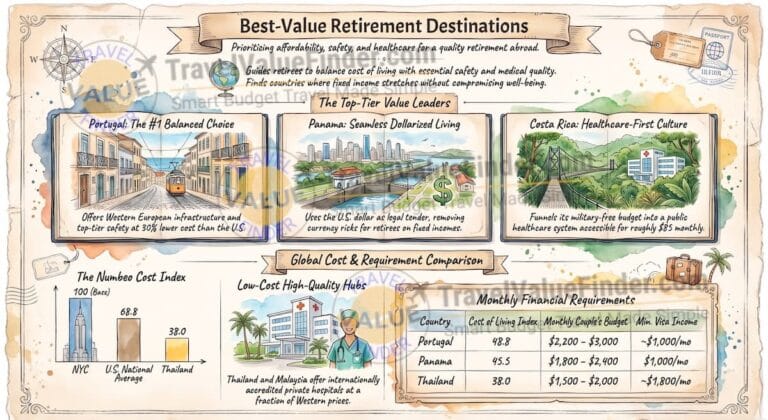
This infographic showcases some of the cheapest countries to retire in, highlighting destinations where everyday expenses, housing, and healthcare remain affordable while still offering rich culture and comfortable living. It’s a quick overview of top picks that balance cost and lifestyle, giving you a starting point for planning your move. For a closer look at living costs, residency requirements, and what to expect day-to-day, explore the full article.
Our Three-Tier Framework for the Cheapest Countries to Retire In
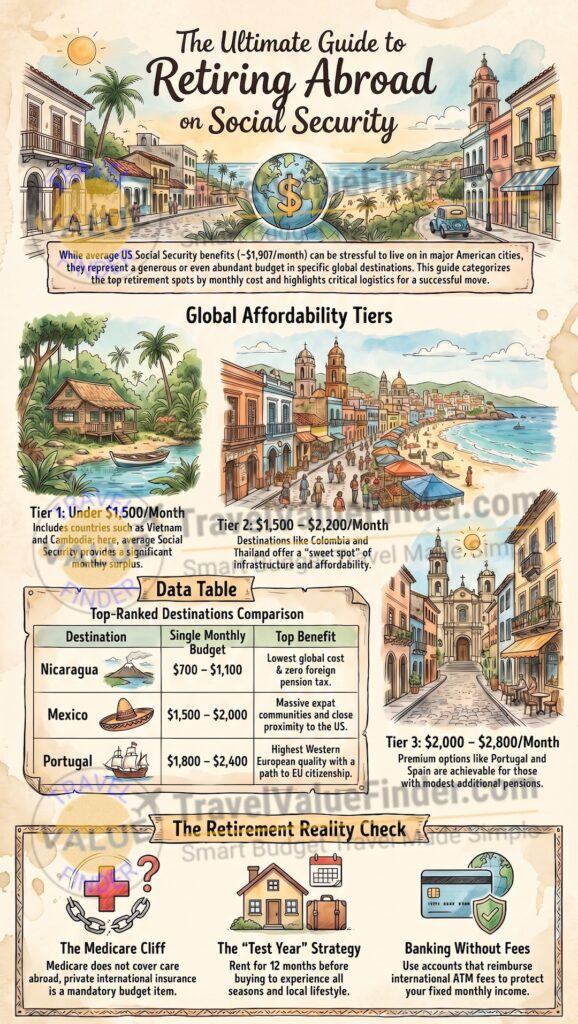
Most guides on the cheapest countries to retire in simply list countries by lowest daily cost. This misses the key variable: can you live there on Social Security alone? Our three-tier framework answers that question directly, sorted by what a single American retiree receiving the average Social Security benefit ($1,907/month) can actually afford:
| Tier | Monthly Budget (Single) | Monthly Budget (Couple) | Social Security Solo? |
| TIER 1 | Under $1,500 | Under $2,200 | YES – comfortably |
| Nicaragua, Vietnam, Cambodia, Bolivia, Philippines | $700 – $1,400 | $1,000 – $2,000 | Yes – with money to spare |
| TIER 2 | $1,500 – $2,200 | $2,200 – $3,200 | YES – on average SS |
| Mexico, Colombia, Thailand, Ecuador, Albania, Romania | $1,200 – $2,000 | $1,800 – $3,000 | Yes – average SS benefit |
| TIER 3 | $2,000 – $2,800 | $3,000 – $4,200 | YES – with small pension |
| Portugal, Spain, Greece, Panama, Costa Rica | $1,800 – $2,500 | $2,500 – $3,800 | Yes – with modest pension |
The Cheapest Countries to Retire In 2026: Complete Rankings at a Glance
This is the complete reference table for every country ranked in this guide. All budgets are all-inclusive monthly estimates for a single retiree living comfortably – not the absolute minimum survivable budget:
| # | Country | Single/Month | Couple/Month | Visa Req. | SS Eligible | Best For |
| TIER 1 – Cheapest Countries to Retire In: Under $1,500/month | ||||||
| 1 | Nicaragua | $700 – $1,000 | $1,000 – $1,500 | Pensionado | Yes | Lowest total cost on earth; zero foreign pension tax |
| 2 | Vietnam | $1,000 – $1,500 | $1,400 – $2,000 | E-visa (90 days) | Check SSA | World’s best food culture; Hanoi 100K expats |
| 3 | Cambodia | $900 – $1,400 | $1,300 – $1,900 | Retirement Visa | Check SSA | Angkor Wat access; extreme affordability |
| 4 | Bolivia | $1,000 – $1,400 | $1,400 – $2,000 | Visa-free 2026 | Yes | Cheapest S. America; salt flats; new visa-free access |
| 5 | Philippines | $1,000 – $1,600 | $1,400 – $2,200 | SRRV (Special) | Yes | English official language; SRRV lifetime visa |
| TIER 2 – Very Affordable: $1,500 – $2,200/month | ||||||
| 6 | Mexico | $1,500 – $2,000 | $2,000 – $2,800 | Residente | Yes | 1M+ American expats; Lake Chapala community |
| 7 | Colombia (Medellín) | $1,500 – $2,000 | $2,000 – $2,800 | Retirement Visa | Yes | Year-round spring; growing US expat scene |
| 8 | Thailand (Chiang Mai) | $1,500 – $2,000 | $2,000 – $2,800 | Retirement Visa O-A | Verify SSA | World-class private healthcare at 40% US prices |
| 9 | Albania | $1,200 – $1,800 | $1,800 – $2,500 | 1-yr visa-free | Yes | Europe’s hidden gem; Adriatic coast; no language visa |
| 10 | Romania | $1,400 – $1,900 | $1,900 – $2,800 | Long-Stay Visa | Yes | EU quality; Transylvanian castles; lowest EU costs |
| TIER 3 – Affordable Premium: $2,000 – $2,800/month | ||||||
| 11 | Portugal | $1,800 – $2,400 | $2,400 – $3,200 | D7 Visa | Yes | Best European quality of life; path to EU citizenship |
| 12 | Panama | $2,000 – $2,500 | $2,500 – $3,500 | Pensionado | Yes | USD economy; $1,000/mo qualifies; 50% discounts |
| 13 | Costa Rica | $1,800 – $2,400 | $2,400 – $3,200 | Pensionado | Yes | Zero tax on foreign pensions; 5 Blue Zone communities |
| 14 | Spain | $2,000 – $2,600 | $2,800 – $3,800 | Non-Lucrative | Yes | World’s best healthcare; food culture; EU access |
| 15 | Greece | $2,000 – $2,500 | $2,500 – $3,200 | Non-Lucrative | Yes | IL 2026 #1; 7% flat tax 15 years; 300+ sunny days |
Monthly budgets are all-inclusive: accommodation, food, utilities, local transport, international health insurance, and modest leisure. Data from Taxes for Expats 2026, International Living 2026 Global Retirement Index, and first-hand research. Budgets are single-retiree unless noted.
What the Top-Ranking Articles on Cheapest Countries to Retire In Get Wrong
Most guides ranking the cheapest countries to retire in share three critical gaps that cause real problems for American retirees who rely on them:
Gap 1: They Never Tell You If Social Security Actually Gets Paid There
Many top-ranking articles on the cheapest countries to retire in list Vietnam, Cambodia, and Nicaragua as top budget destinations – without telling you that the Social Security Administration has specific payment restrictions for some of these countries. According to the SSA’s official international payments guidance, benefits generally cannot be sent to Cuba or North Korea, and specific rules apply to Cambodia, Vietnam, and parts of the former Soviet Union. This is not a reason to avoid these countries – but it is critical to verify before you plan your life around them. Always use the SSA Payments Abroad Screening Tool before making any long-term commitment to a destination.
Gap 2: They Ignore the Medicare Cliff – The Biggest Financial Risk of Retiring Abroad
Every article on the cheapest countries to retire in for Americans should open with this sentence and does not: Medicare does not cover medical care outside the United States. If you retire abroad and depend on Medicare for health coverage, you are effectively uninsured the moment you leave US territory. International health insurance – required as a condition of most retirement visas including Portugal, Spain, Greece, Costa Rica, and Thailand – costs $150 – $600/month for retirees in their 60s and 70s. This is not optional. It must be factored into every monthly budget calculation in this guide (and has been).
Gap 3: They List Countries at Their Cheapest Possible Minimums, Not Real Comfortable Budgets
Guides on the cheapest countries to retire in regularly quote figures like ‘Vietnam: $600/month’ or ‘Nicaragua: $700/month’ – which technically exist but require living in ways most American retirees would find uncomfortable: no air conditioning, local food only, no expat community, no private health coverage. Every budget in this guide is a ‘comfortable expat budget’ – a private apartment with air conditioning (or heat), restaurant meals 3 – 4 times per week, international health insurance, local transport, and occasional leisure travel. No surprises.
Tier 1: The Absolute Cheapest Countries to Retire In – Under $1,500/Month
These are the cheapest countries to retire in by total monthly cost – destinations where the average Social Security benefit ($1,907/month) covers all expenses and leaves a monthly surplus.
#1 Nicaragua – The Single Cheapest Country to Retire In for Americans
Monthly budget (single): $700 – $1,000 | Monthly budget (couple): $1,000 – $1,500 | Retirement visa: Pensionado | Foreign pension tax: Zero
Nicaragua is the cheapest country to retire in on earth for Americans who want a comfortable, genuinely livable lifestyle – and it is almost never discussed in mainstream retirement guides because it sits in the shadow of its more famous Central American neighbours. That oversight is a gift to those willing to look past the headline. According to Get Golden Visa’s retirement analysis, a comfortable retirement in Nicaragua costs under $1,000 per month for a single person – and pays zero local income tax on foreign pension income. The combination is unmatched anywhere in the world for Americans on a modest fixed income.
Nicaragua’s pension visa (Pensionado) requires proof of approximately $600/month in pension income – the lowest bar of any retirement visa in the Western Hemisphere. The country’s Pacific coast (San Juan del Sur, the beach town beloved by both surfers and retirees) and the colonial cities of Granada and León offer genuinely beautiful settings: Spanish colonial architecture, active volcanoes visible from the street, enormous freshwater Lake Nicaragua with its islands and wildlife. A one-bedroom apartment in Granada rents for $200 – $350/month. A restaurant meal costs $3 – $7. A local beer costs $1.
| Expense | Monthly Cost (Single) | Notes |
| 1-bedroom apartment (Granada/León) | $200 – $350 | Furnished, utilities included in many cases |
| Groceries and local restaurants | $150 – $250 | Local market shopping; restaurants 3 – 4x/week at $3 – $7 per meal |
| International health insurance | $150 – $300 | Required for visa; covers gap left by Medicare |
| Local transport | $30 – $60 | Chicken buses $0.25 – $1 per trip; taxis $1 – $3 |
| Utilities and miscellaneous | $80 – $150 | Electricity, internet, phone |
| Total monthly (single) | $700 – $1,100 | Well within average US Social Security benefit |
- Honest caveat: Nicaragua’s political situation requires monitoring – the US State Department rates it at Level 3 (Reconsider Travel). The expat community is smaller than in neighbouring Costa Rica. Research thoroughly and visit for at least one month before committing
- Healthcare: Private healthcare costs are extremely low ($15 – $40 per consultation). For serious medical needs, many Nicaragua retirees travel to Costa Rica or back to the USA – budget accordingly
#2 Vietnam – The Cheapest Country to Retire In with World-Class Food Culture
Monthly budget (single): $1,000 – $1,500 | Monthly budget (couple): $1,400 – $2,000 | Retirement visa: E-visa (90 days); no formal retirement visa | SSA payments: Verify individually
Vietnam sits in a unique position among the cheapest countries to retire in: it offers extraordinary food culture (consistently ranked among the world’s best cuisines at the lowest prices), a massive and growing international expat community (Hanoi alone has approximately 100,000 expats according to GOBankingRates 2026), and daily living costs that are among the lowest in Asia. One retiree profiled in the GOBankingRates International Living report lives in Hanoi for under $1,800 per month – a figure that includes accommodation, food, entertainment, and private healthcare.
The critical caveat for Americans considering Vietnam as one of the cheapest countries to retire in: Vietnam does not have a formal retirement visa programme. Most long-term retirees in Vietnam manage their stay through a combination of tourist visas (the e-visa now grants 90 days), business visas, or extended stays through local visa agents. The SSA also has specific payment rules for Vietnam – verify your individual benefit status using the SSA Payments Abroad Screening Tool before planning a long-term move.
- Best cities for budget retirement: Hanoi (cultural, slightly cooler, massive expat community), Hội An (lantern-lit UNESCO town, massive artistic community, beach nearby), Da Nang (beach city, fastest-growing expat hub, modern infrastructure), Ho Chi Minh City (urban energy, highest cost in Vietnam but still extremely affordable)
- Healthcare advantage: Vietnam’s private hospitals in major cities are excellent and cost 20 – 40% of comparable US prices. Many expats pay out-of-pocket for routine care (consultations from $15 – $30) and maintain international insurance for major events and medical evacuation
#3 Cambodia – The Cheapest Country to Retire In Near Angkor Wat
Monthly budget (single): $900 – $1,400 | Monthly budget (couple): $1,300 – $1,900 | Retirement visa: Ordinary Visa E (renewable annually) | SSA payments: Verify individually
Cambodia consistently makes lists of the cheapest countries to retire in for one compelling financial reason: its combination of USD economy (the US dollar is widely used alongside the Cambodian riel), extremely low accommodation and food costs, and an accessible visa system makes it one of the simplest and most affordable places in the world for American retirees to settle. The Ordinary E Visa is renewable annually through a local visa agent for approximately $300 – $400 per year. No income proof, no formal retirement visa programme – just a straightforward renewable visa.
- Siem Reap vs Phnom Penh: Siem Reap (gateway to Angkor Wat) is slower, cheaper ($700 – $1,200/month all-in), and more community-focused. Phnom Penh (capital) is more urban, faster, slightly pricier but offers better medical facilities and international connections
- Healthcare: Phnom Penh has Royal Phnom Penh Hospital (internationally accredited) with excellent English-speaking staff. For serious medical events, most expats fly to Bangkok (1.5 hours) where Thailand’s world-class private hospitals are available
#4 Albania – The Cheapest Country in Europe to Retire In (And the Most Underrated)
Monthly budget (single): $1,200 – $1,800 | Monthly budget (couple): $1,800 – $2,500 | Visa: Americans can stay 1 full year visa-free | SSA payments: ✓ Yes
Albania is the answer to a question most people do not know to ask: which is the cheapest country in Europe to retire in? Not Romania (second cheapest), not Bulgaria (third), but Albania – a country that is not yet in the EU, speaks a language few foreigners know, and has been almost completely off the radar of American retirement researchers until the past few years. According to Vagabond Buddha’s 2026 retirement research, the cost of living for typical expats ranges from $1,200 to $2,200 per month, with frugal retirees potentially living on less.
Albania’s extraordinary advantage for American retirees is its 1-year visa-free entry policy for US citizens – meaning you can arrive, stay for a full year, leave briefly, and return. No retirement visa paperwork, no income proof required for the initial year. The Albanian Riviera (the stretch of Ionian and Adriatic coast between Sarandë and Himarë) rivals Santorini and Dubrovnik in scenery and costs a fraction of the price. Guesthouses and apartments on the coast run $300 – $600/month in the shoulder season. A full meal at a local restaurant costs $6 – $10.
- Tirana (the capital): Modern, walkable, good infrastructure, tree-lined boulevards, excellent cafe culture, international restaurants at local prices. One-bedroom apartments from $350 – $600/month in good central neighbourhoods
- For the longer term: A formal Albanian retirement visa exists for those who want to stay beyond the 1-year visa-free period; it requires proof of pension of approximately $1,350/month or purchase of residential property
- Cheap Countries to Visit in 2026: Best Value Destinations Ranked
Tier 2: Very Affordable Cheapest Countries to Retire In – $1,500 – $2,200/Month
These are the cheapest countries to retire in that hit the sweet spot for most American retirees: low enough that the average Social Security benefit covers everything comfortably, with enough infrastructure and expat community to make the transition manageable.
#5 Mexico – The Cheapest Country to Retire In That Feels Like Home
Monthly budget (single): $1,500 – $2,000 | Monthly budget (couple): $2,000 – $2,800 | Retirement visa: Residente Permanente | SSA payments: ✓ Yes
Mexico occupies a unique category among the cheapest countries to retire in: it is the only country on this list where you can retire abroad without, in many practical senses, fully leaving home. Three-hour flights from most US cities. Costco and Walmart in major cities. English widely spoken in expat communities. Over one million American expats already living there – including more than 20,000 in the Lake Chapala/Ajijic area near Guadalajara, the world’s largest American expat retirement community.
The peso-to-dollar exchange rate (approximately 17 – 18 pesos per dollar as of April 2026) means a $2,000/month Social Security income has the purchasing power of $4,000 – $5,000 in US retail prices. A comfortable one-bedroom apartment in Mérida (the Yucatán’s increasingly popular, genuinely safe colonial city) rents for $400 – $700/month. A full restaurant dinner costs $8 – $15. Private medical consultation: $25 – $50.
| Mexico Region | Monthly Budget (Single) | Best For |
| Lake Chapala / Ajijic | $1,400 – $1,900 | Largest American expat community; English-first lifestyle; mountain lake setting |
| Mérida, Yucatán | $1,300 – $1,800 | Safety, Mayan culture, colonial architecture, cenotes, beach access |
| San Miguel de Allende | $1,600 – $2,200 | Arts community, UNESCO heritage, cooler highland climate |
| Puerto Vallarta / Oaxaca | $1,500 – $2,000 | Beach lifestyle; Oaxacan food and mezcal culture |
- Cheap Countries to Visit in 2026 (Mexico featured)
- Solo Travel Tips for First-Timers (Mexico section)
#6 Colombia – The Cheapest Country to Retire In With Year-Round Spring
Monthly budget (single): $1,500 – $2,000 | Monthly budget (couple): $2,000 – $2,800 | Retirement visa: Pensión Visa | SSA payments: ✓ Yes
Medellín, Colombia sits at 5,000 feet above sea level and maintains a temperature of approximately 72°F year-round – earning its nickname ‘the city of eternal spring.’ It is one of the cheapest countries to retire in for Americans looking for urban sophistication at developing-world prices. A couple can live well in El Poblado (Medellín’s safest, most expat-friendly neighbourhood) for $2,000 – $2,500/month all-in. The metro system is world-class. The restaurant scene is extraordinary. Private medical consultations cost $25 – $60.
- Cartagena: Colombia’s Caribbean coast alternative – warmer, more beachside, historic colonial walled city. Slightly higher costs than Medellín ($1,800 – $2,200/month) but extraordinary lifestyle
- Safety note: Exercise increased caution; stay in El Poblado and Laureles in Medellín; use official taxis and Uber; check US State Department advisory before planning long-term relocation
- Best Countries to Retire Abroad on a Budget in 2026
#7 Portugal – The Cheapest Country in Western Europe to Retire In
Monthly budget (single): $1,800 – $2,400 | Monthly budget (couple): $2,400 – $3,200 | Retirement visa: D7 Passive Income Visa | Income requirement: ~$1,350/month | SSA payments: ✓ Yes
Among the cheapest countries to retire in in Western Europe, Portugal stands alone. According to Taxes for Expats 2026 data, basic monthly living costs (excluding rent) for a single person in Portugal run at just $776 – the lowest in Western Europe. Add a comfortable one-bedroom apartment ($600 – $900 in Porto; $800 – $1,200 in Lisbon; $400 – $700 in inland cities like Coimbra or Évora) and international health insurance ($200 – $400/month), and a single retiree can live well in Portugal for $1,600 – $2,200/month.
Portugal’s D7 Passive Income Visa requires approximately $1,350/month in passive income for a single applicant – well within the reach of an average Social Security recipient. After five years, you qualify for Portuguese citizenship and an EU passport: visa-free access to 188 countries and the right to live anywhere in the European Union’s 27 member states.
- Best value regions outside Lisbon: Porto (more affordable, equally beautiful), Coimbra (university city, extraordinary history, lower prices), Alentejo wine region (authentic, rural, extraordinary value), Silver Coast (beaches without Algarve prices)
- Retire in Portugal: A Practical Guide for Over-55s
- Where to Stay in Lisbon – Best Neighborhoods
- Spain vs Portugal for Retirement: Full Comparison
Real Monthly Budget Breakdowns: What ‘$1,500/Month’ Actually Looks Like in Three Cheapest Countries
The gap between ‘cheapest countries to retire in’ and ‘what does $1,500 actually buy in the cheapest countries to retire in‘ is significant. Here are real, detailed monthly budgets for three different retirement styles across three different Tier 2 destinations:
Budget A: $1,500/Month in Chiang Mai, Thailand – The Digital Nomad Retirement
| Expense Category | Monthly Cost |
| Studio/1-bed apartment (Nimman or Old City area) | $350 – $500 |
| Food (mix of street food + restaurants) | $200 – $350 |
| International health insurance | $200 – $350 |
| Motorbike rental or rideshare | $60 – $100 |
| Gym/yoga (Chiang Mai has world-class studios) | $30 – $60 |
| Utilities and co-working | $80 – $120 |
| Entertainment, day trips, culture | $100 – $200 |
| Total | $1,020 – $1,680 |
| What you get: | Air-conditioned private apartment; restaurant meals most days; yoga 3x/week; health coverage; day trips to temples and elephant sanctuaries; surplus from average SS benefit |
Budget B: $1,800/Month in Mérida, Mexico – The Comfortable Expat Retirement
| Expense Category | Monthly Cost |
| Comfortable 2-bed apartment (Centro or Paseo Montejo area) | $500 – $750 |
| Groceries (mix of local market and Costco/Walmart) | $200 – $300 |
| Restaurants (5 – 6 times per week including weekend splurge) | $150 – $250 |
| International health insurance | $200 – $400 |
| Transport (Uber, taxi, colectivos) | $80 – $120 |
| Activities, day trips (cenotes, ruins) | $100 – $200 |
| Utilities, streaming, phone | $100 – $150 |
| Total | $1,330 – $2,170 |
| What you get: | Spacious 2-bedroom in a beautiful colonial city; multiple restaurant meals per week; Chichén Itzá day trips; private health coverage; still within average SS benefit for a couple |
Budget C: $2,200/Month in Porto, Portugal – The European Culture Retirement
| Expense Category | Monthly Cost |
| 1-bed apartment (Cedofeita or Bonfim neighbourhood) | $700 – $900 |
| Groceries (Continente supermarket + local markets) | $250 – $380 |
| Restaurants (mix of tascas and occasional fine dining) | $200 – $350 |
| International health insurance + access to SNS public health | $250 – $450 |
| Porto metro and occasional taxi/Uber | $60 – $100 |
| Port wine tastings, Douro Valley day trips, culture | $100 – $200 |
| Utilities, internet, phone | $120 – $180 |
| Total | $1,680 – $2,560 |
| What you get: | Central apartment in one of Europe’s most beautiful cities; wine tastings; restaurant meals; full health coverage; access to EU travel on budget airlines; path to EU citizenship |
Ready to compare cities now?
- Use our Free Retirement Cost of Living Calculator — get your personalized report in 30 seconds – Free PDF download.
- How to Use a Retirement Cost of Living Calculator – to Compare Cities Worldwide
5 Things Other Guides About the Cheapest Countries to Retire In Never Tell You
After analysing the top-ranking pages on the cheapest countries to retire in, here are the five most important pieces of advice that none of them include:
1. The ‘Test Year’ Strategy: Rent Before You Retire Abroad
The single biggest mistake American retirees make when choosing the cheapest countries to retire in is moving based on two-week tourist visits. A tourist’s experience of Chiang Mai in February (cool, beautiful, uncrowded) is completely different from a resident’s experience in April (hot season, burning season, smoke from agricultural fires). Visit your shortlisted destination for at least 4 – 6 weeks across different seasons before committing. Many experienced expats recommend a ‘test year’ – renting for 12 months with no permanent commitment before selling the US home or signing long-term leases abroad.
2. The Banking Trap – Open a Wise or Charles Schwab Account Before You Move
Standard US bank accounts charge 2 – 3% foreign transaction fees plus $3 – $8 per ATM withdrawal. On a $2,000/month retirement income, that is $60 – $150 in unnecessary fees annually. Two solutions that every retiree in the cheapest countries to retire in should know: Charles Schwab Bank reimburses all ATM fees worldwide – making it the gold-standard checking account for international retirees. Wise provides the mid-market exchange rate with low transfer fees for international money movement. Set up both before you move.
3. The Isolation Risk – Expat Community Size Matters
Cost is not the only factor when choosing the cheapest countries to retire in. The size and vitality of the expat community matters enormously to long-term happiness. Nicaragua is genuinely cheap but has a small American expat community. Albania has an even smaller one. Mexico’s Lake Chapala has over 20,000 Americans – the largest American retirement community outside the United States. Portugal’s expat community is growing rapidly. Thailand’s Chiang Mai has a massive international community. Research the community size for your destination before committing – isolation is the primary reason international retirements fail and people return home.
4. Healthcare Quality Varies Wildly Within Countries – Choose Your City Carefully
Every list of the cheapest countries to retire in rates ‘healthcare’ at the country level. But healthcare quality in Cambodia varies enormously between Phnom Penh (accredited international hospital) and a rural province (very limited care). In Vietnam, Ho Chi Minh City and Hanoi have excellent international hospitals; smaller cities do not. In Mexico, Guadalajara and Mérida have world-class private hospitals; rural areas do not. Always choose your specific city based on healthcare proximity – not just country-level ratings.
5. Inflation in Cheap Countries Is Real and Accelerating in Popular Expat Destinations
The cheapest countries to retire in of five years ago are not the same as the cheapest countries today. Lisbon’s rents have roughly doubled in five years due to expat demand. Medellín’s El Poblado neighbourhood has risen significantly since 2020. Bali is meaningfully more expensive than in 2019. Chiang Mai has seen gradual increases. If you are planning to retire in 5 – 10 years based on current prices, build in a 15 – 25% inflation buffer and prioritise destinations where your income is protected by treaty, dollar-denominated, or indexed to inflation.
The 10-Step Pre-Move Checklist for the Cheapest Countries to Retire In
- Verify Social Security payments to your destination: Use the SSA Payments Abroad Screening Tool – this takes 5 minutes and should be Step 1 for every destination
- Get international health insurance before you leave: Do not move abroad without coverage. Medicare stops at the US border. Budget $150 – $600/month depending on age and destination. Purchase before your flight
- Open a Charles Schwab checking account: Zero international ATM fees. Essential for every retiree in any of the cheapest countries to retire in. Takes one week to set up; do it before departure
- Consult an expat tax professional: You still file US taxes. Most retirees owe very little after Foreign Tax Credit, but the filing process for expats is complex. Find an Enrolled Agent who specialises in expat returns – average cost $500 – $1,200/year, pays for itself in tax savings
- Do a 4 – 6 week test stay before committing: Across at least two seasons if possible. Experience the destination as a resident, not a tourist
- Apply for your retirement visa 3 – 6 months in advance: Most retirement visas process in 60 – 90 days. Start the paperwork well before your planned move date
- Research the specific city’s healthcare options: Identify the nearest international-accredited or JCI-accredited hospital. Know how to reach it and what it costs. This is more important than any other practical preparation
- Rent for at least 12 months before buying property: Property markets in cheap retirement countries can be opaque. Rent first; buy only after you know the neighbourhoods, the legal system, and the true market value
- Join the local expat community before you move: Facebook groups, Reddit (r/expats, r/legaladvice), and official country-specific expat forums are invaluable. Ask specific questions. Learn from people who are already living the life you are planning
- Tell the SSA your new address immediately after moving: Failure to update your address can interrupt Social Security payments. Contact the SSA or your nearest US Embassy’s Federal Benefits Unit within 30 days of relocation
Plan Your Retirement in the Cheapest Countries: Complete Resource Guide
Our full retirement and budget travel library at TravelValueFinder:
- Best Countries to Retire Abroad on a Budget in 2026
- Explore the Best Destinations for Retirees in 2026: Where to Go This Year
- Discover the Travel After 60: Everything You Need to Know Guide.
- Travel Tips for Retirees: 20 Ways to Travel Better After 60
- Digital Nomad Retirement: How to Work and Travel After 55
- Retire in Portugal: A Practical Guide for Over-55s
- Retire in Spain: A Practical Guide
- Retire in France After 55: Healthcare, Costs, Visas and Lifestyle
- How to Retire Early and Travel the World: A Practical Guide
- Best Places to Retire in Europe on a Small Budget
- Spain vs Portugal for Retirement: Full Comparison
- Affordable Retirement: Best Countries Where Your Money Goes Further
- Solo Travel Over 50: Tips, Destinations & Budget Advice
- Cheap Countries to Visit in 2026: Best Value Destinations Ranked
- Budget Travel Tips: 30 Strategies to Travel More for Less
- Travel Insurance Guide: What It Covers and Best Options
- How to Save Money on Hotels: The Budget Traveler’s Complete Guide
- How to Find Cheap Flights: 12 Proven Strategies That Actually Work
- Best Solo Travel Destinations for Budget Travelers in 2026
- How Much Does a Greece Trip Cost? Budget Breakdown for 2026
- How Expensive Is Portugal? A Real Cost Guide for Budget Travelers
- Best Budget Travel Destinations in Southeast Asia for 2026
- Free AI Trip Planner: Get a Day-by-Day Itinerary in Seconds
Start with an exploratory trip to any of the cheapest countries to retire in. Book your flights and accommodation through our trusted partner: Search Cheap Retirement Destination Flights – TravelValueFinder. We earn a small commission at no extra cost to you – helping keep all our guides free.
Frequently Asked Questions: Cheapest Countries to Retire In
What is the cheapest country to retire in for Americans?
Nicaragua is the cheapest country to retire in for Americans by total monthly cost – a comfortable single-person lifestyle runs $700 – $1,000/month, and the Pensionado visa requires just $600/month in pension income. However, Nicaragua’s political situation (US State Department Level 3) requires careful research. For Americans who want the cheapest country with strong safety and established expat infrastructure, Mexico (Lake Chapala/Mérida, $1,500 – $2,000/month) or Colombia (Medellín, $1,500 – $2,000/month) are the practical best answers. For the cheapest country in Europe, Albania ($1,200 – $1,800/month) and Romania ($1,400 – $1,900/month) lead, both with 1-year visa-free access for Americans.
Can I retire in a cheap country on Social Security alone?
Yes – in many of the cheapest countries to retire in. The average US Social Security benefit of approximately $1,907/month comfortably covers total living expenses in Nicaragua, Vietnam (when payments can be received), Cambodia, Albania, Romania, Mexico, Colombia, and Thailand. A combined Social Security income (both spouses) of $3,000 – $3,800/month is generous in every country on this list. Even Portugal and Spain – the priciest countries on this list – are achievable on a combined Social Security income with some planning.
Which cheap countries to retire in have the easiest retirement visas?
The easiest retirement visas for Americans in the cheapest countries to retire in are: (1) Panama’s Pensionado Visa – just $1,000/month pension income required, permanent residency immediately; (2) Costa Rica’s Pensionado Visa – $1,000/month pension, straightforward process; (3) Philippines’ SRRV (Special Resident Retiree’s Visa) – $10,000 – $20,000 deposit into a Philippine bank, lifetime visa; (4) Colombia’s Pension Visa – approximately $730/month in pension income, straightforward documentation; and (5) Albania – no visa required at all for the first year for American citizens.
What happens to my Medicare if I retire in a cheap country?
Medicare (Parts A and B) does not cover medical care outside the United States, with very limited exceptions. You are effectively uninsured for non-emergency care the moment you leave US territory. Purchase comprehensive international health insurance before relocating to any of the cheapest countries to retire in – costs range from $150 – $600/month depending on age and destination. Many retirement visa programs (Portugal, Spain, Greece, Costa Rica, Thailand) require proof of international health insurance as a condition of application. If you have a Medicare Advantage plan, check whether it includes any international emergency coverage – some do, but it is limited.
Do I still pay US taxes if I retire in one of the cheapest countries?
Yes – the United States taxes its citizens on worldwide income regardless of where they live. However, most retirees in the cheapest countries to retire in owe little or no additional federal tax after applying: the standard deduction ($15,750 single, $31,500 married for 2025 tax year filed in 2026), the senior bonus deduction ($1,550 additional for those 65+), and the Foreign Tax Credit (dollar-for-dollar offset for taxes paid in your host country). Countries with US tax treaties (Portugal, Spain, France, Italy, Mexico, Colombia, and others) reduce the risk of double taxation further. Most retirees discover that an expat tax specialist can structure their withdrawals and credits to owe virtually nothing.
Which cheapest countries to retire in have the best healthcare?
Healthcare quality varies significantly among the cheapest countries to retire in. The best combinations of affordability + quality: Thailand (world-class private hospitals at 30 – 50% of US prices – JCI-accredited hospitals in Bangkok and Chiang Mai), Panama City (Joint Commission International-accredited hospitals), Portugal (excellent national health system, access after residency established), Spain (consistently ranked among the world’s best healthcare systems, access after residency), and Colombia’s major cities (Medellín has excellent private hospitals at $25 – $60 per consultation). For routine care, Mexico, Vietnam, and Costa Rica all offer high-quality private options at very low prices.
Final Thoughts: The Cheapest Countries to Retire In Are Not About Sacrifice – They Are About Strategy
The cheapest countries to retire in are not destinations where you go to make do. They are destinations where fixed American retirement incomes – Social Security, modest pensions, small 401(k) distributions – buy a genuinely better life than they could in most US cities. Longer, warmer days. Extraordinary food for a fraction of what you would pay at home. A slower pace that retirement is supposed to bring but rarely does when the bills are still stressful.
Over 760,000 Americans are already living this reality. They discovered the cheapest countries to retire in not because they failed at saving enough – but because they did the math and found that a $2,000/month budget in Chiang Mai buys something that $6,000/month in Phoenix cannot: genuine ease. Financial breathing room. The end of the low-grade financial anxiety that has followed most Americans their entire adult working lives. Explore How to Afford Travel in Retirement on a Fixed Income.
Your Social Security check is worth more than you think. You just have to know where to spend it.
Every retiree I’ve met who moved to one of the world’s cheapest countries for retirement tells me the same thing: they only wish they’d done it sooner. The fears before the move – the loneliness, the healthcare, the logistics – were real but manageable. The gains – the freedom, the food, the pace, the money – were more than they imagined. Leslie, TravelValueFinder.com
Book your first exploratory trip to any of the cheapest countries to retire in. Our trusted partner searches hundreds of providers for the best prices: Find Cheap Retirement Destination Flights – TravelValueFinder. Secure booking, transparent pricing. We earn a small commission at no extra cost to you.