Travel Value Finder

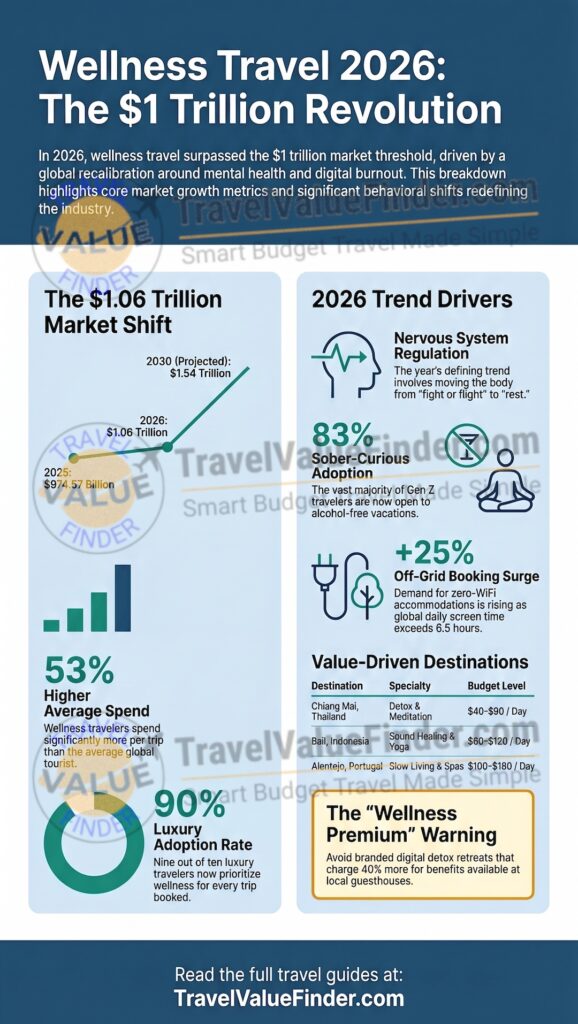
Wellness travel 2026 has crossed a historic threshold that the travel industry has been anticipating for a decade: the global wellness tourism market has grown from USD 974.57 billion in 2025 to USD 1.06 trillion in 2026, growing at 9.6% annually according to Research and Markets. For the first time in history, taking a trip specifically to restore your mental, physical, and emotional health is a trillion-dollar industry. More than 90% of luxury travelers now actively look for wellness programs when booking any trip — not a dedicated wellness retreat, but any trip — according to the International Luxury Travel Market. And 68% of travelers say they are willing to spend more to prioritize mental and physical wellbeing during travel. This guide covers every major wellness travel trend of 2026, the best destinations at every budget level, what wellness travel actually costs, and Leslie Nics’ honest framework for extracting maximum wellness value at minimum cost.
Leslie Nics | TravelValueFinder.com | Travel Alert | April 27, 2026 | Last reviewed: April 27, 2026
Table of Contents
What is wellness travel? Wellness travel is travel where improving or maintaining physical, mental, and emotional health is a primary purpose — rather than purely sightseeing or leisure. It includes spa retreats, yoga and meditation programs, digital detox retreats, thermal baths, Ayurveda treatments, forest bathing, fitness escapes, sound healing, and nature immersion trips. The global wellness tourism market reached USD 1.06 trillion in 2026 (Research and Markets), growing at 9.6% annually. Wellness travelers spend 53% more per trip than the average tourist. The market is projected to reach USD 1.54 trillion by 2030 and USD 2.4 trillion by 2035.
Why Wellness Travel 2026 Is No Longer a Luxury — It Is a Mainstream Priority
The fastest way to understand the 2026 wellness travel shift is through a convergence of three simultaneous forces that are documented across multiple market research sources. First: burnout, hormonal imbalance, and nervous system overload have moved from niche health conversations to mainstream daily experience — Elite Traveler’s 2026 wellness analysis describes this as a fundamental cultural recalibration around health, longevity, and emotional wellbeing. Second: global screen time now averages 6 hours and 40 minutes per day, with Americans exceeding 7 hours and Gen Z averaging 9 hours of daily digital exposure — creating what Grand View Research identifies as significant demand pressure for digital detox and nature-immersion experiences. Third: the COVID-19 pandemic permanently shifted how people value rest — not as a reward for productivity, but as a non-negotiable maintenance requirement for human performance.
For TravelValueFinder’s audience — value-focused travelers, retirees, and those planning extended international stays — the wellness travel boom has an additional practical implication: many of the world’s best wellness destinations are in the same affordable countries that appear on budget and retirement shortlists. Bali, Portugal, Thailand, Japan, Colombia, and India appear on both lists simultaneously.
For years I thought wellness travel meant expensive retreats I could not afford. Then I realized that a week in a Portuguese farmhouse with a kitchen, a daily walk through the vineyards, and meals cooked from a local market was wellness travel. It just did not have a spa invoice attached to it. — Leslie Nics, TravelValueFinder.com
The Wellness Travel 2026 Market: What the Numbers Show
| Metric | Figure | Source |
| Global wellness tourism market value 2026 | USD 1.06 trillion | Research and Markets, 2026 |
| Market value in 2025 | USD 974.57 billion | Research and Markets, 2026 |
| Annual growth rate CAGR 2026 | 9.6% | Research and Markets, 2026 |
| Projected market value by 2030 | USD 1.54 trillion | Research and Markets, 2026 |
| Projected market value by 2035 | USD 2.4 trillion | Grand View Research, 2026 |
| Luxury travelers who seek wellness on any trip | 90%+ | International Luxury Travel Market 2026 |
| Travelers willing to spend more for wellbeing | 68% | Business Research Insights 2026 |
| Wellness travelers spend more per trip vs average tourist | 53% more | My1Health wellness tourism data |
| 1 in how many travelers now prioritizes wellness | 1 in 5 travelers globally | My1Health wellness tourism data |
| North America wellness tourism market share | 35.9% — largest regionally | Grand View Research, 2026 |
| Digital wellness booking platform adoption growth | 55% increase in 2025-26 | Business Research Insights 2026 |
| Number of spas worldwide 2024 | 201,861 — up 15% from 2019 | Global Wellness Institute |
| Tanzania spa demand increase YoY — top destination 2026 | 194% increase | Spa Trends Report 2026 |
| Africa wellness tourism market projected value by 2029 | USD 114.24 billion | BizzCommunity via PlanetWare |
| Screen time — global daily average January 2025 | 6 hours 40 minutes | Grand View Research citing WHO data |
| Americans daily screen time | Over 7 hours | Grand View Research 2026 |
| Gen Z daily screen exposure | Average 9 hours | Grand View Research 2026 |
Sources: Research and Markets Wellness Tourism Market Report 2026; Grand View Research Wellness Tourism Industry Analysis 2026; International Luxury Travel Market 2026; My1Health Global Wellness Tourism data; Business Research Insights Wellness Tourism Market 2026; Global Wellness Institute; Spa Trends Report 2026; BizzCommunity.
The 8 Biggest Wellness Travel Trends of 2026
These eight trends are drawn from analysis across National Geographic Travel (January 2026), Elite Traveler (January 2026), PlanetWare (January 2026), HELLO! Magazine (March 2026), Explore.com (January 2026), and the Global Wellness Institute. Each represents a measurable, documented shift in how wellness travel is being consumed in 2026 — not speculation, but confirmed booking behavior and market data.
1. Nervous System Regulation Travel — The Defining Wellness Trend of 2026
Elite Traveler identifies nervous system regulation as the central wellness concept reshaping travel in 2026. Travelers are now specifically seeking destinations and experiences that offer what wellness experts call a nervous system reset — remote, nature-rich environments where the absence of overstimulation is the primary feature. Ponsonby of Elite Traveler describes demand rising for Patagonia, Kenya, Nepal, and Sri Lanka specifically because these landscapes provide the conditions for perspective and physiological reset.
Practices being embedded into retreats and hotel stays include breathwork, gentle movement, somatic therapy, and extended time in nature — all clinically documented tools for moving the autonomic nervous system from sympathetic (fight or flight) to parasympathetic (rest and digest) dominance. National Geographic’s January 2026 wellness trends guide describes 2026 as the year travelers shifted from external wellness experiences (massages, spa days) toward internal regulation practices (breathwork, forest bathing, cold water immersion).
For value travelers: the best nervous system regulation destinations are often the least expensive. Rural farmhouses, mountain refuges, and remote island guesthouses are almost universally cheaper than urban luxury spa hotels — and they deliver the same physiological conditions.
2. Glowcations — Skincare and Aesthetic Treatment Travel
National Geographic’s 2026 wellness travel guide identifies glowcations — travel specifically for skincare and aesthetic treatments — as one of the most commercially significant emerging trends. Seoul, South Korea has established itself as the definitive global glowcation capital: travelers arrive for glass skin facials, micro-needling, head spa and scalp analysis, personalised Korean skincare consultations, and treatments rooted in the K-beauty tradition that has dominated global beauty media for the past five years.
The value case for medical beauty travel to Seoul is substantial: clinical-grade treatments available in Seoul for USD 80 to USD 200 frequently cost USD 400 to USD 1,200 for equivalent procedures in the United States or United Kingdom. Regent Holidays offers a 13-day Wellness Escape to Korea from £6,860, but independent travelers can access most of the same treatments by booking directly with Seoul’s well-reviewed medi-clinics — an approach that costs 60 to 70% less.
3. Sound Healing — From Alternative to Five-Star Standard
Sound healing — singing bowls, gongs, tuning forks, and frequency-based treatments — has moved decisively into the five-star spa market in 2026. Elite Traveler reports that five-star spa hotels are embedding sound baths, gong meditations, and frequency-based treatments into their standard menus, citing sound therapy’s ability to create rapid states of deep relaxation without medication. Sound practitioner Nancy Trueman notes its growing appeal in both luxury and corporate wellness: the treatment accesses profound states of calm and emotional release that surface-level spa treatments cannot reach.
Budget alternative: sound healing sessions in Bali, Chiang Mai, and Rishikesh run USD 15 to USD 40 — equivalent physiological experience at a fraction of the five-star cost. Ubud, Bali has the most established sound healing community globally outside of dedicated retreat centers.
4. Digital Detox Retreats — Off-Grid Accommodation Surges 25%
With global screen time exceeding 6.5 hours daily, structured digital detox experiences have produced a recognizable commercial category in 2026. National Geographic’s wellness trend analysis specifically highlights off-grid accommodation — yurts, pods, shepherd’s huts, and cabins with zero WiFi — as one of 2026’s fastest-growing booking categories. UK-based Unplugged, a pioneer in digital detox cabin accommodation, reported a 25% rise in bookings in 2025 and launched 20 new cabin locations across the UK to meet demand. Unplugged escapes start from £390 for three nights self-catering.
The important distinction for value travelers: the physiological benefit of digital detox is available anywhere without reliable WiFi — a rural farmhouse, a mountain refuge, a remote island guesthouse. The wellness premium charged by branded digital detox retreats is significant; the experience itself costs whatever a night’s accommodation without internet costs in that destination.
5. Wellness Safaris — Africa’s Biggest 2026 Wellness Story
Tanzania became the world’s top destination for spa lovers in 2026 with a documented 194% increase in spa demand year-over-year, according to the Spa Trends Report 2026. Rwanda came in second. This is connected to the emergence of the wellness safari category — safari experiences designed specifically around wellbeing programming alongside wildlife observation. PlanetWare cites Artisans of Safari’s women-only wellness safaris at Chem Chem Lodge in Tanzania as the exemplar: daily yoga and meditation, guided walks with a Maasai tracker, and meetings with local women leading wildlife conservation — the Slow Safari ethos applied to East Africa’s most extraordinary landscapes.
Africa’s wellness tourism market is projected to grow to USD 114.24 billion by 2029. Rwanda and Botswana are developing dedicated wellness safari offerings in response to Tanzania’s surge.
6. Sober-Curious Travel — 83% of Gen Z Open to Alcohol-Free Vacations
According to Flight Centre Travel Group’s 2024 State of Student and Youth Travel Report, 83% of Gen Z travelers are open to alcohol-free vacations — a statistic that is actively reshaping how tourism infrastructure is designed for younger travelers. PlanetWare’s 2026 trend analysis documents cruise lines introducing dedicated mocktail menus, and global tour operator Contiki announcing Sober Curious itineraries across Britain and Ireland. Contiki CEO Adam Armstrong told Travel Market Report: “The data doesn’t lie. Young travelers are not only drinking less in general, but are increasingly curious about what a completely sober travel experience would look like.”
The practical implications for destination economies are significant: the social infrastructure building around sober-curious travel — wellness cafés, functional beverage bars, evening yoga sessions as alternatives to pub culture — is creating new economic activity in destinations that previously depended heavily on alcohol-driven nightlife revenue.
7. Family Wellness Travel — Wellbeing as a Multi-Generational Practice
Elite Traveler identifies family wellness travel as one of 2026’s fastest-growing commercial segments, with resorts designing programs that support children, teenagers, and adults simultaneously. Zulal Wellness Resort by Chiva-Som in Qatar is cited as the benchmark: its Discovery wing offers age-appropriate activities — kayaking, creative expression, mindful movement — alongside adult wellness therapies, allowing families to unwind and reconnect through shared wellbeing practices rather than passive poolside leisure.
The economic signal is important: families are increasingly choosing wellness resorts over traditional beach resorts, and spending significantly more per trip as a result. The wellness family travel premium is real — but it reflects a genuine shift in what families report wanting from a holiday in 2026 surveys.
8. Rail and Cruise Wellness — The Journey as the Experience
HELLO! Magazine’s 2026 wellness report, citing the Global Wellness Institute, identifies the repositioning of the journey itself as a wellness experience as one of the most commercially significant trends. Slow travel and wellness have merged in the rail and cruise sectors. Belmond’s Eastern & Oriental Express and Royal Scotsman trains both feature Dior Spa carriages. The Britannic Explorer debuted with a wellness suite developed with Wildsmith featuring a Signature Circadian Rhythm Reset treatment. Celebrity Cruises launched a programme led by Gwyneth Paltrow focused on onboard fitness, nutrition, and mindful experiences.
Singapore’s Changi Airport — frequently cited in wellness travel content — offers an 80-foot rooftop swimming pool, yoga classes in Canopy Park (a 150,000 sq ft garden sanctuary), and Reformer Pilates sessions overlooking the Rain Vortex waterfall. As travel and hospitality foresight analyst Seyi Oduwole told HELLO! Magazine: “The idea of travel as escape has matured into a wellness space in motion.”

Best Wellness Travel Destinations 2026 at Every Budget Level
The wellness travel market has a structural problem that benefits value-focused travelers: the word wellness has been attached to price tags that bear no relationship to the actual wellness benefit delivered. A USD 500-per-night wellness resort and a USD 50-per-night yoga center in Ubud can deliver equivalent physiological recovery. The difference is thread count, not cortisol reduction. Here is TravelValueFinder’s destination guide across three budget tiers.
| Destination | Wellness Specialty | Daily Budget | Best Value Wellness Experience | TVF Rating |
| Rishikesh, India | Yoga, Ayurveda, meditation, ashram stays | USD 30–80/day | 10-day Vipassana silent meditation from USD 200 all-in; yoga teacher training from USD 500/month | Exceptional — birthplace of yoga, unmatched depth |
| Chiang Mai, Thailand | Meditation, Muay Thai, Thai massage, detox | USD 40–90/day | Traditional Thai massage from USD 8/hour; Vipassana centres from USD 150/10 days all-in | Outstanding — lowest cost per wellness experience globally |
| Bali — Ubud, Indonesia | Yoga, meditation, sound healing, Ayurveda | USD 60–120/day | Retreat centres from USD 80/night with 2 yoga sessions included; sound healing from USD 15 | Exceptional — best global wellness value at mid-range |
| Alentejo, Portugal | Digital detox, slow living, thermal spas, wine | USD 100–160/day | Rural farmhouse week from USD 700; Termas de Monfortinho thermal spa from USD 40/session | Excellent — combines wellness with slow travel and wine country |
| Tuscany, Italy | Farm wellness, thermal baths, olive oil spa treatments | USD 150–250/day | Terme di Saturnia natural thermal pools — completely free public access, open 24 hours | Good — premium destination but the best experience is free |
| Costa Rica | Jungle wellness, surf therapy, forest bathing | USD 80–150/day | Nosara Yoga Institute residential programs from USD 150/day; cloud forest retreats from USD 90/night | Good — best Latin America nature-based wellness |
| Japan — Onsen Ryokan Regions | Thermal bathing, forest bathing (Shinrin-yoku), kaiseki meals | USD 100–200/day incl. meals | Traditional onsen ryokan in Tohoku or Shikoku from USD 90/night with two kaiseki meals included | Excellent — culturally unique wellness impossible to replicate elsewhere |
| South Korea — Seoul | Glowcation skincare, jimjilbang public spas, K-wellness | USD 70–110/day | Jimjilbang public spa all-day entry from USD 10; clinical K-beauty facial from USD 80–200 | Outstanding — best value medical wellness in Asia |
| SHA Wellness Clinic, Spain | Medical wellness, hormone health, longevity programs | USD 400–800/day | Full SHA medical wellness program — premium but genuinely clinical quality | Luxury tier — most comprehensive medical wellness in Europe |
All daily budget figures from mid-range accommodation, local transport, and dining. Wellness experience costs listed separately. Live data from Booking.com, Airbnb, and retreat booking platforms, April 2026.
What Does This Mean for Your Wellness Travel Budget?
Wellness travel costs range from USD 30 per day (budget yoga ashram in Rishikesh, India) to USD 800+ per day (SHA Wellness Clinic, Spain). The USD 60–120/day tier — achievable in Bali, Chiang Mai, and Portugal’s Alentejo — delivers genuine, evidence-based wellness benefits comparable to the premium tier at a fraction of the cost.
| The most important reframe for budget wellness travelers: the wellness benefit is not in the invoice — it is in the nervous system reset, the cortisol reduction, and the sleep quality improvement that follow from the experience. A week in a quiet farmhouse with daily walks, market cooking, thermal baths, and no WiFi delivers all three documented benefits of wellness travel without a single spa treatment. The wellness travel premium to avoid: branded digital detox retreats, Instagram-optimized yoga retreats with celebrity instructors, and hotel wellness programs that charge USD 200 for services available at local practitioners for USD 20. The physiological benefit is identical. The branding is not. |
The Science Behind Wellness Travel: What Research Actually Shows
| Wellness Benefit | Research Evidence | How Travel Delivers It |
| Cortisol reduction during nature immersion | Multiple peer-reviewed studies — avg 12.4% reduction in forest environments | Forest bathing (Shinrin-yoku); extended stays near natural landscapes; reduced urban stimulation |
| Improved sleep quality | 87% of extended-stay wellness participants report improvement (GWI research) | Reduction in blue light exposure; physical activity; regular mealtimes; natural light rhythms |
| Increased oxytocin through genuine social connection | Behavioral science research on meaningful vs superficial contact | Cooking classes, cultural workshops, community-based retreat formats |
| Mood improvement lasting after return | Average 5 weeks post-trip according to GWI research | Profound positive experiences create lasting memory traces (Kahneman peak-end rule) |
| Behavior change adoption (yoga, meditation, diet) | Higher rates than home-based programs | Immersive environment removes competing habitual cues — new habits form more easily |
| Awe experiences increase oxytocin and decrease anxiety | Research cited by Explore.com — night sky and desert experiences specifically | Star-gazing in dark-sky destinations; desert landscapes; wilderness immersion |
| Immune function boost from phytoncides (forest chemicals) | International Journal of Environmental Research and Public Health | Forest bathing and extended forest accommodation; Shinrin-yoku trails in Japan |
| Blood pressure reduction from thermal bathing | Documented in onsen and European thermal spa research | Hot spring ryokan stays in Japan; Terme di Saturnia in Italy; Termas in Portugal |
Sources: International Journal of Environmental Research and Public Health; Global Wellness Institute; Kahneman peak-end rule research; Grand View Research wellness tourism analysis 2026; Explore.com wellness trend analysis January 2026.
People Also Ask — Wellness Travel 2026
| Quick Answer: What is the difference between wellness travel and medical tourism? Wellness travel focuses on prevention, restoration, and enhancement of wellbeing for generally healthy travelers — yoga retreats, spa programs, digital detox, nature immersion, thermal bathing, and mindfulness experiences. Medical tourism involves traveling specifically to receive medical treatment — surgery, dental work, fertility treatments, or specialized procedures — often at lower cost or higher quality than available at home. The two overlap in medical wellness destinations like SHA Wellness Clinic in Spain and Chiva-Som in Thailand, which offer both luxury wellness experiences and clinical medical diagnostics and treatment programs under one roof. |
| Q: How much does wellness travel cost in 2026? A: Wellness travel costs range from USD 30 per day (budget yoga ashram in Rishikesh, India) to USD 800+ per day (luxury medical wellness resort in Spain). The most accessible effective wellness travel budget is USD 60–120 per day, achievable in Bali, Chiang Mai, Portugal’s Alentejo, and South Korea. This covers comfortable accommodation, nutritious local food, one paid wellness activity per day (massage, yoga class, thermal bath session), and local transport. Wellness travelers spend on average 53% more per trip than the average tourist — but this premium is concentrated at the luxury end of the market. Budget wellness travel is significantly underpriced relative to its benefit. |
| Q: What are the proven benefits of wellness travel? A: The documented benefits of wellness travel include: cortisol reduction averaging 12.4% during extended forest immersion (IJERPH research); improved sleep quality in 87% of wellness retreat participants (GWI research); increased oxytocin through genuine social connection in retreat environments; mood improvement lasting an average of 5 weeks after return from a wellness trip (GWI); higher rates of behavior change adoption — continuing yoga, meditation, or dietary changes — compared to home-based wellness programs. Wellness travelers also report that immersive environments make new habits form more easily by removing competing habitual cues from daily home routines. |
| Q: What is forest bathing and does it actually work? A: Forest bathing (Shinrin-yoku in Japanese) is the practice of spending mindful, unhurried time in a forested environment — walking slowly, breathing deeply, and engaging all senses. Research published in the International Journal of Environmental Research and Public Health confirms forest bathing reduces cortisol levels by an average of 12.4%, lowers blood pressure, boosts natural killer (NK) cell activity which supports immune function, and decreases anxiety and depression scores. In Japan, 48 official Shinrin-yoku trails have been scientifically certified, with forest therapy guide sessions available from USD 30–80. The Black Forest in Germany, Arenal Rainforest in Costa Rica, and Fiordland in New Zealand’s South Island are among the best certified forest bathing destinations outside Japan. |
| Q: Is wellness travel worth it for retirees? A: Wellness travel is exceptionally well-suited to retirees for several reasons: time flexibility allows extended wellness stays rather than compressed weekend retreats; many wellness destinations overlap with retirement-friendly locations (Portugal, Spain, Thailand, Japan, Costa Rica); thermal spa culture in Japan and Portugal aligns with the joint health and circulation priorities of travelers over 55; and the slow travel philosophy underlying most wellness travel matches retirement’s greatest gift — time without urgency. The most practical approach for retirees: plan a one-month slow travel wellness stay in Portugal’s Alentejo or Japan’s Tohoku region, which simultaneously serves as lifestyle research for potential retirement relocation and delivers genuine wellness restoration. |
| Q: Can I do wellness travel without going to a retreat? A: Absolutely — and in Leslie Nics’ experience, self-directed wellness travel is often more effective than structured retreats for travelers who already have established wellness practices. Self-directed wellness travel means: choosing a destination with strong wellness infrastructure (Bali, Chiang Mai, Alentejo Portugal, onsen towns in Japan); booking apartment or farmhouse accommodation with a kitchen; establishing a daily routine that includes morning movement, market cooking, thermal bathing, and deliberate rest; and selecting one or two specific wellness experiences per week rather than every day. This approach delivers equivalent restoration at 40–60% of the cost of a structured retreat program, and allows the spontaneous discoveries that structured retreats — by definition — cannot. |
Leslie Nics’ Value Wellness Travel Framework: 5 Rules
The best wellness trip I ever took cost less than USD 50 a day. Two weeks in Rishikesh, India — morning yoga at sunrise on the banks of the Ganges, Ayurvedic meals, evening meditation, and the most profound silence I have ever experienced. Wellness travel does not require a five-star budget. It requires a willingness to be still.” — Leslie Nics, TravelValueFinder.com
- Choose a destination where wellness infrastructure is embedded in daily life, not charged for separately. Thermal baths in Japan are cultural — a 30-minute onsen session costs USD 5–15. The same thermal soak at a branded resort costs USD 100. Same water, same minerals, very different invoice.
- Prioritize accommodation with a kitchen. Cooking your own meals with local, seasonal produce from a market is nutritional wellness — and it cuts daily food costs by 40–60% while delivering better quality than tourist restaurant food.
- Build movement into your daily routine rather than paying for fitness classes. Walking, hiking, cycling, and swimming are free in virtually every wellness destination. Morning yoga on a beach costs nothing. The wellness industry charges for instruction — the activity itself is always free.
- Book shoulder season. Wellness destinations like Bali, Chiang Mai, and Costa Rica in off-peak months cost 20–40% less than peak season. The weather is marginally less perfect. The savings are significant.
- Choose one paid wellness experience per destination and spend what it is worth. One deeply restorative Thai massage, one sound healing session, one guided forest bathing walk. Do not fill every day with paid activities — that defeats the stillness wellness travel is designed to create.
FAQ — Wellness Travel 2026
Q: How do I find legitimate wellness retreats that are not overpriced?
A: The most reliable sources for verified, fairly-priced wellness retreats in 2026 are: BookRetreats.com (the largest dedicated wellness retreat booking platform with verified community reviews); Retreat.guru (specialist directory with detailed program descriptions and transparent pricing); WorldPackers (for exchange-based volunteer programs at wellness centers — often free accommodation in exchange for a few hours of work per day); and destination-specific Facebook groups and Reddit communities where past retreat participants share unfiltered reviews. Red flags for overpriced retreats: vague program descriptions emphasizing transformation without specifying what is included; retreat centers that do not clearly disclose accommodation type and meal quality; and celebrity or influencer-promoted retreats with no independent review record.
Q: What should I pack for a wellness retreat?
A: Essential items for any wellness retreat: comfortable breathable clothing for yoga, hiking, or spa use in natural fabrics (linen, cotton, bamboo); a good reusable water bottle; a journal — analog, not digital; earplugs and a sleep mask for sensory rest; any prescription medications in original packaging; a small first aid kit; and a genuinely open itinerary. The most common mistake is over-packing activity wear and under-packing comfortable loungewear for rest periods. Most wellness retreats provide yoga mats, towels, and basic toiletries — confirm what is included before packing anything beyond essentials.
Q: What is a jimjilbang and why is it one of 2026’s best wellness values?
A: A jimjilbang is a Korean public bathhouse and multi-service wellness facility — part thermal spa, part sauna complex, part social space. Entry typically costs USD 8–15 for all-day access including gender-separated hot and cold baths, dry and wet saunas, communal heated rest areas (usually co-ed, with guests wearing provided shorts and t-shirts), and often sleeping areas for overnight stays. Major jimjilbangs in Seoul are open 24 hours. They represent the most cost-effective authentic wellness experience in Asia — delivering thermal bathing, heat therapy, and genuine cultural immersion for less than the cost of a single coffee at a branded wellness hotel. Jjimjilbang culture is specifically highlighted in National Geographic’s 2026 guide to Seoul wellness travel.
Wellness Travel for Retirees — A Note From Leslie Nics
The overlap between the top wellness travel destinations and the top retirement research destinations is not a coincidence — it reflects a genuine alignment between what wellness travel delivers (restoration, slowness, health-supporting environments, and community) and what retirement travelers are looking for (quality of life, affordable healthcare, walkable communities, and a pace that human beings were designed to sustain). Portugal’s Alentejo, Thailand’s Chiang Mai, Japan’s Tohoku region, Spain’s Costa Blanca, and Colombia’s Medellín appear on both lists for the same underlying reasons.
For TravelValueFinder’s readers who are planning retirement relocations, a wellness travel stay of three to four weeks in a target destination delivers dual value: genuine physical and mental restoration, and the lived research that no amount of reading can substitute. You learn whether the healthcare system is accessible in practice, whether the food culture supports your nutritional needs, whether the climate suits your body, and whether the daily pace feels like freedom or deprivation.
- Related: Affordable Retirement: Best Countries Where Your Money Goes Further — covers Portugal, Thailand, Colombia, Malaysia, and Spain with monthly cost breakdowns.
- Related: Spain vs Portugal Retirement: Which Is Better for American Retirees in 2026? — full comparison for wellness-focused travelers considering longer-term stays.
- Related: Slow Travel 2026: The Complete Value Guide — the overlap between slow travel and wellness travel and how to combine both on a budget.
Related Guides on TravelValueFinder.com
- Slow travel as wellness strategy: Slow Travel 2026: The Complete Value Guide
- Wellness-friendly retirement destinations: Affordable Retirement: Best Countries Where Your Money Goes Further
- Portugal for wellness and retirement: Spain vs Portugal Retirement: Which Is Better for American Retirees?
- Budget Europe travel for wellness trips: How to Travel Europe on a Budget: The 2026 Guide
- Best value destinations 2026: Best Travel Destinations 2026: Skip the U.S. and Save Up to 2,600
- Japan wellness regions: Japan Tourist Tax 2026: Your Trip’s True Cost
- Solo Female Travel 2026: The Definitive Safety, Destination, and Budget Guide
Sources and Editorial Transparency
Primary Sources: Research and Markets — Wellness Tourism Market 2026 • Grand View Research — Wellness Tourism • National Geographic — Wellness Travel Trends 2026 • Elite Traveler — Wellness Travel Trends 2026 • PlanetWare — 11 Wellness Trends 2026 • HELLO! Magazine — Slow Travel Wellness 2026 • Global Wellness Institute
Researched and written by Leslie Nics, founder of TravelValueFinder.com, with personal wellness travel experience across Bali, Thailand, Japan, Portugal, India, and South Korea. Sources: Research and Markets Wellness Tourism Market Global Report 2026; Grand View Research Wellness Tourism Industry Analysis 2026; National Geographic Traveller UK — Best Wellness Travel Trends 2026 (January 16, 2026); Elite Traveler — Biggest Wellness Travel Trends 2026 (January 5, 2026); PlanetWare — 11 Wellness Travel Trends 2026 (January 18, 2026); HELLO! Magazine — Slow Travel Wellness Trend 2026 (March 2026); Explore.com — Growing Wellness Trends 2026 (January 26, 2026); Global Wellness Institute published research; International Luxury Travel Market 2026; Spa Trends Report 2026; Flight Centre Travel Group State of Student and Youth Travel Report 2024; Business Research Insights Wellness Tourism Market 2026; BizzCommunity Africa wellness tourism projections. All destination cost data from live Booking.com and Airbnb searches, April 2026. Last reviewed: April 27, 2026.