Travel Value Finder


Europe is not what most Americans think it is when it comes to retirement costs. Yes, Paris, London, Zurich, and Amsterdam are expensive – sometimes brutally so. But those cities represent perhaps 10% of what Europe actually offers. The other 90% includes towns in southern Portugal where one-bedroom apartments rent for €500 a month, villages in rural Greece where a three-course dinner costs €12, regions of southern Italy where the government offers a 7% flat tax specifically designed to attract retirees, and entire countries like Romania and Albania where a comfortable expat life costs $1,400 – $1,900 a month all-in.
Leslie Nics, TravelValueFinder.com | Updated April 2026 | Written for US retirees and pre-retirees | First-hand research across 40+ countries, including extended time in Portugal, Spain, Greece, France, and Eastern Europe | Data cross-referenced with International Living 2026 Global Retirement Index, Taxes for Expats 2026, and European visa authorities
According to Get Golden Visa’s 2026 analysis, approximately 38% of Americans who retire abroad choose Europe as their destination. The reasons are compelling: world-class healthcare systems, extraordinary cultural richness, political stability, a network of established American expat communities, and – crucially for budget-conscious retirees – living costs that are dramatically lower than the equivalent lifestyle would cost back home. The best places to retire in Europe on a small budget are not a compromise. They are an upgrade in almost every dimension that matters in retirement.
This guide goes further than any other ranking of the best places to retire in Europe on a small budget. It includes the real 2026 visa income requirements (updated after the significant changes in 2025), honest monthly budget breakdowns by region, the critical healthcare and Social Security facts that most guides omit, the new ETIAS entry system coming in Q4 2026, and Leslie Nics’s personal assessment of what daily life actually feels like in each destination.
The Europe I know from 15 years of travel is not the Europe of travel magazines – glamorous, expensive, and exhausting. It is the Europe of morning coffee at a taberna in Évora for €1.20, afternoon walks through a Roman amphitheatre that has been there for 2,000 years, and dinner for two with wine for €25 that takes three hours because nobody is in a hurry. This Europe is the best retirement destination in the world on a small budget. You just have to know where to look. Leslie Nics, TravelValueFinder.com
Planning your European retirement move? Research exploratory trips through our trusted partner: Search European Retirement Destination Flights and Hotels – TravelValueFinder. Real-time prices, secure booking.
Table of Contents
Important 2026 Updates Every American Retiree in Europe Needs to Know
Before the rankings, three significant changes in 2026 affect Americans planning to retire in Europe on a small budget:
| Change | What It Means for Retirees |
|---|---|
| Bulgaria and Romania joined full Schengen (January 2025) | Important: Days in Bulgaria and Romania now count toward your 90-day Schengen limit. If you visit either country without a long-term visa, those days are subtracted from your overall 90/180-day Schengen allowance. For retirees considering Romania or Bulgaria on a retirement visa, this is not an issue – your residency visa supersedes the tourist limit |
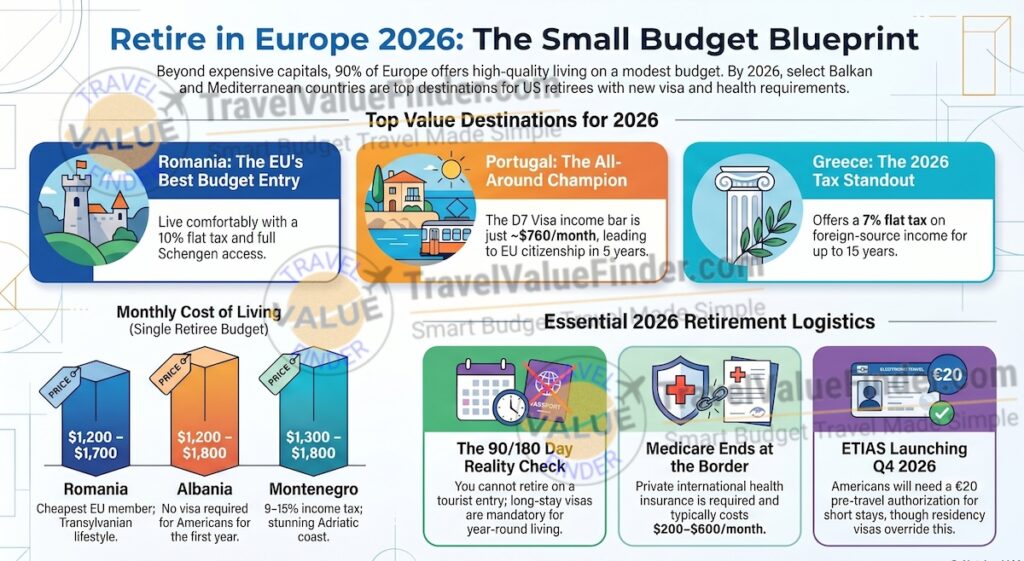
| ETIAS launching Q4 2026 – €20 pre-travel authorization | According to Newsweek 2026, Americans will need ETIAS pre-travel authorization from Q4 2026 for Schengen countries. The ETIAS costs €20 (~$23), is valid for 3 years, and works like the US ESTA. It is NOT a visa and does NOT change your 90-day tourist allowance – it just adds a pre-approval step. Retirees on long-stay visas are not affected |
| European retirement visa requirements updated in 2025 | Portugal lowered its D7 income threshold to align with the Portuguese minimum wage (~€760/month). Spain clarified its Non-Lucrative Visa income requirements (€2,150/month for a single applicant). Greece streamlined residency processing. GaminTraveler’s 2026 analysis provides the most comprehensive breakdown of updated requirements |
| Medicare remains non-portable internationally | According to SJB Global 2026, there is no prospect of Medicare international portability in 2026. Every American retiring in Europe must purchase private international health insurance. Most European retirement visas require proof of this coverage. Budget $200 – $600/month depending on age and destination |
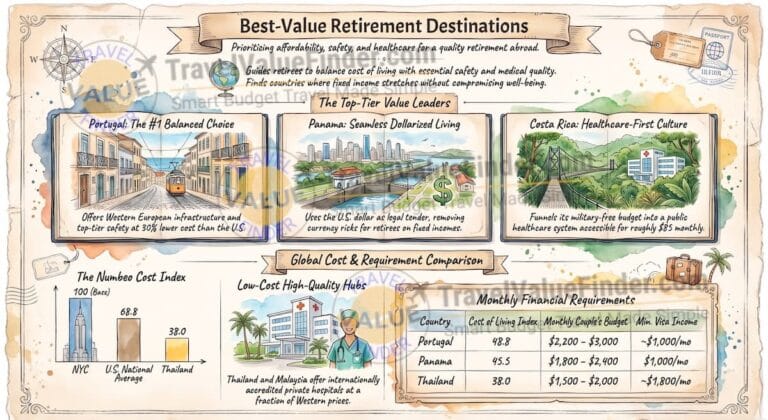
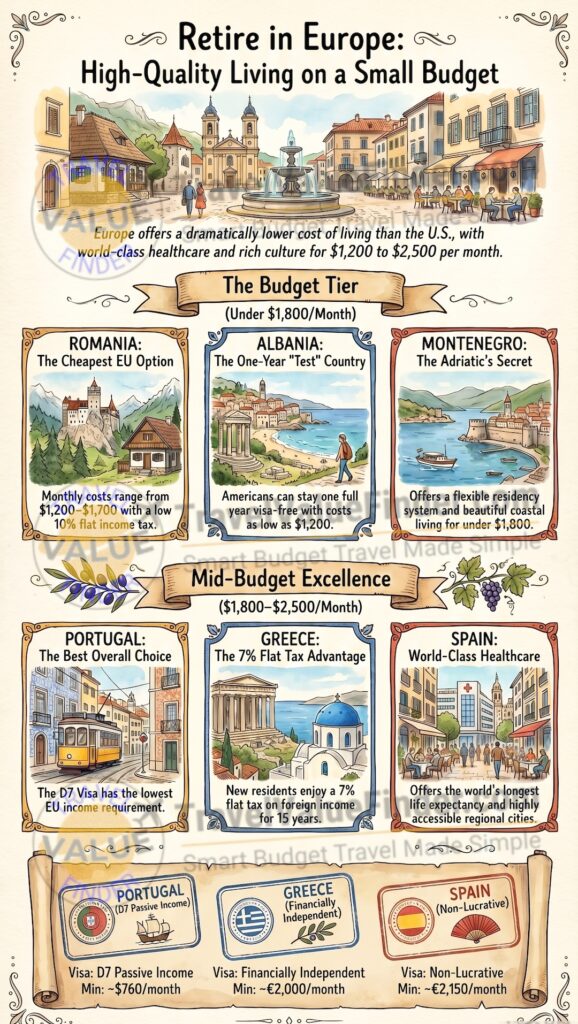
Discover some of the best places to retire in Europe without stretching your budget. From charming coastal towns to culturally rich cities, this infographic snapshot highlights a few affordable destinations that offer a high quality of life, scenic surroundings, and welcoming communities. While these picks give you a quick glimpse of what’s possible, be sure to read the full article for a deeper analysis into costs, lifestyle, and practical tips to help you choose the perfect retirement spot.
Best Places to Retire in Europe on a Small Budget: Complete 2026 Rankings
This is the complete reference for the best places to retire in Europe on a small budget in 2026. All monthly budgets are all-inclusive estimates for a single American retiree living comfortably:
| Country | Single/Month | Couple/Month | Visa | SS Payments | Key Advantage |
|---|---|---|---|---|---|
| BUDGET TIER – Under $1,800/month (single) | |||||
| Romania | $1,200 – $1,700 | $1,800 – $2,400 | Long-Stay Visa | ✓ Yes | Cheapest EU country; Transylvania; 10% flat income tax |
| Albania | $1,200 – $1,800 | $1,800 – $2,500 | 1-yr visa-free | ✓ Yes | Cheapest European country; Adriatic Riviera; no visa first year |
| Montenegro | $1,300 – $1,800 | $1,800 – $2,500 | Temporary Residence | ✓ Yes | Adriatic gem; low 9 – 15% income tax; non-EU flexibility |
| Bulgaria | $1,300 – $1,800 | $1,900 – $2,600 | Long-Stay Visa | ✓ Yes | EU country; 10% flat tax; Plovdiv, Varna, Bansko |
| MID-BUDGET TIER – $1,800 – $2,500/month (single) | |||||
| Portugal (inland/Porto) | $1,600 – $2,200 | $2,400 – $3,200 | D7 Visa | ✓ Yes | EU citizenship in 5 yrs; US tax treaty; superb healthcare |
| Greece (islands/mainland) | $1,800 – $2,300 | $2,500 – $3,200 | Retirement Visa | ✓ Yes | IL 2026 #1; 7% flat tax 15 yrs; 300+ sunny days |
| Spain (Valencia/Andalusia) | $2,000 – $2,600 | $2,800 – $3,800 | Non-Lucrative | ✓ Yes | World’s best healthcare; food culture; active expat scene |
| Italy (South/Sardinia) | $1,800 – $2,400 | $2,600 – $3,400 | Elective Residency | ✓ Yes | 7% flat tax in southern towns; Sardinia from $400/mo rent |
| PREMIUM BUDGET – $2,500 – $3,500/month (single) | |||||
| France (Dordogne/Lyon) | $2,200 – $3,000 | $3,200 – $4,500 | Long-Stay Visa | ✓ Yes | World’s best healthcare; Dordogne £800 – £1,000 rent |
| Slovenia | $1,800 – $2,400 | $2,600 – $3,400 | Temporary Residence | ✓ Yes | EU gem; Ljubljana, Lake Bled; €620/mo income req. |
| Malta | $2,500 – $3,200 | $3,500 – $4,500 | Global Residence | ✓ Yes | English-speaking; EU; Mediterranean; tax-favourable |
All budgets are all-inclusive monthly estimates: accommodation, food, utilities, private health insurance, local transport, modest leisure. Sources: Taxes for Expats 2026, International Living 2026, GaminTraveler 2026, and first-hand research. Single-person budgets unless noted.
The Schengen 90/180 Rule: What Every American Budget Retiree Must Understand
The single most misunderstood aspect of retiring in the best places to retire in Europe on a small budget is the 90/180 Schengen rule. Americans can visit most European countries for up to 90 days in any 180-day period without a visa. But that 90 days covers all Schengen countries combined – not 90 days per country.
This means you cannot simply ‘travel around Europe’ indefinitely on a tourist entry. After 90 days in the Schengen Area, you must leave for at least 90 days before returning – unless you have a long-stay visa or residency permit. If you want to live in Europe year-round on a small budget, you need a long-stay visa (or residency). The good news: the retirement visas available in Portugal, Spain, Greece, France, Italy, and Slovenia are among the most accessible in the world for Americans with modest income.
The European Retirement Visa Comparison: 2026 Requirements
| Country | Visa Name | Income Requirement | Processing | Path to Residency/Citizenship |
|---|---|---|---|---|
| Portugal | D7 Passive Income Visa | ~$760/mo (individual); updated lower 2025 | 60 – 90 days | Permanent residency after 5 years; EU citizenship eligible after 5 years |
| Spain | Non-Lucrative Visa | €2,150/mo (single); €2,700/mo (couple) | 60 – 90 days | Permanent residency after 5 years; Spanish citizenship after 10 years |
| Greece | Financially Independent Persons | €2,000/mo (€24,000/yr) | 30 – 60 days (streamlined 2025) | Greek residency renewable annually; citizenship after 7 years |
| France | Long-Stay Visitor Visa | ~€1,400/mo (~$1,623/mo) | 60 – 90 days | Renewable annually; permanent residency after 5 years |
| Italy | Elective Residency Visa | ~$31,000/yr passive income | 60 – 90 days | Renewable annually; Italian citizenship possible after 10 years |
| Slovenia | Temporary Residence (Financially Independent) | ~€620/mo | 30 – 60 days | Lowest income bar in EU; renewable; permanent residency after 5 years |
| Romania | Long-Stay Visa (D-type) | Proof of income ~$1,000+/mo | 30 – 60 days | Temporary residency renewable; permanent after 5 years; EU member |
| Montenegro | Temporary Residence | Bank balance or regular income proof | 30 – 60 days | Non-EU; renewable; no Schengen limit affects it separately |
| Albania | No visa first year; retiree visa thereafter | ~$1,350/mo pension (formal visa); none for first year | N/A first year | 1-year tourist entry automatic for Americans; renewable formally after |
Leslie Nics’s key insight: Portugal’s D7 Visa and Slovenia’s Temporary Residence have the lowest income requirements in Europe for non-EU retirees – both genuinely reachable on a single average Social Security benefit. Portugal additionally offers a path to EU citizenship in 5 years – the most powerful passport benefit available to any American retiree who wants freedom to live, work, and travel anywhere in the EU’s 27 nations.
Budget Tier: Best Places in Europe to Retire on Under $1,800/Month
The best places to retire in Europe on a small budget – under $1,800/month all-in for a single retiree – are primarily found in the Balkans, Eastern Europe, and non-EU Mediterranean. These destinations offer genuinely excellent quality of life at prices that feel almost incomprehensibly low to American eyes.
#1 Romania – The Cheapest EU Country to Retire In on a Small Budget
Single monthly budget: $1,200 – $1,700 | Couple: $1,800 – $2,400 | Retirement visa: Long-Stay D-type Visa | EU membership: Yes | Social Security: ✓ Yes
Romania is the best place to retire in Europe on a small budget that almost nobody is talking about – and that oversight is a gift to early movers. According to Taxes for Expats 2026, Romania’s basic monthly living costs (excluding rent) for a single person run at just $682 – the lowest in Europe. Add comfortable accommodation ($350 – $600/month for a good apartment in Brașov, Cluj-Napoca, or Sibiu) and international health insurance ($200 – $350/month), and a single retiree lives very well in Romania for $1,200 – $1,700 per month.
Romania joined the full Schengen Area in January 2025 – meaning retirees here enjoy free travel throughout Europe’s borderless zone. The country is an EU member, meaning your residency comes with the structural legal protections, property rights, and consumer rights of EU membership. Romania’s 10% flat personal income tax is the most transparent and predictable tax environment in the EU. And the country itself – Transylvanian medieval cities, the Carpathian Mountains, painted monasteries of Moldova, and the Danube Delta (the largest wetland in Europe) – is extraordinary and still essentially undiscovered by mass tourism.
| Best Romanian City for Retirees | 1-Bed Apt ($/month) | Character |
|---|---|---|
| Brașov | $350 – $500 | Medieval Transylvanian city; ski resorts nearby; Germanic architecture; mountain air |
| Cluj-Napoca | $400 – $600 | University city; modern, energetic; vibrant arts scene; airport hub |
| Sibiu | $300 – $500 | Most picturesque city in Romania; European Capital of Culture; compact and walkable |
| Timișoara | $350 – $500 | Western Romania; most Western-influenced; strong expat infrastructure |
| Bucharest (outskirts) | $450 – $700 | Capital; best international medical care; cosmopolitan; higher costs but best services |
- Healthcare: Bucharest has excellent private hospitals. Regional cities have improving private clinics at very low costs ($15 – $40 per consultation). Budget for international insurance ($200 – $350/month) that includes medical evacuation
- Language: Romanian is a Latin-based language similar to Spanish and Italian – easier for Romance language speakers. English is widely spoken in cities among younger residents and expat communities
#2 Albania – The Best Place in Europe to Retire on a Small Budget (Non-EU Gem)
Single monthly budget: $1,200 – $1,800 | Couple: $1,800 – $2,500 | Visa: Americans stay 1 full year visa-free | Social Security: ✓ Yes
Albania is the only country in Europe where American retirees can arrive with no visa, no income proof, no paperwork – and stay for one full year completely legally. After that initial year, a formal retirement visa exists – but many retirees use the 1-year free entry as a ‘test year’ to experience Albanian life before committing to formal residency. The combination of Europe’s lowest living costs (tied with Romania), a genuinely beautiful Adriatic and Ionian coastline that rivals Greece and Croatia at a fraction of the price, and a warm, deeply hospitable culture makes Albania the best place to retire in Europe on a small budget for retirees who want to move quickly and test the waters first.
The Albanian Riviera – stretching from Sarandë south toward the Greek border, with crystal-clear water, limestone mountains, and small fishing villages – is one of Europe’s genuinely extraordinary coastal landscapes. Off-season (October – May), apartments in coastal towns like Ksamil, Himara, and Dhermi rent for $200 – $400/month. Tirana, the capital, has a cosmopolitan energy that surprises most first-time visitors: tree-lined boulevards, excellent café culture, international restaurants at local prices, and a young, energetic population making it one of Europe’s most rapidly evolving cities.
- Tax situation: Albania’s income tax uses moderate progressive bands; employment and business income over ALL 14 million (~$150,000) reaches the top rate. For most retirees receiving pension income, the effective rate is low. Foreign-sourced pension income treatment should be confirmed with a local tax advisor before formal residency is established
- Healthcare: Improving rapidly but not yet at EU standards for serious conditions. Most long-term expats combine local care for routine needs with Turkish or Greek hospitals for anything complex (both are 30 – 90 minutes from major Albanian cities)
- Cheap Countries to Visit in 2026 (Albania featured)
#3 Montenegro – The Adriatic’s Secret Budget Retirement Gem
Single monthly budget: $1,300 – $1,800 | Couple: $1,800 – $2,500 | Visa: Temporary Residence | Social Security: ✓ Yes
Montenegro’s Kotor Bay – a deep, fjord-like inlet ringed by medieval walls, ochre-roofed towns, and mountains that plunge directly into Adriatic water – is one of Europe’s most photographed landscapes. According to Money Talks News 2026, furnished rentals in the Kotor area start at $500 – $900/month, and meals at local restaurants hover under $20 – making Montenegro genuinely affordable while being genuinely extraordinary to live in. A 9 – 15% personal income tax scale means retirees on modest pension income face light local tax burdens.
Montenegro’s specific advantage for Americans wanting to retire in Europe on a small budget is its non-EU status. As a country actively pursuing EU membership (expected in the early 2030s), Montenegro has designed its residency system to be flexible and accessible. Temporary residence is obtainable through proof of property rental or ownership, with no specific minimum income threshold that disqualifies modest-income retirees. And unlike most Schengen countries, your days in Montenegro do not count toward the 90-day Schengen calculation – meaning you can combine a Montenegro base with 90 days in Schengen countries per half-year.
- Beyond Kotor: Budva (more beach-party energy, cheaper), Tivat (marina town, modern), Herceg Novi (steep but beautiful, cheaper rentals, ferry to Dubrovnik), Cetinje (the old royal capital, authentic, very affordable inland)
- Healthcare: Bar City Hospital handles serious cases; private clinics in Kotor and Budva offer good routine care. Many residents travel to Serbia’s Belgrade or Croatia’s Dubrovnik for complex procedures – both within 2 – 3 hours
Mid-Budget Tier: Best Places in Europe to Retire on $1,800 – $2,500/Month
The mid-budget best places to retire in Europe on a small budget offer the sweet spot for most American retirees: full EU membership and its legal protections, excellent healthcare access, strong expat communities, and monthly costs well within the reach of a combined Social Security income or modest pension.
#4 Portugal – The Best Overall Place to Retire in Europe on a Small Budget
Single monthly budget: $1,600 – $2,200 | Couple: $2,400 – $3,200 | Visa: D7 Passive Income | Income required: ~$760/month (individual) | Social Security: ✓ Yes
Portugal has led nearly every ranking of best places to retire in Europe on a small budget for a decade – and in 2026, it remains the strongest all-round argument for European retirement on modest American income. The D7 Passive Income Visa has the lowest income requirement of any EU retirement visa (approximately $760/month for an individual – within reach of many single Social Security recipients), and it leads directly to EU citizenship in 5 years: a Portuguese passport gives you visa-free access to 188 countries and the right to live and work anywhere in the EU’s 27 member states.
According to Taxes for Expats 2026, Portugal’s basic monthly living costs (excluding rent) for a single person run at $776 – the most affordable in Western Europe. Outside Lisbon (which has risen significantly in price), Portugal is still genuinely affordable. Porto, Coimbra, Évora, Braga, and the Alentejo wine region all offer apartment rents of $500 – $900/month, local restaurant meals for €10 – €18, and a quality of life – warm Atlantic climate, extraordinary food, extraordinarily safe streets, deeply hospitable people – that is difficult to match anywhere on earth.
| Portugal Region | Monthly Budget Single (incl. rent) | Best For |
|---|---|---|
| Alentejo (inland wine country) | $1,400 – $1,800 | Most authentic Portugal; lowest prices; UNESCO cork forests; wine; slow life |
| Silver Coast (Caldas, Peniche, Óbidos) | $1,500 – $1,900 | Atlantic beaches without Algarve prices; large British/Northern European expat community |
| Braga / Minho (northwest) | $1,500 – $1,900 | Greenest Portugal; university city energy; cheaper than Porto; near Spain |
| Porto (city centre) | $1,700 – $2,200 | One of Europe’s most beautiful cities; Douro wine region; excellent infrastructure |
| Algarve (off-season) | $1,800 – $2,400 | Atlantic beaches; largest English-speaking expat community; British-American infrastructure |
#5 Greece – International Living’s #1 Retirement Destination for 2026
Single monthly budget: $1,800 – $2,300 | Couple: $2,500 – $3,200 | Visa: Financially Independent Persons Residency | Income: €2,000/month | Social Security: ✓ Yes
Greece made history in 2026 by claiming the top position in International Living’s Annual Global Retirement Index – the first time in 35 years of the index. The reasons are specific and financially significant. Greece offers a 7% flat tax on all foreign-source income for up to 15 years – meaning an American retiree receiving $3,000/month in Social Security, pension, and investment income pays just 7% to Greece (€2,520/year on that income) instead of navigating progressive local tax rates. Combined with the Foreign Tax Credit on US returns, most American retirees in Greece face a meaningfully lower combined tax burden than they would in the United States.
One expat profiled in International Living’s 2026 data lives on Crete for €2,900 – €3,000/month (approximately $3,200 – $3,300/month) – which covers a house with sea views (owned), dining out twice a week, and all living expenses. A modest two-bedroom on the mainland or inland Crete goes for €600 – €800/month ($660 – $880). The Greek island lifestyle – fresh seafood daily, afternoon ouzo at tavernas, warm Aegean sun for nine months of the year – is not a mythology. It is a genuinely extraordinary way to live, and it costs dramatically less than most Americans expect.
- Best regions for budget retirees: Inland Crete (authentic, half the price of coastal tourist areas), the Peloponnese (Nafplio, Kalamata, Sparta – beautiful, little-known to foreigners, excellent value), Epirus (mountainous northwest, extraordinary landscape, even lower prices)
- Where to Stay in Athens – Best Neighborhoods
#6 Spain – The Best Quality of Life in Europe for Budget Retirees
Single monthly budget: $2,000 – $2,600 | Couple: $2,800 – $3,800 | Visa: Non-Lucrative Visa | Income: €2,150/month (single) | Social Security: ✓ Yes
Spain’s Non-Lucrative Visa income requirement (€2,150/month for a single applicant, approximately $2,350/month as of April 2026) is the highest income bar among the mid-budget best places to retire in Europe on a small budget – but Spain earns that premium with what it delivers: the world’s longest life expectancy among major nations (83.1 years), consistently rated among the world’s best healthcare systems, extraordinary food culture (the tapas bar is not a tourist concept – it is how Spanish people actually eat, and it is extraordinarily affordable), and a diversity of climate and lifestyle that no other country on this list can match.
Spain’s affordability is intensely regional. According to International Living’s Spain correspondent living in Málaga, a one-bedroom apartment near the Málaga coast now costs €1,000 – €1,300/month – up from €500 in 2020. But inland Andalusia (Ronda, Jaén, Úbeda), rural Extremadura, the Murcia region, and the lesser-known parts of Catalonia’s Costa de la Luz all offer one-bedroom apartments at €400 – €600/month, meals for €8 – €12, and a monthly pass on public transport for €30 – €45. Spain rewards those who choose the regional cities over the famous coastal hotspots.
- Best value regions: Murcia (warmest mainland climate, lower prices than Alicante), Extremadura (extraordinary history, no tourists, very low prices), inland Andalusia (Ronda, Úbeda, Baeza), the Canary Islands (year-round warmth, lower costs than mainland)
- Retire in Spain: A Practical Guide
- Spain vs Portugal for Retirement: Full Comparison
#7 Southern Italy – The 7% Tax Region That Budget Retirees Are Discovering
Single monthly budget: $1,800 – $2,400 | Couple: $2,600 – $3,400 | Visa: Elective Residency Visa | Income: ~$31,000/year passive | Social Security: ✓ Yes
Southern Italy’s 7% flat tax regime for new residents in qualifying small municipalities (under 20,000 population) is one of Europe’s best-kept retirement secrets – and one of the few genuinely unique financial incentives that makes the best places to retire in Europe on a small budget conversation more interesting than a simple list of cheapest countries. Available in municipalities in Sicily, Calabria, Campania, Basilicata, Molise, Abruzzo, and Sardinia, the programme applies a flat 7% rate on all foreign-source income for 10 years. For a retiree receiving $3,000/month, that is $2,520/year in local Italian tax – significantly less than most US state income taxes.
Sardinia – which Money Talks News 2026 profiles as one of 2026’s top European retirement spots – offers furnished apartments from $400 – $950/month, a Mediterranean climate of extraordinary quality, beaches that rival anything in the Mediterranean, and a pace of life centred on food, family, and community that makes it one of Italy’s most liveable regions. Sardinia is also one of the world’s five ‘Blue Zones’ – communities where an unusually high proportion of residents live past 100. Something in that air and food and pace is working.
France on a Small Budget: The Premium Option That’s Worth Every Euro
France sits at the top of the best places to retire in Europe on a small budget premium tier – not the cheapest country, but arguably the one with the highest value per euro spent. The French Long-Stay Visitor Visa requires approximately €1,400/month in income (~$1,623/month) – one of the lower income requirements in Western Europe – and grants access to one of the world’s most celebrated quality of life systems.
According to International Living’s France correspondent, a couple in the Dordogne region lives on €2,900 – €3,000/month (~$3,200 – $3,300/month), covering all expenses. Outside major cities, a furnished two-bedroom apartment rents for €800 – €1,000/month. Basic utilities for a 900 square-foot apartment average €145/month. Groceries for a couple cost €600 – €800/month. And lunch at a French restaurant – a full menu with starter, main, dessert, and wine – runs €18 – €26 per person in provincial France.
France’s specific attraction for American retirees is healthcare. The WHO’s 2000 ranking placed France first in the world for healthcare quality – and 25 years later, that position is broadly maintained. After establishing residency, retirees can access the national health system (after a 3-month qualifying period for Long-Stay Visa holders), which covers most medical care at 70 – 80% reimbursement. The combination of healthcare quality and monthly living costs ($2,200 – $3,000/month for a couple in provincial France) makes France genuinely competitive with US healthcare + living costs in lower-cost American states.
- Retire in France After 55: Healthcare, Costs, Visas and Lifestyle
- How Much Does It Cost to Visit Paris? What to Budget Per Day
The Leslie Scorecard: Ranking the Best Places in Europe to Retire on a Small Budget
After spending extended time in all of these countries, here is my personal assessment of the best places to retire in Europe on a small budget across the factors that matter most to American retirees:
| Country | Budget (/5) | Healthcare (/5) | Expat Community (/5) | English Coverage (/5) | Overall (/5) |
|---|---|---|---|---|---|
| Romania | ★★★★★ | ★★★☆☆ | ★★★☆☆ | ★★★★☆ | ★★★★☆ |
| Albania | ★★★★★ | ★★★☆☆ | ★★☆☆☆ | ★★★☆☆ | ★★★☆☆ |
| Montenegro | ★★★★★ | ★★★☆☆ | ★★★☆☆ | ★★★★☆ | ★★★★☆ |
| Portugal | ★★★★☆ | ★★★★★ | ★★★★★ | ★★★★★ | ★★★★★ |
| Greece | ★★★★☆ | ★★★★☆ | ★★★★☆ | ★★★★☆ | ★★★★★ |
| Spain | ★★★☆☆ | ★★★★★ | ★★★★★ | ★★★★☆ | ★★★★★ |
| Southern Italy | ★★★★☆ | ★★★★★ | ★★★☆☆ | ★★★☆☆ | ★★★★☆ |
| France | ★★★☆☆ | ★★★★★ | ★★★★☆ | ★★★☆☆ | ★★★★★ |
| Slovenia | ★★★★☆ | ★★★★☆ | ★★★☆☆ | ★★★★☆ | ★★★★☆ |
Leslie Nics’s overall pick: Portugal for beginners and those who want EU citizenship. Greece for those who want the best value per dollar, the most sunshine, and the most dramatic quality-of-life improvement for a mid-level income. Romania for those who want EU membership at the absolute lowest possible cost.
Ready to compare cities now?
- Use our Free Retirement Cost of Living Calculator — get your personalized report in 30 seconds – Free PDF download.
- How to Use a Retirement Cost of Living Calculator – to Compare Cities Worldwide
Plan Your European Retirement: Complete Resources on TravelValueFinder
Our full European retirement and budget travel library:
- Best Countries to Retire Abroad on a Budget in 2026
- Travel Tips for Retirees: 20 Ways to Travel Better After 60
- Cheapest Countries to Retire In: Top Picks for 2026
- How to Retire Early and Travel the World: A Practical Guide
- Digital Nomad Retirement: How to Work and Travel After 55
- Retire in Portugal: A Practical Guide for Over-55s
- Retire in Spain: A Practical Guide
- Retire in France After 55: Healthcare, Costs, Visas and Lifestyle
- Spain vs Portugal for Retirement: Full Comparison
- Affordable Retirement: Best Countries Where Your Money Goes Further
- Solo Travel Over 50: Tips, Destinations & Budget Advice
- How to Travel Europe on a Budget: The Complete 2026 Guide
- How Much Does It Cost to Visit Italy? A 2026 Budget Breakdown
- How Much Does It Cost to Visit Paris? What to Budget Per Day
- Where to Stay in Athens – Best Neighborhoods
- Where to Stay in Barcelona – Best Neighborhoods
- Where to Stay in Amsterdam – Neighborhood Guide
- Travel Insurance Guide: What It Covers and Best Options
- Free AI Trip Planner: Get a Day-by-Day Itinerary in Seconds
Book your European retirement exploratory trip today. Find the best prices on flights and first-month accommodation through our trusted partner: Search European Retirement Flights and Hotels – TravelValueFinder. We earn a small commission at no extra cost to you.
Frequently Asked Questions: Retiring in Europe on a Small Budget
What is the best place to retire in Europe on a small budget?
For a single American retiree on a very small budget (under $1,500/month), Romania and Albania offer the best overall package – EU membership (Romania) or 1-year visa-free access (Albania), daily living costs of $1,200 – $1,800/month, and genuinely beautiful settings. For the best overall balance of affordability, established expat community, healthcare, and long-term residency options, Portugal remains the strongest single answer – the D7 Visa has the lowest income requirement in the EU and leads to citizenship in 5 years. For the best quality of life per dollar spent, Greece is the 2026 standout, anchored by the 7% flat tax on foreign income for 15 years.
Can I retire in Europe on Social Security alone?
Yes – in the right countries. A single average US Social Security benefit of approximately $1,907/month covers total living expenses comfortably in Romania, Albania, Montenegro, Bulgaria, and Slovenia. Portugal’s D7 Visa has an income requirement of approximately $760/month – well within reach of most single Social Security recipients. Greece’s income requirement (€2,000/month for the Financially Independent Persons visa) is more challenging for a single recipient but achievable for couples with combined Social Security. Spain’s Non-Lucrative Visa at €2,150/month is the most demanding income requirement among budget European destinations but remains accessible for most retirees with modest pension supplement.
What is the cheapest EU country to retire in on a small budget?
Within the European Union, Romania is the cheapest country to retire in on a small budget – with basic monthly living costs of approximately $682/month for a single person (excluding rent) according to Taxes for Expats 2026 data. Total all-in monthly costs for a comfortable single retiree in Romanian cities like Brașov or Sibiu run $1,200 – $1,700/month. Romania joined the full Schengen Area in January 2025, meaning retirees enjoy free travel throughout Europe. Bulgaria is the second cheapest EU option; Slovenia third for income-requirement accessibility (the lowest minimum income of any EU residency visa at €620/month).
Does Medicare cover me if I retire in Europe?
No. Medicare does not cover medical care outside the United States. This applies in every European country, including EU member states. Every American planning to retire in Europe must purchase private international health insurance – most European retirement visas require proof of this coverage as a condition of application. Costs vary by age and destination, typically $200 – $600/month for retirees in their 60s – 70s. The good news: European private healthcare is typically 30 – 60% cheaper than comparable US care, meaning the insurance premium plus out-of-pocket costs often total less than what American retirees pay under Medicare with copays and deductibles.
What is the 90/180 Schengen rule and how does it affect European retirement?
The 90/180 Schengen rule limits Americans to 90 days of visa-free stay within any 180-day period across all Schengen countries combined. This means you cannot simply ‘travel around Europe’ indefinitely on a tourist entry. After 90 days, you must leave the Schengen Area for at least 90 days before returning. To live in Europe year-round on a small budget, you need a long-stay visa or residency permit – such as Portugal’s D7, Spain’s Non-Lucrative Visa, or Greece’s Financially Independent Persons residency. Note: Bulgaria and Romania joined the full Schengen Area in January 2025, meaning days there now count toward your overall 90-day tourist limit. Montenegro and Albania are not in Schengen, giving retirees there more flexibility for short European travel.
Which European countries have the easiest retirement visas for Americans?
The easiest European retirement visas for Americans on a small budget in 2026 are: (1) Portugal’s D7 Visa – lowest income requirement (~$760/month individual), straightforward documentation, leads to EU citizenship in 5 years; (2) Slovenia’s Temporary Residence for Financially Independent Persons – lowest income requirement in the EU at ~€620/month; (3) France’s Long-Stay Visitor Visa – ~€1,400/month income, no specific pension requirement; (4) Greece’s Financially Independent Persons Residence – €2,000/month, streamlined processing after 2025 reforms; and (5) Albania – no visa required for the first year for Americans. Montenegro offers the most flexible non-EU option with no specific minimum income threshold.
Final Thoughts: The Best Places to Retire in Europe on a Small Budget Are Closer Than You Think
The best places to retire in Europe on a small budget are not distant, complicated, or inaccessible. Portugal’s D7 Visa requires approximately the monthly income that the average Social Security recipient already receives. Romania’s residency is achievable on an income that would not support renting in most American cities. Greece’s extraordinary 7% flat tax deal is available to any American who meets the €2,000/month income bar. These are not special arrangements for wealthy people. They are practical options for ordinary American retirees who are willing to live somewhere extraordinary instead of somewhere familiar and expensive.
The 38% of American retirees who choose Europe are not choosing a compromise. They are choosing better healthcare than they had in America, at lower cost. They are choosing food that takes three hours to eat because nobody is in a hurry. They are choosing walking distances to history that is older than the United States by 2,000 years. And they are doing it on a budget that leaves them financially secure rather than anxious.
The best place to retire in Europe on a small budget is the one you book a flight to and actually visit. Go. See it. The rest follows.
The most common question I get from readers who’ve moved to Europe on a small budget is not ‘was it worth it?’ It’s ‘why did I wait so long?’ The answer is always the same: the fear before the move was bigger than the reality after it. It always is. Leslie Nics, TravelValueFinder.com
Take the first step: book your European retirement reconnaissance trip. Find the best prices on flights and hotels: Search European Retirement Flights – TravelValueFinder. We earn a small commission at no extra cost to you – helping keep all our guides completely free.