Travel Value Finder

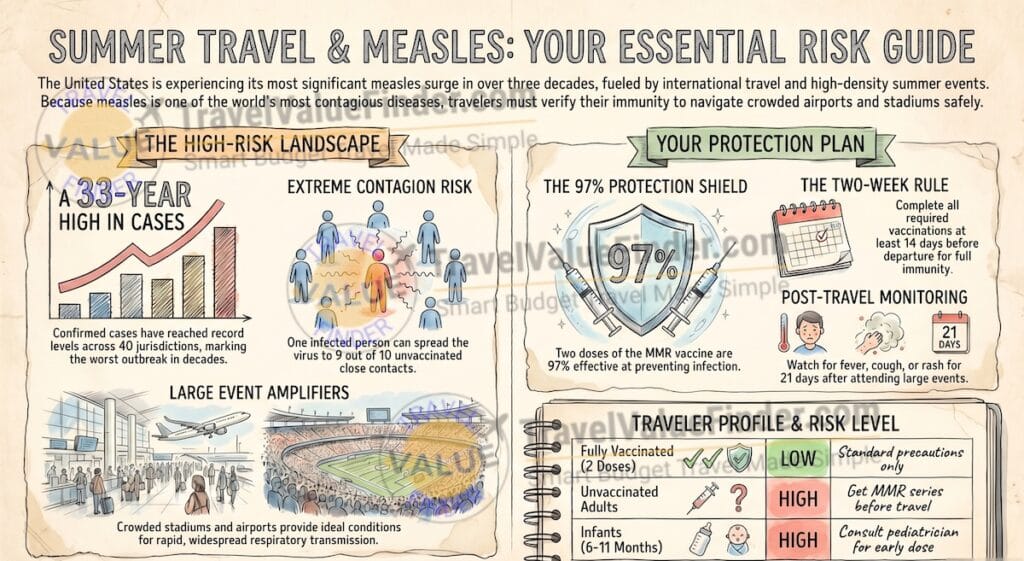
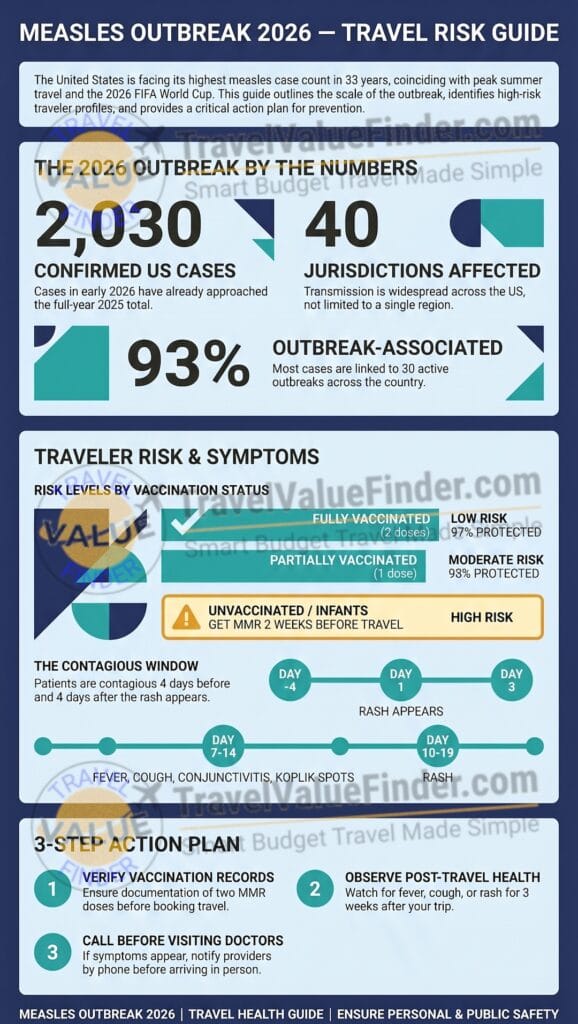
Is it safe to travel during the 2026 measles outbreak? For fully vaccinated travelers (two doses of MMR vaccine, which is 97% effective), the measles outbreak travel risk for 2026 remains low for general travel. However, the CDC has confirmed 2,030 measles cases across 40 US jurisdictions as of June 4, 2026 – a 33-year high – with 30 active outbreaks accounting for 93% of cases. The CDC has explicitly warned that summer travel and large events will likely increase case numbers further. Unvaccinated or partially vaccinated travelers, infants under 12 months, and immunocompromised individuals face meaningfully higher risk, especially when traveling internationally or attending large crowded events such as FIFA World Cup matches. The CDC recommends all international travelers be fully vaccinated with two MMR doses at least two weeks before departure.
By Leslie Nics | Founder & Travel Value Expert, TravelValueFinder.com | Published: June 10, 2026 | Updated Bi-Weekly
If you are planning international travel this summer – or hosting visitors arriving for the FIFA World Cup, which kicked off June 11 across the US, Canada, and Mexico – there is a health alert you need to understand that has nothing to do with strikes, borders, or flight cancellations. The United States is experiencing its worst measles outbreak in over three decades, and the CDC has explicitly warned that summer travel season will make it worse.
As of June 4, 2026, the CDC confirmed 2,030 measles cases across 40 US jurisdictions in 2026 alone – already approaching the full-year 2025 total of 2,288, which itself was the highest annual count in more than 30 years. Ninety-three percent of this year’s cases are linked to 30 active outbreaks. The CDC has issued a direct warning: with international and domestic travel and large events increasing through spring and summer, additional measles cases are expected – and the agency has told health departments to prepare accordingly.
This matters to you whether you’re vaccinated, traveling with young children, attending a World Cup match in a crowded stadium, or simply flying through a major airport this summer. This guide – compiled from CDC outbreak data, CDC Travelers’ Health notices, and US News health reporting – explains the measles outbreak travel risk for 2026, who is at risk, and exactly what steps to take before you travel.
The Numbers: How Bad Is the 2026 Measles Outbreak?
Two thousand and thirty cases by early June is not a statistic – it’s a trajectory. The US is on pace to substantially exceed last year’s total, and last year was already the worst in three decades. If you are unvaccinated and traveling this summer, you are walking into the highest-risk measles environment most Americans have seen in their lifetime. – Leslie Nics, TravelValueFinder.com
2026 vs Historical Context
As of June 4, 2026, the United States has recorded 2,030 confirmed measles cases across 40 jurisdictions this year. This already approaches the full 2025 total of 2,288 cases – which itself was the highest annual count in the US in over three decades. With seven months remaining in 2026, and the CDC specifically warning that summer travel will drive additional cases, the 2025 record is likely to be broken well before year-end.
Thirty new outbreaks (defined by the CDC as three or more linked cases) have been reported in 2026. Ninety-three percent of confirmed cases – 1,890 of 2,030 – are outbreak-associated, split between 558 cases from outbreaks that began in 2026 and 1,332 cases from outbreaks that started in 2025 and are still active.
| Metric | 2026 Figure (as of June 4) | Context |
|---|---|---|
| Confirmed US measles cases (2026) | 2,030 | Already near full-year 2025 total |
| Full-year 2025 total | 2,288 | Highest in over 30 years (until 2026) |
| US jurisdictions affected (2026) | 40 | Includes AK, AZ, CA, CO, FL, GA, ID, IL, KY, ME, MA, MI, MN, MO, MT, NE, NM, NY, NC, ND and more |
| New outbreaks in 2026 | 30 | Defined as 3+ linked cases |
| Cases that are outbreak-associated | 93% (1,890 of 2,030) | 558 from 2026 outbreaks, 1,332 from ongoing 2025 outbreaks |
| CDC official warning | More cases expected with summer travel | Issued ahead of summer travel season and large events |
| Source of most imported cases | International travel – typically 2 of 3 unvaccinated importers are Americans | CDC Travelers’ Health |
Why the CDC Is Sounding the Alarm Now
The CDC’s warning is precise: “With continued measles transmission in areas across North America and expected increases in international and domestic travel and large events during spring and summer, additional measles cases are anticipated in the coming months.” This is not a generic seasonal advisory – it is a direct statement that the events calendar of summer 2026, including the FIFA World Cup, is expected to accelerate transmission.
The mechanism is well understood by epidemiologists: measles is one of the most contagious diseases known, with a single infected person capable of infecting 9 out of 10 unvaccinated close contacts. International travelers – most often unvaccinated Americans returning from abroad – import the virus, and crowded settings like airports, train stations, tourist attractions, and large events provide ideal conditions for onward transmission to under-vaccinated communities.
| Could the US lose its measles elimination status in 2026? The United States achieved measles elimination status in 2000, defined by the absence of continuous disease transmission for 12 months or more. US News reports that officials are preparing to review the nation’s elimination status following the 30 new outbreaks recorded in 2026. Elimination status could be at risk if any single outbreak chain of transmission continues uninterrupted for a full 12 months. With 1,332 of this year’s cases linked to outbreaks that began in 2025 and remain active, the duration threshold is a genuine concern for health officials monitoring the situation through 2026. Losing elimination status would not change individual travel risk significantly in the short term, but it would represent a major public health milestone reversal – the US would join a small number of countries that have lost and not regained this designation. Source: U.S. News & World Report, June 5, 2026 | CDC Measles Data and Surveillance |
Who Is Most at Risk While Traveling This Summer?
Risk Levels by Traveler Profile
Not all travelers face the same risk. The CDC’s guidance differentiates risk primarily by vaccination status and age – but travel itinerary, destination, and exposure to crowded events also matter significantly in 2026’s environment.
| Traveler Profile | Risk Level | Recommended Action |
|---|---|---|
| Fully vaccinated adults (2 MMR doses) | LOW – 97% protected | Standard precautions. No additional action needed for most travel. |
| Adults with only 1 MMR dose | MODERATE – 93% protected | Consider a second dose before international travel – talk to your doctor. |
| Unvaccinated adults (no immunity evidence) | HIGH | Get MMR vaccine at least 2 weeks before travel – 2 doses, 28 days apart. |
| Infants 6-11 months traveling internationally | HIGH – too young for routine MMR | Early MMR dose may be recommended – consult clinician. Does not replace standard 2-dose schedule. |
| Infants under 6 months | HIGHEST – no vaccine protection possible | Discuss travel risk with pediatrician. Extra precautions in crowded settings. |
| Immunocompromised individuals (any age) | HIGH regardless of vaccination | Consult your specialist before any travel to outbreak areas or large events. |
| Travelers attending World Cup matches (crowds of 70,000+) | ELEVATED – large crowd exposure | Confirm vaccination status before attending. Watch for symptoms for 3 weeks after. |
Where in the US Are Cases Concentrated?
Forty US jurisdictions have reported measles cases in 2026, spanning a wide geographic range: Alaska, Arizona, California, Colorado, Florida, Georgia, Idaho, Illinois, Kentucky, Maine, Massachusetts, Michigan, Minnesota, Missouri, Montana, Nebraska, New Mexico, New York, North Carolina, North Dakota, and many more. This breadth means the outbreak is not confined to a single region – travelers cannot assume safety simply by avoiding one or two well-publicized hotspot states.
If you are planning domestic travel this summer, check the CDC’s measles case tracker for your specific destination state before departure. The CDC updates this data weekly, every Thursday at 12:00pm ET.
The World Cup Factor: Why Crowded Events Amplify Measles Risk
Seventy-eight matches, eleven US cities, over a million international visitors, and a measles outbreak already at a 33-year high – these elements were always going to intersect. The good news is that this is one of the most preventable risks on this entire list. Two MMR doses, taken weeks before you travel, essentially solve the problem for you personally. – Leslie Nics, TravelValueFinder.com
Why Large Events Are a Measles Amplifier
Measles spreads through respiratory droplets and remains infectious in the air or on surfaces for up to two hours after an infected person leaves an area. Large stadium crowds, airport terminals, public transit connecting fans to venues, and fan zones create exactly the kind of high-density, high-turnover environments where a single infectious traveler can expose hundreds of people in a single day.
The FIFA World Cup 2026 spans 16 cities across the US, Canada, and Mexico from June 11 to July 19, with international travelers arriving from dozens of countries – some with measles transmission rates significantly higher than the US, and some with lower vaccination coverage. Combined with the existing 30 active US outbreaks, health officials are watching this period closely.
What World Cup Travelers Should Do
- Confirm your MMR vaccination status now – if you have any uncertainty, check vaccination records or speak with your healthcare provider immediately, ideally at least 2 weeks before travel
- If you have only had 1 MMR dose as an adult, consider getting a second dose – it raises protection from 93% to 97%
- Infants 6-11 months traveling to matches or large events may benefit from an early MMR dose – this is a special recommendation and does not replace the standard 12-15 month and 4-6 year doses
- Watch for symptoms – fever, cough, runny nose, red/watery eyes, followed by a rash – for 3 weeks after travel or attending a large event, even if you believe you are vaccinated
- If you develop symptoms, call ahead before visiting a healthcare facility so they can take precautions to prevent further spread
- This guidance applies in addition to – not instead of – all FIFA World Cup entry, ESTA, and immigration requirements covered in TravelValueFinder.com’s World Cup travel alerts guide
MEASLES SYMPTOMS: WHAT TO WATCH FOR AFTER TRAVEL
Early symptoms (appear 7-14 days after exposure): high fever (can spike above 104°F/40°C), cough, runny nose, red and watery eyes (conjunctivitis). Rash: appears 3-5 days after early symptoms begin, typically starting on the face and spreading down the body. The rash consists of flat red spots, sometimes with raised bumps.
Contagious period: measles is contagious from 4 days before the rash appears to 4 days after – meaning a person can spread the virus before they know they’re infected. If you or your child develop these symptoms within 3 weeks of travel or attending a large event: call your healthcare provider BEFORE visiting in person, and mention your recent travel history. Source: CDC Measles Symptoms and Complications
Your Pre-Travel Measles Checklist for Summer 2026
Step-by-Step: Protecting Yourself Before Any Trip
- Check your vaccination records. If you were born after 1957 and do not have documented evidence of either two MMR doses, a positive measles antibody test (titer), or a prior measles diagnosis confirmed by a healthcare provider, you should be considered unvaccinated.
- If unvaccinated or unsure, schedule an MMR vaccination appointment NOW. The CDC recommends international travelers complete vaccination at least 2 weeks before departure to allow immunity to develop.
- The standard adult schedule is 2 doses, at least 28 days apart. If your trip is less than 28 days away, getting even one dose provides significant (93%) protection – better than none.
- For infants aged 6-11 months traveling internationally or to domestic outbreak areas, ask your pediatrician about an early MMR dose – this is a CDC-recognized exception to the standard 12-15 month schedule.
- Check the CDC’s Travel Health Notices (wwwnc.cdc.gov/travel/notices) for your specific destination – measles notices currently exist for global travel generally, with additional specific notices for various countries and US states.
- During travel, practice standard respiratory hygiene in crowded settings: airports, train stations, stadiums, and fan zones are higher-risk environments during an active outbreak period.
- After travel, monitor for symptoms for 3 weeks. If you develop fever with cough, runny nose, red eyes, or a rash, call your healthcare provider before visiting in person and disclose your travel history.
| How effective is the MMR vaccine against measles? One dose of the MMR (measles, mumps, rubella) vaccine is approximately 93% effective at preventing measles. Two doses – the standard recommended schedule – increase effectiveness to approximately 97%. The standard schedule is the first dose at 12-15 months of age and the second dose between ages 4 and 6. Adults without documented immunity can receive both doses at any age, with the second dose at least 28 days after the first. For infants 6-11 months traveling to an area with an outbreak, an early dose may be given – but this child will still require the standard two-dose series later (one dose at 12-15 months, the second between 4-6 years). Source: CDC Measles Vaccination Recommendations |
Other Active CDC Travel Health Notices – June 2026
Measles is not the only health-related travel notice active right now. The CDC’s Travelers’ Health page lists several Level 1-3 notices currently in effect that international travelers should be aware of, depending on destination:
| Health Notice | Level | Destination & Key Info |
|---|---|---|
| Measles (Global) | LEVEL 1 | Cases rising in many countries worldwide. All international travelers should be fully MMR-vaccinated. |
| Ebola (Bundibugyo) – DRC, Uganda, S. Sudan | LEVEL 4 (US State Dept: DO NOT TRAVEL) | Active outbreak. WHO declared PHEIC May 17, 2026. No vaccine for this strain. US entry restrictions remain via Dulles/Houston only. |
| Meningococcal Disease – DRC (Kongo Central) | NEW – June 2026 | Outbreak in Mangembo Health Zone. Meningococcal vaccination recommended for travelers to this area. |
| Chikungunya – French Guiana | NEW – June 4, 2026 | Mosquito-borne. Use repellent, protective clothing, and mosquito netting. |
| Malaria – Mayotte | NEW – June 2, 2026 | Increased cases reported. Antimalarial prophylaxis recommended – consult a travel medicine clinic. |
| Hepatitis A – Manitoba, Canada | NEW – June 4, 2026 | Outbreak in Manitoba. HAV vaccine recommended, especially for unvaccinated travelers. |
| Diphtheria – Sub-Saharan Africa | NEW – June 2, 2026 | Multiple countries: Chad, Guinea, Mali, Mauritania, Niger, Nigeria, Somalia. Diphtheria vaccination essential. |
This list underscores a broader point: 2026 is an unusually active year for travel health notices. Before any international trip – and especially before high-volume summer events – checking the CDC Travelers’ Health page (wwwnc.cdc.gov/travel/notices) for your specific destination should be a standard part of trip preparation, alongside checking passport validity, visa requirements, and travel insurance.
People Also Ask – Expert Answers
Can I get measles even if I’m vaccinated?
It is possible but uncommon. Two doses of MMR vaccine are approximately 97% effective, meaning about 3% of fully vaccinated people may not develop full immunity (sometimes called ‘breakthrough’ cases). If a vaccinated person does contract measles, the illness is typically milder and less likely to lead to complications or further transmission. The CDC still recommends that fully vaccinated travelers monitor for symptoms for 3 weeks after potential exposure, particularly during an active outbreak period like 2026.
Do I need a measles vaccine to attend a World Cup match?
There is no measles vaccination requirement to enter a World Cup stadium or to enter the US, Canada, or Mexico for the tournament. However, given the active 2026 outbreak (2,030+ cases, 30 outbreaks) and the CDC’s specific warning about summer travel and large events, being fully vaccinated is strongly recommended for your own protection – not as an entry requirement, but as a personal health precaution given the crowd sizes and international traveler mix involved.
How long after exposure do measles symptoms appear?
Measles symptoms typically appear 7 to 14 days after exposure to the virus. Early symptoms include high fever, cough, runny nose, and red, watery eyes – followed 3 to 5 days later by the characteristic rash, which usually starts on the face and spreads downward across the body. A person is contagious from 4 days before the rash appears through 4 days after, meaning transmission can occur before any visible symptoms – which is part of why measles spreads so effectively in crowded travel settings.
Which US states currently have the most measles cases in 2026?
The CDC reports that 40 US jurisdictions have confirmed measles cases in 2026, including Alaska, Arizona, California, Colorado, Florida, Georgia, Idaho, Illinois, Kentucky, Maine, Massachusetts, Michigan, Minnesota, Missouri, Montana, Nebraska, New Mexico, New York, North Carolina, and North Dakota, among others. The CDC updates state-by-state case counts weekly on its measles data page. Because 30 active outbreaks exist across this wide geography, travelers should check current data for their specific destination rather than relying on outdated regional assumptions.
What should I do if I think I was exposed to measles while traveling?
If you believe you were exposed to measles – for example, you were in a location where a confirmed case was later reported, or you develop symptoms within 7-21 days of travel – call your healthcare provider before going to a clinic or emergency room in person. This allows the facility to take precautions to prevent measles from spreading to others, particularly vulnerable patients like infants, pregnant individuals, and immunocompromised people. Inform them of your recent travel history and any large events you attended.
Is the measles outbreak connected to the Ebola situation in Africa?
No, these are entirely separate outbreaks caused by different viruses with different transmission methods, geographic scopes, and risk profiles. The 2026 measles outbreak is primarily a US domestic issue driven by declining vaccination rates and importation via international travel. The Ebola Bundibugyo outbreak is concentrated in DRC, Uganda, and South Sudan, was declared a WHO PHEIC on May 17, 2026, and has triggered separate US Level 4 Do Not Travel advisories and entry restrictions for those three countries specifically. Both are active health alerts relevant to international travelers in June 2026, but they require different precautions and are unrelated in cause.
Leslie Nics’ 7-Point Action Plan – Week of June 10, 2026
- Check your MMR vaccination records today – don’t wait until you’re packing. If you can’t find documentation, contact your healthcare provider or state immunization registry.
- If unvaccinated or unsure, book an MMR appointment now. Aim for at least 2 weeks before any travel – sooner is better given current case trends.
- Traveling with infants 6-23 months? Ask your pediatrician specifically about early-dose MMR guidance for international travel or visits to current outbreak areas.
- Check the CDC’s measles case data (cdc.gov/measles/data-research) for your specific US destination – updated every Thursday.
- Check CDC Travelers’ Health Notices (wwwnc.cdc.gov/travel/notices) for ALL active health alerts relevant to your destination – not just measles. June 2026 has multiple new notices including meningococcal disease, chikungunya, malaria, hepatitis A, and diphtheria.
- World Cup attendees: build vaccination verification into your pre-travel checklist alongside ESTA/visa checks, passport validity, and travel insurance.
- Watch for symptoms for 3 weeks after any international travel or large event attendance. Call ahead before visiting a healthcare provider if symptoms develop.
Frequently Asked Questions (FAQs)
Q: I’m fully vaccinated. Do I still need to worry about measles this summer?
Your personal risk is low – two MMR doses are about 97% effective. However, ‘low risk’ is not ‘zero risk,’ and the scale of the 2026 outbreak (2,030+ cases, 40 jurisdictions, 30 active outbreaks) means community-level transmission is at its highest in decades. Practically, this means: no special action is required beyond normal travel precautions, but it’s worth knowing the symptoms (fever, cough, red eyes, rash) so you can seek prompt medical attention if you develop them within 3 weeks of travel, and you should still consider mentioning recent travel to a healthcare provider if you become ill.
Q: My child is 8 months old and we have international travel booked. What should we do?
Contact your pediatrician now. The CDC’s standard MMR schedule begins at 12-15 months, but for infants 6-11 months traveling internationally – especially to countries or US jurisdictions with active outbreaks – an early dose may be recommended. This early dose does NOT replace the standard two-dose series; your child will still need the routine doses at 12-15 months and 4-6 years. This decision should be made with your pediatrician based on your specific itinerary and destination.
Q: Will a measles outbreak affect FIFA World Cup matches or cause cancellations?
There is no indication that the 2026 measles outbreak will cause World Cup match cancellations or venue changes. Measles is a vaccine-preventable disease with well-established public health response protocols, unlike the more severe entry restrictions associated with the Ebola PHEIC. The practical impact for World Cup attendees is personal health preparation – vaccination status and symptom awareness – rather than any tournament-level disruption.
Q: How is the 2026 outbreak different from previous US measles outbreaks?
The scale and breadth are the key differences. Previous notable US outbreaks – such as the 2019 outbreak primarily centered in New York – were largely concentrated in specific communities with lower vaccination rates. The 2026 outbreak spans 40 jurisdictions with 30 separate active outbreaks, indicating more widespread transmission chains across the country rather than a single concentrated event. Additionally, 1,332 of the 2,030 cases are linked to outbreaks that began in 2025 and remain active in 2026 – suggesting longer-running transmission chains, which is part of why officials are reviewing the nation’s measles elimination status.
Q: Where can I find the most current measles case data before I travel?
The CDC’s measles data and surveillance page (cdc.gov/measles/data-research) is updated every Thursday at 12:00pm ET with the latest confirmed case counts by jurisdiction. For destination-specific health notices covering measles and other diseases, check CDC Travelers’ Health (wwwnc.cdc.gov/travel/notices), which lists Level 1-4 notices for specific countries and situations. TravelValueFinder.com’s weekly travel alerts also summarize the most relevant updates for travelers.
Stay Ahead of Every Travel Alert – Free Monthly Updates from TravelValueFinder.com
From measles outbreaks to Ebola advisories, World Cup entry rules to European border delays – TravelValueFinder.com’s Travel Alerts page, updated weekly by Leslie Nics, translates primary-source intelligence from the CDC, WHO, and government agencies into clear, actionable guidance for real travelers.
Subscribe free and travel with confidence this summer.
Explore: TravelValueFinder.com/travel-alerts | /travel-insurance-guide | /flight-deals | /europe-travel-tips | /cruise-travel-guide
Find our more on Travel Alerts June 2026: 3 Critical Crises Shaping Every International Journey This Month, and July 2026 Travel Alerts: Europe’s Historic Heatwave Is Dangerous — and It’s Not Over
Ready to plan the trip? Use our Free AI Trip Planner to build a day-by-day focused itinerary for any destination, and browse our destination guides to find exactly where to stay for the best local food access.
About the Author
Leslie Nics is the founder of TravelValueFinder.com and a travel value strategist with over a decade of experience tracking global travel alerts, health advisories, and disease outbreak guidance for international travelers. All data in this article is sourced from primary health authorities: the US Centers for Disease Control and Prevention (CDC), CDC’s Health Alert Network (HAN), CDC Travelers’ Health Notices, the World Health Organization (WHO), and US News health reporting. This article reflects verified conditions as of June 10, 2026.
Sources
All data verified from primary sources as of June 10, 2026:
- CDC – Measles Cases and Outbreaks Data (Updated June 5, 2026) | cdc.gov/measles/data-research
- CDC – Plan for Travel: Measles | cdc.gov/measles/travel
- CDC – Travelers’ Health Notices | wwwnc.cdc.gov/travel/notices
- CDC – Measles in Globe, Level 1 Travel Health Notice | wwwnc.cdc.gov/travel/notices/level1/measles-globe
- ABC News – CDC Warns Additional Measles Cases Expected Amid Travel Season | abcnews.com
- US News & World Report – Tracking U.S. Measles 2026: 2,000 Cases Put Elimination Status at Risk (June 5, 2026) | usnews.com
- WHO – Ebola Bundibugyo PHEIC Declaration May 17, 2026 | who.int
- US State Department – FIFA World Cup 2026 Travel Information | state.gov/fifa-world-cup-26