Travel Value Finder

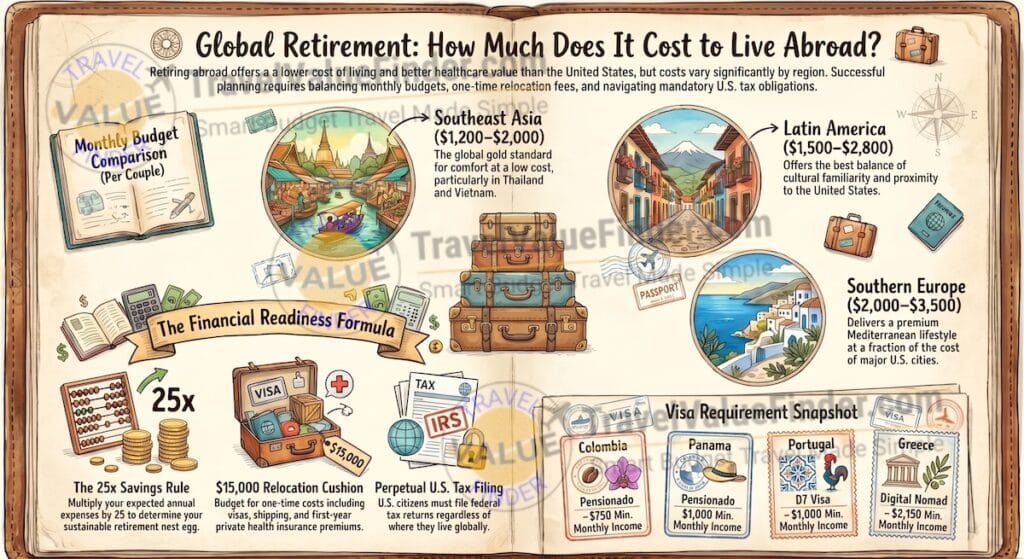
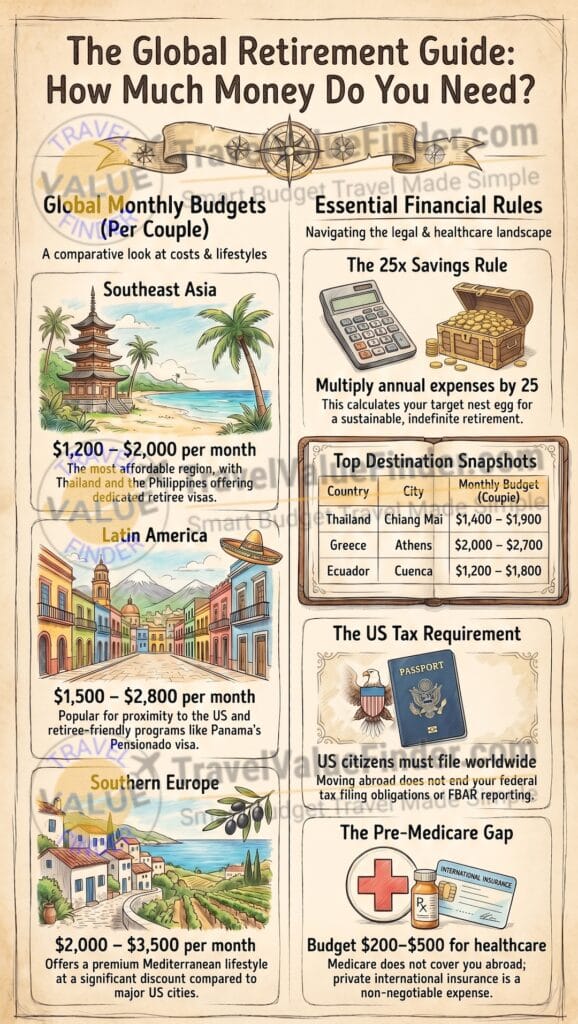
How much money do you need to retire abroad in 2026? The answer depends on where you go. Southeast Asia (Thailand, Vietnam, Philippines) is the most affordable at $1,200–$2,000/month per couple. Latin America (Mexico, Colombia, Panama, Ecuador) typically runs $1,500–$2,800/month. Southern Europe (Portugal, Greece, Spain) costs $2,000–$3,500/month. Budget breakdowns must include housing, food, healthcare, transportation, insurance, and entertainment. One-time relocation costs average $3,000–$8,000. U.S. retirees keep filing taxes abroad. Social Security payments continue overseas. Greece ranked #1 in the 2026 International Living Global Retirement Index.
Leslie Nics, TravelValueFinder.com | Last updated: June 2026 | Last Reviewed: June 13 2026
COST GUIDE AT A GLANCE
| Guide Type | Country-by-Country Retirement Budget 2026 |
|---|---|
| Monthly Budget Range | $1,200 (SE Asia frugal) – $4,000+ (W. Europe comfort) |
| Savings Needed (25x Rule) | $360,000 (frugal SE Asia) – $1,200,000+ (Europe comfort) |
| Countries Covered | Thailand, Vietnam, Philippines, Mexico, Colombia, Panama, Ecuador, Portugal, Greece, Spain, Malaysia, Georgia |
| Visa Income Minimum | $800/month (Ecuador) – $6,500+/month (Thailand LTR Pensioner) |
| Healthcare (Private Intl.) | $150–$500/month depending on age and destination |
| U.S. Tax Filing | Required regardless of where you live (FBAR if accounts > $10K) |
| Social Security Abroad | Continues in most countries; withheld in ~30 countries with tax treaty rules |
| Last Data Update | June 2026 – Numbeo, International Living, SSA, Greenback Tax Services |
| Author | Leslie Nics, TravelValueFinder.com (Travel Writer & Long-Term Expat Researcher) |
The Real Answer Starts with One Question: Where?
Here’s the thing most retirement articles bury in paragraph twelve: the money you need to retire abroad isn’t a single number. It’s a range – and the country you pick is the single biggest variable in the entire equation.
Pick Thailand’s Chiang Mai and a couple can live comfortably on $1,500 a month. Pick Lisbon, Portugal, and that same comfortable life costs closer to $2,800. Choose Barcelona or the French Riviera and you’re looking at $3,500 or more. None of those budgets are wrong. They’re just answers to very different versions of the question.
A 2025 Harris Poll found that 44% of U.S. adults have seriously considered retiring abroad, and 14% plan to do so within two years. The motivations are consistent: lower cost of living, better healthcare value, and the ability to stop working sooner than their savings would allow stateside. Stretch $700,000 in rural Portugal instead of suburban California and the retirement math changes dramatically.
The biggest mistake I see first-time retirees make is budgeting for the country, not the city. Two hours outside Lisbon, your money goes 40% further. Two hours outside Bangkok, you could cut your budget nearly in half. The country is just the starting point – pick your city carefully. – Leslie Nics, TravelValueFinder.com
This guide gives you real, city-level budget numbers for 12 top retirement destinations, the visa income requirements you’ll actually need to meet, what healthcare costs look like out of pocket versus insured, and the one tax rule that trips up almost every American who moves abroad.
2026 Master Budget Table: Retire Abroad by Country
The table below shows real-world monthly budgets for a couple (not a single person) living a comfortable – not luxury – lifestyle abroad. All figures are in USD and reflect mid-2026 data from Numbeo, International Living, and firsthand expat reporting.
| Country / City | Monthly Budget (Couple) | Single Person | Visa Income Min. | Ranking 2026 |
|---|---|---|---|---|
| Thailand – Chiang Mai | $1,400–$1,900 | $900–$1,200 | None (O-A); LTR $6,500+ | Top 10 |
| Thailand – Bangkok | $1,800–$2,500 | $1,100–$1,600 | None (O-A); LTR $6,500+ | Top 10 |
| Vietnam – Hanoi/Da Nang | $1,100–$1,600 | $700–$1,000 | No retirement visa | Budget Pick |
| Philippines – Cebu/Davao | $1,000–$1,500 | $650–$900 | ~$800/month (SRRV) | Budget Pick |
| Malaysia – Penang | $1,500–$2,200 | $900–$1,400 | MM2H reviewed (TBC) | Top 15 |
| Mexico – Puerto Vallarta | $1,700–$2,400 | $1,000–$1,500 | ~$1,620/month (2026) | Top 10 |
| Mexico – San Miguel de Allende | $2,000–$2,800 | $1,200–$1,700 | ~$1,620/month (2026) | Top 10 |
| Colombia – Medellín | $1,500–$2,200 | $900–$1,300 | ~$750/month | Rising Star |
| Panama – Boquete/City | $2,000–$3,000 | $1,200–$1,800 | $1,000/month (Pensionado) | Top 5 |
| Ecuador- Cuenca | $1,200–$1,800 | $750–$1,100 | $800/month | Budget Pick |
| Portugal – Algarve | $2,200–$3,000 | $1,300–$1,800 | €920/month (~$1,000) | Top 5 |
| Portugal – Lisbon | $2,800–$3,800 | $1,700–$2,300 | €920/month (~$1,000) | Top 5 |
| Greece – Athens | $2,000–$2,700 | $1,200–$1,600 | €2,000/month (Digital Nomad) | #1 2026 |
| Greece – Crete/Rhodes | $1,700–$2,400 | $1,000–$1,400 | €2,000/month | #1 2026 |
| Spain – Valencia | $2,200–$3,000 | $1,400–$1,900 | €2,259/month | Top 10 |
| Georgia – Tbilisi | $1,000–$1,500 | $600–$950 | No income min. | Hidden Gem |
Note: Mexico’s income threshold increased significantly in 2026. Verify with the nearest Mexican consulate before applying. All figures assume renting (not owning) and do not include one-time relocation costs. Healthcare insurance is included in the monthly estimate at a basic international level for those under 65.
How Much in Savings Do You Actually Need?
There’s a formula that financial planners call the 25x Rule. Multiply your expected annual expenses by 25 and you get a rough target for your retirement nest egg – one that, invested at a modest return rate, should sustain you indefinitely without running out.
Applied to retiring abroad, the math gets interesting fast.
| Lifestyle Level | Monthly Spend (Couple) | Annual | Savings Target (25x) | Representative Destination |
| Frugal | $1,200 | $14,400 | $360,000 | Vietnam, Philippines, Georgia |
| Budget-Comfortable | $1,800 | $21,600 | $540,000 | Chiang Mai, Medellín, Ecuador |
| Comfortable | $2,500 | $30,000 | $750,000 | Portugal Algarve, Boquete, Penang |
| Comfortable+ | $3,200 | $38,400 | $960,000 | Lisbon, Athens, Valencia |
| Premium | $4,500+ | $54,000+ | $1,350,000+ | Barcelona, Tuscany, Swiss Lake Region |
For U.S. retirees, Social Security significantly changes this math. As of 2026, the maximum monthly Social Security payment is $5,251, and the SSA records 738,551+ beneficiaries receiving payments outside the United States – a number that rises every year. If your Social Security benefit covers 60–80% of your abroad budget, your savings requirement drops sharply.
Key Insight: The Social Security Multiplier A couple receiving a combined $3,000/month in Social Security benefits and targeting a $2,200/month lifestyle abroad has a surplus – and could retire with minimal personal savings beyond emergency funds and healthcare reserves. This is why so many Americans who couldn’t retire domestically are thriving in places like Medellín, Algarve, and Chiang Mai.
Southeast Asia: The Most Affordable Region for Retirement Abroad
If your primary goal is making your retirement money last – or retiring earlier than your savings would otherwise allow – Southeast Asia remains the gold standard in 2026. No other region on earth delivers this combination of warm climate, modern amenities, affordable healthcare, and genuine affordability at scale.
Thailand – Best All-Around for Comfort at Low Cost
Thailand’s retirement visa (Non-Immigrant O-A) requires applicants to be 50 or older with 800,000 THB (~$22,000 USD) in a Thai bank account or a monthly income of at least 65,000 THB (~$1,800 USD). Thailand also introduced a Long-Term Resident (LTR) Wealthy Pensioner visa in 2022, which requires $80,000/year in income – targeting high-net-worth retirees.
For most retirees, the O-A visa is the path. And the lifestyle it unlocks is genuinely impressive.
| Expense Category | Chiang Mai (Budget) | Bangkok (Comfortable) | Hua Hin (Relaxed Beach) |
|---|---|---|---|
| 1-BR Apartment (rent) | $350–$500 | $600–$1,000 | $400–$650 |
| Groceries (local markets) | $150–$200 | $180–$250 | $140–$200 |
| Dining Out (mix local/western) | $150–$300 | $200–$400 | $150–$280 |
| Transportation | $50–$100 | $80–$150 | $60–$100 |
| Utilities (A/C, internet, phone) | $80–$120 | $100–$160 | $80–$120 |
| Healthcare insurance (basic) | $100–$200 | $100–$200 | $100–$200 |
| Entertainment / misc | $100–$200 | $150–$300 | $100–$200 |
| TOTAL (Single Person) | $980–$1,620 | $1,410–$2,460 | $1,030–$1,750 |
| TOTAL (Couple) | $1,400–$2,100 | $1,900–$3,000 | $1,500–$2,200 |
Chiang Mai is the easiest sell I’ve ever made to a budget-conscious retiree. The food is incredible, the expat community is enormous, the weather is manageable most of the year, and $1,500 a month for a couple isn’t just survivable – it’s genuinely comfortable. You’re not roughing it. You’re living. – Leslie Nics, TravelValueFinder.com
Vietnam – The Budget Champion (No Retirement Visa, But Still Possible)
Vietnam has no official retirement visa, which means most expats cycle through tourist visa renewals or digital nomad workarounds. That said, it remains one of the most affordable countries on earth for Western retirees, and many live there on $900–$1,200/month as a single person.
Da Nang sits at a sweet spot: beach access, modern infrastructure, lower cost than Hanoi or Ho Chi Minh City, and an increasingly active expat community. Hanoi offers rich history and culture at similar prices.
- 1-BR apartment (Da Nang): $250–$400/month
- Full-service restaurant meal: $3–$8
- Healthcare: excellent private hospitals in major cities, very affordable by Western standards
- Best for: Single retirees, those comfortable with visa flexibility, adventure-seekers
Philippines – Lowest Cost Entry Point with Official Retiree Program
The Philippines offers one of the most accessible formal retirement programs in Southeast Asia: the Special Resident Retiree’s Visa (SRRV). Requirements vary by age and deposit amount, but income of roughly $800/month is sufficient for many applicants over 50.
Cebu City and Davao are particularly popular with American retirees – English is widely spoken, the healthcare system in major cities is solid, and the cost of living remains below $1,500/month for a couple even at a comfortable standard.
Malaysia – The Underrated Middle Ground
Malaysia’s My Second Home (MM2H) program underwent major revisions in 2021 and 2023, and requirements remain somewhat in flux as of 2026. That said, Malaysia’s value proposition is unique: Kuala Lumpur offers world-class infrastructure, English is widely spoken, and Penang’s George Town blends Southeast Asian charm with genuine Western comfort.
- Average couple budget in Penang: $1,500–$2,200/month
- 1-BR apartment in Penang: $300–$500/month
- Private healthcare: excellent quality, roughly 30–50% cheaper than the US
- Bonus: Malaysia has no capital gains tax and no inheritance tax
Latin America: The Best Retirement Abroad Budget for Americans Who Want Convenience
For American retirees, Latin America has a unique advantage that Southeast Asia simply can’t match: proximity, time zones, and cultural familiarity. You can fly home for a family emergency without a 20-hour journey. You can get on a video call with your kids without waking up at 3 a.m. And in many cases, you’ll find Costco, Walmart, and American medical care nearby.
Mexico – Over 1 Million American Expats and Counting
Mexico is the single most popular retirement destination for Americans abroad, hosting well over one million expat residents. The range of lifestyles available is remarkable – from the beach heat of Puerto Vallarta and Cabo to the eternal spring climate of San Miguel de Allende, the colonial elegance of Oaxaca, and the cosmopolitan energy of Mexico City.
Important 2026 update: Mexico raised its income thresholds for the Temporary Resident Visa significantly. As of 2026, applicants typically need to demonstrate monthly income around $1,620 USD or roughly $27,000 in savings. This has priced out some retirees who previously qualified easily, so verify the most current figures directly with the Mexican consulate.
| Expense | Puerto Vallarta | San Miguel de Allende | Mexico City (Roma/Condesa) | Oaxaca City |
|---|---|---|---|---|
| 1-BR Apartment | $600–$900 | $700–$1,100 | $800–$1,400 | $400–$700 |
| Groceries | $200–$280 | $220–$300 | $250–$350 | $150–$220 |
| Dining Out | $200–$350 | $250–$400 | $300–$500 | $150–$300 |
| Transport | $50–$100 | $60–$100 | $80–$150 | $40–$80 |
| Healthcare Ins. | $150–$350 | $150–$350 | $150–$350 | $150–$300 |
| Utilities | $80–$140 | $60–$120 | $100–$160 | $60–$100 |
| COUPLE TOTAL | $1,700–$2,500 | $1,900–$2,900 | $2,100–$3,200 | $1,300–$2,100 |
Colombia – The ‘Eternal Spring’ Budget Winner
Medellín, once known for entirely the wrong reasons, has undergone a transformation that many long-term travelers describe as one of the most remarkable urban turnarounds they’ve witnessed. Today it’s a city with a genuinely pleasant climate year-round (the ‘eternal spring’ reputation is real), an affordable cost of living, and a rapidly growing expat community of retirees, digital nomads, and remote workers.
Colombia’s retirement visa (Visa Pensionada) requires demonstrating income of roughly three times the Colombian national minimum wage – approximately $750–$800/month as of 2026. That’s one of the lowest thresholds in Latin America and makes Colombia accessible to retirees on modest Social Security income.
- Medellín couple budget: $1,500–$2,200/month
- 1-BR apartment in El Poblado: $500–$800/month
- Cartagena: beautiful, but pricier and hotter – budget $1,800–$2,500/month
- Best for: Those who want culture, nightlife, food, and affordability in one package
Panama – The Pensionado Visa: Still One of the World’s Best Retiree Programs
Panama’s Pensionado Visa has been called the most retiree-friendly visa on the planet, and that reputation holds up in 2026. Requirements are simple: a lifetime pension income of $1,000/month. No age restriction. Permanent residency within months. And the discounts that come with the Pensionado card are genuinely significant – 20% off medical consultations, 15% off hospital bills, 50% off entertainment, and 25% off airline tickets.
Panama uses the U.S. dollar, so there’s no currency risk. Infrastructure in Panama City is first-world. And Boquete – a mountain town two hours from the city – is frequently cited as one of the most livable expat communities in the world.
- Panama City couple budget: $2,200–$3,000/month
- Boquete couple budget: $1,800–$2,400/month
- Pensionado Visa income requirement: $1,000/month lifetime pension
- Bonus: Panama’s territorial tax system means foreign income – including pensions and Social Security – is not taxed locally
Ecuador – The Unsung Budget Destination of the Americas
Ecuador is consistently underrated in retirement conversations, and that’s actually part of its appeal – fewer crowds, genuine affordability, and a formal retirement visa with one of the lowest income requirements in Latin America at roughly $800/month.
Cuenca, Ecuador’s colonial mountain city, regularly ranks in International Living’s top retirement destinations for value. A couple can live genuinely well here – full-service restaurant meals under $5, rent under $500 for a comfortable apartment in the historic center, and world-class private hospitals – for $1,200–$1,800/month total.
Ecuador is the destination I recommend when someone tells me they’ve got Social Security and not much else. A couple with $1,600 a month in income can retire comfortably in Cuenca – not scrape by, but actually enjoy their retirement. That’s increasingly rare anywhere in the world. – Leslie Nics, TravelValueFinder.com
Southern Europe: Premium Lifestyle at a Fraction of U.S. Prices
Southern Europe doesn’t compete on price with Southeast Asia or Ecuador. But what it offers in return is a lifestyle that many retirees find irreplaceable: walkable historic cities, world-class cuisine, EU-standard healthcare, rich culture, mild Mediterranean climate, and the kind of old-world quality of life that’s simply not for sale in most American cities at any price.
The key phrase is ‘fraction of U.S. prices.’ Portugal, Greece, and Spain are all expensive by Southeast Asian standards – but they’re dramatically cheaper than retiring in California, New York, or even most mid-sized American metros.
Greece – #1 in the 2026 International Living Global Retirement Index
Greece claimed the top spot in the 2026 International Living Annual Global Retirement Index for the first time in the index’s 35-year history, scoring 90.1. It leads across healthcare value, visa access, cost of living, climate, and real-world expat experience.
The signature draw in 2026 is Greece’s flat 7% tax on all foreign-source income for up to 15 years. For American retirees drawing pensions, investment income, and Social Security, this can result in meaningful tax savings compared to their home-state obligations – and far below standard Greek income tax rates.
| Expense | Athens | Thessaloniki | Crete (Heraklion) | Rhodes Town |
|---|---|---|---|---|
| 1-BR Apartment | $700–$1,100 | $550–$850 | $500–$800 | $500–$750 |
| Groceries (couple) | $250–$350 | $220–$310 | $200–$290 | $200–$280 |
| Dining Out | $200–$400 | $180–$350 | $180–$320 | $180–$320 |
| Transport | $80–$130 | $60–$110 | $60–$100 | $50–$80 |
| Utilities | $100–$160 | $90–$150 | $80–$140 | $80–$130 |
| Healthcare Ins. | $200–$400 | $200–$400 | $200–$350 | $200–$350 |
| COUPLE TOTAL | $2,000–$2,900 | $1,800–$2,600 | $1,700–$2,400 | $1,700–$2,300 |
- Golden Visa: residency via real estate investment from €250,000
- Greece Digital Nomad Visa (accessible for passive income earners): €2,000/month income required
- Private healthcare in Athens and Thessaloniki: excellent, English-speaking specialists widely available
- Island healthcare caveat: smaller islands may have limited specialist care – plan for mainland travel or strong insurance
Portugal – The D7 Visa: Easiest Path to European Retirement
Portugal has welcomed tens of thousands of retirees and remote workers through its D7 Visa – a passive income visa requiring proof of €920/month in stable income as of 2026. For a couple, add 50% for a spouse (€1,380/month total). That’s one of the most accessible income thresholds for European residency anywhere.
After five years of legal residency, permanent residency is available. Citizenship becomes possible after five years. An important 2026 note: in May 2026, Portugal amended its Nationality Law to require most nationals to hold legal residency for 10 years (7 years for EU and Portuguese-speaking country citizens) before qualifying for citizenship – so plan your timeline accordingly.
Portugal 2026 Fast Facts D7 Visa income requirement: €920/month (single); €1,380/month (couple) Golden Visa: still available for qualifying investments (certain funds, cultural heritage) NHR Tax Regime: the original NHR ended; a new IFICI regime for tech workers replaced it (most retirees no longer qualify) Healthcare: public SNS system covers registered residents; private plans average €400/year Path to citizenship: 5 years legal residency (now 10 for most nationalities after May 2026 amendment) Best cities for retirees: Algarve, Silver Coast (Óbidos/Caldas), Porto, Braga
Spain – Sun, Culture, and Solid Healthcare
Spain consistently ranks among the top retirement destinations in Europe for its climate diversity (Atlantic north, Mediterranean east and south, island paradises in the Canaries and Balearics), world-class food and wine culture, and a public healthcare system that covers legal residents.
Spain’s Non-Lucrative Visa requires demonstrating passive income of approximately €2,259/month per person as of 2026. That’s a higher bar than Portugal’s D7, but the lifestyle return is compelling, particularly in Valencia (ranked one of Europe’s most livable cities), Alicante, Málaga, and Seville.
- Valencia couple budget: $2,200–$3,000/month
- Málaga couple budget: $2,400–$3,200/month
- Barcelona: $3,200–$4,500+/month (premium destination, not budget-friendly)
- Spain’s healthcare ranks among the top 10 globally on most international indices
Georgia (Country) – Europe’s Most Surprising Budget Retirement Destination
Georgia – the country on the Black Sea, not the U.S. state – has emerged as one of the most talked-about hidden gems for budget-conscious retirees and expats. Tbilisi, the capital, offers a remarkable quality of life at costs that rival Southeast Asia: $1,000–$1,500/month for a couple.
Georgia has no minimum income requirement for most long-stay visas. American citizens can stay for up to 365 days without a visa. The country uses a territorial tax system, meaning most foreign-sourced income is not taxed locally. And the Georgian food, wine, and hospitality culture is genuinely extraordinary.
- Tbilisi 1-BR apartment: $300–$550/month
- No visa required for Americans (365-day stay)
- No local tax on most foreign income
- Caveat: healthcare infrastructure is improving but remains below Western European standards; strong international health insurance is essential
Healthcare Abroad: The Budget Line You Cannot Skip
Healthcare is where many retirees significantly underbudget when planning life abroad. It’s also the category with the most variation – not just between countries, but between cities within the same country, and between age groups.
Here’s the key principle: don’t plan on your Medicare coverage working abroad. Medicare generally does not cover medical care received outside the United States. You will need private international health insurance.
| Age at Retirement | Region | Basic Intl. Insurance/Month | Comprehensive/Month | Key Note |
|---|---|---|---|---|
| 55–60 | SE Asia | $100–$180 | $200–$320 | Excellent value; local hospitals often preferred |
| 55–60 | Latin America | $130–$220 | $250–$380 | Major cities have US-standard hospitals |
| 55–60 | Southern Europe | $180–$300 | $320–$500 | EU access; excellent specialists |
| 61–65 | SE Asia | $200–$300 | $350–$500 | Pre-Medicare years; most critical gap period |
| 61–65 | Latin America | $220–$350 | $380–$550 | Same – build this into your budget carefully |
| 65+ (on Medicare) | Any | $150–$280 | $280–$450 | Medicare Supplement + local coverage recommended |
The Pre-Medicare Gap: Your Biggest Healthcare Risk If you retire before 65, the years between retirement and Medicare eligibility are your most financially vulnerable. International health insurance during this window can cost $300–$500+/month per person at ages 60–64 – a line item that many retirees forget to include in their abroad budget. Do not make this mistake. It can wipe out the cost savings of living abroad entirely if you face a serious health event uninsured.
Most retirement visa programs require proof of health insurance at the time of application. Portugal’s D7, Spain’s Non-Lucrative Visa, Thailand’s O-A, and Greece’s Digital Nomad Visa all include this requirement. Even Panama, which doesn’t always mandate it for the Pensionado application itself, strongly recommends private coverage since access to the public CAJA system for residents has practical limitations for new arrivals.
Taxes Abroad: What Every American Retiree Needs to Know
The U.S. taxes its citizens on worldwide income, regardless of where they live. Moving to Thailand or Portugal doesn’t end your U.S. tax filing obligation. This surprises many first-time expat retirees – and it’s one of the most important facts to absorb before you book your one-way flight.
The Rules in Plain English
- You must file a U.S. federal tax return every year you earn above the filing threshold, regardless of which country you live in.
- If you have foreign bank accounts with combined balances over $10,000 at any point during the year, you must file an FBAR (FinCEN 114) – separate from your tax return, and with serious penalties for non-filing.
- If you have foreign financial accounts or assets above certain thresholds, FATCA reporting (Form 8938) may also apply.
- Social Security continues to be paid to most countries. However, approximately 30 countries have bilateral tax treaties with the U.S. that can affect how those benefits are taxed – check your destination’s treaty status.
- The Foreign Earned Income Exclusion (FEIE) allows you to exclude up to $132,900 of foreign earned income in tax year 2026. Importantly, FEIE does not apply to pensions or Social Security – it covers wages and self-employment income from foreign sources.
- The Foreign Tax Credit is typically the most valuable tool for retirees, providing dollar-for-dollar credits for income taxes paid to your host country.
| Country | Local Tax on Foreign Income | U.S. Tax Treaty? | Key Tax Benefit |
|---|---|---|---|
| Greece | Flat 7% for 15 years | No (as of 2026) | Ultra-low flat rate on all foreign income |
| Panama | None (territorial) | No | Foreign income fully exempt locally |
| Georgia | None (territorial) | No | Foreign income fully exempt locally |
| Portugal | Standard rates (NHR ended) | Yes | Treaty reduces double-taxation risk |
| Mexico | Territorial (some exceptions) | Yes | Treaty; pension treatment varies |
| Ecuador | Territorial for most income | No | Most foreign income not taxed locally |
| Colombia | Exempt if non-resident status | No | Non-resident status advantageous first years |
| Thailand | Remittance rules apply | Yes | Only remitted income taxed locally |
| Spain | Standard EU rates | Yes | Treaty reduces withholding on US pensions |
| Vietnam | Residency-based | No | Most short-stay retirees pay no local income tax |
Consult a CPA Before You Move Tax rules change annually. The information above is accurate as of June 2026 but should not substitute for advice from a CPA specializing in expat taxation. Firms like Greenback Tax Services and Taxes for Expats specialize in exactly this situation. The cost of a one-hour consultation (typically $150–$300) will almost certainly save you money.
One-Time Relocation Costs: What to Budget Beyond the Monthly
Monthly budgets get all the attention in retirement abroad planning, but the one-time costs of actually making the move are significant and frequently underestimated. Here’s what to build into your moving budget.
| One-Time Cost | Low Estimate | High Estimate | Notes |
|---|---|---|---|
| International shipping / air freight | $1,500 | $8,000 | Less is more – sell before you go |
| First 1–3 months rent (deposit + advance) | $800 | $4,500 | Varies by country and landlord |
| Visa application fees | $150 | $900 | Multiple countries may require consulate visits |
| Flight (couple) | $1,200 | $4,000 | Business class, shipping bags, excess luggage |
| Furnishing (if unfurnished apartment) | $500 | $4,000 | Many expats rent furnished; buy local cheaply |
| Local SIM / internet setup | $50 | $200 | Trivial cost, easy to do on arrival |
| Bank account setup / wire transfers | $50 | $300 | Some countries require in-person |
| Health insurance (first year upfront) | $1,800 | $6,000 | Annual premium vs. monthly payment options |
| Legal / immigration attorney fees | $500 | $3,000 | Optional but recommended for complex visas |
| Emergency fund (3 months expenses) | $3,600 | $12,000 | Non-negotiable; keep liquid in USD |
| TOTAL ESTIMATE | $10,150 | $43,900 | Realistic average: $12,000–$20,000 |
Budget $15,000 to $20,000 for the move itself and treat it as spent – not borrowed from your retirement fund. That means it’s gone before you ever board the plane. Once you’re settled, the monthly savings kick in and you’ll recoup that in a year or two in most destinations. But if you arrive with $3,000 and call it your relocation budget, you’re going to have a very stressful first month. – Leslie Nics, TravelValueFinder.com
2026 Retirement Visa Comparison: Income Requirements by Country
Every country’s retirement or passive income visa has different income thresholds, age requirements, and paths to permanent residency. This table is your at-a-glance comparison for 2026.
| Country | Visa Name | Min. Age | Income Required | Path to PR | Key Benefit |
|---|---|---|---|---|---|
| Panama | Pensionado (Jubilado) | None | $1,000/month pension | Immediate PR | Permanent from day 1 + major discounts |
| Ecuador | Retirement Visa | None | ~$800/month | 3 years – PR | Cheapest income requirement in Americas |
| Colombia | Pensionado Visa | None | ~$750/month | 5 years – PR | Low threshold; Medellín lifestyle |
| Costa Rica | Pensionado | None | $1,000/month | 7 years – PR | Pura vida; solid infrastructure |
| Mexico | Temp. Resident | None | ~$1,620/month (2026) | 4 years – PR | Proximity to U.S.; huge expat network |
| Portugal | D7 Visa | None | €920/month (~$1,000) | 5 years – PR – citizenship | EU residency; clear citizenship path |
| Greece | Digital Nomad / Golden | None | €2,000/month / €250K invest | 5 years – PR | 7% flat tax for 15 years |
| Spain | Non-Lucrative Visa | None | €2,259/month | 5 years – PR | EU access; world-class healthcare |
| Thailand | Non-OA (Retirement) | 50+ | 65K THB/month (~$1,800) | No PR path (visa only) | Renewable annually; easy process |
| Malaysia | MM2H | 35+ | TBC 2026 (check gov site) | No PR path | Excellent infrastructure, low cost |
| Philippines | SRRV | 35+ | ~$800/month | Permanent from start | Low cost; English-speaking |
| Georgia | No visa required | None | None (365-day stays) | 1 year – renewable | Zero income requirement; territorial tax |
Always verify current requirements directly with official government immigration sources or a licensed immigration attorney before applying. Thresholds change, and this guide reflects publicly available data as of June 2026.
Expert Tips: 12 Things to Do Before You Retire Abroad
Planning is what separates retirees who thrive abroad from those who come home within a year. Here are the twelve most important actions to take before you make the move.
- Do a 3-month trial run first. Never commit to a country or city without spending at least 90 days there across at least two different seasons. Climate, social fabric, and daily logistics are impossible to evaluate from a vacation.
- Confirm your Social Security strategy. If you haven’t yet claimed, consider how your target country’s tax treaty (or lack thereof) affects your optimal claiming age and monthly strategy.
- Get an expat tax consultation before you leave. Not after. Ideally six months before, so you can make financial moves (like Roth conversions) that may be advantageous to do while still a U.S. resident.
- Open accounts with Schwab International or a Wise multi-currency account. ATM fees and currency conversion add up. Schwab’s International account reimburses ATM fees worldwide. Wise lets you hold multiple currencies with minimal conversion markup.
- Research your target city’s private hospital network, not just the country’s reputation. Healthcare quality varies enormously within countries. Find the best private hospitals in your target city and verify that English-speaking specialists in your specialty (cardiology, orthopedics, oncology) are available.
- Get international health insurance quotes at least six months in advance. Your options may be more limited if you have pre-existing conditions, and some insurers won’t cover you after certain ages. Lock in coverage early.
- Join expat forums for your target city, not just the country. Facebook groups like ‘Expats in Chiang Mai,’ ‘Americans in Lisbon,’ or ‘Expats in Medellín’ are invaluable sources of current, ground-level information. Ask about rental scams, neighborhood safety, and which grocery stores stock American products.
- Hire a local immigration attorney for your visa. Even for simpler programs like Panama’s Pensionado or Portugal’s D7, a local attorney who does five of these per week will save you time, stress, and often money. Budget $500–$2,500.
- Rent before you buy, for at least the first year. Property laws and purchase processes for foreigners vary significantly and can be complex. The expat who buys in month two often regrets the neighborhood, the building, or the price they paid. Rent first.
- Create a currency buffer. Keep three to six months of living expenses in USD in a U.S.-based account. Exchange rates can swing 10–15% in a year. A currency buffer means you’re not forced to convert at the worst moment.
- Document everything for your visa. Financial documentation for retirement visas requires notarized statements, apostilles, and sometimes certified translations. Collect bank statements going back 12 months, pension letters, Social Security award letters, and any investment account summaries before you leave the U.S. Getting these from abroad is a significant hassle.
- Tell Medicare you’re leaving – then figure out your strategy. Medicare doesn’t cover abroad, but your Part B premium still runs whether you keep it or drop it. If you drop Part B and later re-enroll in the U.S., you may face a late enrollment penalty. Understand the tradeoffs before canceling anything.
Ready to compare cities now?
- Use our Free Retirement Cost of Living Calculator – get your personalized report in 30 seconds – Free PDF download.
- How to Use a Retirement Cost of Living Calculator – to Compare Cities Worldwide
Quick Answers: How Much Money to Retire Abroad
How much money does a couple need to retire abroad comfortably?
Most couples can retire comfortably abroad on $1,500–$3,000/month, depending on the destination. Southeast Asia (Thailand, Philippines, Vietnam) allows comfortable living at $1,500–$2,000/month. Latin America (Mexico, Colombia, Panama) runs $1,700–$2,800/month. Southern Europe (Portugal, Greece, Spain) typically requires $2,200–$3,500/month. These figures include rent, food, transportation, utilities, and basic healthcare insurance.
Can you retire abroad on $2,000 a month?
Yes, in many countries. A couple can live comfortably on $2,000/month in Thailand (Bangkok or Chiang Mai), Medellín (Colombia), Cuenca (Ecuador), Penang (Malaysia), and several cities in Mexico. A single person can retire on $2,000/month almost anywhere in Southeast Asia and most of Latin America.
How much savings do you need to retire abroad?
Using the 25x Rule, a couple targeting $1,800/month in expenses needs approximately $540,000 in retirement savings. At $2,500/month, the target is $750,000. These figures assume no other income. With Social Security, the required savings drop significantly – a couple receiving $2,800/month combined in benefits may need very little additional savings to retire comfortably in Southeast Asia or Ecuador.
Does Social Security continue if you retire abroad?
Yes, Social Security continues in most countries. The SSA reported 738,551+ beneficiaries receiving payments outside the U.S. as of May 2025. A small number of countries (roughly 30) have restrictions based on bilateral tax treaties. Check the SSA’s international payments page and your destination country’s treaty status before finalizing your plans.
Do Americans have to pay U.S. taxes if they retire abroad?
Yes. The United States taxes citizens on worldwide income regardless of residency. Americans retiring abroad must continue filing U.S. federal tax returns. FBAR filing is required if foreign bank accounts exceed $10,000 at any point. A Foreign Tax Credit can offset local taxes paid against U.S. tax liability. Consult an expat CPA before and after making the move.
Which country is cheapest to retire in 2026?
The cheapest countries for American retirees in 2026 include Vietnam, Philippines, Georgia (Eastern Europe/Caucasus), and Ecuador. A single person can retire in Vietnam’s Da Nang or the Philippines’ Cebu on $900–$1,100/month. Couples can live comfortably in Ecuador’s Cuenca for $1,200–$1,500/month. Georgia (Tbilisi) offers similar costs with no income minimum and no local tax on foreign income.
Ready to plan the trip? Use our Free AI Trip Planner to build a day-by-day focused itinerary for any destination, and browse our destination guides to find exactly where to stay for the best local food access.
Bottom Line: The Money You Need to Retire Abroad Is Less Than You Think
If you’ve spent decades assuming that retirement abroad is a fantasy reserved for the wealthy, the numbers in this guide should reframe that belief. A couple with $2,000/month in Social Security benefits and $300,000 in savings can retire comfortably in Thailand, Ecuador, or Colombia – and live better, in many respects, than they could on twice that income in a mid-tier American city.
The math is genuinely compelling. But the math isn’t the only thing that matters. The lifestyle adjustment is real. The distance from family is real. The bureaucracy, the language barrier (in some destinations), and the healthcare uncertainty are all real. None of those challenges are insurmountable – millions of Americans have navigated them successfully – but they require honest planning.
Start with the destination that fits your lifestyle first and your budget second. Then work backward through the numbers. You may discover that the life you’ve been waiting to live is more affordable than you ever imagined.
The retirees I’ve seen struggle abroad are almost always the ones who moved for the money alone. The ones who thrive are the ones who moved toward something – a culture, a pace of life, a community. The money makes it possible. The rest makes it worth it. – Leslie Nics, TravelValueFinder.com
For detailed informational retirement guide, find out about:
- Greece on $2,000 a Month: The Real 2026 Numbers
- Retire in Thailand on $1,500 a Month: The Complete 2026 Guide
- Retire in France on $3,000 a Month: What the 2026 Numbers Actually Say
- Retire in Spain on $2,500 a Month: The Honest 2026 Cost Guide
- Can You Retire in Portugal on $2,000 a Month? (2026 Real Cost Guide)
- The Retirement Travel Bucket List: 50 Experiences to Have After 60
- Best Destinations for Retirees in 2026: Where to Go This Year
- How to Travel in Retirement: The Complete 2026 Guide
- The Cheapest Countries to Retire Abroad in 2026 (Under $2,000/Month)
- Retire Abroad on Social Security: Which Countries Work Best in 2026?
- Best Airlines for Senior Travelers 2026: Comfort, Assistance & Real Value Compared
About the Author
Leslie Nics Travel Writer & Retirement Abroad Researcher | TravelValueFinder.com Leslie Nics is the lead travel writer and cost-of-living researcher at TravelValueFinder.com, where he specializes in practical, budget-focused guides for long-term travelers, digital nomads, and retirees exploring life abroad. With years of firsthand research across Southeast Asia, Latin America, and Southern Europe – including extended stays in Thailand, Portugal, Colombia, and Mexico – Leslie brings ground-level accuracy to destinations and budgets that other guides cover only from a distance. All retirement abroad content is referenced by expat communities across Facebook, Reddit’s r/expats, and international relocation forums. He verifies budget figures against Numbeo’s cost-of-living database, International Living’s annual index, firsthand expat reporting, and official government immigration sources.
Expertise: Retirement cost planning | Expat visa research | International healthcare | Southeast Asia & Latin America living costs
Sources & References (June 2026)
- Numbeo Cost of Living Database – numbeo.com (May–June 2026 data)
- International Living 2026 Annual Global Retirement Index – internationalliving.com
- U.S. Social Security Administration – ‘Payments to Beneficiaries Outside the U.S.’ (May 2025 report)
- Greenback Tax Services – Retire Abroad Tax Planning Guide (March 2026)
- Global Citizen Solutions – Portugal D7 Visa & Retirement Guide (2026)
- LottaLingo Retirement Visa Research – lottalingo.com (June 2026)
- U.S. Bureau of Labor Statistics – Consumer Expenditure Survey (avg. spending age 65+)
- Escape Artist – 2025–2026 Retirement Visa Country Guide
- Boldin – Best Places to Retire in the World (June 2026)
- April International – Best Countries to Retire 2026