Travel Value Finder

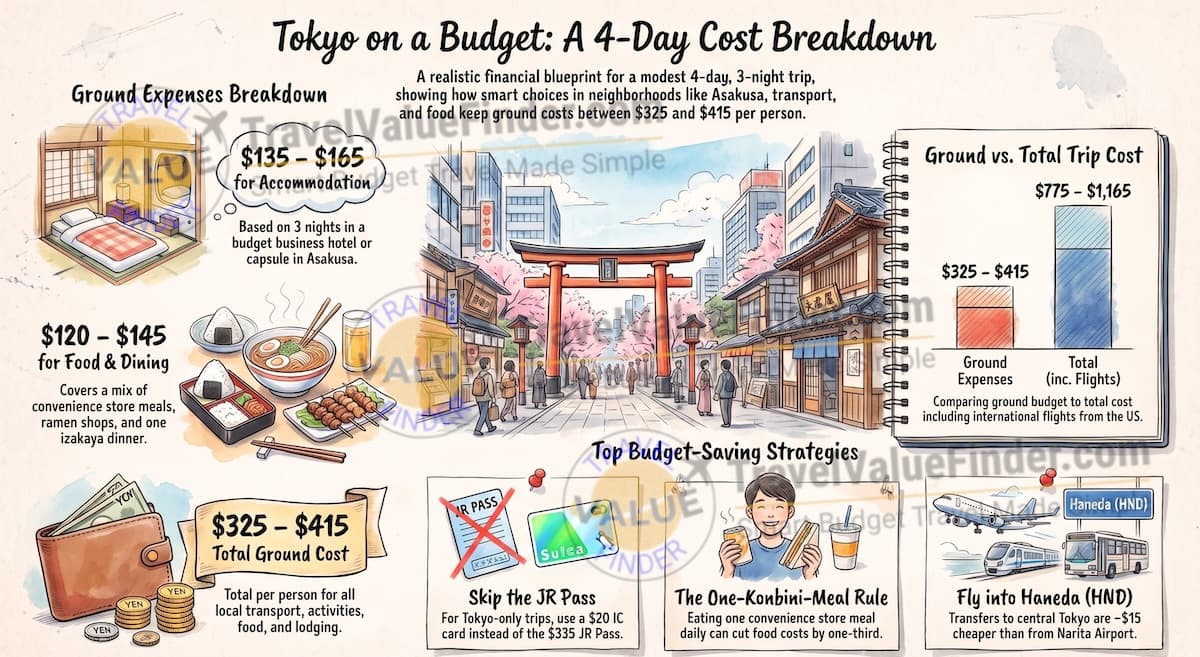
How much does 4 days in Tokyo cost on a modest budget? Roughly $325–$415 per person on the ground (accommodation, food, transport, and activities), or $775–$1,165 including round-trip flights from the US. Skipping the JR Pass and eating at konbini stores once a day are the two biggest cost levers.
Four days in Tokyo on a modest budget costs roughly $325 to $415 per person on the ground (3 nights, excluding international flights) if you stay in a clean budget hotel or capsule room near Asakusa or Ueno, eat a mix of konbini meals and casual restaurants, buy a rechargeable IC card instead of a JR Pass, and build your days around Tokyo’s genuinely excellent free attractions.
Add a round-trip flight from the US, and a realistic 4-day Tokyo budget lands between $775 and $1,165 total. I tracked every yen of my own trip to get these numbers, and below is exactly where it went, day by day, plus what I’d change next time.
Hi, I’m Leslie Nics, founder of TravelValueFinder.com – a travel resource built on real trips, honest research, and a serious passion for getting the most out of every destination without overpaying. I’ve spent weeks exploring Tokyo across multiple visits, from my first disorienting arrival at Shinjuku Station to solo late-night ramen crawls in Golden Gai. Every recommendation in this guide comes from boots-on-ground experience, cross-checked with top sources including the Japan National Tourism Organization and japan-guide.com. My goal: give you the insider knowledge that turns a good Tokyo trip into an unforgettable one. Updated July 2026
What 4 Days in Tokyo on a Modest Budget Actually Costs (Quick Answer)
Most Tokyo itinerary posts either give you a pretty day-by-day plan with no real numbers, or a cost breakdown with no itinerary to hang it on. This guide gives you both, cross-checked against real 2026 pricing. Here’s the quick snapshot before we get into the day-by-day detail:
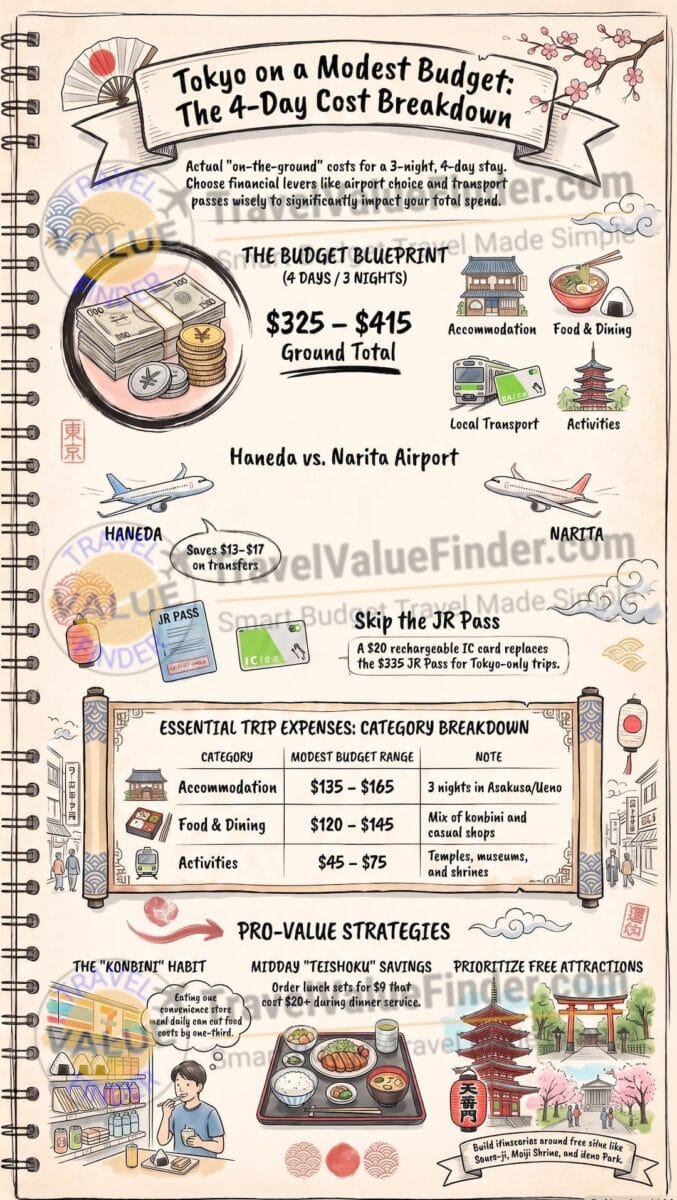
| Category | Modest Budget (4 Days / 3 Nights) | Notes |
| Accommodation (3 nights) | $135 – $165 | Budget hotel or capsule, Asakusa/Ueno area |
| Food (4 days) | $120 – $145 | Mix of konbini, ramen shops, one izakaya dinner |
| Local transport | $25 – $30 | IC card (Suica/PASMO), no JR Pass needed |
| Attractions & activities | $25 – $45 | Mostly free temples/shrines + 1–2 paid extras |
| Misc. (eSIM, contingency) | $20 – $30 | Data, coin lockers, small buffer |
| Ground total (excl. flights) | $325 – $415 | Per person |
| Round-trip flights (US) | $450 – $750 | Varies by coast and booking window |
| Grand total (4 days, all-in) | $775 – $1,165 | Per person, modest budget tier |
I didn’t want a trip that looked cheap on paper and felt cheap in person. Four days in Tokyo on a modest budget still got me conveyor-belt sushi, a night in Shinjuku’s neon glow, and a sunrise walk through Meiji Shrine that cost nothing at all. – Leslie Nics, TravelValueFinder.com
Before You Land: What I Booked and Why
A 4-day Tokyo trip is short enough that some of the standard Japan advice doesn’t actually apply to it – and getting this part wrong is where most budgets quietly blow up. Here’s what I booked and skipped:
- Airport: I flew into Haneda (HND), not Narita. The transfer into central Tokyo costs $3–$4 by monorail versus $17–$21 from Narita on the Skyliner or Narita Express – a difference that adds up fast on a short trip.
- JR Pass: I skipped it entirely. The 7-day Ordinary JR Pass runs about $335, and it only pays for itself if you’re taking multiple long-distance Shinkansen trips between cities. For a Tokyo-only trip, you never touch a bullet train, so the pass is pure waste. This is one of the most common overspends I see in other Tokyo itinerary write-ups.
- IC Card: I loaded ¥3,000 (about $20) onto a Suica card at the airport and topped it up once. It works on every subway line, most buses, and convenience store purchases – tap in, tap out, done.
- eSIM: A 4-day Japan eSIM cost me about $8–$10 through Airalo, installed before I landed. Non-negotiable for navigating the subway system.
- Travel insurance: I bought a short-trip policy before departure. Japan’s hospitals are excellent but not cheap for foreigners without coverage – see my full travel insurance guide for how to pick one.
Where I Stayed (and What a Modest Tokyo Budget Actually Buys)
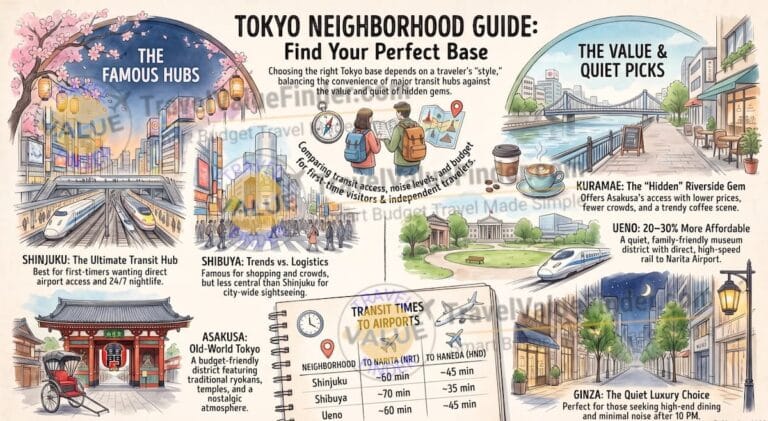
Accommodation is the single biggest lever in a 4-day Tokyo budget, and neighborhood matters more than star rating. I stayed in Asakusa – Tokyo’s old town, built around Senso-ji Temple – because it’s consistently 20–30% cheaper than Shinjuku or Ginza for equivalent quality, while still sitting on a direct subway line to everywhere else on this itinerary.
| Room Type | Price / Night | Best For |
| Capsule hotel | $20 – $40 | Solo travelers who want the novelty and don’t mind close quarters |
| Hostel private room | $35 – $55 | Couples or friends splitting a room |
| Budget business hotel (Toyoko Inn, Super Hotel) | $45 – $65 | Anyone who wants a private bathroom and reliable quiet |
| Mid-range 3-star | $80 – $130 | A step up if you want to stretch the budget slightly |
I booked a business hotel room in Asakusa for $52/night – three nights came to $156, right in the middle of the modest-budget range. Compare hotel prices for your dates through our trusted hotel search partner, or read the full Best Hotel Booking Sites guide for how to compare across platforms before you book.
Day 1: Arrival, Asakusa and Senso-ji (Half Day)
Most 4-day Tokyo itineraries treat arrival day as a write-off. I didn’t waste it. After landing at Haneda in the early afternoon and checking into my Asakusa hotel, I had about four hours of daylight left – enough for the single best free introduction to Tokyo I could imagine.
Senso-ji Temple, Tokyo’s oldest, sits at the end of Nakamise-dori, a shopping street lined with small vendors selling rice crackers and folding fans. Neither the temple grounds nor the walk cost anything. I picked up a small snack from a street stall, wandered until the lanterns lit up at dusk, and had a convenience-store dinner back near the hotel – deliberately simple, since jet lag makes decision fatigue real.
| Day 1 Expense | Cost |
| Haneda → Asakusa transfer (monorail + subway) | $6 |
| IC card initial load (covers multiple days) | $20 |
| Senso-ji Temple & Nakamise-dori | Free |
| Street snack | $4 |
| Convenience store dinner | $7 |
| Day 1 total (excl. hotel) | $37 |
Day 2: Shibuya, Harajuku and Shinjuku (Full Day)
This is the day most people picture when they think of Tokyo, and it’s genuinely walkable as one loop: Harajuku in the morning, Shibuya at midday, Shinjuku at night.
Takeshita Street in Harajuku is free to wander, though the crepe stands and quirky shops will tempt you – budget $5–$8 if you want a snack. Meiji Shrine, a five-minute walk away, is a forested sanctuary in the middle of the city and costs nothing to enter.
For Shibuya Crossing, skip the $22 Shibuya Sky observation deck unless it’s a priority for you – the Tsutaya Starbucks overlooking the crossing gives you nearly the same view of the scramble for the price of a coffee. I finished the day in Shinjuku, ate at a small izakaya for dinner, and wandered the Golden Gai alleys without spending more than the price of one drink.
| Day 2 Expense | Cost |
| Konbini breakfast | $5 |
| Subway day pass | $6 |
| Meiji Shrine | Free |
| Harajuku crepe | $5 |
| Ramen lunch | $9 |
| Shibuya Crossing view (coffee, not the paid deck) | $4 |
| Izakaya dinner in Shinjuku | $16 |
| Day 2 total (excl. hotel) | $45 |
Day 3: Ueno, Akihabara and a Smart Splurge Decision
Day 3 is where a 4-day Tokyo budget usually gets decided, because this is the day with the tempting paid attraction: teamLab Planets, Tokyo’s immersive digital art museum, at roughly $27 per ticket. It’s genuinely excellent, but it’s also optional – and on a modest budget, optional is worth pausing on.
I chose the free-first route: Ueno Park in the morning (cherry blossoms or not, it’s a pleasant walk), the Tokyo National Museum for $7, then Akihabara’s Electric Town in the afternoon, which costs nothing to browse. If you have room in your budget and it’s a priority for you, swap the museum for teamLab and add about $20 to the day – I’d rather you make that call with the real number in front of you than skip it or overspend by accident.
| Day 3 Expense | Cost (Free-First Route) |
| Konbini breakfast | $5 |
| Subway | $6 |
| Ueno Park | Free |
| Tokyo National Museum | $7 |
| Teishoku set lunch | $9 |
| Akihabara Electric Town | Free |
| Conveyor-belt sushi dinner | $13 |
| Day 3 total (excl. hotel) | $40 |
| Optional: swap museum for teamLab Planets | +$20 |
Day 4: Tsukiji Outer Market, Ginza and Departure
The Tsukiji Outer Market – not to be confused with the relocated wholesale fish market – is where I spent my last morning, grazing on grilled skewers, tamagoyaki, and fresh sashimi from street stalls for less than a sit-down breakfast would cost at home.
From there it’s a short walk to Ginza, Tokyo’s upscale shopping district, which costs nothing to window-shop, and the Imperial Palace East Garden, a genuinely underrated free green space most 4-day itineraries skip entirely.
| Day 4 Expense | Cost |
| Tsukiji Outer Market breakfast (street food tasting) | $12 |
| Subway | $5 |
| Ginza window shopping | Free |
| Imperial Palace East Garden | Free |
| Light lunch before airport | $9 |
| Asakusa → Haneda transfer | $6 |
| Day 4 total (excl. hotel) | $32 |
My Real 4-Day Tokyo Budget: Every Dollar Added Up
Add the four daily totals to accommodation and the one-time extras, and here’s what my actual 4 days in Tokyo on a modest budget looked like, side by side with the range you should plan for if prices shift slightly by the time you travel:
| Category | What I Spent | Realistic Range |
| Accommodation (3 nights) | $156 | $135 – $165 |
| Day 1 (arrival, IC card, Asakusa) | $37 | $30 – $45 |
| Day 2 (Shibuya/Harajuku/Shinjuku) | $45 | $35 – $55 |
| Day 3 (Ueno/Akihabara, free-first) | $40 | $32 – $60 |
| Day 4 (Tsukiji/Ginza/departure) | $32 | $28 – $38 |
| eSIM (4 days) | $9 | $8 – $12 |
| Contingency / souvenirs | $18 | $15 – $30 |
| Ground total (excl. flights) | $337 | $325 – $415 |
| Round-trip flight (US West Coast) | $540 | $450 – $750 |
| Grand total | $877 | $775 – $1,165 |
Every itinerary I read before this trip told me what to see. None of them told me what it would actually cost to see it. That gap is exactly what I built this breakdown to close. – Leslie Nics, TravelValueFinder.com
7 Ways I Kept My 4-Day Tokyo Budget Under Control
- Fly into Haneda, not Narita. The airport transfer alone saves $15–$20 round trip, and Haneda is closer to most budget-friendly neighborhoods.
- Skip the JR Pass for a Tokyo-only trip. It’s built for multi-city Japan trips. For four days inside Tokyo, a $20 IC card does everything you need.
- Eat one konbini meal a day. 7-Eleven, Lawson, and FamilyMart sell genuinely good onigiri, bento, and hot food for $3–$6. This single habit can cut a day’s food cost by a third.
- Order lunch sets, not dinner à la carte. A teishoku lunch set that costs $9 can be a $20+ dinner at the exact same restaurant. Eat your one ‘real’ restaurant meal at midday.
- Front-load the free attractions. Senso-ji, Meiji Shrine, Ueno Park, Akihabara’s streets, and the Imperial Palace East Garden are all free – and genuinely among Tokyo’s best experiences, not consolation prizes.
- Pick one paid splurge, not three. teamLab Planets, Shibuya Sky, and a kaiseki dinner are each wonderful. Doing all three on a modest budget is how a $400 trip becomes a $700 trip. Pick the one that matters most to you.
- Use a no-foreign-transaction-fee card. Standard bank cards charge 2–3% on every purchase abroad. A no-fee travel card closes that leak automatically – see our broader budget travel tips for more ways this adds up across a trip.
What I’d Do Differently Next Time
Honest self-critique, because that’s more useful than pretending the trip was flawless:
I underestimated how much time Tokyo’s train transfers eat, even with an IC card – build in 30–45 minutes of buffer between neighborhoods, not the 15 minutes Google Maps optimistically suggests. I’d also move the Tsukiji Outer Market visit to Day 1 or 2 instead of the departure morning, since the best stalls sell out of their best items by late morning and a jet-lagged first morning is actually perfect for an early market visit.
And I’d book the hotel one subway stop further from central Asakusa – I found nearly identical quality for $8 less per night just two stops out.
The mistake isn’t spending money in Tokyo. It’s spending it on the wrong day, when jet lag or exhaustion means you’re not actually present for what you paid for. – Leslie Nics, TravelValueFinder.com
Plan the Rest of Your Trip
This guide covers a focused 4-day Tokyo budget. If your trip is longer, covers more of Japan, or you want the supporting logistics sorted, these guides go deeper:
- How Much Does It Cost to Visit Japan? 2026 Budget Guide – the full country-wide breakdown if you’re adding Kyoto, Osaka, or Hiroshima
- What 4 Days in Tokyo on a Modest Budget Actually Costs: My Full Breakdown
- 25 Best Things to Do in Tokyo – for a longer list of options beyond this 4-day route
- Japan Travel Guide – the hub page for everything else on TravelValueFinder about Japan
- The Tokyo Neighborhood Every Guide Skips (And Why I’d Stay There Twice)
- How to Find Cheap Flights: 12 Proven Strategies – for booking the flight portion of this budget
- Essential Travel Packing List – what to actually pack for a short, walking-heavy Tokyo trip
- Solo Travel Tips for First-Timers – Tokyo is one of the safest, easiest cities in the world to visit alone
- Travel Insurance Guide – what to buy before any international trip
Ready to plan the trip itself? Use our Free AI Trip Planner to build a day-by-day Japan itinerary, and don’t miss our How to Find Cheap Flights guide for strategies on getting affordable flights into Japan, Bangkok, Singapore, or Kuala Lumpur – the most common SEA gateway cities.
Ready to book? Compare real-time flight and hotel prices through our trusted search partner. We earn a small commission at no extra cost to you, which helps keep guides like this one free.
People Also Ask
Is 4 days enough for Tokyo?
Yes, for a first visit focused on central Tokyo. Four days is enough to comfortably cover Asakusa, Shibuya, Harajuku, Shinjuku, Ueno, and Ginza without rushing. It is not enough to add day trips to Kyoto, Hakone, or Mount Fuji – those need extra days or a separate trip.
How many days do you need in Tokyo total?
Most travelers are comfortable with 4–5 days for Tokyo alone, or 3 days if combining it with other Japanese cities on a longer trip. Under 3 days feels rushed given the city’s size and train transfer times.
Is Tokyo cheaper than Paris or London?
On a modest budget, Tokyo is often cheaper day-to-day than Paris or London, mainly because of konbini food culture and the weak yen’s effect on USD purchasing power in 2026. Accommodation is comparable; food and local transport tend to run lower in Tokyo.
Do I need a JR Pass for a Tokyo-only trip?
No. The JR Pass is designed for multi-city Japan itineraries involving Shinkansen bullet trains. For a Tokyo-only trip, a Suica or PASMO IC card covers subway, bus, and even convenience store payments for a fraction of the cost.
Frequently Asked Questions
How much cash should I bring for 4 days in Tokyo?
Budget around $30–$45 in cash per day as a baseline, even though Tokyo is increasingly card-friendly. Small restaurants, shrine donation boxes, and some vending machines are still cash-only.
What’s the cheapest way to get from the airport to central Tokyo?
The Haneda Airport monorail or Keikyu Line, at $3–$4 one way, is the cheapest reliable option. From Narita, the budget bus at roughly $9 beats the Skyliner or Narita Express on price, though it takes longer.
What’s the best neighborhood to stay in on a modest budget?
Asakusa and Ueno consistently offer the best value for equivalent quality compared to Shinjuku, Shibuya, or Ginza, while remaining well connected by subway to everywhere on a typical 4-day itinerary.
Is Tokyo safe for budget travelers, including solo travelers?
Yes. Tokyo is consistently ranked among the safest major cities in the world for solo and budget travelers alike, with low street crime and an exceptionally reliable public transport system, even late at night.
Will prices in this guide change?
Yes – exchange rates, attraction pricing, and transport fares shift over time. The figures here reflect 2026 pricing at the time of research and are cross-referenced against multiple current sources listed below.
Sources
- Japan National Tourism Organization (JNTO) – official Japan tourism board, transport and attraction guidance
- Tokyo Metro (official English site) – subway fares, passes, and route planning
- Numbeo Cost of Living Index: Tokyo – crowdsourced local pricing data
- japan-guide.com – independent, long-established English-language Japan travel reference
- U.S. Department of State: Japan Country Information – entry requirements and travel safety information
Disclaimer: This article contains affiliate links. When you book through our hotel and flight search, TravelValueFinder may earn a small commission at no extra cost to you. Prices are estimates based on research at time of publication and can vary by season, exchange rate, and booking window.
About the Author
Leslie Nics is the founder and primary travel researcher at Travel Value Finder. He specializes in budget travel, destination research, and itinerary planning, drawing on firsthand travel experience across multiple regions – including this Tokyo trip – to help readers find affordable and practical travel options. Read more on the About page or see the site’s Trust & Transparency Policy.