Travel Value Finder

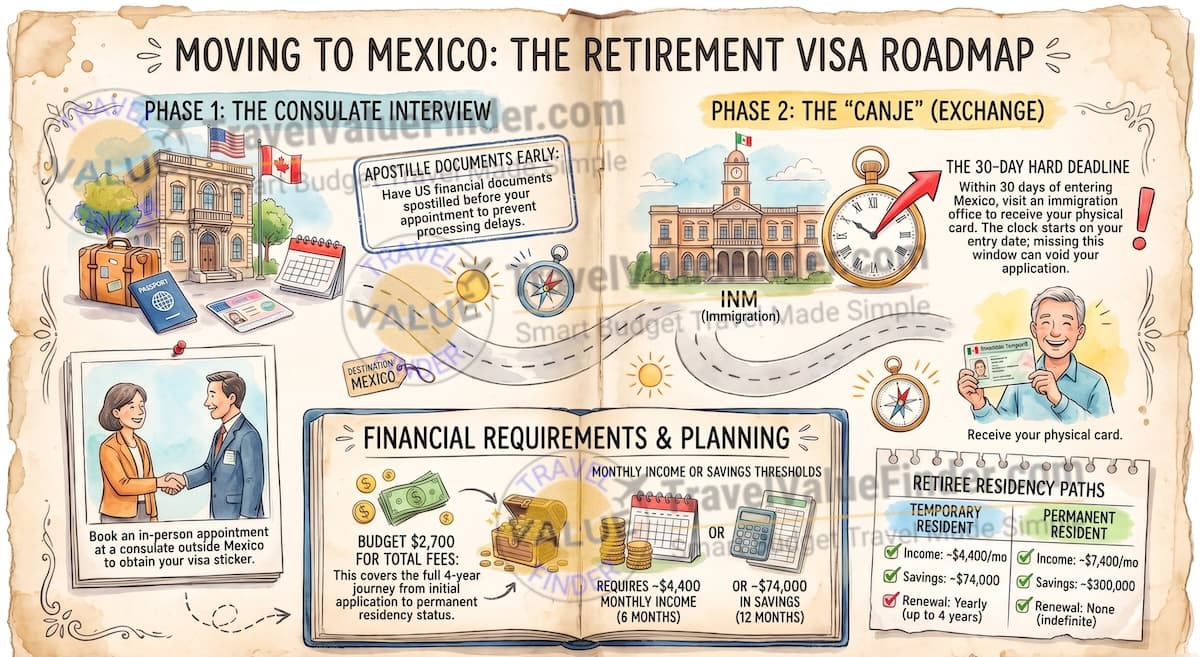
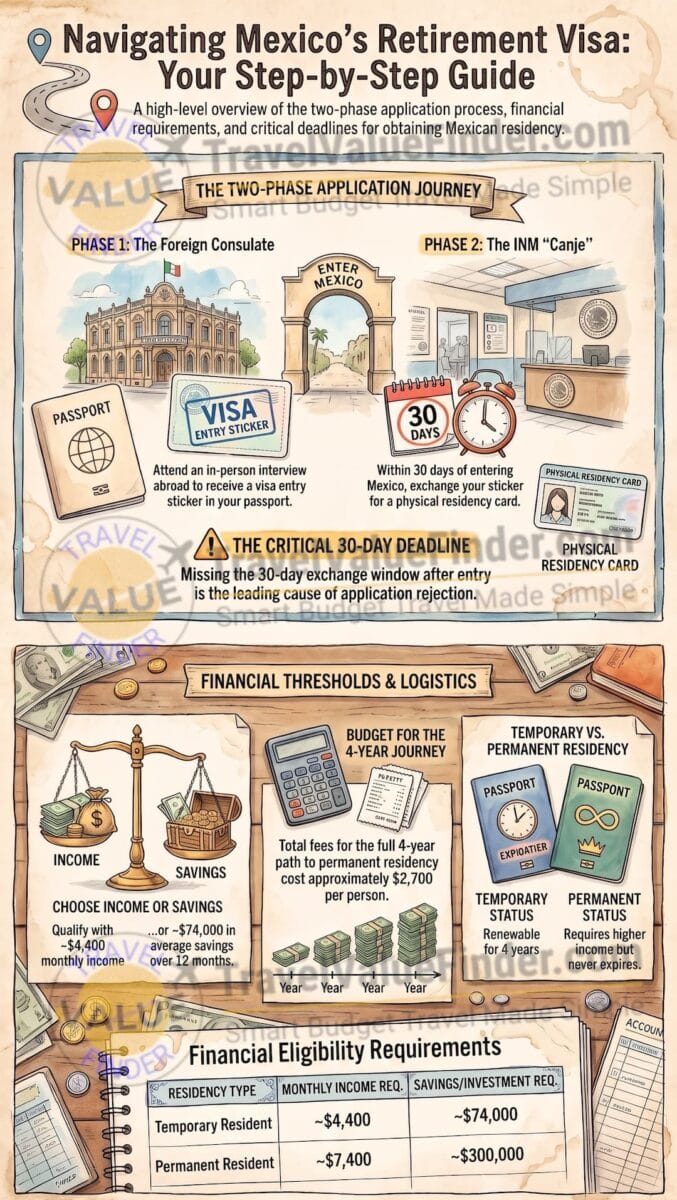
The Mexico retirement visa is really the Residente Temporal – a two-phase process: apply at a Mexican consulate in the US (producing a 180-day entry sticker), then complete the canje at a Mexico INM office within 30 days of arrival to receive the physical card. As of 2026, it requires proof of roughly $4,400/month in income or $74,000 in savings, and total fees across the full 4-year journey run close to $2,700 per applicant.
Leslie Nics, TravelValueFinder.com | Last updated: July 2026 | Last Reviewed: July 31, 2026
Search for a Mexico retirement visa and you’ll find plenty of guides listing the income threshold and calling it done. What most of them skip is the part that actually derails applications: this is a two-phase process split between a US consulate and a Mexican immigration office, with a hard 30-day deadline in between that a meaningful share of first-time applicants miss.
Mexico doesn’t have a visa literally labeled “retirement visa.” Nearly every American retiree instead uses the Residente Temporal (Temporary Resident) visa, qualifying through income or savings rather than age. This is the version built around the two-phase mechanics and the mistakes that actually cause delays, not just the headline income number.
The Two-Phase Process, in the Order It Actually Happens
Phase 1: The Consulate (outside Mexico).
- Book an appointment at a Mexican consulate in your home country (or wherever you’re legally present) – this cannot be done online or by mail.
- Bring proof of income or savings (6 months of statements for income, 12 months for savings), a valid passport, and the completed application form.
- Attend the in-person interview. If approved, the consulate places a visa sticker in your passport – this is not your residency, it’s permission to enter Mexico to complete residency.
Phase 2: INM – Instituto Nacional de Migración (inside Mexico).
- Enter Mexico within 180 days of the visa sticker’s issuance.
- Within 30 calendar days of entry, complete the canje (exchange) at your local INM office: a second application, biometrics, and payment of the card issuance fee.
- Receive your physical Temporary Resident card, typically within 2–4 weeks of the biometrics appointment.
Red Flag: The 30-day canje deadline is where most preventable rejections happen. It is calculated from your entry date, not your visa sticker’s issue date, and it does not pause for a slow-moving move, a delayed shipment, or a holiday closure at your local INM office. Book your canje appointment as early as your entry date allows.
How Much Income Actually Qualifies
| Visa Type | Monthly Income Requirement | Savings Alternative | Length of Stay |
| Temporary Resident | ≈ $4,300–$4,400/month (after-tax, prior 6 months) | ≈ $73,000–$74,000 average balance (prior 12 months) | 1 year initial, renewable to 4 years cumulative |
| Permanent Resident | ≈ $7,400/month | ≈ $300,000 in savings/investments | Indefinite – no renewals required |
You only need to clear one path, income or savings, and married applicants where only one spouse qualifies can typically sponsor the other with an additional $500–$1,300/month in documented income.
Both paths are recalculated annually using the UMA (Unidad de Medida y Actualización), an inflation-linked index that replaced the old minimum-wage-based calculation in mid-2025 – a change that pushed thresholds meaningfully higher than the figures many 2023–2024 sources still cite.
What This Actually Costs, Fee by Fee
| Fee | Amount |
| Consulate visa application (Phase 1) | ≈ $51–$54 per applicant |
| Initial Temporary Resident card (1 year, at INM) | ≈ MXN 5,570 (≈ $312) |
| Renewal, 2-year card | ≈ MXN 8,347 (≈ $468) |
| Renewal, 4-year card | ≈ MXN 12,529 (≈ $703) |
| Conversion to Permanent Resident | ≈ MXN 1,847 + MXN 13,579 card (≈ $866 total) |
| Legal/immigration facilitator support (optional) | $500–$2,000+ |
None of these individually are large, but the full 4-year journey to permanent residency runs close to $2,700 per applicant across every stage – worth budgeting as its own line item well before the income threshold itself comes into play.
Full Document Checklist
| Document | Notes |
| Valid passport | Should remain valid at least 6 months beyond your intended stay |
| Proof of income or $74,000+ in savings | 6 months of bank/pension statements for income; 12 months for savings |
| Completed consulate application form | Available from your specific consulate’s website – forms vary slightly by post |
| Passport photographs | Standard biometric requirement, specifications vary by consulate |
| Proof of Mexican address | Needed for the INM canje stage, not always required at the consulate stage |
| Apostilled Social Security/pension documentation | Recommended for US-sourced retirement income to avoid clarification requests |
| Consulate fee payment | Cash only at most posts – confirm accepted payment method in advance |
One genuine point of contrast worth flagging against this site’s Greece and Portugal visa guides: Mexico’s Temporary Resident visa does not require proof of private health insurance as part of the application itself, unlike Greece’s FIP permit. That doesn’t mean health coverage is optional in practice – see this cluster’s cost-of-living page for why most retirees still get it – it simply isn’t a document INM or the consulate will ask for.
Renewal: What Changes After the First Card
The initial Temporary Resident card is valid for 1 year. Renewals can be granted for 1, 2, 3, or 4 years at INM’s discretion, up to a cumulative maximum of 4 years total as a temporary resident. Unlike some comparable visas elsewhere, Mexico does not require re-proving economic solvency at every single renewal in most cases – though consulate and INM practice varies, and applicants should confirm current requirements with their specific office before assuming continuity.
The mistake I’d guard against isn’t the paperwork on day one – it’s assuming the rules that applied at your first appointment will still apply at renewal. Consulate discretion is real, and it shifts. – Leslie Nics, Founder & Lead Travel Writer, TravelValueFinder.com
The Path Beyond: Permanent Residency and Citizenship
After 4 cumulative years as a Temporary Resident, holders become eligible to apply for Permanent Residency – typically without needing to re-prove economic solvency at that stage, since the years of continuous legal residency themselves satisfy the requirement. Permanent Residency has no expiration and does not need to be renewed.
Mexican citizenship becomes a realistic option after 5 years of legal residency (2 years for spouses of Mexican citizens), though it requires a Spanish-language and civics exam – a meaningfully higher bar than simply maintaining residency status. Many retirees never pursue citizenship at all and are content to renew Permanent Residency indefinitely, which the program explicitly allows.
Temporary Resident vs. Permanent Resident: Which One Actually Fits Retirement Plans
These two get compared constantly, and the mechanical difference matters more than the headline income gap. Temporary Resident status is renewed periodically against a capped 4-year total and lower financial thresholds – a lower barrier to entry, with a defined eventual conversion point. Permanent Resident status requires clearing a much higher income or savings bar upfront but then never needs renewal at all.
| Temporary Resident | Permanent Resident | |
| Income threshold | ≈ $4,400/month | ≈ $7,400/month |
| Savings threshold | ≈ $74,000 | ≈ $300,000 |
| Renewal required? | Yes, up to 4 years cumulative | No – indefinite |
| Best for | Retirees easing into the decision, or below the higher PR threshold | Retirees certain about staying long-term, clearing the higher bar comfortably |
Map Out Your Mexico Retirement Numbers
- Use our Free Retirement Cost of Living Calculator – get your personalized report in 30 seconds – Free PDF download.
- How to Use a Retirement Cost of Living Calculator – to Compare Cities Worldwide
What I’d Prepare Differently
I’d apostille every piece of US-sourced financial documentation before the consulate appointment rather than after a reviewer asks a clarifying question – chasing an apostille from abroad after a delay costs far more time than doing it upfront.
I’d also book the INM canje appointment the same week I enter Mexico, not after I’m settled into an apartment and dealing with movers, furniture, and a new city. The 30-day clock doesn’t care that unpacking took longer than expected.
Everyone prepares carefully for the consulate interview and then treats the 30-day Mexican side of this as an errand they’ll get to. It’s the half of the process most likely to actually go wrong. – Leslie Nics, Founder & Lead Travel Writer, TravelValueFinder.com
Find Out More About Retiring in Mexico
- Retire in Mexico – What Nobody Tells You About Retiring in Mexico: 5 Things I’d Do Differently
- Mexico’s Retirement Visa, Explained: What I’d Actually Prepare Before Applying
- Cost of Living in Mexico: What Retiring in Mexico Really Costs, Category by Category
- Best Places to Retire in Mexico: Which City Actually Fits You
- Where to Stay in Mexico City
You May Be Interested In
- France Retirement Visa Explained: How I’d Plan It After 55
- Portugal D7 Visa
- Spain Non-Lucrative Visa
- Greece’s FIP Visa, Explained: What I’d Actually Prepare Before Applying
- Retirement Cost of Living Calculator
People Also Ask
How much income do I need for Mexico’s retirement visa?
Roughly $4,300–$4,400/month in passive or pension income for the Temporary Resident visa, or about $73,000–$74,000 in savings, either path qualifies, not both.
Why do Mexico visa applications get delayed?
The 30-day canje deadline at INM after entering Mexico is the most common source of delay – it’s a hard window that doesn’t extend for moving logistics, and missing it can jeopardize the application.
How long does the Mexico Temporary Resident process take?
Typically 2–4 months total: consulate processing runs about 10 working days, followed by 2–4 weeks for INM to issue the physical card after biometrics.
Can I lose my Mexico residency status?
Yes, failing to complete the 30-day canje, letting a renewal lapse, or no longer meeting financial requirements at a discretionary renewal check can all put status at risk.
FAQ
Do I need a lawyer to apply for Mexico’s retirement visa?
It’s not required, but many applicants use an immigration facilitator specifically to avoid documentation and timing mistakes, given how much of the process hinges on the 30-day deadline.
Can my spouse be included on my application?
Yes, spouses can apply jointly, and if only one spouse meets the income threshold, they can typically sponsor the other with additional documented income.
Is the Mexico retirement visa the same as the Permanent Resident visa?
No, Temporary Resident is the lower-threshold, renewable option most retirees start with; Permanent Resident requires a much higher income or savings bar but never needs renewal.
What happens if I miss the 30-day canje deadline?
You risk having to restart the process from the consulate stage. Book the INM appointment as early as possible after entering Mexico rather than treating the 30 days as a comfortable buffer.
Does the Mexico retirement visa let me work?
Temporary Residents can generally work remotely for foreign employers or clients; working for a Mexican employer requires a separate work-authorized permit category.
Sources
- Instituto Nacional de Migración (INM) – official residency requirements
- Secretaría de Relaciones Exteriores (SRE) – consulate visa procedures
- U.S. Department of State – Mexico Travel Advisory
About the Author
Leslie Nics is the founder and primary travel researcher at Travel Value Finder. He specializes in budget travel, destination research, and itinerary planning, drawing on firsthand travel experience to help readers find affordable and practical travel options. Read more on the About page or see the site’s Trust & Transparency Policy.