Travel Value Finder

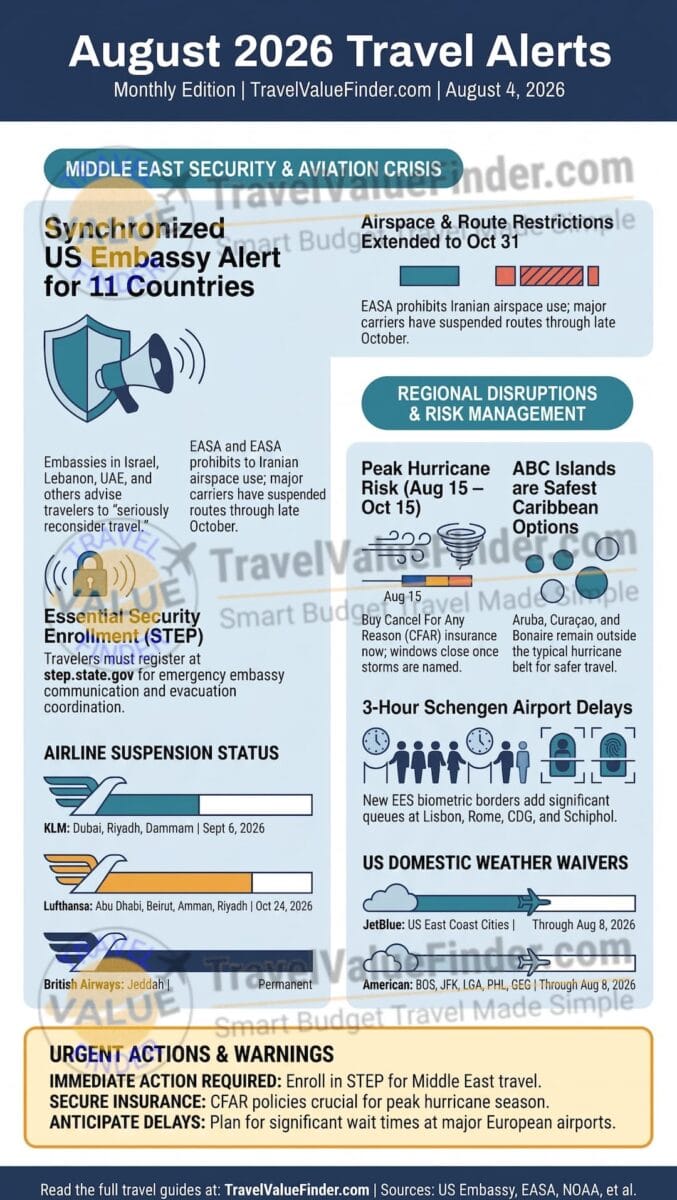
August 2026 Travel Alerts: US Embassy Warnings Across 16 Countries, Middle East Flight Crisis & Peak Hurricane Season. Is it safe to travel to the Middle East in August 2026? On August 1, 2026, US Embassies across eleven Middle East countries – Israel, Lebanon, Iraq, Oman, UAE, Saudi Arabia, Bahrain, Qatar, Kuwait, Egypt, and Jordan – issued synchronized emergency security alerts, warning Americans to exercise heightened vigilance and be prepared for flight cancellations, periodic airspace closures, and potential travel disruptions.
Americans in the region were advised to ‘consider departing, or be prepared to depart should there be escalation.’ Americans outside the region were advised to ‘seriously reconsider travel to and through the region.’
Multiple major airlines have extended flight suspensions to key Middle East destinations through September or October 2026: KLM to Dubai, Riyadh, and Dammam until September 6; Singapore Airlines to Dubai until October 24; Lufthansa to multiple destinations until October 24; British Airways has permanently suspended Jeddah. Emirates, Qatar Airways, and Etihad continue to operate on modified schedules.
The situation is described as rapidly evolving – check your specific flight status directly with your airline before any Middle East departure.
By Leslie Nics | Founder & Travel Value Expert, TravelValueFinder.com | Published: August, 2026
August 2026 opens with the most significant synchronized security alert the US Embassy network has issued since the early days of the Ukraine conflict – and for travelers with Middle East itineraries, the situation is both urgent and still evolving.
On August 1, 2026, US Embassies across eleven Middle East countries issued near-identical emergency security alerts within a 24-hour window, warning Americans of a ‘complex and fluid’ security environment, flight cancellations, periodic airspace closures, and the very real possibility of further escalation driven by heightened US-Iran tensions.
This follows months of aviation disruption that began on February 28, 2026, when large-scale US and Israeli strikes on Iranian military targets triggered immediate airspace closures across the UAE, Qatar, Iran, Iraq, Kuwait, Bahrain, and Jordan, stranding tens of thousands of passengers and grounding more than 1,800 flights at Middle East hub airports in a single day.
While Gulf carriers have partially restored schedules, European and Asian airlines continue to extend their suspension dates – with some now pushed to late October 2026.
Simultaneously, August is the opening of hurricane season’s most dangerous window. NOAA and CSU both identified mid-August through mid-October as peak risk. And for US domestic travelers, East Coast severe weather triggered active airline waivers from JetBlue and American Airlines this week. Here is everything you need to know to protect your August 2026 travel plans.
Alert #1 – US Embassy Emergency Warnings: 16 Countries, One 24-Hour Window
When eleven US Embassies across the Middle East issue near-identical security alerts in a single 24-hour window and tell Americans already in the region to ‘consider departing,’ that is not routine advisory language. That is the diplomatic equivalent of a siren. If you have Middle East travel booked in August or September, today is the day to verify your flight, review your travel insurance, and make a contingency plan. – Leslie Nics, TravelValueFinder.com
What Happened on August 1, 2026
Synchronized alert: On August 1, 2026, US Embassies across the Middle East issued nearly identical emergency security alerts within a 24-hour window. The alerts cover Israel, Lebanon, Iraq, Oman, the UAE, Saudi Arabia, Bahrain, Qatar, Kuwait, Egypt, and Jordan – eleven countries across the region. The text is consistent across all embassies: ‘Due to heightened tensions in the Middle East, the security environment remains complex with the potential for unforeseen escalation. Americans currently in the Middle East should exercise caution and heightened vigilance and should be prepared for flight cancellations, periodic airspace closures, and potential travel disruptions.’
The alerts also state that ‘some airlines in the region have postponed resumption of earlier flight schedules; others have cancelled some routes,’ and advise that Americans in the region ‘consider departing, or be prepared to depart should there be escalation.’ For Americans outside the region, both Embassy Cairo and Embassy Jerusalem specifically state: travelers ‘outside the Middle East should seriously reconsider travel to and through the region.’
This language – ‘seriously reconsider’ – sits below a formal Level 3 advisory upgrade on the State Department’s scale, but in diplomatic terms it is the strongest possible warning short of a formal Level 4 Do Not Travel. It is exactly the language that preceded the formal advisories issued at the start of the February 28 escalation.
The Aviation Disruption Backdrop: How We Got Here
The current warnings build on five months of compounding aviation disruption. The crisis began February 28, 2026, when large-scale US and Israeli military strikes on Iranian targets triggered immediate airspace closures across Iran, Iraq, Israel, Syria, Kuwait, and the UAE. More than 1,800 flights were cancelled by major Middle Eastern airlines on that single day, with Dubai, Abu Dhabi, and Doha airports closing temporarily. Airlines including Air France, Air India, Turkish Airlines, Norwegian, Lufthansa, Air Algérie, and dozens of others issued mass cancellations within hours.
The EASA (European Union Aviation Safety Agency) issued a Safety Information Bulletin advising European operators against flying through Iranian airspace at any altitude – a restriction that has been extended multiple times and currently runs through October 31, 2026. Safe Airspace’s conflict zone database notes that Iran partially reopened the eastern part of its Tehran FIR for overflights in June 2026, while the western part remained closed. As of early August, EASA’s advisory remains fully in effect.
| Airline | Routes Suspended / Modified | Current Suspension Until |
| KLM | Dubai, Riyadh, Dammam – all suspended | September 6, 2026 |
| Lufthansa | Abu Dhabi, Amman, Beirut, Dammam, Riyadh, Erbil, Muscat, Tehran | October 24, 2026 |
| Singapore Airlines | Dubai (SQ494/495 suspended) | October 24, 2026 |
| Finnair | Dubai (suspended); Doha (suspended – no resumption date) | October 24, 2026 |
| British Airways | Jeddah (permanently suspended); several Gulf routes paused | Jeddah: permanent. Others: ongoing review |
| Emirates | Iran, Iraq (Basra/Baghdad), Jordan (Amman) suspended; 75% of pre-conflict schedule restored | Iran/Iraq/Jordan: October 5. Beirut: October 8 |
| Qatar Airways | Operating modified schedule – some routes affected | Largely operating – check route status |
| Etihad Airways | Restoring network – partial suspensions remain | Largely operating – check route status |
| Gulf Air | 75% network restored; growing to full by phased approach | Largely operating – check route status |
IF YOU HAVE MIDDLE EAST TRAVEL BOOKED IN AUGUST OR SEPTEMBER 2026
1. CHECK YOUR FLIGHT STATUS NOW – directly with your airline, not a third-party app. Suspensions are being extended with short notice. Do not go to the airport without a confirmed operating flight.
2. STEP ENROLLMENT IS MANDATORY – register at step.state.gov before any Middle East travel so the nearest US Embassy can contact you in an emergency. This is especially critical given Embassy operational constraints in the current environment.
3. REVIEW YOUR TRAVEL INSURANCE – confirm your policy covers trip cancellation or interruption due to: (a) government security alerts, (b) airline route cancellations, (c) medical evacuation. If traveling as a non-US national, check your own government’s equivalent advisory.
4. HAVE AN EMERGENCY DEPARTURE PLAN – know your nearest operational airport and alternative routing options. The situation is described by embassies as ‘rapidly evolving’ – this means things can change within hours.
5. CONTACT YOUR AIRLINE FOR WAIVERS – most major carriers have active Middle East travel waivers. If your flight has been cancelled, you are entitled to a full cash refund or free rerouting. Do not accept a voucher only.
Sources: US Embassy Cairo – August 1, 2026 | US Embassy Jerusalem – August 1, 2026 | US State Department travel.state.gov
People Also Ask: Will connecting through Dubai or Doha be disrupted?
Emirates has restored approximately 75% of its pre-conflict schedule, and Etihad and Qatar Airways are largely operating. Dubai (DXB) and Doha (DOH) are currently functioning as transit hubs, though on modified schedules.
However, the August 1 Embassy alerts specifically state that ‘some airlines in the region have postponed resumption of earlier flight schedules’ – meaning the picture is changing week by week. Travelers connecting through Gulf hubs should verify their specific connecting flight status directly with Emirates, Etihad, or Qatar Airways at least 48 hours before departure and build buffer time into connections.
Gulf Air confirmed 75% network restoration and a phased approach to full recovery by a structured timeline. Do not book tight connections through Middle East hubs until the situation stabilises.
Alert #2 – East Coast Severe Weather: Active Airline Waivers for August 2–4
Separate from the Middle East situation, a severe weather system affecting the US East Coast has triggered active travel waivers from JetBlue and American Airlines this week – giving affected travelers a no-cost opportunity to reroute or reschedule.
JetBlue – East Coast Severe Weather Waiver (Active): JetBlue is waiving all change and cancel fees for customers traveling August 2–4, 2026 to or from East Coast affected cities. Customers may rebook for travel through August 8, 2026, online via the Manage Trips section of jetblue.com. Customers with cancelled flights may opt for a full refund to the original form of payment. Original travel must have been booked before August 2, 2026. Source: JetBlue Travel Alerts, August 2, 2026.
American Airlines – Northeast Corridor Waiver (Active): American Airlines has issued a weather waiver for customers booked on flights to or from Boston (BOS), New York Kennedy (JFK), New York LaGuardia (LGA), and Philadelphia (PHL) for travel on August 3, 2026. Customers may rebook in the same cabin for travel August 2–4, 2026. Changes must be made by August 3.
A separate waiver covers Spokane, Washington (GEG) for travel August 2–4, with rebooking options extended to August 2–8 and rerouting to Kalispell (FCA), Missoula (MSO), Pasco (PSC), Portland (PDX), or Seattle (SEA). Source: American Airlines Travel Alerts, August 2, 2026.
| How to Use an Airline Travel Waiver – Step by Step Step 1: Go to your airline’s official Travel Alerts page (jetblue.com/travel-alerts or aa.com travel alerts) and confirm your flight is covered by the active waiver. Step 2: Log into the airline’s website or app and navigate to ‘Manage Trips’ or ‘Find Your Trip.’ Most waivers can be applied self-serve – no phone call needed. Step 3: Select your new travel dates within the permitted window. If your preferred dates are not available online, call reservations and specifically reference the waiver code or alert number. Step 4: If your flight was outright cancelled: you are entitled to a full cash refund to your original payment method regardless of the ticket type – including Basic Economy. Do not accept a voucher if you want your money back. Step 5: If you incurred meals, accommodation, or transport costs due to a cancellation: file a duty-of-care claim with the airline. Keep all receipts. |
Alert #3 – Hurricane Season Peak Opens: The Month That Matters Most for Caribbean Travelers
August marks the opening of the statistically most dangerous period of the 2026 Atlantic hurricane season. NOAA and Colorado State University both identified mid-August through mid-October as the peak window – the point at which sea surface temperatures, low wind shear, and reduced dry air collectively create optimal conditions for storm development and intensification.
This year’s below-normal overall forecast does not eliminate August risk – it reduces probability across the full season, not within individual high-risk weeks.
| Peak Season Window | Risk Level | Caribbean Travel Guidance |
| Now – August 14 | MODERATE – ramping up | Below-average activity so far. Good value window. CFAR insurance essential for August 15+ bookings. |
| August 15 – October 15 | PEAK – Highest risk window | Statistically highest storm probability. CFAR insurance strongly recommended. ABC Islands (Aruba, Curaçao, Bonaire) lowest risk – outside typical hurricane belt. |
| October 15 – November 30 | MODERATE – tapering | Good late-season value. Late storms possible (cf. Hurricane Melissa, Oct 2025). Still buy CFAR. |
The single most actionable piece of advice for Caribbean travelers in August: if you have not yet purchased travel insurance with Cancel for Any Reason (CFAR) coverage for any travel between now and October 15, do so today – not next week.
Once a named storm is identified and tracking toward your destination, insurance providers close the window for new CFAR purchases. At that point, a standard policy will not cover voluntary pre-emptive cancellation and a CFAR policy can no longer be added. The window is open right now; it may not be next week.
Below-normal for the whole season still means above zero for every individual storm. One storm, the right destination, the wrong week – that is all it takes. The people who have CFAR sleep better in August. The ones who don’t check the weather obsessively and pray. – Leslie Nics, TravelValueFinder.com
August 2026 Travel Alerts – Master Snapshot
| Alert | Status | Action Required |
| US Embassy – Middle East: 11 countries | URGENT – Aug 1 | Seriously reconsider Middle East travel. If in region: consider departing. Enroll STEP at step.state.gov. |
| Middle East Flights – KLM, Lufthansa, SIA, Finnair, BA | SUSPENDED | Check your specific flight status directly with your airline. Do not go to the airport unconfirmed. |
| EASA – Iranian Airspace Advisory | IN EFFECT to Oct 31 | EU carriers prohibited from Iranian airspace. Iran eastern FIR partially open – western remains closed. |
| JetBlue – East Coast Weather Waiver | ACTIVE Aug 2–4 | Rebook free through August 8 at jetblue.com/travel-alerts. |
| American Airlines – Northeast + Spokane Waiver | ACTIVE Aug 2–4 | Rebook free for BOS, JFK, LGA, PHL, GEG. See aa.com travel alerts. |
| Hurricane Season – Peak Window Opens | PEAK Aug 15–Oct 15 | Buy CFAR travel insurance NOW for Caribbean travel. Window closes when storm is named. |
| Ebola – DRC, Uganda, South Sudan | L4 DO NOT TRAVEL | US Title 42 entry screening: return via Dulles (IAD) or Houston (IAH) only. |
| EES Biometric Borders – Europe | ONGOING – 2–3 hrs | Add 2.5–3 hrs at Lisbon, Rome, CDG, Schiphol. Pre-register via EU Travel to Europe app. |
| ETIAS – EU Travel Permit | LAUNCHING Q4 2026 | Do NOT apply on any website yet. Monitor TravelValueFinder.com for official portal announcement. |
| US Measles Outbreak | 2,030+ cases, 40 states | Confirm two MMR doses before international travel. Check cdc.gov/measles for latest state data. |
People Also Ask
Can I still fly to Dubai in August 2026?
Emirates, Etihad, and Gulf Air continue to operate Dubai routes, with Emirates reporting approximately 75% of its pre-conflict schedule restored. However, the August 1 US Embassy alert advises Americans to be prepared for flight cancellations and airspace closures, and several European carriers (KLM until September 6, Lufthansa until October 24, Singapore Airlines until October 24) remain suspended on Dubai routes.
If you have a Dubai flight booked through a carrier that is operating – Emirates, Etihad, or a Gulf carrier – verify your specific flight status directly with the airline at least 48 hours before departure. If you are connecting through Dubai to a third destination on a European or Asian carrier, check whether your onward carrier is operating that segment.
What does the Embassy security alert mean for my travel insurance?
An Embassy security alert advising Americans to ‘seriously reconsider’ travel does not automatically trigger travel insurance payouts – but it may. The specific trigger language in your policy matters enormously. Many comprehensive travel insurance policies include coverage for ‘government-issued travel warnings’ or ‘travel advisories’ at or above a specified level.
A US State Department Level 3 advisory (Reconsider Travel) is typically the threshold for coverage to activate in such policies. If your policy includes this clause and the relevant country is upgraded to Level 3 or higher, trip cancellation or interruption benefits may apply.
Read your policy’s specific advisory language now – before the situation escalates – and call your insurer to confirm what level triggers coverage for your specific destination. CFAR (Cancel for Any Reason) coverage remains the most flexible option for situations like this.
Is Aruba safe during peak hurricane season in August 2026?
Aruba, Curaçao, and Bonaire – the ABC Islands – sit at approximately 15 degrees north latitude, well below the primary Atlantic hurricane development zone. Historically, all three islands are very rarely affected by hurricanes and are widely considered the safest Caribbean destinations for August-to-October travel.
There are no active storm threats to the ABC Islands as of August 4. They remain the most reliable value option for August–October Caribbean travel for travelers wanting to minimize hurricane weather risk.
Standard travel insurance (not necessarily CFAR) is still recommended for any Caribbean trip, as flights to the ABC Islands may be disrupted even when the islands themselves are unaffected if a storm is active elsewhere in the basin.
Leslie Nics’ 7-Point August 2026 Travel Action Plan
- Middle East travelers: check your flight status directly with your airline today – not via a third-party app. If your carrier has suspended your route, contact them immediately for a cash refund or rerouting. Do not go to any Middle East airport without a confirmed, operating flight.
- Enroll in STEP (step.state.gov) before any Middle East travel. This is the single most important action Americans traveling to a region under Embassy alert can take – it means the Embassy can contact you directly in an emergency and is how evacuation assistance is coordinated.
- Review your Middle East travel insurance policy this week. Confirm it covers: (a) trip cancellation due to government security alerts, (b) airline route cancellation, (c) medical evacuation. If it does not, contact your insurer now – before the situation potentially escalates further.
- East Coast US travelers: check JetBlue (jetblue.com/travel-alerts) and American Airlines (aa.com) for active waivers. If your August 2–4 flight is covered, rebook now – waiver windows close quickly.
- Caribbean travelers: buy CFAR travel insurance for any August 15–October 15 Caribbean trip today. Once a named storm is identified and tracking toward your destination, the CFAR window closes. Use Squaremouth (squaremouth.com) or InsureMyTrip to compare CFAR-eligible policies.
- If you have Europe travel this month: EES border queues at Lisbon, Rome Fiumicino, Paris CDG, and Amsterdam Schiphol continue to run 2–3 hours at peak. Arrive 2.5–3 hours early. Pre-register biometrics via the EU Travel to Europe app. Do not book connections under 3 hours after your first Schengen arrival.
- Subscribe to TravelValueFinder.com/travel-alerts for monthly updates. September’s edition will cover ETIAS launch news as Q4 approaches, the evolving Middle East aviation picture, and post-peak hurricane season wrap-up.
Sources
All data verified from primary authorities as of August 4, 2026:
- US Embassy Cairo – Security Alert August 1, 2026 | eg.usembassy.gov
- US Embassy Jerusalem – Security Alert August 1, 2026 | il.usembassy.gov
- US Department of State – Middle East Travel Advisories | travel.state.gov
- Travel Off Path – US Embassies Issue Urgent Security Alerts For 16 Countries (August 2, 2026) | traveloffpath.com
- The National (UAE) – Middle East Flights: Which Airlines Have Suspended Services (August 2, 2026) | thenationalnews.com
- New Arab – Which Airlines Have Suspended or Cancelled Middle East Flights? | newarab.com
- Radiant Global Logistics – Middle East Disruptions 2026 Tracker | radiantdelivers.com
- Safe Airspace – Conflict Zone & Risk Database: Tehran FIR | safeairspace.net
- EASA – Safety Information Bulletin: Middle East Airspace (valid through October 31, 2026) | easa.europa.eu
- Gulf News – Emirates Extends Flight Cancellations to Iran, Iraq, Jordan | gulfnews.com
- Associated Press – Middle East Airports Closed, Thousands Stranded (February 28, 2026)
- JetBlue – Travel Alerts: East Coast Severe Weather (August 2, 2026) | jetblue.com/travel-alerts
- American Airlines – Travel Alerts: Northeast Weather + Spokane (August 2, 2026) | aa.com
- NOAA – 2026 Atlantic Hurricane Season Outlook | noaa.gov
- Colorado State University – 2026 Atlantic Hurricane Season Forecast | tropical.colostate.edu
| Monthly Travel Alerts from TravelValueFinder.com – Next Edition: September 2026 The September edition will cover the ETIAS Q4 launch announcement as it becomes available, the post-peak hurricane season outlook, the evolving Middle East aviation recovery, and all other active global advisories. Subscribe free at TravelValueFinder.com/travel-alerts. Explore: TravelValueFinder.com/travel-alerts | /etias-europe-travel-permit-2026 | /europe-travel-tips | /travel-insurance-guide | /caribbean-hurricane-season | /flight-deals |
About the Author
Leslie Nics is the founder of TravelValueFinder.com and a travel value strategist with over a decade tracking global travel advisories, aviation disruption, and passenger rights.
All data in this article is sourced from primary authorities: US Embassy Cairo (August 1, 2026), US Embassy Jerusalem (August 1, 2026), US Department of State travel.state.gov, EASA Safety Information Bulletin (Middle East airspace), Safe Airspace conflict zone database, The National (UAE), New Arab, Radiant Global Logistics Middle East Disruptions tracker, JetBlue Travel Alerts (August 2, 2026), American Airlines Travel Alerts (August 2, 2026), NOAA, Colorado State University Tropical Weather Research Group, and Travel Off Path.
Conditions verified as of August 4, 2026.