Travel Value Finder

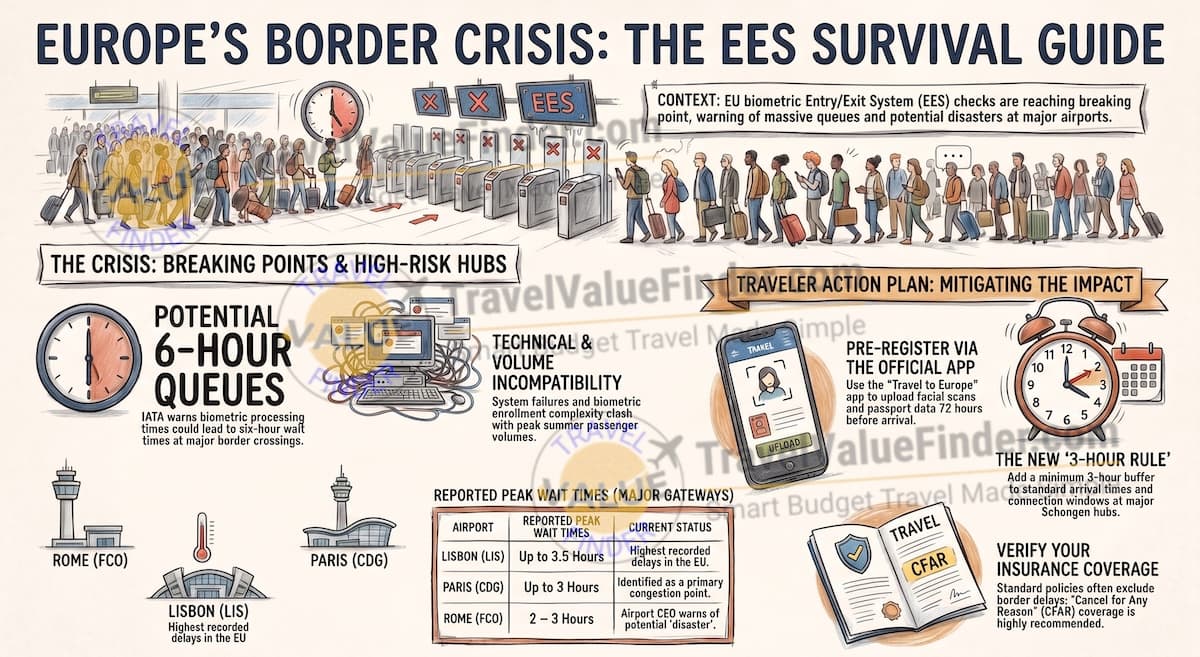
Will EES border checks be suspended in Europe this summer 2026? In reference to the Europe EES border crisis Summer 2026, The CEO of Aeroporti di Roma publicly warned on June 25–26, 2026 that Rome’s Fiumicino and Ciampino airports may suspend EU Entry/Exit System (EES) biometric checks during peak summer weeks to avoid ‘disaster.’ EES has not been formally suspended at Italian airports as of June 27 – but EU Regulation 2025/1534 permits member states to pause checks at individual border crossings for up to six hours at a time when queues become excessive.
Several airports have already applied checks inconsistently or paused them informally. IATA warns queues could reach six hours this summer. ACI Europe’s president Stefan Schulte has called on governments to ‘stop pretending’ EES is working and grant airports full flexibility to suspend checks. The European Commission insists the system is ‘fully operational and works well.’ The outcome for any individual traveler depends on which airport they land at and when. Until formal suspension guidance is issued, all non-EU travelers to Schengen countries should allow a minimum of three extra hours at major airports during the peak summer period.
By Leslie Nics | Founder & Travel Value Expert, TravelValueFinder.com | Published: June 28, 2026 | Updated Weekly
The European Union’s new biometric border system is heading toward a breaking point – and the CEO of Rome’s airports just said so publicly, on the record, in the Financial Times. If you have a flight to Europe this summer, what he said this week should go straight to the top of your travel planning checklist.
Marco Troncone, Chief Executive of Aeroporti di Roma – the company that operates Rome Fiumicino (FCO) and Rome Ciampino (CIA) – told the Financial Times on June 25, 2026 that his airports may be forced to suspend the EU’s Entry/Exit System (EES) biometric checks during the summer peak to avoid what he described, without ambiguity, as a ‘disaster.’ Asked to rate his concern on a scale of one to ten, he put it at ‘eight or nine.’ He added: ‘The process proves to be incompatible with the peak volumes that we are going to face. There is no way that we can deliver 100 per cent of the enrolment.’
This is not a minor operational complaint. It is the CEO of one of Europe’s busiest airport operators publicly warning that the EU’s flagship border security system cannot function at summer capacity – and that the only solution may be to quietly abandon it for weeks at a time. And Rome is not alone. The head of the entire European airport industry made the same call days earlier, IATA has warned that wait times could reach six hours, and a Ryanair flight from Athens has already departed without 20 to 50 passengers stuck in EES queues.
If you are flying to Italy, France, Spain, Portugal, Greece, or any other Schengen country this summer as a non-EU traveler – including all US, UK, Canadian, and Australian passport holders – this is the travel alert that matters most to you right now.
What Is Happening Right Now – and Why It Matters
When the CEO of Rome’s airports tells the Financial Times his concern is an eight or nine out of ten, and the president of Europe’s airport industry tells the BBC to ‘stop pretending’ the system is working – travelers need to listen. These are not social media complaints. These are the people operationally responsible for moving millions of passengers through Europe this summer. – Leslie Nics, TravelValueFinder.com
The Core Problem in Plain Language
EES requires that every non-EU traveler – on their first visit to the Schengen Area under the new system – submits ten fingerprints, a facial scan, and passport details at the border. This replaces the old passport stamp and takes several minutes per person under optimal conditions. At peak summer arrivals, with hundreds of passengers disembarking simultaneously from multiple long-haul flights, those minutes multiply into hours.
The specific technical failure making it worse: The automated self-service kiosks that were supposed to speed up EES processing are frequently not functioning as intended. ACI Europe president Stefan Schulte confirmed to the BBC that ‘not all the self-service booths work.’ Additionally, passengers who have already registered their biometrics on a previous EES crossing are often being forced to repeat the full registration from scratch due to system errors – adding first-time enrollment time to travelers who should be sailing through on a quick verification check.
Who Said What – the Authoritative Voices This Week
| Who | Role | What They Said |
|---|---|---|
| Marco Troncone | CEO, Aeroporti di Roma (Fiumicino + Ciampino) | ‘We are very worried for the summer. The process is incompatible with peak volumes. The only way is to open up the valve.’ Concern: 8–9/10. Described potential outcome as ‘disaster.’ |
| Stefan Schulte | President, ACI Europe; CEO, Frankfurt Airport operator | ‘Stop pretending… that the EES is working just fine.’ Called on politicians to grant airports ‘full flexibility’ to suspend EES. ‘I just do not know how we will be able to cope in the coming weeks.’ |
| Olivier Jankovec | Director General, ACI Europe | Confirmed kiosks are not working correctly. Said airports need ability to ‘fully suspend EES registration to cope with the summer peak.’ |
| IATA | International Air Transport Association | Warned queue times could reach SIX HOURS at some airports this summer. Recorded waits of up to 3.5 hours already. |
| European Commission spokesperson | EU executive body | ‘The EES is fully operational across all Schengen countries and works well.’ Long waits attributed to ‘pre-existing factors’ such as staffing shortages and flight concentration. |
What’s Already Happened – Real Traveler Impact
- A Ryanair flight from Athens to London departed without 20 to 50 passengers who were still stuck in EES passport control queues, as reported by Biometric Update citing Frontex and airline sources.
- Ryanair wrote formally to Italy’s interior minister citing waits of one to two hours or more at nine Italian airports, and calling for EES to be suspended until September.
- French border police temporarily suspended EES checks at the Port of Dover in May 2026 under the flexibility provision – the first such formal suspension by a member state.
- Greece announced it would suspend EES checks for British tourists, then reversed the decision within days after the foreign ministry said it had ‘no information that specific nationalities are temporarily exempt.’
- Some airports – including Pisa – have reportedly applied EES checks inconsistently, with some travelers reporting no checks at all on busy arrival days.
- Portugal announced 340 additional border police officers for airports from July 4 – a response driven directly by EES-related queue pressure.
What This Means for Your Summer Trip – Airport by Airport
The Honest Answer: Expect Inconsistency
The frustrating truth for travelers right now is that EES queue experience varies sharply between airports, between days, and even between different arrival times on the same day. EU Regulation 2025/1534 allows member states to pause EES checks at specific border crossings for up to six hours at a time when queues spike – and some airports have used this flexibility quietly, without announcement. Others have not.
This means the traveler arriving at Rome Fiumicino on a Tuesday afternoon in mid-July may sail through EES in twenty minutes, while a traveler arriving at the same airport on a Friday afternoon peak window may face a two-to-three-hour queue. There is currently no reliable public dashboard showing real-time EES queue status by airport and time.
| Airport | EES Status | Reported Peak Waits | Key Notes |
|---|---|---|---|
| Rome Fiumicino (FCO) | ACTIVE – may suspend | 2–3 hrs at peak | CEO described summer as potential ‘disaster.’ Suspension possible. Allow 3 hrs extra. |
| Rome Ciampino (CIA) | ACTIVE – may suspend | 1.5–2.5 hrs at peak | Same operator as FCO. Smaller airport – potentially faster but equally at risk. |
| Lisbon (LIS) | ACTIVE – worst in EU | Up to 3.5 hrs at peak | 340 extra police from July 4. Wizz Air advises 3 hrs early arrival. Pre-register via EU app. |
| Athens (ATH) | ACTIVE | 1.5–2 hrs at peak | Ryanair flight departed without passengers stuck in queues. High summer volume. |
| Paris CDG | ACTIVE | Up to 3 hrs at peak | ACI Europe cited CDG as key congestion point. Allow generous buffer. |
| Amsterdam Schiphol | ACTIVE | 1.5–2.5 hrs at peak | Schiphol recommending 3 hrs for international connections. |
| Madrid Barajas (MAD) | ACTIVE | 1–2 hrs at peak | AENA advising extra arrival time. Less severe than Italy/Portugal so far. |
| Pisa (PSA) | INCONSISTENT – informal pauses reported | Variable | Some travelers report no EES checks at all on certain arrival days. Inconsistency is itself a risk – do not rely on this. |
IF YOUR FLIGHT LEAVES PASSENGERS BEHIND DUE TO EES QUEUES – YOUR RIGHTS
This is the scenario Ryanair passengers from Athens experienced. If EES queues cause you to miss your departure flight, your rights depend on who caused the delay.
If the AIRLINE departed early before the standard boarding cut-off: contact the airline immediately for rebooking at no cost and duty of care (food, accommodation).
If you were still in the BORDER CONTROL QUEUE at the correct time and border processing caused the delay: the airline is typically not responsible under EU261. However, document everything – photograph the queue, get written confirmation of your queue time from a border officer if possible, and file a formal claim with your travel insurer.
CRITICAL: Cancel for Any Reason (CFAR) travel insurance is the best protection for EES-related trip disruption. Standard policies may not cover border control delays. Check your policy wording before you travel.
Source: EU Regulation 261/2004 | AirHelp Passenger Rights Guide
Your Complete Europe EES Border Crisis Summer 2026 Survival Guide
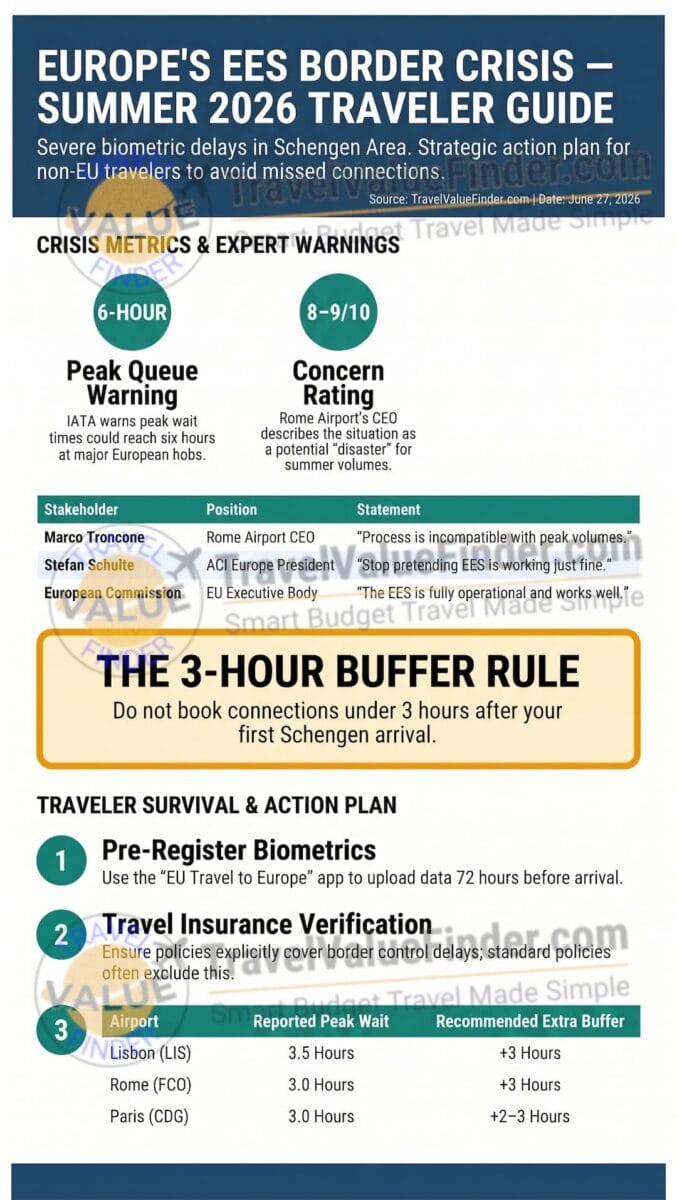
5 Actions to Take Before You Fly to Europe
- Pre-register your biometrics via the EU ‘Travel to Europe’ mobile app (Google Play / App Store). Available in Portugal and Sweden, rolling out across EU. Upload your facial photo and passport data up to 72 hours before arrival. This does not eliminate the in-person EES check but materially reduces processing time.
- Arrive earlier than you ever have before. The minimum recommended buffer at all major Schengen airports is 90 minutes above your normal allowance. At Lisbon, Fiumicino, Paris CDG, and Amsterdam Schiphol during July and August peak windows: arrive 3 hours earlier than you normally would.
- Do not book tight connections after a first-time Schengen arrival. If your first Schengen entry is at Rome and you are connecting to another European city, build in at minimum 3 hours of connection time – more if your flight arrives during a peak window (late morning, early afternoon, Friday or Saturday).
- Check your specific airport’s EES status in the 48 hours before travel. The most reliable real-time source is your airline’s travel advisory page and ACI Europe’s statements. FlightAware and FlightRadar24 show delays but not queue times – use X (Twitter) searches for your arrival airport plus ‘EES’ or ‘passport control’ for on-the-ground reports from recent arrivals.
- Buy travel insurance that covers trip disruption. Confirm your policy explicitly covers missed connections or missed flights caused by border control delays – many standard policies do not. CFAR (Cancel for Any Reason) coverage provides the broadest protection.
| People Also Ask: Can I skip the EES queue if I’ve already registered my biometrics before? In theory, yes – repeat travelers who have already had EES biometrics recorded on a previous Schengen entry are supposed to go through a faster one-check process (either fingerprints or facial scan, not both) rather than full registration. In practice right now: the system is frequently not recognising repeat travelers correctly, forcing them through the full registration process again. ACI Europe’s Olivier Jankovec specifically flagged this fault – passengers who have already passed through EES once before ‘are often forced to carry out checks from scratch, adding to congestion.’ What to do: tell the border officer clearly that you have already completed EES registration (give your first entry date and airport). Have your passport ready and remain patient – the officer may need to manually verify your record in the system. This technical fault is expected to be fixed progressively through the summer, but it is actively affecting travelers right now. Source: ACI Europe statement | Biometric Update report | The Local Italy EES Fact Check |
People Also Ask
Will Italy suspend EES checks for the summer?
As of June 27, 2026, EES has not been formally suspended at Italian airports. The Italian government told the European Commission it does not plan a blanket suspension, and no official emergency decree has been issued. However, EU Regulation 2025/1534 allows border authorities to pause EES checks at a specific crossing for up to six hours at a time when queues become excessive – and some Italian airports (including Pisa) have applied this flexibility informally. What Rome’s airport CEO said publicly this week is that suspension may be unavoidable to prevent ‘disaster.’ Watch for updates in the coming weeks as peak July volumes arrive. TravelValueFinder.com will report any formal suspension announcements immediately.
Is EES working in all Schengen countries or just some?
EES is officially mandatory and operational at all Schengen border crossing points as of April 10, 2026. However, the real-world application is inconsistent. France suspended checks at Dover’s port briefly in May. Greece announced then reversed a UK-traveler exemption. Some Italian airports have applied checks inconsistently on peak days. Portugal has experienced the worst sustained queue times in the EU. The European Commission insists the system ‘works well’ and attributes long waits to pre-existing staffing and infrastructure factors rather than EES itself – a position that ACI Europe and IATA strongly dispute. The honest answer for travelers is: EES is active at all Schengen borders but may be suspended informally or formally at specific crossings without advance notice.
What should I do if I miss my flight because of EES queues?
First: document everything at the border. Photograph the queue, note the time you joined it and the time you cleared it, and if possible get written confirmation from a border officer. Then contact your airline at the airport immediately – not via app – and ask to be rebooked on the next available flight. If the airline departed without you before boarding cut-off, escalate to a formal complaint and claim duty of care costs (food, accommodation, alternative transport). Contact your travel insurer. Note that EU261 compensation may not apply if the delay was caused by border control (an entity outside the airline’s control) rather than the airline itself – this is an area where legal interpretations are still evolving rapidly as EES-related missed flights multiply.
Leslie Nics’ 6-Point Travel Action Plan – Week of June 28, 2026
- Pre-register biometrics via the EU Travel to Europe app before your Schengen arrival. Available in Portugal and Sweden now – expanding. Reduces your first EES crossing time.
- Add a minimum of 90–120 minutes to your standard airport buffer at all Schengen airports this summer. Add 3 hours at Lisbon, Rome, Paris CDG, and Amsterdam Schiphol during peak arrival windows.
- Do not book connections under 3 hours after a first-time Schengen arrival. If your connection is shorter than this, call your airline now about rebooking options – before you travel, not from the connecting gate.
- Verify your travel insurance covers border control delays and missed connections. If it does not, explore CFAR coverage before departure. Squaremouth.com and InsureMyTrip.com are reliable comparison platforms.
- Monitor EES suspension announcements in the 48 hours before travel. Follow TravelValueFinder.com/travel-alerts and your airline’s travel advisory for any last-minute suspension notices at your specific arrival airport.
- If you are a repeat EES traveler (already registered on a previous trip): tell the border officer immediately and have your entry date and airport ready. The system is failing to recognise repeat travelers – asserting your status proactively saves time.
About the Author
Leslie Nics is the founder of TravelValueFinder.com and a travel value strategist with over a decade of experience tracking border policy, airline disruption, and passenger rights. All data in this article is sourced from primary authorities and direct reporting: the Financial Times interview with Aeroporti di Roma CEO Marco Troncone (June 25–26, 2026), Airports Council International Europe (ACI Europe), IATA, the European Commission, EU Regulation 2025/1534, Frontex, and The Local Italy.
This article reflects verified conditions as of June 27, 2026.
Sources
All data verified from primary authorities as of June 27, 2026:
- Financial Times – Interview: Marco Troncone, CEO Aeroporti di Roma (June 25, 2026) | ft.com
- Euronews Travel – ‘Very worried’: Rome airports could suspend EES over summer chaos (June 26, 2026) | euronews.com
- The Local Italy – ‘Very worried’: Rome’s airports may suspend EES over peak summer season (June 25, 2026) | thelocal.it
- Biometric Update – Pressure grows to suspend EES checks during European summer travel | biometricupdate.com
- Travel Weekly UK – Rome airports warn of summer ‘disaster’ amid EES delays | travelweekly.co.uk
- Wego Travel Blog – Italy EES Status 2026: Border Checks at Rome & Milan Airport (June 2026) | blog.wego.com
- ACI Europe – ACI Europe president Stefan Schulte statements, June 24–25, 2026 | acieurope.eu
- EU Regulation 2025/1534 – EES Temporary Suspension Flexibility | eur-lex.europa.eu
- IATA – EES Summer Queue Warning; recorded waits up to 3.5 hrs | iata.org
- European Commission – EES ‘fully operational and works well’ statement | ec.europa.eu
| Europe’s Border System Is in Crisis. Stay Ahead of It – Free Monthly Updates from TravelValueFinder.com EES suspension decisions are being made airport by airport, week by week. TravelValueFinder.com monitors every development and translates it into clear traveler action – so you arrive prepared, not stranded. Subscribe free at TravelValueFinder.com/travel-alerts. Related guides: TravelValueFinder.com/etias-europe-travel-permit-2026 | /europe-travel-tips | /travel-insurance-guide | /flight-deals Travel Alerts guide: ETIAS Europe Travel Permit 2026: The Coming Deadline That Will Blindside 1.4 Billion Travelers Travel Alerts June 2026: 3 Critical Crises Shaping Every International Journey This Month July 2026 Travel Alerts: Europe’s Historic Heatwave Is Dangerous — and It’s Not Over |