Travel Value Finder

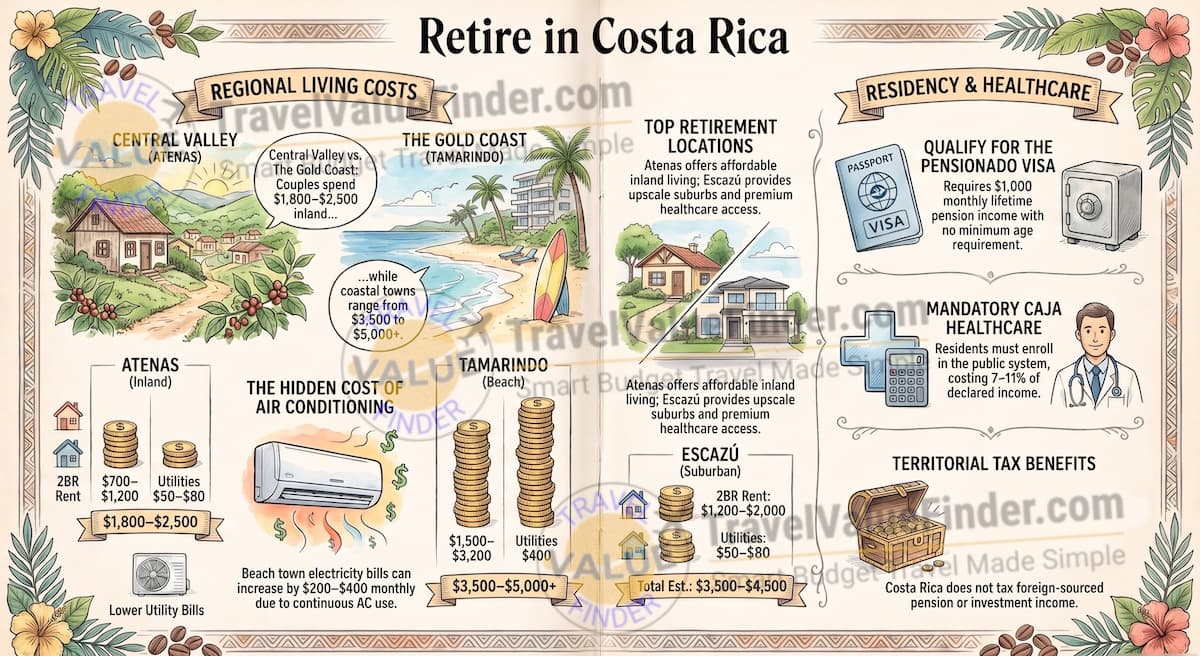
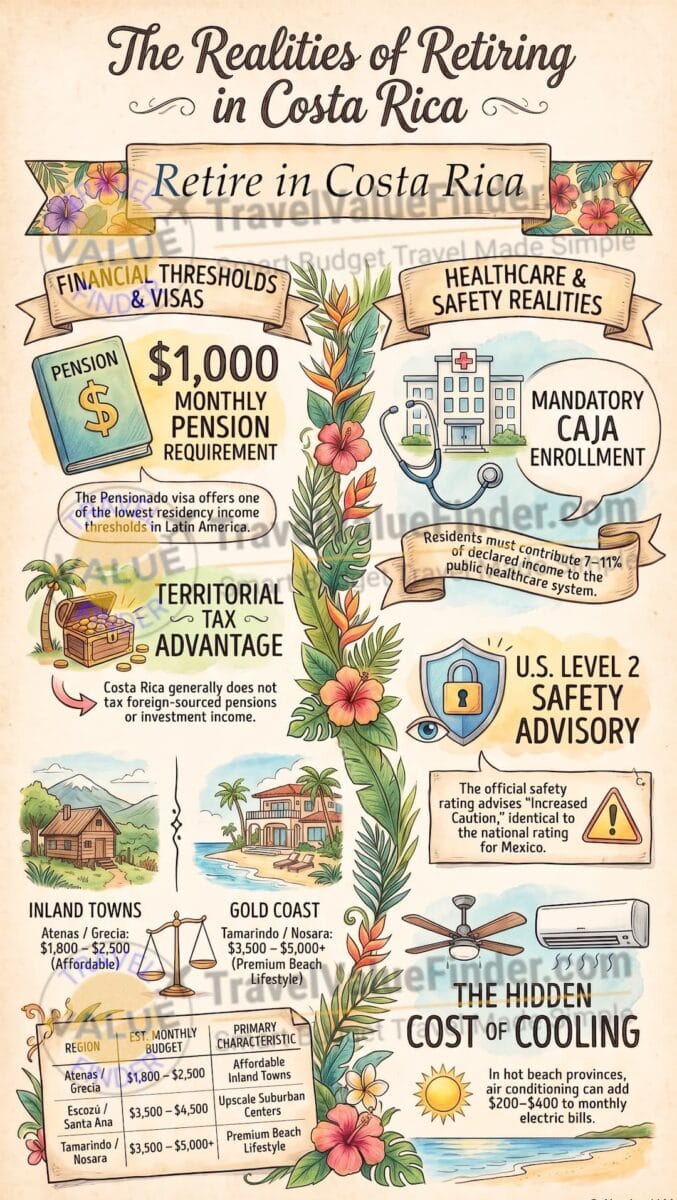
Retiring in Costa Rica costs roughly $1,800–$2,500/month for a couple in an affordable Central Valley town like Atenas or Grecia, versus $3,500–$5,000+ on the Guanacaste “Gold Coast” (Tamarindo, Nosara) – and the Pensionado visa requires only $1,000/month in lifetime pension income, one of the lowest thresholds of any popular retirement country, though healthcare enrollment in the CAJA public system is mandatory, not optional, once you become a resident.
Leslie Nics, TravelValueFinder.com | Last updated: Aug 2026 | Last Reviewed: Aug 06, 2026
Ask most people what retiring in Costa Rica looks like and they’ll repeat the same marketing line: “the safest, happiest country in Latin America.” It’s a good line. It’s also incomplete.
Ask someone who actually pulled the U.S. State Department’s current advisory and ran the real Pensionado numbers, the way I did after finishing the Mexico retirement research for this site, and a more useful picture emerges:
Costa Rica genuinely is one of the easiest countries in the world to qualify for residency in, with the lowest income threshold of any Latin American retirement destination – but its official safety rating and its marketing reputation aren’t quite the same thing, and its healthcare system works on a fundamentally different model than Mexico’s.
Nearly every guide to retiring in Costa Rica repeats the pura vida branding without checking it against the actual government sources. This one checks both, and uses the current 2026 numbers throughout.
Retire in Costa Rica: Quick Facts
| Category | The Number |
| Visa (Pensionado) | $1,000/month lifetime pension – no minimum age, no savings alternative required |
| Visa (Rentista) | $2,500/month guaranteed income for 2 years, or a $60,000 bank CD |
| Central Valley affordable towns (couple) | $1,800–$2,500/month (Atenas, Grecia, San Isidro) |
| Guanacaste “Gold Coast” (couple) | $3,500–$5,000+/month (Tamarindo, Nosara, Flamingo) |
| Healthcare (CAJA) | Mandatory, 7–11% of declared income (≈$70–$220/month) – not optional like Mexico’s IMSS |
| Tax regime | Territorial system – foreign-sourced pension and investment income is not taxed by Costa Rica |
| Path to permanent residency | 3 years of continuous temporary residency |
Retire in Costa Rica: Central Valley vs. the Guanacaste Gold Coast
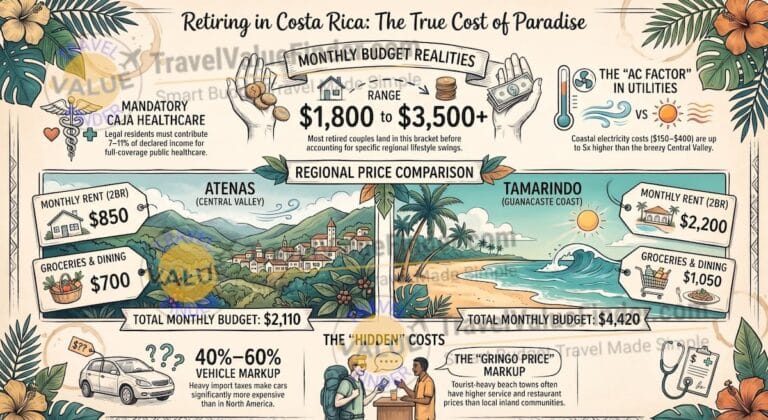
This is the split that actually drives the budget, and it’s a wider gap than most cost-of-living roundups let on. A retired couple living modestly in Atenas or Grecia – cooking at home most nights, using CAJA for healthcare, driving a used car – genuinely can live on $2,000–$2,500/month. The same couple in Escazú or Santa Ana, the upscale Central Valley suburbs favored by many American retirees, runs $3,500–$4,500/month once gated-community rent, private insurance, and regular dining out enter the picture.
Head to the beach and the math shifts again. Tamarindo and Nosara, Guanacaste’s best-known expat beach towns, typically run 20–40% above Escazú pricing, driven almost entirely by air conditioning (which can add $200–$400/month to an electric bill in Guanacaste’s dry, hot climate) and tourist-area food and rent pricing.
Line-Item Comparison: Atenas vs. Escazú vs. Tamarindo
| Atenas / Grecia | Escazú / Santa Ana | Tamarindo / Nosara | |
| 2BR rent | $700–$1,200 | $1,200–$2,000 | $1,500–$3,200 |
| Utilities (AC use) | $50–$80 | $80–$150 | $150–$400 |
| Groceries | $300–$400 | $400–$550 | $450–$650 |
| Est. couple total | $1,800–$2,500 | $3,500–$4,500 | $3,500–$5,000+ |
Costa Rica doesn’t have a single “cheap corner” the way some countries do – even its most affordable towns sit meaningfully above Mexico’s cheapest cities. What it offers instead is remarkable consistency in quality of life across that whole range, from modest inland towns to premium beach communities.
Everyone budgets for the beach house. Almost nobody budgets for what running that beach house’s air conditioner nine months a year actually costs. – Leslie Nics, Founder & Lead Travel Writer, TravelValueFinder.com
| Reality Check Guanacaste is Costa Rica’s driest and hottest province – from December through April you will run air conditioning nearly continuously if you live within a few miles of the beach. That’s a real, recurring monthly cost most beach-town budgets underestimate, not a one-off inconvenience. |
The Safety Reality Check Most Guides Skip: What “Safest in Latin America” Actually Means
This is the section I think matters most and see covered least – and it’s the mirror image of what I found writing this site’s Mexico guide. Nearly every Costa Rica retirement article repeats some version of “safest country in Latin America” without ever citing where that claim comes from or checking it against the official U.S. government rating.
Here’s what the U.S. Department of State’s Costa Rica travel advisory actually says, as of its most recent update: Level 2 – Exercise Increased Caution, the same tier assigned to Mexico nationally, citing petty crime as common throughout the country and violent crime, including armed robbery, that also affects tourists.
That doesn’t mean the marketing claim is false – Costa Rica’s crime rates genuinely compare favorably to much of the rest of Latin America, and unlike Mexico, it has no state-by-state “Do Not Travel” zones at all, a real point in its favor.
What it means is that “safest in Latin America” is a relative claim, not an absence-of-risk claim, and the specific advice the State Department gives – avoid poorly lit beaches and streets at night, don’t display visible wealth, don’t physically resist a robbery attempt – is standard travel-safety guidance, not a footnote to skip past.
The marketing isn’t lying to you, exactly. It’s just answering a different question than the one you’re actually asking when you check whether somewhere is safe to retire. – Leslie Nics, Founder & Lead Travel Writer, TravelValueFinder.com
Costa Rica’s Retirement Visa: Pensionado vs. Rentista
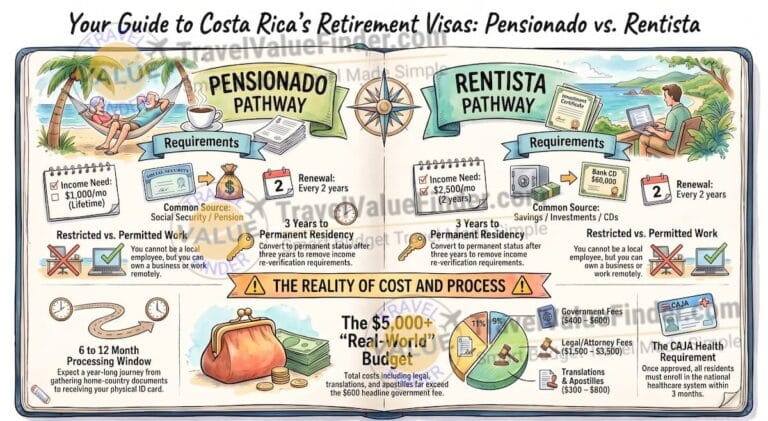
Costa Rica offers what may be the most accessible retirement visa income threshold of any popular Latin American destination: the Pensionado category requires just $1,000/month in guaranteed lifetime pension income – Social Security, a workplace pension, or equivalent – with no minimum age requirement at all.
Retirees without a qualifying lifetime pension can instead use the Rentista category, which requires proof of $2,500/month in guaranteed income for at least two years, commonly satisfied with a $60,000 deposit into a Costa Rican bank CD.
| Visa Type | Requirement | Renewal | Path to Permanent Residency |
| Pensionado | $1,000/month lifetime pension | Every 2 years, income re-verified | After 3 years of temporary residency |
| Rentista | $2,500/month for 2 years, or $60,000 bank CD | Every 2 years, income re-verified | After 3 years of temporary residency |
Total government fees run $400–$600, but a realistic full-process budget – including certified document translation, apostilles, and often an immigration attorney – runs closer to $5,000–$6,000 once every real cost is counted, notably higher than Mexico’s roughly $2,700 all-in figure for a comparable process.
Taxes: Costa Rica’s Territorial System, and an Incentive Window Worth Double-Checking
Costa Rica runs a territorial tax system: income earned outside the country – foreign pensions, foreign investment income, foreign rental income – generally isn’t taxed by Costa Rica at all, regardless of how long you’ve been a resident.
That’s structurally different from Mexico, where foreign income becomes taxable once you cross the 183-day tax-residency threshold, and it’s a genuine point in Costa Rica’s favor for retirees living primarily off pension or investment income.
Update: This Incentive Window Has Closed
Costa Rica’s Law 9996 import-tax incentives (tax-free household goods, up to two vehicles, partial real estate transfer relief) were only available to investors, rentistas, and pensionados who opted in during the law’s first five years.
Costa Rica’s Ministry of Hacienda published Law 9996 in La Gaceta No. 135 on July 14, 2021 – meaning that five-year window closed on July 14, 2026, before this article’s writing date.
New Pensionado or Rentista applicants can no longer claim these benefits; anyone who secured them before the deadline keeps them for 10 years from the date granted.
Confirm current status with a Costa Rican immigration attorney or migracion.go.cr before making any decisions based on this incentive.
As with Mexico, moving to Costa Rica doesn’t end U.S. tax obligations – citizens and green card holders still file annual returns and report worldwide income per IRS guidance for Americans abroad, and combined foreign account balances over $10,000 trigger an FBAR filing. The Social Security Administration confirms Costa Rica is one of the countries where benefit payments continue abroad without reduction.
Healthcare: Why CAJA Is Mandatory, Not Optional
This is the clearest structural difference from this site’s Mexico guide. Mexico’s IMSS is voluntary for legal residents.
Costa Rica’s CAJA (Caja Costarricense de Seguro Social) enrollment is mandatory for Pensionado and Rentista residents, typically required within 3 months of residency approval, at a cost of 7–11% of declared monthly income – commonly $70–$220/month for retirees, with the employee contribution rate having risen to 10.83% as of January 1, 2026.
| Option | Typical Cost | Notes |
| CAJA (mandatory) | 7–11% of declared income, ≈$70–$220/month | Zero co-pays, covers pre-existing conditions, longer specialist wait times |
| Private insurance (INS, government-run) | $60–$250/month | Faster specialist access, layered on top of CAJA, not a replacement for it |
| International private insurance | $100–$1,000+/month | Broadest coverage, highest cost |
Mandatory sounds like a downside until you actually price it against a US premium. CAJA covers pre-existing conditions with zero co-pays for roughly what a lot of Americans pay for a single specialist visit at home. – Leslie Nics, Founder & Lead Travel Writer, TravelValueFinder.com
Most retirees settle into the same pattern seen across this site’s other retirement guides: CAJA as the mandatory, comprehensive backbone, with a modest private policy layered on top specifically to skip the specialist wait times, which can run three to six months for non-urgent care through the public system.
Top private hospitals such as CIMA in Escazú and Clínica Bíblica in San José are internationally accredited and staffed by English-speaking, often US-trained physicians.
Where Retirees Actually Land
Atenas / Grecia
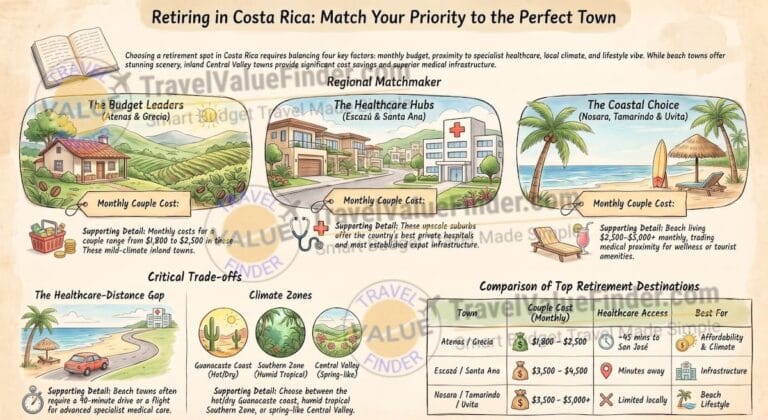
The Central Valley’s most affordable, most-recommended inland towns for budget-focused retirees, at $1,800–$2,500/month for a couple. Elevation keeps temperatures mild year-round (65–75°F), and both are within an hour of San José’s hospitals.
Escazú / Santa Ana
The upscale Central Valley suburbs where the majority of American retirees settle, at $3,500–$4,500/month for a couple. The best hospital access, the most established expat infrastructure, and the closest proximity to Juan Santamaría International Airport of any option on this list.
Tamarindo / Nosara (Guanacaste)
Costa Rica’s best-known beach-retirement towns, at $3,500–$5,000+/month for a couple. Nosara has built a specific reputation as the country’s wellness and yoga hub; Tamarindo trades a bit of authentic local character for tourist-ready infrastructure and amenities.
Uvita / Ojochal (Southern Zone)
A quieter, less-developed Pacific alternative to Guanacaste, running roughly $2,500–$3,500/month for a couple – lower cost and fewer crowds than the Gold Coast, at the trade-off of a smaller expat community and more limited healthcare access.
Run Your Own Numbers
- Use our Free Retirement Cost of Living Calculator – to get a personalized budget report comparing Costa Rica against any of the other countries covered on this site – free, instant, no account needed.
- How to Use a Retirement Cost of Living Calculator – to Compare Cities Worldwide
Common Mistakes First-Time Researchers Make
- Repeating the “safest in Latin America” line without checking it against the actual State Department Level 2 rating and its specific, practical advice.
- Assuming CAJA is optional the way Mexico’s IMSS is – it isn’t, and budgeting without it as a mandatory line item understates real costs.
- Pricing a beach-town budget off Central Valley numbers, then being surprised by a $200–$400/month air conditioning bill in Guanacaste.
- Assuming the vehicle and household-goods import tax breaks are still active without confirming current status – these incentives had a stated expiration window.
- Underestimating vehicle costs generally: import taxes routinely push a $25,000 US car’s Costa Rican price above $40,000.
The biggest mistake in my own process wasn’t a number I got wrong – it was almost repeating the same marketing language everyone else does instead of pulling the actual State Department source, the way I should have from the start – Leslie Nics, Founder & Lead Travel Writer, TravelValueFinder.com
Which Fits You
| Priority | Best Fit |
| Lowest possible cost | Atenas or Grecia |
| Best healthcare access | Escazú or Santa Ana |
| Established expat community | Escazú, Tamarindo, or Nosara |
| Beach lifestyle, budget secondary | Tamarindo or Nosara – budget for AC and tourist pricing |
| Quieter coast, lower cost than Guanacaste | Uvita or Ojochal |
Find Out More About Retiring in Costa Rica
This is the pillar page for TravelValueFinder’s Costa Rica retirement cluster. The linked child pages below are the next articles planned for this cluster and should be published and cross-linked before this page goes live:
- Retire in Costa Rica – What Nobody Tells You About Retiring in Costa Rica: 5 Things I’d Do Differently
- Costa Rica’s Retirement Visa, Explained: What I’d Actually Prepare Before Applying
- Cost of Living in Costa Rica: What Retiring in Costa Rica Really Costs, Category by Category
- Best Places to Retire in Costa Rica: Which Town Actually Fits You
- Costa Rica Travel Budget
You May Be Interested In
- Retire in Mexico: What Nobody Tells You About Retiring in Mexico: 5 Things I’d Do Differently
- Retire in Portugal: A Warm, Practical Guide for People Over 55
- Retire in Spain: A 55+ Guide to Planning Your Dream Life
- What Nobody Tells You About Retiring in Greece: 5 Things I’d Do Differently
- Affordable Retirement: Best Countries Where Your Money Goes Further
- Retirement Cost of Living Calculator
People Also Ask
How much money do I need to retire in Costa Rica?
A couple can live comfortably on $1,800–$2,500/month in affordable Central Valley towns like Atenas or Grecia, or $3,500–$5,000+/month on the Guanacaste coast. The Pensionado visa itself requires only $1,000/month in qualifying pension income.
Is Costa Rica actually safe for American retirees?
The U.S. State Department rates Costa Rica Level 2, “Exercise Increased Caution,” the same as Mexico nationally, citing common petty crime and some violent crime affecting tourists. Costa Rica has no Level 4 “Do Not Travel” zones, unlike Mexico’s six restricted states.
Is CAJA healthcare mandatory in Costa Rica?
Yes. Unlike Mexico’s voluntary IMSS system, Costa Rica requires Pensionado and Rentista residents to enroll in CAJA, typically within 3 months of residency approval, at a cost of 7–11% of declared income.
What is the easiest way to get residency in Costa Rica?
The Pensionado visa, requiring $1,000/month in lifetime pension income with no minimum age, is widely considered the most accessible retirement residency threshold among popular Latin American destinations.
FAQ
Do I need a visa to retire in Costa Rica?
Yes, for long-term residency. Most retirees use the Pensionado (pension-based) or Rentista (proof-of-income-based) category, both administered through Costa Rican immigration.
What is the cheapest place to retire in Costa Rica?
Inland Central Valley towns like Atenas, Grecia, and San Isidro typically offer the lowest cost of living among established, well-connected retirement destinations.
Can I buy property in Costa Rica as a foreigner?
Yes, foreigners have the same property ownership rights as citizens in most of Costa Rica, with no fideicomiso-style trust requirement like Mexico’s coastal Restricted Zone.
Is healthcare good in Costa Rica for retirees?
Yes, CAJA is a mandatory, comprehensive public system with no co-pays and no pre-existing condition exclusions, and private hospitals like CIMA and Clínica Bíblica offer US-standard care at 50–70% below US pricing.
How much does health insurance cost in Costa Rica?
Mandatory CAJA enrollment runs roughly $70–$220/month based on declared income. Supplemental private insurance through INS runs $60–$250/month; international plans run $100–$1,000+/month.
Sources
- U.S. Department of State – Costa Rica Travel Advisory
- IRS – U.S. Citizens and Resident Aliens Abroad
- FinCEN – Report of Foreign Bank and Financial Accounts (FBAR)
- Social Security Administration – International Programs
- Costa Rica Ministry of Finance (Hacienda) – Official publication of Law 9996 in La Gaceta No. 135 (July 14, 2021)
- Dirección General de Migración y Extranjería (DGME) – official Costa Rican residency requirements (migracion.go.cr)
- Caja Costarricense de Seguro Social (CCSS/CAJA) – official contribution rate schedule (ccss.sa.cr)
About the Author
Leslie Nics is the founder and primary travel researcher at Travel Value Finder. He specializes in budget travel, destination research, and itinerary planning, drawing on firsthand travel experience to help readers find affordable and practical travel options. Read more on the About page or see the site’s Trust & Transparency Policy.