Travel Value Finder

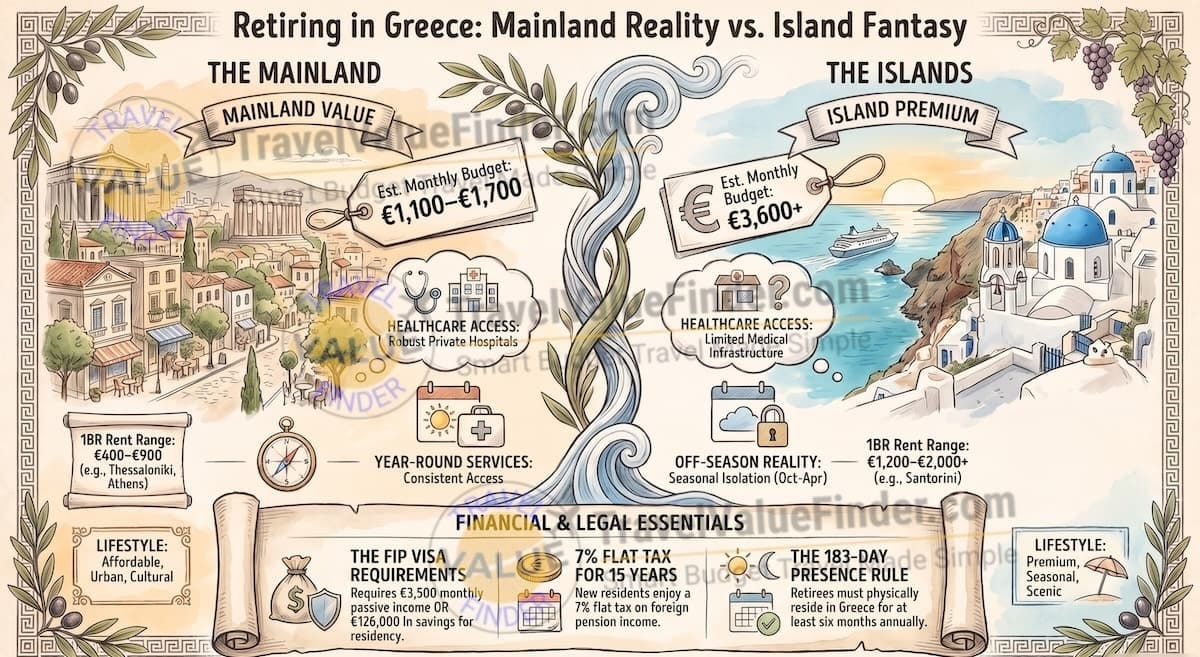
Retiring in Greece costs roughly €1,100–€1,700/month on the mainland versus €1,800–€3,600+ on the islands, and the FIP visa (€3,500/month passive income) pairs with a 7% flat tax on foreign pension income for up to 15 years. The island lifestyle most people picture when they hear “retire in Greece” is the expensive, seasonal exception – not the norm.
Leslie Nics, TravelValueFinder.com | Last updated: July 2026 | Last Reviewed: July 26 2026
Ask most people what retiring in Greece looks like and they’ll describe a whitewashed house on a Cycladic cliff.
Ask someone who’s actually done it, and the picture splits in two almost immediately: mainland Greece, where a comfortable retirement runs closer to what people expect from “affordable Europe,” and the postcard islands, where the same lifestyle can cost triple.
Nearly every guide to retiring in Greece blends these two realities into one misleading average. This one keeps them separate, on purpose, because the region you pick changes the entire financial picture more than any other decision you’ll make.
Quick Facts
| Category | The Number |
| Visa | FIP Visa – €3,500/month passive income (+20% spouse, +15%/child) or €126,000 in savings |
| Tax regime | 7% flat tax on foreign pension income, valid up to 15 years |
| Mainland cost (single) | €1,100–€1,700/month (Thessaloniki cheapest, Athens higher) |
| Island cost (single) | €1,800–€3,600+/month (varies enormously by island and season) |
| Healthcare | EOPYY public system via AMKA registration, or private (€50–€150/month) |
| Path to permanent residency | 5 years of continuous legal residency |
Mainland vs. Island: The Decision That Actually Drives Your Budget
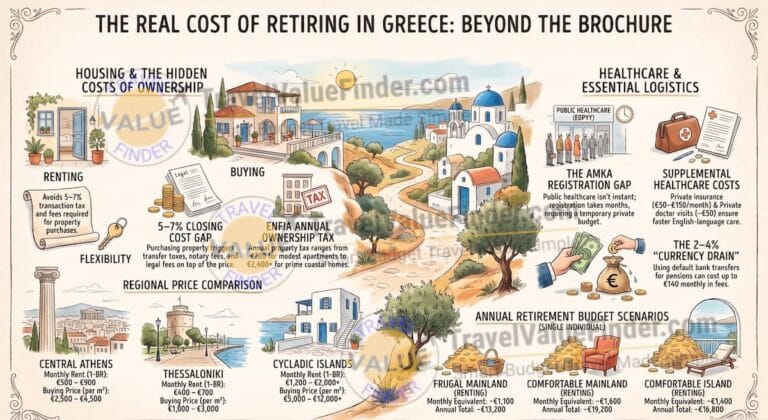
This is the trade-off that deserves top billing, not a footnote near the bottom of the page. Thessaloniki, Greece’s second city, runs a comfortable single-person budget around €1,100–€1,200/month. Athens comes in higher at €1,500–€1,700, largely driven by a rental market that’s climbed steadily since 2020 on the back of tourism and short-term-rental demand.
Smaller mainland cities like Ioannina, Larissa, Kavala undercut both, often running 15–20% below Athens for a similar quality of life.
Islands break that pattern entirely. Crete and the larger, more self-sufficient islands can run close to mainland pricing – around €1,400/month for a comfortable single-person budget.
But the islands most people picture when they imagine Greek retirement – Santorini, Mykonos – run €3,600/month or more, with rental costs 60–70% above mainland levels and heavily seasonal service availability.
Line-Item Comparison: Athens vs. Thessaloniki vs. Crete vs. Santorini
| Thessaloniki | Athens | Crete | Santorini | |
| 1BR rent | €400–€700 | €500–€900 | €450–€800 | €1,200–€2,000+ |
| Utilities | €120–€180 | €150–€250 | €120–€200 | €150–€280 |
| Groceries | €180–€250 | €200–€300 | €200–€280 | €280–€400 |
| Est. single-person total | €1,100–€1,200 | €1,500–€1,700 | €1,300–€1,500 | €3,000–€3,600+ |
The gap between Thessaloniki and Santorini isn’t a rounding error – it’s close to triple. That spread is the single most important number in this entire guide, and it’s the one most “retire in Greece” content buries under scenic photography instead of leading with.
Reality Check: Small Cycladic islands can feel genuinely isolating from October through April, when ferry service drops sharply and many businesses close for the season. Healthcare on these islands is often minimal – real emergencies can mean a helicopter evacuation or a rough winter sea crossing to reach a mainland hospital.
The Ferry Factor Most Cost-of-Living Guides Ignore
Anyone budgeting for island retirement needs to price in inter-island and mainland travel as a recurring cost, not a one-time vacation expense.
Ferry fares have risen with fuel costs – a route like Piraeus to Syros has climbed from roughly $32 to around $40 in recent years – and retirees who plan to see family on the mainland, attend specialist medical appointments, or simply leave the island regularly should expect this to be a real monthly or quarterly line item.
There’s a partial offset: permanent residents of certain Greek islands qualify for ferry fare rebates of up to 50% on travel to and from Athens, a benefit worth confirming directly with local authorities before ruling an island out on transport cost alone.
The FIP Visa: What Actually Qualifies
Greece doesn’t have a visa labeled “retirement visa” – the route almost every retiree uses instead is the Financially Independent Person (FIP) permit.
The current income threshold is €3,500/month in passive income (raised from €2,000 by Law 5038/2023), plus 20% more for a spouse and 15% per dependent child. Applicants can qualify through steady passive income or, alternatively, by showing €126,000 in savings, sized to cover the visa’s full three-year validity period. Processing fees run around €2,500.
Crucially, the income has to be passive – pensions, dividends, rental income, investment returns – not wages or self-employment earnings, the same distinction that trips up applicants across nearly every retirement visa in southern Europe.
The permit is valid for three years and renewable, provided the financial requirement continues to be met. The detail that catches people off guard: holders must spend at least 183 days (six months) per year physically in Greece to maintain the permit – this isn’t a passive residency-on-paper option the way some other countries’ investor visas are.
The FIP Visa vs. the Golden Visa: Which One Actually Fits Retirement Plans
Greece also runs a Golden Visa program, and it’s worth separating clearly from the FIP visa since the two get conflated constantly in casual research. The Golden Visa grants residency through property investment – starting around €250,000 in smaller islands or restoration properties, up to €800,000 in Athens, Thessaloniki, or larger islands – and critically, it carries no minimum-stay requirement at all.
That makes it a fit for retirees who want the option of Greek residency without committing to living there full-time, or who see it primarily as a Schengen-access and estate-planning tool. The FIP visa, by contrast, is built for retirees who actually intend to live in Greece most of the year, backed by income rather than a lump-sum property purchase.
Choosing between them is really a question of intent – full-time residence versus flexible optionality – more than a question of which is “better.”
Greece’s 7% Flat Tax – and How It Actually Compares to Italy’s
Since 2020, Greece has offered qualifying foreign retirees a flat 7% tax rate on foreign-source pension income, including U.S. Social Security, private pensions, and IRA distributions. To qualify, applicants must not have been Greek tax residents in the previous five years.
The rate then applies for up to 15 years – five years longer than Italy’s equivalent Article 24-ter regime, which caps out at 10. For retirees comparing the two countries primarily on tax treatment rather than lifestyle, that extra five years is a real, quantifiable difference, not a marketing detail.
Everyone compares Greece and Italy on cost of living and stops there. The 7% regime running 15 years instead of 10 is the number that should be in the spreadsheet, and almost nobody puts it there. – Leslie Nics, Founder & Lead Travel Writer, TravelValueFinder.com
Healthcare: EOPYY vs. Going Private
Once a retiree has a Greek Social Security Number (AMKA), they gain access to EOPYY, the national health system, at low or no direct cost – including specialist visits without a referral, though waiting times apply in busier facilities.
Athens and Thessaloniki both have strong private hospital networks as well, and many retirees layer private insurance on top of EOPYY access specifically for faster appointments and more English-speaking doctors. A private doctor’s visit runs about €50, prescriptions €5–€15, and private insurance plans €50–€150/month depending on age and coverage.
The catch, echoing the island-vs-mainland divide already running through this whole guide: healthcare access on smaller islands is meaningfully thinner than in Athens or Thessaloniki, which is a genuine consideration for retirees weighing age and health alongside the appeal of island living.
Where Retirees Actually Land
Beyond the generic “mainland or island” framing, five specific places account for most of where foreign retirees in Greece actually settle:
Athens
The most infrastructure, the most private healthcare options, and the highest mainland cost – €1,500–€1,700/month for a single retiree, with rents having climbed noticeably since 2020. Neighborhoods like Koukaki and Pangrati offer a walkable, less tourist-dense alternative to central Kolonaki, at meaningfully lower rents than the postcard neighborhoods most visitors see.
Thessaloniki
Greece’s most consistently recommended value pick among mainland cities – comparable culture and infrastructure to Athens at 15–25% lower cost, around €1,100–€1,200/month. It also has a notably younger, more local (less internationally touristed) daily rhythm than Athens, which some retirees prefer and others find means fewer English-speaking services.
Crete
The rare island that behaves more like the mainland financially – large enough to be self-sufficient, with strong healthcare access and around €1,300–€1,500/month for a comfortable single-person budget. Its size also means genuine regional variety within one island, from the busier Chania and Heraklion to quieter inland and southern coastal towns.
Corfu
A retiree favorite for its greener, less arid landscape and strong ferry/flight connections, sitting in a cost bracket between Crete and the more expensive Cycladic islands. Its proximity to Italy also appeals to retirees who want easy access to a second country without a long flight.
Smaller mainland cities (Ioannina, Larissa, Kavala)
The actual budget leaders – 15–20% below Athens – for retirees prioritizing cost over the coastal-island lifestyle Greece is best known for. Ioannina in particular draws retirees for its lake setting and university-town cultural life, at costs closer to €1,100/month.
Ready to compare cities now?
- Use our Free Retirement Cost of Living Calculator – get your personalized report in 30 seconds – Free PDF download.
- How to Use a Retirement Cost of Living Calculator – to Compare Cities Worldwide
Common Mistakes First-Time Applicants Make
1. Pricing the island fantasy, then budgeting for the mainland reality. Most retirees who move to Greece don’t end up on Santorini – but plenty budget as if a mainland cost of living will stretch to cover an island lifestyle, then are surprised by the gap once rent, ferry travel, and higher grocery prices actually hit.
2. Treating the six-month presence requirement as a formality. It’s an active condition of keeping the FIP permit, not a suggestion – retirees who split time between Greece and elsewhere need to plan around it deliberately, and falling short of 183 days can jeopardize renewal.
3. Assuming EOPYY access is automatic. It requires an AMKA number and proper registration – it isn’t triggered simply by holding a residence permit, and the registration process itself takes real lead time most retirees don’t budget for.
4. Comparing Greece to Italy on cost alone. The 15-year vs. 10-year difference in the flat-tax window is a bigger factor for many retirees’ total tax bill than the modest cost-of-living gap between the two countries, especially for retirees with larger pension incomes.
5. Choosing an island for a two-week vacation feel, then living there full-time. What feels charming in July can feel genuinely isolated in January – a distinction that only shows up after the lease is signed, when ferry schedules thin out and half the town’s businesses close for the season.
The honeymoon period on a small island ends the first time you need a specialist appointment and realize the nearest one is a ferry ride away. – Leslie Nics, Founder & Lead Travel Writer, TravelValueFinder.com
Which Fits You
| Priority | Best Fit |
| Lowest possible cost | Thessaloniki or a smaller mainland city (Ioannina, Larissa, Kavala) |
| Best healthcare access | Athens or Thessaloniki |
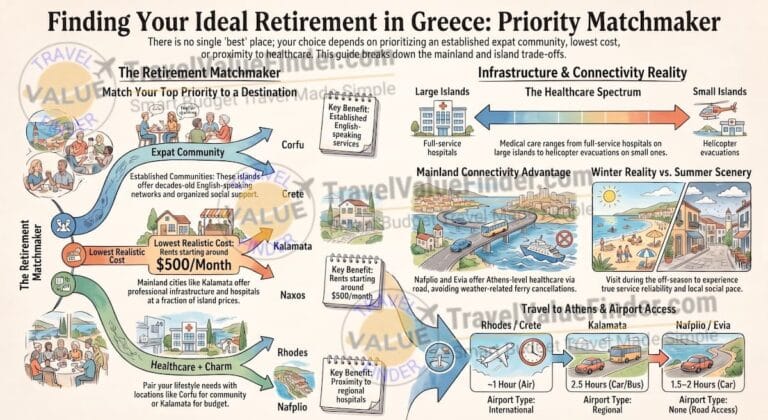
| Island lifestyle without island isolation | Crete or Corfu |
| Longest tax-advantaged window | Any qualifying location – the 15-year 7% regime applies regardless of mainland or island |
| Postcard island living, budget secondary | Santorini or Mykonos – go in with eyes open on cost and seasonality |
I’d pick the region by what January looks like, not what August looks like. Every island is beautiful in August. – Leslie Nics, Founder & Lead Travel Writer, TravelValueFinder.com
Find out more about retiring in Greece
- Retire in Greece – What Nobody Tells You About Retiring in Greece: 5 Things I’d Do Differently
- Greece’s FIP Visa, Explained: What I’d Actually Prepare Before Applying
- Cost of Living in Greece: What Retiring in Greece Really Costs, Category by Category
- Best Places to Retire in Greece: Which Island or Mainland City Actually Fits You
- What to Do in Athens Greece
- Where to Stay in Santorini Greece
You May Be Interested in
- Italy Travel Guide For First-Time Visitors (2026)
- Where to Stay in Rome (2026 Guide): Best Areas, Hotels & Neighborhoods for Every Budget
- Retire in Portugal: A Warm, Practical Guide for People Over 55
- Best Places to Live in Portugal After 55: My Personal Guide
- Retire in Spain: A 55+ Guide to Planning Your Dream Life
- Best Places to Live in Spain After 55: A Practical Comparison
- Retire in France After 55: Healthcare, Cost, Visas & Lifestyle Explained
- Best Places to Live in France After 55: Regions Retirees Truly Enjoy
People Also Ask
How much money do I need to retire in Greece?
The FIP visa requires €3,500/month in passive income for a single applicant, or €126,000 in savings – though actual living costs can run as low as €1,100/month on the mainland.
Is Greece cheaper than Italy for retirees?
Mainland Greece is generally comparable to or slightly cheaper than southern Italy, while Greece’s 7% tax regime runs five years longer (15 years vs. Italy’s 10), which can matter more than the modest cost-of-living gap for some retirees.
Do retirees get free healthcare in Greece?
Not automatically – access to the EOPYY public system requires registering for a Greek Social Security Number (AMKA) after establishing residency; many retirees also carry supplemental private insurance for faster access.
Is it better to retire on a Greek island or the mainland?
It depends heavily on healthcare needs, budget, and tolerance for seasonal isolation – the mainland and larger islands like Crete offer more reliable year-round infrastructure, while smaller islands trade that reliability for scenery and quiet.
FAQ
What is the minimum stay requirement for the FIP visa?
Holders must spend at least 183 days (six months) per year in Greece to maintain the permit.
Can my spouse and children be included on my FIP visa application?
Yes, the income requirement increases by 20% for a spouse and 15% per dependent child.
How long does Greece’s 7% flat tax regime last?
Up to 15 years, provided the retiree wasn’t a Greek tax resident during the five years prior to relocating.
Is the Greece Golden Visa a better option than the FIP visa for retirees?
The Golden Visa (from €250,000 in qualifying property) doesn’t carry a residency requirement, which suits retirees who want Greek residency without living there full-time – the FIP visa suits those planning to actually live in Greece most of the year.
What’s the path to permanent residency in Greece?
Permanent residency is generally available after five years of continuous legal residency under the FIP permit.
Sources
- Law 5038/2023 – updated FIP visa income threshold
- Greek Law 4172/2013, Article 5B – 7% flat tax regime for foreign pension income
- EOPYY (National Organization for the Provision of Health Services) – public healthcare access guidance
About the Author
Leslie Nics is the founder and lead researcher at TravelValueFinder.com, where the focus is always on what things actually cost – not what the brochure says they cost. Read more on the About page or see the site’s Trust & Transparency Policy.