Travel Value Finder

Leslie Nics, TravelValueFinder.com | Last updated: September 2026 | Based on current airfare data
Learning how to find cheap flights comes down to timing, flexibility, and the right tools. This guide breaks down what actually lowers airfare, based on real booking patterns.
You will find the best booking windows, tools, and habits below. Each one is ranked by how much it typically saves you on a return trip.
Prices mentioned are estimates and change often. Always confirm the final cost before you pay.
Table of Contents
Quick answer: Book domestic flights 1 to 2 months out. Book international flights 2 to 5 months ahead of departure. Fly midweek, compare three search tools, then set a price alert.
Affiliate disclosure: the two links below are affiliate links. If you book through them, TravelValueFinder may earn a small commission at no extra cost to you. Compare live hotel prices on Booking.com. Bundle a flight and a hotel on Expedia and often pay less than booking each one separately.
Fast Facts
| Question | Quick Answer |
| Best day to fly | Tuesday or Wednesday |
| Best day to book | Any day, it barely matters |
| Domestic booking window | 1 to 2 months ahead |
| International booking window | 2 to 5 months ahead |
| Best free comparison tool | Google Flights |
People Also Ask: How to Find Cheap Flights
Is Tuesday really the cheapest day to book flights?
Not anymore, according to recent airfare studies. Booking day barely changes the price today. Focus on your travel dates instead of your purchase date.
How far ahead should I book international flights?
Book most international flights 2 to 5 months before departure. Long haul routes to Asia or Australia often price best even earlier.
Do flight prices drop closer to departure?
Rarely, and it is a risky bet to wait. Airlines usually raise prices as seats fill up, not lower them.
Is it cheaper to book directly with the airline?
For budget carriers, always book directly on their own site. For full service airlines, aggregators like Google Flights work just as well.
Does a VPN actually lower flight prices?
Results are inconsistent and vary by route. The Federal Trade Commission says firms must disclose how data shapes prices shown to you.
How to Find Cheap Flights by Booking at the Right Time
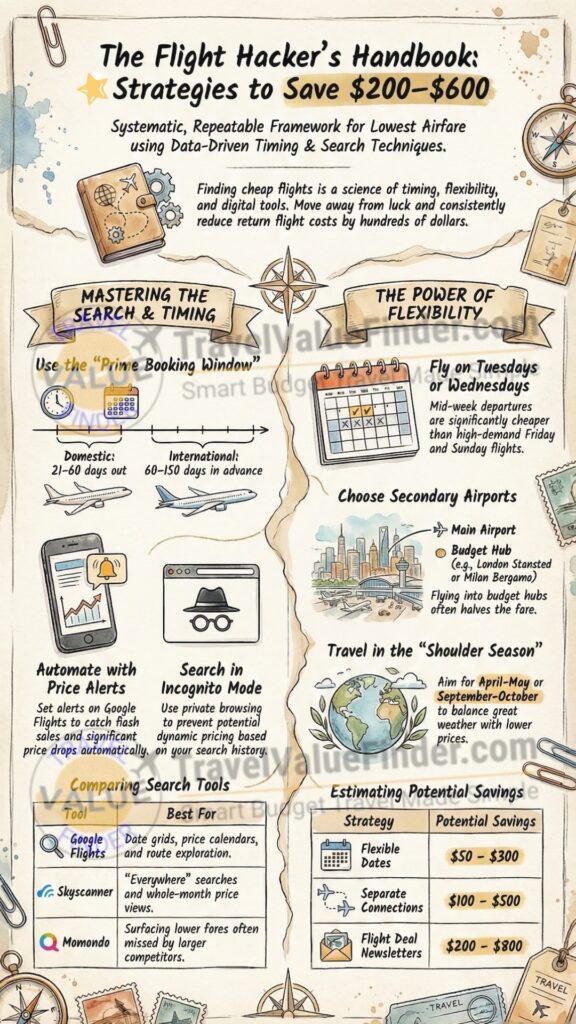
Booking at the right time is the biggest lever you control. Book too early and the lowest fares are not released yet. Book too late and those cheap seats are already gone.
Airlines release inventory in batches and price each batch a little higher than the last. Searching early tells you the floor price. Searching again a few weeks later tells you whether it is rising.
| Route Type | Best Booking Window |
| Domestic US | 1 to 2 months ahead |
| Transatlantic (US or Canada to Europe) | 2 to 5 months ahead |
| Long haul (Asia, Australia) | 3 to 6 months ahead |
| Holiday and peak season | 4 to 6 months ahead |
The U.S. Department of Transportation notes many discount fares need advance purchase. Some require booking at least 14 to 21 days ahead of travel.
Search Tools That Show the Full Fare, Not Just the Base Price
Not every search engine shows the same price. Some hide fees until checkout, so compare more than one site.
Metasearch tools like Google Flights and Kayak scan many airlines and sites at once. An online travel agency like Expedia lets you book a flight and hotel together. That bundle often beats pricing them separately.
| Tool | Best For |
| Google Flights | Price calendar and route map |
| Skyscanner | Whole month and anywhere search |
| Kayak | Price trend forecast |
| Momondo | Sometimes surfaces fares others miss |
| Kiwi.com | Combines separate airlines into one trip |
DOT requires airlines and travel sites to advertise the full price you will pay. Always confirm the fare on the airline’s own site before you pay.
Shifting Your Departure Day Lowers the Price
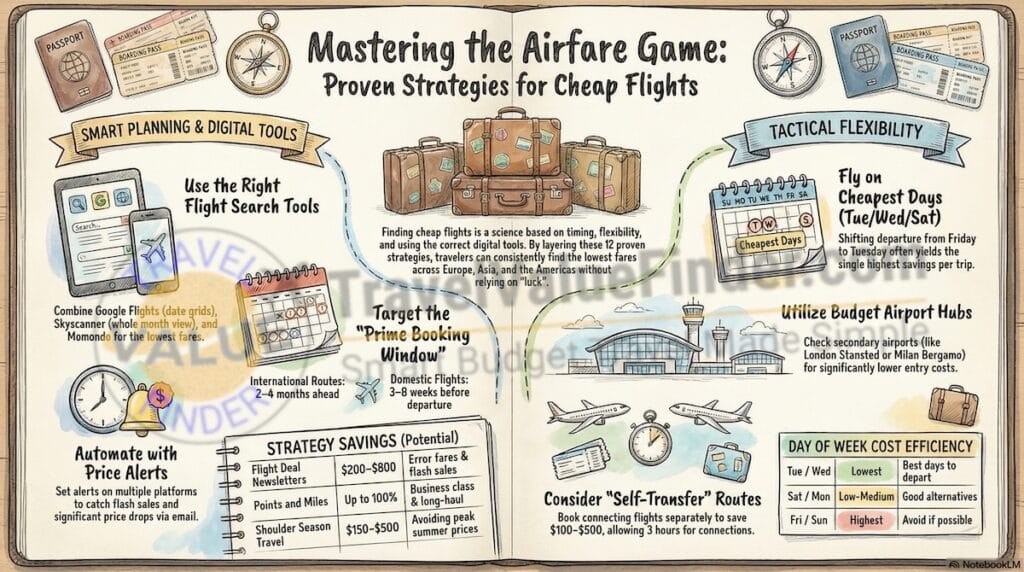
The day you fly matters more than the day you book. A midweek departure is usually cheaper than a Friday or Sunday one. Leisure routes show this pattern most clearly.
| Day of Week | Typical Fare |
| Tuesday | Usually lowest |
| Wednesday | Usually low |
| Saturday | Often good for leisure trips |
| Monday, Thursday | Average |
| Sunday, Friday | Usually highest |
Use a price calendar on Google Flights or Skyscanner to see every date at once. That single view removes most of the guesswork from picking a date.
Nearby Airports Worth Checking Before You Book
Big cities often have more than one airport nearby. The price difference between them can be significant, even for the same travel dates.
| City | Main Airport | Cheaper Alternative |
| London | Heathrow (LHR) | Stansted or Luton |
| Paris | Charles de Gaulle (CDG) | Beauvais, about 90 minutes out |
| Rome | Fiumicino (FCO) | Ciampino (CIA) |
| Barcelona | El Prat (BCN) | Girona, about 90 minutes out |
| New York | JFK or Newark | Stewart Airport for some carriers |
Weigh the airfare savings against the extra ground transport cost and time. A cheaper flight into a distant airport is not always the better deal. Add the bus or train ticket before you decide.
Flying into a nearby country and continuing by train can also help. Landing in Frankfurt and taking a train to Paris often beats flying direct.
For more overland routes, see our guide on how to travel Europe on a budget.
Budget Carriers Save Money, With a Few Catches
Budget carriers can cost a fraction of a legacy airline seat. The same route can cost $180 on one airline and $30 on another. Bag and seat fees are added on top of that base fare.
| Airline | Strong Region | Watch For |
| Ryanair | Western and Central Europe | Strict cabin bag limits |
| easyJet | UK, France, Spain, Italy | Second bag fees add up fast |
| Wizz Air | Central and Eastern Europe | Seat and boarding fees |
| Vueling | Spain and southern Europe | Competitive fares on Spain routes |
New DOT rules require airlines to disclose baggage and change fees upfront. Even so, check the airline’s own baggage policy before you fly. Limits vary by fare type and by route.
Ryanair publishes its full cabin baggage allowance online. It is worth a five minute read before you pack. A mispacked bag can cost more than the seat itself.
Points, Miles, and Rewards Cards, Explained Simply
Points and miles let frequent flyers pay little or nothing for a seat. Getting started is simpler than most people think, even for occasional travelers.
- A travel rewards card can earn enough points for a free flight within a year.
- Airline loyalty programs are free to join, even without a co branded card.
- Transferring card points to an airline partner often unlocks the best value.
- Save points for business class seats, where cash prices run highest.
Weigh any annual card fee against how often you actually fly. A card that charges $95 a year only pays off if you use the points.
A single card welcome bonus once covered my entire flight to Japan. Leslie Nics, TravelValueFinder.com
Why Shoulder and Off Season Travel Costs Less
When you fly matters almost as much as how you book. Peak season fares can run far higher than shoulder season prices. The route stays the same, only the crowd changes.
| Season | Months | Typical Fare |
| Peak | June through August, plus major holidays | Highest |
| Shoulder | April, May, September, October | Moderate |
| Off season | November through March, excluding holidays | Lowest |
Shoulder season trades a small drop in weather for a large drop in price and crowds. It also means shorter lines at popular sites and easier hotel bookings.
See our guides on the best time to visit Paris and Rome.
Both cover seasonal price patterns in detail.
Deal Alerts and Price Tracking Tools Worth Using
Error fares and flash sales disappear within hours. A dedicated alert service catches them long before manual searching ever would.
- Google Flights lets you track a route and get an email when the price shifts.
- Going and The Flight Deal focus on US departures and error fares.
- Secret Flying and Fly4Free lean toward European and long haul deals.
Set a Google Flights Alert in Three Steps
- Search your route on Google Flights.
- Turn on price tracking below the search bar.
- Wait for an email when the price moves.
Free tiers of most deal services are genuinely useful on their own. A paid tier, often $25 to $50 a year, suits frequent bookers best.
Airfarewatchdog is another option worth a look for domestic US routes. It leans toward mainstream carriers rather than error fares or flash sales.
Small Habits That Quietly Add Up
Searching in private browsing mode costs nothing and cannot hurt. Whether it actually changes the price you see is genuinely debated among travel experts.
The Federal Trade Commission is actively reviewing how personal data shapes prices. It says firms must disclose how data shapes the price shown to you. The rules on this are still developing.
- Clear cookies or use a private window before every new search.
- Try a different currency or region setting, since prices sometimes shift.
- Book connecting flights separately when the combined price beats one itinerary.
- Compare prices on a second device before you commit to buying.
Booking two flights separately, called a self booked connection, drops the airline’s own rebooking protection. Only try it with carry on bags and a long layover between flights.
Multi City and Open Jaw Tickets Can Cost Less
A multi city ticket lets you fly into one city and out of another. This often beats booking two one way tickets separately, which airlines tend to price higher.
An open jaw ticket works the same way for a road trip style itinerary. Fly into Lisbon, travel overland, then fly home from Madrid instead of doubling back.
| Ticket Type | Best Use | Note |
| Round trip | Simple trips, one destination | Easiest to price and compare |
| Multi city | Visiting two or three regions | Often cheaper than separate one ways |
| Open jaw | Road trips between cities | Skips backtracking to your entry airport |
Family and Group Bookings Need a Different Approach
Booking four or five seats at once can raise the fare shown on some routes. Search for one seat first, then book the group once you see the real price.
Split large groups into two smaller bookings when seats run low. This keeps each search below the level that sometimes triggers a price jump.
Keep every traveler’s name exactly as it appears on their ID. A mismatched name can mean a fee, or denied boarding at the gate.
Why Airfare Prices Change So Often
Airlines adjust prices constantly based on demand and how many seats remain. A flight can cost more today than it did yesterday, even with no schedule change.
Fuel costs, competition on the route, and remaining seat count all play a part. None of it is aimed at a single shopper, even though it can feel personal.
Basic Economy Fares: What the Lowest Price Leaves Out
The cheapest fare class on a full service airline usually comes with real limits. Knowing them before you book avoids an unpleasant surprise at the gate.
| Feature | Basic Economy | Standard Economy |
| Seat selection | Assigned at check in | Choose your seat |
| Carry on bag | Often allowed | Always allowed |
| Changes | Usually not allowed | Often allowed for a fee |
| Boarding group | Last to board | Earlier boarding group |
A basic economy fare can still be the right call for a short, simple trip. Skip it for a tight connection or a trip you might need to change.
One Trip, Several Habits: A Real Savings Breakdown
Small savings add up fast once you stack a few habits together. Here is a sample New York to Rome return trip booked for a September departure.
| Action Taken | Approx Savings |
| Compared three search tools instead of one | $100 |
| Shifted departure from Friday to Tuesday | $180 |
| Flew into Ciampino instead of Fiumicino | $90 |
| Booked 10 weeks ahead instead of last minute | $150 |
| Traveled in September instead of August | $200 |
| Total saved | About $720 |
None of these steps required a special trick or a loyalty status. They are simply habits applied together on one booking. The same math works on most routes.
Plan the Rest of the Trip Once Your Flight Is Booked
Sort out where to stay next. Compare rooms on Booking.com. Or bundle a flight and hotel on Expedia for a possible discount.
For city picks, see our guides on where to stay in Rome and Barcelona. Both list areas near the best transit links.
Frequent flyers may want to compare TSA PreCheck and Global Entry before their next trip.
Frequently Asked Questions About How to Find Cheap Flights
What is an error fare?
An error fare is a mistaken price set by an airline or booking system. They disappear fast, and airlines are not required to honor them, though many do.
Are budget airline fees worth the lower base fare?
Usually yes, if you pack light and skip extras. Add every fee before comparing the total to a full service airline price.
Can I get a refund if the price drops after I book?
Only within 24 hours of booking, under DOT rules for most US flights. After that window, a price drop generally does not trigger a refund.
What is the best day of the week to actually fly?
Tuesday and Wednesday are usually the cheapest days to fly. Friday and Sunday are typically the most expensive on leisure routes.
Do prices really differ by device or browser?
Some travelers report small differences, but the evidence is weak. Compare a few devices if you have time, but do not expect a large swing.
Sources
- U.S. Department of Transportation, Getting the Best Airline Fares
- U.S. Department of Transportation, Buying a Ticket
- U.S. Department of Transportation, Refunds
- U.S. Department of Transportation, Final Rule on Airline Junk Fees
- Federal Trade Commission, Enforcement Policy Statement on Personalized Pricing
- Ryanair, Official Cabin Baggage Allowance