Travel Value Finder


These 30 budget travel tips are the ones I actually use. They cover every category including flights, hotels, food, transport, money management, technology, and the mindset that holds it all together.
Some will save you hundreds on a single trip. Some will save you thousands across a year of travel. All of them work.
Leslie Nics, TravelValueFinder.com | Updated September 2026
Disclaimer: This article is for general informational purposes only and does not constitute financial, investment, tax, legal, immigration, or other professional advice. Costs and other figures are estimates and can change. Always verify current information and consult a qualified professional before making significant financial or retirement decisions.
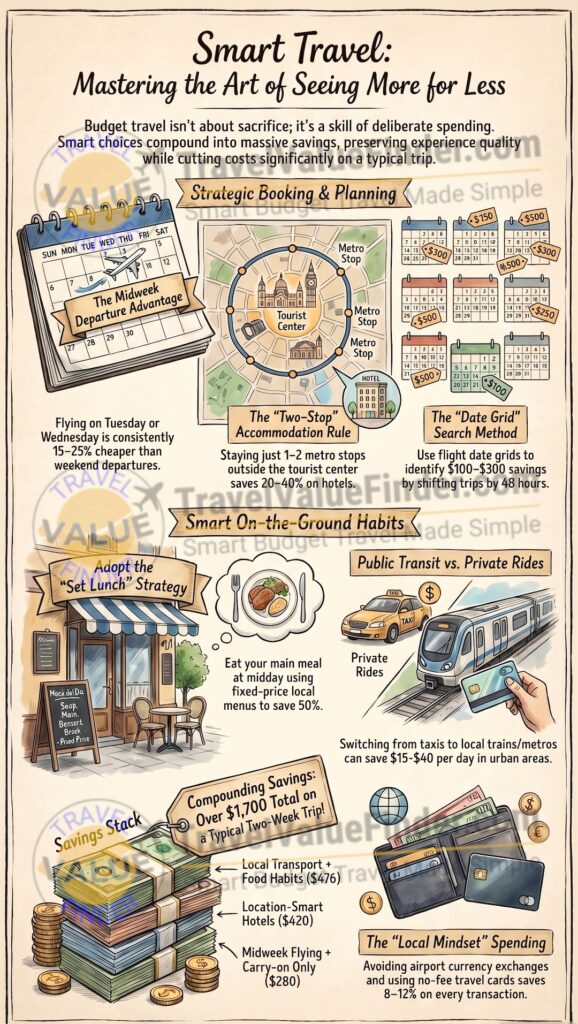
Table of Contents
All 30 Budget Travel Tips at a Glance
Here is a complete overview of all 30 budget travel tips, organised by category with estimated savings impact:
| # | Budget Travel Tip | Category | Savings Impact |
| 1 | Use the Google Flights date grid before setting travel dates | Flights | $80 – $300 per round trip |
| 2 | Set flight price alerts and wait for the dip | Flights | $100 – $400 on international routes |
| 3 | Fly midweek: Tuesday and Wednesday departures | Flights | 15 – 25% vs. Friday/Sunday |
| 4 | Use budget airlines within regions | Flights | $40 – $200 per intra-regional flight |
| 5 | Pack carry-on only – avoid baggage fees | Flights | $30 – $120 per trip |
| 6 | Sign up for flight deal alert newsletters | Flights | $200 – $800 on error fares and flash sales |
| 7 | Compare direct hotel rates vs. OTA prices | Hotels | 5 – 15% per stay |
| 8 | Stay outside the tourist centre – 1 – 2 stops on transit | Hotels | 20 – 40% cheaper same tier |
| 9 | Join hotel loyalty programs wih free membership | Hotels | 5 – 10% member rate + perks |
| 10 | Book refundable rates, rebook if price drops | Hotels | $20 – $100+ per stay |
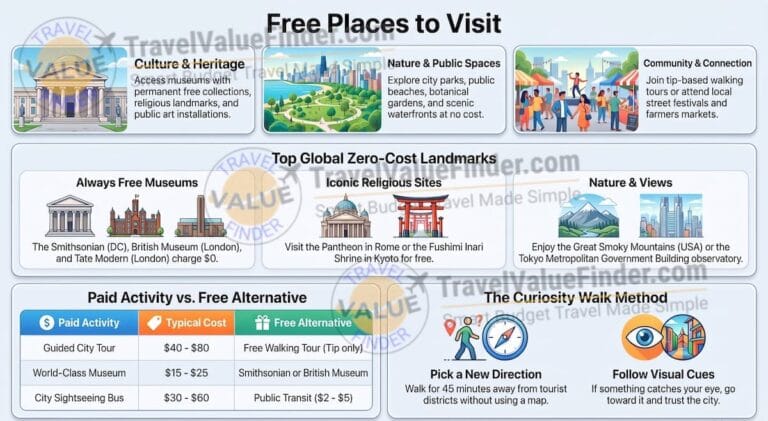
| 11 | Use points and miles for free hotel nights | Hotels | Up to 100% off accommodation |
| 12 | Consider hostels and private rooms have improved dramatically | Hotels | $30 – $80/night saving |
| 13 | Eat where locals eat, not where tourists eat | Food | 40 – 60% less per meal |
| 14 | Order the set lunch menu (plat du jour, menú del día) | Food | Save $10 – $20 per day vs dinner |
| 15 | Self-cater one meal per day using local supermarkets | Food | $10 – $25/day in food savings |
| 16 | Make coffee and breakfast before heading out | Food | $8 – $15/day |
| 17 | Use public transport instead of taxis and rideshares | Transport | $15 – $40/day in cities |
| 18 | Take overnight buses or trains to save accommodation | Transport | $30 – $90 per overnight journey |
| 19 | Walk more. It’s free and shows you more | Transport | $5 – $20/day in urban areas |
| 20 | Get a no-fee travel card (Wise or Revolut) | Money | 2 – 3% on all spending + ATM fees |
| 21 | Use travel credit card welcome bonuses for free flights | Money | $600 – $1,500 in travel value |
| 22 | Never exchange currency at airports or hotels | Money | 8 – 12% exchange rate saving |
| 23 | Track every dollar for the first week | Money | Prevents $20 – $50/day in unseen waste |
| 24 | Travel in shoulder season (spring/fall) not peak summer | Timing | 20 – 50% on flights + hotels |
| 25 | Choose destinations where your dollar goes further | Destination | Entire daily budget can drop 40 – 60% |
| 26 | Slow down – spend more time in fewer places | Strategy | $10 – $25/day in reduced transport |
| 27 | Use cashback portals on top of OTA hotel bookings | Tech | 1 – 10% cashback stacked on savings |
| 28 | Download offline maps before you arrive | Tech | Saves data costs and prevents costly wrong turns |
| 29 | Use an eSIM instead of international roaming | Tech | $30 – $100 per trip |
| 30 | Adopt the local spending mindset, not the tourist one | Mindset | Transforms every category above |
Budget Travel Tips for Flights: Tips 1 – 6
Flights are where most budget travel battles are won or lost. These six budget travel tips cover the full flight-booking system from the first search to the moment you board.
Tip 1: Use the Google Flights Date Grid Before Setting Your Travel Dates
Most travelers make the mistake of choosing their travel dates first, then searching for flights. The smarter approach: go to Google Flights, enter your route, and open the Date Grid view before committing to any dates.
You will see a full month of fares at a glance, and the difference between the most and least expensive dates is often $100 – $300 on a return ticket. Shift by even 48 hours and that money goes back into your trip budget.
- Action: On Google Flights, click the calendar icon next to the date fields to open the grid. Green dates are cheapest, red are most expensive
Tip 2: Set Flight Price Alerts : Let Deals Come to You
Checking flights daily is time-consuming and ineffective. Price alerts automate the process. You set an alert for your route, and you get emailed when the price drops.
Set alerts on Google Flights (toggle ‘Track prices’), Kayak, and Skyscanner simultaneously. For error fares and flash sales which can drop transatlantic flights to $200 – $300. Subscribe to Going (formerly Scott’s Cheap Flights). Their free tier is genuinely useful.
Tip 3: Fly Midweek: Tuesday and Wednesday Are Cheapest
Tuesday and Wednesday departures are consistently 15 – 25% cheaper than Friday, Saturday, and Sunday flights on most routes.
The reason is simple demand: business travelers fly Monday through Thursday; leisure travelers usually on Friday and Sunday.
Flying on the cheapest day is one of the quickest budget travel tips to apply and requires nothing more than flexibility of 24 – 48 hours in your schedule.
Tip 4: Use Budget Airlines Within Regions
Once you reach your destination region, budget carriers make internal travel remarkably affordable.
- Ryanair, EasyJet, and Wizz Air in Europe;
- AirAsia in Southeast Asia;
- Volaris and VivaAerobus in Mexico
These carriers fly routes for $15 – $60 one-way that would cost $150 – $300 on a full-service airline. Always book directly on the airline’s own website. They frequently do not list cheapest fares on aggregators.
For Europe flight tips: How to Find Cheap Flights: 12 Proven Strategies
Tip 5: Pack Carry-On Only Every Time
Checked baggage fees on budget airlines are not a minor inconvenience. They are a significant cost that many travelers fail to factor in until they are at the check-in counter.
Ryanair’s checked bag fee can reach €35 each way. On a return trip, that is €70 added to the ticket price.
Packing carry-on only eliminates this entirely, speeds up every airport transit, and eliminates the risk of lost luggage.
It is one of the budget travel tips that pays dividends on every single flight for the rest of your traveling life. Full packing guide: Essential Travel Packing List: What to Bring and What to Leave
Tip 6: Sign Up for Flight Deal Alert Newsletters
Error fares genuine pricing mistakes that drop $800 transatlantic flights to $200 appear briefly and vanish.
The only way to catch them is to have an alert system already in place.
Going and Secret Flying both monitor thousands of routes 24/7 and email subscribers the moment a deal appears.
The free tiers of both services are genuinely useful. A premium Going membership (~$25/year) gives you first access before deals sell out – worth it on a single booking.
Budget Travel Tips for Accommodation: Tips 7 – 12
Accommodation is your biggest daily variable cost and the category with the most budget travel tips available. These six strategies alone can cut your nightly cost by 30 – 60%.
Tip 7: Save on Hotel Rates
Use Google Hotels to see all available prices side by side, including the direct rate, in one search. For a complete breakdown: How to Save Money on Hotels: The Budget Traveler’s Complete Guide
Tip 8: Stay Outside the Tourist Centre Just 1 to 2 Metro Stops
The most effective location-based budget travel tip in any city: move your accommodation search 1 to 2 public transit stops away from the main tourist centre.
The price difference for equivalent rooms is typically 20 – 40%.
- In Paris, staying in the 11th arrondissement instead of the 6th saves $40 – $60 per night.
- In Venice, staying in Mestre on the mainland saves 40 – 60% versus staying on the island.
Every minute of extra transit time pays back many times over in nightly savings.
Tip 9: Join Hotel Loyalty Programs Free with an Instant 5 – 10% Off
Joining a hotel loyalty programme costs nothing and immediately unlocks a member rate of 5 – 10% on direct bookings.
According to NerdWallet’s hotel rewards analysis, hotel programmes offer members a discount when they book through their own channels as an incentive to bypass commission-charging booking sites.
Sign up for the free tier of Marriott Bonvoy, Hilton Honors, and IHG One Rewards today. Takes five minutes and pays off on the very next booking.
Tip 10: Book Refundable Rates, Then Rebook If the Price Drops
Book the refundable version of any hotel stay (even if it costs slightly more than non-refundable).
Set a price alert or check back weekly. If the rate drops before your stay, cancel and rebook at the lower price.
You lose nothing and gain the difference. Kayak’s Price Forecast feature predicts whether hotel prices on your route will rise or fall in the next seven days; a useful tool for timing this strategy.
Tip 11: Use Points and Miles for Free Hotel Nights
Points and miles are the most powerful budget travel tip in the entire playbook when used correctly. They eliminate your accommodation cost entirely.
A travel credit card welcome bonus of 60,000 – 100,000 points is worth 1 – 3 free hotel nights at quality properties.
Tip 12: Give Hostels a Genuine Chance
The hostel of 2026 is not the hostel of 2010.
Many modern hostels particularly in Europe, Southeast Asia, and Latin America offer private rooms at $25 – $50 per night.
These rival budget hotels in quality, plus communal spaces, free breakfast, local event programs, and a social atmosphere that no hotel can match.
Book through hotels.com and filter by destination, dates and hostels
Budget Travel Tips for Food: Tips 13 – 16
Food is where budget travel tips feel most like upgrades rather than cuts.
The best food in any city is almost never in the tourist restaurant. It is at the market stall, the lunch counter, the neighbourhood trattoria.
Here is how to find it consistently.’
The most expensive restaurant near any major tourist attraction is rarely the best. Walk two blocks, follow the people who work nearby at lunch, and you will eat better food for half the price.” Leslie Nics, Founder & Lead Travel Writer, TravelValueFinder.com
Tip 13: Eat Where Locals Eat, Not Where Tourists Eat
This is the most universal of all budget travel tips and the one with the highest dual return: lower price, better food.
The restaurant with the laminated menu in six languages and the outdoor speaker playing generic music is always the most expensive option. It almost is never the best one.
Walk away from the tourist centre and follow simple signals:
- Is the menu written on a chalkboard?
- Are most of the other customers clearly local?
- Is the place busy at noon on a Tuesday?
Those are the restaurants that will give you the most authentic and affordable meal of your trip.
Tip 14: Order the Set Lunch Menu Every Chance You Get
Across France, Spain, Portugal, and Italy, restaurants serve a fixed-price lunch menu.
Plat du jour, menú del día, and menu fisso that includes 2 – 3 courses, bread, sometimes a drink, for €12 – €18.
This is how working Parisians and Roman office workers eat every day.
It is typically better food than the à la carte dinner menu, served faster, and costs half the price.
Make the set lunch your main meal of the day, and you can keep dinner relaxed and inexpensive. For example a market picnic, a slice of pizza, and a konbini meal in Japan.
Tip 15: Self-Cater One Meal Per Day
One self-catered meal per day, usually breakfast, saves $10 – $25 depending on where you are.
- In France, buying a fresh croissant and coffee from a boulangerie costs €2.50.
- In Spain, a bag of fruit and cheese from Mercadona costs €5 and feeds you all morning.
- In Japan, a full konbini breakfast of onigiri, coffee, and a pastry costs ¥500 ($3.35).
That money, compounded across a two-week trip, is $140 – $350 – often the cost of one additional night of accommodation.
Shop at;
- Lidl and Aldi (Europe);
- Monoprix (France);
- Mercadona (Spain);
- 7-Eleven/Lawson (Japan);
- Walmart/Oxxo (Mexico)
Tip 16: Fill a Reusable Water Bottle Instead of Buying Bottled Water
Bottled water at tourist prices costs $2 – $5 per bottle.
A reusable water purification bottle, filled from tap water where it is safe (Europe, Japan, USA, Canada, Australia; everywhere tap water is drinkable) or from filtered water stations at hostels, saves $4 – $10 per day.
That is $56 – $140 over two weeks. This is the smallest budget travel tip on this list and the easiest to dismiss, and it genuinely adds up.
Budget Travel Tips for Getting Around: Tips 17 – 19
Tip 17: Use Public Transport Everywhere It Exists
Taxis and Ubers are the enemy of the budget traveler. A taxi from the airport in many cities costs $40 to $80. The airport train costs $5 to $20.
A taxi across Rome costs €15 to €20. The metro costs €1.50.
Over seven days of travel, switching from taxis to public transit for every journey saves $50 to $150 with zero reduction in the quality of your experience.
Use Citymapper for real-time routing in 100+ cities worldwide, or Google Maps offline.
Tip 18: Take Overnight Buses or Trains to Save on Both Transport and Accommodation
An overnight bus from Lisbon to Madrid ($20 – $40) or an overnight train from Paris to Barcelona (~$50 – $80 booked early) does two jobs simultaneously:
- it transports you between cities while you sleep,
- eliminating both the daytime travel cost and a night’s accommodation cost.
This single budget travel tip saves $50 – $100 per overnight journey, and turns a potentially boring travel day into a useful, restful one.
Book through FlixBus for buses or Trainline for overnight train routes across Europe.
Tip 19: Walk More. It Is Free and Shows You the Real City
Walking is simultaneously the most cost-effective and the most experientially rich form of urban transport.
The best things in almost every city are discovered on foot:
- the bakery you never would have found,
- the square the guidebook does not mention,
- the conversation with a local that starts when you ask for directions.
Most major European cities are genuinely walkable, for example in Paris, Florence, Lisbon, Prague.
In Asian cities, app-based bike share (Lime) and e-scooters (Bolt) fill the gap for slightly longer distances at $0.50 – $2 per ride.
Budget Travel Tips for Money Management: Tips 20 – 23
The budget travel tips in this section do not change what you buy. They change how much the same things cost you.
Hidden fees and poor exchange rates can add $5 – $15 to your daily spending without a single memorable purchase.
Tip 20: Get a No-Fee Travel Card Before Every International Trip
Standard bank debit cards charge a foreign transaction fee of 2 – 3% on every purchase abroad – plus $3 – $8 per ATM withdrawal in many cases.
On a $3,000 trip, that is $60 – $150 in fees for nothing. Wise and Revolut both offer the real mid-market exchange rate with minimal fees.
Charles Schwab’s debit card reimburses all ATM fees worldwide. A favorite of long-term budget travelers for this reason.
Tip 21: Use Travel Credit Card Welcome Bonuses for Free Flights and Hotels
A travel credit card welcome bonus is the single highest-value budget travel tip available to American travelers – and the most underused.
A 60,000-point welcome bonus on the Chase Sapphire Preferred is worth $750 – $1,200 in travel when transferred to airline and hotel partners.
Tip 22: Never Exchange Currency at Airports, Hotels, or Tourist Kiosks
Airport currency exchange booths charge 8 – 12% above the real mid-market exchange rate.
On a $500 cash withdrawal, that is $40 – $60 in pure waste before you have even left the terminal.
The solution:
- land with no foreign cash,
- walk past the airport exchange desk, and
- withdraw local currency from an ATM after clearing customs.
Use your no-fee travel card (Tip 20) for the withdrawal and pay close to the real exchange rate.
Tip 23: Track Every Dollar for the First Week of Any Trip
Most budget over-runs happen not in single large purchases but in dozens of small, untracked ones:
- the extra coffee,
- the cab when you were tired,
- the bottle of water you did not need.
Tracking every purchase for the first week of a trip creates self-awareness that naturally moderates spending for the rest of the journey.
Apps like Trail Wallet and TravelSpend take five seconds per entry and give you an instant daily total. After one week, most travelers barely need to track, the patterns are set.
Budget Travel Tips for Timing and Destination: Tips 24 – 26
Tip 24: Travel in Shoulder Season : Spring and Fall, Not Summer
According to the IPX1031 2026 American Travel Statistics Survey, 71% of Americans are budgeting for travel in 2026. However, most plan to travel in peak summer, when prices are highest.
Shifting your trip to April – May or September – October (shoulder season for most popular destinations) typically saves 20 – 50% on hotels and 15 – 30% on flights.
The weather is usually excellent. The queues at attractions are manageable.
And the experiences are frequently richer because you are not competing with peak-season crowds for every restaurant table and tour ticket.
| Destination | Peak Season | Best Shoulder Season for Budget |
| Europe (general) | Jun – Aug | April – May or September – October: 20 – 30% cheaper on hotels |
| Japan | Cherry blossom (Mar – Apr), Nov | May or September: same great country, 30 – 50% lower accommodation |
| Mexico / Caribbean | December – April | May – June or late September – October: significantly cheaper flights and hotels |
| Southeast Asia | Nov – Feb | March – May: hot but manageable, much cheaper than peak dry season |
| USA (domestic) | Summer, major holidays | Late January – March or October – November: excellent domestic savings |
Tip 25: Choose Destinations Where Your Dollar Goes Further
This is the most impactful single budget travel tip for Americans in 2026:
choose destinations where exchange rates and local cost structures favour your spending power.
In Vietnam, a full day of excellent food, comfortable accommodation, and interesting activities costs $25 – $40.
In London, the same quality of experience costs $200+.
The experience in Vietnam is not inferior, in many ways it is richer. It is simply not priced for the Western tourist market.
The strong US dollar makes international travel particularly favorable right now.
Southeast Asia (Vietnam, Thailand, Indonesia), Latin America (Mexico, Colombia, Peru, Guatemala), and Eastern Europe (Hungary, Romania, Bulgaria) all offer extraordinary value for American travelers in 2026.
For our complete guide: How to Travel on $50 a Day (and Actually Enjoy It)
Tip 26: Slow Down. Spend More Time in Fewer Places
Moving cities every two days is expensive.
Every city move costs transport (often $20 – $80 per leg), last-minute accommodation premiums, and the time and money spent getting oriented in a new place.
Slowing down, staying in one city for five or seven days instead of two unlocks weekly accommodation discounts (typically 15 – 25%).
This gives you time to find the good local restaurants rather than defaulting to tourist-area options, and dramatically reduces your daily transport spending.
This budget travel tip is also the one most likely to improve the quality of your trip alongside reducing the cost.
Budget Travel Tips for Technology: Tips 27 – 29
Tip 27: Use Cashback Portals on Top of Hotel Booking Sites
Cashback portals like Rakuten and TopCashback give you 1 – 10% back on hotel bookings made through Booking.com, Hotels.com, and Expedia.
The cashback is paid separately. You get the hotel booking at the normal OTA price plus a percentage refund.
Stack this on top of whatever loyalty points or credit card rewards you earn and the saving compounds. Takes 30 seconds to implement: visit your cashback portal first, click through to the booking site, book as normal.
Tip 28: Download Offline Maps Before You Arrive
Getting lost in a new city costs money: wrong taxis, missed transport, frustration that leads to impulse restaurant decisions.
Downloading Google Maps offline or Maps.me for your destination before departure eliminates data dependency entirely.
You navigate precisely even with no signal. In countries where data is expensive or connectivity unreliable, this is essential.
Everywhere else, it is a $0 budget travel tip that pays in reduced stress and faster movement.
Tip 29: Use an eSIM Instead of International Roaming
International roaming with your US carrier typically costs $10 – $25 per day – $140 – $350 for a two-week trip.
An eSIM from Airalo covers most countries with 1 – 5GB of data for $5 – $15 total.
Holafly offers unlimited data eSIMs for $30 – $60 per destination.
Install before departure by scanning a QR code. No physical SIM swapping, and no local phone shop, available in 190+ countries.
The Most Important Budget Travel Tip of All: Tip 30
Tip 30: Adopt the Local Spending Mindset. Not the Tourist One
Every other budget travel tip on this list is a tactic.
This one is a strategy.
The mindset shift that unlocks all the savings in this guide is simple:
- in your daily life at home, you do not eat at the most expensive restaurant on your street every meal, take taxis everywhere, or pay the maximum retail price for everything you buy.
- You make smart decisions. You know the good value grocery store. You have a coffee spot that does not charge $7.
Take that same mindset with you when you travel.
The person next to you on the metro in Rome who just paid €1.50 for their journey is not a worse traveler than the tourist who paid €15 for a hop-on hop-off bus tour.
They are having a richer, more authentic experience of the city at one-tenth the price.
How These 30 Budget Travel Tips Stack: The Compounding Effect
None of these budget travel tips operates in isolation. The real magic happens when you apply several simultaneously, and the savings compound on each other.
Here is a worked example of how that stacking works on a two-week European trip:
| Budget Travel Tip Applied | Individual Saving | Running Total Saved |
| Tip 3: Fly midweek departure | $160 | $160 |
| Tip 5: Carry-on only (no baggage fees) | $120 | $280 |
| Tip 8: Stay outside tourist centre | $420 (14 nights × $30/night) | $700 |
| Tip 13: Eat local 2 of 3 meals daily | $196 (14 days × $14) | $896 |
| Tip 17: Public transit instead of taxis | $280 (14 days × $20) | $1,176 |
| Tip 20: No-fee travel card | $90 (3% on $3,000) | $1,266 |
| Tip 24: Shoulder season travel | $200 (25% off flights + hotel) | $1,466 |
| Tip 29: eSIM instead of roaming | $270 (14 days × $20 saving) | $1,736 |
| Total saved vs. unplanned tourist approach | ~$1,736 | On a 2-week Europe trip |
Estimates based on a two-week Western European trip for one person departing from the USA. Individual savings vary by destination, season, and specific choices. The principle – that multiple budget travel tips compound – applies universally.
Get a PDF download with our Free AI Trip Planner. Build a full day-by-day itinerary. No account or sign-in required.
Put these budget travel tips into action. Find the best prices on flights and hotels through our trusted partner: Search Flights and Hotels – TravelValueFinder Deals. Hundreds of providers, real-time prices, secure booking. We earn a small commission at no extra cost to you.
Frequently Asked Questions
What is the single most effective budget travel tip?
If you can only apply one tip, make it destination selection. Traveling to Southeast Asia, Latin America, or Eastern Europe where the US dollar goes 2 – 5x further has a greater impact on your daily budget than any individual strategy like midweek flying or loyalty points.
How do I start budget travel if I have never done it before?
Start with the strategies that require no sacrifice and take five minutes to implement: (1) join the free loyalty programs for Marriott, Hilton, and IHG; (2) sign up for the free tier of Going for flight deal alerts; (3) apply for a no-fee travel card like Wise; and (4) download Google Flights and learn the date grid.
Is budget travel only for young people?
Absolutely not. Budget travel is for anyone who values experiences over the performance of spending.
Do I have to stay in hostels to travel on a budget?
No. Hostels are one tool among many. Budget business hotel chains (Toyoko Inn in Japan, Ibis in Europe, budget Marriott brands) deliver clean, reliable private rooms at $40 – $80 per night.
How much can these budget travel tips actually save?
On a two-week trip to Europe, applying the eight strategies in our worked example above saves approximately $1,736 compared to an unplanned tourist approach.
Final Thoughts: Budget Travel Tips Are a Skill, Not a Sacrifice
The reason that 42% of Americans would rather skip a vacation than book budget travel is not that budget travel is bad.
It is that they have a mental image of budget travel that is outdated and inaccurate. The miserable hostel, the terrifying budget airline, and the endless compromises. That image has nothing to do with what these budget travel tips actually deliver.
Applied together, these 30 strategies produce a different kind of travel experience altogether:
- more authentic,
- more flexible,
- more connected to the places you visit, and
- less stressful than the alternative.
The traveler who
- eats where locals eat,
- moves the way locals move, and
- sleeps in places where other travelers stay is having a richer trip
while spending dramatically less.
Start with five tips. Build from there.
Within two trips, these budget travel tips will be habits, and you will wonder why you ever traveled any other way.
To save money on your travel, get The Only No Foreign Transaction Fee Credit Card I’d Get Before My Next International Trip
Travel more. Spend less. Start today.