Travel Value Finder

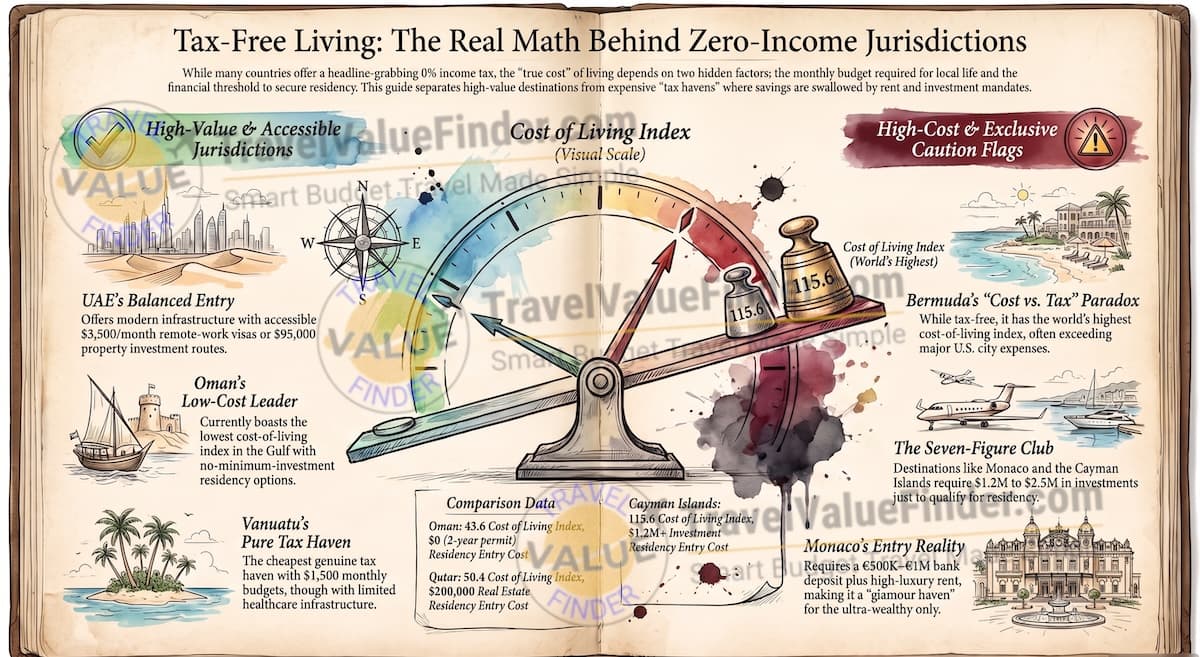
Searching for countries with no income tax usually starts with one number in mind: zero. Zero percent on your salary, your pension, your investment gains. But zero income tax and low cost of living are two completely different things and mixing them up is how high-net-worth retirees and digital nomads end up paying $25,000 a month in rent to save on a tax bill they could have legally minimized elsewhere for a fraction of the cost.
Leslie Nics, TravelValueFinder.com | Last updated: July 2026 | Last Reviewed: July 18 2026
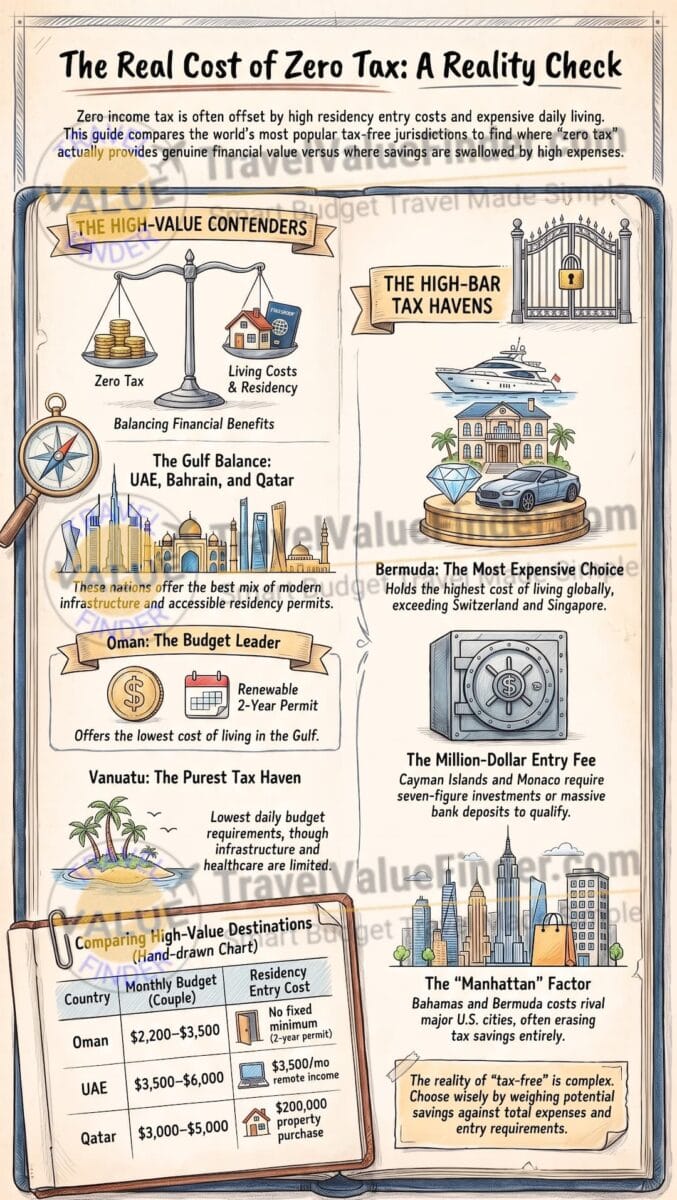
This guide ranks 10 genuinely zero-income-tax countries by what actually determines value: the real cost of living once you’re there, and what it costs in cash to qualify for residency in the first place.
Countries With No Income Tax: Why ‘Tax-Free’ Doesn’t Always Mean Cheap
Every country on this list charges 0% personal income tax on salaries, pensions, and investment income for qualifying residents. That much is consistent. What varies enormously is everything else: the cost of living once you arrive, the size of the check you need to write just to get a residency permit, and how realistic that permit actually is for someone who isn’t already a billionaire.
Leslie Nics, founder of TravelValueFinder.com, cross-checked each destination’s cost of living against its residency threshold to separate the countries where zero tax translates into genuine value from the ones where the ‘savings’ get swallowed by $10,000-a-month rent before you’ve unpacked a single box.
A lot of people fixate on the 0% and skip the arithmetic. If moving somewhere costs you $2 million in real estate and $150,000 a year in rent to avoid a tax bill that a good accountant could have cut in half from your kitchen table, that’s not a tax strategy – that’s an expensive vacation. Leslie Nics, Founder & Lead Travel Writer, TravelValueFinder.com
Cost-of-living figures below come from the Numbeo Cost of Living Index by Country 2026 (U.S. = 68.8 as the baseline). Residency and investment thresholds are cross-checked against each country’s official immigration or investment authority, linked in each profile and in the Sources section at the end of this guide.
Tax rules shift – Oman, for example, has already announced a 5% personal income tax starting in 2028 for high earners – so always confirm current status directly with official sources before making any decision.
| 10 Countries With No Income Tax, Ranked by Real Value 1. UAE – best all-round balance of safety, infrastructure, and accessible visas 2. Bahrain – cheapest Gulf option with an easy golden visa 3. Oman – lowest cost of living in the Gulf, but a 5% tax arrives for high earners in 2028 4. Qatar – newly affordable $200K residency tier, modern and safe 5. Vanuatu – the cheapest true tax haven on earth, with real trade-offs 6. Kuwait – genuinely cheap, but residency is nearly closed to non-employees 7. Bahamas – close to the U.S., but costs nearly as much as Manhattan 8. Cayman Islands – a real tax haven only for the genuinely wealthy 9. Bermuda – the most expensive cost of living Numbeo tracks, anywhere 10. Monaco – the ultimate glamour tax haven; a cautionary tale in the math |
Cost of Living vs. What It Actually Costs to Get In
This is the comparison most tax-haven roundups skip: the sticker price to live there once you’re a resident, side by side with the sticker price to become a resident in the first place. A country can be genuinely ‘zero tax’ and still be a poor deal once you run both numbers.
| Country | Cost of Living Index | Couple’s Monthly Budget | Residency Cost to Qualify |
| 1. UAE | 55.2 | $3,500–$6,000 | $95K+ property or $3,500/mo remote-work income |
| 2. Bahrain | 47.6 | $2,800–$4,500 | Real estate or business investment, no fixed public minimum |
| 3. Oman | 43.6 | $2,200–$3,500 | As low as no minimum (2-yr permit) up to $650K (5-yr) |
| 4. Qatar | 50.4 | $3,000–$5,000 | $200K real estate (new 2025 tier) |
| 5. Vanuatu | n/a (very low) | $1,500–$2,500 | $100K property investment |
| 6. Kuwait | 42.5 | $2,500–$4,000 | Employer sponsorship, or $16.3M investor tier |
| 7. Bahamas | 98.8 | $5,500–$9,000 | $750K+ property for permanent residency |
| 8. Cayman Islands | 115.6 | $7,000–$12,000+ | $1.2M–$2.4M real estate investment |
| 9. Bermuda | 135.8 | $9,000–$15,000+ | $2.5M qualifying investment |
| 10. Monaco | very high (n/a) | $15,000–$30,000+ | €500K–€1M bank deposit + luxury rent |
Figures are planning ranges based on the sources cited throughout this guide and change with exchange rates and program updates – always verify current thresholds with the relevant government authority before committing.
1. United Arab Emirates – The Best All-Round Balance
The UAE remains the most practical of all countries with no income tax for a working retiree or digital nomad: modern infrastructure, strong safety, direct flights worldwide, and critically genuinely accessible residency routes that don’t require eight-figure wealth. Dubai runs noticeably pricier than Abu Dhabi or Sharjah, so the metro area you choose changes this math substantially.
Cost of Living Index: 55.2 (vs. U.S. 68.8)
Value verdict: Good – the most accessible tax-free residency of the major Gulf states
Residency routes: Remote Work Visa (~$3,500/month foreign income), Golden Visa (AED 2M / ~$545K property or investment), or standard employment visa
The catch: 5% VAT on purchases; 9% corporate tax on business profits over AED 375,000; Dubai living costs rival many U.S. cities
If you are considering visiting Dubai before committing, find Best Budget Hotels in Dubai
2. Bahrain – The Cheapest Gulf Option With an Easy Golden Visa
Bahrain is consistently the least-discussed and most underrated Gulf option: lower costs than the UAE or Qatar, a causeway connection to Saudi Arabia, and residency routes that don’t demand the eight-figure sums some Caribbean and European tax havens require.
Cost of Living Index: 47.6 (vs. U.S. 68.8)
Value verdict: Good, genuinely affordable by Gulf standards with straightforward investor and property routes
Residency routes: Employment contract, business investment, or golden visa via qualifying real estate purchase
The catch: Smaller expat infrastructure and fewer direct international flights than Dubai or Doha
3. Oman – The Lowest Cost of Living in the Gulf (For Now)
Oman offers the cheapest cost of living of any Gulf tax-free country and uniquely among this group – a no-minimum-investment pathway to a renewable two-year residency permit, alongside larger investment tiers for longer terms. The one thing to flag clearly: Oman has already announced a 5% personal income tax beginning in 2028 for annual income above roughly $109,000, so ‘zero tax’ has a shelf life here for higher earners.
Cost of Living Index: 43.6 (vs. U.S. 68.8)
Value verdict: Good today, worth watching – the cheapest Gulf option, but not permanently zero-tax for high earners
Residency routes: No-minimum 2-year renewable permit; $650K for 5-year residency; $1.3M for 10-year residency
The catch: 5% tax on income above ~$109,000/year begins January 2028; 180-day physical presence required to maintain most permits
4. Qatar – A Newly Affordable, Modern Entry Point
Qatar spent years positioning its residency-by-investment program at a $1 million threshold before introducing a far more accessible $200,000 real estate tier in 2025 – a genuine shift that puts World Cup-era infrastructure within reach of a much wider range of retirees and remote professionals.
Cost of Living Index: 50.4 (vs. U.S. 68.8)
Value verdict: Good, the new lower-tier property route is a real improvement in accessibility
Residency routes: $200K real estate (renewable residency, no sponsor needed) or $1M real estate (permanent residency)
The catch: Property must sit in one of 25 government-designated freehold zones; permanent-residency approvals are capped annually
5. Vanuatu – The Cheapest Genuine Tax Haven on Earth
If pure cost of living is the priority, Vanuatu is the standout on this entire list – a South Pacific nation with zero personal income, capital gains, and inheritance tax, and a monthly budget that undercuts every other country here by a wide margin. The trade-off is real: limited healthcare infrastructure, a small expat community, and long flight connections from North America.
Cost of Living Index: Not tracked by Numbeo, but consistently reported around $1,500/month for a comfortable single budget
Value verdict: Good for budget-focused nomads, with real infrastructure trade-offs to weigh honestly
Residency routes: Investor Permit – $100,000 in property or agricultural land, renewable up to 10 years
The catch: Limited specialist healthcare; most serious medical care means flying to Australia or New Zealand
Kuwait is a genuinely cheap, genuinely zero-tax country – and almost impossible to move to without a job offer or eight figures. That’s the pattern I want people to see: cheap and tax-free and accessible are three different boxes, and very few countries check all three. – Leslie Nics, Founder & Lead Travel Writer, TravelValueFinder.com
6. Kuwait – Cheap and Tax-Free, but Practically Closed to Outsiders
Kuwait belongs on this list because it genuinely charges zero personal income tax and has a lower cost of living than the UAE or Qatar. But it earns a caution flag for a reason competitor round-ups often skip: unlike its Gulf neighbors, Kuwait has no accessible investor or golden-visa route for most foreigners. Residency is almost entirely tied to employer sponsorship, and the newer 15-year investor track requires a roughly $16.3 million minimum investment.
Cost of Living Index: 42.5 (vs. U.S. 68.8)
Value verdict: Caution, cheap on paper, but not a realistic option without a job offer or extreme wealth
Residency routes: Employer-sponsored work visa (Iqama); 15-year investor residency requires ~$16.3M
The catch: No accessible retiree or digital-nomad visa exists as of this writing
7. The Bahamas – Close to Home, But It Costs Like Manhattan
The Bahamas is the closest zero-income-tax country to the U.S. mainland, and that proximity carries a real price tag: a Cost of Living Index of 98.8 puts it close to major U.S. cities, not below them. Permanent residency requires a $750,000 property purchase, and a 15% corporate tax now applies to large multinationals.
Cost of Living Index: 98.8 (vs. U.S. 68.8) – nearly on par with the U.S. national average
Value verdict: Caution – the proximity and lifestyle appeal is real, but the tax savings shrink fast against the cost of living
Residency routes: Permanent Residency via $750K+ property purchase; Annual Residence Permit for remote workers
The catch: Imported goods, including groceries and vehicles, run significantly above U.S. prices
8. Cayman Islands – A Real Tax Haven, Priced for the Genuinely Wealthy
The Cayman Islands is the financial-services gold standard of zero-tax jurisdictions – no income, capital gains, corporate, or inheritance tax. But it’s honest to say this destination is built for investors who can write a seven-figure check without blinking: residency starts at $1.2 million and permanent residency requires $2.4 million in developed real estate, on top of a cost of living that runs well above the U.S. national average.
Cost of Living Index: 115.6 (vs. U.S. 68.8)
Value verdict: Caution – excellent tax structure, but only genuinely good value for high-net-worth individuals
Residency routes: Residency Certificate – $1.2M investment; Certificate of Permanent Residence – $2.4M in developed real estate
The catch: Residency certificates generally don’t grant the right to work locally; groceries and housing run well above U.S. prices
9. Bermuda – The Most Expensive Cost of Living Numbeo Tracks, Anywhere
Bermuda tops Numbeo’s global Cost of Living Index outright – more expensive than Switzerland, more expensive than Singapore. It’s the clearest illustration on this list of the core lesson: zero income tax means nothing if daily life costs more than the tax bill you’re avoiding. The island’s Economic Investment Residential Certificate requires a $2.5 million qualifying investment.
Cost of Living Index: 135.8 – the highest of any country tracked by Numbeo’s 2026 index
Value verdict: Caution – a genuine tax haven, but the world’s most expensive cost of living erodes much of the benefit for all but the wealthiest
Residency routes: Economic Investment Residential Certificate – $2.5M qualifying investment; employer-sponsored work permits also available
The catch: No standalone retiree or digital-nomad visa; most non-investment routes require a Bermuda-based employer
10. Monaco – The Ultimate Glamour Tax Haven, and the Clearest Cautionary Tale
Monaco is the destination most people picture when they hear ‘tax haven,’ and it delivers exactly what the reputation promises: zero personal income tax, extraordinary safety, and a two-square-kilometer principality packed with the wealthy. The reality check is stark – a realistic first-year budget to establish residency, including the required bank deposit, runs €600,000 to €800,000 for a single applicant, with ongoing annual living costs of €80,000 to €150,000 even after that.
Cost of Living Index: Not tracked by Numbeo, but consistently ranked among the most expensive places on earth
Value verdict: Caution – a legitimate tax haven strictly for the ultra-wealthy, not a realistic ‘affordable tax-free’ option
Residency routes: Monegasque bank deposit, typically €500K–€1M, plus proof of accommodation via lease or purchase
The catch: A modest one-bedroom rents for €3,500–€5,000/month; French citizens remain subject to French taxation even while resident
What I’d Do Differently
The mistake I see most often with countries with no income tax isn’t picking the wrong country – it’s skipping the arithmetic entirely. Someone reads that Bermuda or the Cayman Islands charges zero income tax, gets excited about the headline number, and doesn’t run the actual math on rent, groceries, and the investment threshold until they’re already deep into the application.
I’ve started asking one blunt question before recommending any tax-free destination: what does a comfortable, unremarkable month actually cost here – not the marketing version, the real one? For Bermuda, that number is genuinely higher than most U.S. cities.
For Bahrain or Oman, it’s often lower than where the person already lives. That single gut-check reshuffled this entire ranking away from the flashiest names toward the ones that hold up under real scrutiny.
Tax-free doesn’t mean cost-free. Run the actual monthly budget before you run the paperwork – the country with the best headline tax rate is rarely the one with the best total cost of living. – Leslie Nics, Founder & Lead Travel Writer, TravelValueFinder.com
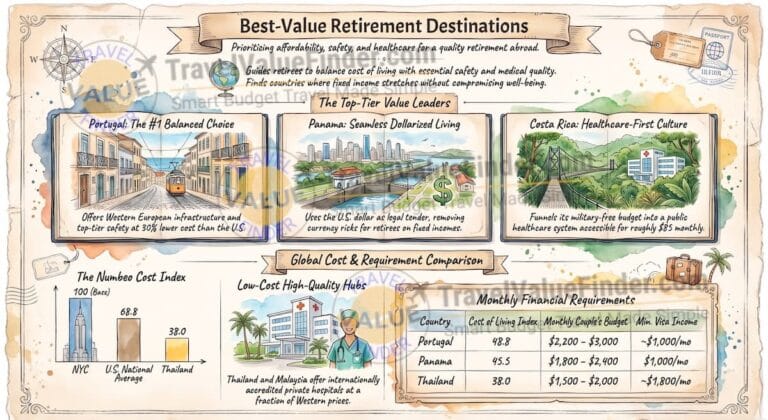
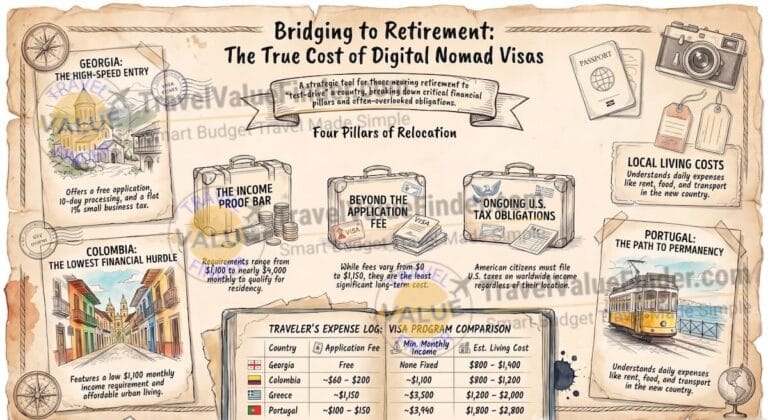
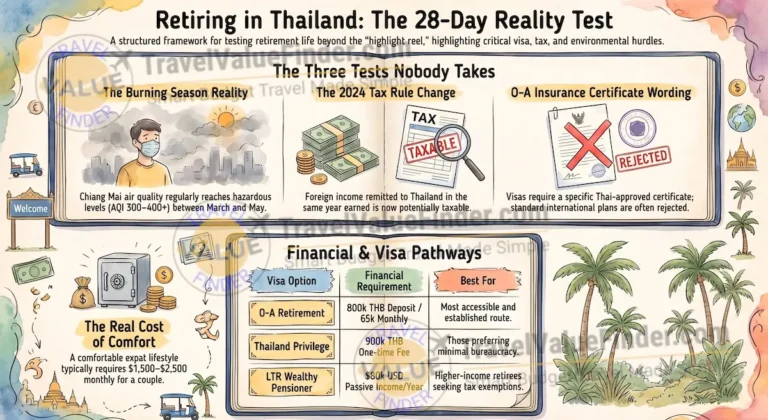
If retirement destinations with lower barriers to entry are also on your radar, our Affordable Retirement guide and our full ranking of cheapest places to live in the world for retirees cover countries with low taxes and low costs of living, even where the rate isn’t literally zero. And if visa cost is a factor either way, see our breakdown of what digital nomad visas actually cost.
People Also Asked
Which country has no income tax and a low cost of living?
Among genuinely zero-income-tax countries, Oman and Bahrain currently offer the lowest cost of living paired with realistic residency requirements. Vanuatu is cheaper still on a day-to-day basis, but comes with meaningfully less healthcare infrastructure and a smaller expat community.
Do U.S. citizens still owe taxes in a country with no income tax?
Yes. The United States taxes citizens on worldwide income regardless of where they live. The Foreign Earned Income Exclusion can shield a portion of foreign-earned income each year, but U.S. citizens generally remain required to file a federal return no matter which zero-tax country they relocate to. A cross-border tax professional should confirm your specific situation.
What is the easiest tax-free country to get residency in?
Oman’s no-minimum-investment two-year renewable permit and the UAE’s Remote Work Visa (requiring roughly $3,500/month in foreign income, with no property purchase) are currently the two most accessible entry points among established zero-income-tax countries.
Are there any tax-free countries that are actually cheap to live in?
Yes, Oman, Bahrain, and Vanuatu all combine zero personal income tax with a cost of living meaningfully below the U.S. national average. The more famous tax havens – Monaco, Bermuda, and the Cayman Islands – tend to be dramatically more expensive both to live in and to qualify for residency.
Ready to compare cities now?
- Use our Free Retirement Cost of Living Calculator — get your personalized report in 30 seconds – Free PDF download.
- How to Use a Retirement Cost of Living Calculator – to Compare Cities Worldwide
Frequently Asked Questions
What countries have zero income tax in 2026?
As of 2026, countries that charge no personal income tax include the UAE, Bahrain, Oman, Qatar, Kuwait, Saudi Arabia, Vanuatu, the Bahamas, Bermuda, the Cayman Islands, Monaco, Brunei, and several other Caribbean and Gulf jurisdictions. Rules change; always confirm current status with the relevant country’s tax authority.
Is Dubai really tax-free for expats?
Personal income in the UAE, including Dubai, is not subject to income tax at the federal or emirate level. Residents do pay 5% VAT on most purchases, and a 9% corporate tax applies to qualifying business profits above AED 375,000 – so ‘tax-free’ applies specifically to personal income, not to every form of taxation.
How much money do you need to move to a tax-free country?
It varies enormously by country. Oman offers a no-minimum-investment two-year permit, while Bermuda’s investment-based residency requires $2.5 million and Monaco typically expects a €500,000–€1,000,000 bank deposit. Employment-based visas in several Gulf states require no personal investment at all, just a qualifying job offer.
Do these countries have other hidden costs besides tax?
Most fund government operations through VAT, corporate tax, import duties, tourism levies, or natural-resource revenue instead of personal income tax. Practically, that often shows up as higher prices on imported goods, groceries, and vehicles – factor these into your cost-of-living comparison rather than looking at the income tax rate alone.
Is it worth moving to a tax haven just to save on taxes?
This depends entirely on your income level, the size of the tax bill you’re offsetting, and how much you value the lifestyle differences of relocating. For very high earners, the math can work out clearly in destinations like the UAE or Bahrain. For more moderate incomes, the cost of relocating and the higher cost of living in some tax havens can outweigh the tax savings – this is genuinely worth modeling with a tax professional before deciding, not a decision to make from the headline rate alone.
The Bottom Line
Countries with no income tax are a legitimate, well-established wealth-planning strategy for high earners – but the zero-percent headline number tells you almost nothing about whether a destination is actually good value.
The UAE, Bahrain, Oman, and Qatar currently offer the strongest combination of accessible residency and reasonable cost of living. Vanuatu is the cheapest genuine option for those willing to trade some infrastructure for savings.
Monaco, Bermuda, and the Cayman Islands remain legitimate zero-tax jurisdictions – just ones where the true cost of entry and daily living needs to be run in full before the tax savings mean anything.
Whichever destination you’re considering, confirm current tax rules and residency thresholds directly with official government sources – both change, sometimes with little advance notice.
Sources
- Numbeo Cost of Living Index by Country 2026
- UAE – Golden Visa, Official Government Portal
- Qatar – Ministry of Interior / Hukoomi e-Government Portal
- Oman – Royal Oman Police, Investor Residency Program
- Bahrain – Labour Market Regulatory Authority
- Kuwait – Public Authority for Civil Information
- Vanuatu – Department of Immigration and Passport Services
- The Bahamas – Ministry of Financial Services, Trade & Industry
- Cayman Islands – Department of Immigration (WORC)
- Bermuda – Department of Immigration
- Monaco – Immigration and Residence Department
- U.S. Internal Revenue Service – Foreign Earned Income Exclusion
About the Author
Leslie Nics is the founder and lead researcher at TravelValueFinder.com, where she covers cost-of-living comparisons, retirement destinations, and value-focused travel planning. Leslie researches each destination’s cost data, safety records, and healthcare access directly from official sources before publishing. Learn more about Leslie or read the site’s Trust & Transparency Policy.