Travel Value Finder

If you’ve searched for the cheapest places to live in the world, you’ve probably noticed that most lists rank countries by price alone – a $1,200-a-month apartment in a place you’d never actually want to grow old in. For retirees, a low price tag only matters if it comes bundled with real safety, decent healthcare, and infrastructure that actually works when you need it to.
Leslie Nics, TravelValueFinder.com | Last updated: July 2026 | Last Reviewed: July 17 2026
This guide ranks the 10 best-value countries for retirees by combining hard cost-of-living data with official safety and healthcare rankings, so you can see where a fixed income genuinely stretches – without gambling on the basics that matter most after 55.
Why the Cheapest Places to Live in the World Aren’t Always the Best Value for Retirees
Plenty of roundups chase the single cheapest countries on earth – places where a dollar goes furthest on paper. But raw cost-of-living data doesn’t tell you whether an ambulance will show up, whether the tap water is safe, or whether your bank card will work at the pharmacy.
For this list, Leslie Nics, founder of TravelValueFinder.com, weighted four factors that actually determine quality of life in retirement: day-to-day cost of living, personal safety, healthcare access and quality, and the practical infrastructure (banking, internet, transport, English-language services) that makes daily life manageable.
I’ve stopped recommending the absolute cheapest country on any list. The retirees who thrive abroad aren’t the ones who saved the most on rent – they’re the ones who never had to think twice about calling a doctor. Leslie Nics, Founder & Lead Travel Writer, TravelValueFinder.com
The rankings below draw on the Numbeo Cost of Living Index (U.S. = 68.8 as the baseline), the Institute for Economics and Peace’s Global Peace Index, the U.S. Department of State’s country-by-country travel advisories, and healthcare-quality data reported by the CEOWORLD Health Care Index.
Visa income figures are cross-checked against each country’s official immigration portal, linked in the profile below and in the Sources section at the end of this guide.
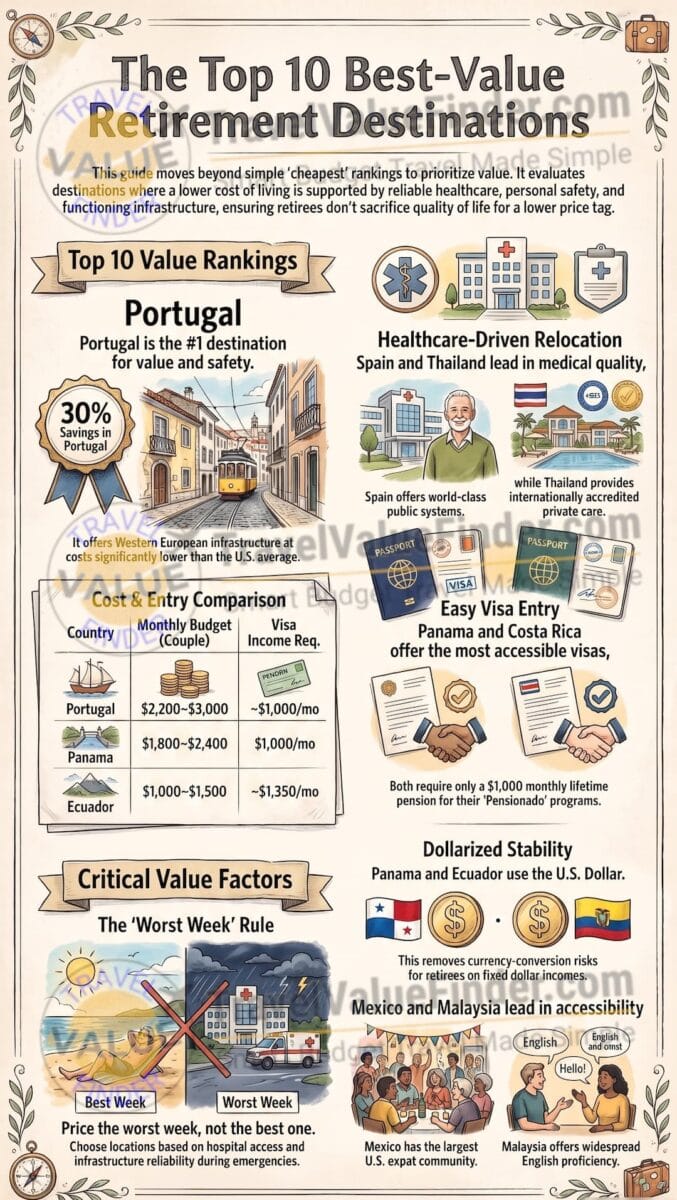
| The 10 Cheapest Places to Live in the World for Retirees (Ranked by Value) 1. Portugal – safest top-10 country in the world with a public healthcare system 2. Uruguay – South America’s most stable democracy, low cost premium for peace of mind 3. Costa Rica – no standing army, subsidized CCSS healthcare from $85/month 4. Panama – U.S. dollar economy, $1,000/month Pensionado visa 5. Spain – one of the world’s top-ranked public healthcare systems 6. Malaysia – low cost, English widely spoken, modern private hospitals 7. Mexico – closest to the U.S., massive established retiree communities 8. Thailand – internationally accredited hospitals at a fraction of U.S. cost 9. Colombia – cheapest major city living with fast-improving urban safety 10. Ecuador – the lowest cost of living on this list, fully dollarized economy |
Cost, Safety & Healthcare at a Glance
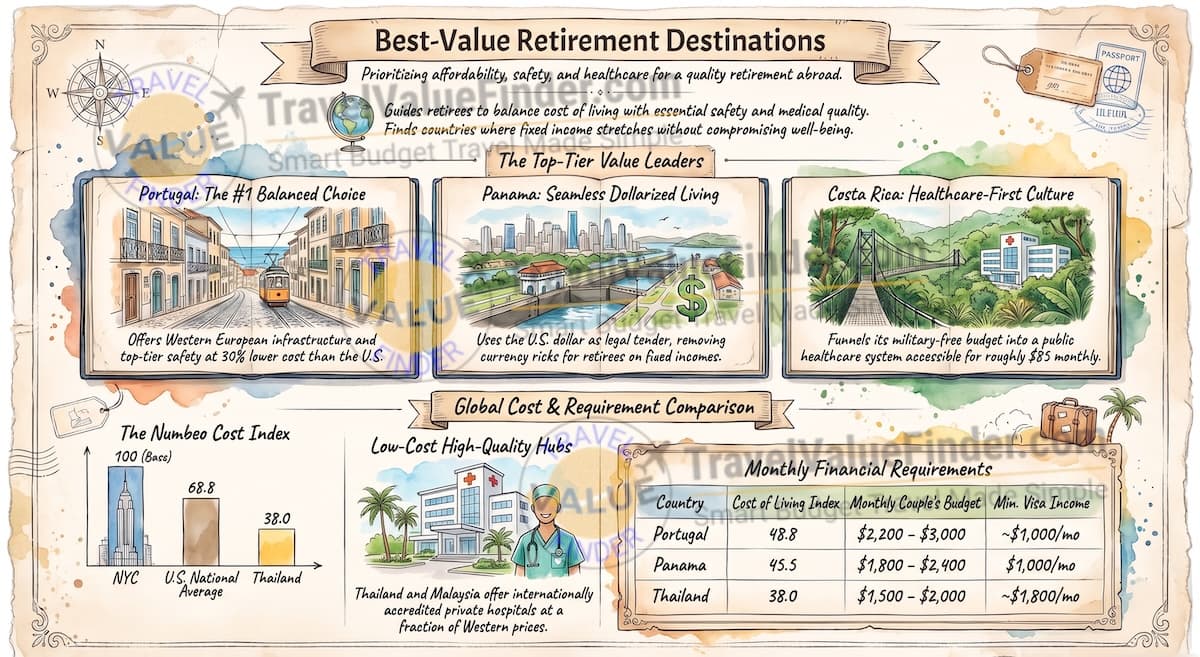
The table below compares all 10 destinations side by side. The Numbeo Cost of Living Index uses New York City as 100, so a score of 45 means daily costs run roughly 45% of NYC prices, not 45% of the U.S. average – the U.S. national figure sits at 68.8 for comparison.
| Rank / Country | Cost of Living Index | Couple’s Monthly Budget | Retiree Visa Income Req. |
| 1. Portugal | 48.8 | $2,200–$3,000 | €920/mo (~$1,000) |
| 2. Uruguay | 55.6 | $2,300–$2,900 | No fixed minimum* |
| 3. Costa Rica | 52.9 | $2,000–$2,600 | $1,000/mo pension |
| 4. Panama | 45.5 | $1,800–$2,400 | $1,000/mo pension |
| 5. Spain | 51.6 | $2,500–$3,200 | ~$2,650/mo |
| 6. Malaysia | 34.0 | $1,500–$2,100 | ~$1,050/mo + deposit |
| 7. Mexico | 42.6 | $1,600–$2,200 | ~$1,620–$2,700/mo** |
| 8. Thailand | 38.0 | $1,500–$2,000 | ~$1,800/mo or deposit |
| 9. Colombia | 31.7 | $1,200–$1,700 | ~$1,000/mo |
| 10. Ecuador | 30.9 | $1,000–$1,500 | ~$1,350/mo |
- Uruguay’s residency process weighs demonstrated means rather than a single published income floor – check current guidance from Uruguay’s immigration authority.
- Mexican consulates calculate the threshold differently post-by-post; some use the UMA formula, which can run notably higher than the historic minimum-wage formula.
- Always confirm current figures directly with the relevant consulate or immigration ministry before planning a move.
1. Portugal – The Safest Top-10 Country With Genuinely Affordable Living
Portugal keeps landing on cheapest places to live in the world lists for a simple reason: it delivers Western European infrastructure, an excellent public healthcare system, and one of the best safety records anywhere, at a cost of living roughly 30% below the U.S. national average. Lisbon and Porto run higher; smaller towns in the Algarve or Alentejo stretch a retirement budget considerably further.
Cost of Living Index: 48.8 (vs. U.S. 68.8)
Safety: Ranked among the world’s 10 safest countries on the 2026 Global Peace Index
Healthcare: Public Serviço Nacional de Saúde (SNS) is open to legal residents; life expectancy of 82+ years
Retiree visa: D7 Passive Income Visa – €920/month (~$1,000) for a single applicant, plus 50% for a spouse
TravelValueFinder covers Portugal in depth in our Retire in Portugal guide, our Portugal cost-of-living breakdown, and our D7 visa walkthrough.
2. Uruguay – South America’s Quietest, Most Stable Democracy
Uruguay isn’t the cheapest country on this list, and that’s the point: you’re paying a modest premium for the kind of political and social stability that’s rare in the region. It’s consistently described as one of the calmest, most orderly countries in Latin America, with strong rule of law and a well-regarded mutualista (private-cooperative) healthcare system that residents can join affordably.
Cost of Living Index: 55.6 (vs. U.S. 68.8)
Safety: Regularly cited as one of the most stable countries in the Americas
Healthcare: Mutualista system offers broad coverage; Montevideo has modern private hospitals
Retiree visa: Renewable residency based on demonstrated means; no employment required
3. Costa Rica – Pura Vida Living With a Public Health System That Works
Costa Rica abolished its military in 1948 and has funneled that budget into education and healthcare ever since – a genuinely unusual foundation for a retirement destination. The Pensionado visa is one of the most accessible retirement visas anywhere, and CCSS (‘the Caja’) public healthcare buy-in typically runs around $85 a month based on declared income.
Cost of Living Index: 52.9 (vs. U.S. 68.8)
Safety: No standing army since 1948; U.S. State Department rates it similarly to much of Western Europe
Healthcare: CCSS (Caja) public system open to residents from roughly $85/month
Retiree visa: Pensionado – $1,000/month lifetime pension, or Rentista – $2,500/month for 2 years
If you’re weighing a trip before committing, our real Costa Rica travel budget breakdown shows exactly what a week there costs on the ground.
4. Panama – A Dollarized Economy With One of the World’s Easiest Retiree Visas
Panama uses the U.S. dollar as legal tender, which removes currency-conversion guesswork entirely – a genuine, underrated perk for retirees on a fixed dollar income. The Pensionado visa requires only a $1,000 monthly lifetime pension (as low as $750 if paired with a $100,000 property purchase) and comes with a legally mandated discount schedule covering everything from hospital bills to bus fares.
Cost of Living Index: 45.5 (vs. U.S. 68.8)
Safety: U.S. dollar economy; State Department advisory in line with most of Central America
Healthcare: Modern private hospitals in Panama City; public CSS system for residents
Retiree visa: Pensionado – $1,000/month lifetime pension, no age minimum
5. Spain – Higher Cost, but Genuinely World-Class Healthcare
Spain costs more than the other countries on this list, but it earns its spot because of the trade it offers: a public healthcare system that regularly ranks among the best on earth, extensive infrastructure, and an enormous, well-established expat community. Retirees who prioritize medical quality over rock-bottom prices consistently choose Spain over cheaper neighbors.
Cost of Living Index: 51.6 (vs. U.S. 68.8)
Safety: Low violent crime; State Department notes general caution around crowded tourist areas
Healthcare: Public system ranked among the world’s best; residents gain access after registration
Retiree visa: Non-Lucrative Visa – approximately $2,650/month in passive income
See our full Retire in Spain guide, Spain cost-of-living numbers, and our side-by-side Spain vs. Portugal retirement comparison if you’re deciding between the two.
The retirees who regret their move almost never regret the country – they regret skipping the healthcare research. Read the visa fine print before you fall in love with the beach. Leslie Nics, Founder & Lead Travel Writer, TravelValueFinder.com
6. Malaysia – Asia’s Best Value for English-Speaking Retirees
Malaysia combines a genuinely low cost of living with widespread English proficiency, modern private hospitals, and a multicultural food scene that consistently surprises first-time visitors. The Malaysia My Second Home (MM2H) program has been revised several times, so current applicants should confirm requirements directly with the program before planning around older figures.
Cost of Living Index: 34.0 (vs. U.S. 68.8)
Safety: Generally low crime; English widely spoken in Kuala Lumpur and Penang
Healthcare: Private hospitals draw international medical tourists at a fraction of U.S. prices
Retiree visa: MM2H ‘Silver’ tier – roughly RM150,000 fixed deposit plus RM5,000/month income
Curious what the region looks like before committing to residency? Our Kuala Lumpur budget hotel guide is a useful starting point for a scouting trip.
7. Mexico – The Closest, Most Established Retiree Community
No country on this list has a larger, longer-established American retiree population than Mexico. Lake Chapala, San Miguel de Allende, and Mérida have decades-old expat infrastructure – English-speaking doctors, familiar grocery brands, direct flights home. Safety varies significantly by region, so it’s worth researching specific states rather than treating ‘Mexico’ as a single data point.
Cost of Living Index: 42.6 (vs. U.S. 68.8)
Safety: Overall advisory sits at ‘exercise increased caution’; conditions vary sharply by state – check region-specific guidance
Healthcare: IMSS public option plus extensive, affordable private care in major retiree hubs
Retiree visa: Temporary Resident Visa – income thresholds vary by consulate, roughly $1,600–$2,700+/month
Explore the country first with our Where to Stay in Mexico City guide.
8. Thailand – Internationally Accredited Hospitals at a Fraction of U.S. Cost
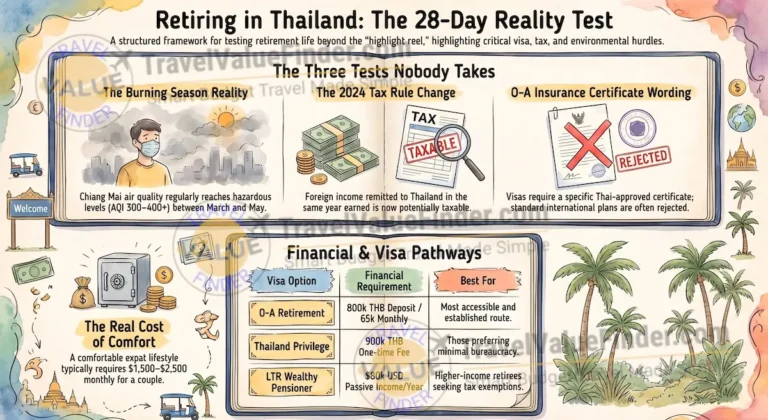
Thailand built a reputation as a medical-tourism hub for a reason: Bangkok’s flagship hospitals hold the same international accreditations recognized by U.S. insurers, at a small fraction of stateside prices. The O-A retirement visa is well-established, though it requires either a substantial bank deposit or a monthly income well above Costa Rica or Panama’s thresholds.
Cost of Living Index: 38.0 (vs. U.S. 68.8)
Safety: Overall advisory at ‘exercise increased caution’; border regions carry elevated caution notices
Healthcare: Internationally accredited private hospitals in Bangkok and Chiang Mai
Retiree visa: O-A Visa – 800,000 THB (~$22,000) deposit or ~65,000 THB/month (~$1,800) income
See our Where to Stay in Bangkok guide for a first look at the city.
9. Colombia – The Cheapest Major Cities on This List, With Fast-Improving Safety
Medellín’s transformation over the past two decades is well documented, and it now anchors a growing community of North American retirees drawn to its spring-like climate and low costs. Colombia’s retirement visa is straightforward for anyone with a qualifying pension, though – as with Mexico – safety and infrastructure vary meaningfully by neighborhood and city.
Cost of Living Index: 31.7 (vs. U.S. 68.8)
Safety: Overall advisory at ‘exercise increased caution’; major retiree-friendly neighborhoods have improved substantially
Healthcare: EPS system offers broad, affordable coverage; well-regarded private clinics in Bogotá and Medellín
Retiree visa: Pensioner (Type M) visa – roughly $1,000+/month in qualifying pension income
10. Ecuador – The Lowest Cost of Living on This List, Fully Dollarized
Ecuador rounds out this ranking as the cheapest country here by Numbeo’s index – and it uses the U.S. dollar, so there’s no currency conversion to track. Cuenca, a UNESCO World Heritage colonial city in the Andean highlands, is the long-time favorite among American retirees for its walkable center, spring-like climate, and lower crime profile than coastal cities.
Cost of Living Index: 30.9 (vs. U.S. 68.8) – the lowest on this list
Safety: Overall advisory at ‘exercise increased caution’; highland cities like Cuenca generally see fewer safety concerns than the coast
Healthcare: IESS public system open to residents; affordable private hospitals in Quito and Cuenca
Retiree visa: Pensioner visa – roughly $1,350/month in qualifying pension income
What I’d Do Differently
I’ll be honest about a mistake I see readers make constantly, because I made a version of it myself early on: chasing the lowest cost-of-living number without weighting healthcare access. On an early scouting trip, I nearly recommended a coastal town purely because rent was unbeatable – until I asked where the nearest hospital with a cardiologist actually was, and the answer was a two-hour drive.
Now I won’t put a destination on a cheapest places to live list unless I can point to a specific hospital, clinic network, or public health system a retiree could actually reach in an emergency. That single filter has quietly bumped several popular ‘ultra-cheap’ destinations off my own shortlist – and it’s why this ranking leans toward Portugal, Uruguay, and Costa Rica over destinations that are cheaper on paper alone.
Cheap only counts as value if you’d still choose it after a bad week – a hospital visit, a power outage, a bank card that doesn’t work. Price the worst week, not the best one. Leslie Nics, Founder & Lead Travel Writer, TravelValueFinder.com
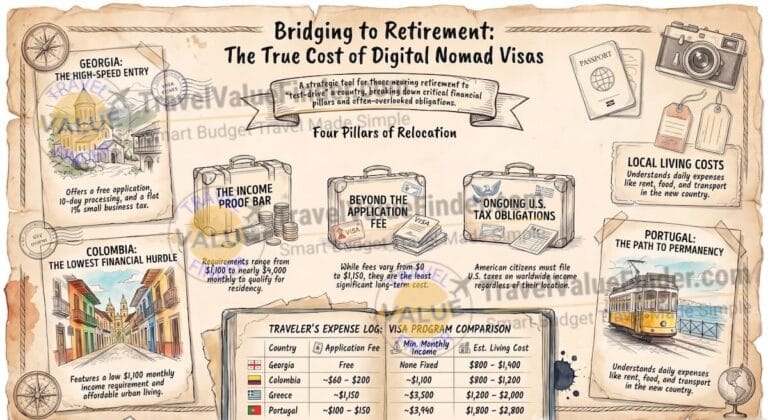
For deeper planning, our Affordable Retirement guide compares countries by where your money goes furthest, and if a visa program is part of your decision, our breakdown of what digital nomad and residency visas actually cost is a useful companion read.
You may be interested to find out more about Countries With No Income Tax: The Real Cost-of-Living Reality Check for Retirees & Digital Nomads
People Also Asked
What is the cheapest and safest country to retire to?
Based on the combined cost, safety, and healthcare data in this guide, Portugal offers the strongest balance: a Cost of Living Index of 48.8 against the U.S.’s 68.8, a spot among the world’s 10 safest countries on the 2026 Global Peace Index, and a public healthcare system open to legal residents.
Can I retire abroad on just Social Security?
In several countries on this list – including Portugal, Panama, Costa Rica, and Colombia – the average U.S. Social Security benefit clears the minimum income threshold for a retiree visa on its own, though a comfortable monthly budget typically calls for some additional savings or supplemental income.
Which countries let retirees keep receiving U.S. Social Security payments?
The Social Security Administration pays benefits to eligible retirees living in most countries worldwide, with a short list of exceptions. Confirm your specific destination against the official SSA payments-abroad guidance before finalizing a move.
Do I need private health insurance if I retire abroad?
Most retiree visa programs – including Portugal’s D7, Panama’s Pensionado, and Thailand’s O-A – require proof of private health insurance at the time of application, even in countries with strong public systems. Many retirees carry private coverage initially, then transition to the local public system once residency is established.
Frequently Asked Questions
What is the actual cheapest place to live in the world?
By Numbeo’s 2026 Cost of Living Index, some of the lowest-cost countries globally include Pakistan, Egypt, and Afghanistan – but these don’t appear on this list because they don’t meet the safety, healthcare, or infrastructure standards most U.S. retirees require. Among destinations that do meet those standards, Ecuador is the least expensive on this list, with a Cost of Living Index of 30.9.
How much money do I need to retire abroad comfortably?
Across the 10 destinations in this guide, a couple can typically live comfortably on $1,000 to $3,200 a month, depending on the country and city. Ecuador, Colombia, and Malaysia sit at the lower end; Spain and Uruguay sit at the higher end but offer trade-offs in healthcare quality or regional stability.
Is it safe for American retirees to live in Latin America?
Safety varies significantly by country and even by neighborhood, which is why this guide checks each destination against official U.S. State Department travel advisories rather than treating an entire region as uniformly safe or unsafe. Costa Rica, Panama, and Uruguay consistently score well; safety in Mexico and Colombia depends heavily on the specific state or city.
What’s the easiest retirement visa to qualify for?
Costa Rica’s Pensionado visa and Panama’s Pensionado visa both set the bar at $1,000 a month in guaranteed lifetime pension income – among the lowest and most straightforward thresholds of any dedicated retirement visa program worldwide.
Do these countries tax U.S. retirement income?
Tax treatment varies by country and depends on your specific income sources, residency status, and any applicable tax treaty. This is genuinely worth a conversation with a cross-border tax professional before you move – the details below are general starting points, not personal tax advice.
The Bottom Line
The cheapest places to live in the world for retirees aren’t always the ones with the lowest sticker price – they’re the ones where safety, healthcare, and everyday infrastructure hold up once you’re actually living there.
Portugal, Uruguay, and Costa Rica lead this ranking because they balance genuine affordability with the systems that matter most after 55.
Whichever destination you’re weighing, verify visa income requirements directly with the relevant government agency before you commit – thresholds and program rules change, sometimes with little notice.
Sources
- Numbeo Cost of Living Index by Country 2026
- Institute for Economics & Peace – Global Peace Index
- U.S. Department of State – Travel Advisories
- U.S. Social Security Administration – Payments Abroad
- Portugal – Ministry of Foreign Affairs Visa Portal
- Costa Rica – Dirección General de Migración y Extranjería
- Panama – Servicio Nacional de Migración
- Spain – Ministerio de Asuntos Exteriores
- Malaysia My Second Home – Official Program Portal
- Mexico – Secretaría de Relaciones Exteriores
- Thailand Immigration Bureau
- Colombia – Ministerio de Relaciones Exteriores
- Ecuador – Ministerio de Relaciones Exteriores
- World Health Organization
About the Author
Leslie Nics is the founder and lead researcher at TravelValueFinder.com, where she covers cost-of-living comparisons, retirement destinations, and value-focused travel planning. Leslie researches each destination’s cost data, safety records, and healthcare access directly from official sources before publishing. Learn more about Leslie or read the site’s Trust & Transparency Policy.